this week in theater

THERE WILL BE BLOOD: RED BULL’S TITUS ANDRONICUS SPURTS AND SPLATTERS AT THE SIGNATURE

Patrick Page stars as the title war hero in Red Bull’s Titus Andronicus (photo by Carol Rosegg)

TITUS ANDRONICUS
The Pershing Square Signature Center
Alice Griffin Jewel Box Theatre
480 West 42nd St. between Tenth & Eleventh Aves.
Tuesday – Sunday through May 3, $49-$129
www.redbulltheater.com

On my way into the Alice Griffin Jewel Box Theatre at the Signature Center to see Red Bull’s adaptation of William Shakespeare’s rarely performed Roman play Titus Andronicus, I saw the company’s always-smiling founding artistic director, Jesse Berger, who was greeting ticket holders by the doors. I told him how much I had enjoyed the troupe’s 2016 production of Coriolanus at Barrow Street, a bloody and violent retelling of another of the Bard’s seldom-staged plays, and how terrific Patrick Page was in it, portraying the peace-seeking mediator Menenius Agrippa.

I pointed at the poster for Titus Andronicus, which depicts Page, who plays the title character, in a chef’s hat, surrounded by blood.

I said to Jesse, the director of the new show, “Looks like you’re promising sharp knives and lots of blood again.”

He responded, “I don’t think you’ll be disappointed.”

I wasn’t.

The Goths seek revenge after an execution in bloody Shakespeare adaptation (photo by Carol Rosegg)

Red Bull’s Titus Andronicus is a glorious triumph, a bloody and violent — and hilarious — tale of power and revenge involving two warring sides, the Andronici and the Goths. A handy family tree is included in the program to help identify who’s who, although the narrative makes that clear as well.

The plot unfolds in an indeterminate time; the language is all Shakespeare’s, but there are guns, Budweiser tallboys, wristwatches, military and modern dress, sneakers, a paperback of Ovid’s Metamorphosis, and a hardbound copy of Alexandre Dumas’s 1846 novel The Count of Monte Cristo, one of the most famous revenge tales ever written. Beowulf Boritt’s set features about a dozen rounded pillars; the actors occasionally bring chairs and tables on and off and wander through the aisles and in the balcony, and there is a small trapdoor that serves multiple purposes.

The emperor has died, and his eldest son, Saturninus (Matthew Amendt), declares to the people that he will assume the throne, but his younger brother, Bassianus (Howard W. Overshown), believes that there should be a free and fair election, and the tribune Marcia Andronicus (Enid Graham) makes a case for her brother, Titus, a returning war hero, to become emperor. Bassianus is engaged to Titus’s only daughter, Lavinia (Olivia Reis), and knows that his brother is a vain, childish man unlikely to be a worthy ruler.

Titus then arrives with his three remaining sons, who all fought bravely in the war: Lucius (Anthony Michael Lopez), Mutius Valentine (Anthony Michael Martinez), and Quintus (Zack Lopez Roa). They are followed by five chained prisoners: Tamora (Francesca Faridany), queen of the Goths; her three sons, Alarbus (Blair Baker), Chiron (Jesse Aaronson), and Demetrius (Adam Langdon); and her secret lover, Aaron (McKinley Belcher III), a Moor. Titus announces that Alarbus, the queen’s eldest son, will be sacrificed as punishment for the Goths’ treachery and the death of three of Titus’s sons.

Tamora begs for mercy with a heart-wrenching plea: “Sufficeth not that we are brought to Rome, / To beautify thy triumphs and return / Captive to thee and to thy Roman yoke, / But must my sons be slaughtered in the streets / For valiant doings in their country’s cause? / O, if to fight for king and commonweal / Were piety in thine, it is in these. / Wilt thou draw near the nature of the gods? / Draw near them then in being merciful. / Sweet mercy is nobility’s true badge. / Thrice noble Titus, spare my first-born son.”

Alarbus is then slain, his blood spurting on one of the pillars.

Titus surprises everyone by declining to seek the throne, throwing his support to Saturninus, who immediately accepts and proclaims that Lavinia will be his bride, even though she is betrothed to his brother. Titus agrees to give her to the new emperor, but Lavinia and Bassianus refuse, and Saturninus instead chooses Tamora for his bride, setting in motion a series of brutal, vengeful atrocities, each side trying to outdo the other in violent displays that splatter the pillars and floor with more and more blood.

Titus Andronicus (Patrick Page) leads a hunt for the Goths in Jesse Berger’s revelatory adaptation (photo by Carol Rosegg)

Titus Andronicus, which Shakespeare may have cowritten with George Peele and is not based on real history, has been adapted into a major film only once, the 1999 Titus, directed by Julie Taymor and starring Anthony Hopkins as Titus, Jessica Lange as Tamora, Alan Cumming as Saturninus, and Harry Lennix as Aaron. The Public has presented it at the Delacorte as part of its Shakespeare in the Park series only twice, in 1967 and 1989, the former with Jack Hollander, David Birney, Olympia Dukakis, Charles Durning, Moses Gunn, David Clennon, and Raul Julia, the latter with Donald Moffat, Bill Camp, Keith David, Kate Mulgrew, and Rainn Wilson.

Berger (The Government Inspector, Volpone) brings it back to life, directing with a sly hand while mixing a healthy dose of comedy into the fierce carnage, which involves rape and numerous body parts being disconnected from their owners. Amendt (Coriolanus, ‘Tis Pity She’s a Whore) plays Saturninus as a whiny fool; Belcher, who just starred in Coriolanus at TFANA, winks knowingly several times at the audience, eliciting much-needed and unexpected laughter; Page (All the Devils Are Here: How Shakespeare Invented the Villain, Hadestown) imbues Titus’s descent into madness with an occasional Looney Tunes glee; and the spurting of blood and chopped-off limbs are reminiscent of Monty Python’s “Salad Days” sketch, in which a garden party turns into a hilarious massacre as directed by Sam Peckinpah.

But that doesn’t mean that this Titus Andronicus is easy to watch; the rape scene is among the most savage and intense I have ever seen onstage, and no character emerges squeaky clean. Berger has trimmed it down to a lean two hours (plus intermission), and there are a couple of weak links in an otherwise exemplary cast led by the majestic Page, a true New York City treasure, a boldly ferocious Belcher, and a fine Overshown in two roles.

The full design crew deserves kudos, from Boritt’s set, Emily Rebholz’s costumes, and Jiyoun Chang’s lighting to Adam Wernick’s music, Wernick and Shannon Slaton’s sound, and Anya Kutner’s props.

In Taylor Mac’s fun, frenetic 2019 Broadway debut, Gary: A Sequel to Titus Andronicus, Santo Loquasto’s Tony-nominated set was highlighted by a tremendous mound of corpses and body parts. After seeing Red Bull’s Titus Andronicus at the Signature Center, you’ll understand that all the more — and might even be able to identify some of the dead bodies and detached limbs.

[Mark Rifkin is a Brooklyn-born, Manhattan-based writer and editor; you can follow him on Substack here.]

MARTHA CLARKE, BETH HENLEY, AND JOHN KELLY BRING HENRY DARGER TO LIFE: BUGHOUSE AT THE VINEYARD

John Kelly stars as Outsider artist Henry Darger in Bughouse (photo by Carol Rosegg)(photo by Carol Rosegg)

BUGHOUSE
Vineyard Theatre
Gertrude and Irving Dimson Theatre
108 East 15th St. between Union Square East & Irving Pl.
Tuesday – Sunday through April 5, $63.72-$118.80
www.vineyardtheatre.org

“Just because there’s questions, that does not mean there are answers,” Kiyoko Lerner, Henry Darger’s last landlady and caretaker of his art, says in Jessica Yu’s 2004 documentary In the Realms of the Unreal: The Mystery of Henry Darger.

The same can be said about Bughouse, an intriguing play about Darger (pronounced with a hard g) conceived and directed by Martha Clarke, written by Beth Henley, and starring solo specialist and downtown legend John Kelly.

An isolated, reclusive, hard-edged man, Darger died in a Chicago nursing home on April 13, 1973, at the age of eighty-one. He never married and had no children. His mother died when he was three after giving birth to a daughter who was put up for adoption. His disabled father, an easygoing tailor, was moved to a poorhouse when Henry was eight; the boy was first sent to an orphanage, then to the Illinois Asylum for Feeble-Minded Children.

He later worked as a hospital janitor and seems to have had only one friend, an immigrant named William Schloeder.

But he left behind a remarkable legacy in his cramped Chicago apartment. Amid piles and piles of newspapers, magazines, books, religious icons, clippings, a crank record player, a radio, a handmade “No Smoking” sign, and art supplies, Kiyoko and her husband, Nathan, discovered large-scale watercolors, a five-thousand-page memoir, a six-volume weather journal, and the fifteen-thousand-page illustrated novel The Story of the Vivian Girls, in What Is known as the Realms of the Unreal, of the Glandeco-Angelinian War Storm, Caused by the Child Slave Rebellion, an epic fantasy set on a different planet, where the Abbieannians, led by the seven Vivian Girls, battle the Glandelinians over their enslavement of children. It was in part inspired by the 1911 abduction of Elsie Paroubek, who Darger transforms into the heroic Annie Aronburg.

Two-time Obie winner Clarke (Angel Reapers, The Garden of Earthly Delights) and Pulitzer winner Henley (Crimes of the Heart, The Miss Firecracker Contest) incorporate those elements and more into Bughouse, which includes Darger sharing his story directly with the audience, typing out his autobiography to prerecorded dialogue, and talking to visions he sees in windows and mirrors. He trudges around his apartment with a slight limp, muttering to himself about history and the weather and relating tales from his past. “Why have you not answered my prayers?” he asks God at the very beginning.

The voices of the Vivian Girls often deliver quotes from Darger’s novel. “I have received warnings that I am in danger of assassination, but as horrible as it is to be murdered in cold blood, I defy my enemies before God to do it,” Annie says. One of the other girls tells him, “All Blengiglomenean Serpents are the greatest lovers of children of all nations, whether good or bad, and children of bad nations have been carried away by these enormous creatures so that their souls would not be ruined by the sinful ways of the government or their parents.”

When Darger talks about his life, black-and-white footage of the Chicago street outside are projected in the back windows. When the girls speak, animated depictions of them, based on Darger’s art, float around the set, their voices emanating from speakers placed throughout the theater. Storms occasionally rattle the space. The lighting is by Christopher Akerlind, with sound by Arthur Solari, projections by John Narun, cinematography by Fred Murphy, and animation by Ruth Lingford. The exquisite set and props are by Neil Patel and Faye Armon-Troncoso, re-creating the controlled chaos of Darger’s strange world.

Bughouse re-creates a day in the life of Henry Darger (John Kelly) (photo by Carol Rosegg)

Kelly, a multimedia artist and performer who has portrayed Egon Schiele in Pass the Blutwurst, Bitte, Caravaggio in The Escape Artist, Joni Mitchell in Paved Paradise, Antonin Artaud in Life of Cruelty, and Samuel Steward in Underneath the Skin, embodies Darger with an air of creepy mystery and unsettling angst; Darger is not a man most people would want to spend a lot of time with, and mercifully the play is barely more than an hour.

But as creative as Clarke, Henley, and Kelly are, the play is likely to be difficult for those who don’t know much about Darger. In the lobby are cards that share information about the Vivian Girls and Darger’s life, which are recommended reading for audience members who know little or nothing about either. We never get to see the real images Darger drew, only animated versions, nor his handwriting, which lends insight into his character. The play also forces connections between Darger’s personal experiences and his art, but they are not as direct as Clarke and Henry posit.

I’ve been to several Darger exhibitions and saw the documentary when it came out, and they all left me feeling a combination of disgusted, confused, and blown away by Darger’s sheer talent; unfortunately, the play does not zero in enough on his extraordinary artistic abilities.

The show’s art history consultant, Michael Bonesteel, contributes a biographical program note in which he writes, “Henry Darger is viewed today as probably the greatest Outsider artist in the art brut canon. He was an autodidactic world-builder of the first order and the ultimate poster child for savant syndrome. He will be remembered as an indomitable creative genius who, single-handedly and against all odds, imaginatively transformed his tragic, impoverished life into a mythic wonderland within the confines of his one-and-a-half-room boardinghouse flat.”

You won’t learn much of that from the play itself, but spending an hour in the presence of Kelly is always worthwhile.

[Mark Rifkin is a Brooklyn-born, Manhattan-based writer; you can follow him on Substack here.]
KILLING AN EVENING WITH EDGAR ALLAN POE: JOHN KEVIN JONES RETURNS TO MERCHANT’S HOUSE WITH SPECIAL GUESTS

(photo by Joey Stocks)

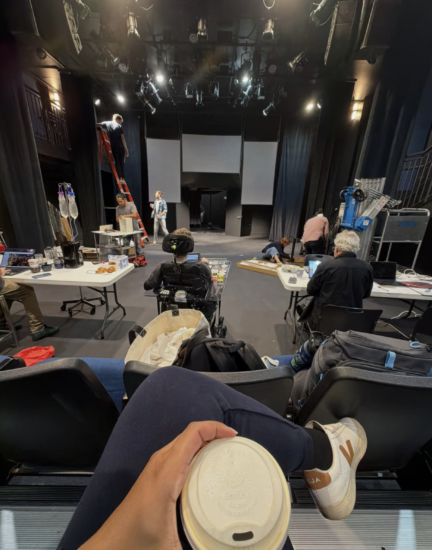
John Kevin Jones pays tribute to Edgar Allan Poe at historic Merchant’s House Museum (photo by Joey Stocks)

KILLING AN EVENING WITH EDGAR ALLAN POE
Merchant’s House Museum
29 East Fourth St. between Lafayette St. and the Bowery
March 25 – April 5, $65-$75
merchantshouse.org
summonersensemble.org

John Kevin Jones is back for his annual residency at the historic Merchant’s House Museum on East Fourth St. with Killing an Evening with Edgar Allan Poe: Murder at the Merchant’s House. Jones has gained a kind of cult fan club for his unique one-man shows, which also include his unique version of A Christmas Carol at the historic museum, a home built in 1831-32 that was occupied continuously by the Tredwell family from 1835 to 1933. The nineteenth century feels very present in the house, which was one of the first twenty buildings to gain landmark status under the city’s 1965 law and functions as a museum, preserving the Tredwell family’s furnishings as they would have appeared when Poe, coincidentally, lived nearby for a time at 85 West Third St. and later in a cottage in the Bronx. Dressed in nineteenth-century-style jacket, vest, top hat, and ascot, Jones celebrates Edgar Allan Poe with three of his most popular writings, preceded by short introductions about each work and Poe’s career.

Forty people are squeezed into the Tredwells’ candlelit double parlor — with a coffin at one end and a dining table at the other — and Jones walks up and down the narrow space between, where the audience is seated on three sides, boldly delivering several classic Poe tales of treachery and murder, “The Tell-Tale Heart,” “The Angel of the Odd,” and “The Cask of Amontillado,” from memory. His deep, theatrical voice resonates through the room as he catches the eye of audience members, adding yet more chills and thrills to the mystery in the air. He then sits down with a book for the long poem “The Raven,” evoking the great Poe actor Vincent Price. Jones, director Dr. Rhonda Dodd, and stage manager Dan Renkin, the leaders of Summoners Ensemble Theatre, keep the focus on Poe’s remarkable narrative technique; you might be watching one man, but you’ll feel like you’re seeing each of Poe’s characters in vivid detail.

Killing an Evening with Edgar Allan Poe runs March 25 through April 5, and for select performances there will be a “Raise a Glass to Edgar” preshow reception option ($30) in which Jones will recite “Annabel Lee” and “Alone,” Natalia “Saw Lady” Paruz will perform, and the kitchen, family room, and garden will be open. In addition, medium Heather Carlucci will give psychic readings after both Sunday shows.

There is also a concerted public effort to save the Merchant’s House from construction next door that could negatively impact its structural future; find out how you can help here.

[Mark Rifkin is a Brooklyn-born, Manhattan-based writer and editor; you can follow him on Substack here.]

INAUGURAL COFFEE HOUSE FRIDAY LUNCH AT THE NATIONAL ARTS CLUB WITH RODD CYRUS AND CARL RAYMOND

Who: Rodd Cyrus, Carl Raymond
What: Inaugural Friday lunch conversation
Where: The Coffee House at the National Arts Club, 15 Gramercy Park South
When: Friday, March 20, $85, 11:30 am
Why: Back in November, I wrote in a Substack post about meeting actor Rodd Cyrus after seeing Ragtime at Lincoln Center; I was there with a group of women from Wellesley organized by Rodd’s mother. Cyrus plays Harry Houdini, who enters by dangling on a wire and declaring, “He made his mother proud.”

Now you can meet Cyrus as well when he is the special guest at the inaugural Coffee House Club lunch at the National Arts Club. He will be interviewed by writer, lecturer, tour guide, and social and culinary historian Carl Raymond, host of the Gilded Gentleman podcast.

Cyrus was born in Boston and raised in the San Francisco Bay Area and is of Iranian-English-Irish-Welsh-Italian-American heritage. In addition to starring in Ragtime, he is a regular on Elsbeth, has appeared in such plays as James Joyce’s Exiles and Maija García’s Valor and such films as Doctor, Doctor and 72 Hours, and portrayed Giuseppe Naccarelli in The Light in the Piazza at Encores!

“Rodd’s story is not only a great theatrical story; it’s a uniquely American story,” Raymond told twi-ny. “To be playing the role of immigrant superstar Harry Houdini in this revival along with his own personal story makes his portrayal unique and deeply important.”

The prix fixe lunch includes beet and mixed green salads, a choice of a turkey club sandwich, mushroom power bowl, rigatoni alla Bolognese, or chicken Marsala, and nostalgic sweets for dessert.

Only a few tickets remain to be part of this exciting event.

[Mark Rifkin is a Brooklyn-born, Manhattan-based writer; you can follow him on Substack here.]
THE PLUCK OF THE IRISH: THE US PREMIERE OF ULSTER AMERICAN

Director Leigh Carver (Max Baker), playwright Ruth Davenport (Geraldine Hughes), and actor Jay Conway (Matthew Broderick) meet for the first time in David Ireland’s Ulster American (photo by Carol Rosegg)

ULSTER AMERICAN
Irish Repertory Theatre, Francis J. Greenburger Mainstage
132 West Twenty-Second St. between Sixth & Seventh Aves.
Wednesday – Sunday through May 24, $55-$125
irishrep.org

Among the topics raised in the US premiere of David Ireland’s Ulster American are the n word, rape, murder, the Troubles, car crashes, religion, Brexit, alcoholism, and self-identity.

Oh, did I mention that it’s a comedy — and a hilarious one at that?

The eighty-minute play takes place in real time on a Sunday night in the cozy living room of British theater director Leigh Carver’s (Max Baker) London home, decorated by set designer supreme Charlie Corcoran, with two armchairs, a couch, several small tables, a writing desk, a window in a rear nook, theater posters for The Mousetrap, Camelot, London Assurance, Macbeth, and the National Theatre, and several bookcases filled with tomes about Noël Coward, Samuel Beckett, and other theater legends.

Leigh is meeting with Jay Conway (Matthew Broderick), an Oscar-winning American actor who is starring in a new work Leigh is directing, by Irish playwright Ruth Davenport (Geraldine Hughes). Rehearsals are set to begin the next day, and Leigh wants the three of them to get to know each other more first. Jay is on the couch, in the middle of a conversation with Leigh, telling him, “Is there homophobia in Hollywood? Of course. And misogyny? How can we deny it? It’s reflected in so much of our output. Narrative upon narrative centered around the abuse of women, the violent abuse of women. And racism? Only a fool could pretend otherwise.”

Leigh is surprised when Jay asks, “You ever use the n word?” After discussing James Baldwin, power dynamics, and the Bechdel test — a measure, proposed by cartoonist Alison Bechdel, that judges a fictional work based on whether it includes scenes in which at least two women talk about something other than men — Jay adds, “Why should I, a man, dictate to Bechdel, a woman, what should or should not be part of her fucking theory? This is me, learning from my mistakes, learning to shut the fuck up. . . . And that’s what I’m saying, this is where we’re at. Guys like me and you taking a back seat. Allowing the Ruth Davenports of the world to have their say. Fucking white heteronormative, privileged fucking uh . . . cis . . . motherfuckers like you and I who have to stand aside now. We have a moral responsibility to . . . I mean not me. Obviously. I’m Irish Catholic, so I can’t . . . I’m not part of that – the equation of – . . . I have an intersectional exemption.”

Jay speaks in a calm manner but with an undercurrent of excitement as he attempts to show off what he believes to be his supreme knowledge of society and his allyship with women and people of color. Leigh gets bored quickly but jumps in every once in a while to agree with Jay or correct a mistake, but nothing is going to stop Jay from making his points. He’s clearly a superstar who is used to being coddled and listened to.

Leigh is then shocked when Jay determinedly asks, “Do you think there are any circumstances where it’s morally acceptable to rape someone?” The audience is shocked as well as Jay describes a situation, inspired by a movie plot, when it might actually benefit a certain kind of woman; he names the person he would rape, then forces Leigh to choose his victim. The director squirms in his chair as they debate the validity of the question, but Jay is not about to give up until Leigh finally gives him a name, trapped by his need to suck up to Jay, since a lot is riding on this play.

A few minutes later, Ruth arrives, and things get really bizarre. She apologizes for being late, explaining that her mother had just gotten into an accident and is in the hospital. Her mother was driving Ruth to the airport and they were arguing about a friend of Ruth’s who was killed in the Troubles. Ruth tells the men, “I just lost it with her and — I don’t know what came over me, I just said, ‘Mummy — why do you always have to be such a cold-souled, blackhearted thoughtless fucking bitch?’” That was followed by the crash.

Initially, the three of them heap praise on one another. Ruth gushes that she’s Jay’s biggest fan and feels like she already knows him. Jay thanks her for writing him the role of a lifetime, saying, “Your script. Your fucking script, Ruth. Is the single best script I’ve read for ten fucking years.” Leigh believes that, given the quality of the script and the beloved star, they are critic-proof. “Hey, fuck the critics, I don’t give a fuck about the critics,” Jay declares. “They’re fucking animals, Leigh. They’re animals, Ruth. And we should do with them what we do with animals. Kill them and eat them. And the good ones keep as pets.”

But when Ruth says that, although she is from Northern Ireland, she considers herself British and that the protagonist of her play is the same, both Jay and Leigh are infuriated, and the real fireworks begin.

Jay: Are you British because Britain used to own Ireland? So they used to own you, like a slave, so you’re British?
Leigh: Exactly!
Ruth: They never owned me. I was never a slave!
Jay: It’s confusing because to me you sound Irish.

The confusion only increases as the battle lines are drawn.

History and identity collide in superb dark comedy at Irish Rep (photo by Carol Rosegg)

Ulster American debuted at the 2018 Edinburgh Fringe and had a highly touted 2023 London revival starring Woody Harrelson, Louisa Harland, and Andy Serkis. Director Ciarán O’Reilly’s (The Weir, The Emperor Jones) adaptation is a sizzling slow build, balancing humor with pathos and bravado until all hell breaks loose. Leigh, Ruth, and Jay dig deep into their personal sense of identity while also judging the others’. “You don’t get to decide who’s British and who isn’t,” Ruth says to Leigh, who replies, “Well, we sort of do. That’s the point.” A bewildered Jay chimes in, “This is more complicated than I thought.”

The argument relates to what is happening in the United States right now, as liberals and conservatives, both in the government and private citizens, feud over the status of legal and illegal immigrants.

The three characters also all bring up the subject of history, as if that will provide the answers they are seeking. “History is so important to this. For this play, I feel like I need to know the history of Ireland like I know my own ball sack,” Jay says. But even history is subjective these days.

Tony winner and New York City native Broderick (Shining City, Evening at the Talk House) is brilliant as Jay; his singsong delivery and stiff posture imbue the Hollywood icon with a sense of invulnerability, but in this case he is on his own, not surrounded by a sycophantic entourage he is probably used to. He glories in stating his opinions and flaunting his progressive ideals, but they are essentially only lip service, with curses casually thrown in not for emphasis but just because.

The Belfast-born Hughes (Molly Sweeney, Jerusalem) is a powder keg as Ruth, who is beyond thrilled to be working with Leigh and Jay until she starts learning more about them and some of their views; she’s not about to just sit back and let them run all over her, instead going toe-to-toe.

And Baker (Continuity, The Low Road), who hails from Baton Rouge, Louisiana, is completely convincing as the British Leigh, who has to walk the fine line between Jay and Ruth but is more conniving than he likes to admit, unable to remain neutral even as he attempts to befriend and care about each of them.

Ireland (What The Animals Say, Most Favoured) and O’Reilly (The Weir, The Emperor Jones) know what of they speak; both are from the north of Ireland, but the former is from Belfast and Ballybeen in Northern Ireland, while the latter is from Cavan, in the Republic of Ireland. In one of his previous, plays, the darkest of dark comedies Cyprus Avenue, Ireland also examines the issue when the protagonist insists, after calling another character the n word, “The last thing I am is Irish. I am anything but Irish. I am British. I am exclusively and non-negotiably British. I am not nor never have been nor never will be Irish.”

Ireland and O’Reilly take that to the next level in Ulster American, along with a sensational cast, critics be damned.

[Mark Rifkin is a Brooklyn-born, Manhattan-based writer; you can follow him on Substack here.]
THE TASTE OF CAPITALISM: MOTHER RUSSIA AT THE SIGNATURE

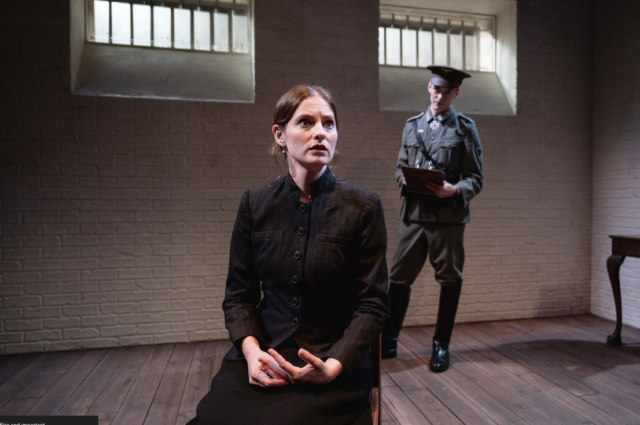
David Turner stars as the title character in Lauren Yee’s Mother Russia (photo by HanJie Chow)

MOTHER RUSSIA
The Pershing Square Signature Center
The Romulus Linney Courtyard Theatre
480 West 42nd St. between Tenth & Eleventh Aves.
Tuesday – Sunday through March 22, $74-$162
signaturetheatre.org

Asian American playwright Lauren Yee continues her geographic theatrical journey with the New York premiere of Mother Russia at the Signature, the third of what she calls her “cycle of communism plays in Asia in the twentieth century and its intersection with Western pop culture.” Cambodian Rock Band was a play with music about the second-generation immigrant experience and the Cambodian genocide of 1975–79, while The Great Leap was a culturopolitical fantasy about a basketball “friendship game” between American and China in 1981 that delved into the Chinese Cultural Revolution and the Tiananmen Square uprising.

In Mother Russia, Yee explores that nation’s conversion to capitalism in the wake of Mikhail Gorbachev’s introduction of Glasnost and Perestroika in the mid-1980s, the tearing down of the Berlin Wall in 1989, and the 1991 collapse of the Soviet Union. It’s 1992, and the character Mother Russia, hilariously portrayed by David Turner in an all-red nun’s habit / opera clown costume, prepares the audience for what’s to come.

“Do not bother to check. I am not in program. So you will not find me. Don’t worry, I am no one,” she says by way of introduction. “They think I will die before long. But! What do they know? . . . I have been let down by so many shitty men. Have you ever loved a shitty man? My life — if you can call this a life — has been one shitty man after another. So now I am here. With you sluts. You have kids? Never have kids. You are only as happy as your unhappiest child, and me? I have so many. And no matter what you do, they will never be happy.”

The only son of a lowly widow, twenty-five-year-old Dmitri Petrovich (Steven Boyer) thinks he is happy and successful; he runs a little metal-shack kiosk in St. Petersburg, selling condoms, bullets, candy bars, Nestlé’s Quik, Heinz Ketchup, Marlboro cigarettes, Coca-Cola, and other American goods, and he is in love with his girlfriend, Masha, the name of characters in Russian playwright Anton Chekhov’s Three Sisters and The Seagull. The shack has an ad for Folger’s coffee on its facade, in Russian except for the company logo, an example of the intrusion of capitalism. Meanwhile, Dmitri still dreams of being a spy for the KGB. One day a man enters the shop and Dmitri instinctively pulls a (Chekhovian) gun on him until he recognizes it is his old pal Evgeny Evgenievich (Adam Chanler-Berat), who had moved to Moscow three years earlier with his father, a powerful party leader who has now become “a burgeoning capitalist.”

“Oh, seems like just yesterday my mom was scrubbing the horseshit out of the floor of your dad’s government dacha!” Dmitri proclaims.

However, it turns out that Evgeny is not there to say hello to Dmitri but to shake him down, which is the job his father has forced him to do even though he is no good at it. Nonetheless, the naive Dmitri trusts Evgeny enough to let him in on a secret: that he is being paid handsomely in vouchers to secretly record the comings and goings of Yekaterina Mikhailovna Shevchenko (Rebecca Naomi Jones), a former famous activist and singer known as Katya M who defected to the West but has now returned as a quiet teacher whose past has been forgotten — except for the man who is paying Dmitri to track her.

Evgeny declares that he is a big fan of Katya M’s and wants to participate in the surveillance, begging Dmitri to hire him. “You want to be my servant?” Dmitri asks. Evgeny responds, “More like an employee,” having a hard time forming that last word.

Soon Evgeny is not only listening in on Katya at home and school but also following her on the bus, where they strike up a conversation. His obsession grows as he seeks relationship advice from Dmitri while hiding his identity from Katya. Both he and Katya are plagued by unseen fathers: Evegeny seeks approval from his ever-silent father, closed off from him behind a door, while Katya wants the truth about what happened to her father, a poet who was disappeared many years before.

In one of the funniest moment of the play, Dmitri and Evgeny devour a McDonald’s “filettofish” sandwich together. “Is this what capitalism tastes like?” Dmitri says with a rush of excitement.

It isn’t long before everyone is getting a taste of capitalism and Western society, filtered through Adam Smith’s theory of the invisible hand.

Dmitri (Steven Boyer) and Evgeny (Adam Chanler-Berat) spy on Katya (Rebecca Naomi Jones) in New York City premiere at the Signature (photo by HanJie Chow)

“There is not enough of me in this play,” Mother Russia says at one point. “Have you noticed this? Right?”

We noticed; there’s not enough of Mother Russia, and David Turner, in the play. She shows up in various places in interstitial scenes — sitting in the audience or on the ledge of Dmitri’s shack — to share her wisdom about the nation, embodying it with humor and angst while delving into history. “Back in the day, we would all have same couch. This is true!” she recalls. “Now you go to store, and all you see are choices.” After Evgeny claims that these are “unprecedented times,” Mother Russia goes into a riotous monologue about the history of Russia, arguing, “What bullshit. You know what was a hard year? Seven. Seven was a hard year.”

Turner (By the Way, Meet Vera Stark, Arcadia) is enchanting as the acerbic Mother Russia; he also portrays Katya’s mother in one critical scene. Boyer (Hand to God, Moscow Moscow Moscow Moscow Moscow Moscow) is sweetly appealing as the not-too-smart Dmitri, Chanler-Berat (Next to Normal, Nantucket Sleigh Ride) is steady as the deeply conflicted Evgeny, and Jones (Big Love, Oklahoma!) is alluring as Katya, although her story has a few key plot holes. As funny as the play is, there are several overly goofy and silly scenes and awkward moments, but it all works out in the end.

Western pop culture is central to the play, more than in just Katya’s former life as a pop star. Outside the theater, in the lobby, is a poster for “The Mother Russia Mixtape,” which notes, “The musical genre heightened the appeal of anti-Soviet countries, causing dissent and the rise of counterculture among Russian youth.” It includes sixteen influential tracks, from the Beatles’ “Back in the USSR” and Prince’s “Ronnie, Talk to Russia” to Sting’s “Russians” and Billy Joel’s “Leningrad” along with Sergey Kuyokhin’s “Intro Pop-Mechanics” and Kino’s “I Want Changes.”

The preshow music features such late-1980s, early 1990s Russian rock songs as Mumiy Troll’s “Медведица” (“A Bear”) and Kombinatsiya’s “Бухгалтер” (“Accountant”); Yee and director Teddy Bergman (KPOP, Empire Travel Agency) shape the play like a pop song, with Mother Russia serving as a kind of chorus and bridge to the stanzas by Dmitri, Evgeny, and Katya, with a bonus dance number set to a pumped-up version of the theme from Swan Lake. The play also references Vanilla Ice, Die Hard, Rambo, Robert De Niro, American baseball teams, and Meryl Streep as well as Anton Chekhov and his wife, Olga Knipper.

“I miss communism!” Dmitri shouts near the grand finale.

In today’s world, maybe that’s what capitalism tastes like.

[Mark Rifkin is a Brooklyn-born, Manhattan-based writer; you can follow him on Substack here.]
GETTING PAST THE DAM: THE RESERVOIR AT THE ATLANTIC

Noah Galvin displays an infectious charm as Josh in The Reservoir at the Atlantic (photo by Ahron R. Foster)

THE RESERVOIR
Atlantic Theater Company, Linda Gross Theater
336 West 20th St. between Eighth & Ninth Aves.
Tuesday – Sunday through March 22, $56.50-$131.50
atlantictheater.org

As the audience enters the Atlantic’s Linda Gross Theater to see Jake Brasch’s off-Broadway debut, The Reservoir, they are met by an unusual sight: An actor is flat on his back on the floor, as if dead. Next to him is wheeled luggage. There are two empty chairs on either side of the stage, in front of curtains, more of which hang high in the back, above a curving piece of scenery that represents water, as if the young man has washed onshore, perhaps having drowned. The night I went, most of the crowd paid little attention to the actor, instead checking their phones and engaging in conversation, as life goes on without him. It’s an apt metaphor for the play itself, which is an engaging and clever foray into family and addiction until it starts drowning in melodrama in the second half.

The young man is Josh (Noah Galvin), an alcoholic college student on leave because of his blackout benders and subsequent disappearances. After Josh awakes, appreciating the sunrise, a park ranger (Matthew Saldívar) tells him he can’t sleep there. Josh turns to the audience and says, “Focus on the cop, speak to the cop. But how did I get here? Did I get on a plane? A greyhound? Wouldn’t be the first time. One time I went to a club in Brooklyn and woke up three days later at a Chick-fil-a in West Virginia.”

A moment later he adds, “Okay. Focus. Morning. Bleeding. Suitcase. Denver. What’s the last thing I remember? The hot rehab worker breathalyzed me and drove me into Miami and then . . . Here we go. Here comes the sober. I hate this part, when the dam breaks and the questions come pouring in.”

He has mysteriously returned home, where his mother, Patricia (Heidi Armbruster), wants him back in rehab. He begs her for one last chance and she agrees to let him stay in his room if he promises to remain sober, take a job at the independent bookstore she owns, and go back to school in the fall.

For most of the play, the four chairs are occupied by Josh’s grandparents, the easygoing Catholic Irene (Mary Beth Peil) and Hank (Peter Maloney) on Patricia’s side, the talkative Jewish Beverly (Caroline Aaron) and Shrimpy (Chip Zien) on his father’s. Despite being surrounded by family and working for a mellow boss, Hugo (Saldívar), Josh can’t get his life in order, especially when Irene’s dementia gets worse. When she suddenly breaks into a lovely version of “O Come, All Ye Faithful,” he starts understanding that she is seriously ill, telling Beverly about it. Grandma Beverly is very different from Grandma Irene:

Beverly: So this was truly, completely out of nowhere?
Josh: Unprompted. It felt channeled. Like a spirit was moving through her or something.
Beverly: Christ.
Josh: Yeah, maybe, could have been him. I mean really though, it was actually kinda beautiful.
Beverly: Well, if I ever get like that, if I start randomly singing at lunch, you have to shoot me, understand?
Josh: What?
Beverly: I’m serious. It’s not hard. This is Colorado. Use my credit card, go to Walmart, buy a rifle.
Josh: Dark.
Beverly: I’ll tell you what’s dark: old age. That’s why you’ll help your granny when the time is right.
Josh: I won’t.
Beverly: If I’m all but three words into “O Come, All Ye Faithful” —
Josh: I doubt that would be your song of choice.
Beverly: “Mi Chamocha” whatever. Push me off a cliff.

Meanwhile, Shrimpy, long divorced from Beverly, is planning on having his second bar mitzvah, at the age of eighty-three, and wants Josh to help him prepare, but he has a tendency to speak a little too openly, particularly when it comes to sex. Acknowledging that Josh is gay, Shrimpy asks him whether he has ever had a threesome, then explains, “I’m straight. Mostly. But, you know, sometimes I look at dicks on my computer. What can I say? I do. I look at the dicks. Hey, what do you say you help me with my bar mitzvah prayers?”

Josh, who has no friends his own age and is not dating, joins Beverly at her senior aerobics class at the JCC taught by Lenni (Armbruster), who says things like “Okay, my beautiful Jewish women, let’s start with a step touch. . . . And five six seven eight . . . Goyim style!” He spends nearly all his free time with his grandparents, but when Irene takes a turn for the worse, Josh’s life once again spirals out of control.

Josh (Noah Galvin) is surrounded by his grandparents in Jake Brasch’s The Reservoir (photo by Ahron R. Foster)

In my recent review of Jacob Perkins’s The Dinosaurs, which just ended its run at Playwrights Horizons, I wrote, “If I never see another play set entirely at an AA or grief counseling meeting consisting of a group of people sitting on folding chairs near some coffee and donuts, it will be too soon.”

A coproduction with Ensemble Studio Theatre and the Alfred P. Sloan Foundation, The Reservoir is not set entirely at an AA or grief counseling meeting, but much of the second half feels like it does as Josh battles to remain sober while all of his grandparents experience health declines. The first act had a sharp, very funny, and relatable tone and mood, but after intermission it all falls apart as Brasch heaps on the soapy melodrama, sucking the life out of the story and hamstringing each of the actors and characters, which also include Josh’s imaginary doctor, Yaakov Stern (Saldívar), a real neuroscientist who discusses the concept of cognitive reserve and offers such advice as “Listen, Joshua. Alcoholism and Alzheimer’s? Not the same thing. You can rebuild, they cannot,” as well as Rabbi Silver (Armbruster), who leads Josh and Shrimpy in a wholly improbable scene in a temple.

Director Shelley Butler (The Scarlet Letter, This Is Fiction) can’t rein in a narrative that gets lost at sea as various pieces of furniture and book carts are wheeled on- and offstage through the sheer curtains, which turn color based on Jiyoung Chang’s lighting shifts. (The set is by Takeshi Kata, with casual costumes by Sara Ryung Clement and sound and incidental music by Kate Marvin.)

Independent Spirit Award nominee Galvin (Waitress, Dear Evan Hansen) is a delight to watch, infusing Josh with a bittersweet complexity that makes you want to root for him in spite of his many serious mistakes. Helen Hayes Award nominee Aaron (A Kid Like Jake, Madwomen of the West) and three-time Drama Desk nominee Zien (Harmony, Caroline, or Change) nearly steal the show as the madcap Jewish relatives, while two-time Tony nominee and Obie winner Peil (Dying for It, Cornelia Street) and Drama Desk nominee Maloney (I’m Revolting, On the Shore of the Wide World) are touching as the gentle old goyim. Armbruster (Boy, Man from Nebraska) and Saldívar (Junk, The Wild Duck) do what they can with underwritten, overly clichéd roles.

Brasch, who describes themself as “a queer, sober, Jewish clown,” was inspired to write the play based on a year in his own recovery during which he reconnected with his grandparents. The Reservoir feels almost too personal, with too many plot holes and too many off-color jokes that start sounding repetitive as the protagonist faces ever-harder truths.

Talking about a metaphorical river, Josh says, “Nothing can get past the dam. And we’ll never know where the water was heading. We’ll never know what lurks beyond. Immense dryness. A great expanse. Terrifying. What do we remember? What have we forgotten? All of the things that we do not know that we do not know. That gnawing feeling that there’s something missing. Something small. Something minor. Or maybe something huge?”

The first half of The Reservoir is rich and free flowing, but there’s too much missing in the second half, preventing it from getting past that dam.

[Mark Rifkin is a Brooklyn-born, Manhattan-based writer; you can follow him on Substack here.]