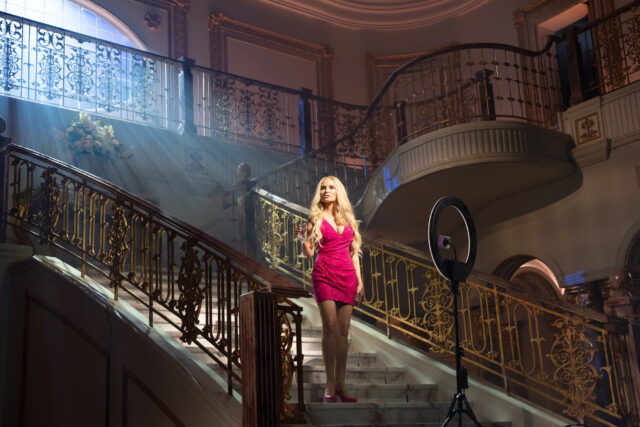
Taste of Times Square is back with local signature bites September 9 (photo by Michael Hull for the Times Square Alliance)
TASTE OF TIMES SQUARE
46th St. between Broadway & Ninth Ave., Broadway between 45th & 46th Sts.
Wednesday, September 9, dishes $5-$10, 4:00 – 8:00 timessquarenyc.org
The international culinary flavor of the Times Square area will be on display September 9 at the annual Taste of Times Square, where more than three dozen local restaurants will be serving their signature dishes on and around Restaurant Row; there will also be live performances representing several current Broadway shows from the Broadway Dreams Foundation and Ellen’s Stardusters. Most dishes cost five dollars, with a few no more than ten bucks, purchased with “tastes”; you can get 25% off advance wristbands of $25 and $50 through September 8.
The menu lineup includes lobster toast from Rosie O’Grady’s, beef or chicken suya from Lagos, tacos from Toloache, sliders from Schnipper’s, rigatoni Bolognese from Orso, a Cuban sandwich from Havana Central, penne from Becco, escovitch fish fingers from Jasmine’s Caribbean Cuisine, tiramisu from Bond 45, cheesecake from Junior’s, and frrrozen hot chocolate from Serendipity 3. There’s also fare from the Hard Rock Cafe, Planet Hollywood, and Applebee’s but not Olive Garden or Bubba Gump.
[Mark Rifkin is a Brooklyn-born, Manhattan-based writer and editor; you can follow him on Substack here.]
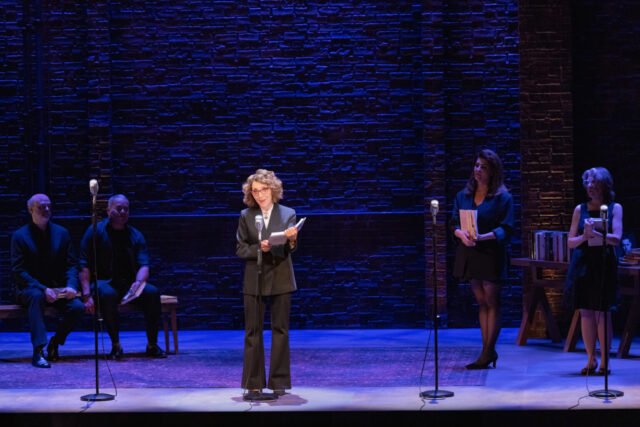
Andrea Martin was one of many celebrity guests reading about other celebrities in Celebrity Autobiography (photo by Evan Zimmerman)
CELEBRITY AUTOBIOGRAPHY
Shubert Theatre
225 West Forty-Fourth St. between Broadway & Eighth Ave
Closed June 21, $49-$329 celebrityautobiography.com
The trouble was obvious from the start. Eugene Pack’s Celebrity Autobiography made its Broadway debut at the Shubert on May 18; when I saw it on June 1, the audience was so sparse that they roped off the mezzanine and moved everyone down to the orchestra; still, there were plenty of empty seats. Scheduled to run through August 16, the show closed early, after the June 21 performance.
Which is a shame, because it was a lot of fun, with great rotating casts and a ton of laughs. But perhaps its eyes were bigger than its stomach.
Since 1998, Celebrity Autobiography has been a hit in cities around the world, packing them in at clubs from New York and Los Angeles to London and Sydney. For its Broadway run, it announced an enticing list of stars who would participate in the show’s novel structure, which is neither drama nor comedy and nearer to stand-up. A row of celebrities stand at mics, reading excerpts from the memoirs of other celebrities, with their tongues either firmly placed in their cheeks or attacking the often mind-boggling prose with virtuoso gusto.
Perhaps in our celebrity-obsessed, social-media-dependent culture, it was too much, too mean-spirited. Certainly, the top ticket price of $329 was exorbitant wishful thinking, but it was well worth the $49 for the cheap seats.
I caught a lovely group of actors having an infectiously fabulous time onstage, even when the histrionics did get excessive. Ralph Macchio kicked things off with David Hasselhoff’s Don’t Hassel the Hoff, allowing time for the audience to burst out in gleeful guffaws. Robert Sean Leonard cast sly glances about as he read from Ryan Seacrest and Geraldo Rivera. Mario Cantone couldn’t contain himself as he did wicked impressions while sharing passages from Carol Channing’s Just Lucky I Guess and Kathleen Turner’s Send Yourself Roses. Pamela Adlon took on Arnold Schwarzenegger and Oprah. Gina Gershon channeled Celine Dion and Cher. Nia Vardalos brought down the house with her interpretation of Khloe Kardashian.
The most hilarious mashup was the back and forth between Macchio/Justin Bieber and Andrea Martin/Kylie Jenner discussing Leonardo da Vinci’s Mona Lisa. The sports section was highlighted by Pack reading from Tiger Woods’s How I Play Golf, which sounded more like a sex manual. Dayle Reyfel, who developed the show with Pack in the late 1990s and directed the Broadway edition with him, brings us Dolly Parton’s thoughts.
Adding in the poetry of Matthew McConaughey and Suzanne Somers didn’t fit and in the latter case was particularly cruel. A segment dedicated to Debbie Reynolds, Eddie Fisher, Elizabeth Taylor, and Richard Burton was a dishy delight but couldn’t possibly appeal to younger audiences.
Was that enough to kill off the Broadway run? Not in my opinion, as most of the ninety minutes were filled with a plethora of humor, helping us forget about the horrors occurring outside in the real world, far beyond star culture.
Among the others who got to appear in the show before its shuttering were Brooke Adams, Lewis Black, Matthew Broderick, Danny Burstein, Katie Couric, Christopher Jackson, Eric McCormack, Ray Romano, Phil Rosenthal, Daphne Rubin-Vega, Tony Shalhoub, Keenan Thompson, and Rita Wilson; those waiting in the wings included Jason Alexander, Christie Brinkley, Bob Costas, Griffin Dunne, Susan Lucci, Billy Porter, and Tiler Peck.
In 2009, Celebrity Autobiography won a Drama Desk Award for Unique Theatrical Experience; it is still a unique theatrical experience, though maybe not unique enough for 2026 audiences.
[Mark Rifkin is a Brooklyn-born, Manhattan-based writer; you can follow him on Substack here.]
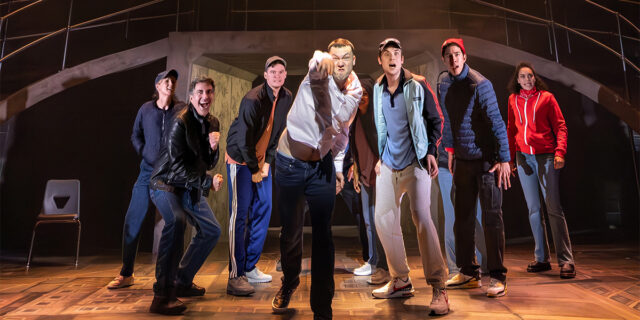
The cast of The Balusters looks at the Tony nominations it received (photo by Jeremy Daniel)
Tonight is the seventy-ninth annual presentation of the Tony Awards, celebrating the best in theater this past season. Twenty-four shows have been recognized among twenty-six categories.
Below is a look at every production that received at least one nomination, as well as a few that were shut out, arranged by how many nods it received. The only eligible shows I did not see were All Out and Mamma Mia!, both of which were shut out.
I refrain from making predictions, although I will share that, for me, the Best Play is The Balusters and the Best Musical is Schmigadoon!
But please feel free to argue — I’m sure there is plenty to debate.
THE LOST BOYS
Palace Theatre
1564 Broadway at 47th St.
Tuesday – Sunday through March 7, $69.75-$372.50 www.lostboysmusical.com
Peter Pan ain’t go nothing on these darling bloodsucking Lost Boys. Director Michael Arden sinks his teeth into this delicious musical adaptation of the 1987 horror comedy, with a touching book by David Hornsby and Chris Hoch and a dramatic score by the Rescues. When Lucy Emerson (Shoshana Bean) moves to the eerie town of Santa Carla, she and her two sons, Michael (LJ Benet) and Sam (Benjamin Pajak), get a whole lot more than they bargained for as Michael falls in love with Star (Maria Wirries) and develops a bromance with David (Ali Louis Bourzgui), who only comes out at night. Fantastic sets by Dane Laffrey, blasting music, and high-flying by Lauren Yalango-Grant and Christopher Cree Grant turn the Palace into a dazzling dark nightmare, even with a few silly subplots.
The Lost Boys is nominated for twelve Tonys: Best Musical, Best Book, Best Orchestrations, Best Direction, Best Choreography, Best Original Score, Best Performance by an Actress in a Featured Role in a Musical (Bean), Best Performance by an Actor in a Featured Role in a Musical (Bourzgui), Best Scenic Design, Best Costume Design, Best Lighting, and Best Sound.
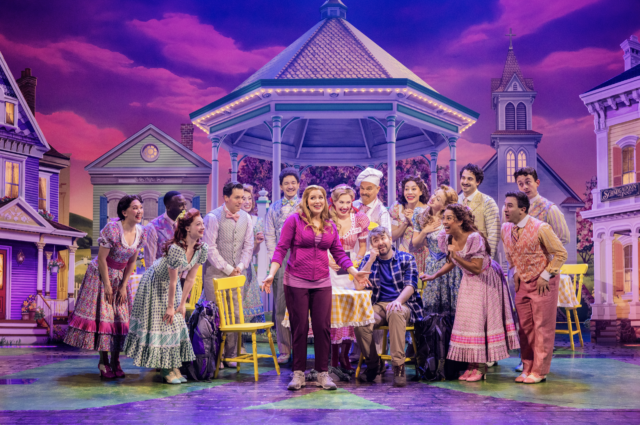
Cinco Paul’s Schmigadoon! is a charmer from start to finish (photo by Matthew Murphy and Evan Zimmerman)
SCHMIGADOON!
Nederlander Theatre
208 West Forty-First St. between Broadway & Eighth Ave.
Tuesday – Sunday through January 3, $79-$349.50 schmigadoonbroadway.com
Cinco Paul does a masterful job of translating his Apple TV show, Schmigadoon!, to Broadway, where it feels it has always belonged, and has always been. Josh Skinner (Alex Brightman) and Melissa Gimble (Sara Chase) are forced to reevaluate their relationship when they wander into a magical land where every day is a musical — and are unable to leave without passing a test of the heart. The show lovingly parodies hit songs from such musicals as Carousel,The Sound of Music,The Music Man,Oklahoma!, and, of course, Brigadoon, with utter glee. The terrific ensemble boasts Ana Gasteyer as the teetotaling Mildred Layton, Brad Oscar as the conflicted Mayor Menlove, Ann Harada as his wife, Max Clayton as hunky Danny Bailey, Maulik Pancholy as the leprechaun and the minister, McKenzie Kurtz as the marriage-hungry Betsy, and Isabella McCalla as a lovely schoolteacher. It’s a candy-colored fantasy not only about musicals but about tolerance and diversity, without getting too preachy. If there’s any justice in this world, it should run forever.
Schmigadoon! is nominated for twelve Tonys: Best Musical, Best Book, Best Orchestrations, Best Direction (Christopher Gattelli), Best Choreography (Gattelli), Best Original Score, Best Performance by an Actress in a Leading Role in a Musical (Chase), Best Performance by an Actress in a Featured Role in a Musical (Gasteyer), Best Scenic Design, Best Costume Design, Best Lighting, and Best Sound.
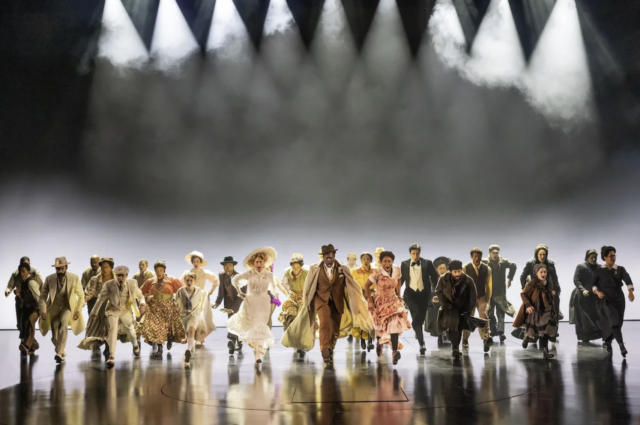
Ragtime has the joint jumping in potent Lincoln Center revival (photo by Matthew Murphy)
RAGTIME
Vivian Beaumont Theater at Lincoln Center Theater
150 West 65th St. between Broadway & Amsterdam Ave.
Tuesday – Saturday through August 2, $114-$421 www.lct.org/shows/ragtime
Lear deBessonet’s breathtaking revival of Ragtime has the best opening number I’ve even seen, a spectacular introduction of the characters while setting the mood and atmosphere for a potent tale of class and racism in old New York. Based on E. L. Doctorow’s 1975 novel, which was also made into a 1981 film by Miloš Forman, the musical has a fabulous score by Stephen Flaherty and Lynn Ahrens, a hard-hitting book by Terrence McNally, and sweeping orchestrations by William David Brohn, performed by an amazing cast led by Joshua Henry as Coalhouse Walker Jr., Caissie Levy as a New Rochelle housewife, Brandon Uranowitz as new immigrant Tateh, Rodd Cyrus as Harry Houdini, Anna Grace Barlow as Evelyn Nesbit, and Nichelle Lewis as Sarah. Every minute of its nearly three-hour-length packs a punch as Walker refuses to bend his knee to societal mores. But at its heart, it’s a powerful story of parents and children.
Ragtime is nominated for eleven Tonys: Best Revival, Best Direction, Best Choreography, Best Performance by an Actor in a Leading Role in a Musical (Uranowitz, Henry), Best Performance by an Actress in a Leading Role in a Musical (Levy), Best Performance by an Actor in a Featured Role in a Musical (Ben Levi Ross), Best Performance by an Actress in a Featured Role in a Musical (Lewis), Best Costume Design, Best Lighting, and Best Sound.
CATS: THE JELLICLE BALL
Broadhurst Theatre
235 West Forty-Fourth St. between Broadway & Eighth Aves.
Tuesday – Sunday through January 17, $58-$321 catsthejellicleball.com
In June 2024, I wrote, “The Pride celebration of the summer and, hopefully, beyond is happening seven times a week at PAC NYC, where Zhailon Levingston and Bill Rauch’s electrifying reimagining of Andrew Lloyd Webber’s Cats — yes, that Cats — is running now through September 8, not quite forever, but not bad.” Its transfer to the Broadhurst is beyond disappointing; what was an engaging, involving production on a long catwalk, with the audience on three sides, is now a standard proscenium-stage musical that has lost its edge. It might be glittery and flashy, but not it’s all about the primping and voguing. Not that the story has ever been so compelling, but who cares when we have glitz galore? And what’s with those two seats onstage?
Cats: The Jellicle Ball is nominated for nine Tonys: Best Revival of a Musical, Best Orchestrations, Best Direction, Best Choreography, Best Performance by an Actor in a Featured Role in a Musical (André De Shields), Best Scenic Design, Best Costume Design, Best Lighting, and Best Sound.
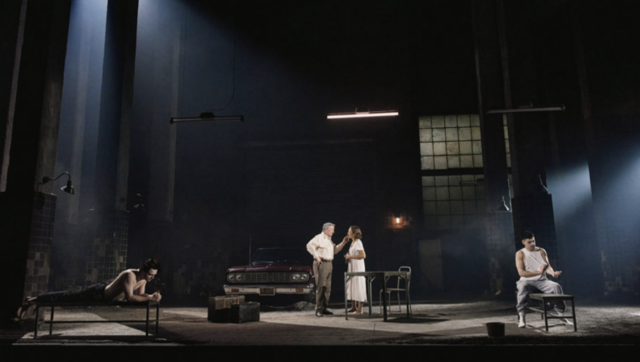
Latest Death of a Salesman revival takes place in an industrial-style garage (photo by Emilio Madrid)
DEATH OF A SALESMAN
Winter Garden Theatre
1634 Broadway between 50th & 51st Sts.
Tuesday – Sunday through August 9, $99-$799 salesmanbroadway.com
Is Death of a Salesman showing its age? Joe Mantello’s revival, the seventh time Arthur Miller’s 1949 masterwork has appeared on Broadway (and third time in fourteen years), starts off well and good with a superb first act, but everything changes after intermission, except the dour, threatening industrial garage set. Nathan Lane as Willy Loman acts more like Nathan Lane, Laurie Metcalf as his devoted wife, Linda, virtually disappears (that’s the way Miller wrote it, but you feel her absence), the hotel and dinner scenes are problematic, and the graveyard ending is, well, I don’t know what to say about it. Christopher Abbott is as compelling a Biff as I’ve ever seen. Although I couldn’t tolerate the cinematic music, it is nominated for a Tony, as is Metcalf, who should have received a Best Actress nod for Little Bear Ridge Road as well. And yes, once again, my wife’s theory holds that there is trouble a-brewing any time an actual car or other motor vehicle is driven on and off a Broadway stage.
Death of a Salesman is nominated for nine Tonys: Best Revival, Best Direction, Best Performance by an Actor in a Leading Role in a Play (Lane), Best Performance by an Actress in a Featured Role in a Play (Abbott), Best Performance by an Actress in a Featured Role in a Play (Metcalf), Best Original Score, Best Scenic Design, Best Lighting, and Best Sound.
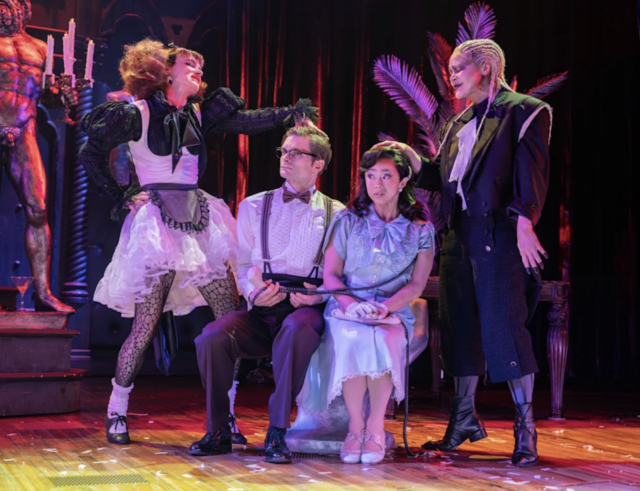
Revival of Rocky Horror is everything you’d hoped it would be (photo by Joan Marcus)
THE ROCKY HORROR SHOW
Studio 54
254 West 54th St. between Seventh & Eighth Aves.
Tuesday – Sunday through November 29, $82-$339 www.roundabouttheatre.org
Be prepared to give yourself over to absolute pleasure in Sam Pinkleton’s outrageously fun revival of Richard O’Brien’s The Rocky Horror Show, from the second you walk into Studio 54. When Brad — asshole! — and Janet — dammit, Janet! — end up at a creepy mansion in the middle of nowhere, their happy plastic life on this planet goes rather awry as they encounter the motley crew of Riff Raff (Amber Gray), Magenta (Juliette Lewis), Columbia (Michaela Jaé Rodriguez), Rocky (Josh Rivera), Eddie (Harvey Guillén), and their deliciously wicked boss, Frank-N-Furter (Luke Evans). And it’s narrated by the hilarious Rachel Dratch, who has a blast with the audience, even if the call-outs still need some work. It’s just about everything you hoped it would be. And remember: It’s just a jump to the left, then a step to the right.
The Rocky Horror Show is nominated for nine Tonys: Best Revival, Best Choreography, Best Performance by an Actor in a Leading Role in a Musical (Evans), Best Performance by an Actress in a Leading Role in a Musical (Hsu, Dratch), Best Scenic Design, Best Costume Design, Best Sound, and Best Lighting, Best Director.
Robin Rainey (Christiani Pitts) and Dougal Todd (Sam Tutty) are about to have a time to remember in Two Strangers (Carry a Cake Across New York) (photo by Matthew Murphy)
TWO STRANGERS (CARRY A CAKE ACROSS NEW YORK)
Longacre Theatre
220 West 48th St. between Broadway & Eighth Aves.
Tuesday – Sunday through November 22, $69-$299 twostrangersmusical.com
Broadway shows set in New York City have a difficult task getting things right, needing to satisfy tourists as well as native New Yorkers, who will immediately criticize any geographic or sociocultural mistakes while tiring of genre clichés about the City That Never Sleeps. For every Hell’s Kitchen, there’s a New York, New York. Happily, the charming Two Strangers (Carry a Cake Across New York) gets things right. Sam Tutty is adorable in his Broadway debut as Dougal Todd; you just want to run up and hug him (but please don’t). Dougal looks at the city in the way not only tourists but longtime denizens should, with wonder and happiness and promise. Christiani Pitts, who has appeared in such other New York City shows as A Bronx Tale and King Kong, is heart-wrenching as Robin, who believes she has hit a dead end and needs to be reenergized. Their chemistry is evident from their first meet-cute bump.
Two Strangers is nominated for eight Tonys: Best Musical, Best Book, Best Orchestrations, Best Original Score, Best Performance by an Actor in a Leading Role in a Musical (Tutty), Best Performance by an Actress in a Leading Role in a Musical (Pitts), Best Scenic Design, and Best Director.
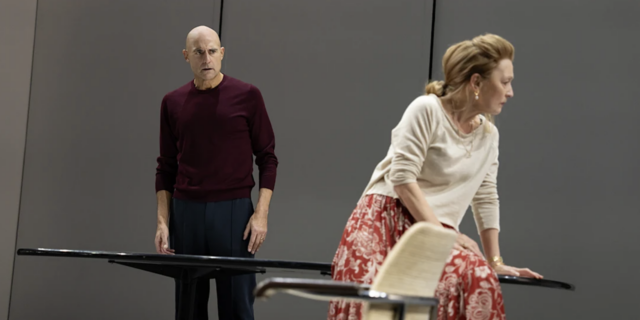
Oedipus (Mark Strong) has some strong words for Jocasta (Lesley Manville) in modern update of Greek tragedy (photo by Julieta Cervantes)
OEDIPUS
Studio 54
254 West 54th St. between Seventh & Eighth Aves.
Closed February 8 oedipustheplay.com
Every season there seems to be one show that everyone goes gaga over except me. Last year it was Maybe Happy Ending, which won six Tonys, including Best Musical. I found it okay but couldn’t get past the plot holes and inconsistencies, as well as the inclusion of the crooner. This time around it’s Robert Icke’s modern-day adaptation of Sophocles’s Oedipus. It seems that the rest of the world is championing this production, which stars Mark Strong as Oedipus, Lesley Manville as Jocasta, an excellent John Carroll Lynch as Creon, and Anne Reid as a mystifying version of Merope. It takes place in the British political arena as Oedipus seeks to become prime minister. I’ve raved about some of Icke’s previous works (Hamlet,Oresteia,Enemy of the People), but I couldn’t connect with this one, which felt like watching election-night coverage on cable TV. However, I will now start pronouncing it as “Eedipus.”
Oedipus is nominated for seven Tonys: Best Revival, Best Direction, Best Performance by an Actor in a Leading Role in a Play (Strong), Best Performance by an Actress in a Leading Role in a Play (Manville), Best Scenic Design, Best Lighting, and Best Sound.
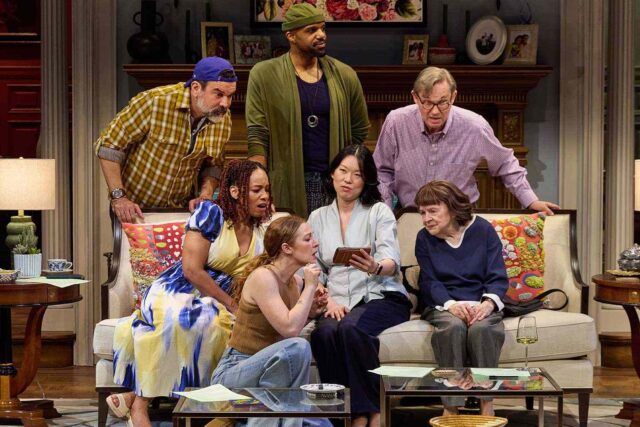
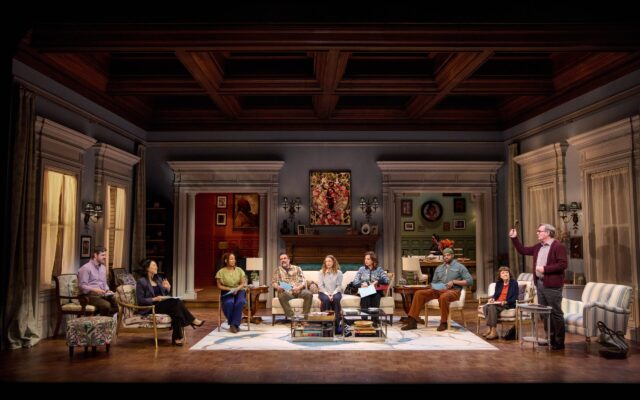
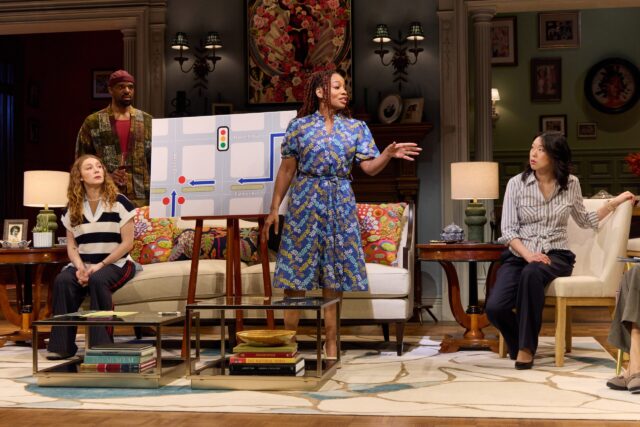
A series of meetings of the Vernon Point Neighborhood Association opens up old and new wounds in The Balusters (photo by Jeremy Daniel)
THE BALUSTERS
Samuel J. Friedman Theatre
261 West Forty-Seventh St. between Broadway & Eighth Ave.
Tuesday – Sunday through June 21, $58-$347 www.manhattantheatreclub.com
David Lindsay-Abaire’s The Balusters takes on a kitchen sink of contemporary issues, from homophobia, racism, classism, and corruption to toxic masculinity, privilege, bigotry, and furniture. And it does so in hilarious ways; I can’t remember the last time I laughed so long and hard during a play or clapped so often after side-splitting, sparkling lines of dialogue. The hundred-minute comedy is set at several meetings of the Vernon Point Neighborhood Association, where a group of nine people regularly gather to discuss the state of their beloved community, a peaceful, old-fashioned enclave steeped in history, boasting well-manicured lawns, comfortable, attractive porches, and an overall flavor of Victorian elegance. The terrific ensemble forms an outrageously funny extended family, led by Emmy winner Richard Thomas and Tony winner Anika Noni Rose, but theater treasure Marylouise Burke steals the show as Penny, who always knows just what to say.
The Balusters is nominated for five Tonys: Best Play, Best Director (Kenny Leon), Best Performance by an Actor in a Featured Role in a Play (Thomas), Best Performance by an Actress in a Featured Role in a Play (Burke), and Best Costume Design.
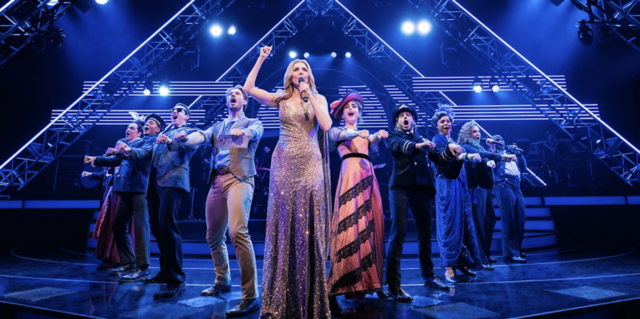
Bryce Pinkham leads a supercharged ensemble in Chess Broadway revival (photo by Matthew Murphy)
CHESS: A COLD WAR MUSICAL
Imperial Theatre
249 West 45th St. between Broadway & Eighth Ave.
Tuesday – Sunday through May 3, $74-$571 chessbroadway.com
The current Broadway production is the first iteration I’ve seen, and I found it to be a ton more exciting than watching, well, a chess match. Tony-winning director Michael Mayer has teamed up with Emmy-winning film and television writer, actor, and director Danny Strong, making his Broadway debut, to reimagine the show, and it’s a major triumph filled with clever and insightful moves, despite occasionally delving into soapy melodrama, while not overplaying the cold war connections between the 1980s and today. The American chess master Freddie Trumper (Aaron Tveit) is in love with his second, the beautiful theoretician Florence Vassy (Lea Michele). They are preparing for a major match against the brilliant Anatoly Sergievsky (Nicholas Christopher), whose handler is the devious Alexander Molokov (Bradley Dean), who later uses Anatoly’s estranged wife, Svetlana (Hannah Cruz), against him. As the players travel to Merano, Stockholm, and, most famously, Thailand, where they spend a memorable night in Bangkok, relationships come together and fall apart, loyalty is tested, and the SALT II treaty is hotly debated as the KGB and the CIA fight to assert their prominence. Chess is a thrilling evening of theater, highlighted by Pinkham, often accompanied by a terrifically talented ensemble performing Lorin Latarro’s dazzling choreography; the singers and dancers are like a glorious symphony that makes you instantly forget the book’s occasional meanderings and messiness. Yes, there are too many songs, Freddie’s transition to being an announcer is annoying, the love triangle is messy, the politics are oversimplified, and the ballads are histrionic, but Mayer and Strong keep the actual chess to a minimum, and every time the show threatens to give in to the lowest common denominator, Pinkham and the ensemble swoop in to rescue it as the endgame approaches.
Chess is nominated for five Tonys: Best Orchestrations, Best Performance by an Actor in a Leading Role in a Musical (Christopher), and Best Performance by an Actor in a Featured Role in a Musical (Pinkham), Best Performance by an Actress in a Featured Role in a Musical (Cruz), and Best Lighting.
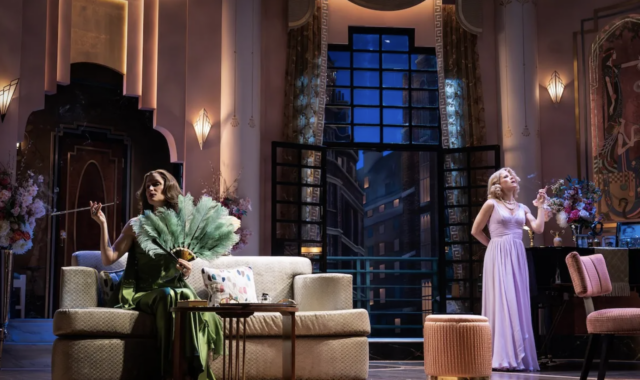
Rose Byrne and Kelli O’Hara make a fabulously elegant comic duo in Fallen Angels (photo by Joan Marcus)
FALLEN ANGELS
Todd Haimes Theatre
227 West 42nd St. between Broadway & Eighth Ave.
Closed June 7 www.roundabouttheatre.org
Rose Byrne and Kelli O’Hara are the most hilarious comedy duo on Broadway in Scott Ellis’s elegant slapstick revival of Noël Coward’s Fallen Angels. When an old Parisian flame (Mark Consuelos) might be coming to town, Julia (O’Hara) and Jane (Byrne) get some interesting ideas while their men (Aasif Mandvi and Christopher Fitzgerald) are away. The Champagne flows, as do their bodies over the furniture, all while the new maid, Saunders (Tracee Chimo), who seems to know everything about everything, keeps a close watch on the proceedings. The story itself may be slight, but in the hands of Byrne and O’Hara, it’s a riot. Oh, and their hair!
Fallen Angels is nominated for five Tonys: Best Revival, Best Performance by an Actress in a Leading Role in a Play (Byrne, O’Hara), Best Scenic Design, and Best Costume Design.
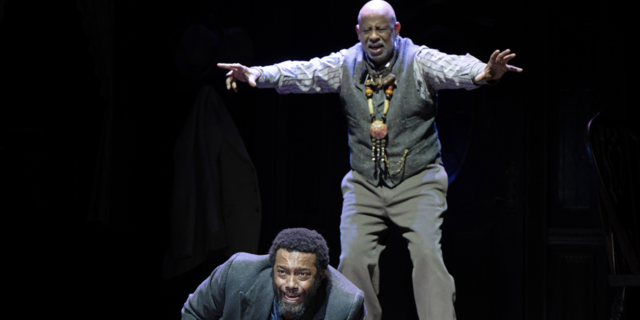
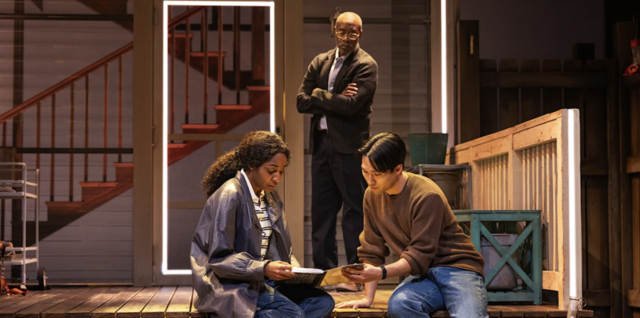
Joe Turner’s Come and Gone is another Broadway triumph for August Wilson (photo by Julieta Cervantes)
JOE TURNER’S COME AND GONE
Barrymore Theatre
243 West Forty-Seventh St. between Broadway & Eighth Ave.
Tuesday – Sunday through July 26, $69 – $499 joeturnerbway.com
The fourth play in August Wilson’s Pittsburgh Cycle, Joe Turner’s Come and Gone is set in the 1910s in a boardinghouse run by Seth Holly (Cedric the Entertainer) and his wife, Bertha (Taraji P. Henson). Among the residents are conjure man Bynum Walker (a never-better Ruben Santiago-Hudson) and guitar player and ladies man Jeremy Furlow (Tripp Taylor), while hanging around is people finder Rutherford Selig (Bradley Stryker). When the scary Herald Loomis (Joshua Boone) arrives with his young daughter, Zonia, trying to track down his wife, the past bubbles up, laced with supernatural elements. Joe Turner is another sparkling work by Wilson, a poetic exploration of the lasting impact of slavery and the Great Migration, a tempting mix of humor, music, and history that looks and sounds marvelous on the stage, directed by Debbie Allen.
Joe Turner’s Come and Gone is nominated for five Tonys: Best Original Score, Best Performance by an Actor in a Featured Role in a Play (Santiago-Hudson), Best Sound, Best Lighting, and Best Costume Design; oddly, it did not make the cut for Best Revival of a Play.
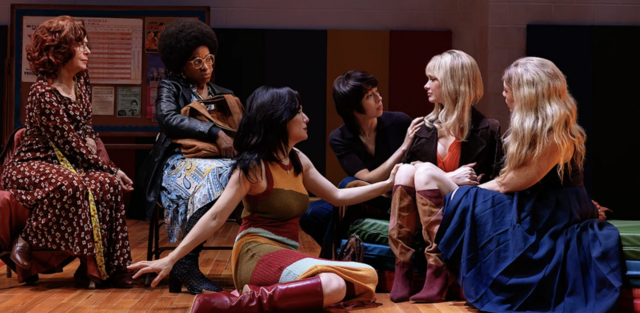
Six women form a consciousness-raising group in 1970 Ohio in Bess Wohl’s Liberation (photo by Little Fang)
LIBERATION
James Earl Jones Theatre
138 West Forty-Eighth St. between Sixth & Seventh Aves.
Closed February 1 liberationbway.com
In Bess Wohl’s dazzling Liberation: A Memory Play About Things I Don’t Remember, the playwright reimagines her mother’s 1970s consciousness-raising women’s group. The women meet in a rec center basement in Ohio to discuss the role of women in society, how it impacts their lives individually and what they can do to help change the status quo publicly. The concept of the Everywoman takes center stage at the start of the second act, when Lizzie, Margie, Susie, Celeste, Isidora, and Dora remove their clothing and sit in the usual semicircle of folding chairs, as Cha See’s gymnasium lighting keeps them brightly lit so there’s nowhere to hide. One by one, they share intimate details — or opt not to — about their bodies, each one dealing with their nudity in a different way, choosing to proudly reveal or attempt to conceal. The overt nakedness can make the audience, especially the men, uncomfortable, confronting them with questions about their own attitudes. It’s an unforgettable theatrical experience written by one of America’s best playwrights.
Liberation is nominated for five Tonys: Best Play, Best Direction of a Play (Whitney White), Best Performance by an Actress in a Leading Role in a Play (Susannah Flood), Best Performance by an Actress in a Featured Role in a Play (Betsy Aidem), and Best Costume Design.
BUG
Samuel J. Friedman Theatre
261 West Forty-Seventh St. between Broadway & Eighth Ave.
Closed March 8 www.manhattantheatreclub.com
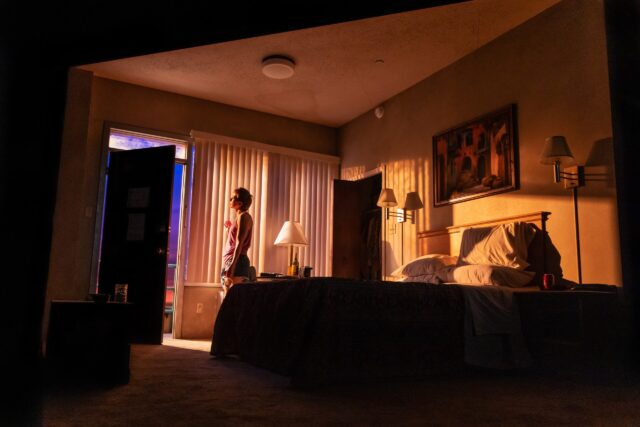
It’s been several months since I saw the Broadway debut of Tracy Letts’s Bug, and I’m still feeling all itchy and out of sorts, scratching myself all over, thinking I’m being invaded by tiny killer insects. The show is led by the sizzling hot Carrie Coon, Letts’s wife, who plays Agnes White, a forty-four-year-old woman living in a motel room outside of Oklahoma City. The opening moment is stark and beautiful: Agnes stands near the door, smoking a cigarette and holding a wineglass, looking outside as if the world is not for her. Later she’s having a crack, coke, and booze party with her best friend, the wild R.C. (Jennifer Engstrom), and a guy R.C. just met, a veteran named Peter Evans (Namir Smallwood), who is soon insisting that the room is crawling with dangerous bugs that are immune to standard spray. The play is like the bizarre offspring of Francis Ford Coppola’s brilliant 1974 The Conversation and the 1941 Popeye cartoon Flies Ain’t Human.Bug is a taut, involving thriller, with authentic scares that get under your skin. It will also make you feel genuinely threatened the next time you’re itchy, searching for a creepy crawly creature — or following a military industrial complex conspiracy theory — with an unusual taste for human blood.
Bug is nominated for four Tonys: Best Performance by an Actress in a Leading Role in a Play (Coon), Best Scenic Design, Best Sound, and Best Lighting.
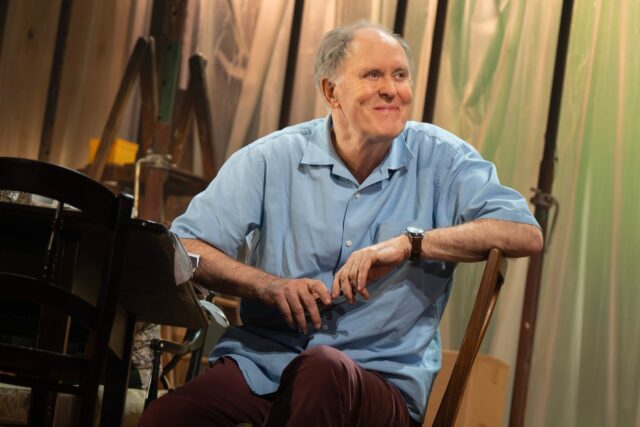
John Lithgow stars as Roald Dahl in Giant on Broadway (photo by Joan Marcus)
GIANT
Music Box Theatre
239 West 45th St. between Broadway & Eighth Aves.
Wednesday – Sunday through June 28, $89–$599 gianttheplay.com
Roald Dahl might not be “a beautiful role,” but it is one that John Lithgow performs with delicious relish in Mark Rosenblatt’s first play, Giant. It is as hard to like the character as it is to accept what he says — the show focuses on Dahl’s overt antisemitism, which created a controversy in 1983 that is still relevant today — but speech must be free if it is anything. Aya Cash is a fine foil as a sales director refusing to back down, Elliot Levey is strong as a weak-willed man some would call a self-hating Jew, Rachael Stirling is terrific as a woman caught in the middle of it all, and Stella Everett shines as the house cook who stays out of everything until she can’t. The show is splendidly directed by Sir Nicholas Hytner, maintaining a furious pace and glorying in the English language.
Giant is nominated for four Tonys: Best Play, Best Direction of a Play (Hytner), Best Performance by an Actor in a Leading Role in a Play (Lithgow), and Best Performance by an Actress in a Featured Role in a Play (Cash).
Titanique hits a minor iceberg on its journey to Broadway (photo by Evan Zimmerman for MurphyMade)
TITANIQUE
St. James Theatre
246 West Forty-Fourth St. between Broadway & Eighth Aves.
Tuesday – Sunday through September 20, $69.44-$879.63 titaniquebroadway.com
In September 2022, I wrote, “I couldn’t help but fall under the bewitching spell of Titanique, a wild and wooly musical parody of the beloved 1997 weepie shipwreck rom-com,” after seeing the DIY show at the downstairs Asylum Theatre. While its transfer to Broadway isn’t quite a disaster, it doesn’t come close to the joy and energy it had underground. Much of its original charm was its “Let’s put on a show” atmosphere, but as soon as the curtain rose at the St. James, my mouth dropped, sad that it is now a big-budget extravaganza. It still is fun, led by stellar performances by cocreator Constantine Rousouli as Jack Dawson and Melissa Barrera as Rose DeWitt Bukater, but Jim Parsons overplays Ruth, cocreator Marla Mindelle is too cutesy as host Céline Dion, and too many of the nonstop inside jokes and modern references fall flat.
Titanique is nominated for four Tonys: Best Musical, Best Book, Best Performance by an Actress in a Leading Role in a Musical (Mindelle), and Best Performance by an Actor in a Featured Role in a Musical (Layton Williams).
Stephen Adly Guirgis and Rupert Goold have a tough time adapting Dog Day Afternoon for the stage (photo by Matthew Murphy and Evan Zimmerman)
DOG DAY AFTERNOON
August Wilson Theatre
245 West Fifty-Second St. between Broadway & Eighth Ave.
Tuesday – Sunday through July 12, $57.12-$418.88 dogdayafternoon.com
Jessica Hecht is wonderful as chief bank teller Colleen in Stephen Adly Guirgis and Rupert Goold’s adaptation of Sidney Lumet’s classic 1975 based-on-fact crime thriller about a bank robbery gone terribly wrong, which also applies to this production. Jon Bernthal and Ebon Moss-Bachrach, costars on The Bear, had been wanting to take the film to Broadway for a long time, but unfortunately it still needs more work. Bernthal is Sonny, famously played by Al Pacino in the movie, who decides to rob a Brooklyn bank in order to raise money for his lover’s (Esteban Andres Cruz) sex-change operation. His cohorts are Ray Ray (Christopher Sears), who has a meltdown, and the absurdly jumpy Sal (Moss-Bachrach, taking on John Cazale’s unforgettable part), who seems to have a happy trigger finger. John Ortiz is fine as the detective attempting to bring them in, but Spencer Garrett misfires as FBI Agent Sheldon. (I can only imagine what Matthew Broderick, who was sitting two rows in front of me, was thinking, as his father, James, was superb as the FBI agent in the film.) Too much happens off the cool set, and as the play goes on, Bernthal becomes more and more like Pacino, except he is unable to whip up excitement in the crowd watching him.
Dog Day Afternoon is nominated for three Tonys: Best Scenic Design, Best Costume design, and Best Lighting.
Broadway debut of Gina Gionfriddo’s extremely funny dark comedy is a must-see (photo by Marc J. Franklin)
BECKY SHAW
Hayes Theater
240 West 44th St. between Broadway & Eighth Ave.
Tuesday – Sunday through June 14, $154 – $347 2st.com
Alden Ehrenreich plays one of the all-time biggest assholes in the Broadway debut of Gina Gionfriddo’s extremely funny dark comedy about family dysfunction, empathy, and how we care for one another — or don’t, all beginning with a blind date that goes terribly wrong. David Zinn’s gorgeous sets are enhanced by the activity that takes place during scene changes; be sure to pay close attention! Also in the outstanding cast are Patrick Ball, Madeline Brewer, Linda Emond, and Lauren Patten. This one is a gem, directed with acerbic wit by Trip Cullman.
Becky Shaw is nominated for two Tonys but deserved many more: Best Revival and Best Performance by an Actor in a Featured Role in a Play (Ehrenreich).
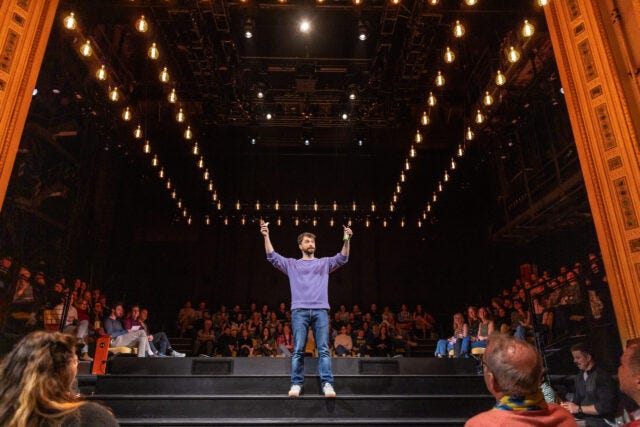
Daniel Radcliffe interacts with the audience in Every Brilliant Thing (photo by Matthew Murphy)
EVERY BRILLIANT THING
Hudson Theatre
141 West Forty-Fourth St. between Sixth & Seventh Aves.
Tuesday – Sunday through January 4, $62.72-$301.28 everybrilliantthing.com
I previously saw the sixty-five-minute Every Brilliant Thing at the Barrow Street Theatre in March 2015, starring Jonny Donahoe, who gets a smaller-font writing credit with the larger-font Duncan Macmillan. George Perrin directed that version, but the Broadway iteration is helmed by Macmillan and Jeremy Herrin. Be sure to arrive early, because when the doors open, the star (originally Daniel Radcliffe, but now Mariska Hargitay, to be followed by Tracee Ellis Ross) is roaming around the theater, handing out prompts and speaking with various audience members, both in the regular seating as well as three rows of rafters on the stage. They are looking for people to call out items from a list and to play several important roles in the character’s life. The narrator re-creates scenes from the past, all involving the audience in one way or another. The success of the play depends on the audience members’ performances and the narrator’s ability to improvise if things don’t go quite as expected; the night I went, both were in top form. Through it all, Macmillan and Donahoe explore the fragile nature of depression and suicide, from how families deal with mental illness to the hyper-controlled way it’s depicted in the media. Every Brilliant Thing is essentially about making connections, both in life and in theater, being part of something that is bigger than yourself. It’s tragedy and comedy of the highest order, an unforgettable experience that just might lead to your jotting down some of the things that make your life worth living. And the first one is very likely to be: Every Brilliant Thing.
Every Brilliant Thing is nominated for two Tonys: Best Revival and Best Performance by an Actor in a Leading Role in a Play (Radcliffe).
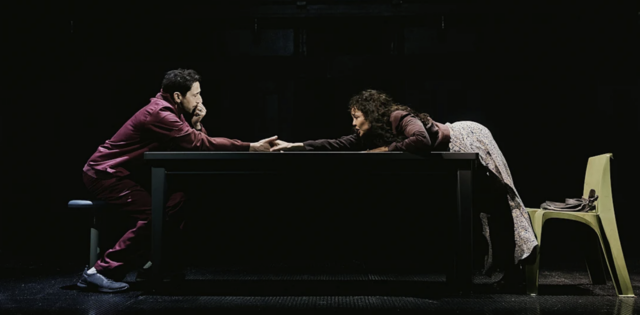
Adrien Brody and Tessa Thompson star in prison drama based on a real story (photo by Emilio Madrid)
THE FEAR OF 13
James Earl Jones Theatre
138 West Forty-Eighth St. between Sixth & Seventh Aves.
Tuesday – Sunday through July 12, $51-$299 thefearof13broadway.com
The excitement was palpable for the Broadway debuts of two-time Oscar winner Adrien Brody and Tessa Thompson in Lindsey Ferrentino’s The Fear of 13, directed by the great David Cromer, but I’m afraid the based-on-fact prison drama never breaks out. Brody plays Nick Yarris, who is on death row for a crime he might not have committed. He is befriended by Jacki Miles (Thompson), a regular visitor reaching out to incarcerated men but she develops an intimate bond with Nick, who at first seems resigned to eventually being executed. Brody and Thompson do have an affecting chemistry, but the show is too long at 110 minutes, it often feels convoluted even though it’s true, there are extraneous scenes, and it never makes a connection with the audience.
The Fear of 13 is nominated for two Tonys: Best Lighting and Best Sound.
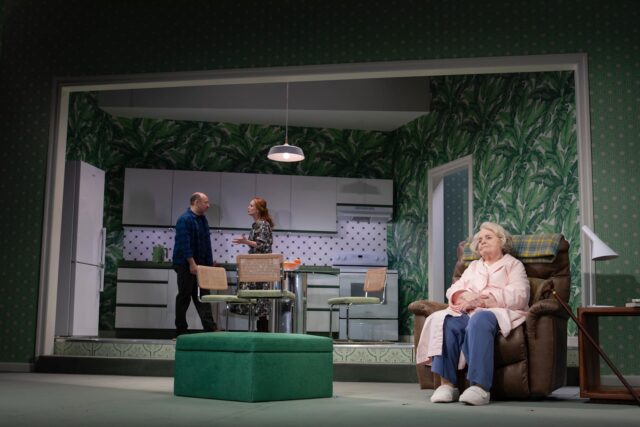
June Squibb is exquisite as a nonagenarian looking back at her life in Marjorie Prime (photo by Joan Marcus)
MARJORIE PRIME
Hayes Theater
240 West 44th St. between Broadway & Eighth Ave.
Closed February 15 2st.com
“Age will be no obstacle,” Jon (Danny Burstein) reads from an old love letter in the Broadway premiere of Jordan Harrison’s Marjorie Prime. The play, adroitly directed by Anne Kauffman, stars ninety-six-year-old June Squibb as the title character, an eighty-six-year-old woman who lives with her daughter, Tess (Cynthia Nixon), son-in-law, Jon, and an AI version of her late husband, Walter Prime (Christopher Lowell), who leads Marjorie through carefully selected — and edited — memories, from their early dates to watching their dog run on the beach, all while avoiding one particular horrific family tragedy. The prime begins its existence as a blank slate; it merely processes whatever information it has been fed. Harrison refers to the physical reincarnations as “descendants of the current chatbots.” When Marjorie dies, Tess has to decide whether she wants to turn her mother into a prime and have her AI program, and Walter’s, keep living with them. The play debuted in 2014 and was made into a film in 2017; as far as aging goes, it already feels out of date as the AI boom explodes nearly every day, detracting from its impact. However, the ending is absolutely brilliant.
Marjorie Prime is nominated for two Tonys: Best Performance by an Actor in a Featured Role in a Play (Burstein) and Best Performance by an Actress in a Featured Role in a Play (Squibb).
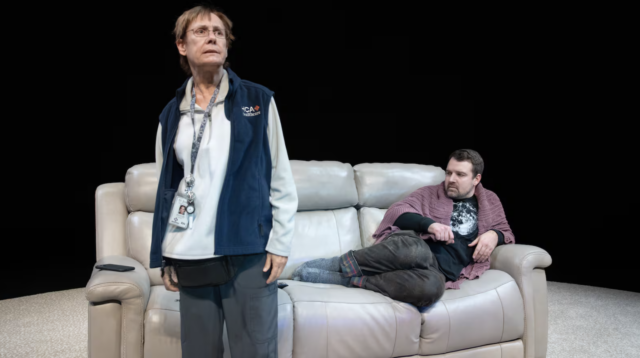
Laurie Metcalf can’t believe another Broadway show she’s in is closing early (photo by Julieta Cervantes)
LITTLE BEAR RIDGE ROAD
Booth Theatre
222 West 45th St. between Broadway & Eighth Ave.
Closed December 21 littlebearridgeroad.com
For me, the biggest disappointment of the year in theater is the early closing of Samuel D. Hunter’s sensational Little Bear Ridge Road. Originally scheduled to run until February 14, it is instead closing December 21, after opening on October 30 to a bevy of rave reviews. The play is a gripping ninety-five minutes of nonstop tension, brilliantly directed by two-time Tony winner Joe Mantello on Scott Pask’s beautifully minimalist set. On a couch on a round, carpeted platform, Sarah (Laurie Metcalf) and her nephew, Ethan (Micah Stock), spend a lot of time watching TV and complaining about their lives following the passing of Sarah’s brother, Ethan’s estranged father, a drug addict who died a miserable death. The narrative takes place between 2020 and 2022, and the pandemic plays a key role in how characters interact with each other, whether out at a bar or sitting home watching television, especially Extraterrestrial. Heather Gilbert’s intimate lighting is exceptional, making the audience feel like it’s on the couch, hanging out with Sarah, Ethan, and James. It’s a fabulous Broadway debut for Hunter; I apologize for all the superlatives, but each one is well deserved. Not only did it close early, but it received a mere single nod for Best Play, with no love for any of the myriad elements that made it so special.
Little Bear Ridge Road is nominated for one Tony: Best Play, which apparently got there without any worthy elements.
Will Harrison leads an excellent cast in harrowing true story (photo by Matthew Murphy)
PUNCH
Samuel J. Friedman Theatre
261 West Forty-Seventh St. between Broadway & Eighth Ave.
Closed November 2 www.manhattantheatreclub.com
Will Harrison makes an electrifying Broadway debut as a young Nottingham man whose life changes forever on a wild night in James Graham’s Punch. Harrison stars as Jacob in the true story, based on the memoir Right from Wrong by Jacob Dunne, which explores bullying, drugs, class, and restorative justice. One night, nineteen-year-old Jacob and his large gang of friends are out drinking and snorting as they barhop through Nottingham, Jacob in search of some action; he finds it when he unleashes a massive punch on a random stranger just for kicks, but when the young man, twenty-eight-year-old James Hodgkinson, dies as a result of the altercation, Jacob is sent to prison while James’s parents, David Hodgkinson (Sam Robards) and Joan Scourfield (Victoria Clark), deal with the tragic loss of their son and contemplate whether they should forgive Jacob. The energetic, fast-paced first act shifts between the punch and its immediate aftermath and a group therapy session led by Sandra (Lucy Taylor, who also plays Jacob’s mother and a probation officer), where Jacob shares his story with others. Sandra describes it as a place for “talking and listening. Difficult conversations.” Those conversations center on restorative justice, as Jacob, Joan, and David decide if they are going to meet face-to-face. The second half is decidedly slower and less compelling, but you can’t take your eyes off Harrison, a rising star with a bright future.
Punch is nominated for one Tony: Best Performance by a Leading Actor in a Play (Harrison).
Keanu Reeves and Alex Winter star in Broadway smash version of Samuel Beckett’s Waiting for Godot (photo by Andy Henderson)
WAITING FOR GODOT
Hudson Theatre
141 West Forty-Fourth St. between Sixth & Seventh Aves.
Closed January 4 godotbroadway.com
Last fall, the talk of the town was Keanu Reeves and Alex Winter reprising — well, channeling? — their roles from 1989’s Bill & Ted’s Excellent Adventure and the 1991 and 2020 sequels in Waiting for Godot at the Hudson Theatre. Action star Reeves was making his Broadway debut as Estragon (Gogo) in Jamie Lloyd’s bumpy adaptation, while Winter returned to the Great White Way for the first time in forty-four years as Vladimir (Didi). For the most part, they hold the audience’s attention. Gogo and Didi usually find themselves in a strange, dark wasteland, with only a single bare tree, a country road, and a solitary stone as they contemplate life and death, heaven and hell, and existence and humanity, but Lloyd and set designer Soutra Gilmour locate them inside a giant tube that is part tunnel, part circular skateboard ramp, part existential void in space. Resembling abandoned vaudevillians in all black, sporting impressive bowlers (the costumes are also by Gilmour), they sit at the edge of the tube, feet dangling, waiting for the mysterious Godot to arrive and, perhaps, bring meaning to their sad, pathetic lives. Reeves and Winter may not display a wide range of emotions, but they avail themselves well enough to keep the audience engaged. At one point Didi says, “This is not boring you I hope,” looking out at us, and we essentially answer no.
Waiting for Godot is nominated for one Tony: Best Performance by an Actor in a Featured Role in a Play (Brandon J. Dirden).
James Corden, Neil Patrick Harris, and Bobby Cannavale star as three friends reaching a crisis point in Art (photo by Matthew Murphy)
ART
Music Box Theatre
239 West 45th St. between Broadway & Eighth Aves.
Closed December 21 artonbroadway.com
One of my favorite theatrical moments of 2025 occurred at the end of the matinee of Art I attended. As the curtain closed, James Corden gave a little hop, skip, and jump, grabbing onto the shoulders of his two costars, Bobby Cannavale and Neil Patrick Harris, as a wide, childlike smile broke out across his face. It was one of the most happy-making things I’d seen all year. It made the whole experience that much more enjoyable, helping me forget some of the holes in what is a pleasurable if not nearly as deep as it wants to be show. What are these men doing in Paris? Were they ever really close friends? Can Marc (Cannavale) and Serge (Harris) just leave poor Yvan (Corden) alone already? When the audience enters the Music Box Theatre, they are greeted by a framed white rectangle on the red curtain, not only representing the white painting that Serge has paid three hundred thousand dollars for, but also the blank slate we all come into the world with, onto which we project our personal likes and dislikes, including how we appreciate, or don’t, art itself. When the play is over, some will have loved it, some will have despised it, and other, perhaps most, will find themselves in between. Friends will defend their views, just as Serge defends his purchase to Marc, who is insulted that Serge spent so much money on a white canvas, while Yvan is caught in the middle.
Art received no Tony nominations.
Beaches musical got beached early (photo by Marc J. Franklin)
BEACHES
Majestic Theatre
247 West 44th St. between Broadway & Eighth Aves.
Closed May 24 beachesthemusical.com
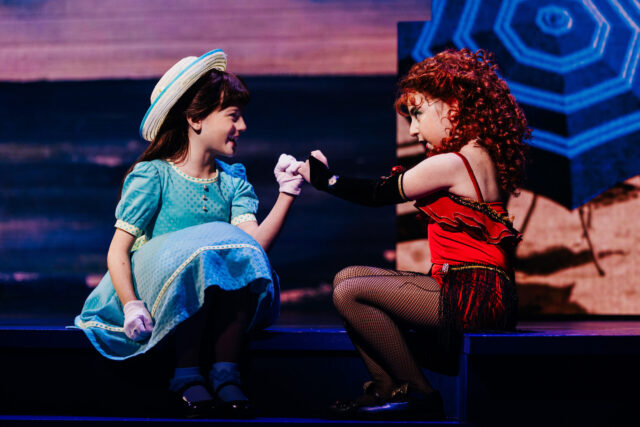
Directors Lonny Price and Matt Cowart’s Broadway musical adaptation of the beloved 1988 film about female friendship starring Bette Midler and Barbara Hershey is all washed up. Novel author Iris Rainer Dart wrote the drab book with Thom Thomas and penned the drab lyrics, and the drab music is by Mike Stoller. While the first act mostly works, as Bertie (Zeya Grace) and Cee Cee (Samantha Schwartz) meet as kids on the Atlantic City boardwalk, as they grow up, the narrative goes all over the place, the songs are unmemorable, and the plot untenable. Jessica Vosk does some heavy lifting as the adult Cee Cee, while Kelli Barrett has less to do as the mature Bertie. I can’t recall a single major dance number, although a choreographer is listed on the program. There’s just not enough wind beneath these wings.
Beaches received no Tony nominations.
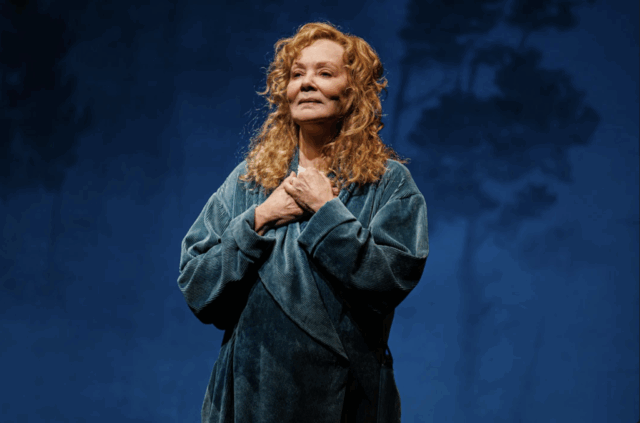
Jean Smart makes a triumphant return to Broadway in Call Me Izzy (photo by Marc J. Franklin)
CALL ME IZZY
Studio 54
254 West 54th St. between Seventh & Eighth Aves.
Closed August 17 callmeizzyplay.com
Baton Rouge native Jamie Wax’s debut play, Call Me Izzy, is a darkly funny and insightful one-person drama, an exploration of an all-too-familiar topic: domestic abuse. Although it borders on clichéd situations and flirts with poverty porn, it never tips over the edge. The stellar production, directed by Sarna Lapine and anchored by an exquisite performance by six-time Emmy winner and Tony and Grammy nominee Jean Smart, makes it much more. In a triumphant return to Broadway after nearly twenty-five years, Smart portrays Isabelle Scutley, née Fontenot, a woman living with her brutish husband, a pipe fitter named Ferd, in a mobile home in the fictional Louisiana Lady Trailer Park in the real town of Mansfield, Louisiana. Telling her story directly to the audience, Isabelle, who was married at seventeen and got a cemetery plot as a wedding present from her husband, has been trying to establish her own identity since she was a child, but under societal constraints and Ferd’s firm thumb she has rarely had a true sense of self. An aspiring poet, she asks, “If you write something and no one ever reads it, does it even exist? Do I exist? Do you exist?” Lapine keeps things moving smoothly through the play’s hundred minutes, but the show belongs to Smart, who has the rapturous audience behind her every step of the way. At the matinee I saw, applause broke out after numerous scenes not just for Smart’s acting talent but for choices Izzy makes.
Call Me Izzy received no Tony nominations.
Don Cheadle stars in Broadway revival of Proof (photo by Matthew Murphy)
PROOF
Booth Theatre
222 West 45th St. between Broadway & Eighth Ave.
Tuesday – Sunday through July 19, $58 – $297 proofbroadway.com
In 2001, David Auburn’s Proof won the Pulitzer Prize and Tonys for Best Play and Best Director (Daniel Sullivan), and all four cast members were nominated, with Mary-Louise Parker taking home the award for Best Actress. Watching Thomas Kail’s revival, there’s no evidence was to what all the hubbub was about. Don Cheadle stars as Robert, a deceased genius mathematician with severe mental illness who still talks to his genius daughter, Catherine (Ayo Edebiri), who is stuck in a rut. Her sister, Claire (Kara Young), is trying to reach out, and one of her father’s former students, Hal (Jin Ha), wants to go through Robert’s notebook in the hopes of finding something publishable. Numerous times, Catherine is asked how she’s doing, and she answers, “fine.” And that’s what this show is, merely fine. And oh, that interstitial music.
Proof received no Tony nominations.
Even Kristin Chenoweth can’t save The Queen of Versailles from getting high on its own supply (photo by Julieta Cervantes)
THE QUEEN OF VERSAILLES
St. James Theatre
246 West Forty-Fourth St. between Broadway & Eighth Aves.
Tuesday – Sunday through December 21, $88.48-$441.28 queenofversaillesmusical.com
It’s never fun writing a review for a show that is closing early; it’s sort of like that old saying, Don’t speak ill of the dead. When I went to the St. James Theatre to see The Queen of Versailles, a musical based on the hit documentary, I was fully prepared to find something to like about it despite all the negative chatter that was circulating. And indeed, I thoroughly enjoyed the first scene, which takes place in Paris in 1661, as Louis XIV (Pablo David Laucerica) is getting ready to move to his new home in Versailles. I also was all in on the second scene, with the action moving to Florida in 2006, where Jackie Siegel (Kristin Chenoweth) is overseeing the construction of her own Versailles with her fabulously wealthy, much older husband, David (F. Murray Abraham). After that, well, I just couldn’t. The story devolves quickly into tawdry melodrama, along with clunky staging and less-than-compelling musical numbers. The book, which refuses to decide whether Jackie is a strong woman, a greedy socialite, or a misunderstood wife and mother, is by Olivier nominee Lindsey Ferrentino, the director is Tony winner Michael Arden, and the music and lyrics are by Oscar winner Stephen Schwartz, all of whom should have known better.
The Queen of Versailles received no Tony nominations.
[Mark Rifkin is a Brooklyn-born, Manhattan-based writer and editor; you can follow him on Substack here.]
A series of meetings of the Vernon Point Neighborhood Association opens up old and new wounds in The Balusters (photo by Jeremy Daniel)
THE BALUSTERS
Samuel J. Friedman Theatre
261 West Forty-Seventh St. between Broadway & Eighth Ave.
Tuesday – Sunday through May 24, $58-$347 www.manhattantheatreclub.com
Yesterday afternoon I bumped into Richard Thomas on the Upper East Side. I told him how fabulous I thought The Balusters, the new Broadway play he’s starring in, is and what a great cast he’s working with. But as much fun as I had at the show, it appears that he is having even more, if that’s possible, gushing about David Lindsay-Abaire’s script and the entire ensemble. His smile was even bigger than mine.
Making its world premiere at MTC’s Samuel J. Friedman Theatre, The Balusters takes on a kitchen sink of contemporary issues, from homophobia, racism, classism, and corruption to toxic masculinity, privilege, bigotry, and furniture. And it does so in hilarious ways; I can’t remember the last time I laughed so long and hard during a play or clapped so often after side-splitting, sparkling lines of dialogue.
The hundred-minute comedy is set at several meetings of the Vernon Point Neighborhood Association, where a group of nine people regularly gather to discuss the state of their beloved community, a peaceful, old-fashioned enclave steeped in history, boasting well-manicured lawns, comfortable, attractive porches, and an overall flavor of Victorian elegance. The host is the newest member, Kyra Marshall (Anika Noni Rose), who has recently moved from Baltimore with her husband and their twin daughters. She lives in a beautifully designed home with fashionable chairs and couches, fancy china, and paintings of and by distinguished Blacks on the walls, as if overseeing the coming shenanigans, including, in the foyer, a print of George DeBaptiste’s 1978 portrait of Toussaint L’Ouverture, who was born a slave and went on to be a leader of the Haitian Revolution, and, above the fireplace, a flower-laden portrait of a Black feminist that evokes the work of contemporary Black American artists Harmonia Rosales and Kehinde Wiley. (The elegant set is by two-time Tony and two-time Emmy winner Derek McLane.)
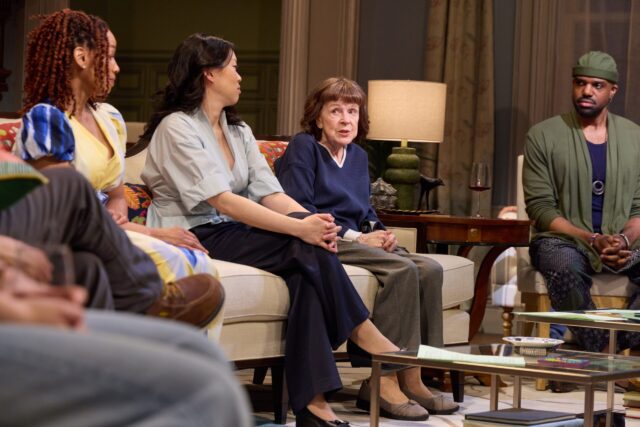
The gavel-wielding president of the association is Elliot Emerson (Thomas), a fuddy-duddy real-estate broker intent on protecting the legacy of Vernon Point. The other members are Latino contractor Isaac Rosario (Ricardo Chavira); the acerbic, antagonistic Jewish treasurer, Ruth Ackerman (Margaret Colin); Willow Gibbons (Kayli Carter), a young, white vegan who sees microaggressions everywhere; Brooks Duncan (Carl Clemons-Hopkins), a gay Black travel writer who is married and has a son; the somewhat hapless Alan Kirby (Michael Esper), a white man in his fifties who considers himself an ally and doesn’t understand why he is so often ignored; Melissa Han (Jeena Yi), an ambitious Asian American lesbian and lawyer who is the vice president; and Penny Buell (Marylouise Burke), the elderly white secretary who used to work for Elliot and is not nearly as doddering as she might let on, surprising everyone with sharply focused acerbic quips. Also present is Luz Baccay (Maria-Christina Oliveras), Kyra’s ultra-efficient Filipino housekeeper who left the Emersons’ employ for unstated reasons.
New resident Kyra Marshall (Anika Noni Rose) has no idea what she’s in for after joining group (photo by Jeremy Daniel)
Among the topics of discussion are expanding the hours of the safety van to catch porch pirates, how to handle kids who don’t live in Vernon Point but hang out there, and the plain, ahistorical balusters the Crawfords may be installing, which insult Elliot and lead to the following exchange, which helps define the characters while establishing the play’s central metaphor.
Elliot: Farmhouse balusters aren’t true to the period or style of the original railing. They’d look ridiculous on that Queen Anne. Melissa: But we don’t police our neighbors. Elliot: It’s not policing. If you live here, you’ve agreed to certain guidelines. Kyra: I hate to ask, but what exactly are balusters? Elliot: I’m sorry, Kyra. We should’ve started with that. Isaac: They’re the posts that support a railing. They’re like spindles but with footings. Kyra: Okay, I’m gonna nod and pretend I know what that means. Melissa: You’re gonna learn so much useless information here. Elliot: It’s not useless. The balusters are important. They hold everything up. A porch’ll fall to pieces without the right support. Ruth: As riveting as this is, may we move on?
When Kyra suggests that the group request stop signs for a corner where numerous accidents have occurred, heated arguments ensue, eventually becoming personal over the course of several meetings and leaving no one unscathed, their biases revealed via revenge, gossip, and carelessness.
Penny Buell (Marylouise Burke) is deceptively clever and prescient in brilliant new Broadway comedy (photo by Jeremy Daniel)
The Balusters is brilliantly written by Tony and Pulitzer winner Lindsay-Abaire (Rabbit Hole,Kimberly Akimbo) and expertly directed with a wry sense of humor by Tony winner Kenny Leon (Purlie Victorious: A Non-Confederate Romp Through the Cotton Patch,Home). It is reminiscent of both Bruce Norris’s Tony- and Pulitzer-winning Clybourne Park and Jonathan Spector’s Tony-winning Eureka Day, two plays that explore what can go wrong when small groups of people think they can decide what’s right and wrong for others. It will also likely remind New Yorkers of why they don’t want to be on their coop board.
Five-time Tony nominee Emilio Sosa’s costumes are impeccable, and four-time Tony nominee Allen Lee Hughes’s lighting and six-time Tony nominee Dan Moses Schreier’s sound — he also composed the excellent interstitial music, which features a rap bent — are in sync throughout, especially when thunder and lightning strike at just the right instances.
The terrific ensemble forms an outrageously funny extended family, led by Emmy winner Thomas (Our Town,The Little Foxes) as an older man seeing his carefully curated life slip away and Tony winner Rose (Caroline, or Change,A Raisin in the Sun) as a younger woman who is not afraid to get in Elliot’s way, but theater treasure Burke (Ripcord,Infinite Life), in her seventh collaboration with Lindsay-Abaire, steals the show as Penny, who always knows just what to say.
“I’d just like to remind us that everyone in this room is a decent person,” Penny interjects at one point when things are threatening to get out of hand. “We wouldn’t be here if we didn’t care about our neighbors. At the same time, no one is perfect, and sometimes people make mistakes.”
Now, where’s my gavel?
[Mark Rifkin is a Brooklyn-born, Manhattan-based writer; you can follow him on Substack here.]
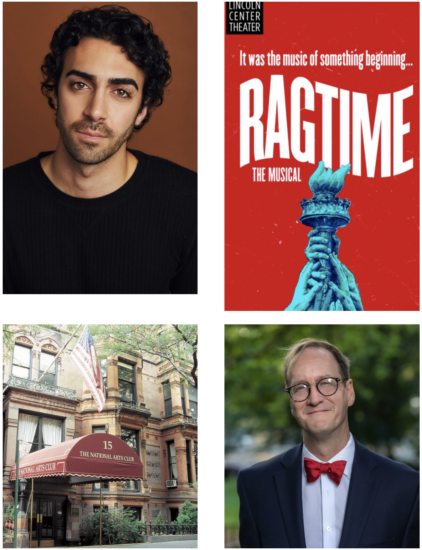
Who:Rodd Cyrus,Carl Raymond What: Inaugural Friday lunch conversation Where:The Coffee House at the National Arts Club, 15 Gramercy Park South When: Friday, March 20, $85, 11:30 am Why: Back in November, I wrote in a Substack post about meeting actor Rodd Cyrus after seeing Ragtime at Lincoln Center; I was there with a group of women from Wellesley organized by Rodd’s mother. Cyrus plays Harry Houdini, who enters by dangling on a wire and declaring, “He made his mother proud.”
Now you can meet Cyrus as well when he is the special guest at the inaugural Coffee House Club lunch at the National Arts Club. He will be interviewed by writer, lecturer, tour guide, and social and culinary historian Carl Raymond, host of the Gilded Gentleman podcast.
Cyrus was born in Boston and raised in the San Francisco Bay Area and is of Iranian-English-Irish-Welsh-Italian-American heritage. In addition to starring in Ragtime, he is a regular on Elsbeth, has appeared in such plays as James Joyce’s Exiles and Maija García’s Valor and such films as Doctor, Doctor and 72 Hours, and portrayed Giuseppe Naccarelli in The Light in the Piazza at Encores!
“Rodd’s story is not only a great theatrical story; it’s a uniquely American story,” Raymond told twi-ny. “To be playing the role of immigrant superstar Harry Houdini in this revival along with his own personal story makes his portrayal unique and deeply important.”
The prix fixe lunch includes beet and mixed green salads, a choice of a turkey club sandwich, mushroom power bowl, rigatoni alla Bolognese, or chicken Marsala, and nostalgic sweets for dessert.
Only a few tickets remain to be part of this exciting event.
[Mark Rifkin is a Brooklyn-born, Manhattan-based writer; you can follow him on Substack here.]
BUG
Samuel J. Friedman Theatre
261 West Forty-Seventh St. between Broadway & Eighth Ave.
Tuesday – Sunday through March 8, $92-$407 www.manhattantheatreclub.com
It’s been several weeks since I saw the Broadway debut of Tracy Letts’s Bug, and I’m still feeling all itchy and out of sorts, scratching myself all over, thinking I’m being invaded by tiny killer insects.
Straight psychological horror plays don’t have a particularly impressive history on Broadway. While there have been plenty of successful spooky musicals, the same has not been true of legitimately frightening dramas. Recently, Levi Holloway’s thrilling Grey House got short shrift, closing early, and while Stranger Things: The First Shadow keeps going strong at the Marquis, it’s not pure horror, especially with its awkward Oklahoma! high school musical subplot. The last time I felt so shuddery after a Broadway play might go all the way back to watching Frank Langella from the front row of the Martin Beck Theatre in the 1977 smash Dracula.
Bug premiered in London in 1996 and came to New York eight years later, starring Shannon Cochran, Michael Shannon, Michael Cullen, Amy Landecker, Brían F. O’Byrne, and Reed Birney. It was adapted into a film in 2006, directed by William Friedkin (The Exorcist,The French Connection) and featuring Ashley Judd, Harry Connick Jr., and Michael Shannon.
Its Broadway bow at the Samuel J. Friedman is led by the sizzling hot Carrie Coon, Letts’s wife, a four-time Emmy nominee who has delighted in such series as The White Lotus,The Leftovers,Fargo, and, currently, The Gilded Age. In Bug she plays Agnes White, a forty-four-year-old woman living in a motel room outside of Oklahoma City. The opening moment is stark and beautiful: Agnes stands near the door, smoking a cigarette and holding a wineglass, looking outside as if the world is not for her. The phone rings but nobody says anything on the other end; Agnes assumes it’s her ex-husband, Jerry Goss (Steve Key), calling from prison. “I got a gun,” she warns the caller.
Next she’s having a crack, coke, and booze party with her best friend, the wild R.C. (Jennifer Engstrom), and a guy R.C. just met, a veteran named Peter Evans (Namir Smallwood). Agnes is suspicious of Peter, saying, “He’s a fuckin’ maniac, for all I know. . . . He’s a maniac DEA ax murderer, Jehovah’s Witness.” R.C. assures her he’s okay, as does Peter, whose first words are, “I’m not an ax murderer.” Agnes takes a liking to Peter and lets him stay while R.C. goes off to another shindig.
Peter explains to Agnes that he makes people nervous and uncomfortable with his talent for picking up on things, telling Agnes that he is a preacher’s son just looking for a connection to other people. When Peter starts hearing a chirping he can’t identify, Agnes at first thinks it’s a cricket. “Don’t kill him. It’s bad luck,” she says. It turns out to be the battery in the smoke alarm, which Peter claims is “more radioactive than plutonium.” He gets rid of it outside, disposing of a warning system that both of them will need as they go down a rabbit hole of conspiracy theories centered around Peter’s insistence that the room is crawling with dangerous bugs that are immune to standard sprays. “They’re blood-sucking aphids,” he later tells R.C. and Agnes, “and we’re infested.”
By the time Dr. Sweet (Randall Arney) arrives, it might already be too late.
A Steppenwolf production presented by Manhattan Theatre Club, Bug is a dark dive into paranoia, perhaps even more relevant today than it was in 1996 or 2006, given the vast reach of social media, where anyone can say anything about whatever they want and watch their beliefs, regardless of facts and the truth, spread across the internet and, potentially, into mainstream society — and the government.
The play is like the bizarre offspring of Francis Ford Coppola’s brilliant 1974 The Conversation, in which Gene Hackman stars as Harry Caul, a surveillance expert who soon thinks he himself is the target being bugged, and — stay with me, now — the 1941 Popeye cartoon Flies Ain’t Human, in which the spinach-gulping hero tries his darnedest to kill flies in his home, even using a rifle.
Takeshi Kata’s hotel-room set is appropriately claustrophobic, especially in the second act. Heather Gilbert’s lighting maintains the dark mysteries hovering over it all, while Josh Schmidt’s sound ranges from a chilling quiet to brash noises.
Tony winners Letts (The Minutes,Mary Page Marlowe) and director David Cromer (Meet the Cartozians,Prayer for the French Republic) allow the plot to slowly slither along until some major set changes during intermission — which the audience can watch — ratchet up the tension for the even creepier second act as the characters’ perspectives on reality shift dramatically.
Tony nominee and Obie winner Coon (Mary Jane,Who’s Afraid of Virginia Woolf?) is hypnotic as Agnes, a strong-minded, independent woman who gets caught up in something she may not be able to get out of; you can’t take your eyes off her as her immediate future grows more and more ominous. Smallwood (Pass Over,Pipeline) portrays Peter with a keen ambiguity; you never know what he’s going to say or do. Their long nude scene together — the reason audience members must place their phones in Yondr pouches for the duration of the show — binds them to each other in a moving and emotional way. (The naturalistic costumes are by Sarah Laux.)
Bug is a taut, involving thriller, with authentic scares that get under your skin. It will also make you feel genuinely threatened the next time you’re itchy, searching for a creepy crawly creature — or following a military industrial complex conspiracy theory — with an unusual taste for human blood.
[Mark Rifkin is a Brooklyn-born, Manhattan-based writer; you can follow him on Substack here.]
Bryce Pinkham leads a supercharged ensemble in Chess Broadway revival (photo by Matthew Murphy)
CHESS: A COLD WAR MUSICAL
Imperial Theatre
249 West 45th St. between Broadway & Eighth Ave.
Tuesday – Sunday through May 3, $74-$571 chessbroadway.com
There are practically as many versions of the musical Chess as there are opening gambits in the fifteen-hundred-year-old game of intense strategy and mental acuity. With an original book by Tim Rice, music by ABBA’s Benny Andersson and Björn Ulvaeus, and lyrics by Rice and Ulvaeus, the show has gone through multiple adaptations since the release of the concept album in 1984, from concert versions to music videos to full theatrical presentations in the West End in 1986, on Broadway in 1988, and around the world, attracting major directors (Trevor Nunn, Des McAnuff, Jim Sharman, Rob Marshall) and actors (Josh Groban, Judy Kuhn, Raúl Esparza, Carolee Carmello), featuring significantly changed books (by Richard Nelson, Robert Coe, and Rice himself, several times) involving song swaps and deletions and major plot alterations, often due to shifting world politics, primarily between Russia/the Soviet Union and the United States.
The current Broadway production, scheduled to continue through May 3 at the Imperial Theatre, where it’s breaking house box-office records, is the first iteration I’ve seen, and I found it to be a ton more exciting than watching, well, a chess match. Tony-winning director Michael Mayer (Spring Awakening,American Idiot) has teamed up with Emmy-winning film and television writer, actor, and director Danny Strong, making his Broadway debut, to reimagine the show, and it’s a major triumph filled with clever and insightful moves, despite occasionally delving into soapy melodrama, while not overplaying the cold war connections between the 1980s and today.
“Nineteen seventy-nine. The entire world is on high alert, trapped in a never ending confrontation between two opposing ideologies: communism and democracy,” the Arbiter (Bryce Pinkham), a kind of narrator and referee who oversees the proceedings, announces at the start. The ensemble belts out, “No one can deny that these are difficult times,” and the Arbiter responds, “It’s the US vs. USSR / Yet we more or less are / To our credit putting all that aside / We have swallowed our pride. . . . / No one’s way of life is threatened / by a flop.” The ensemble adds, “But we’re gonna smash their bastard / Make him wanna change his name / Take him to the cleaners and devastate him / Wipe him out, humiliate him / We don’t want the whole world saying / ‘They can’t even win a game!’ We have never reckoned on coming in second / There’s no use in losin’.”
Just in case you’re not already considering how the plot aligns with the foreign policy of President Donald Trump compared to that of Ronald Reagan, who was commander-in-chief when the show was written, the American chess master is named Freddie Trumper (Aaron Tveit), who is in love with his second, the beautiful theoretician Florence Vassy (Lea Michele). They are preparing for a major match against the brilliant Anatoly Sergievsky (Nicholas Christopher), whose handler is the devious Alexander Molokov (Bradley Dean). Molokov is quick to remind Anatoly what happened to the previous Soviet champion who lost to an American, but Anatoly tells him, “I do not fear sharing the same fate as Boris Ivanovich. The State cannot execute a man that is already dead.” But Molokov is relentless in his defense of his country, later using Anatoly’s estranged wife, Svetlana (Hannah Cruz), against him.
As the players travel to Merano, Stockholm, and, most famously, Thailand, where they spend a memorable night in Bangkok, relationships come together and fall apart, loyalty is tested, and the SALT II treaty is hotly debated as the KGB and the CIA fight to assert their prominence, with the game of chess as its centerpiece.
Freddie Trumper (Aaron Tveit) and Florence Vassy (Lea Michele) have a complicated personal and professional relationship in Chess (photo by Matthew Murphy)
Inspired in part by the famous 1972 world championship between American Bobby Fischer and Boris Spassky of the Soviet Union held in Reykjavík, Iceland, which was seen as a microcosm of the ongoing battle between the US and the USSR, Chess is a thrilling evening of theater, highlighted by Pinkham (A Gentleman’s Guide to Love & Murder,Ohio State Murders), who serves as an engaging ringleader to the proceedings, addressing the audience directly and including playful contemporary references. He is often accompanied by a terrifically talented ensemble performing Lorin Latarro’s dazzling choreography; the singers and dancers are like a glorious symphony that makes you instantly forget the book’s occasional meanderings and messiness.
The orchestra is spread across David Rockwell’s glittering multilevel set, which boasts columns of chess pieces and live and archival video footage by Peter Nigrini. The costumes, by Tom Broecker, glitter as well, particularly for the ensemble, with flashy lighting by Kevin Adams and blasting sound by John Shivers.
Yes, there are too many songs, Freddie’s transition to being an announcer is annoying, the love triangle is messy, the politics are oversimplified, and the ballads are histrionic, but Mayer and Strong keep the actual chess to a minimum, and every time the show threatens to give in to the lowest common denominator, Pinkham and the ensemble swoop in to rescue it as the endgame approaches.
This Chess is certainly no flop.
[Mark Rifkin is a Brooklyn-born, Manhattan-based writer and editor; you can follow him on Substack here.]