this week in art

“TO BE PUERTO RICAN IS TO BE AMERICAN”: ROBERTO LUGO IN MADISON SQUARE PARK

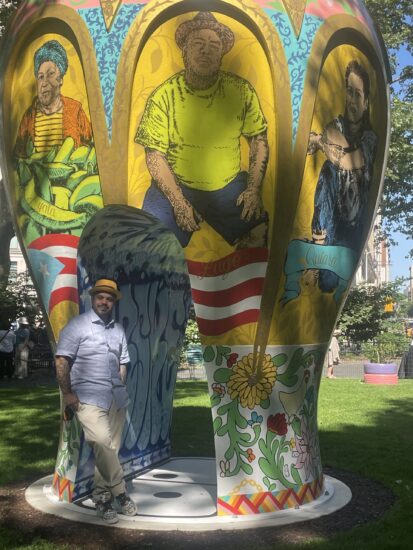
Roberto Lugo poses under depictions of his parents on Capicú de Cariño (I Heard It Both Ways) in Madison Square Park (photo by twi-ny/mdr)

ROBERTO LUGO: ALFARERO DEL BARRIO
Madison Square Park
26th St. between Fifth & Madison Aves.
Through December 6, free
www.madisonsquarepark.org
www.robertolugostudio.com
flickr slideshow and videos

“I knew of the Madison Square Park art program from Martin Puryear’s work, from Maya Lin’s work, and thinking about this as a moment to see an artist’s vision in this context, a place where everybody goes,” Roberto Lugo told me at the May opening of “Alfarero del Barrio (Village Potter).” He added, “I also think about this as an opportunity, that we have this crossing of so many cultures that are intersecting here, so I thought to myself, If I ever have the opportunity to do something like that, what would my focus be? How do I represent my culture and connect to places in New York? When I think about Puerto Rican culture, I think about the Bronx, Spanish Harlem, all these places where there’s this fusion in the contribution of Puerto Ricans, and I wanted to see them come here, but even Latino people in general, people of color, when they’re coming here, it feels really good to have something bright and colorful and celebratory.”

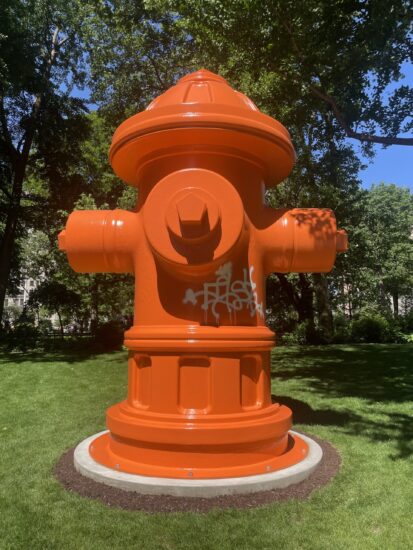
Roberto Lugo’s Para Los Días Caliente (This Is for the Hot Ones) is not for the dogs (photo by twi-ny/mdr)

“Alfarero del Barrio (Village Potter)” is a multipart installation that consists of a fifteen-foot-high graffiti-laden red fire hydrant, Para Los Días Caliente (This Is for the Hot Ones), a giant version of the first piece he made as a ceramicist and an homage to his father, who, on hot days in the Kensington neighborhood of Philadelphia where they’re from, would cool off with his family by spraying water from a hydrant; four Domino Tables around the reflecting pool feature images of Lugo, his grandfather, baseball hero Roberto Clemente, and Cuban-American singer Celia Cruz (people are invited to bring their own dominoes and play on the tables); and Capicú de Cariño (I Heard It Both Ways) is a twenty-foot-high vase-urn made of foam, paint, and steel with portraits of Puerto Ricans around it: Hamilton creator Lin-Manuel Miranda, Supreme Court Associate Justice Sonia Sotomayor, singer Bad Bunny, Clemente, playwrights Quiara Alegría Hudes and Lemon Andersen, and Lugo’s parents, in addition to flowers, dominoes, chickens, and other lively elements. There is also a graffitied archway that allows you to walk through the vase, further immersing you in Puerto Rican culture and history.

“He remembers where he came from,” his father told me.

In his artist statement, Lugo declares, “Yo soy Boricua. / a proud domino-playing, / pasteles-making, / piragua-selling, / fire hydrant-spraying, / plantain-peeling, / salsa-dancing, / alcapurria-consuming, / limber-on the front porch-hustling Puerto Rican.” He also explains, “In recognition of the semiquincentennial of the United States of America, I wanted to recognize the diverse contributions of Puerto Ricans. ‘Alfarero del Barrio’ is a celebration of Puerto Rican culture and a visual representation of our resilience, creativity, and courage. Puerto Rican heritage has roots in African, Taíno, and Spanish culture — a sofrito that provides flavor to everything we do. The history of this intersection is filled with stories of strife, injustice, and horror, but through it all, Puerto Ricans have proven to be icons of resourcefulness and ingenuity that are celebrated through our food, music, and culture.”

On September 16 at 5:30 and October 14 at 5:00, there will be free twenty-minute evening art tours starting on the Redbud Lawn, led by the MSPC curatorial team. And on September 19, a tea ceremony will take place on the Cherry Lawn at 4:30, including a performance by Lugo, who is also a spoken-word poet, and special musical guests Lennie Simo and Marley Howard, with everyone enjoying Puerto Rican snacks and Lugo’s mother’s ginger tea in cups made by Lugo that you can keep.

IMG_8372

The exhibition continues through December 6, so you have plenty of time to experience its meaningful beauty and, as Lugo suggests, take photos of yourself in the vase, play dominoes, have fun at the hydrant, and “see that to be Puerto Rican is to be American.”

[Mark Rifkin is a Brooklyn-born, Manhattan-based writer and editor; you can follow him on Substack here.]
LIGHTING UP MORNINGSIDE HEIGHTS: A COMMON THREAD AT COLUMBIA

The theme of this year’s “Morningside Lights” is “A Common Thread” (photo courtesy Processional Arts Workshop)

MORNINGSIDE LIGHTS: A COMMON THREAD
Lantern workshops
Miller Theatre, Broadway & 116th St.
September 12-18, free with advance RSVP
Procession
Morningside Park
Saturday, September 19, free, 8:00
www.morningside-lights.com

THe fifteenth annual “Morningside Lights” takes place on September 19 at 8:00, as hundreds of people participate in a procession through Morningside Park, carrying twenty-five large lanterns. Initiated in 2012 by Brenna St. George Jones, Alex Kahn, Sophia Michahelles, and Melissa Smey, the event connects Columbia students and their families with members of the community. From September 12 to 18, the university hosts daily lantern workshops, led by artistic directors Kahn and Michahelles, as the lanterns go through four essential steps, involving coroplast, cheesecloth, glue, and white and colored tissue, before they’re ready for the procession, which begins at 116th St. and Broadway and marches through Morningside Park to the Columbia campus. Lantern holders will be chosen at 7:00 on a first-come, first-served basis; no experience is necessary.

This year’s theme is “A Common Thread,” bringing everyone together. In their artists statement, Kahn and Michahelles explain that for the 2026 iteration, “We delve into the fabric of iconic patterns, decorative motifs, and recurring images that surround us – in woven and printed textiles, in personal and domestic adornments, in architectural and engineered spaces. While some patterns meld into the rhythm of everyday life, others reveal sacred geometries or cultural connections that transport us out of the present into the timeless. In their endless juxtapositions and recombinations, such patterns reveal the patchwork stories of a pluralistic city and nation, made anew with every generation.”

In conjunction with the anniversary, the exhibition “Carried by Light: Celebrating Fifteen Years of Morningside Lights” will be on view in the Miller Theatre lobby through next May. “Morningside Lights began fifteen years ago with a small team and a simple idea: that making art together could bring a community closer,” Smey said in a statement. “Since then, more than twenty-five thousand participants have helped shape lanterns, stories, and shared moments. This anniversary is a moment to look back with gratitude, and to look forward with excitement to all those who will continue to carry this tradition forward.”

[Mark Rifkin is a Brooklyn-born, Manhattan-based writer; you can follow him on Substack here.]
JOSIAH McELHENY & FRIENDS: “INSTRUMENT OBJECTS” AT THE KITCHEN

Who: Josiah McElheny, Zeena Parkins, Wendy Eisenberg, David Grubbs, Raven Chacon, Jennie C. Jones, George Lewis, Fred Moten, Claire Chase, Mary Halvorson, Ikue Mori, Tomeka Reid, Jason Moran, Craig Taborn, John Corbett
What: Programs in conjunction with the exhibition “Josiah McElheny: Instrument Object”
Where: The Kitchen at Westbeth, 163B Bank St., fourth floor loft
When: September 10 – November 7, free
Why: Josiah McElheny, who specializes in working with glass and mirrors, will be opening his latest exhibition, “Instrument Object,” on September 10 at the Kitchen at Westbeth, in which the Boston-born, New York City–based artist pays tribute to ten musicians and composers by translating their work into visual form. The multimedia installation, on view through November 7, honors the legacies of Pauline Oliveros, Lucia Dlugoszewski, Julius Eastman, John Cage, Milford Graves, David Grubbs, Big Mama Thornton, Joe McPhee, Wes Montgomery, and Sun Ra in such pieces as Bench for Archival Listening, Ladder Harp, Cosmic Blue Trumpet, and Heartline.

The show will be accompanied by a series of free live performances and gatherings, beginning September 10 at 7:00 with Zeena Parkins and continuing September 11 with a sunset duet by Wendy Eisenberg and David Grubbs, October 1 with the experimental dialogue “Limb Independence” at Giorno Poetry Systems with McElheny, Raven Chacon, Jennie C. Jones, George Lewis, and Fred Moten, and concluding November 7 and 8 with the two-day “Improvisation, Archive, and Homage” symposium with Claire Chase, Mary Halvorson, Ikue Mori, Tomeka Reid, Jason Moran, and Craig Taborn, moderated by John Corbett. In addition, there will be family art-making workshops on September 19 and 26 and October 3 at 11:00 am and 12:30 pm. All programs are free with advance RSVP.

[Mark Rifkin is a Brooklyn-born, Manhattan-based writer; you can follow him on Substack here.]
FINDING FELINE SANCTUARY: COMMUNICATING WITH KITTIES AT CREATIVE TIME

Drawing by Olivia LaBarre, seen in Isle Wild, 2025, directed, produced, and edited by Anna Moot-Levin & Daniel Schloss (courtesy of the artists)

Who: Adrian Wong, Olivia LaBarre, Rossana Ceruzzi
What: Cat Sanctuary and Beyond: Structures of Our Shared Realms
Where: CTHQ, 59 East Fourth St., seventh floor
When: Wednesday, September 9, free with advance RSVP, 6:00
Why: “There are two means of refuge from the misery of life — music and cats,” Albert Schweitzer wrote. The German polymath would often have to do his writing while one of his cats, Sizi or Piccolo, spread out on his desk in front of him, not making it easy ― but Schweitzer worked around them, giving them preference.

For those of us who completely understand that thought process, Creative Time is offering “Cat Sanctuary and Beyond: Structures of Our Shared Realms,” a program at their East Village headquarters that brings together artist Adrian Wong, telepathic animal communicator Olivia LaBarre, and Wildlife Freedom Foundation founder Rossana Ceruzzi. The special evening is part of the “Toward Sanctuary” series curated by Celine Wong Katzman and Dr. Gervais Marsh with Buffy Sierra, inspired by the practice of transdisciplinary visual artist, choreographer, and healer Guadalupe Maravilla, who is preparing a Creative Time public art commission. At CTHQ, they will discuss animal rescue, communication between animals and humans, and interspecies collaboration. Wong’s mixed-media cat condo, The House That Snoopy Built, dedicated to his late family kitty — who may have been reincarnated as his rabbit Omar — will be on view through September, along with related works and ephemera. Admission is free with advance RSVP.

Adrian Wong’s The House That Snoopy Built will be on view at CTHQ throughout September (photo courtesy of the artist)

“Toward Sanctuary” continues November 5 with “We Keep Us Safe: The Whores Feast and Feeding,” a film screening and live performance by Red Canary Song and collaborators in support of Asian and migrant sex workers and building sustainable communities.

As I write this, our fabulous feline Tuki is spread out on my desk, between my keyboard and monitor, a loving tribute to Schweitzer, Sizi, and Piccolo.

[Mark Rifkin is a Brooklyn-born, Manhattan-based writer; you can follow him on Substack here.]
NOT MAKING SENSE: DOUG AITKEN’S LIGHTSCAPE AT THE SHED

The audience can sit on a central wooden platform or move about the space to experience Doug Aitken’s Lightscape (photo by twi-ny/mdr)

DOUG AITKEN: LIGHTSCAPE
The Shed
545 West 30th St. at Eleventh Ave.
Tuesday – Sunday through September 13, pay-what-you-wish (suggested $10)
theshed.org
www.lightscapeart.org

“All of this will never make sense,” one of the characters says in Doug Aitken’s Lightscape, a seven-screen immersive installation at the Shed that is an audiovisual tone poem about the old and the new, nature and technology, and America itself — where we were, where we are, and where we’re heading. Gorgeously photographed by Chris Hadland and Aitken, it’s beautiful to watch and listen to; it makes you want to stop and look and treasure what you have, what’s around you right now.

A cowboy (Christopher Duke Blassman) hovers on the periphery before riding to a gas station in the desert. Two dancers (Daphne Fernberger and Konkrete) subtly move about in an Amazon factory. A couple (Natasha Lyonne and Bryn Mooser) contemplate their relationship in a high-rise hotel. A man (Nikki Haas) keeps running, more toward something than away. Potentially dangerous animals lurk.

The cast also features Ray Braungart as the diving man, Megan Renee as the city driver, Benjamin Earl as the truck stop drifter, Victoria Martinez as the sleeping young woman, and Beck as the man in the donut shop. The images swirl across the screens, with shots reminiscent of the work of Robert Smithson, Andreas Gursky, Edward Burtynsky, and David Hockney, occasionally offering different angles of the same scene. Music by Philip Glass, Steve Reich, Meredith Monk, Beck, LA LOM, and Aitken with Grant Gershon echoes throughout the room, performed by the Los Angeles Philharmonic and the LA Master Chorale.

Doug Aitken’s Lightscape continues at the Shed through September 13 (photo by twi-ny/mdr)

Characters rarely speak but when they do, they offer up such bons mots as “One day I’ll slip away,” “It just keeps going and going,” and “You can get lost in the blink of an eye.”

The audience can sit on the platform, facing any direction, or walk around the room; I advise checking out some of the film from behind the screens. It’s on a sixty-five-minute loop, and the abstract narrative has no obvious beginning, middle, and end, so you can enter at any time. As a woman tells us, “It’s all connected.”

A Redondo Beach native based in California and New York City, Aitken has previously presented such shows as Sleepwalkers, a multichannel video starring Donald Sutherland and Tilda Swinton created for MoMA’s sculpture garden and facade, 100 Yrs, which concluded with the destruction of 303 Gallery, New Horizon, involving a gondola and a hot air balloon rising into the night sky, and Station to Station, which took place on a moving transcontinental train.

With Lightscape, previously seen in unique iterations at Disney Hall and the Marciano Art Foundation, Aitken continues his investigation of art’s role in a changing world. The work doesn’t condemn the future, but it questions how we’re getting there, emphasizing how everything is connected but all of it will never make sense, able to slip away in the blink of an eye as it keeps going and going.

[Mark Rifkin is a Brooklyn-born, Manhattan-based writer; you can follow him on Substack here.]
SERVING AND PERFORMING ARCHETYPES: DEREK FORDJOUR ON THE HIGH LINE

Derek Fordjour will discuss his High Line commissions in an artist talk on August 22 (photos by twi-ny/mdr)

Who: Derek Fordjour, Cecilia Alemani
What: Artist talk
Where: The High Line at Twenty-Second St.
When: Saturday, August 22, free with advance RSVP (walkups as available), 3:00
Why: When I was on the High Line looking at Derek Fordjour’s Archetypes I, II, and III, a trio of painted bronze Black figures on plinths shaped like plantation columns, one of a woman in a burlesque costume performing (Seduction), one of a male waiter in a black vest and white apron (Servility), and a third of a boxer with white gloves, shorts, and lace-up boots (Resilience), I couldn’t help but notice that a series of people were taking pictures of their friends smiling and posing with the works; they clearly did not carefully look at the sculptures or read the accompanying labels. The three sculptures deal with how Black bodies are used in entertainment and service economies, dealing with such issues as power, labor, and control. “Who do these performers serve?” Fordjour asks in an Instagram video.

It made me immediately think of Kara Walker’s 2014 A Subtlety or the Marvelous Sugar Baby: an Homage to the unpaid and overworked Artisans who have refined our Sweet tastes from the cane fields to the Kitchens of the New World on the Occasion of the demolition of the Domino Sugar Refining Plant, sculptures of melting slave children carrying baskets amid an enormous white sphinx, made of foam and refined white sugar, sitting proudly, a highly sexualized mammy figure. At the time, I wrote, “Central to the work are viewers’ reactions. Some are in awe of its beauty and scope, while others pose in front of it for touristy photographs. Some consider the history and mystery that literally surround it, while others smile and pretend to put their arms around one of the slave babies as if they are friends or perform silly acts with the sphinx’s backside and genitalia. Many are so obsessed with taking pictures and video that they never pause, process, and contemplate what they are looking at. Yes, it’s spectacle, but it’s spectacle on a grand order, an unforgettable experience that places a powerful mirror on America’s four-hundred-year history, revealing telling elements that many still refuse to accept.” Walker responded to the public reaction with the Chelsea exhibition Afterword, writing, “Conversation around A Subtlety wound its way across different social media platforms to become an object of contention as well as reverence, and a talking point about historic injustice, artistic hubris, the public gaze, responsible viewership, black audiences vs. white ones, black female representation, aggressive male behavior, self recognition, and ‘selfies.’ . . . It was certainly a curiosity.”

I don’t mean to imply that Fordjour feels the same way about how his installation is being received — it also includes the nearby mural Backbreaker Double, depicting a pair of Black marching band drum majors in the middle of an acrobatic stunt — but most likely he is thrilled that people are engaging with it. You can find out more on August 22 at 3:00 when he sits down with High Line Art director and chief curator Cecilia Alemani for a High Line Wordmark artist talk on the High Line at Twenty-Second St. The advance RSVP line is full but walkups are encouraged.

[Mark Rifkin is a Brooklyn-born, Manhattan-based writer; you can follow him on Substack here.]
MORE HUMAN THAN HUMAN? NEW MUSEUM FORGES INTO THE FUTURE

The expanded New Museum’s inaugural exhibition “New Humans: Memories of the Future” is closing over the next few weeks, floor by floor (photo by Dario Lasagni / courtesy New Museum)

NEW HUMANS: MEMORIES OF THE FUTURE
New Museum
235 Bowery at Prince St.
Tuesday – Sunday through August 9, 23, 30, $19-$25 (eighteen and under free)
www.newmuseum.org

Following a two-year renovation, the New Museum reopened in March with an exciting look at what’s next for the interaction between people and art; this is the last weekend to catch all of “New Humans: Memories of the Future,” three floors of works by more than two hundred international artists and scientists that explore technological shifts impacting life on this planet. The fourth floor closes August 9, followed by the third on August 23 and the second on August 30.

Pieces by such older figures as James Tilly Matthews (1770–1815), Albert Robida (1848–1926), Frank Gilbreth (1868–1924), Valentine de Saint-Point (1875–1953), Henrique Alvim Corrêa (1876–1910), Constantin Brâncuși (1876–1957), Max Ernst (1891–1976), Benedetta (1897–1977), Erwin Blumenfeld (1897–1969), Hans Bellmer (1902–75), and Francis Bacon (1909–82) to such living artists as Barbara Chase-Riboud, Lynn Hershman Leeson, Lee Bul, Wangechi Mutu, Philippe Parreno, Mika Rottenberg, Hito Steyerl, Alice Wang, WangShui, and the youngest in the show, Pol Taburet, who was born in 1997. The wide range of years emphasizes the ever-growing celebration and worries that comes with major steps forward, especially today as AI and robotics are dominating conversations. Among the other familiar names represented are Salvador Dalí, Agnes Denes, Jean Dubuffet, Marcel Duchamp, Alberto Giacometti, H. R. Giger, Eva Hesse, Fernand Léger, Nam June Paik, Francis Picabia, Man Ray, and Jean Tinguely.

Be careful where you walk; a snake might reach for your ankle, or that person you say “Excuse me” to may not actually be a person. Be sure to scour everywhere; there are treats on the floors, walls, ceilings, and nooks. Be on the lookout for Andro Wekua’s untitled installation of a woman slightly levitating, her chin balancing on a sheet of glass; Anicka Yi’s In Love with the World, balloonlike spacecraft that float over your head; Pierre Huyghe’s creepy Human Mask film; LuYang’s digital videos DOKU Heaven — God Mode and DOKU Hell — God Mode in an elevator; Precious Okoyomon’s singing stairway surprise When the Lambs Rise Up Against the Bird of Prey; Catalina Ouyang’s disturbing fairy tale gone wrong otherwise, spite: 1. whores at the end of the world / 2. from every drop of his blood another demon arose (1829–1840); glowing creatures in Christopher Kulendran Thomas’s The Finesse; Jordan Wolfson’s dangling puppet Red Sculpture; and Tishan Hsu’s wall mural ears-screen-skin: New York.

On Saturday and Sunday visitors can use Rirkrit Tiravanija’s silk-screened ping pong table untitled (mañana es la cuestión) and Caoi Fei’s full-length film Nova will be screened; in addition, there will be a collage workshop on Saturday afternoon.

[Mark Rifkin is a Brooklyn-born, Manhattan-based writer; you can follow him on Substack here.]