this week in opera

TICKET ALERT: LITTLE ISLAND SUMMER SEASON 2026

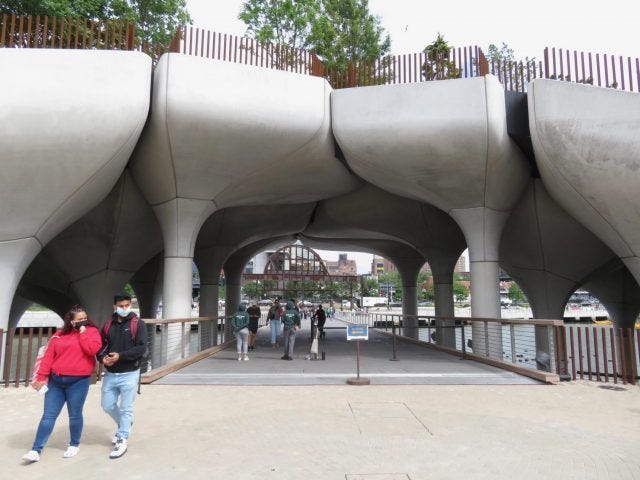
Concrete tulip pillars welcome visitors to Little Island, which just announced its summer performance season (photo by twi-ny/mdr)

LITTLE ISLAND SUMMER SHOWS
The Amph at Little Island
Pier 55, Hudson River Park at West Thirteenth St.
July 29 – September 6, $25 unless otherwise noted, 8:30
littleisland.org

In 2015, Barry Diller and Diane von Furstenberg cemented their local legacy by donating $113 million to Little Island, a lovely paradise built on the remnants of a ramshackle pier at West Thirteenth St.

Little Island is a warm and welcoming oasis rising more than 60 feet above the Hudson River; it is shaped like a large leaf, bursting with more than 350 species of flowers, trees, and shrubs, a 687-seat amphitheater for live performances known as the Amph, the Play Ground plaza where you can get food and drink, and stage and lawn space called the Glade. More than 66,000 bulbs and 114 trees were initially planted, taking into account the changing seasons and even the differences in light between morning, afternoon, and night. It all sits upon 132 concrete pillars of varying heights that resemble high heels or slightly warped tulip Champagne glasses.

Lovers of the live arts have been waiting impatiently for the announcement of Little Island’s summer schedule, and at last it is here. There are only seven presentations, so it’s not nearly as expansive as previous years, but you better act quickly, because tickets are only $25 (and free for the Summer Legacy Ball). Below is the full schedule.

Wednesday, July 29
Thursday, July 30
Friday, July 31

Justin Vivian Bond: Summer’s Eve, with Justin Vivian Bond, Bernice “Boom Boom” Brooks on drums, Nath Ann Carrera on guitar, Claudia Chopek on violin, Mike Jackson on bass, and Matt Ray on piano

Saturday, August 1
Summer Legacy Ball, hosted by Qween Jean, with honorees Miss Major Griffin-Gracy, Boom Boom Balenciaga, Kiara St. James, and Brenda Continental Milan Soulja, preachers Samora Pinderhughes and Dr. Jehbreal Jackson, MCs Julz Romell and Thunda, performer Haus of Telfar, panelists Luna Luis, Tracey Africa Norman, and Mother Pandora West, ball DJ Blaize, and afterparty DJ DANIRO, free

Wednesday, August 5
through
Sunday, August 9

Anthony Roth Costanzo: Minimalism, with countertenor Anthony Roth Costanzo and different formations of Sandbox Percussion, Bryan Wagorn or Vicky Chow on piano, PUBLIQuartet, and mezzo-soprano Rachael Wilson

Wednesday, August 12
through
Sunday, August 16

Cécile McLorin Salvant: Tin Pan Alley, with different lineups including vocalists Lillias White, Cécile McLorin Salvant, and Mikaela Bennett, Billy Stritch on piano, Kyle Poole or Buddy Williams on drums, George Coleman on sax, Sullivan Fortner on piano, and Paul Sikivie on bass

Wednesday, August 19
through
Sunday, August 23

Louis Cato: The Harlem Renaissance, with bandleader Louis Cato on guitar, vocalist Catherine Russell, Louis Fouché on alto sax, Alphonso Horne on trumpet, Philip Kuehn on bass, Jeffrey Miller on trombone, Tivon Pennicott on tenor sax, Mathis Picard on piano, and Evan Sherman on drums, featuring recorded interviews with Ron Carter, Catherine Russell, and others
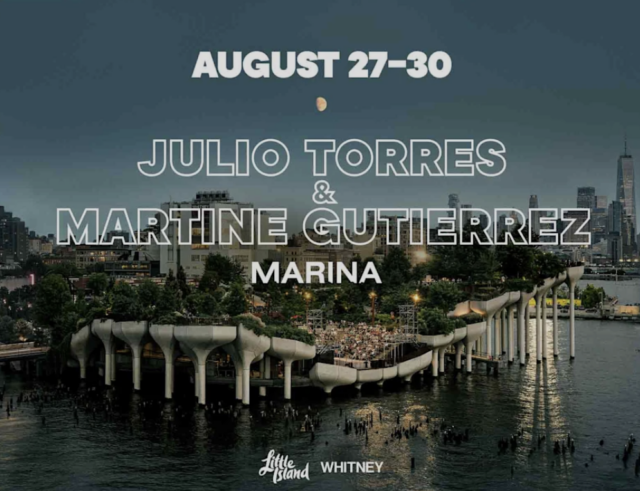
Saturday, August 29
and
Sunday, August 30

Julio Torres & Martine Gutierrez: Marina, conceived by Julio Torres & Martine Gutierrez, written and directed by Julio Torres, composed by Lia Ouyand Rusli, choreographed by Ryan McNamara, and starring Martine Gutierrez, River L. Ramirez, Spike Einbinder, Brandon Flynn, Scully James, and more, commissioned for the Whitney Biennial

Wednesday, September 2
through
Sunday, September 6

Thomas Bartlett: Allen Ginsberg at 100, with various configurations including curator Thomas Bartlett on piano, consultant Laurie Anderson, poet Anne Waldman, Oren Bloedow on guitar, Jason Burger on drums, vocalists Jennifer Charles and Davóne Tines, Spencer Murphy on bass, and Douglas Wieselman on sax, featuring special guests Rufus Wainwright on September 2, Bill Frisell on September 3, and others to be announced

[Mark Rifkin is a Brooklyn-born, Manhattan-based writer; you can follow him on Substack here.]
BEWARE OF THE DISGUISE: HEARTBEAT OPERA’S VANESSA

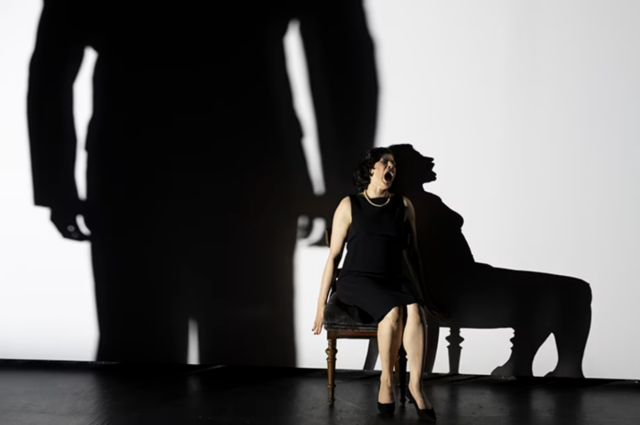
Heartbeat Opera’s Vanessa continues at Baruch Performing Arts Center through May 31 (photo by Russ Rowland)

VANESSA
Baruch Performing Arts Center
55 Lexington Ave. at 25th St.
Through May 31, $53 – $133
www.baruch.cuny.edu/bpac
www.heartbeatopera.org/vanessa

Heartbeat Opera’s Vanessa is a treat for opera lovers as well as opera newbies.

Adapted by company artistic director and conductor Jacob Ashworth with arrangements by music director Dan Schlosberg, the 1958 Pulitzer Prize winner by composer Samuel Barber and librettist Gian Carlo Menotti has been distilled down into its essence, a chilling one-hundred-minute Gothic romance with flashes of Douglas Sirk melodrama, film noir, and German expressionism. Sung in English, it is a taut tale of love both requited and unrequited, with a stark loneliness boiling at its center.

Vanessa (soprano Inna Dukach) has been pining away in her country mansion for twenty years, believing that her lost love will return to her. She lives with her niece, Erika (mezzo-soprano Kelsey Lauritano), who has sacrificed her youth to tend to her aunt, as well as her mother, the aging Baroness (mezzo-soprano Mary Phillips).

“Oh, I shall die if anything happens to him! / My heart, my heart, I can wait no longer,” Vanessa opines. Erika offers to calm her down by reading to her, choosing a rather relevant section from Sophocles’s Oedipus Rex, in which the protagonist declares, “Woe, woe is me, / Sorrowful, sorrowful that I am! / Where am I? Where am I going? / Where am I cast away?”

When someone approaches on a dark, stormy night, Vanessa is sure that it must be Anatol coming back to her, but it is actually his son, also named Anatol (tenor Freddie Ballentine), who shows affection for both Vanessa and Erika as the Baroness watches closely, suspicious of his intentions. Anatol explains, “All through my youth / I heard that name, ‘Vanessa.’ / Like a burning flame / it used to scorch my mother’s lips / and light my father’s eyes with longing. / Now that I am alone / I have been driven here / to meet at last the woman / who haunted so my house: Vanessa.”

When the Doctor (baritone Joshua Jeremiah) calls on Vanessa, he is at first overjoyed that she seems happy. “Ah, how good it is to see this house alive again!” the Doctor, who has loved Vanessa from afar, proclaims, but he is dumbfounded by the sudden appearance of Anatol and consumed by a jealousy that he does not know how to express. Meanwhile, both Vanessa and Erika have fallen for Anatol, but only the latter can face the reality of the situation. “It is a long winter here. Must the winter come so soon?” she wonders.

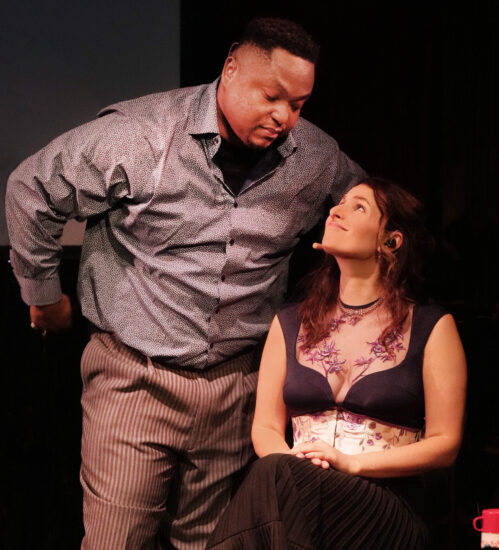
Vanessa (Inna Dukach) believes she has finally found love with Anatol (Freddie Ballentine) in Samuel Barber and Gian Carlo Menotti’s Pulitzer Prize winner (photo by Russ Rowland)

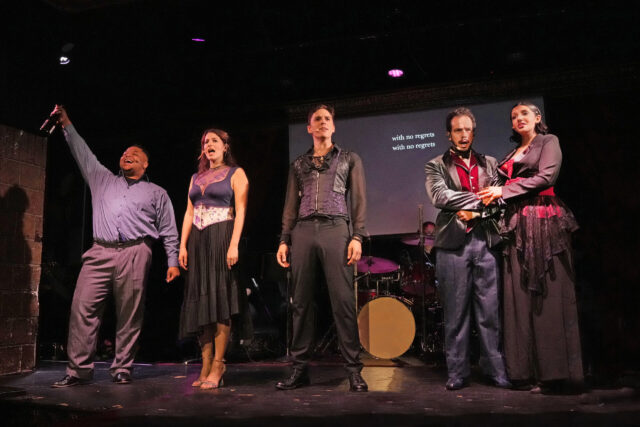
Vanessa unfolds on a spare, narrow, horizontal stage backed by a large white, angled screen onto which menacing shadows are cast by the performers, who are all dressed in black. Monochrome as the costumes are, the production’s one nod to excess, other than the emotional pitch, are the fabulous, diva-worthy retro ensembles. (The set is by Jiaying Zhang, with costumes by Terese Wadden and lighting by Yuki Nakase Link.) On one side is the seven-piece band, consisting of Sunny Sheu on violin, Thapelo Masita on cello, Louis Arques on clarinet and saxophone, Grace O’Connell on trumpet, Sam George on trombone, Deanna Cirielli on harp, and Eliot Goldmund on piano, playing the often ominous score.

Directed by R. B. Schlather (In the Penal Colony, The Mother of Us All), the opera drags a bit as it reaches its conclusion but is otherwise poignant and exciting, with superb performances by the ensemble amid striking visuals; the only props are chairs that are occasionally brought on and off, allowing the focus to be on the intense narrative.

It’s a heart-wrenching story that soars at the intimate Baruch Performing Arts Center, best encapsulated by the words of the Baroness, who says to Erika, “My poor child, love never bears / the image that we dream of; / when it seems to, / beware of the disguise!”

[Mark Rifkin is a Brooklyn-born, Manhattan-based writer; you can follow him on Substack here.]
RAW AND NASTY OPERA: HEARTBEAT’S MANON!

MANON!
The Space at Irondale
85 South Oxford St. between Fulton St. & Lafayette Ave., Brooklyn
January 27 – February 15, $28.32-$116.75
www.heartbeatopera.org

“What will be surprising and exciting about this is how raw and some might even say nasty opera can be,” Natalie Walker says in a promotional video for Heartbeat Opera’s Manon!, running January 27 through February 15 at the Space at Irondale. The indie opera company is presenting a unique take on Jules Massenet’s 1884 opéra comique, based on the 1731 novel L’histoire du chevalier des Grieux et de Manon Lescaut by the Abbé Prévost. Set during the reign of King Louis XV, the narrative tells the story of a convent-bound woman who is caught between two men, the Chevalier Des Grieux and finance minister Guillot. Henri Meilhac and Philippe Gille’s original libretto has been adapted with a new book and English lyrics by Jacob Ashworth and Rory Pelsue, with Golden Age–style musical arrangements by conductor Dan Schlosberg; the show is directed by Obie winner Pelsue (The Last Bimbo of the Apocalypse, Circle Jerk) and choreographed by Sara Gettelfinger.

The cast features Emma Grimsley as Manon, Matt Dengler as the Chevalier, Glenn Seven Allen as Guillot, Jamari Darling as Lescaut, Justin Lee Miller as the Count Des Grieux, Kathryn McCreary as Pousette, and Walker as Javotte; the set is by Alexander Woodward, with costumes by David Mitsch, lighting by Yichen Zhou, and sound by Ryan Gamblin. The eight-piece orchestra consists of Pablo O’Connell on oboe and English horn, Atao Liu on bassoon, Nicolee Kuester on horn, Deanna Cirielli on harp, Julia Danitz on violin, Thapelo Masita on cello, Eleonore Oppenheim on bass, and Schlosberg on keyboards. There are still some pay-what-you-want preview tickets available starting at $10, but you need to act fast to grab them.

“No one’s ever done anything like this,” Dengler promises in the video.

[Mark Rifkin is a Brooklyn-born, Manhattan-based writer and editor; you can follow him on Substack here.]
“I AM MUSIC”: ANTHONY ROTH COSTANZO CHANNELS MARIA CALLAS IN GALAS

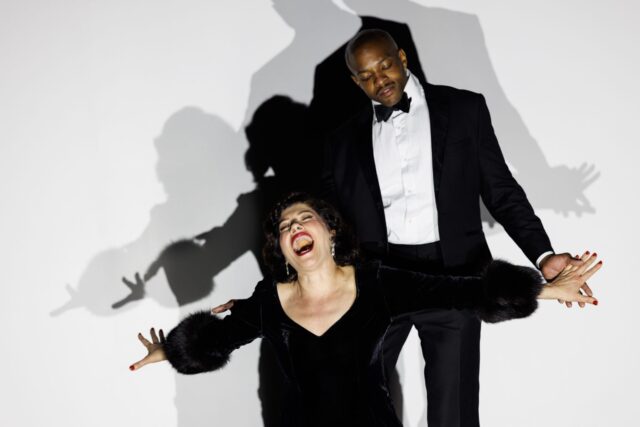
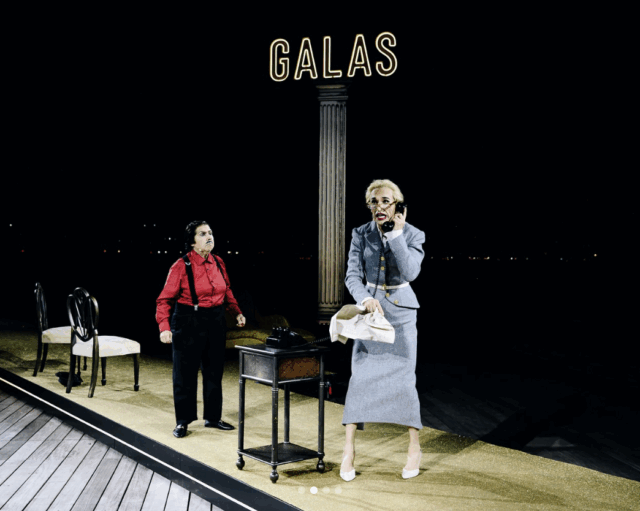
Anthony Roth Costanzo is sensational as a fictionalized version of Maria Callas in Galas at Little Island

GALAS: A MODERN TRAGEDY
The Amph at Little Island
Pier 55, Hudson River Park at West Thirteenth St.
September 6-28, $10 standing room, $25 seats, 8:30
littleisland.org

The first half of Eric Ting’s exciting version of Charles Ludlam’s rarely revived 1983 downtown hit, Galas: A Modern Tragedy, is everything you want it to be: hilariously campy, with fabulous singing, outrageous staging, and delicious costumes. The second half veers far off course until righting itself for a thrilling finale.

Ludlam, who founded the highly influential Ridiculous Theater Company in 1967, wrote, directed, and starred in the original, portraying the title character, Maria Magdalena Galas, an opera diva based on American-born Greek soprano Maria Callas. Today, the use of the word “tragedy” in the subtitle is twofold: the revered Callas died in 1977 at the age of fifty-three, while the beloved Ludlam passed away in 1987 when he was just forty-four, of AIDS.

Despite the inspired lunacy of the acting and plot, Galas is surprisingly faithful to Callas’s life and career. The show begins at the Verona train station, where successful brick industrialist Giovanni Baptista Mercanteggini (Carmelita Tropicana) is waiting to pick up Galas (Anthony Roth Costanzo), who is scheduled to perform the lead role in Amilcare Ponchielli’s La Gioconda at the Arena di Verona. They meet at a café, where they have a delightful and meaningful exchange.

Galas: You are an opera lover?
Mercanteggini: Yes, I’m a real aficionado. Now there’s something we have in common, eh?
Galas: What’s that?
Mercanteggini: We are both music lovers.
Galas: I am not a music lover. I am a musician.
Mercanteggini: But surely you love music.
Galas: I am a musician. And because I am a singer I am a musical instrument. A music lover, no. I am music.
Mercanteggini: But you don’t love it? Not even a little bit?
Galas: I wouldn’t dare. Art is so great it frightens me sometimes.

Carmelita Tropicana and Anthony Roth Costanzo make a fine comic duo in Galas

Mercanteggini offers her a deal: He will serve as her manager and benefactor for one year; she agrees, moving into his home, where she encounters his brusque housekeeper, Bruna Lina Rasta (Mary Testa), a former soprano based on Lina Bruna Rasa, who had a meltdown onstage and, because of mental illness, stopped singing.

Soon Galas and Mercanteggini are married, and she experiences success on tour but it’s not enough; she desperately wants to become a company member of La Scala. Fritalini (Samora la Perdida) and Ghingheri (Austin Durant) of La Scala offer her a onetime slot as a guest-artist replacement for the ill Baldini to sing La Gioconda, which she reluctantly does after some fabulous prima donna fits of pique. Later, after a tough negotiation, Galas does become a company member, agreeing to appear in I Vespri Siciliani, Norma, and Don Carlo on the condition that she sing La Traviata as well, an occasion for even more entertaining diva displays.

While the feverish Italian press offers ever-more outré explanations for her significant weight loss, which made her a svelte femme fatale, Galas has a contentious audience with Pope Sixtus VII (la Perdida), with whom she argues about the value of Wagner’s operas, and later has to cut short her performance of Norma at La Scala because she has lost control of her voice.

Giving up singing, she heads out with Mercanteggini and Bruna on a yacht owned by wealthy womanizer Aristotle Plato Socrates Odysseus (Caleb Eberhardt), who is traveling with his wife, Athina (Erin Markey); his former mistress, Hüre von Hoyden (Patricia Black); and gossip columnist Ilka Winterhalter (la Perdida); and takes an instant liking to Galas, not hiding his desire. (After ten years of marriage, Callas left Mercanteggini for Aristotle Onassis.) A final conversation between Galas and Bruna reveals a desperate Maria trying to hold on to something, anything.

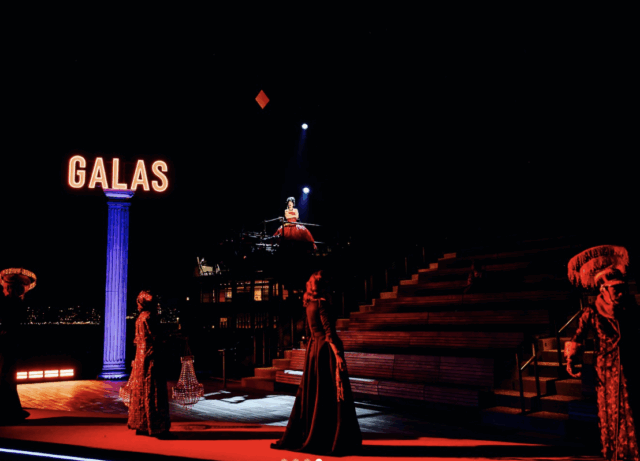
Tony and Obie winner Mimi Lien’s set features a long, movable catwalk, some furniture, and a tall Greek column with the word Galas at the top in neon lights that change color. Jackson Wiederhoeft’s costumes for Galas are spectacular, from an elegant red gown to a tight-fitting business dress. The other costumes, by Hahnji Jang, are fun and frolicsome, especially the getups for the pope. Jiyoun Chang’s lighting and Tei Blow’s sound work well in the outdoor setting. Raja Feather Kelly’s choreography is way too over the top during the yacht scene.

Rare revival of Charles Ludlam’s Galas continues through September 28

Countertenor Costanzo, who has appeared in lead roles for the Metropolitan Opera, the English National Opera, the Teatro Real Madrid, and other international companies and is the general director and president of the innovative Opera Philadelphia, has become Little Island’s breakout star; last year he performed all the live singing parts in an almost-solo version of Mozart’s The Marriage of Figaro, and he is outstanding here as Galas, wearing fanciful outfits, dishing dirt, and luxuriating in the high life but understanding that it could all go away in the blink of an eye. The role was originally played by Ludlam, then by the late Ludlam’s longtime partner, Everett Quinton, in the first-ever revival in 2019. (Quinton designed the costumes and played Bruna in the 1983 staging.)

Obie winner Testa (On the Town, Oklahoma!) serves as the anchor for the show, balancing pathos with physical comedy and her lovely singing voice. Tropicana (With What Ass Does the Cockroach Sit?/Con Que Culo Se Sienta la Cucaracha, Memorias de la Revolucion) is a hoot as the short and stout Mercanteggini, and la Perdida sparkles as the nonbinary pontiff.

Obie-winning director Ting (The Comeuppance, Between Two Knees), who helmed Alina Troyano and Branden Jacobs-Jenkins’s Give Me Carmelita Tropicana!, guides numerous delightful moments in the first half, particularly with his interpretation of a train arriving at a station and his later use of chandeliers, but the yacht scenes drag on, feeling like a Fellini movie that was never released. And the way the characters say “La Scala” with their tongues sticking out is humorous at first but eventually dries up.

Galas is at its best when Costanzo is singing, whether an aria from Carmen, “Casta Diva” from Norma, or additional selections he made. But even with its troubled center section, it’s a triumphant tribute to a downtown theater legend, an eternal opera diva, and the cost of living for art.

[Mark Rifkin is a Brooklyn-born, Manhattan-based writer and editor; you can follow him on Substack here.]

HARLEM PRESENTS: OPERA EBONY IN MARCUS GARVEY PARK

Who: Opera Ebony
What: The Harlem Opera Festival
Where: Richard Rodgers Amphitheater, Marcus Garvey Park, Fifth Ave. at 124th St.
When: Saturday, July 26, free (advance RSVP recommended), 7:00
Why: Now in its fifty-first season, the nonprofit Opera Ebony is the longest continually operated Black opera company in the world. Founded in 1973 by bass baritone Benjamin Matthews with mezzo-soprano Sis. Elise Sisson (SBS), music director Wayne Sanders, and conductor Margaret Harris, the troupe has staged works around the globe, from Carmen, Aida, and La Traviata to Porgy & Bess, Faust, and Cosi Fan Tutte in addition to such original pieces as Frederick Douglass, Sojourner Truth, The Meetin’, and O’Freedom.

As part of Harlem Presents, Opera Ebony is holding a pair of concerts prior to the Classical Theatre of Harlem’s production of Will Power and Carl Cofield’s Memnon at the Richard Rodgers Amphitheater in Marcus Garvey Park. The forty-five-minute concerts start at 7:00, the play at 8:30; arriving early to see the music has the added benefit of garnering you an excellent seat for Memnon, as the amphitheater fills up pretty quickly.

On July 19, baritone Shavon Lloyd sang “Silvio’s Aria” from Pagliacci, the spiritual “Ride on King Jesus,” H. Leslie Adams’s “Prayer,” and “Make Them Hear You” from Ragtime, while mezzo soprano Daveda Browne performed “Seguidilla” from Carmen, “Mon Coeur” from Samson and Delilah, “When I Am Laid” from Dido and Æneas, and the spiritual “Wade in the Water.” They were both accompanied by pianist Kyle P. Walker; the program for July 26 will feature soprano Linnesha Crump and tenor David Morgans performing pieces by Wagner, Bizet, Puccini, Cilea, and Gershwin and duetting on William Still’s “Calm as the Bayou Waters.” Be sure to check out the pop-up market with community outreach booths, fashion and beauty boutiques, and food and drink from Creole Soul, Lizzy’s Treats, Kiki’s Cookies, Greensicle, Campbell & Carr, and Bee Favored. (The preshow music and market will be different on July 25 and July 27.) The concert and play are free; advance RSVP is recommended.

[Mark Rifkin is a Brooklyn-born, Manhattan-based writer and editor; you can follow him on Substack here.]
LEGACY, MEMORY, AND IMPERMANENCE: CELEBRATING MEREDITH MONK AT IFC

Meredith Monk looks at her past, present, and future in Billy Shebar’s celebratory and deeply affecting documentary

MONK IN PIECES: A CONCEPT ALBUM (Billy Shebar, 2025)
IFC Center
323 Sixth Ave. at West Third St.
July 24–31
www.ifccenter.com
monkinpieces.com

Near the beginning of Billy Shebar’s revelatory documentary, Monk in Pieces, composer Philip Glass explains that Meredith Monk “was a self-contained theater company. She, amongst all of us, I think, was the uniquely gifted one — is the uniquely gifted one.” It’s an important correction because Monk, at eighty-three, is still hard at work, creating live performances and films that defy categorization.

While several of her earliest projects were met with derision in critical circles, today she is revered for her remarkable output, although it is still impossible to put her into any kind of box. At one point in the documentary, a chorus of Monk scholars sings her praises; one says, “She’s achieved so much, has received so many accolades, and yet she’s this unknown,” a second notes, “She kind of falls through the cracks of music history,” and a third admits, “We don’t know how to talk about her.”

Written, directed, and produced by Shebar — whose wife, coproducer Katie Geissinger, has been performing with Monk since 1990 — and David Roberts, Monk in Pieces does a wonderful job of righting those wrongs, celebrating her artistic legacy while she shares private elements of her personal and professional life. Born and raised in Manhattan, Monk details her vision problem, known as strabismus, in which she is unable to see out of both eyes simultaneously in three dimensions, which led her to concentrate on vocals and the movement of her physical self. She studied Dalcroze Eurhythmics: “All musical ideas come from the body; I think that’s where I’m coming from,” she says. All these decades later, her distinctive choreography and wordless tunes are still like nothing anyone else does.

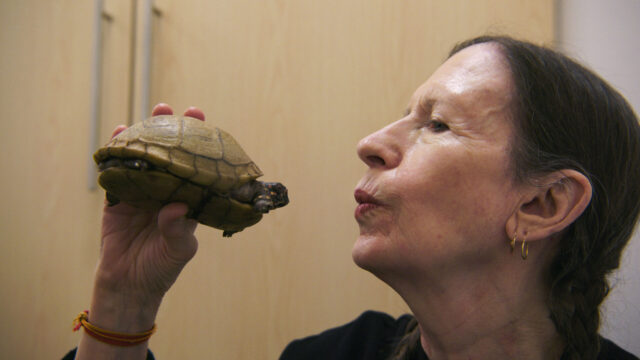
Meredith Monk shares a special moment with her beloved turtle, Neutron

Unfolding at a Monk-like unhurried pace, the ninety-five-minute documentary is divided into thematic chapters based on her songs, including “Dolmen Music,” “Double Fiesta,” “Memory Song,” “Turtle Dreams,” and “Teeth Song,” while exploring such presentations as Juice (1969), the first theatrical event to be held at the Guggenheim; Education of the Girlchild (1973), in which a woman ages in reverse; Quarry (1976), a three-part opera about an American child sick in bed during WWII; Impermanence (2006), inspired by the sudden death of her partner, Mieke von Hook; and her masterwork, Atlas (1991), in which the Houston Grand Opera worries about her numerous requests and production costs, whether the piece will be ready in time, and if it even can be considered opera. There are also clips from Ellis Island, Book of Days, Facing North, and Indra’s Net, her latest show, which was staged at Park Ave. Armory last fall. In addition, Monk reads from her journals in scenes with playful animation by Paul Barritt.

Monk opened up her archives for the filmmakers, so Shebar, Roberts, and editor Sabine Krayenbühl incorporate marvelous photos and video from throughout Monk’s career, along with old and new interviews. “It was her voice that was so extraordinary, not only the different kind of sounds she could make, but the imagination she was using in producing the sound . . . totally individual,” Merce Cunningham says. WNYC New Sounds host John Schaefer gushes, “I don’t know when words like multimedia and interdisciplinary began to become in vogue, but Meredith was all of those things.” Her longtime friend and collaborator Ping Chong offers, “She had to fight to be acknowledged in the performing arts world because critics were saying that what she was doing was nonsensical, was crazy, was not serious; in a way, it’s a fight to survive. Pain is where art comes from. . . . Art has to come out of need. And now she’s an old master.”

And Björk, who recorded Monk’s “Gotham Lullaby,” touts, “Meredith’s melody making is like a timeless door that’s opened, like a gateway to the ancient is found. It definitely affected my DNA. . . . Her loft that she has lived in for half a century is an oasis in a toxic environment.” Among the other collaborators who chime in are longtime company member Lanny Harrison; composer Julia Wolfe; and David Byrne, for whom she created the opening scene of his 1986 film, True Stories, and who says he learned from Monk that “you can do things without words and it still has meaning, it still has an emotional connection.”

Some of the most beautiful moments of the film transpire in Monk’s loft, where she tends to her beloved forty-two-year-old turtle named Neutron, puts stuffed animals on her bed, meditates while staring at windows lined with Tibetan prayer flags, composes a new song, looks into a mirror as she braids her trademark pigtails, and sits at her small kitchen table, eating by herself. Surrounded by plants and personal photographs, she moves about slowly, profoundly alone, comfortable in who she is and what she has accomplished, contemplating what comes next.

“What happens when I’m not here anymore?” Monk, who received the 2014 National Medal of Arts from President Barack Obama, asks while working with director Yuval Sharon, conductor Francisco J. Núñez, and performer Joanna Lynn Jacobs on a remounting of Atlas for the LA Philharmonic in 2019. “It’s very rare that anybody gets it.”

Monk in Pieces goes a long way toward rectifying that, filling in the cracks, helping define her place in music history.

Monk in Pieces runs July 24-31 at IFC Center; there will be Q&As following the 6:45 screenings on July 24 with Monk, Shebar, and producer Susan Margolin, moderated by Schaefer; on July 25 with Monk, Shebar, and Margolin, moderated by violist Nadia Sirota; and on July 26 with Shebar.

[Mark Rifkin is a Brooklyn-born, Manhattan-based writer and editor; you can follow him on Substack here.]
WHAT IS THIS? MOZART’S DON GIOVANNI — A ROCK OPERA AT THE CUTTING ROOM

Mozart’s Don Giovanni — A Rock Opera offers a new take on a classic (photo by Ken Howard)

MOZART’S DON GIOVANNI — A ROCK OPERA
The Cutting Room
44 East 32nd St. between Madison & Fifth Aves.
Through July 7, $39-$125, $25 food & beverage minimum per person, 7:00
212-691-1900
thecuttingroomnyc.com
www.dgrocks.com

Rachel Zatcoff is superb as Donna Elvira in Adam B. Levowitz’s rock opera adaptation of Mozart’s Don Giovanni at the Cutting Room; if only the rest of the production lived up to her excellence. Mozart’s 1787 tale, with a libretto by Lorenzo DaPonte, is returning to the Met this fall, a two-hundred-minute extravaganza directed by Ivo van Hove and conducted by Yannick Nézet-Séguin and Daniele Rustioni; producer, director, and orchestrator Levowitz’s English-language version has been streamlined to about two hours, primarily by eliminating the subplot involving Zerlina and Mesetto.

The crux of the central story is still intact. After bedding Donna Anna (Anchal Dhir), the dashing Don Giovanni (Ryan Silverman) is challenged to a duel by her father, the Commander (Edwin Jhamaal Davis). Giovanni implores the older man to walk away, but his pride gets the best of him, and Giovanni kills him. Anna then insists that her fiancé, the weak-kneed Don Ottavio (Felipe Bombonato), defend her honor and kill Giovanni, which is not really in his wheelhouse.

Meanwhile, a former lover of Giovanni’s, Elvira, has been searching for “the bastard who left me,” prepared to “take a bow knife and slice his heart from his chest . . . for the maidens he deflowered.” Giovanni and his right-hand man, the clownish Leporello (Richard Coleman), keeper of The Almanac of Fornication, come upon a woman they do not recognize at first, and Giovanni turns to woo her until he sees that it is indeed Elvira, who tells him she wants to castrate him. He runs away.

Levowitz’s plot grows more and more silly as Anna and Ottavio seek revenge, Giovanni keeps trying to increase the number of women he has seduced, Elvira has to decide whether she actually loves or hates Giovanni, and Leporello serves Giovanni through thick and thin, providing comic relief that is mostly thin.

Leporello (Richard Coleman) and Donna Elvira (Rachel Zatcoff) know something is afoot in rock opera (photo by Ken Howard)

Mozart’s Don Giovanni — A Rock Opera is misguided from the start. The conceit is that we are gathered at the Cutting Room at the invitation of Baroness Margarete Voigt on December 5, 1891, the centennial of Mozart’s death at the age of thirty-five. We are told in a letter that we are in for “an evening of elegance, fine food and drink (for a modest indulgence), sensuality, and sublime music,” which sets the bar far too high for what ensues.

For two hours, Leporello makes anachronistic, self-referential jokes that fall flat, like “I won’t block your Dopamine / No, no, no, no, no, no / Cue Giovanni and scene” and “Not my circus, not my monkeys / I’m just here for vegan snacks.” The eight-piece band, consisting of two guitars, two trumpets, three trombones, bass, drums, and piano, often feels out of sync; songs work best when it’s just pianist and conductor Nevada Lozano accompanying the singer. There were significant problems with the surtitles projected onto the back screen, as they got stuck or just vanished; in addition, there were numerous typos (rogue/rouge, savoir/savior), and what was being sung was not always exactly what was on the screen. While the sentences still meant the same thing, the slight differences were distracting. Projections that were supposed to identify locations got lost on the carved facade above the stage. The acting was a mixed bag, ranging from excellent to, well, not so excellent. There were also issues with the microphones, which were so close to the performers’ mouths that the sound squealed through the speakers; only the classically trained soprano Zatcoff (The Phantom of the Opera, Candide) kept her mic at a distance, letting her lovely voice sound more naturally through the space. Debbi Hobson’s costumes make it look like the characters are not always in the same time period.

I’m all for reimagining the classics in any way possible, but this Don Giovanni had me aching for something more traditional.

Early on, Anna asks, “My God, What Is This?” After seeing the show, I have the same question.

[Mark Rifkin is a Brooklyn-born, Manhattan-based writer and editor; you can follow him on Substack here.]