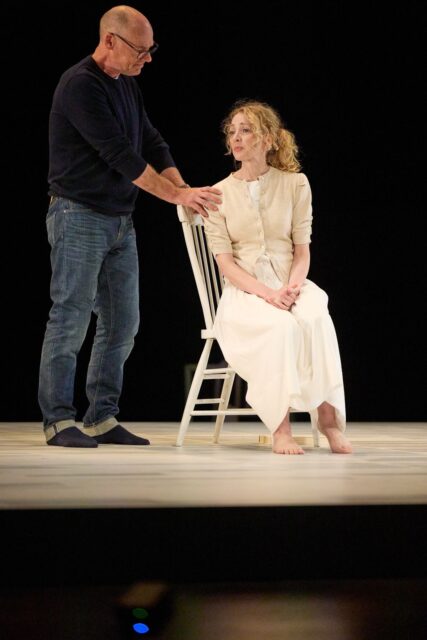
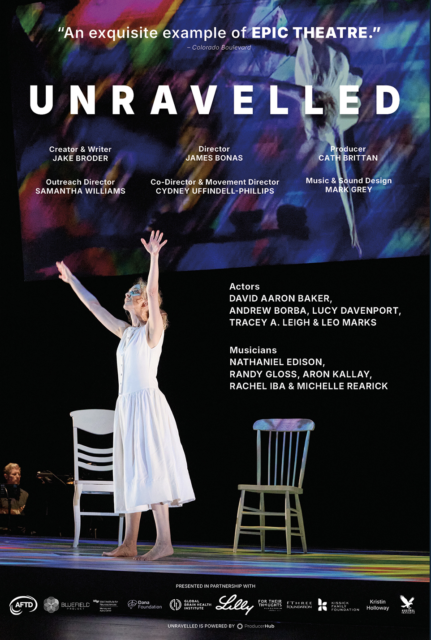
One of the most fascinating plays that I saw during the Zoom era came from an unlikely source: the Global Brain Health Institute (GBHI) at the University of California, San Francisco (UCSF). Jake Broder’s UnRavelled is a deeply affecting ninety-minute play that shares the true story of Canadian scientist Anne Adams, who, in 1994, at the age of fifty-three, became obsessed with Maurice Ravel’s “Bolero” and made a remarkable painting based on the 1928 musical work, which Ravel composed for dancer Ida Rubenstein in 1928, when he was fifty-three. As it turns out, both Adams and Ravel had the same serious brain disease, Frontotemporal Dementia (FTD), which affects memory while lighting a creative fuse.
The play has now been adapted into an in-person production that is on the road, arriving at the Miller Theatre at Columbia University On October 23 and 24.
“I always imagined UnRavelled onstage, but with the pandemic, we had to pivot and present it virtually. After the first Zoom reading, the audience really came out of the woodwork to tell us their stories, and we realized how powerful this piece could be,” Broder, whose other plays include Our American Hamlet and Sense of Decency, told twi-ny. “I truly had no idea when I first made it if UnRavelled was good or effective, but once we put it in front of people, we realized we had to keep presenting this story. The twi-ny Pandemic Award [for Best Scientific Play] helped drive traffic to that version, which allowed us to present it on the West Coast and get articles and reviews about the project in Ireland and England. This helped us realize UnRavelled’s extensive reach. Quite simply, the story is only relevant to two kinds of people: those with a brain or those who love someone who has one. Having a brain is a great human unifier.”
Directed by James Bonas, the ninety-five-minute UnRavelled stars Lucy Davenport as Anne, a mathematician, chemist, and biologist, and Andrew Borba as her husband, Robert, a traffic architectural engineer. They are trying to hold together following a serious accident involving their son, but when they continue to have trouble communicating and Anne starts spending more time by herself in her studio, listening to “Bolero” and painting, Robert begins to suspect something else is going on, and Dr. Bruce Miller (David Aaron Baker) ultimately confirms that.
Anne is not necessarily alone; she is having imaginary conversations with Ravel (Leo Marks) about art, love, and science. Ravel also speaks with Rubenstein (Tracey A. Leigh), who has commissioned “Bolero,” which Ravel detests and can’t believe he actually wrote. Davenport and Marks reprise their roles from the online version. Keyboardist Aron Kallay serves as music director, with Randy Gloss on percussion, Rachel Iba on violin, Michelle Elliott Rearick on cello, and Nathaniel Edison on flute, clarinet, bass clarinet, oboe, and dizi.
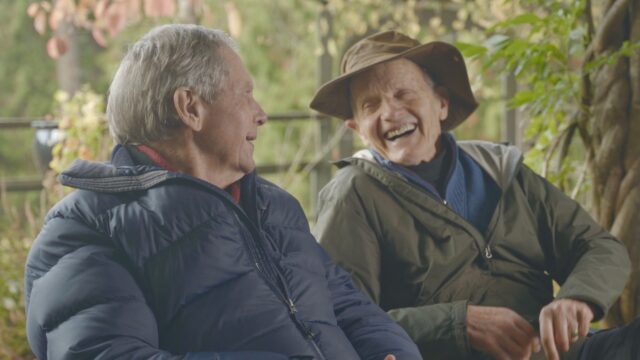
The real Dr. Miller is the founding director of GBHI and the director of the Edward and Pearl Fein Memory and Aging Center at UCSF; you can watch the online Zoom presentation of UnRavelledhere, followed by a panel discussion with Broder, Dr. Miller, behavioral neurologists Bill Seeley and Adit Friedberg, and virtual director Nike Doukas, as well as a related dance choreographed by Magda Kaczmarska.
Of course, first check it out at the Miller Theatre, in person, how it was always meant to be seen.
[Mark Rifkin is a Brooklyn-born, Manhattan-based writer; you can follow him on Substack here.]
ZIV KOREN’S OCTOBER 7 WAR
Temple Emanu-El Streicker Center
1 East Sixty-Fifth St. at Fifth Ave.
Wednesday, October 7, free with advance RSVP, 4:00-8:00
Exhibition continues through November 4 streicker.nyc zivkoren.com
On October 7, 2023, Israeli photojournalist Ziv Koren headed to the south of the country immediately after hearing about Hamas’s attack during the festive Jewish holiday of Simchat Torah. The photos he took captured the horrific brutality of the day and the war that followed.
On the third anniversary of that terrible day, the Temple Emanu-El Streicker Center is opening the exhibition “Ziv Koren’s October 7 War,” displaying photos from Koren’s 2024 book, The October 7 War (Gefen, $70), which he published “to pay respect to some of those thousands of fateful moments that went undocumented and to the heroes of those moments.”
At 6:30, a yahrzeit candle will be lit and kaddish will be said for the victims. The exhibition, another example of the Jewish legacy of bearing witness, continues through November 4. In addition, an auction is being held for one of Koren’s original framed photographs, with the proceeds benefiting the Hostages and Missing Families Forum.
[Mark Rifkin is a Brooklyn-born, Manhattan-based writer; you can follow him on Substack here.]
Partners Annie Sprinkle and Beth Stephens explore the many aspects of fire in latest documentary
PLAYING WITH FIRE: AN ECOSEXUAL EMERGENCY (Annie Sprinkle & Beth Stephens, 2025)
Anthology Film Archives
32 Second Ave. at Second St.
Saturday, October 10, 7:30
Sunday, October 11, 4:00 anthologyfilmarchives.org sprinklestephens.ucsc.edu
There’s an important warning at the start of Annie Sprinkle and Beth Stephens’s Playing with Fire: An Ecosexual Emergency: “This film contains environmental destruction, explicit ecosexuality, and performance art.”
It sure does.
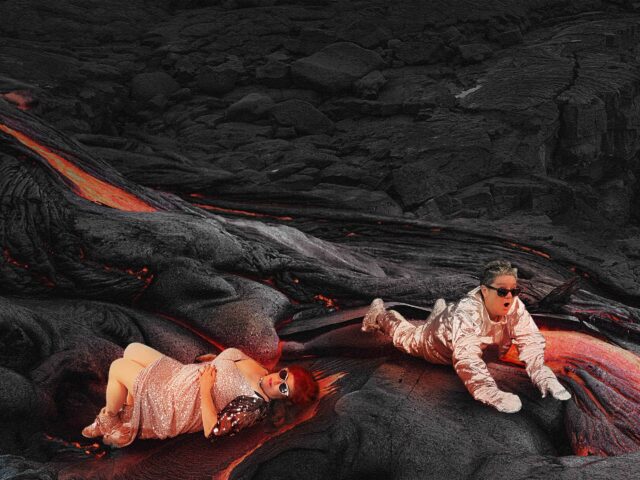
In the film, longtime life and professional partners Sprinkle, a former sex worker turned feminist performance artist and sex educator, and Stephens, an artist, filmmaker, and art professor at the University of California, Santa Cruz, explore both the beneficial and detrimental aspects of fire. The topic became forefront in their minds after they survived the devastating CZU Lightning Complex Fire of 2020; not everyone in their tight-knit community of Boulder Creek, California, was so fortunate.
In such chapters as “The Inferno,” “The Return,” and “Some Like It Hot,” they meet with a wide range of people who work with fire, from ceramicists Laurie and Dan Hennig, musicians Kate Freeman and Hillary Kay, and permaculturalist Aaron Allen to Forestry & Fire Recruitment Program cofounder Brandon Smith, artistic directors and curators Melonie and Melorra Green, and burlesque queen Lady Monster. Fire is seen as a necessary part of the Earth as it is used in rituals, art, weddings, and healing.
Therapist and witch Deborah Oak shares her “10 Top Tips for Staying Sane in Insane Times.” Indigenous sustainability professor Melissa Nelson explains, “Fire is a destroyer, it’s a great destroyer, but it’s a great regenerator.” Artists and game designers Antigoni Tsagkaropoulou and Huntrezz Janos display one of their projects as the latter says, “We want to showcase pleasure in a world of pain, and we want to help people dealing with catastrophe and survival.”
After her house is completely destroyed, Agz Rags owner Agnes De Lucchi says, “More than my own home, I worried about the trees.”
Sprinkle and Stephens, whose previous films include Water Makes Us Wet,Goodbye Gauley Mountain, and Playing in the Garden, also introduce us to their dog, Butch, and their remarkable white peacock, Albert, who became a symbol of Boulder Creek’s resilience. Their positive outlook on life is infectious, and more than a little woo-woo, as they delve into the connection between environmental fires and social fires through a trans rights march, playful animation (including animals talking and texting), discussions of consumption, and, ultimately, cremation.
“Not only do we believe that art can help our society evolve, we also believe in the power of love and pleasure,” Beth says, getting to the heart of ecosexuality.
Playing with Fire: An Ecosexual Emergency is screening October 10 at 7:30 and October 11 at 4:30 at Anthology Film Archives as part of the series “The Cinema of Gender Transgression”; Sprinkle and Stephens will perform the ten-minute “Ecosex 101” before each show. In addition, they will participate in a Q&A with Urban Tantra and The Book of Ecstasy author Barbara Carrellas on October 10 and A Body to Live In director Angelo Madsen on October 11; there will also be a reception and book signing on Sunday, celebrating the milestone birthdays of adult entertainment legends Veronica Vera and Veronica Hart, cofounders of the pornstar support group Club 90. Attendees are strongly encouraged to dress up in fire or ecosex costumes for both screenings.
[Mark Rifkin is a Brooklyn-born, Manhattan-based writer; you can follow him on Substack here.]
The remarkable journey of Bristol Foster, Robert Bateman, and the Grizzly Torque is fondly detailed in The Art of Adventure
THE ART OF ADVENTURE (Alison Reid, 2025)
New Plaza Cinema @Macaulay Honors College
35 West Sixty-Seventh St. between Central Park West & Columbus Ave.
Sunday, October 11, 4:45 theartofadventuremovie.com newplazacinema.org
“Life is an adventure. It’s mystical. It’s magical. I’d like to be twenty-five years old again, but I’m glad I had all those life experiences,” biologist and naturalist Bristol Foster says at the beginning of Alison Reid’s utterly fabulous documentary, The Art of Adventure. “In those days, it was just raw nature, raw and beautiful. I think of how much things have changed and how damn lucky we were to do it then.”
Artist and naturalist Robert Bateman adds, “I think I’m basically the same kid that I always was. I always wanted to do adventures and speak up, spread the word about nature. . . . It was like a dream trip in a way.”
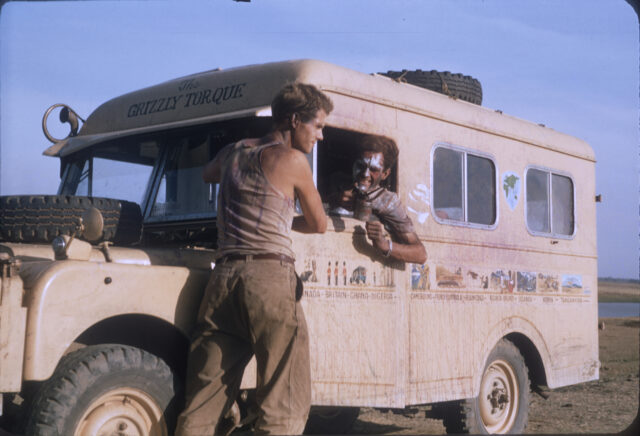
In 1957, Foster and Bateman, both Canadians in their twenties, began an eighteen-month journey covering more than fifty thousand miles, visiting nineteen countries across four continents in a brownish-yellow 1957 Series I Land Rover that they dubbed the Grizzly Torque. They drove it through mud and desert, had it transported (not so safely) by sea and air, and lived in it, sometimes surrounded by curious indigenous people and animals. They were originally in search of birds, but their discoveries quickly became far more anthropological and wide-ranging.
Fortunately for the world, they extensively detailed the trip, with copious photographs, movies, and a detailed journal, and Bateman added a small painting of each nation they visited to a mural around the Grizzly Torque. What they found on their route is remarkable; what is even more remarkable is that they survived, and now, in their nineties, best friends for eight decades, they’re sharing their story.
Reid’s previous feature documentary, The Woman Who Loves Giraffes, is about Canadian zoologist Anne Innis Dagg, who worked with Foster and is credited as a producer on The Art of Adventure; she died in 2024 at the age of ninety-one. In this follow-up, Reid and editor Dave Kazala interweave stunning footage of Bateman and Foster’s travels with new interviews of Bateman and Foster, members of their families, and such others as geographer and naturalist Briony Penn, writer and art curator Paul Gilbert, artist and naturalist Erik Thorn, anthropologist and writer Wade Davis, Haida leader and political activist Gidansda Guujaaw, environmental activists David Suzuki and Tara Cullis, and Land Rover collector Alan Simpson. Gilbert, the author of The Rover Boys, gets significant screen time; he was also one of Bateman’s high school art students and helped form the Bateman Foundation. Together they paint a loving picture of these two extraordinary men who have dedicated their lives to protecting and saving the environment, well before it was a cause célèbre or hot-button political issue.
“This is not a trip that you could do today. They saw the world at a time when it was transitioning from almost the Middle Ages to the modern world, and they saw it as it was,” Gilbert says. Bateman surmises, “In a tiny way, I guess people might view Bristol and I as adventurers in another era.”
Robert Bateman and Bristol Foster recount their old and new adventures in award-winning documentary
It’s also a poignant look at aging, as the film shifts between shots of the two rugged, handsome, well-built young men and their current selves, walking slowly, facing medical problems, but never giving up on their goals, both still doing whatever they can to help get us out of the mess we’ve created. Cinematographer Dale Hildebrand captures the two elderly men in gorgeous vistas of beautiful landscapes whose very existence is in jeopardy, but even then, hope conquers fear.
The last part of the film focuses on what became of the Grizzly Torque, which comes to represent everything to the men. “This Land Rover symbolizes nature, like a magic carpet to get into magical places,” Bateman says.
And, in its way, The Art of Adventure is like a cinematic carpet, taking us into magical places.
The Art of Adventure is screening October 11 at 4:45 at New Plaza Cinema, followed by a Q&A with Reid and Wild Tomorrow cofounder and COO and Columbia adjunct professor Wendy Hapgood.
[Mark Rifkin is a Brooklyn-born, Manhattan-based writer; you can follow him on Substack here.]
TRAINS: LOCAL ROUTES
Metrograph
7 Ludlow St. between Canal & Hester Sts.
October 3 – November 1 metrograph.com
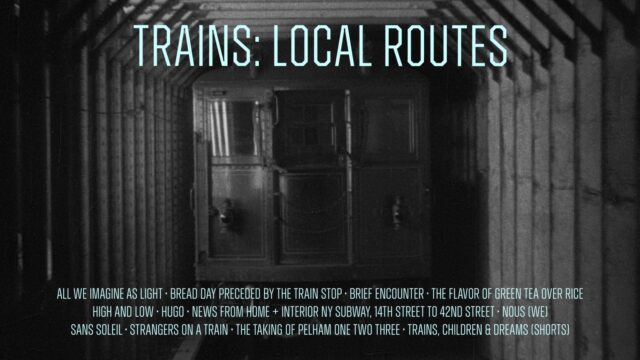
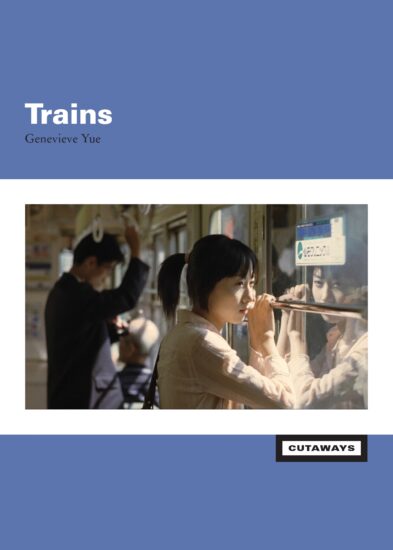
In her new book, Trains (Fordham University Press, October 6, $18.99-$70), New School associate professor Genevieve Yue writes about the connection between trains and cinema around the world in four chapters: “How It Feels to Be a Woman on a Train (Itinerary: London to Venice),” “Ends of the Line (Itinerary: Los Angeles to Rhinecliff),” “Phantom Rides (Itinerary: Shanghai to Hong Kong),” and “Strangers on Trains.” In conjunction with the publication of the book, Yue is guest-curating the two-part Metrograph series “Trains: Local Routes,” running October 3 through November 1. The seventeen films range from Louis Lumière’s 1896 L’Arrivée d’un train en gare de La Ciotat to Payal Kapadia’s 2024 All We Imagine as Light, including works by Chantal Akerman, Martin Scorsese, Sergei Dvortsevoy, Alfred Hitchcock, Chris Marker, and Bruce Conner.
“The humble journeys of the short-range rail rarely get their due. The subway ride, the suburban commute, and the municipal railways that encircle daily life: these are spaces we typically associate with boredom and routine, unlike the adventure of their long-distance cousins,” said in a statement. “The history of film, however, tells a different story. From the Lumière brothers’ train of early cinema, rolling into the station at La Ciotat — and, by some accounts, headed straight into the audience — to the wind that sweeps through the Mumbai local in Payal Kapadia’s All We Imagine as Light (2024), the short line has been a place where working people have crowded together and discovered, sometimes, romantic possibility, unnerving encounters, and opportunities for existential self-interrogation. For women especially, like the housewives in David Lean’s Brief Encounter (1945) and Yasujirō Ozu’s The Flavor of Green Tea over Rice (1952), the train offers a space of reflection and relative freedom, even as its berth is narrow, its passages fleeting.”
Below is a closer look at several of the films, not all of which have been scheduled yet. Each review is followed by a quote from Yue, who will attend several screenings for introductions and book signings.
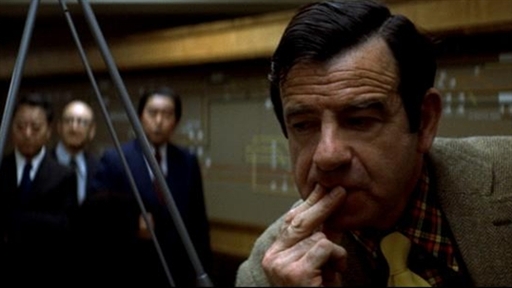
Walter Matthau tries to get to the bottom of a bizarre subway heist in The Taking of Pelham One Two Three
THE TAKING OF PELHAM ONE TWO THREE (Joseph Sargent, 1974)
Metrograph
Saturday, October 3, 2:30
Friay, October 9, 2:00 metrograph.com
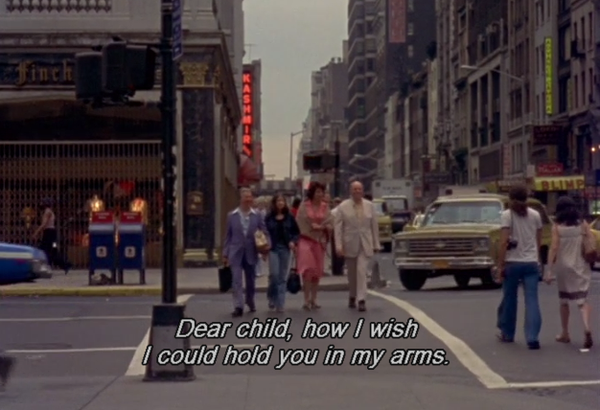
Loosely adapted from the book by John Godey, Joseph Sargent’s underground thriller, The Taking of Pelham One Two Three, wonderfully captures the cynicism of New York City in the 1970s. Four heavily armed and mustached men — Mr. Blue (Robert Shaw), Mr. Green (Martin Balsam), Mr. Gray (Hector Elizondo), and Mr. Brown (Earl Hindman), colorful pseudonyms that influenced Quentin Tarantino’s Reservoir Dogs — hijack an uptown 4 train, demanding one million dollars in one hour from a nearly bankrupt city or else they will kill all eighteen passengers, one at a time, minute by minute. The hapless mayor (Lee Wallace) is in bed with the flu, so Deputy Mayor Warren LaSalle (Tony Roberts) takes charge on the political end while transit detective Lt. Zachary Garber (a great Walter Matthau) and Inspector Daniels (Julius Harris) of the NYPD team up to try to figure out just how in the world the criminals expect to get away with the seemingly impossible heist.
Sargent (Sybil) offers a nostalgic look back at a bygone era, before technology radically changed the way trains are run and police work is handled. The film also features a very funny, laconic Jerry Stiller as Lt. Rico Patrone and the beloved Kenneth McMillan as the borough commander. It was remade as a television movie in 1998, starring Edward James Olmos, Vincent D’Onofrio, and Lorraine Bracco, and as an embarrassingly bad big-budget bomb in 2009 by Tony Scott.
Genevieve Yue, who will introduce the October 3 screening with film scholar Erika Balsom and will sign copies of her book after the film: “Featuring one of the grittiest New Yorkers ever seen on film: the ruddy-cheeked wino who, despite the commotion on her hijacked 6 train, sleeps through the entire ordeal.”
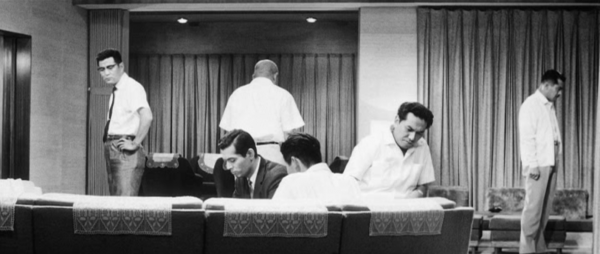
A group of men try to find kidnappers in Akira Kurosawa’s tense noir / police procedural
HIGH AND LOW (TENGOKU TO JIGOKU) (Akira Kurosawa, 1963)
Metrograph
Sunday, October 4, 1:15
Saturday, October 10, 10:20 metrograph.com
On the verge of being forced out of the company he has dedicated his life to, National Shoes executive Kingo Gondo’s (Toshirō Mifune) life is thrown into further disarray when kidnappers claim to have taken his son, Jun (Toshio Egi), and are demanding a huge ransom for his safe return. But when Gondo discovers that they have mistakenly grabbed Shinichi (Masahiko Shimazu), the son of his chauffeur, Aoki (Yutaka Sada), he at first refuses to pay. But at the insistence of his wife (Kyogo Kagawa), the begging of Aoki, and the advice of police inspector Taguchi (Kenjiro Ishiyama), he reconsiders his decision, setting in motion a riveting police procedural that is filled with tense emotion. Loosely based on Ed McBain’s 87th Precinct novel King’s Ransom, Akira Kurosawa’s High and Low, photographed by longtime Kurosawa cinematographer Asakazu Nakai, is divided into two primary sections: The first half takes place in Gondo’s luxury home, orchestrated like a stage play as the characters are developed and the plan takes hold. The second part of the film follows the police, under the leadership of Chief Detective Tokura (Tatsuya Nakadai), as they hit the streets of the seedier side of Yokohama in search of the kidnappers.
Known in Japan as Tengoku to Jigoku, which translates as Heaven and Hell, High and Low is an expert noir, a subtle masterpiece that tackles numerous socioeconomic and cultural issues as Gondo weighs the fate of his business against the fate of a small child; it all manages to feel as fresh and relevant today as it probably did back in the ’60s. Spike Lee remade the film as Highest 2 Lowest in 2025 but failed to capture the intricacies of the story and characters.
Genevieve Yue: “High and Low has one of the most iconic train scenes of all time. And though it’s only one of many segments, the entire, wildly careening film has the feeling of a train in the slow-motion throes of derailment.”
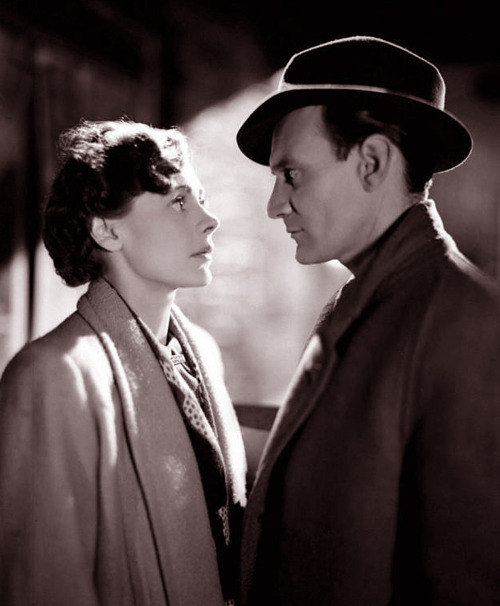
Laura Jesson (Celia Johnson) and Alec Harvey (Trevor Howard) explore an extramarital affair in Brief Encounter
BRIEF ENCOUNTER (David Lean, 1945)
Metrograph
Saturday, October 10, noon
Friday, October 23, 1:50 metrograph.com
“Don’t hurry. I’m perfectly happy,” Laura Jesson (Celia Johnson) tells her rather boring husband, Fred (Cyril Raymond), as he returns to his crossword puzzle one night. “How can I possibly say that?” she then thinks to herself. “‘Don’t hurry. I’m perfectly happy.’ If only it were true. Not, I suppose, that anybody’s ever perfectly happy, really. But just to be ordinarily contented, to be at peace. It’s such a little while ago really but it seems an eternity since that train went out of the station, taking him away into the darkness. I was happy then.” In David Lean’s Brief Encounter, one of the greatest romantic films ever made, Laura, a housewife and mother, can’t stop herself from falling for dapper doctor Alec Harvey (Trevor Howard), who is also married. As they explore a potential physical relationship, Laura is wracked with guilt, especially as she keeps bumping into nosy gossip Myrtle Bagot (Joyce Carey). But the two potential lovers are so drawn to each other, filling the holes in each other’s lives, that they consider risking all they have for just one more moment together.
Winner of the 1946 Palme d’Or at Cannes, Brief Encounter is told in flashback in Laura’s voice as she goes over every wonderful and terrifying detail in her mind while contemplating whether to spill the beans to the generally oblivious Fred. Written by Noël Coward based on his 1936 one-act play, Still Life, the film features terrifically subtle performances by Johnson and Howard as the daring couple; you can’t help but root for them, despite the possible consequences. Lean, who earned the first of his seven Best Director Oscar nominations for the heartbreaking film, keeps things relatively, well, lean, getting right to the point in less than ninety minutes; he would go on to helm such sprawling epics as The Bridge on the River Kwai, Lawrence of Arabia, Doctor Zhivago, and A Passage to India before his death in 1991 at the age of eighty-three.
Genevieve Yue: “The trains are mercilessly exact in Brief Encounter — there’s only three minutes between the departures of the trains that take Laura and Alec away from each other, and they’re never late.”
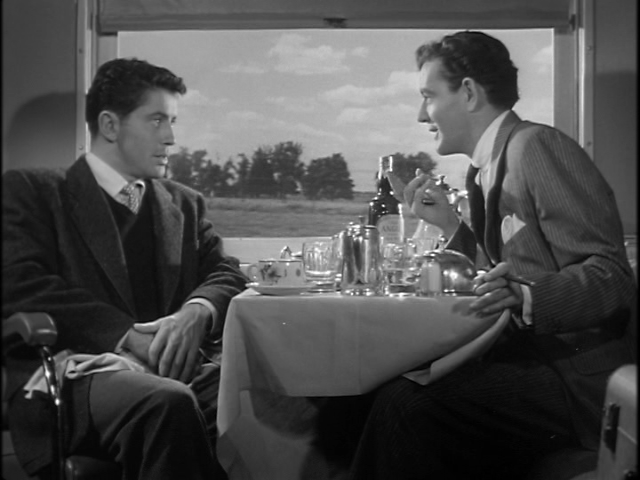
Opposites attract in strange ways in Alfred Hitchcock’s STRANGERS ON A TRAIN
STRANGERS ON A TRAIN (Alfred Hitchcock, 1951)
Metrograph
Friday, October 16, 2:15
Friday, October 23, 3:50 metrograph.com
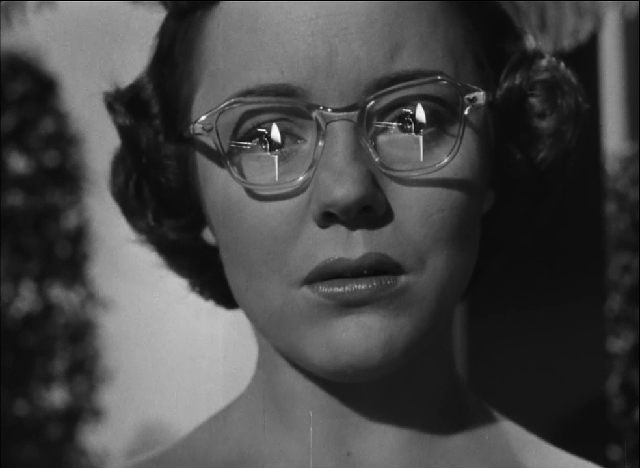
Metrograph’s “Trains: Local Routes” continues with one of Alfred Hitchcock’s most multilayered, complex tales, the 1951 psychological double-murder thriller Strangers on a Train. Shortly after introducing himself to amateur tennis star Guy Haines (Farley Granger) on a train, mama’s boy Bruno Anthony (an appropriately creepy Robert Walker) concocts a supposedly foolproof plan in which Bruno will kill Guy’s unfaithful wife, Miriam (Laura Elliott), so Guy can marry his socialite girlfriend, Anne Morton (Ruth Roman), one of the daughters of a U.S. senator (Leo G. Carroll). In return, Guy will kill Bruno’s father (Jonathan Hale). Bruno believes he has devised the perfect crisscross murder, with neither man having a clear motive and nothing for the cops to find to link them together. While Bruno is serious, Guy thinks he’s just a loon (Walker had in fact been recently released from a psychiatric clinic after suffering a nervous breakdown and died at the age of thirty-two before the film even opened), but after the psychopathic Bruno actually does kill Miriam — photographed in an unforgettable way by cinematographer Robert Burks, shown in a pair of broken eyeglasses — he starts shadowing Guy, insisting he keep his part of the bargain and kill Mr. Anthony, something Guy never intended on doing. Soon the cops are involved, along with a broken alibi, a key, and a critical cigarette lighter, leading to a spectacular conclusion on a merry-go-round.
Reflections in a pair of glasses continue the theme of doubling in eerie Hitchcock classic
Loosely based on Patricia Highsmith’s debut novel and featuring an early screenplay written by Raymond Chandler (whose name was kept in the credits for marquee value despite Hitchcock’s famous — and literal — trashing of his contribution), Strangers on a Train is a powerful, tense mystery built around the idea of the double; from the opening scene of two pairs of shoes — immediately equating, and differentiating between, the two protagonists, as if they were two parts of the same person — to Hitchcock’s appearance carrying a double bass, to Anne’s younger sister, Babs (Patricia Hitchcock, Alfred’s daughter), wearing the same glasses as Miriam, to Bruno’s declaration, upon ordering two double scotches and relating them to tennis, “The only kind of doubles I play,” the film is filled with mirroring or directly opposing elements. As with Hitchcock’s Rope, which also starred Granger, Strangers on a Train also has a clear homosexual subtext; in real life Walker was straight while Granger was bisexual. Shot in a dark black-and-white that adds to the chilling effects, Strangers on a Train is one of Hitchcock’s best, a fully realized, frightening film that ends in a big way.
Genevieve Yue: “In Hitchcock, the people you meet on trains can spell romance, adventure, or, in the case of Strangers on a Train’s Guy Haines, a colossal headache! Tip: beware anyone wearing spectator shoes.”
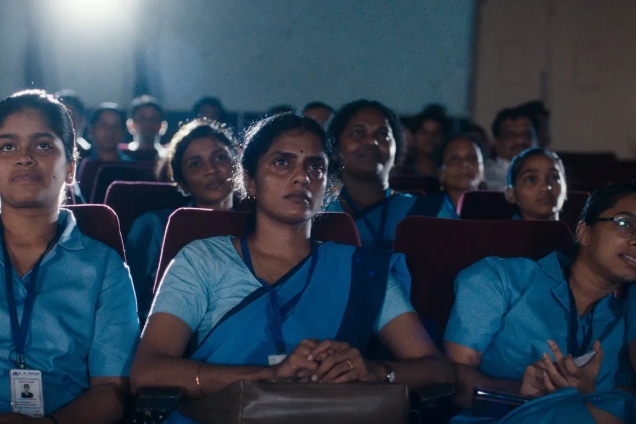
Prabha (Kani Kusruti) takes a new look at her life in All We Imagine as Light
ALL WE IMAGINE AS LIGHT (Payal Kapadia, 2024)
Metrograph
Sunday, October 25, 12:15 metrograph.com
Indian filmmaker Payal Kapadia won the Golden Eye at Cannes in 2021 for best documentary for A Night of Knowing Nothing, a film that mixes fact and fiction while telling the story of two lovers trying to stay connected via letters amid student protests in India. Kapadia mixes fact and fiction again in her follow-up, the tender and deeply poignant All We Imagine as Light, which won the Grand Prix at Cannes.
The follow-up opens with gritty shots of the streets of Mumbai, as unseen people share their difficulties trying to make a new life for themselves after migrating from the country. “There’s always the feeling I’ll have to leave,” one person says. Another opines, “The city takes time away from you.” A third argues, “Why would anyone want to move back?”
Kapadia, who was born in Mumbai, then shifts to the fictional tale of two nurses and a third hospital employee fighting loneliness as they care for sick people. Prabha (a heart-wrenching Kani Kusruti) and the younger Anu (Divya Prabha) live together in an apartment in the city. Prabha, who is in an arranged marriage, has not seen her husband, who is working in Germany, for more than a year. Anu, whose family is Hindi, is in love with a Muslim man, Shiaz (Hridhu Haroon), keeping their relationship secret for fear of being discovered and shunned. And Parvaty (Chhaya Kadam) is a recent widow who is being evicted from her home of twenty-two years because her name is nowhere on the paperwork left behind by her husband.
When Prabha receives a brand-new German rice cooker in the mail, she assumes it is from her spouse, perhaps a message that he is not coming back and that she should proceed with her life. But she is tentative to start dating, even as she is pursued by the goofy but sweet Dr. Manoj (Azees Nedumangad), who writes poetry for her.
The three women decide to hit the road, taking a trip to Parvaty’s seaside Maharashtrian hometown, where they take stock of their lives, particularly after a man washes up onshore.
All We Imagine as Light is sensitively shot by cinematographer Ranabir Das, with a soft, jazzy score by Topshe as soft rain falls, trains pass by in the background, and Prabha and Parvaty throw stones at a billboard for a pending skyscraper that proclaims, “CLASS is a privilege reserved for the PRIVILEGED.”
All We Imagine as Light is an engaging and touchingly lyrical look at womanhood in contemporary Mumbai, as the city threatens three women with potential isolation and alienation until they bind together. The youngest, Anu, instills new energy into the others to reevaluate their situations and take action. “Do you ever think of the future?” Anu asks.
The film appropriately provides no firm answers in the end, but it is clear that Kapadia’s future is a bright one.
Genevieve Yue: “The humble journeys of the short-range rail rarely get their due. The subway ride, the suburban commute, and the municipal railways that encircle daily life: these are spaces we typically associate with boredom and routine, unlike the adventure of their long-distance cousins. The history of film, however, tells a different story. From the Lumière brothers’ train of early cinema, rolling into the station at La Ciotat—and, by some accounts, headed straight into the audience—to the wind that sweeps through the Mumbai local in Payal Kapadia’s All We Imagine as Light (2024), the short line has been a place where working people have crowded together and discovered, sometimes, romantic possibility, unnerving encounters, and opportunities for existential self-interrogation. For women especially, like the housewives in David Lean’s Brief Encounter (1945) and Yasujirō Ozu’s The Flavor of Green Tea over Rice (1952), the train offers a space of reflection and relative freedom, even as its berth is narrow, its passages fleeting.”
Chantal Akerman combines footage of 1970s New York with letters from her mother in News from Home
NEWS FROM HOME (Chantal Akerman, 1977)
Metrograph
Sunday, November 1 metrograph.com
In 1971, twenty-year-old Chantal Akerman moved to New York City from her native Belgium, determined to become a filmmaker. Teaming up with cinematographer Babette Mangolte, she made several experimental films, including Hotel Monterey and La Chambre, before moving back to Belgium in 1973. But in 1976 she returned to New York City to make News from Home, a mesmerizing work about family and dislocation, themes that would be prevalent throughout her career. The film consists of long, mostly static shots, using natural sound and light, depicting a gray, dismal New York City as cars move slowly down narrow, seemingly abandoned streets, people ride the graffiti-laden subway, workers and tourists pack Fifth Ave., and the Staten Island Ferry leaves Lower Manhattan. The only spoken words occur when Akerman, in voice-over, reads letters from her mother, Natalia (Nelly) Akerman, sent during Chantal’s previous time in New York, concerned about her daughter’s welfare and safety. “I’m glad you don’t have that job anymore and that you’re liking New York,” Akerman reads in one letter. “People here are surprised. They say New York is terrible, inhuman. Perhaps they don’t really know it and are too quick to judge.” Her mother’s missives often chastise her for not writing back more often while also filling her in on the details of her family’s life, including her mother, father, and sister, Sylviane, as well as local gossip.
Although it was not meant to be a straightforward documentary, News from Home now stands as a mesmerizing time capsule of downtrodden 1970s New York, sometimes nearly unrecognizable when compared to the city of today. The film also casts another light on the relationship between mother and daughter, which was highlighted in Akerman’s final film, No Home Movie, in which Chantal attempts to get her mother, a Holocaust survivor, to open up about her experiences in Auschwitz. Nelly died shortly after filming, and Akerman committed suicide the following year, only a few months after No Home Movie played at several film festivals (and was booed at Locarno). News from Home takes on new meaning in light of Akerman’s end, a unique love letter to city and family and to how we maintained connections in a pre-internet world. News from Home will be preceded by G. W. “Billy” Bitzer’s 1905 short, Interior NY Subway, 14th Street to 42nd Street.
Genevieve Yue, who will introduce the November 1 screening: “Though Chantal Akerman’s voice can be heard throughout News from Home, her image is only briefly glimpsed, in a reflection on the train. We can’t quite see her, but others undoubtedly can — men, especially, gawk unashamedly, a reminder that the graffiti-covered subway of 1976 New York was often a place of danger and hostility. Not so for the turn-of-the-century train of Interior NY Subway, 14th Street to 42nd Street, whose newly built tunnels are illuminated by lanterns that glow like Christmas lights.”
Asa Butterfield stars as a homeless orphan on a mission in Martin Scorsese’s 3-D adventure
HUGO (Martin Scorsese, 2011)
Metrograph
Dates to come metrograph.com
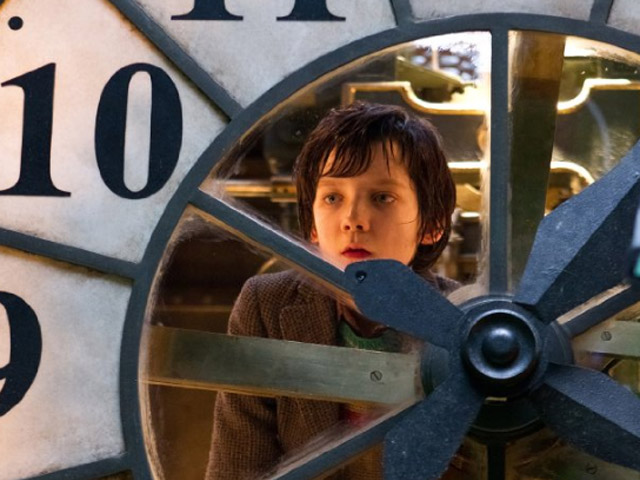
Martin Scorsese wears his cinematic heart on his sleeve in his first family-friendly film, Hugo. Based on Brian Selznick’s Caldecott-winning 2007 illustrated historical-fiction novel The Invention of Hugo Cabret, the 3-D movie follows the adventures of the title character, a homeless orphan boy (Asa Butterfield) who survives by his wits in a Paris train station in the early 1900s. He spends his days stealing small bits of food, winding the big clock, avoiding Inspector Gustav (Sacha Baron Cohen), and trying to find parts for an automaton he is rebuilding, hoping it will have a message for him from his father (Jude Law). He soon makes his only friend, a girl named Isabelle (Chloë Grace Moretz) who is being raised by her godparents, the bitter Papa Georges (Ben Kingsley) and his wife, Mama Jeanne (Helen McCrory). When it turns out that Papa Georges is the one and only Georges Méliès, who made the world’s first science-fiction film, A Trip to the Moon, among hundreds of others, then was thought to have died in obscurity, all of his work destroyed, Hugo and Isabelle, along with the help of film historian René Tabard (Michael Stuhlbarg), are determined to resurrect Papa Georges and his reputation.
Gorgeously shot by Robert Richardson and featuring marvelous period sets by Dante Ferretti, Hugo is beautiful to look at, the camera roaming through the immense train station and up the tall clock tower like in a Jules Verne story. Such side plots as the budding romances between a café owner (Frances de la Tour) and the newspaper seller (Richard Griffiths) and between Gustav and a shy flower girl (Emily Mortimer) feel forced, and the main narrative meanders its way into treacly territory as all the parts slowly come together. At its heart, Hugo is a movie about the love of movies, paying tribute to the early cinema of Méliès, Harold Lloyd, and others but it gets too stuck on the underlying theme of the preservation of old films, one of Scorsese’s driving forces. Still, Hugo is a visual treat in which Scorsese makes the most of 3-D technology, particularly in the first half, before things get a little too sticky (and slickly) sweet, even for a children’s film.
Genevieve Yue: “Of all the mechanical marvels in Hugo — a mysterious automaton, a wind-up mouse, the camera of early film pioneer Méliès — the steam locomotive is what brings them all together, and Hugo to his newfound family, like a set of converging tracks.”
[Mark Rifkin is a Brooklyn-born, Manhattan-based writer; you can follow him on Substack here.]
Volunteers are needed for special public art project on Saturday (artwork: Join Together, 2026, by Debra Pearlman)
TAKE ONE ACTION
Cristin Tierney Gallery, 49 Walker St., and other locations
Saturday, October 3, free, noon – 6:00
Volunteers needed: info@artatatimelikethis.com artatatimelikethis.com cristintierney.com
Two weeks ago, Art at a Time Like This (ATLT) kicked off its “Take One Action” public art project programming with a panel discussion in Brooklyn, focusing on how to resist current US immigration policies. The next phase launches on October 3, when six mobile LED trucks hit the streets, featuring original work by Shaun Leonardo, Marilyn Minter, Robert Longo, Sasha Stiles, Jonathan Allen, Marka27, Janet Biggs and Terry Berkowitz, Debra Pearlman, Autumn Savage, Kiyo Gutiérrez, and Julian Alexander, as part of Fall of Freedom, “an open instigation to artists, venues, and institutions across all disciplines to put your work in the world on October 2, 3, and 4, countering fascist repression and censorship with joyful communities of defiant creativity.” The ATLT works examine patriotism, immigration, the climate crisis, and a call to participate.
The day begins at noon at Cristin Tierney Gallery on Walker St., where many of the artists will be available for a meet-and-greet. The other trucks will depart from the Studio Museum in Harlem, Brooklyn Bridge Park, and MoMA PS1 at 11:00, and Columbia University and the Bronx at noon. Each truck will follow a unique route; maps will be available.
“I often hear people say, but what can we do? We believe that taking one small action can make a difference, create a snowball effect, and restore a sense of empowerment and hope,” ATLT cofounder and director Barbara Pollack said in a statement.
ATLT considers the project “an antidote” for what is happening around the globe today, where freedom finds itself facing more frightening barriers every day. The organization, which was formed at the beginning of the pandemic, is looking for volunteers to be onsite and share information about the project with pedestrians and viewers and take photographs at two of the stops. If interested, please send an email to info@artatatimelikethis.com.
The event concludes at Cristin Tierney at 6:00, where people will gather for a celebration amid Biggs’s terrific “Path of Totality” exhibition, which includes two stunning short films, the 2022–24 Eclipse (Antarctica, December 4, 2021) and the 2025 three-channel Eclipse (Amazon, September 7, 1858), in addition to fascinating related ephemera.
What can you do? You can volunteer for this exciting project and/or check out several of the trucks as they campaign for change one month before the extremely consequential midterm elections.
As Pollack told twi-ny a few months ago, “At the very beginning of a worldwide pandemic, we asked a simple question: How can you think of art at a time like this? The question is now more relevant than ever, which presents both a tragedy and an opportunity for creative solutions.”
[Mark Rifkin is a Brooklyn-born, Manhattan-based writer; you can follow him on Substack here.]
A new production of Václav Havel’s Unveiling comes to Chelsea this month (photo courtesy Untitled Theater Company No. 61)
UNVEILING
Torn Page
435 West Twenty-Second St. between Ninth & Tenth Aves.
Thursday – Saturday, October 1–17, general admission $2, suggested donation $25 untitledtheater.com tornpage.org
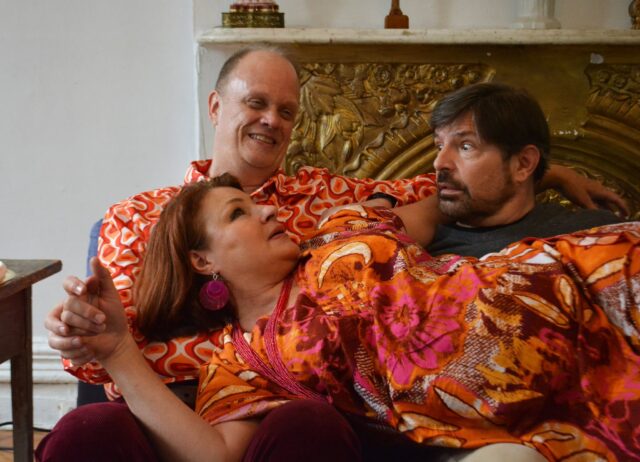
In honor of what would have been Václav Havel’s ninetieth birthday — the first president of the Czech Republic and acclaimed dissident playwright died in 2011 at the age of seventy-five — Edward Einhorn and Untitled Theater Company No. 61 are bringing a revival of Havel’s 1975 absurdist one-act play Unveiling (Vernisáž) to Torn Page in Chelsea, in association with the Czech Center New York. Part of the Vaněk Trilogy that also includes Audience and Protest, the work continues the story of Ferdinand Vaněk, a kind of Havel alter ego who battles authoritarianism.
In Unveiling, running October 1–17 in a production directed by Einhorn using a translation by Jan Novák, Vaněk is invited to see how two of his friends, Vera and Michael, have upgraded their apartment, where they get caught up in a debate about moral integrity and Communism in a way that relates to what is happening today, when Americans are faced with ever-more-ethical choices nearly every day. When the couple shows him their new confessional, he asks, “What do you do with it?” The cast features Craig Anderson, Bob Brader, and Yvonne Roen, with costumes by Ramona Ponce.
On October 5 ($27.50), the play will move to the Bohemian National Hall on the Upper East Side for one night only, with live ASL translation, followed by a panel discussion and a reception with goulash.
And on October 12 at Torn Page, Untitled Theater Company No. 61 will present a staged reading of Einhorn’s Frida Vaněk, a modern sequel to Unveiling starring Vas Eli, Nalina Mann, Alyssa Simon, and Richard Toth, about Ferdinand’s niece, whose mother dies, leaving behind a file that contains some surprising information. General admission is $2, with a suggested donation of $10. Seats are limited for all performances.
As Havel himself said, “Truth and love must overcome lies and hatred.”
[Mark Rifkin is a Brooklyn-born, Manhattan-based writer; you can follow him on Substack here.]