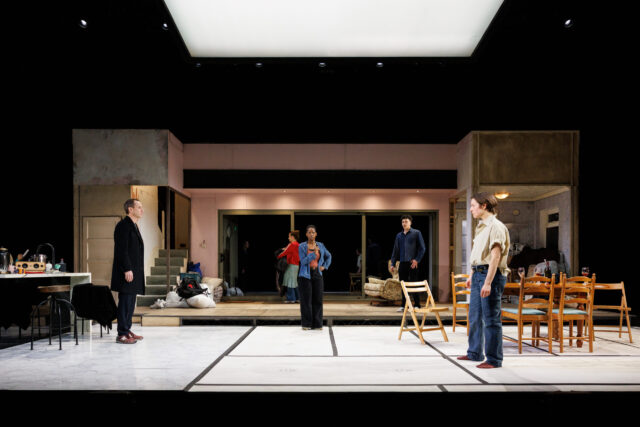
Alexander Zeldin’s The Other Place was inspired by Sophocles’s Antigone (photo by Maria Baranova)
THE OTHER PLACE
The Shed’s Griffin Theater
545 West 30th St. at Eleventh Ave.
Tuesday – Sunday through March 31, $24-$124
theshed.org
British dramatist Alexander Zeldin follows up his staggering 2023 Love at Park Ave. Armory, about the homeless crisis being experienced by English citizens and refugees, with the intense dysfunctional-family drama The Other Place at the Shed’s Griffin Theater, in which he explores the many forms of grief.
The play is set in the present day, in a lavish home amid a major renovation. It’s been ten years since successful businessman Chris’s (Tobias Menzies) brother, Adam, died, and Chris has decided that it is time to scatter Adam’s ashes in a garden in St. Margaret’s Park. Chris’s wife, Erica (Lorna Brown); their son, Leni (Lee Braithwaite); Chris’s best friend and contractor, Tez (Jerry Killick); and Chris’s niece, Issy (Ruby Stokes), are all waiting for Issy’ sister, Annie (Emma D’Arcy), to join them. Annie and Issy are Adam’s daughters, and Annie has been long estranged from the family, facing her own demons. She is particularly at odds with her uncle Chris, who she believes has wrongly usurped her father’s estate and exploited her delicate mental health. When Annie arrives, there is almost instant conflict.
Annie believes her father’s ashes should remain in the house that he loved, and she goes to extremes to prevent the scattering from happening.
“Are you unwell again?” Chris asks her, continuing, “Are you on medication? . . . I paid for a very expensive psychiatrist —” Annie shoots back, “Didn’t ask you to.”
Soon the two are cursing at each other as they fight over the ashes, with Issy caught in the middle, Erica upset with what’s happening, Leni paying little attention, and Terry trying to calm everyone down. And it only gets worse when Annie decides to sleep in a tent in the backyard, under the tree where her father hanged himself.
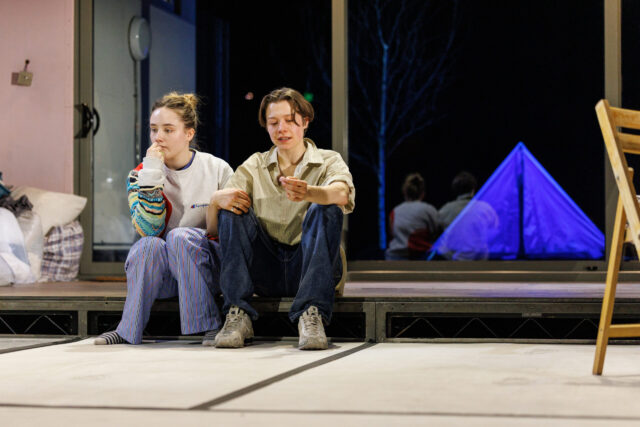
Sisters Issy (Ruby Stokes) and Annie (Emma D’Arcy) fight for the family legacy in The Other Place (photo by Maria Baranova)
The eighty-minute play is loosely inspired by Sophocles’s Antigone, the Greek tragedy about honor and shame involving sisters Antigone and Ismene; their brothers, Polynices and Eteocles, who were killed on opposite sides of a civil war; and their uncle Creon, who becomes king and declares that while Eteocles will receive a hero’s burial, Polynices’s body will be left to decay in the desert in disgrace, a fate Antigone refuses to accept and the blind prophet Tiresias predicts will be a mistake. (The siblings’ parents were Oedipus and Jocasta, who suffered their own horrible deaths.)
Writer-director Zeldin (Beyond Caring, Faith Hope and Charity) makes few specific references to Antigone, although he gives the characters names that start with the same letter as in Sophocles’s classic, but several of the underlying themes are the same, from family responsibility and legacy to pride and loyalty. At the center is the fraught relationship between Chris and Annie and how it affects the others, leading to a shocking twist, followed by a tragic conclusion.
“What I think is there are people who are suffering and you can’t go through your life as if they aren’t there and you don’t help them. If everyone did that, what kind of world would that be?” Erica asks early on. “Euh, like this one,” Leni responds. “That’s funny,” Annie says. “Thanks, Leni,” Chris adds sarcastically.
Rosanna Vize’s set is an open living room and kitchen, with newly installed sliding glass doors in the back that both reflect the actors and provide views of the forestlike backyard, depending on the positioning of a large, overhead rectangular lightbox that at one point rotates until it magically disappears. (The lighting is by James Farncombe; Vize also designed the contemporary costumes.) Josh Anio Grigg’s sound features one unnecessary jump scare while regularly competing with Yannis Philippakis’s original synthesizer score, which ranges from an ominous, ghostly drone to more cinematic flourishes that can become intrusive.
The play was written specifically for D’Arcy (House of the Dragon, Bluets), who is fearless as Annie, who resents having to return home but feels the need to protect what was hers and her father’s. Menzies (Outlander, The Hunt) is an excellent foil as the dark, determined Chris, who wants to finally move on from his brother’s death, exemplified by the changes he is making to the inside and outside of the house, rebuilding the family psyche.
Stokes (The Habits, Till the Stars Come Down) provides solid support as Issy, who finds herself in a bad situation with no easy way out. Braithwaite’s (Pinocchio, Laughing Boy) and Brown’s (Two Ladies, Wings) characters are underdeveloped and feel extraneous, while Killick (The Confessions, Bloody Mess) does what he can with Tez, who seems to be in a different play. (Perhaps that’s “the other place” in the otherwise unclear title?)
When Erica declares, “Sorry, it’s just such a mess, the bloody builders. Honestly it’s a been a warzone in here, like Iraq or I don’t know!,” she’s not referring only to the renovation. A few minutes later, Annie says, “More people are harmed from within the family than outside of it. That’s literally a fact.” Meanwhile, Issy keeps up hope, telling everyone, “The scattering will be healing and we can all come back here and have years of peace.”
But as Creon says in Antigone, “To yield is grievous, but the obstinate soul / That fights with Fate, is smitten grievously.”
[Mark Rifkin is a Brooklyn-born, Manhattan-based writer; you can follow him on Substack here.]