
Maneesh (Karan Brar) and Jonah (Brandon Flynn) take a break from work by playing ping-pong in Data (photo by T. Charles Erickson)
DATA
Lucille Lortel Theatre
121 Christopher St.
Tuesday – Sunday through March 29, $61-$126
www.datatheplay.com
lortel.org
The New York debut of Matthew Libby’s chilling Data feels like it’s been ripped from today’s headlines, but the playwright first started thinking about it in 2017, after interviewing for and not getting an internship at Palantir — one of the tech companies at the center of the current massive expansion of artificial intelligence — then reading an Intercept article about the firm’s plans, the title of which would be a major spoiler.
Data premiered in the fall of 2024 at Arena Stage in Washington, DC, directed by Margot Brodelon; director Tyne Rafaeli’s skillful adaptation opened at the Lucille Lortel on January 25 and has been extended through March 29. Karan Brar reprises his role as Maneesh Singh, a twenty-two-year-old Indian American working in the User Experience (UX) department of the fictional, highly prestigious Silicon Valley company Athena Technologies.
The play begins with Maneesh playing ping-pong in the almost blindingly white break room with fellow UX employee Jonah (Brandon Flynn), who has been assigned to be his mentor. They are not competing at championship-level table tennis but instead are hitting the ball back and forth slowly and casually, reminiscent of Pong, the 1972 Atari video game that brought digital technology into the mainstream and people’s homes. While the somewhat goofy Jonah gossips about secrecy, cutting-edge software, potential layoffs, Taco Tuesday, and an engineer in Data Analytics who left the company under mysterious circumstances, the very serious Maneesh has no interest in networking, listens to what his parents tell him to do (or not do), and, despite his obvious abilities, seems happy to stay in UX and not be promoted to Data Analytics, where the real work is being done.
When he bumps into Riley (Sophia Lillis), a college classmate now in Analytics, she is shocked that he is in UX. Next he is meeting with Alex Chen (Justin H. Min), the charming, fast-talking analytics head who used to work with Maneesh’s brother and now wants Maneesh to team up with Riley on a special project that involves signing an NDA. Maneesh is hesitant and uncomfortable, especially when Alex insists on knowing more about his breakthrough predictive algorithm, which Maneesh developed as a way to anticipate the success of baseball players and has since made it closed source, preventing access to it.
“Talk to me, bro. Cone of silence,” Alex says. Maneesh responds, “Look. As I got further and further into my thesis, and I realized what exactly it was I was creating . . . I, like, saw this conversation. Like, this exact conversation we’re having right now. Right down to the joking about baseball, because of course, the algorithm has nothing to do with baseball. The rare event model can be applied, hypothetically, to predict . . . anything, really. And so, after I presented the initial results, I started getting emails. But not from sports teams. They were from headhunters, trying to poach me, poach the project — investment firms, lobbying groups, even an oil company. And that . . . I guess I realized that scared me. I just mean — I felt it. That it’s not what I wanted.”
But it’s exactly what Alex and Athena want.
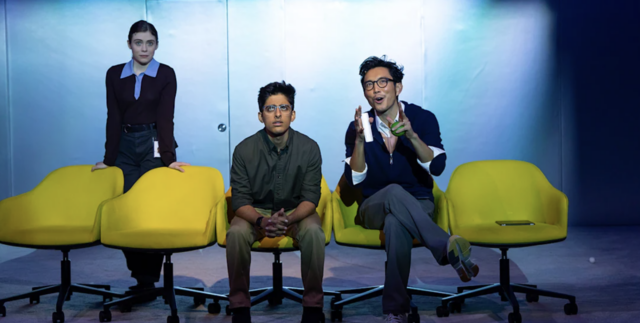
Riley (Sophia Lillis), Maneesh (Karan Brar), and Alex Chen (Justin H. Min) have different grand plans in New York City premiere (photo by T. Charles Erickson)
According to the script, the story takes place in the mid-2020s, but “it might already have happened.” The plot will make you think not only of Palantir but also about Mantic, Anthropic, OpenAI, Cambridge Analytica, and other such tech firms in the news. One of the script’s epigraphs is a quote from OpenAI CEO Sam Altman: “AI will probably most likely lead to the end of the world, but in the meantime, there’ll be great companies.” Last month, Anthropic safety researcher Mrinank Sharma quit, writing in an open letter, “The world is in peril. . . . We appear to be approaching a threshold where our wisdom must grow in equal measure to our capacity to affect the world, lest we face the consequences.”
Data marks Libby’s off-Broadway debut, and it’s an exciting one. The dialogue is keenly pointed, the characters believable, and plot twists and surprises abound in a taut hundred minutes. Only Jonah’s sexual pursuit of Riley rings false and feels forced, but otherwise Rafaeli (Weather Girl, Becoming Eve) maintains a deft touch.
Marsha Ginsberg’s set morphs from the break room to Alex’s spare, pristine office to a fascinating late shift; the whiteness recalls the streaming hit Severance, where employees are not sure what their jobs are for or what the company does while they keep their working and personal lives completely separate, one knowing nothing about the other. Scene changes are made in darkness as fluorescent lights speed around a rectangular frame accompanied by 8-bit digital music. (The lighting is by Amith Chandrashaker, with sound and music by Daniel Kluger and contemporary casual costumes by Enver Chakartash.)
Brar makes a terrific theatrical debut as Maneesh, capturing his deep unease at where his life appears to be going against his better judgment. Despite his vast tech knowledge and abilities, he represents all of us who are more concerned about the future of humanity than the success of a business, or a government. Lillis (Heroes of the Fourth Turning, A Midsummer Night’s Dream) brings a beguiling nuance to the complicated Riley, Min nails the bold, forward-thinking, eminently likable but ethically questionable tech boss, and Flynn (Kowalski, Kid Victory) lends Jonah the right balance, aside from the pervy subplot.
Libby studied cognitive science and symbolic systems at Stanford, so he knows what he’s talking about when Alex says, “It’s a geopolitical reality. Data is the language of our time. And like all languages, its narratives will be written by the victors.” But he’s also on target when Maneesh considers that AI can make “the world a worse place.”
It may have taken more than a half century to proceed from Pong to today’s video games, but so many elements of AI are moving so fast, Data could potentially be an ancient relic — like Pong — by the time it completes its run at the Lortel.
Thus, it’s better to see it now, while it’s still a legitimate cautionary tale and not a portent that the end is near, brought on by humanity itself.
[Mark Rifkin is a Brooklyn-born, Manhattan-based writer; you can follow him on Substack here.]