this week in music

ART BLACK: WALKING THROUGH HARLEM WITH JOHN T. REDDICK

Walking tour of Harlem is part of special exhibition programming at Poster House

POSTER HOUSE WALKING TOUR WITH HISTORIAN JOHN T. REDDICK
Poster House
119 West Twenty-Third St. (tour starting point given upon ticket purchase)
Saturday, July 18, $25, 11:00 am to 1:00 pm
Exhibition runs through September 6
posterhouse.org

In September 2024, longtime Harlem resident, preservationist, and Yale University School of Architecture graduate John T. Reddick gave me a tour of the exhibit “Illustrating Tin Pan Alley: From Ragtime to Jazz” at the Society of Illustrators, consisting of his remarkable collection of sheet music art from the Tin Pan Alley era, focusing on Black composers, musicians, and performers. He told me that while doing his research, “It was just shocking; as I bought sheet music or got to see the names, I realized they all lived in Harlem during the same time period.”

Reddick is now collaborating with Poster House on a walking tour of Harlem in conjunction with the institution’s “Act Black: Posters from Black American Stage & Screen,” comprising promotional posters for musical revues, theatrical presentations, and movies featuring Black performers from the 1870s to the 1940s (including from Cabin in the Sky, Zouzou, and Imitation of Life). The one-hour tour will visit Strivers’ Row, the Schomburg Center, and Harlem Hospital’s WPA murals, among other locations that played a role in the Harlem Renaissance.

Reddick, who is a member of the Board of Directors of the Tin Pan Alley American Popular Music Project, is an engaging storyteller and a font of knowledge, so this should be a special adventure; tickets are $25, and the starting point will be given upon purchase.

[Mark Rifkin is a Brooklyn-born, Manhattan-based writer; you can follow him on Substack here.]

THINGS WILL BE ALRIGHT: JIM ALLEN CELEBRATES THE OLD AND THE NEW IN PARK SLOPE

Jim Allen will be celebrating old and new music at special Brooklyn show on July 12 (photo by Therese Ragghianti)

JIM ALLEN ALBUM RELEASE AND 30TH ANNIVERSARY CELEBRATION
Young Ethel’s
506 Fifth Ave., Park Slope
Sunday, July 12, 3:00
youngethels.com
jimallen.bandcamp.com

On his new record, Maybe Things Will Be Alright, singer-songwriter and music journalist extraordinaire Jim Allen delves into darkness, with such words as fear, scared, frightened, panic, and sorrow jumping out across a dozen wide-ranging tracks. But as he declares in the opening title tune, “Maybe I won’t crack up / Maybe I won’t break down / Maybe the worst is passed / and all of our dreams won’t drown / Maybe hope has got a way to hang on through the night / Who knows, maybe things will be alright.” With its bright, jangly guitar hook and lovely harmonies from dB’s cofounder Peter Holsapple, the song offers an optimistic mantra amid the world’s despair.

At last month’s twenty-fifth anniversary gala for This Week in New York, Allen reminded me that in April 2001, I was at the Ear Inn on Spring St. with him and drummer supreme Steve Goulding, mulling over my future after I had been laid off from the entertainment database company where we all were working. I described to them a plan to write about my experiences in New York City, and thus, twi-ny was born.

I’ll be returning the favor of party attendance on July 12 when you can find me at Young Ethel’s in Park Slope for an exciting doubleheader as Allen celebrates the release of Maybe Things Will Be Alright along with the thirtieth anniversary of his debut record, 1996’s Weeper’s Stomp. He’ll be playing both albums in their entirety, joined by Paul Foglino (5 Chinese Brothers), Matt Applebaum (Allen’s the Ramblin’ Kind), and Goulding (Mekons, the Rumour) on the former and guest singer Katie Curley and Applebaum on the latter. Foglino will open the afternoon with a solo set.

On the new album, anchored by the masterful Goulding, Allen explores multiple styles, from power pop, folk rock, and blues to alt country, prog rock, and even a murder ballad, resulting in a record that beautifully transcends genres. A rollicking piano, propulsive drumming, and a searing six-string solo drive “Panic Button” (“I’ve been under a doctor’s orders / Not to turn off my bedroom light”). “Let My People Go to Sleep” is a jaunty delight (“Karloff as the creature / Shock horror double feature / Only the monster in the mirror scares me / He’s locked in there forever / Unless I pull this lever / You wouldn’t want to be the one who dares me”). “In a Cave,” hoisted by a British Invasion–style organ and backing vocals by Bongos cofounder Richard Barone, needs to be the theme song for the next BritBox secret-agent series.

“Downpour Blue” (“One two downpour blue / Three feet deep in the morning dew / Four five I’m still alive / Six feet under is a dead man’s jive / There are seven ways to heaven through a poor man’s doorway”) recalls the swampy grit of the first song on Allen’s debut, “Inchworm Blues.” “Underground” begins with a nod to Supertramp. Nick Cave would be proud of the sizzling “They Get Up” (“Hard Hat Hank slips out from underneath a girder / Doing such a dizzy dance you might forget that he’d been murdered / The Lady of the Dunes lumbers madly through the sand / With a hammer in her skull and a dagger in her hand / They’d gone rotten and forgotten in their fatal plight / But they get up and walk around at night”). The twinkling “Where I Am,” with flourishes of Steve Earle as a medieval troubadour, boasts contributions by United States of America lead vocalist Dorothy Moskowitz and Lothar & the Hand People keyboardist Paul Conly. Also on the record are C. P. Roth, Rembert Block, Lizzie Edwards, Erica Smith, and Byron Isaacs.

The album concludes with the infectious “It’s Hard,” in which Allen assures us, “And it’s hard, yeah, it’s hard / I might be slightly past what you’d consider my prime / And the incline won’t diminish / Before the story’s finished / In fact it’s a perpetual climb.” The song hearkens back to the jazzy noir “Bottom Rung” from Weeper’s Stomp, in which Allen sings, “You know it really doesn’t matter / whose foot is on the ladder / when you’re living on the bottom rung.”

The story is far from finished for the Bronx born-and-raised Allen, who is perhaps just hitting his prime. In addition to making music, he writes liner notes for many reissues, posts regularly for “Rock and Roll Globe,” and pens the Bandcamp column “Prog Is a State of Mind.”

Perhaps it’s time for Allen to reconsider the title of his new album and lose that “maybe.”

[Mark Rifkin is a Brooklyn-born, Manhattan-based writer; you can follow him on Substack here.]
WEIRDER AND WEIRDER: LAPTOP CELEBRATES THIRTIETH ANNIVERSARY WITH SPECIAL SHOW

LAPTOP: FROM START UP TO REBOOT
Ki Smith Gallery
170 Forsyth St.
Friday, July 10, $25, 7:00
www.laptoptheband.com
www.kismithgallery.com

“I’m ready to roll the end credits / Ready for the curtain call,” Jesse Hartman sings on a remastered version of “End Credits,” one of seven tracks on Laptop’s new EP from Hurricane Cove. The original was released in 1997 and appeared on the 2001 album, Opening Credits, but Hartman decided to revisit it after Doublespeak, consisting of Erasure’s Vince Clarke, Blancmange’s Neil Arthur, and producer and musician Benge, teamed up for a surprise cover that came out in May.

In addition to five versions of that track — “Remaster,” “Tower of Babel,” “Director’s Cut,” “The Sweet & Lowdown,” and “The Rise and Fall of a Phone Call” — the EP includes covers of Blancmange’s “Living on the Ceiling” and Erasure’s “Love to Hate You” as a kind of thank-you.

The curtain is not quite ready to close on Laptop and Hartman, who will be performing a rare live show on July 10 at Ki Smith Gallery on the Lower East Side, a thirtieth anniversary homecoming that will feature songs from their heyday, 1997–2003, accompanied by visuals from multidisciplinary artist Anne Senstad.

In addition, for the first time in more than twenty-three years, Laptop will be releasing a record of new material, On This Planet, in September, featuring such tracks as “Confused,” “Xanadu,” and “Squirrel-a-Bug.” It’s a very different kind of album from Laptop, with more pop elements, but they still capture the state of the world, and the band itself, starting with the opening track, in which Hartman explains, “It’s getting weirder and weirder / on this planet.”

Yes it is.

[Mark Rifkin is a Brooklyn-born, Manhattan-based writer; you can follow him on Substack here.]
TICKET ALERT: LITTLE ISLAND SUMMER SEASON 2026

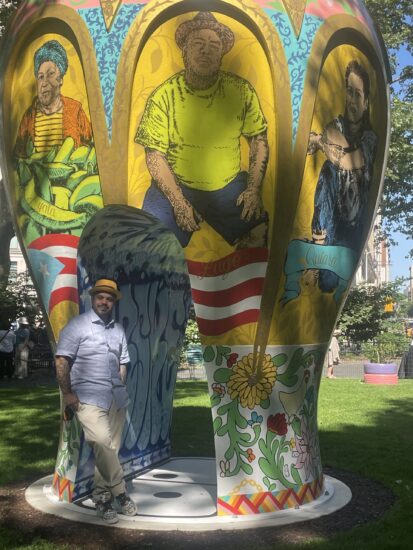
Concrete tulip pillars welcome visitors to Little Island, which just announced its summer performance season (photo by twi-ny/mdr)

LITTLE ISLAND SUMMER SHOWS
The Amph at Little Island
Pier 55, Hudson River Park at West Thirteenth St.
July 29 – September 6, $15-$25 unless otherwise noted, 8:30
littleisland.org

In 2015, Barry Diller and Diane von Furstenberg cemented their local legacy by donating $113 million to Little Island, a lovely paradise built on the remnants of a ramshackle pier at West Thirteenth St.

Little Island is a warm and welcoming oasis rising more than 60 feet above the Hudson River; it is shaped like a large leaf, bursting with more than 350 species of flowers, trees, and shrubs, a 687-seat amphitheater for live performances known as the Amph, the Play Ground plaza where you can get food and drink, and stage and lawn space called the Glade. More than 66,000 bulbs and 114 trees were initially planted, taking into account the changing seasons and even the differences in light between morning, afternoon, and night. It all sits upon 132 concrete pillars of varying heights that resemble high heels or slightly warped tulip Champagne glasses.

Lovers of the live arts have been waiting impatiently for the announcement of Little Island’s summer schedule, and at last it is here. There are only seven presentations, so it’s not nearly as expansive as previous years, but you better act quickly, because tickets are only $15-$25 (and free for the Summer Legacy Ball). Below is the full schedule.

Wednesday, July 29
Thursday, July 30
Friday, July 31

Justin Vivian Bond: Summer’s Eve, with Justin Vivian Bond, Bernice “Boom Boom” Brooks on drums, Nath Ann Carrera on guitar, Claudia Chopek on violin, Mike Jackson on bass, and Matt Ray on piano

Saturday, August 1
Summer Legacy Ball, hosted by Qween Jean, with honorees Miss Major Griffin-Gracy, Boom Boom Balenciaga, Kiara St. James, and Brenda Continental Milan Soulja, preachers Samora Pinderhughes and Dr. Jehbreal Jackson, MCs Julz Romell and Thunda, performer Haus of Telfar, panelists Luna Luis, Tracey Africa Norman, and Mother Pandora West, ball DJ Blaize, and afterparty DJ DANIRO, free

Wednesday, August 5
through
Sunday, August 9

Anthony Roth Costanzo: Minimalism, with countertenor Anthony Roth Costanzo and different formations of Sandbox Percussion, Bryan Wagorn or Vicky Chow on piano, PUBLIQuartet, and mezzo-soprano Rachael Wilson

Wednesday, August 12
through
Sunday, August 16

Cécile McLorin Salvant: Tin Pan Alley, with different lineups including vocalists Lillias White, Cécile McLorin Salvant, and Mikaela Bennett, Billy Stritch on piano, Kyle Poole or Buddy Williams on drums, George Coleman on sax, Sullivan Fortner on piano, and Paul Sikivie on bass

Wednesday, August 19
through
Sunday, August 23

Louis Cato: The Harlem Renaissance, with bandleader Louis Cato on guitar, vocalist Catherine Russell, Louis Fouché on alto sax, Alphonso Horne on trumpet, Philip Kuehn on bass, Jeffrey Miller on trombone, Tivon Pennicott on tenor sax, Mathis Picard on piano, and Evan Sherman on drums, featuring recorded interviews with Ron Carter, Catherine Russell, and others

Saturday, August 29
and
Sunday, August 30

Julio Torres & Martine Gutierrez: Marina, conceived by Julio Torres & Martine Gutierrez, written and directed by Julio Torres, composed by Lia Ouyand Rusli, choreographed by Ryan McNamara, and starring Martine Gutierrez, River L. Ramirez, Spike Einbinder, Brandon Flynn, Scully James, and more, commissioned for the Whitney Biennial

Wednesday, September 2
through
Sunday, September 6

Thomas Bartlett: Allen Ginsberg at 100, with various configurations including curator Thomas Bartlett on piano, consultant Laurie Anderson, poet Anne Waldman, Oren Bloedow on guitar, Jason Burger on drums, vocalists Jennifer Charles and Davóne Tines, Spencer Murphy on bass, and Douglas Wieselman on sax, featuring special guests Rufus Wainwright on September 2, Bill Frisell on September 3, and others to be announced

[Mark Rifkin is a Brooklyn-born, Manhattan-based writer; you can follow him on Substack here.]

COPLAND & TWAIN, COPELAND & COREA, DUNBAR & HUGHES, AND MORE: CELEBRATING AMERICA’S 250th IN CHELSEA

Pianist Min Kwon reimagines “America the Beautiful” at Chelsea Music Festival

CHELSEA MUSIC FESTIVAL: EVERY STORY COUNTS
St. Paul’s German Church and other venues
June 20-27, $65-$150, season pass $500
chelseamusicfestival.org

“This season, our theme, ‘Every Story Counts,’ draws inspiration from the phrase ‘Every Vote Counts,’ where each person’s vote is dignified and counted in a democracy,” 2026 Chelsea Music Festival artistic directors Melinda Lee Masur and Ken-David Masur said in a statement. “This summer, we celebrate the power of music and storytelling to preserve and elevate the voices of people from all walks of life in America. As we contemplate America’s 250th anniversary, we welcome the voices of composers, musicians, artists, chefs, and creators who contribute to the cultural fabric of this country and strive to elevate our shared humanity. Our hope is to continue providing a stage and safe haven for the exchange of ideas and differences, and a fertile ground for artistic collaborations between the performing, visual, and culinary arts.”

The seventeenth annual event, running June 20–27, consists of nine special presentations, with seventeen New York premieres and two world premieres; tickets for some are near capacity or already sold out, so you better hurry if you want to be part of this year’s fest.

Invitation to Love — Opening Night with Clara Osowski
St. Paul’s German Church
315 West Twenty-Second St.
Saturday, June 20, $85, 7:00
chelseamusicfestival.org

Mezzo-soprano Clara Osowski and pianists Dimitri Dover and Melinda Lee Masur lead a six-piece ensemble in an evening of works that explore the American immigrant experience and the poetry of Langston Hughes and Paul Laurence Dunbar, comprising Mark Carlson’s Stars — The Dream Keeper, Aaron Copland’s Three Old American Songs, Erich Wolfgang Korngold’s Three Songs, Libby Larsen’s This Unbearable Stillness: Songs from the Balcony, Reinaldo Moya’s DREAM Songs, Frederick Piket’s The Dream Keeper, Damien Sneed’s All Night, All Day and I Dream A World, and Steven Ward’s Invitation to Love.

Mark Twain–inspired Southern Sunday Brunch
City Winery Bistro
25 Eleventh Ave.
Sunday, June 21, $100, 12:30
chelseamusicfestival.org

Food and drink aren’t the only things on the menu at this City Winery brunch with Melinda Lee Masur and Ken-David Masur, joined by director, writer, and producer Bill Barclay for a talk about the making of Copland & Twain (see below), along with music by violinists Yuyu Ikeda and Carlos Rafael Martinez Arroyo. Oh, yes, there is food and drink as well; the menu features buttermilk biscuits, buttermilk fried chicken and waffle, farm egg scramble, Saratoga potatoes, heirloom tomato, and warm apple pie.

America/Beautiful
St. Paul’s German Church
315 West Twenty-Second St.
Monday, June 22, $65, 7:00
chelseamusicfestival.org

During the pandemic, pianist Min Kwon initiated her America/Beautiful project, in which she asked more than seventy composers around the country, “What is America — is it beautiful, was it ever, or will it ever be?” Some of the results will be heard when she teams up with pianists Timo Andres, Chaihun Kim, and Jorges Tabarés and violinist Claire Bourg to perform America-themed works by Stewart Copeland, Vijay Iyer, Nico Muhly, and others, accompanied by landscape photography by Park Joon.

Verona Quartet at Poets House
Poets House
10 River Terr.
Tuesday, June 23, pay-what-you-wish, 7:00
chelseamusicfestival.org

The Verona Quartet — Jonathan Ong and Dorothy Ro on violin, Abigail Rojansky on viola, and Jonathan Dormand on cello — perform Philip Glass’s String Quartet No. 2 “Company,” George Walker’s Lyric for String Quartet, Jerod Impichchaachaaha’ Tate’s MoonStrike, and arranger Peter Myers’s Twenties Tunes Jazz Suite, with narration by Byron Singleton and poetry from Wayne Koestenbaum, followed by a wine reception.

American Street Food Stories with Chef Hinnerk von Bargen
St. Paul’s German Church
315 West Twenty-Second St.
Wednesday, June 24, $75, 7:00
chelseamusicfestival.org

CIA professor and Street Foods author Hinnerk von Bargen hosts an evening of culinary delights from street food stalls, including sloopy bun, curry wurst, cold Sichuan-style sesame noodles, and fruit sandos.

Aaron Copland and Mark Twain join forces in unique theatrical concert

Copland & Twain — A Theatrical Concert
Open Jar Studios
1601 Broadway, floor 11
Thursday, June 25, $150, 7:00
chelseamusicfestival.org

One of the highlights of the festival is Bill Barclay’s Copland & Twain — A Theatrical Concert, a genius pairing of Brooklyn-born composer Aaron Copland and Missouri-born humorist Samuel Langhorne Clemens, better known as Mark Twain. Their lives barely overlapped — Copland was nine when Twain died in 1910 at the age of seventy-four — but writer-director Barclay and Concert Theatre Works have produced an evening that brings together Copland’s Music for the Movies and Music for the Theater and Twain’s Diaries of Adam and Eve, performed by the Festival Chamber Orchestra, conducted by Ken-David Masur, and actors Caleb Mayo, Chloe McFarlane, Maurice Emanuel Parent, Robert Walsh, and Carson Elrod, in costumes by Arthur Oliver.

“This program began by imagining how to publicly go about celebrating America’s 250th anniversary. How could this event serve such a polarized time in our history? I have always been moved by some of the traditional American tunes and hymns, but the state of our country called for something else, something I couldn’t quite identify at first,” Barclay explains. “I now realize that for some reason or other, I wanted to laugh. I wanted to release energy, not summon it. I wanted the community of joy, not the burden of politics. And it seemed that avoiding politics entirely was ignoring the elephant in the room. A symphony audience today may be one of the last public spaces of American life that is truly politically heterogeneous. Classical music plays to Republicans, Democrats, and Independents alike. This prompts a follow-up question: Is there a way we can laugh about ourselves without excluding people?”

Shelters in the Desert — An Evening with Vu, León, Susman, Smirnóv, Hernández
St. Paul’s German Church
315 West Twenty-Second St.
Friday, June 26, $85, 7:00
chelseamusicfestival.org

Water, memory, and transformation are the underlying themes of Shelters in the Desert, in which the Festival Chamber Orchestra, conducted by Ken-David Masur, plays Ania Vu’s Water Realms, Tania León’s Esencia — I. Agua de Florida for strings, Grigóry Smirnóv’s Impromptu, J. E. Hernández’s Desert Shelter, and William Susman’s Clouds and Flames, the last piece inspired by Philippe Petit’s 1974 tightrope walk between the Twin Towers; a reception follows.

Family Event: Every Storybook Counts
St. Paul’s German Church
315 West Twenty-Second St.
Saturday, June 27, free with RSVP, 10:30 am
chelseamusicfestival.org

American composers are celebrated in this interactive family-friendly morning with Paul Collins, the creator of the Unbannable Library.

Jazz Finale: Warren Wolf plays Chick Corea
St. Paul’s German Church
315 West Twenty-Second St.
Saturday, June 27, $85, 7:00
chelseamusicfestival.org

The 2026 Chelsea Music Festival concludes with a jazz finale celebrating the life and career of multi-instrumentalist legend Chick Corea, who died in 2021 at the age of seventy-nine. Vibraphonist Warren Wolf and pianist Alex Brown, joined by the Ivalas Quartet (violinists Tiani Butts and Reuben Kebede, violist Marcus Stevenson, cellist Pedro Sanchez), will perform Brown’s The Old Line and the New York premiere of Corea’s Lyric Suite for Sextet, with a reception to follow.

[Mark Rifkin is a Brooklyn-born, Manhattan-based writer and editor; you can follow him on Substack here.]

DON’T LOCK HIM AWAY: STAYING IN A WORLD WITH PETER ASHER

Peter Asher signs autographs with Gordon Waller, as seen in Peter Asher: Everywhere Man

PETER ASHER: EVERYWHERE MAN (Dayna Goldfine & Dan Geller, 2025)
Quad Cinema
34 West 13th St. between Fifth & Sixth Aves.
Opens Thursday, June 18
quadcinema.com
thefilmcollaborative.org

Peter Asher: Everywhere Man is so utterly engaging and delightful, so happy-making and surprising, that I actually wanted to crawl inside the screen and enter Peter Asher’s extraordinary life.

In Terry Gilliam’s 1988 film The Adventures of Baron Munchausen, John Neville stars as the title character, who tells a fanciful, impossible-to-believe story based on Rudolf Erich Raspe’s 1785 collection The Surprising Adventures of Baron Munchausen, consisting of heavily embellished tall tales loosely inspired by the real-life eighteenth-century German nobleman Hieronymus Karl Friedrich Freiherr von Münchhausen, whose name was given to the mental disorder Munchausen syndrome, a subtype of factitious illness in part characterized by, according to the National Library of Medicine, “pseudologia fantastica, a pattern of fabricating detailed falsehoods regarding personal history, education, and achievements.”

In the extraordinary documentary Peter Asher: Everywhere Man, the title figure tells his fanciful, impossible-to-believe story — but in this case, it’s all remarkably true, including that his father, endocrinologist Dr. Richard Asher, is credited with introducing the term “Munchausen syndrome.”

Born in England in 1944, Asher has lived a charmed, and charming, life. He and his sisters, Jane and Clare, three redheads, were child actors affectionately known as the Carrots of Wimpole Street. At Westminster School, he met Gordon Waller, a fellow guitarist, and they formed a duo, Peter and Gordon, who joined the British Invasion and scored a series of huge hits, anchored by “A World without Love,” written for them in 1964 by Jane’s boyfriend, Paul McCartney, who was living in the Asher home at the time. Other songs followed: “I Don’t Want to See You Again,” “Woman,” “I Go to Pieces,” and “Nobody I Know,” and they appeared on The Ed Sullivan Show. Asher’s mother, Margaret, was an oboist and professor who taught music to George Martin, the Beatles’ innovative producer.

Asher opened the highly influential Indica bookstore and gallery, where John Lennon met Yoko Ono. After serving as head of A&R for Apple Records, he became producer and then manager of a rising young folk singer named James Taylor, which led to him working with Linda Ronstadt, Carole King, and so many others (Diana Ross, Cher, Neil Diamond, Morrissey, Elton John, Rodrigo y Gabriela, 10,000 Maniacs, Robin Williams). He threw the party at which Mick Jagger and Marianne Faithfull fell in love, even though she was married to one of Asher’s Indica partners, John Dunbar. He put together backing bands with such musicians as King, bassist Leland Sklar, guitarists Danny “Kootch” Kortchmar and Waddy Wachtel, multi-instrumentalist Andrew Gold, and drummer Russ Kunkel, and he listed them on albums, something that previously was not done on pop records. And he did all of it with little or no training, just thriving on improvisation and experience.

“I think that Peter just got better and better at what he did,” Kortchmar says in the film. “Producing is a very broad term. Sometimes it means he’s a musical prodigy, and sometimes it means he’s a social worker or a therapist. And sometimes it means he or she just enables somebody who’s musically gifted to do their thing and get out of the way. And I think he probably can wear any of those hats.”

Directors and producers Dayna Goldfine and Dan Geller structure the documentary around Asher’s cabaret show, A Musical Memoir of the ’60s and Beyond, which they saw in December 2019 with Ronstadt. In the multimedia performance, Asher narrates his story and sings various songs with a band, along with projections of archival photos and videos. Editor Darren Lund intercuts new interviews with Monty Python veteran and The Adventures of Baron Munchausen costar Eric Idle, Steve Martin, Lyle Lovett, McCartney (voice), Twiggy, Kortchmar, Pattie Boyd, Paul Jones (Manfred Mann), Taylor and his sister Kate, Rolling Stone journalist Ben Fong-Torres, Indica cofounders Dunbar and Barry Miles, Natalie Merchant, and Asher’s longtime personal assistant, Chris O’Dell, among others, in addition to clips from a 2006 interview of Waller. They also follow Asher around London as he gives a tour to his daughter, Victoria.

Asher is generous with his time, although every now and then he prefers not to go into deep detail. When he is asked about drugs back in the 1960s and ’70s, he admits that he partook, although Ronstadt points out, “Cocaine was a lot of fun but it ruined everything.” Meanwhile, he had the unique ability to go where the action was, or create it himself.

Peter Asher relaxes in his office surrounded by many of his successes in an extraordinary career

Throughout it all, Asher, with his shock of bright red hair and dapper style, seems to have remained a warm, gentle, and caring individual who would do whatever it takes for his clients and friends, without seeking stardom for himself, at least since Peter & Gordon broke up in 1968. However, Wachtel states, “He’s a ham like the rest of us.”

“I suppose I do have this sort of generally optimistic view of what I set my hand to seems to work out okay, and I don’t think it’s necessarily to my credit at all,” he says humbly. “I think it could all just be a series of fortunate circumstances. But I’ve never really known what I was going to be doing next.”

Asher, a three-time Grammy winner and CBE (Commander of the British Empire), has touched so many people around the world over the last seven decades, whether they realize it or not, and it’s to his credit that he doesn’t get caught up in that, although he is clearly proud of his nearly endless accomplishments, as he should be. The film, to its credit, captures that beautifully. Asher was so often in the room where it happened, and is still happening, and Goldfine and Geller bring audiences into those very rooms.

Peter Asher: Everywhere Man opens June 18 at the Quad, with Goldfine and Geller (The Galapagos Affair: Satan Came to Eden, Hallelujah: Leonard Cohen, a Journey, a Song) participating in Q&As following the screenings on June 18 at 7:15 (moderated by Alan Light), June 19 at 7:00 (Dennis Elsas), June 20 at 7:00 (Joe Neumaier), and June 21 at 2:30 (Neumaier). You can find a Spotify playlist for the film here.

[Mark Rifkin is a Brooklyn-born, Manhattan-based writer; you can follow him on Substack here.]

FOUR TEENS TAKE A CHANCE ON MUSIC AND MORE AT THE VINEYARD

Four teen girls explore their lives through music in world premiere play by Eisa Davis (photo by Carol Rosegg)

||: GIRLS :||: CHANCE :||: MUSIC :||
Vineyard Theatre
Gertrude and Irving Dimson Theatre
108 East 15th St. between Union Square East & Irving Pl.
Tuesday – Sunday through June 21, $37.80-$106.92
www.vineyardtheatre.org

Eisa Davis’s ||: Girls :||: Chance :||: Music :|| unfolds like an improvisatory jazz theatrical piece, transforming the concept of the creation and playing of music into subtle and not-so-subtle metaphors about growing up and making choices. It explores chaos and empathy, education and impermanence, and building — or not building — family and community, with time jumps and forays into alternate realities.

If you’re one of the first twelve people entering the Vineyard Theatre, you’ll be offered the opportunity of selecting a note on a keyboard chart that will, when done, form a unique tone row for that night’s performance, serving as the underlying musical theme. The cast will develop it at the start of the play, asking the audience to participate, and the tune will make appearances later on as well.

The show follows four teenagers of color as they prepare for their final project at a girls summer music program in Berkeley. Clementine (Gianna DiGregorio Rivera) is a straightforward flutist who mostly stays in the background; Fax (Hillary Fisher) is a vocalist who always prefers to have a plan; Margot (Naomi Latta) is a wildly unpredictable drummer; and Rile (Yeena Sung) is a pianist who enjoys experimenting.

Early on, Rile is playing the end of “Una Voce Poco Fa” from Rossini’s The Barber of Seville when she makes a mistake and improvises around it, completely throwing Fax off. “I mean it’s about being intentional with your juxtaposition,” Fax says, clearly unhappy. Rile responds, “Putting things together that don’t seem like they’ll fit.” Soon after, Fax declares, “Don’t do random shit onstage that’s different from what we practiced.”

Over the course of 105 minutes, the four characters face such issues as race, class, gender, and sexuality as they try to find their place not only in music but in the world itself, one filled with trouble and danger. “I love getting up in the morning to come here — when the world feels like one disaster after another,” Fax says.

Margot later explains, “Quake wasn’t random and it wasn’t planned / just cause and effect from billions of years ago to now / we’re given an effect and we get to make a new cause with it / which makes a new effect and / it’s a chain / a network of exchange.”

Margot (Naomi Latta) and Fax (Hillary Fisher) form a unique bond in ||: Girls :||: Chance :||: Music :|| (photo by Carol Rosegg)

Nina Ball’s set consists of four small platformed music sections, one for each character, surrounded by angled columns that harken back to Greek tragedy; it evokes how the girls are four distinct individuals who can benefit from working together as a kind of band instead of on their own, like in life. Loneliness is a leitmotif. When Margot and Fax art talking about being artists — and human beings — Margot advises, “We’re supposed to do things we’re not supposed to do . . . you have to go out on a limb to do anything crucial,” but Fax replies, “But then you’re like lonely.” Fax has a home to go back to, one that seems to be growing by the day, while Margot is much more on her own.

Mel Ng’s costumes change often, with cool little touches that at first define the characters by specific color schemes. Russell H. Champa’s lighting gives each of the girls their personal moment to take center stage. It’s a strong, talented ensemble, like a tight-knit jazz quartet, although the narrative does occasionally meander off track, becoming too abstract, but it always finds its way back to the melody. Fisher (The Notebook, Between the Lines) and Latta, in her impressive off-Broadway debut, play off each other with a gorgeous rhythm, with Sung (Mary V, Comfort Women: A New Musical) riling things up just enough as Rile, and Rivera, in her off-Broadway debut, providing the right elements as the ending approaches.

Produced by the Vineyard in conjunction with American Conservatory Theater, ||: Girls :||: Chance :||: Music :|| is conducted — er, directed — with an understanding, guiding hand by Tony winner Pam MacKinnon (Clybourne Park, Who’s Afraid of Virginia Woolf?), who turns Davis’s (Bulrusher, The Essentialist) complex script into a mini-symphony.

It is both a perplexing and rewarding play, weaving in and out of time and reality, expectations and desires, as four teenagers contemplate — or don’t — what’s waiting for them around the corner, and what their role in taking those next steps might be.

[Mark Rifkin is a Brooklyn-born, Manhattan-based writer and editor; you can follow him on Substack here.]