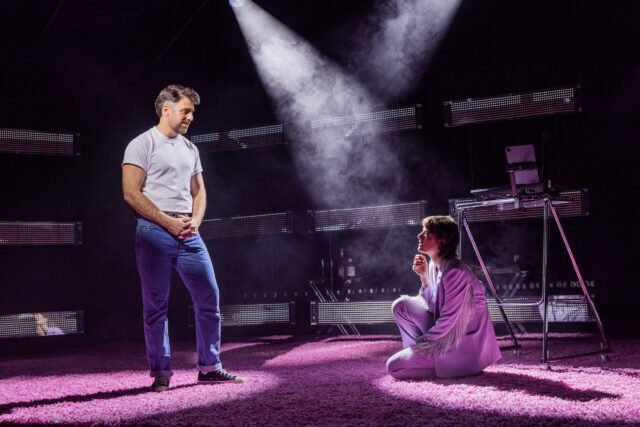
Simon Leary and Karin McCracken face heartache in Heartbreak Hotel at DR2 Theatre (photo by Evan Zimmerman for MurphyMade)
HEARTBREAK HOTEL
DR2 Theatre
103 East 15th St. between Irving Pl. & Park Ave.
Tuesday – Sunday through April 19, $29-$56
heartbreakhotelplay.com
www.darylroththeatre.com
New Zealand company EBKM sets the tone for the American premiere of Heartbreak Hotel during the entrance music, with such songs about romantic pain and misery as Aimee Mann’s “Save Me,” Alanis Morissette’s “That I Would Be Good,” Cher’s “Believe,” and Lenny Kravitz’s “It Ain’t Over ’Til It’s Over” preparing the crowd for what is to come at the small, intimate DR2 Theatre.
Writer and star Karin McCracken, who cofounded the troupe with director Eleanor Bishop, comes onstage, walks to the lip, and, with the lights on, looks out at the audience and says, “I was hoping to get to know everyone a bit before we start, so I’m going to ask you a couple of questions. For the first question, you don’t need to respond out loud. If you just think your answer, and make eye contact with me, I’ll be able to tell. It’s just a thing I’m able to do. So: Is anyone here heartbroken, or grieving, or otherwise bereft?” Starting at the back, she then goes row by row, looking into the eyes of each of the ninety-nine audience members, a clever way to form an instant connection.
She then explains she’s neither a musician nor a singer but she has taken up both disciplines because she read that creativity promotes neuroplasticity and singing suppresses cortisol, relieving stress — “Unless you’re singing in an environment that would naturally promote anxiety, like live performance.”
Over the course of about seventy minutes, she shares her story directly with the audience, re-creating scenes from her character’s past. Simon Leary performs all the other roles: a tinder date, her gay bestie, a supermarket worker, a doctor, and her former partner, who she was with for six years. She also plays, on synthesizer, relevant songs by Bonnie Raitt, Sinéad O’Connor, and the Cranberries, dances, and uses such other scientific terminology as “norepinephrine,” “monocytes,” “RNAs,” “serotonin,” “oxytocin,” “Takotsubo syndrome,” and “chipotle sauce,” which serves as medical explanations regarding love and loss as well as potential excuses for why humans make certain decisions.
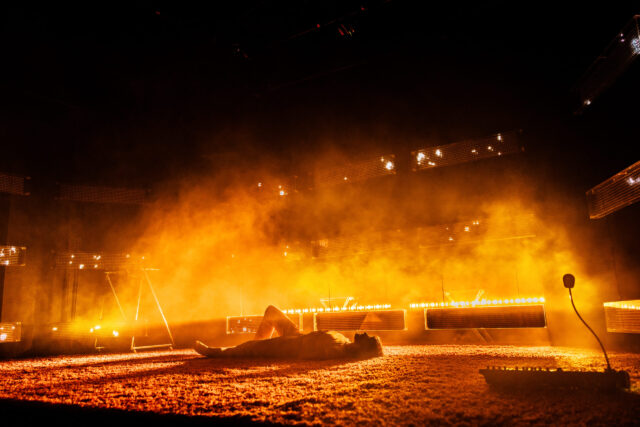
Karin McCracken wrote and stars in US premiere of EBKM’s Heartbreak Hotel (photo by Evan Zimmerman for MurphyMade)
Dressed in a country-rock-style jacket with sequins, fringe, and tassels, she deals with her situation with limited success, clearly unable to put the relationship behind her, in scenes such as “Dating While Heartbroken,” “The Science: Protest,” and “Anxious/Avoidant,” the words passing by on a semicircle of LED boxes like digital ticker tape. The production design, which also features pink shag carpeting, is by Rachel Marlow (who also did the lighting) and Brad Gledhill of Filament Eleven 11, with sound by Te Aihe Butler that ranges from a German club to a noisy bar to a quiet beach.
McCracken is engaging as the unnamed woman, imbuing her with a believable honesty, refusing to make her a victim while not afraid to reveal her flaws and mistakes. You’ll root for her to finally take those necessary next steps even as she keeps getting in her own way. Leary slides neatly from character to character, making subtle changes in each as the woman’s story unfolds.
It all leads to a powerful finale, one that resonates with Presley’s 1956 hit — “Well, since my baby left me / I found a new place to dwell / It’s down at the end of Lonely Street / At Heartbreak Hotel / Where I’ll be, I’ll be so lonely, baby / I’m so lonely / I’ll be so lonely, I could die” — but has a hopeful twist at the end, hinting that there may be a way out of the woman’s self-imposed prison.
On the way out of the theater, each audience member is given a small pamphlet consisting of notes and resources, from poetry and music influences to illustrations and acknowledgments, including one for her mum.
Early on in the show, her mother, in a prerecorded voiceover, says, “When someone is in the midst of a heartbreak, it feels like time has stopped — because they want the past and don’t want what the future holds. A state of limbo. It’s a terrible thing.”
As always, mother knows best.
[Mark Rifkin is a Brooklyn-born, Manhattan-based writer and editor; you can follow him on Substack here.]