this week in literature

AN APPETIZING TALK & LUNCH: RUSS & DAUGHTERS AT THE COFFEE HOUSE CLUB

Who: Niki Russ Federman, Josh Russ Tupper, Joshua David Stein, Reggie Nadelson
What: Russ & Daughters: 100 Years of Appetizing, a Conversation
Where: The Coffee House Club at the National Arts Club, 15 Gramercy Park South
When: Friday, May 8, $85, 11:30 am
Why: In 1904, Polish Jewish immigrant Joel Russ started selling herring from a pushcart on the Lower East Side. Ten years later, he opened an appetizing shop on Orchard St., moved to Houston St. in 1920, and renamed it Russ & Daughters in 1933, after his children Hattie, Ida, and Anne. Today it is a thriving business with multiple locations, run by fourth-generation owners and cousins Niki Russ Federman and Josh Russ Tupper. In September 2025, they published Russ & Daughters: 100 Years of Appetizing (Flatiron, $39.99), featuring recipes for such delicacies as smoked whitefish chowder, hot borscht, herring sauces, chopped liver, the Super Heebster bagel sandwich (my favorite), noodle kugel, egg creams, and many more delights.

On May 8, Federman and Tupper will be joined by Brooklyn-based author and journalist Joshua David Stein and author and filmmaker Reggie Nadelson for “Russ & Daughters: 100 Years of Appetizing, a Conversation,” a book talk, signing, Q&A, and three-course prix-fixe lunch hosted by the Coffee House Club at the National Arts Club. Tickets are $85; the intimate event for a limited number of guests is scheduled to conclude at 2:00.

[Mark Rifkin is a Brooklyn-born, Manhattan-based writer; you can follow him on Substack here.]

KILLING AN EVENING WITH EDGAR ALLAN POE: JOHN KEVIN JONES RETURNS TO MERCHANT’S HOUSE WITH SPECIAL GUESTS

(photo by Joey Stocks)

John Kevin Jones pays tribute to Edgar Allan Poe at historic Merchant’s House Museum (photo by Joey Stocks)

KILLING AN EVENING WITH EDGAR ALLAN POE
Merchant’s House Museum
29 East Fourth St. between Lafayette St. and the Bowery
March 25 – April 5, $65-$75
merchantshouse.org
summonersensemble.org

John Kevin Jones is back for his annual residency at the historic Merchant’s House Museum on East Fourth St. with Killing an Evening with Edgar Allan Poe: Murder at the Merchant’s House. Jones has gained a kind of cult fan club for his unique one-man shows, which also include his unique version of A Christmas Carol at the historic museum, a home built in 1831-32 that was occupied continuously by the Tredwell family from 1835 to 1933. The nineteenth century feels very present in the house, which was one of the first twenty buildings to gain landmark status under the city’s 1965 law and functions as a museum, preserving the Tredwell family’s furnishings as they would have appeared when Poe, coincidentally, lived nearby for a time at 85 West Third St. and later in a cottage in the Bronx. Dressed in nineteenth-century-style jacket, vest, top hat, and ascot, Jones celebrates Edgar Allan Poe with three of his most popular writings, preceded by short introductions about each work and Poe’s career.

Forty people are squeezed into the Tredwells’ candlelit double parlor — with a coffin at one end and a dining table at the other — and Jones walks up and down the narrow space between, where the audience is seated on three sides, boldly delivering several classic Poe tales of treachery and murder, “The Tell-Tale Heart,” “The Angel of the Odd,” and “The Cask of Amontillado,” from memory. His deep, theatrical voice resonates through the room as he catches the eye of audience members, adding yet more chills and thrills to the mystery in the air. He then sits down with a book for the long poem “The Raven,” evoking the great Poe actor Vincent Price. Jones, director Dr. Rhonda Dodd, and stage manager Dan Renkin, the leaders of Summoners Ensemble Theatre, keep the focus on Poe’s remarkable narrative technique; you might be watching one man, but you’ll feel like you’re seeing each of Poe’s characters in vivid detail.

Killing an Evening with Edgar Allan Poe runs March 25 through April 5, and for select performances there will be a “Raise a Glass to Edgar” preshow reception option ($30) in which Jones will recite “Annabel Lee” and “Alone,” Natalia “Saw Lady” Paruz will perform, and the kitchen, family room, and garden will be open. In addition, medium Heather Carlucci will give psychic readings after both Sunday shows.

There is also a concerted public effort to save the Merchant’s House from construction next door that could negatively impact its structural future; find out how you can help here.

[Mark Rifkin is a Brooklyn-born, Manhattan-based writer and editor; you can follow him on Substack here.]

ALL IN THE TELLING: SAUL RUBINEK AT THE MUSEUM OF JEWISH HERITAGE

Saul Rubinek will be at the Museum of Jewish Heritage for two very special, deeply personal evenings

Who: Saul Rubinek, Annette Insdorf, Caroline Aaron
What: “All in the Telling — a somewhat true story”
Where: Museum of Jewish Heritage, Edmond J. Safra Plaza, 36 Battery Pl.
When: Wednesday, March 25, and Thursday, March 26, $18, 7:30
Why: Last fall, Genie Award winner Saul Rubinek brought his one-man show, Playing Shylock, a melding of the Bard’s Merchant of Venice and Rubinek’s own life, to the Polonsky Shakespeare Center in Fort Greene. The Jewish Canadian Rubinek, who was born in a German refugee camp in 1948 and later raised in Canada — and whose parents were Holocaust survivors — is now coming to Manhattan to present two special evenings at the Museum of Jewish Heritage. On March 25 and 26, he will perform excerpts from and sign copies of his new novel, All in the Telling: a somewhat true story (Redwood, $24.99), described as “a true story of miraculous survival, a murder mystery, an operatic family drama, and undying romance,” inspired by his parents’ real-life experiences.

The reading will be accompanied by clips from his 1987 documentary, So Many Miracles, in which Rubinek takes his mother and father back to Poland to reunite with the farmers who hid them during the Holocaust. The first night will be followed by a conversation with Columbia University School of the Arts film professor Annette Insdorf (Indelible Shadows: Film and the Holocaust), while the second night will conclude with a discussion with actress Caroline Aaron (The Marvelous Mrs. Maisel, Between the Temples). Rubinek, who has starred in such films as Joel and Ethan Coen’s The Ballad of Buster Scruggs, Clint Eastwood’s Unforgiven, Tony Scott’s True Romance, and Ralph L. Thomas’s Ticket to Heaven, is a master storyteller who knows how to command an audience, so these programs promise to be memorable events.

[Mark Rifkin is a Brooklyn-born, Manhattan-based writer; you can follow him on Substack here.]

CELEBRATING WIFREDO LAM AT MoMA WITH DANCE, MUSIC, AND POETRY

Wifredo Lam with the unfinished Bélial, empereur des mouches in his garden, Havana, 1947 (courtesy Archives SDO Wifredo Lam, Paris / photo by Ylla © Pryor Dodge)

Who: Ballet Hispánico New York, Aruán Ortiz, Yaissa Jimenez
What: A Special Evening Celebrating “Wifredo Lam: When I Don’t Sleep, I Dream”
Where: Museum of Modern Art, 11 West Fifty-Third St. Between Fifth & Sixth Aves.
When: Thursday, March 19, free with advance RSVP, 6:30
Why: “I knew I was running the risk of not being understood either by the man in the street or by the others,” Cuban-born artist Wifredo Óscar de la Concepción Lam y Castilla said, “but a true picture has the power to set the imagination to work, even if it takes time.” The wide-ranging MoMA retrospective “Wifredo Lam: When I Don’t Sleep, I Dream” paints a fascinating portrait of Lam, the son of a Chinese immigrant and the grandson of a Congolese former slave mother. It’s a marvelous collection of paintings, drawings, archival photographs, sketches, books, and ephemera tracing Lam’s career, which took him from Cuba, Spain, and France to Martinique, Haiti, and New York as his imagination turned to Spanish modernism, Surrealism, and Afro-Cuban tradition. Among the highlights of the exhibition, which runs through April 11, are the 1943 gouache on paper masterpiece The Jungle, a trio of dazzling abstracts, and a collection of plates.

On March 19 at 6:30, MoMA will be hosting “A Celebration of ‘Wifredo Lam: When I Don’t Sleep, I Dream,’” as Ballet Hispánico New York, Cuban-born, Brooklyn-based pianist, violist, and composer Aruán Ortiz, and Dominican writer and poet Yaissa Jimenez will perform specially commissioned new works in the exhibition galleries, paying tribute to Lam and his legacy. Admission is free with advance RSVP.

[Mark Rifkin is a Brooklyn-born, Manhattan-based writer; you can follow him on Substack here.]
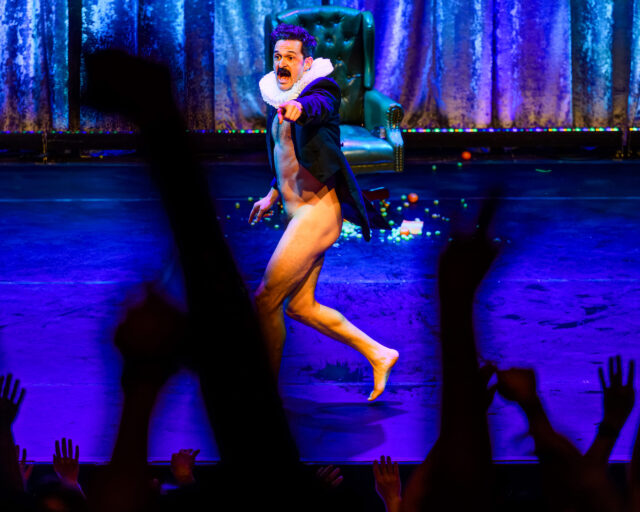
INCIPIENT INTIMATIONS AND PROVOCATIVE MELONSMELLONOUS OSCULATION: ERS’S ULYSSES AT THE PUBLIC

Elevator Repair Service adaptation of Ulysses is fun frolic through 1920 masterpiece (photo by Joan Marcus)

ULYSSES
The Public Theater, Martinson Hall
425 Lafayette St. by Astor Pl.
Tuesday – Sunday through March 1, $109
www.publictheater.org
www.elevator.org

Who knew that Ulysses was such raunchy fun? Certainly not me, who, like many others, have cracked open but never fully read James Joyce’s 1920 masterpiece.

Since 1991, the downtown avant-garde theater troupe Elevator Repair Service has been staging unique adaptations, from Shakespeare’s Measure for Measure and Chekhov’s The Seagull to Euripides’s The Bacchae and Albee’s Who’s Afraid of Virginia Woolf? The daring company now continues its reinterpretations of classic literature, which include William Faulkner’s The Sound and the Fury, The Select (Ernest Hemingway’s The Sun Also Rises), and Gatz, an eight-hour extravaganza featuring every single word of F. Scott Fitzgerald’s The Great Gatsby, with a frisky frolic through what is considered to be one of the greatest books ever written.

“Hello and welcome to Ulysses,” longtime ERS cast member and codirector Scott Shepherd announces at the beginning. “Get ready. As one critic said, not much happens in Ulysses, apart from everything you can possibly imagine.” Shepherd prepares the audience by explaining that Joyce purposely filled the novel with enigmas and puzzles and experimental turns, writing many chapters in different styles, in order to “keep the professors busy for centuries arguing about what he meant, and that’s how he would insure his immortality. And like many things Joyce said, it’s a joke, but also not a joke, because here we are, more than a hundred years later, and the professors are still arguing.”

The set, by the collective known as dots, is centered by a long table in the front, where seven actors playing forty characters often sit before getting up and participating in absurdist scenes. A clock on a far wall keeps track of the time, which goes back and forth on Thursday, June 16, 1904, in Dublin. Shepherd and codirector John Collins have trimmed the story down to a lean 165 minutes with intermission; whenever they skip a few sentences, paragraphs, or pages, the words are speedily projected on the table and/or wall, initially accompanied by screeching sounds that eventually calm down a bit as the actors grab on to the table, as if the time jumps have them holding on for dear life.

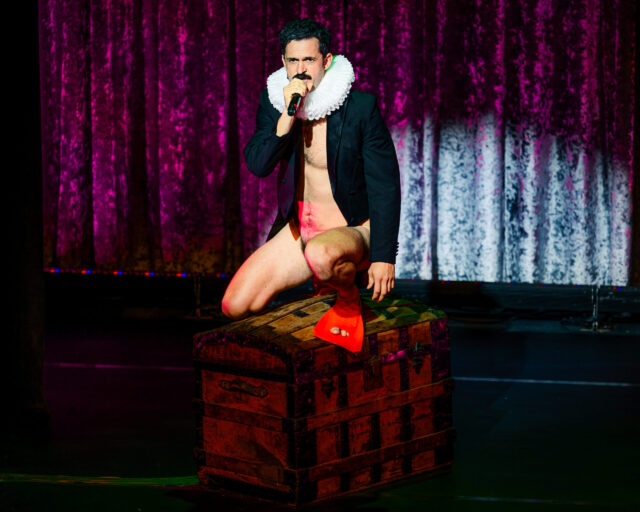
Dr Malachi Mulligan (Scott Shepherd) examines “bisexually abnormal” asylum escapee Dr Bloom (Vin Knight) in Ulysses (photo by Joan Marcus)

The narrative consists of eighteen episodes, from “Telemachus” and “Nestor” to “Ithaca” and “Penelope,” reimagining Homer’s eighth-century BC saga The Odyssey, adding references to King Lear and Hamlet. The action travels from Eccles St., Essex Bridge, and the post office to Davy Byrne’s pub, the library, and the Ormond Hotel, following the (mis)adventures of protagonist Leopold Bloom (Vin Knight), a simple man married to Marion, also known as Molly (Maggie Hoffman), a singer who is having an affair with her goofy manager, Blazes Boylan (Shepherd), who struts around with his silly locks of hair spewing out from under his straw hat, and Stephen Dedalus (Christopher-Rashee Stevenson), who previously appeared in Joyce’s A Portrait of the Artist as a Young Man and returns here as a deeply pensive history professor mourning the loss of his mother (Stephanie Weeks) while avoiding his father, Simon (Kate Benson).

Among the other figures who pop in and out of the less-than-neatly-laid-out plot are university students Armstrong (Dee Beasnael) and Haines (Benson), Dr Punch Costello (Weeks), the expert spitter known as the citizen (Benson), newspaper editor Myles Crawford (Benson), antisemitic headmaster Mr Deasy (Knight), pub gossipers Joe Hynes (Stevenson) and John Wyse Nolan (Weeks), Nosey Flynn (Weeks) from Dubliners, and medical student Buck Mulligan (Shepherd), who is the subject of Joyce’s beloved opening: “Stately, plump Buck Mulligan came from the stairhead, bearing a bowl of lather on which a mirror and a razor lay crossed. A yellow dressinggown, ungirdled, was sustained gently behind him on the mild morning air. He held the bowl aloft and intoned: ‘Introibo ad altare Dei.’”

Don’t try to get caught up in the plot, as it’s not the point, although Odyssey fans are likely to spot numerous similarities between Homer’s and Joyce’s characters; instead, Ulysses, in the book and in this vastly entertaining ERS staging, is about human consciousness and the love of language, with tongues firmly in cheeks. Exquisite verbiage pours forth at any moment — “Ah! Godblazeqrukbrukarchkrasht!” Boylan declares to Marion, who responds, “O! Weeshwashtkissinapooisthnapoohuck?” — as well as spectacular, unforgettable lines, such as when Stephen says, “History is a nightmare from which I am trying to awake.” Also showing up are such fab phrases as “the scrotumtightening sea,” “ineluctable modality of the visible [and the audible],” “Shut your eyes and see,” “the incipient intimations of proximate dawn,” and “the heaventree of stars hung with humid nightblue fruit.” Oh, and let’s not forget “He kissed the plump mellow yellow smellow melons of her rump, on each plump melonous hemisphere, in their mellow yellow furrow, with obscure prolonged provocative melonsmellonous osculation.”

Here is an exemplary passage, the narration divided between two of the performers:

SW: Mr Leopold Bloom ate with relish the inner organs of beasts and fowls.
KB: He liked thick giblet soup,
SW: nutty gizzards,
KB: a stuffed roast heart,
SW: liverslices fried with crustcrumbs,
KB: fried hencods’ roes.
SW: Most of all he liked grilled mutton kidneys which gave to his palate a fine tang of faintly scented urine.

Leopold Bloom (Vin Knight) takes a gander at the dirty Sweets of Sin in ERS adaptation (photo by Joan Marcus)

“The pity is, the public will demand and find a moral in my book — or worse they may take it in some more serious way, and on the honour of a gentleman, there is not one single serious line in it,” Joyce told Djuna Barnes in a 1922 interview for Vanity Fair. “In Ulysses I have recorded, simultaneously, what a man says, sees, thinks, and what such seeing, thinking, saying does, to what you Freudians call the subconscious — but as for psychoanalysis, it’s neither more nor less than blackmail.”

ERS takes that spirit and runs with it, from Enver Chakartash’s playful costumes, Marika Kent’s mischievous lighting, and Ben Williams’s brash sound to Matthew Deinhart’s text projections and Patricia Marjorie’s hilarious props, which range from paper airplanes to doll babies. The six actors hit just the right note throughout as they switch in an instant from one character to narrator to another character, never missing a beat.

You don’t have to have read the book or seen Joseph Strick’s 1967 film adaptation to understand what is going on, since nothing happens, and everything. Just sit back, relax, and enjoy the wild, unpredictable shenanigans as ERS celebrates another literary treasure as only it can.

As Stephen says early on, “When one reads these strange pages of one long gone one feels that one is at one with one who once . . .”

[Mark Rifkin is a Brooklyn-born, Manhattan-based writer; you can follow him on Substack here.]
MAKING NEW FRIENDS AT BOOKS OF WONDER

Who: Maria Bea Alfano, Corey Ann Haydu, Katie Risor
What: Book launches with readings and signings
Where: Books of Wonder, 42 West Seventeenth St.
When: Saturday, November 8, free with RSVP, 3:00
Why: “GioGioGio! Ruffruffruff, arooo!” So begins Maria Bea Alfano’s Barker’s Doghouse 2: Leave It! (Pixel+Ink, November 25, $16.99), the follow-up to the first Barker’s Doghouse book, Fetch! Illustrated by Laura Catalán, the books detail the adventures of ten-year-old Gio Barker as he moves to a new town and finds friends in a group of talking canines.

Alfano will be at Books of Wonder on November 8, joined by Corey Ann Haydu, author of Zoomi and Zoe and the Tricky Turnaround and Zoomi and Zoe and the Sibling Situation (Quirk, $15.99), a series, illustrated by Anne Appert, about a monster and her new imaginary friend, and Katie Risor, the author-illustrator of Welcome to the Forest: The Harvest Party (Andrews McMeel, $11.99), about charming woodland creatures.

Each author will introduce and/or read from their books, then be available for a meet and greet to sign copies.

[Mark Rifkin is a Brooklyn-born, Manhattan-based writer and editor; you can follow him on Substack here.]
GENIUS STROKES: HIRSCHFELD AND SONDHEIM AT THE ALGONQUIN

“Strokes of Genius: Hirschfeld at the Algonquin” continues through September 20 at historic hotel (photo © the Al Hirschfeld Foundation)

STROKES OF GENIUS: HIRSCHFELD AT THE ALGONQUIN
The Algonquin Hotel Oak Room
59 West 44th St. between Fifth & Sixth Aves.
Through September 20, free, noon – 7:00 pm
www.alhirschfeldfoundation.org
www.algonquinhotel.com

On September 9, theater stars came out of the woodwork — or, actually, their framed caricatures on the walls of the Alqonquin’s famed Oak Room — to celebrate the opening of the new exhibition “Strokes of Genius: Hirschfeld at the Algonquin” as well as the launch of the oversize poster book Hirschfeld’s Sondheim (Abrams ComicArts, $29.99).

Among those on hand to share their stories about being drawn by Al Hirschfeld, the St. Louis–born artist who spent decades making black-and-white portraits of Broadway celebrities, writers, and other famous names, were Tony winners Danny Burstein, John Leguizamo, and Len Cariou, Emmy winner and Tony nominee Lonny Price, Tony nominee and Obie winner Charles Busch, Obie winner Jackie Hoffman, Tony nominee Veanne Cox, and Broadway stalwart Jim Walton. Al Hirschfeld Foundation creative director David Leopold presented several of them with reproductions of the images they are in.

As you walk around the space, you’ll see Cathy Rigby in Peter Pan, Yul Brynner in The King and I, Carol Channing in Hello, Dolly!, Leonard Nimoy and William Shatner in Star Trek, and Liza Minnelli, George Gershwin, Carol Burnett, Zero Mostel, Katharine Hepburn, Leonard Bernstein, Whoopi Goldberg, Stephen Sondheim, Barbra Streisand, Dizzy Gillespie, Frank Sinatra, the Grateful Dead, the casts of The Phantom of the Opera, The Sopranos, and A Funny Thing Happened on the Way to the Forum, the Algonquin Round Table, and a few self-portraits.

Meanwhile, Hirschfeld’s Sondheim consists of ready-to-frame posters of drawings from West Side Story, Passion, Company, Getting Away with Murder, Assassins, Into the Woods, and many more in addition to a graphic timeline; each drawing is accompanied by a brief anecdote. “I can hardly think of a better way to memorialize Steve and his art other than actually watching his shows or listening to his songs,” Bernadette Peters writes in the introduction. “Al, in a single image, captures a memorable emotion, indelibly etching out hearts and memories with Steve’s artistic contributions.”

Longtime theater critic Ben Brantley explains in his foreword, “In these drawings, I have found something like a past-recapturing, Proustian madeleine, made of ink instead of flour and sugar. These seemingly simple pen strokes — and the ellipsis of the white space, which your own, happily collaborative mind fills in — are anything but static. They tremble with energy, tension, and, above all, character, as it is conjured in real time on a stage.”

The exhibit at the Algonquin continues through September 20; an online companion show runs at Helicline Fine Art until November 2.

“It’s hard to imagine twentieth-century Broadway without either Hirschfeld or Sondheim,” Leopold writes in the book’s afterword. “Both men admired each other’s work, and both loved the theater, their legacies strengthened by remaining a presence on the Great White Way with two Broadway houses named in their honor.”

[Mark Rifkin is a Brooklyn-born, Manhattan-based writer and editor; you can follow him on Substack here.]