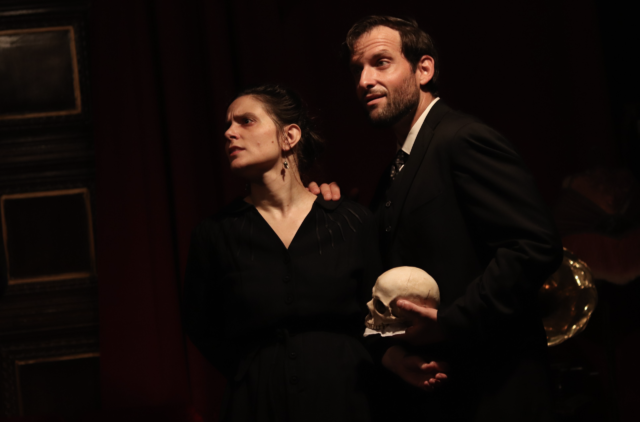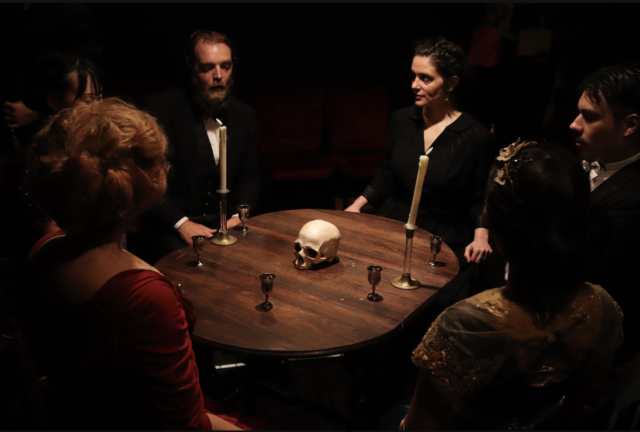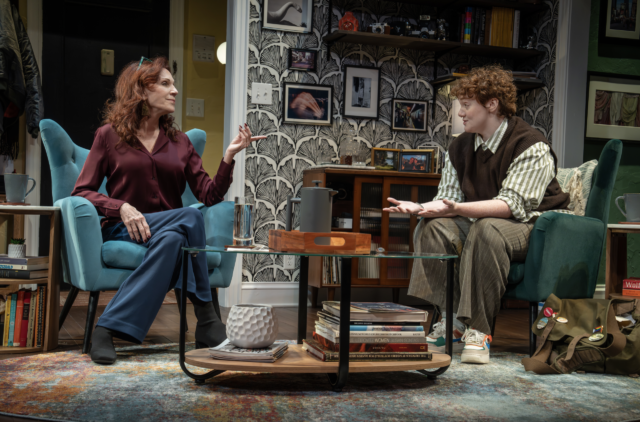
Who: Jocelyn Kuritsky, Kate MacCluggage, Jake Hart, Colleen Werthmann, Cecil Baldwin, Carl Raymond What: Special live radio play presentation of A Simple Herstory Where:The Tank, 312 West Thirty-Sixth St. between Eighth & Ninth Aves.; after-party at Torn Page, 435 West Twenty-Second St. between Ninth & Tenth Aves. When: Sunday, June 7, radio play $28, 3:00, after-party free (suggested donation $13), 6:00 Why: In its award-winning inaugural season, actor, creator, producer, host/interviewer, and occasional designer Jocelyn Kuritsky’s audio fiction podcast, A Simple Herstory, explored the life and career of Victoria Woodhull, the suffragist who was the first woman to run for president, in 1872, representing the Equal Rights Party, battling incumbent commander in chief Ulysses S. Grant and newspaper editor and publisher Horace Greeley.
The upcoming second season turns its attention to Maine’s Margaret Chase Smith, who served in the House from 1940 to 1949 and in the Senate from 1949 to 1973. She ran for president in 1964 in the Republican primary, which was won by Barry Goldwater. Smith is most well remembered for her June 1, 1950, fifteen-minute speech delivered on the Senate floor that concluded with “A Declaration of Conscience,” a five-point message aimed at Wisconsin senator Joseph McCarthy’s communist witch hunt but still rings true today. “It is high time that we stopped thinking politically as Republicans and Democrats about elections and started thinking patriotically as Americans about national security based on individual freedom,” she said, supported by six other senators.
On June 7 at 3:00, a segment from season two of A Simple Herstory will be performed live at the Tank, featuring Kuritsky (Woodshed Collective), Kate MacCluggage (Left on Tenth), Jake Hart (Big George), Colleen Werthmann (Mr. Burns: A Post-Electric Play), and Cecil Baldwin (Welcome to Night Vale), directed by Meghan Finn (A Trojan Woman,Mahinerator) and written and developed by Jonathan A. Goldberg (Real Dead Ghosts,Deus Machina Ex or Eleanor Roosevelt vs. the God Machine). Don’t worry about the serious, and relevant, subject matter; Kuritsky promises “a fast, funny, inventive recounting of history that refracts the complexity and tension of politics through a live radio play experience.”
The show, being held in conjunction with the twenty-fifth anniversary of the Tribeca Festival, will be followed by an after-party at Torn Page, where the creative team will discuss the project with moderator Carl Raymond, creator and host of the podcast The Gilded Gentleman.
[Mark Rifkin is a Brooklyn-born, Manhattan-based writer; you can follow him on Substack here.]
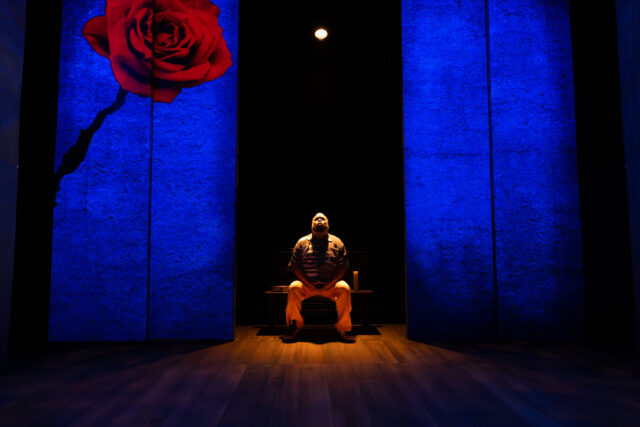
Natasha Roland and Xhloe Rice star in And Then the Rodeo Burned Down at Ars Nova (photo by Ben Arons)
AND THEN THE RODEO BURNED DOWN
Ars Nova
511 West 54th St. between Tenth & Eleventh Aves.
Monday – Friday through July 2, $43.67 – $80.12 arsnovanyc.com www.xhloeandnatasha.com
“This is the best place in the world,” Dale says several times in Xhloe Rice and Natasha Roland’s enchanting, exhilarating And Then the Rodeo Burned Down. Dale is not just talking about the rodeo, where he is a clown who dreams of becoming a cowboy, but is referring to America itself — and how it may be necessary to burn it down and start all over again.
In 2022, the New York City–based duo known as Xhloe and Natasha won the Edinburgh Fringe First Award for Rodeo, then took home the prize in 2023 for What If They Ate the Baby?, a satire about being a conventional wife in 1950s America, and again in 2024 for A Letter to Lyndon B Johnson or God: Whoever Reads This First, which captures the America of the late 1960s as well as today, as politics, religion, and the military become intertwined and the everyday struggles of the common people are completely misunderstood or purposely ignored.
Last month they received a special Drama Desk Award for Baby?, which ran at SoHo Playhouse in the fall, and Letter to LBJ, which played there last June. They were cited for “their absurdist sensibilities [that] test the parameters of several genres and movement styles . . . and invite new appreciation for all of them.”
Rodeo, which opens today at Ars Nova for a run that has already been extended to July 2, continues their testing of parameters in yet another brilliant, endlessly inventive, and absolutely delightful work of theatrical wonder.
The fun begins with the program itself, which, on one page, identifies Natasha and Xhloe, in clown makeup and western garb, as “prime suspects” in an unnamed crime and offers a reward if they are found alive. “We will not be held liable for any hijinks, shenanigans, or mishaps you may or may not encounter in pursuit of these delinquents,” the poster proclaims.
Emmie Finckel has transformed the space into a welcoming one-ring circus centered by a platform with a star in the middle, a small animal gate, and banners and flags hanging everywhere, some depicting cartoonish wealthy businessmen and ridiculous royalty. The entrance music consists of such songs as Luke Bryan’s “Country Girl (Shake It for Me),” Carrie Underwood’s “Before He Cheats,” and, appropriately setting the stage, Shania Twain’s “Man! I Feel Like a Woman!,” in which the superstar sings, “Let’s go, girls! Come on! / I’m goin’ out tonight, I’m feelin’ alright / Gonna let it all hang out / Wanna make some noise, really raise my voice / Yeah, I wanna scream and shout / No inhibitions, make no conditions / Get a little outta line / I ain’t gonna act politically correct / I only wanna have a good time.”
And Then the Rodeo Burned Down is a hilarious excoriation of the American dream (photo by Ben Arons)
Over the course of the next seventy deliriously entertaining minutes, Xhloe and Natasha ostensibly tell the story of Dale (Rice) as he shares his hopes and dreams, often counteracted by his shadow (Roland). “Who are you?” Dale asks the figure that is suddenly sticking close to him. “I’m just like you!” the shadow answers in the first of many instances of mirroring.
Naming the shadow Dilly Dally, Dale explains, “The rodeo is the best place in the world. It’s where cowboys compete in roping calves and wrestling steer and riding bronco and everybody cheers and claps for ’em and everybody comes to see ’em and everybody wants to go to the rodeo and everybody wants to work at the rodeo and I get to live here and be here every day . . . so.” The metaphor of the rodeo — whose fan base leans heavily toward midwestern Republicans — as America is made clear by their relatively ratty costumes: Not only is their makeup red, white, and blue, but Xhloe is wearing pants with red and white stripes, while Natasha’s has a star on her butt. Together, they form their own version of Old Glory.
Soon Dale is being mentored by the rodeo’s macho main attraction, Barnaby (Roland), who Dale considers to be the perfect cowboy and role model. He makes it clear that this is his show and that Dale should be thankful just to be in his presence. “Ya know, you don’t want to confuse the audience on where to look,” he points out. “’Cause I know a thing or two about show business and lesson number one is to never make an audience confused; audiences are notoriously stupid.” (Warning: There is more than one ‘lesson number one.’”)
Barnaby’s tutoring is a subtly effective way of emphasizing classism, power, and misogyny that is enhanced as he teaches Dale how to smoke, endangering his health while hiding the addictive element of cigarettes, and when Arnold the Bull (Roland) escapes from his cage, calling to mind unjustly incarcerated minorities, undocumented immigrants, and American citizens held down by a corrupt, biased, bigoted system. “That thick head of yours not know the rules?” Dale, who is terrified of breaking the written and unwritten laws, says.
Various hilarious episodes deal with freedom, the silencing of women, gun violence, same-sex relationships, poverty, religion, the price of gas, and shoveling shit. But Xhloe and Natasha make sure Rodeo never gets preachy, never wears its heart on its sleeve. Incorporating magic, music (relevant songs by Johnny Cash and Elvis Presley), mime, Marx brothers slapstick, and marvelously simple props, Xhloe and Natasha, with director Tom Costello, keep the laughs coming; the two performers’ affection for each other, and, perhaps even more important, for the audience, shines through. That tenderness and warmth are also evident in Angelo Sagnelli’s lighting, which primarily remains bright so everyone can see one another until snapping into a stark darkness.
The show takes a critical shift shortly past the halfway point, turning into a fascinating, no-less-funny treatise on creativity and art in a country that no longer values those fundamental elements as it once did. Defending his profession, Dale says, “It is a really important job. I keep everybody safe.” But from what?
Putting all that aside, at its heart And Then the Rodeo Burned Down is about how we need to learn to love ourselves before we can love others, and even the country itself, the type of love that involves empathy, compassion, faith, trust, hope, and, most definitely, plenty of laughter.
Thus, right now, Ars Nova is one of the best places in the world, wherever Xhloe and Natasha are.
[Mark Rifkin is a Brooklyn-born, Manhattan-based writer; you can follow him on Substack here.]
Hugh Jackman, Marianna Gailus, and Sepideh Moafi star in Ella Hickson’s New Born (photo by Evan Zimmerman for MurphyMade)
NEW BORN
Audible’s Minetta Lane Theatre
18 Minetta Lane between Sixth Ave. and MacDougal St.
Through June 8, $25-$286.50 www.audible.com
There’s an important reason why the title of Ella Hickson’s new play, New Born, is two words; although children figure prominently in each of the three monologues that comprise the nearly two-hour show, it is not about pregnancy or infants. Instead, it deals with three people whose lives are changed forever by someone who unexpectedly enters their sphere of existence, as if they are born anew. Although their stories do not intersect, all three actors — Sepideh Moafi, Marianna Gailus, and Hugh Jackman — are onstage together at the beginning and end of each segment, as if part of an unrelated trio that intrinsically understands one another.
The play opens with “Light,” in which Moafi beautifully portrays a married mother of a young boy. She has a classics degree and an MFA from RISD, is obsessed with celebrity culture, has a job as an illustrator, and believes she is satisfied with her situation.
“I don’t complain, obviously. Never! Me? No. I’m very easy to live with,” she explains. “I can hear my husband cleaning the kitchen, while I’m on the floor, in the dark, holding our kid’s hand, trying to get him to sleep. . . . I can hear my breathing and our child’s breathing, and the soft clanking of my husband cleaning the sink . . . and I do know I’m lucky . . . the luckiest of all.”
But then one Saturday night she has to meet her brother-in-law at a club in order to give him the keys to their summer place and is swept off her feet by an international pop superstar. One dance could potentially lead to more as she takes stock of who she is and what she wants amid a flurry of text messages.
“Hearing from the singer feels like light. Like someone has opened up the top of my skull and poured a load of light inside,” she shares. She is so excited that she forgets to contemplate her own death, something that has plagued her since the day her son was born.
As the two women grow closer, the narrator is faced with yet more choices, none of them easy.
Wearing jeans and a white top, Moafi (The Pitt,Corruption) is warm and engaging as she wanders around Brett J. Banakis and Christine Jones’s spare, seemingly unfinished set, which features black-and-silver utility trunks, scattered chairs and tables, and a ladder in the center, as if it is still a work-in-progress at the Minetta Lane. She is so calmly appealing that I was disappointed when her monologue ended, with a shock.
“Light” is followed by “Rattle,” a blistering if uneven story told by Martha (Gailus), a bartender in her early twenties at an inn in the small town of Sheridan, Wyoming, about a hundred years ago. Raised by a single mother, Martha lives a simple life, one where, she says, “my feet ain’t never left this red sand ground.”
She works with her mama and Little Jimmy, a ten-year-old Black child. She appears to be unsocial yet content. “At nights, I hear the train horn sound right out across the plains, miles and miles of nothing in its way, and it gives me a feeling so lonely — like some kind of poverty,” she says. “I try to focus on something else — even mama’s snoring, or late summer, the sound of them poor cows when the ranchers take their calves away.”
But then one day three cowboys enter the bar: John, who she remembers from school, his friend Wyatt, and a third man. While serving them, the rag she is using for her menstrual flow falls onto the floor, and she notices at the same time the three men do. Seized with a sort of defiance, she doesn’t immediately pick it up, and Wyatt gives her a hard time and eventually punches her in the face.
Soon Martha is getting cozy with John, Wyatt might be hanging around with the Ku Klux Klan, and Little Jimmy goes missing.
Wearing a contemporary outfit, Gailus (Patriots,Sylvia, Sylvia, Sylvia) is deeply affecting as Martha, a jittery young woman who is surrounded by trouble but won’t let that bring her down. She appears to make questionable choices, even when aware of the possible consequences. She is a living dichotomy, just like Wyoming, the first state to grant women the right to vote, in 1890, while also becoming home to a wave of KKK activity in the 1920s.
“Rattle” is a bumpy tale with cinematic language, but it loses track of itself as it meanders to a surprising ending.
Hugh Jackman plays a hunky tree surgeon in “Deadwood” (photo by Evan Zimmerman for MurphyMade)
The show concludes with “Deadwood,” which lives up to its name. Jackman stars as a hunky tree surgeon who falls for one of his customers, a single woman named Katie. He is of course well aware that he is rather handsome and desirable, and he knows how to use that to his advantage.
“In my job, I meet a lot of women. I don’t know why, but it’s usually women who book the tree surgeon, or they’re the ones who are around when I show up — and, if they’re women of a certain age, like — you know, a decade either side of me — I do, just in a normal way — think . . . ‘Would I?’” he admits after she compliments him. “But on this occasion — and I know this sounds, I mean — but I think, I hadn’t considered sleeping with her because I was distracted by her — beauty. Not that I didn’t find her sexually attractive, because now she’s mentioned it, I really do — and I must have taken a while to respond, because she’s kind of laughing, in a nice way, waiting for me to say something.”
As their relationship evolves, he shares numerous metaphors involving trees, dead wood, wood chips, bark, and potentially dangerous boughs, but it all feels like a Hallmark romance movie for people of a certain age. It’s overgrown with genre clichés, standard plot twists, and somewhat boring explication, all delivered in the same straightforward manner by Emmy, Grammy, and Tony winner and Oscar nominee Jackman (The River,The Music Man). Even when tragedy strikes, he maintains his cool demeanor, which is admirable if not realistic. It fails to connect the way the first two monologues did, especially “Light.”
New Born is smoothly directed by Ian Rickson (Jerusalem,The Weir), who has helmed all four plays that have been presented at Audible’s Minetta Lane Theatre by Jackman and Sonia Friedman’s company, Together, which is “dedicated to live theater that is intimate and accessible . . . driven by a commitment to offering audiences a chance to experience theater in a fresh and engaging way.” Last year they staged Hannah Moscovitch’s Sexual Misconduct of the Middle Classes and August Strindberg’s Creditors in repertory with all-star casts, to well-deserved acclaim; this spring they brought back Sexual Misconduct for an encore, along with New Born and a wonderful revival of Tom Noonan’s What Happened Was . . .
A terrific idea that is off to a fine start, Together, still in its infancy, is an ambitious project that I hope continues long into the future.
[ Mark Rifkin is a Brooklyn-born, Manhattan-based writer; you can follow him on Substack here.]
Kip Williams’s adaptation of Jean Genet’s The Maids skewers contemporary society (photo by Julieta Cervantes)
THE MAIDS
St. Ann’s Warehouse
45 Water St.
Tuesday – Sunday through June 14, $49-$149 stannswarehouse.org
“None of it is real,” two characters say in Kip Williams’s scathing adaptation of Jean Genet’s 1947 play The Maids, running through June 14 at St. Ann’s Warehouse.
In his lengthy introduction to the published edition of the play (paired with Deathwatch), Jean-Paul Sartre wrote, “It is the element of fake, of sham, of artificiality that attracts Genet in the theatre. He has turned dramatist because the falsehood of the stage is the most manifest and fascinating of all. Perhaps nowhere has he lied more brazenly than in The Maids.”
Williams has reimagined the work for today’s social-media-obsessed culture, with potent results that, despite the “lies,” ring only too true.
Sisters Solange (Phia Saban) and Claire (Lydia Wilson) are live-in maids toiling for Madame (Yerin Ha), a wealthy, famous influencer whose father is a billionaire. The siblings both hate and love Madame, wanting to be her while also dreaming of killing her. They rummage through her closets of expensive couture and luxuriate in her bedroom, which is filled with colorful flowers and floor-to-ceiling mirrors.
For the first part of the play, Rosanna Vize’s plush, elegant set is surrounded by a thin translucent curtain, as if the characters are trapped inside, but when it opens it merges the “falsehood of the stage” with a kind of realism that only enhances the fantasy world Genet and Williams have created and the three characters bask in.
Solange and Claire have deviously plotted to frame Madame’s boyfriend, who has been arrested for embezzlement, another example of fakery. “I needed it to be real,” Claire says when detailing how they pulled it off.
When Madame finally shows up, she is aghast at everything and everyone, from the flowers Kim Kardashian has sent her to the selfie a fan had asked for. “You can tell her assistant directly from me that he should either consider a career change or do some fucking research cos even fucking ChatGPT could tell you that nobody is doing pink fucking hydrangeas anymore. Fuck. Why is it so hard to get good help these days?” she complains to Solange. “Ok!? I feel like I’m going to die, but there’s like a massive difference between my metaphoric death and sending me this fucking disgusting death parade of flowers. Like I am in mourning for my literal life, but like not for actual real, ok?”
As insults fly and the tension mounts, the proceedings are projected on the mirrored closets as if being broadcast live on Instagram or TikTok, complete with filters that make the characters look like garish versions of Brad Pitt and Angelina Jolie, name-dropping such brands as Gianvito Rossi, Balenciaga, and Gucci by Ancora while Madame worries that her boyfriend will be sent to Guantanamo and that she’ll have to move to her father’s villa in France to get away from all the tumult. “It’s going to be really hard,” Madame says. “I will make such a fuss over you both. You’ll be like my little country dolls.”
But through it all, the three women make sure to capture nearly every minute online, which is the only thing that truly matters.
“I’m over. I’m dead. I’ve been cancelled, babes!” Madame opines. “Solange, film this. Film this. This is perfect. This is how it ends. This is perfection!”
Madame (Yerin Ha) chooses just the right dress as sisters Solange (Phia Saban) and Claire (Lydia Wilson) stand back to back (photo by Julieta Cervantes)
Genet grew up in foster care and was arrested numerous times, including for vagrancy, theft, and using false identity papers. Identity is key to The Maids, as the characters occasionally take one another’s place and create fake identities online. Loosely inspired by the true story of sisters Christine and Léa Papin, two maids who killed their mistress and her daughter in France in 1933, Williams’s version is an unsparing satire about twenty-first-century Western culture mired in the desperate need of individuals to put their lives online, acquire likes, and expand their influence amid classism and capitalism run amok.
The Maids is tailor made for actors to hold nothing back and has boasted major trios in the past: Vivien Merchant, Glenda Jackson, and Susannah York in 1973, Cate Blanchett, Isabelle Huppert, and Elizabeth Debicki in 2013, and Uzo Aduba, Zawe Ashton, and Laura Carmichael in 2016. Saban (House of the Dragon,Oedipus) and Olivier nominee Wilson (King Charles III,Pains of Youth) appropriately devour the scenery as the virtually interchangeable sisters, while Ha (Bridgerton,Lord of the Flies) gets her fill as well, leading to a finale that reaches a devastating crescendo.
Williams, who also used live video in his Tony-nominated The Picture of Dorian Gray,Dracula, and Strange Case of Dr. Jekyll and Mr. Hyde, keeps the artifice front and center throughout. Zakk Hein’s projections are huge and grotesque, getting in the audience’s face, both enhancing and overwhelming the action unfolding onstage; should we be looking at the actors themselves or their giant images? Are we actually seeing ourselves and our desire for a fancy home, expensive clothing and accessories (the fanciful, and absurd, costumes are by Marg Horwell), and online fame assisted by botox and Ozempic? And how far are we willing to go to achieve any of that?
The stellar production also features sound by Dan Balfour, lighting by Jon Clark, and original music by DJ Walde that add to the “artificiality” of Genet’s vision. It’s often hard to watch, but you can’t turn away; as fantastical and outrageous as it all seems, it’s also all too real.
“Everything must be so false that it sets our teeth on edge,” Sartre adds in his introduction.
My teeth are still chattering.
[Mark Rifkin is a Brooklyn-born, Manhattan-based writer; you can follow him on Substack here.]
Mayhem ensues when a surprise being appears on board a corporate research vessel in Axis Theatre’s Specimen (photo by Regina Betancourt)
SPECIMEN
Axis Theatre Company
One Sheridan Sq. between West Fourth & Washington Sts.
Wednesday – Saturday through June 6, $10-$40, 7:00 www.axiscompany.org
Randall Sharp’s Specimen is not a cautionary tale of where America is heading; instead, it’s a frenetic sci-fi satire warning us that it’s already too late to save the ship and its crew.
“We are dead in the water. We’re just floating. Communication is out,” Overholser (Britt Genelin), an engineer aboard the US VitaNavis Nomad, says early on in the seventy-five-minute play. “All we need is a little push to get to the earth-pull zone for home. I hope we don’t just smash into it! Plus I could use a decent med clinic. And a haircut. I feel sick. I feel tired.”
The corporate research vessel Nomad, named after people who move around from place to place — for example, undocumented immigrants and refugees — is on a mission to collect valuable living specimens more for their potential financial value rather than their scientific worth. The crew is a ragtag “bunch of morons,” as Lt. Commander Gordon (Julian Rozzell Jr.) refers to them. Gordon has annoyed his team because he has fudged critical reports. The ambitious and energetic Overholser has been beaten up by the severely ill King (Spencer Aste, only seen on video). Dr. Gardener (Andrew Dawson), the chief medical officer, says, “I know what I’m doing” without any evidence to support that. Medical assistant Longshore (Jon McCormick) asks a lot of questions but provides no answers. Louden’s (Jim Sterling) primary responsibility is to greet newcomers, but he can’t get anything to work. And Capt. Gonickeau (Lynn Mancinelli) is hiding in sick bay, not wanting to confront any kind of problem at all.
An endless stream of glitches plagues the Nomad: Ironic, familiar pop songs come and go on the speaker system. The monitors flash on and off with reckless abandon, broadcasting a bright, sunny commercial with the VitaNavis president (Robert Ierardi) that quickly goes bad, as well as private video diaries that are not meant to be seen by others, a melding of the captain’s log and social media posts. The food supply, from saltines to what they call “SUP,” is running dangerously low. And various odd smells are wafting about. Patience is wearing thin even with Earth so close.
The Nomad’s archnemesis, the stellar Jericho, is nearby, rumored to have a pair of prize specimens that are likely to make them win the battle once again. (In the lobby case is a previous trophy the Jericho won, along with a roster of its crew, featuring one member who becomes central to the plot.) It seems like the Jericho, whose name in Arabic means “fragrant” and the Bible calls “the City of Palms,” can do no wrong, the polar opposite of the Nomad, as if one is the dream of America, the other the current reality, one an oasis, the other a boiling inferno.
But when a mysterious being (Brian Barnhart) suddenly arrives in a pod, all hell breaks loose as the crew fights over whether the creature is a fabulous Andro-Primatus specimen worth millions or jokester Jay Marlin, a doctor from the Jericho who is in need of medical help. The doctor’s last name could be a sly reference to the large fish Santiago catches and struggles to bring back in Ernest Hemingway’s The Old Man and the Sea, believing it will turn his luck around. “It is good that we do not have to try to kill the sun or the moon or the stars. It is enough to live on the sea and kill our true brothers,” Santiago says to himself.
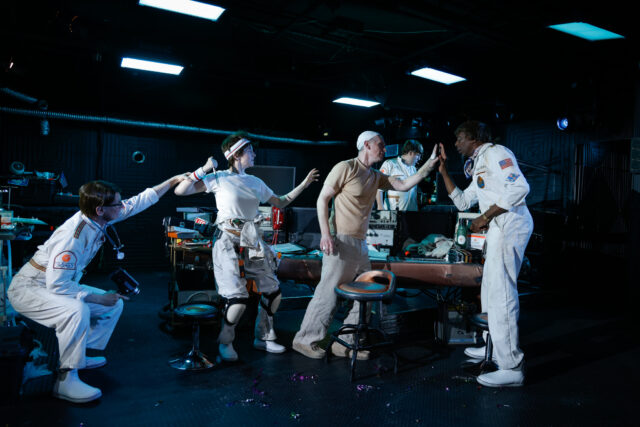
The ramshackle set, by Sharp, McCormick, and Mancinelli, is like a bizarro-world merging of the starship Enterprise, the Discovery from 2001, and the Nostromo from Alien, with a nod to Tom Sachs’s DIY NASA installations. The white uniforms, designed by Karl Ruckdeschel, have fun touches, such as the character’s job stenciled on the back in big letters. David Zeffren’s lighting and Paul Carbonara’s sound and original music, along with Nicholas Guldner’s video design, maintain the low-tech atmosphere of impending doom.
The exemplary ensemble, consisting of Axis company members and returnees, somehow manages to keep straight faces despite all the absurdist mayhem taking place, led by Rozzell Jr. (Our Planet,Father Comes Home from the Wars) as the determined lieutenant and Genelin (Twelfth Night,Washington Square) as a kind of bruised and battered ingénue in an ill-fitting spacesuit. Each actor also sports fantabulous hair, riffing on the obvious wigs worn by the cast of the original Star Trek movies.
Sharp, who has previously adapted such classics as High Noon and Dead End and written and directed such new works as Worlds Fair Inn and Last Man Club, orchestrates a clever balance between farce and fright as the proceedings continue and the crew has to figure out who or what the specimen is and what to do with it.
It’s a subtle but ripe parody of a bumbling administration that prefers money over science, with little interest in aiding immigrants, giving their employees proper training or affordable health care, or fixing a spacecraft that is falling apart.
When the pod first pulls into the port, there is no sign of anyone there. “Hello!! Maybe . . . maybe it’s not American?” Dr. Gardener asks. Gordon replies, “Of course it’s American. What else would it be.”
Oh, this is America all right.
Over and out.
[Mark Rifkin is a Brooklyn-born, Manhattan-based writer; you can follow him on Substack here.]
The Challenger disaster offers new insight into Jared Mezzocchi’s relationship with his mother in 73 Seconds (photo by Maria Baranova)
73 SECONDS
Lower Eastside Girls Club
402 East Eighth St. at Ave. D
Thursday – Monday through May 18, $70-$140 www.engardearts.org/73seconds
“You remember where you were when it happened,” Jared Mezzocchi says in his multimedia solo show 73 Seconds. “What do you do when there is no explosion?”
I remember exactly where I was when it happened — Mezzocchi is referring to the Challenger disaster, when the space shuttle carrying a crew of seven, including the first teacher in space, Christa McAuliffe, broke apart seventy-three seconds into its flight on January 28, 1986. I was picking up my sister from high school, sitting in the car, listening to the radio when the news hit.
We went straight home, and I watched for hours as Dan Rather talked and talked about solid rocket boosters and McAuliffe and CBS showed the explosion over and over again.
“The thing about explosions is that it’s something you can point at,” Obie-winning director, actor, playwright, associate professor, and designer Mezzocchi adds. “There’s before the explosion, the explosion, and then after the explosion. It happens quickly.”
In 73 Seconds — which takes place in an actual working planetarium at the Lower Eastside Girls Club — Mezzocchi turns his attention to his mother, Rosemary, a popular teacher who, at a restaurant celebrating his high school graduation, casually mentions that she once worked for NASA. The revelation blows the space-obsessed Mezzocchi’s mind, and it gets even more complicated when she describes her connection to the Challenger.
It is such a shock to his system that he wonders if it’s actually true, especially as his mother contracts Alzheimer’s. “What am I doing, memorializing someone who’s still alive?” he asks.
It’s territory he’s explored before: In his deeply personal 2021 virtual On the Beauty of Loss, Mezzocchi related the deaths of his father and grandfather.
Jared Mezzocchi integrates old technology into his new solo show (photo by Maria Baranova)
Mezzocchi shares his mother’s story — which can often get too intimate and explanatory, as if he’s speaking with his therapist instead of a theater audience — using a mix of technology, much based on what was available in the 1980s, including an overhead projector, cassette tapes, poorly composed family photographs, and scratchy audio. He occasionally projects the universe onto the planetarium dome, but not quite enough. The sound is by Ryan Gamblin, with lighting and video by Jeanette Oi-Suk Yew and production design by Calvin Anderson.
Directed and co-created by the always inventive Aya Ogawa (The Nosebleed,Meat Suit, or the shitshow of motherhood), the narrative hits some bumpy snags — it’s by no means a smooth ride, but it does echo what appears to be going on inside Mezzocchi’s head as he deals with this surprising new family information, from small explosions to bigger ones — but it cleverly explores the never-ending, complex relationships between parents and children. It also answers some questions that Mezzocchi (The Wind and the Rain,Vietgone) raised in On the Beauty of Loss, when he races to the hospital after being told his father has been admitted there.
Ultimately, 73 Seconds is a touching experience, one that will have you thinking about your own relationship with your parents. It’s about how we grieve, the secrets we keep, and the connections we need to move forward.
And it’s another unique piece from En Grade Arts, which specializes in presenting work in unusual spaces, from a Brooklyn bar and New York City apartments to Brookfield Place and Hudson River Park — and now a surprise planetarium in an unexpected location.
[Mark Rifkin is a Brooklyn-born, Manhattan-based writer; you can follow him on Substack here.]
Ophelia (Francesca Mills) and Hamlet (Hiran Abeysekera) try to hold on to their love in National Theatre production at BAM (photo by Julieta Cervantes)
HAMLET
Brooklyn Academy of Music
BAM Strong Harvey
651 Fulton St.
Through May 17, $46-$226 www.bam.org/hamlet
One of the myriad great things about Shakespeare’s plays is their adaptability; they can be done as straightforwardly as possible or be transplanted into an endless number of settings, changing the time and place while staying true to the Bard’s words. Nevertheless, some productions get so caught up in their tinkering that they lose sight of the play itself.
Two current shows in New York City take different approaches to a pair of Shakespeare’s most popular tragedies, but each is a celebration of the language. I found myself discovering details in the National Theatre’s Hamlet at BAM and Bedlam’s Othello at the West End Theatre that made each work feel fresh and new across their nearly three hours.
BAM has a long history with Hamlet; it was their inaugural theatrical presentation, in 1861. It was also the National’s first play in London, in 1963. Continuing at the Harvey through May 17, director Robert Hastie (Operation Mincemeat) reimagines the dour Dane for the modern era in a dark and funny version with numerous delicate touches.
Hiran Abeysekera portrays Hamlet as a kind of nepo baby trying to find his way in a world that has suddenly shifted for him following the death of his father, the king (a terrific Ryan Ellsworth, also the Player King and the gravedigger), followed by his mother’s (Ayesha Dharker) almost immediate marriage to the king’s brother, Claudius (a splendid Alistair Petrie), who now wears the crown. It gets even more complicated when his father’s ghost appears and reveals that uncle Claudius poisoned him in order to ascend to the throne.
With vengeance on his mind, Hamlet doesn’t have enough room in his life for Ophelia (a sprightly Francesca Mills, donning angel wings), who loves him deeply. Her father, Polonius (Matthew Cottle), is Claudius’s chief counselor, and her brother, Laertes (Tom Glenister), is determined to defend her honor at any cost.
Hamlet finds comfort in his closest friend, Horatio (a delightful Tessa Wong), but is suspicious when two of his best buds from childhood, Rosencrantz (Hari Mackinnon) and Guildenstern (Joe Bolland), suddenly arrive; it’s not long before he gets them to admit that they were brought to Denmark by Gertrude to spy on him because of his recent odd behavior.
When a traveling theater troupe arrives to put on a play, Hamlet convinces the First Player (Maureen Beattie) to stage The Mousetrap with a bonus passage by Hamlet, telling the story of a man who kills his brother, the king, exactly how Claudius murdered his sibling, in order to wed his widow and become king himself. “The play’s the thing / Wherein I’ll catch the conscience of the King,” Hamlet says.
As Hamlet descends into madness, Fortinbras (Kiren Kebaili-Dwyer), the crown prince of Norway, prepares his troops to invade Denmark and bodies start piling up.
Hamlet begins in an elegant ballroom with realistic forest wallpaper and transforms into a theater for the fabulous play-within-a-play and a graveyard; the sets are by Ben Stones, who also designed the modern costumes, which for Hamlet includes a Blockbuster Video sweatshirt, a nod to Michael Almereyda’s 2000 film version in which Ethan Hawke delivers the “To Be or Not to Be” monologue while walking through a Blockbuster store, and a “Tobacco and Boys” T-shirt that references the unconfirmed Christopher Marlowe quote “All they that love not Tobacco and Boys are fools”; the phrase was also used by Shakespearean actor Stephen Fry in the title of his 1979 play, Latin! or Tobacco and Boys.
Hastie makes small tweaks to the script that practically leap off the page. Polonius tells Laertes, “To thine own selves be true,” altering “self” to “selves”; Ophelia loudly joins in when Polonius advises his son, “Neither a borrower nor a lender be”; and the “To Be or Not to Be” soliloquy is moved to later in the play, at a crucial point. The language is so front and center that the nearly endless stream of familiar phrases that became names of books, plays, and movies jumps out, from Infinite Jest and What Dreams May Come to The Undiscovered Country and Sleep No More.
As adorable as he is melancholic, Abeysekera (Life of Pi) grabs the audience’s attention from the beginning and never lets go, regularly making faces and gesturing at the crowd. When another character delivers a monologue directly to the audience, Abeysekera looks at them, and us, as if wondering what is going on, believing that only he can see and talk to us. And when he does speak to us, he has us in the palm of his hands, even with his millennial flourishes as he delivers some of Shakespeare’s most unforgettable soliloquies in his own style. He may not be Olivier, Burton, Branagh, Bernhardt, or Gielgud, but he doesn’t have to be; he just has to be Abeysekera, putting his own stamp on the part.
Through it all, the words stand tall, even conquering a few scenes that linger too long or go a bit off-kilter.
Of course, the play’s the thing.
Susannah Millonzi, Susannah Hoffman, Ryan Quinn, and Eric Tucker play all the roles in Bedlam’s stripped-down Othello (photo by Ashley Garrett)
OTHELLO
West End Theatre at St. Paul & St. Andrew United Methodist Church
263 West Eighty-Sixth St. between Broadway & West End Ave.
Tuesday – Sunday through May 30, $24-$86 bedlam.org/w-o/othello
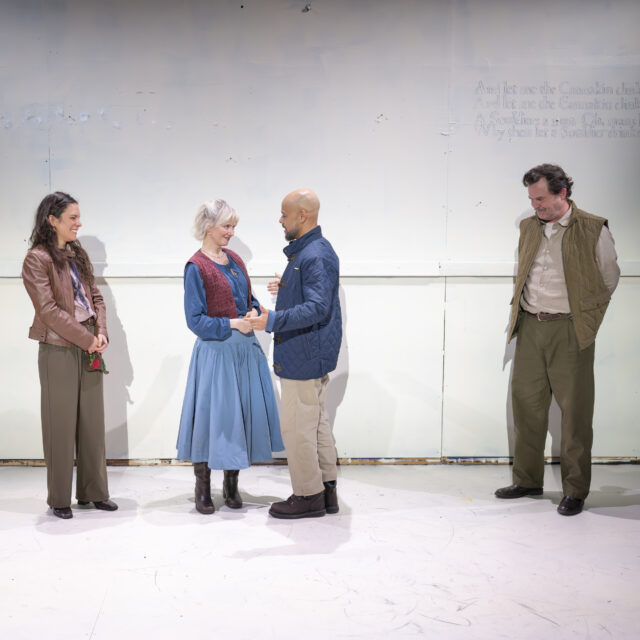
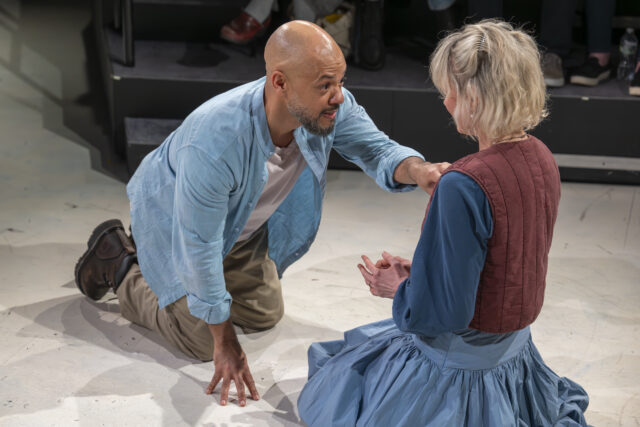
In the National Theatre’s Hamlet, eighteen actors take on twenty-six roles on multiple sets. In Bedlam’s Othello, a cast of four performs more than a dozen parts in a bare white space, with only a handful of small props: Susannah Hoffman is Desdemona and Cassio, Susannah Millonzi is Roderigo and Emilia, Ryan Quinn is Othello and Bianca, and director Eric Tucker is Iago. As with Hamlet, Shakespeare’s words take center stage, for nearly three captivating hours.
Angry that Othello named Cassio his first lieutenant instead of him, Iago is intent on bringing Othello down, through trickery and deceit. He conspires with the Venetian gentleman Roderigo to convince everyone that the Moorish general Othello used evil witchcraft to force Senator Brabantio’s daughter, Desdemona, into a secret marriage. “Your daughter and the Moor are now making the beast with two backs,” Iago tells the powerful politician, using race as a sword.
When Othello and Desdemona publicly declare their love for each other, Iago concocts a diabolical plan to persuade Othello that his beloved is having an affair with Cassio, thus ruining the general and his lieutenant, lifting Iago’s station, and allowing Roderigo to pursue his own lust for Desdemona.
“O beware, my lord, of jealousy! / It is the green-eyed monster which doth mock / The meat it feeds on,” Iago says to Othello. “That cuckold lives in bliss / Who, certain of his fate, loves not his wronger; / But O, what damnèd minutes tells he o’er, / Who dotes yet doubts, suspects yet soundly loves!”
To achieve his revenge, Iago must also pull the wool over the eyes of his wife, Emilia, who is Desdemona’s maidservant; Bianca, Cassio’s lover; the Duke of Venice; Gratiano, Brabantio’s brother; Lodovico, Desdemona’s cousin; and Montano, the governor of Cyprus.
That’s precisely what Iago seeks to destroy in anyone who gets in his way.
Othello (Ryan Quinn) and Desdemona (Susannah Hoffman) face doom and dread in Bedlam production (photo by Ashley Garrett)
The first act of Othello takes place with the actors performing on a dirty white floor in front of an unsteady white wall; initially, the only props are a bell and a black rope/noose, but a string of Christmas lights and a microphone are added for a karaoke scene. For the second act, the three rafters of seating are rearranged to form a circle closing in on the middle, where most of the action occurs, although the actors also stomp around behind the audience and up and down the aisles. Cheyenne Sykes’s lighting gets much darker, the characters at times using flashlights. The actors usually but not always make tiny adjustments to Sam Debell’s contemporary costumes to indicate when they are a different character, which can get a little awkward. The karaoke scene is awkward as well, straying from the simpler beauty of the rest of the show.
Hoffman and Millonzi excel in their multiple roles, and Quinn is an admirable, heart-wrenching Othello, but the key to the narrative lies in the hands of Iago, and Tucker, who also designed the tense sound, is a slyly devious master manipulator, his tongue often in his cheek as his plot unfolds; possessed of a rapier wit, he thinks quick on his feet, like an improv comic who’s not about to lose control of the upcoming punch line.
Bedlam’s first two productions, back in 2013, were four-actor versions of Bernard Shaw’s Saint Joan and Hamlet, so this Othello is a return to its roots following such other successful shows as Sense & Sensibility,Arcadia,The Good John Proctor, and Are the Bennet Girls OK? Because of the minimal staging, the words flow beautifully; you have to listen closely, resulting in picking up small elements you may have missed in bigger adaptations with major stars.
Through it all, the words stand tall, even conquering a few scenes that linger too long or go a bit off-kilter.
Of course, the play’s the thing.
[Mark Rifkin is a Brooklyn-born, Manhattan-based writer; you can follow him on Substack here.]