this week in theater

SINCE MY BABY LEFT ME: HEARTBREAK HOTEL AT DR2

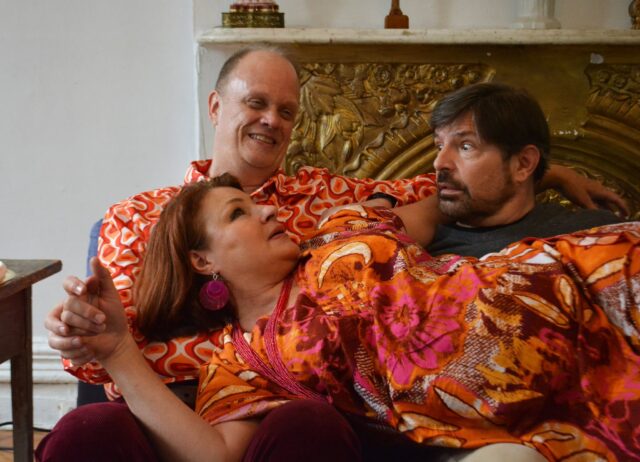
Simon Leary and Karin McCracken face heartache in Heartbreak Hotel at DR2 Theatre (photo by Evan Zimmerman for MurphyMade)

HEARTBREAK HOTEL
DR2 Theatre
103 East 15th St. between Irving Pl. & Park Ave.
Tuesday – Sunday through April 19, $29-$56
heartbreakhotelplay.com
www.darylroththeatre.com

New Zealand company EBKM sets the tone for the American premiere of Heartbreak Hotel during the entrance music, with such songs about romantic pain and misery as Aimee Mann’s “Save Me,” Alanis Morissette’s “That I Would Be Good,” Cher’s “Believe,” and Lenny Kravitz’s “It Ain’t Over ’Til It’s Over” preparing the crowd for what is to come at the small, intimate DR2 Theatre.

Writer and star Karin McCracken, who cofounded the troupe with director Eleanor Bishop, comes onstage, walks to the lip, and, with the lights on, looks out at the audience and says, “I was hoping to get to know everyone a bit before we start, so I’m going to ask you a couple of questions. For the first question, you don’t need to respond out loud. If you just think your answer, and make eye contact with me, I’ll be able to tell. It’s just a thing I’m able to do. So: Is anyone here heartbroken, or grieving, or otherwise bereft?” Starting at the back, she then goes row by row, looking into the eyes of each of the ninety-nine audience members, a clever way to form an instant connection.

She then explains she’s neither a musician nor a singer but she has taken up both disciplines because she read that creativity promotes neuroplasticity and singing suppresses cortisol, relieving stress — “Unless you’re singing in an environment that would naturally promote anxiety, like live performance.”

Over the course of about seventy minutes, she shares her story directly with the audience, re-creating scenes from her character’s past. Simon Leary performs all the other roles: a tinder date, her gay bestie, a supermarket worker, a doctor, and her former partner, who she was with for six years. She also plays, on synthesizer, relevant songs by Bonnie Raitt, Sinéad O’Connor, and the Cranberries, dances, and uses such other scientific terminology as “norepinephrine,” “monocytes,” “RNAs,” “serotonin,” “oxytocin,” “Takotsubo syndrome,” and “chipotle sauce,” which serves as medical explanations regarding love and loss as well as potential excuses for why humans make certain decisions.

Karin McCracken wrote and stars in US premiere of EBKM’s Heartbreak Hotel (photo by Evan Zimmerman for MurphyMade)

Dressed in a country-rock-style jacket with sequins, fringe, and tassels, she deals with her situation with limited success, clearly unable to put the relationship behind her, in scenes such as “Dating While Heartbroken,” “The Science: Protest,” and “Anxious/Avoidant,” the words passing by on a semicircle of LED boxes like digital ticker tape. The production design, which also features pink shag carpeting, is by Rachel Marlow (who also did the lighting) and Brad Gledhill of Filament Eleven 11, with sound by Te Aihe Butler that ranges from a German club to a noisy bar to a quiet beach.

McCracken is engaging as the unnamed woman, imbuing her with a believable honesty, refusing to make her a victim while not afraid to reveal her flaws and mistakes. You’ll root for her to finally take those necessary next steps even as she keeps getting in her own way. Leary slides neatly from character to character, making subtle changes in each as the woman’s story unfolds.

It all leads to a powerful finale, one that resonates with Presley’s 1956 hit — “Well, since my baby left me / I found a new place to dwell / It’s down at the end of Lonely Street / At Heartbreak Hotel / Where I’ll be, I’ll be so lonely, baby / I’m so lonely / I’ll be so lonely, I could die” — but has a hopeful twist at the end, hinting that there may be a way out of the woman’s self-imposed prison.

On the way out of the theater, each audience member is given a small pamphlet consisting of notes and resources, from poetry and music influences to illustrations and acknowledgments, including one for her mum.

Early on in the show, her mother, in a prerecorded voiceover, says, “When someone is in the midst of a heartbreak, it feels like time has stopped — because they want the past and don’t want what the future holds. A state of limbo. It’s a terrible thing.”

As always, mother knows best.

[Mark Rifkin is a Brooklyn-born, Manhattan-based writer and editor; you can follow him on Substack here.]
PLAYING CHICKEN: KRYMOV LAB’S UNCLE VANYA AT LA MAMA

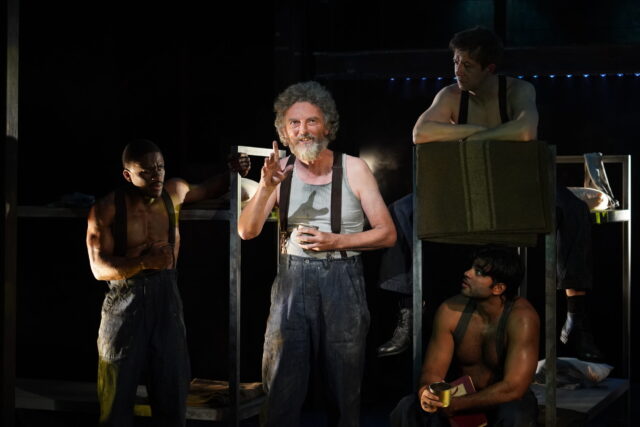
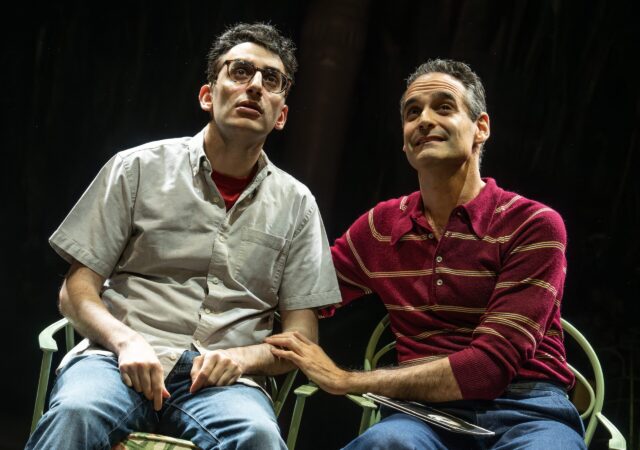
Vanya (Zach Fike Hodges) makes an appeal to Yelena (Shelby Flannery) as Waffles (Amen Igbinosun) watches and Professor Serebryakov (Colin Buckingham) reads in Krymov Lab NYC production at La MaMa (photo by Marina Levitskaya)

UNCLE VANYA, SCENES FROM COUNTRY LIFE
La MaMa Experimental Theatre Club
The Ellen Stewart Theatre
66 East Fourth St. between Second Ave. & Bowery
Tuesday – Sunday through April 12, $10-$60
212-475-7710
www.lamama.org

“When I was supposed to have a master class at Hunter College and I was preparing and I decided to look at Uncle Vanya, the scenes I was going to use for that master class, all of a sudden I felt nauseated,” Dmitry Krymov said at a talkback following the April 1 matinee of Uncle Vanya, scenes from country life at La MaMa, where he pointed out how everything had changed since Russia invaded Ukraine. He was in Philadelphia at the time, preparing The Cherry Orchard, and has been unable to return to his home country ever since. “I felt this is the food I put in the refrigerator many, many years ago, and I’m warming it up over and over again. I was so mad at myself for doing so that I decided to do what you just saw. That was the idea. I jumped in my bed. That’s what you were seeing right now. What you just saw was a work of my imagination at that particular moment.”

And what an imagination Krymov has. His new play is not a reimagination or a reinvention of Chekhov’s 1898 tragicomedy but a glorious explosion of its innards. Krymov shifts the focus to Yelena (Shelby Flannery), who spends most of the show sitting near the front of the stage in her knickers, the rest of the characters seated in a semicircle behind her. A city denizen, Yelena does not want to be in the country, instantly uncomfortable as she is harassed by flies and frightened by the sounds of wild animals nearby. Over the course of ninety inspired minutes, she is approached by Dr. Astrov (Javier Molina), an environmental activist who is in love with her; her husband, Professor Serebryakov (Colin Buckingham), who owns the family estate; Vanya (Zach Fike Hodges), the brother of the professor’s late wife who has no life outside the estate; Sonya (Natalie Battistone), daughter of the professor’s late wife who works with Vanya and is worried about becoming a spinster; Waffles (Amen Igbinosun), a simple-minded man who lives on the estate, faithful to the spouse who abandoned him years before for another man; Vanya’s controlling mother (Anya Zicer); the stern nanny (Tim Eliot) who makes a terrifying chicken soup; and a hen (MaryKate Glenn) wearing pink bunny slippers and a rooster (Sasha Drey) who plays the acoustic guitar.

The existence of the hen and rooster serves as a microcosm of Krymov’s approach to the narrative. In the original play, at one point the nanny calls out to the chickens on the estate and tells Sonya, “The speckled hen has disappeared with her chicks. I am afraid the crows have got her.” Krymov turns that brief mention into a heart-wrenching subplot. The two costumes are hilarious until they’re not, when the actors remove at least part of them. Meanwhile, the set is a long vertical rectangular slightly rising white platform that leads to a large horizontal canvas in the back on which designer Emona Stoykova has painted a rough black-and-white country scene inspired by Vincent Van Gogh’s last painting, “Wheatfield with Crows,” evoking not only the killer crows but the tragedy of Van Gogh’s suicide by gun — the firearm a mainstay of Chekhovian drama and something that Krymov also turns inside out and upside down.

Eventually, Vanya gets tired of not being the center of attention and screams out, “I am the main character of this play! . . . THIS PLAY IS ABOUT ME! IT’S CALLED UNCLE VANYA. NOT UNCLE PROFESSOR, NOT UNCLE DOCTOR, NOT UNCLE SONYA, NOT UNCLE WHAT’S HIS NAME OR WHATEVER YOUR NAME IS. NOT UNCLE MAMA, NOT UNCLE CHICKEN. IT’S UNCLE VANYA. ME!”

However, this is Dmitry Krymov’s Uncle Vanya, not Anton Chekhov’s, as evidenced most defiantly by an utterly brilliant finale.

A hen (MaryKate Glenn) and Yelena (Shelby Flannery) take a smoking break in Uncle Vanya, scenes from country life (photo by Marina Levitskaya)

Writer-director Krymov has assembled a terrific team to pull off this bewitching, circuslike production, every element pulling rabbits out of hats, with costumes by Luna Gomberg, puppets by Leah Ogawa, lighting by Krista Smith, sound by Denis Zabikaya, projections by Yana Biryukova, and impressive dramaturgy by Shari Perkins. The cast is exceptional, led by Flannery as a complex Yelena, who adds depth to a role often performed as a knowing seductress, and Glenn as the unforgettable Hen, who will break your heart.

The play is also heavily influenced by the pandemic and the Russian invasion of Ukraine as the characters search for their identity and place in an ever-more-dangerous world, where potential violence hovers around every corner and love and connection are not easy to come by. At the talkback, Krymov was near tears several times when he spoke fondly about his former home and answered questions from members of the audience watching from Russia (and other countries) on a livestream.

Krymov previously presented his unique takes on Ernest Hemingway and Eugene O’Neill in Three Love Stories Near the Railroad and Alexander Pushkin in Pushkin “Eugene Onegin” in our own words.

I can’t wait to see what magic he has in store for us next.

A BAD CASE OF WRITER’S BLOCK: THE UNKNOWN AT STUDIO SEAVIEW

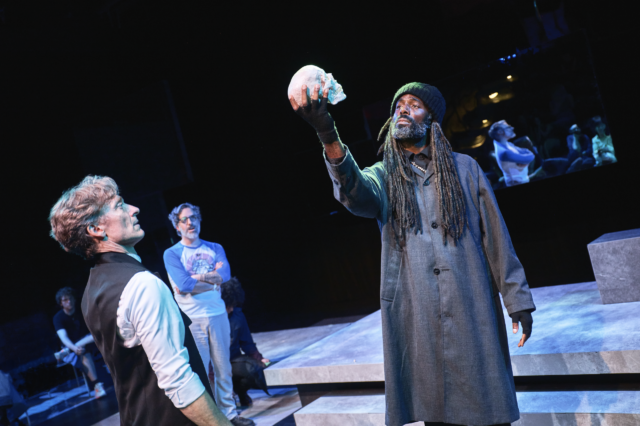
Sean Hayes stars as a writer facing a crisis in David Cale’s The Unknown (photo by Emilio Madrid)

THE UNKNOWN
Studio Seaview
305 West 43rd St. between Eighth & Ninth Aves.
Through April 12, $158-$349, streaming $89
studioseaview.com

There are only a few seats left for each of the final performances of David Cale’s The Unknown at Studio Seaview, but the last four shows, on Friday, Saturday, and Sunday, will also be available as a livestream so you can watch this creepy psychological thriller from the comfort of your own home, where you’re likely to have seen star Sean Hayes in Will & Grace, if not also Martin & Lewis and The Millers. Just be sure to keep the lights off.

Following up his Tony-winning portrayal of Oscar Levant in Good Night, Oscar, Hayes is Elliott, a New York City writer experiencing a bad case of writer’s block. “I don’t know, maybe it’s from spending too much time surfing the internet, and it’s affected my ability to concentrate, but I was having a hard time keeping focused,” he tells us at the beginning.

He accepts an offer from his best friends, Larry and Chloe, to stay for a while in their isolated upstate cabin, but the first day he is there he hears a voice singing, “I Wish You’d Wanted Me,” a song from his hit musical. The sound echoes around the theater, enveloping everyone, but Elliott doesn’t find anyone around the place. Out of cellphone range, he later calls Larry, who claims it is not some kind of prank. Elliott also chooses not to contact the police, the first of numerous possible mistakes he makes as he realizes that the story he is involved in might be just the one to end his block, no matter the consequences.

Solo specialist Cale (The Redthroats, Deep in a Dream of You) and director Leigh Silverman (On the Exhale, The Search for Signs of Intelligent Life in the Universe) previously collaborated on Harry Clarke and Sandra, so they know their way around one-person plays, but The Unknown drifts into TV-detective territory with a convoluted plot that feels overstuffed even at a mere seventy minutes, with several unnecessary scenes and a disappointing twist ending.

Hayes does a fine job on a spare set, standing in front of a brick wall as he switches between Elliott, Larry, Chloe, the mysterious Joey Dupain, and others. Cha See’s lighting maintains a noirish feel, accompanied by Caroline Eng’s sound design and Isobel Waller-Bridge’s music. There are intimate, revealing moments, including one that got a gasp out of the audience, as the concept of stalking is stretched to its limits, but there are just not enough chills. Maybe watching it home alone will offer a better opportunity to get past some of its inscrutability.

[Mark Rifkin is a Brooklyn-born, Manhattan-based writer and editor; you can follow him on Substack here.]
TAKING CHARGE AT THE PUBLIC: THE PEOPLE’S THEATER HITS A GRAND SLAM

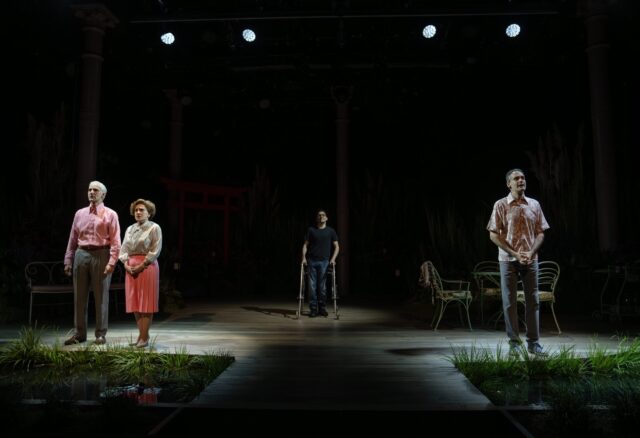
Chorus (Celia Keenan-Bolger) looks on as siblings Ismene (Haley Wong) and Antigone (Susannah Perkins) connect (photo by Joan Marcus)

ANTIGONE (THIS PLAY I READ IN HIGH SCHOOL)
Barbaralee Theater, the Public Theater
425 Lafayette St. at Astor Pl.
Tuesday through Sunday through April 12, $89-$109
publictheater.org

The Public has hit a grand slam with four current productions, continuing founder Joe Papp’s mission that has been embodied by longtime artistic director Oskar Eustis, who wrote in American Theatre in 2007, “The voices that need to be reflected on our stages are not the voices of the few, but the voices of the many.”

The quartet of works explore the state of America, and its position in the world, in wide-ranging plays that take things to the limit and beyond.

In the last dozen years, New York has seen no fewer than ten shows that featured some version of Sophocles’s Antigone character, the daughter of Oedipus and Jocasta who risks her life by insisting on an honorable burial for her brother Polynices after her uncle, King Creon, declares him a traitor. The dark tale has inspired such recent adaptations as Satoshi Miyagi’s lush Antigone at Park Ave. Armory; Alexander Zeldin’s contemporary transformation, The Other Place, at the Shed; and Shayok Misha Chowdhury’s rousing, impassioned version of Lee Breuer and Bob Telson’s The Gospel at Colonus at the Amph at Little Island.

At the Public’s Barbaralee Theater, Anna Ziegler’s Antigone (This Play I Read in High School) reimagines the Greek tragedy as a treatise on a woman’s right to choose what to do with her body. The narrative shifts between an alternate modern-day Thebes, where Antigone (a powerful and moving Susannah Perkins) is pregnant, and Pittsburgh, where the forty-year-old Dicey, serving as the chorus (a tender, superb Celia Keenan-Bolger), is contemplating her surprise pregnancy.

An early scene has them sitting across from each other on a plane, the teenage Antigone reading the Sophocles play. Dicey asks Antigone why she is reading it, and she responds, “Why shouldn’t I?” Dicey says, “It’s just that you don’t seem to like it very much.” Antigone explains, “It’s not that I don’t like it. I’m just like, is it even about her? It seems like it’s all about her brother’s body. A man’s body. . . . Is it even about her?”

With the death of Antigone’s parents, her uncle, Creon (a fine Tony Shalhoub), has taken the throne; one of his first edicts is to make abortion a capital crime, proclaiming, “A big part of the platform of this government is upholding the value of life, family, and kinship.”

Antigone seeks the support of her sister, the pristine, beautiful Ismene (a lovely Haley Wong), who is shocked when Antigone admits to her that she just had a drunken one-night stand with a waiter named Achilles (Ethan Dubin) despite being betrothed to Haemon (Calvin Leon Smith), Creon’s son. “Wouldn’t it have been okay to just let things be . . . quiet for a while. Not to make drama,” Ismene posits, to which Antigone replies, “Isn’t making drama, like, our inheritance?” Ismene is even more distressed when Antigone talks about getting a back-alley procedure from what turns out to be a sketchy proprietor (Katie Kreisler).

Desperately trying to retain control of his family and the kingdom, Creon enlists three guards (Dave Quay, Dubin, and Kreisler) to help, but they are more like the Keystone Cops than worthy protectors as Antigone refuses to back down from her beliefs.

King Creon (Tony Shalhoub) has harsh words for an abortionist (Katie Kreisler) in unique take on Antigone (photo by Joan Marcus)

Beautifully designed by David Zinn with intriguing costumes by Enver Chakartash, Antigone (This Play I Read in High School) is a chilling feminist call to action, a treatise on motherhood, responsibility, and gender expectations; Ziegler (Boy, Actually) and director Tyne Rafaeli (Data, Becoming Eve) challenge the audience while celebrating theater itself, including sharp references to Arthur Miller’s Death of a Salesman. The 135-minute play (with intermission) veers into repetitive didacticism at the conclusion, telling us what they’ve already shown us, but it also reminds us that things we learned in high school do stay with us if we pay attention.

The cast is exemplary, led by a fierce performance by Perkins (Grief Hotel, The Wolves, The Good John Proctor), a rising star who commands the stage even with such Tony-winning veterans as Keenan-Bolger (To Kill a Mockingbird, The Glass Menagerie) and Shalhoub (Happy Days, Act One).

At the start of the second act, Dicey recalls seeing a college production of Death of a Salesman, remembering, “I stood in the back . . . spellbound. There was just something about it.”

The same can be said for this Antigone.

Four Korean American sisters reconnect in Jeena Yi’s playwriting debut (photo by Joan Marcus)

JESA
The Shiva Theater
425 Lafayette St.
Tuesday – Sunday through April 12, $80
publictheater.org
ma-yitheatre.org

The Public teams with resident troupe Ma-Yi Theater Company, whose mission is “to develop and produce new and innovative plays by Asian American writers . . . shaping local and national conversations about what it means to be Asian American today,” for Jesa, a passionate world premiere that marks the playwriting debut of actor Jeena Yi. Although the story is about four Korean American sisters, the script calls it An American Family Drama, an important statement.

In present-day Orange County, four siblings gather for Jesa, a ritual honoring their parents on the anniversary of their deaths. Grace (Shannon Tyo), a seemingly perfect suburbanite with a lovely home, a husband, and a daughter named Lily, is hosting the ceremony, determined to have everything go exactly as planned. The fashionable Elizabeth (Laura Sohn), who works in private equity, arrives first, bringing fruit and a reminder that she is setting up a trust for Lily, no matter what Grace thinks about it. The brash, opinionated Tina (Tina Chilip), a chef, is next, screaming as she enters, “Who’s ready for Jesa, bitches!!!???” The last to show up is Brenda (Christine Heesun Hwang), an independent theater director who has flown in from New York and apparently is not going to stay long.

Grace has decided that they will perform a double Jesa, for their Umma’s (mother’s) one-year anniversary and their Appa’s (father’s) fifth, which doesn’t make all of them happy, as each has their own beliefs about the ceremony. Over the course of ninety minutes, the siblings chastise and insult one another, share good and bad memories, and try to bond as they prepare for and perform the rituals and reevaluate their own and their siblings’ lives.

Elizabeth (Laura Sohn) looks on as Tina (Tina Chilip) and Brenda (Christine Heesun Hwang) have a moment in Jesa (photo by Joan Marcus)

The banter among the women often comes fast and furious, as in this exchange:

Grace: Who knows when you’ll be around again, and its Umma’s first Jesa. You should pour her a drink.
Brenda: If I do Umma’s, then we have to do another round of bows for Liz and this is gonna take forever.
Grace: We have to do another round anyway.
Brenda: How many rounds are there???
Grace: Does it matter?
Brenda: I have to leave in like an hour.
Grace: What? I thought you’re staying here.
Brenda: No, I’m staying at my friend’s place in NoHo.
Liz: NoHo! That’s so far! You’re gonna show up at your friend’s at like three in the morning? Rude!
Brenda: You know what —
Tina: Just pour the drink!
Tina: Show some respect, Brenda.
Brenda: Sorry.

Jesa takes place in You-Shin Chen’s pristinely designed kitchen and living room set; Mel Ng’s costumes firmly define the differences among the four sisters as they discuss shrimp, dress socks, Lily’s upcoming birthday, photos of their parents, and a Jesa app that’s in English. Tyo (Yellow Face, The Comeuppance) is affecting as the ever-dependable Grace, whose idyllic life is starting to reveal some cracks; Heesun Hwang (SUFFS, Miss Saigon) is wistful as Brenda, who is still searching for her purpose; Sohn (The Blacklist) makes a strong New York stage debut as Elizabeth, who has not found happiness through money; and Chilip (Knight of the Burning Pestle, A Delicate Balance) is uproarious as the aggressive, nasty, but honest Tina.

As important as the double Jesa itself is to the plot, it slows down the otherwise swift pace; Yi (Walden, Cymbeline) and director Mei Ann Teo (SKiNFoLK: An American Show, Where We Belong) can’t quite find the right balance there, but otherwise Jesa, boasting an all-female and gender-expansive–identifying AAPI cast and creative team, is a funny and potent world premiere with awesome action, biting dialogue, and a spiritual surprise.

Yes, it’s about a Korean American family, but it could just as well be about any American family, regardless of heritage.

Public Charge explores the career of Julissa Reynoso, who cowrote play (photo by Joan Marcus)

PUBLIC CHARGE
Newman Theater
425 Lafayette St. at Astor Pl.
Tuesday – Sunday through April 12, $99
publictheater.org

Fact-based plays such as Oslo and Kyoto have proved that international diplomacy can be a fascinating theatrical subject, the former about a 1993 peace meeting between Israel and the PLO in Norway, the latter detailing a series of 1989–97 climate change conferences. Foreign policy is similarly at the center of the engrossing Public Charge, continuing at the Public’s Newman Theater through April 12.

Written by former US ambassador Julissa Reynoso and Michael J. Chepiga, the world premiere production tells the true story of Reynoso’s rise from her first attempt to immigrate to the United States from the Dominican Republic when she was six in 1981 to working for the State Department under both Barack Obama and Joe Biden. Accompanied by her uncle Nelsido (Al Rodrigo) to the US Embassy in Santo Domingo, they are questioned by a consular officer (John J. Concado) who assumes the little girl, whose mother is working in a factory in the Bronx, will become a public charge, a noncitizen who will be dependent on the government for support. The officer makes such snide remarks as “Lots of welfare mothers in the Bronx.” and “It looks like her mother makes less than minimum wage. How is she going to feed this girl? We have enough people like you on food stamps.” He also chastises Julissa for not speaking English and rejects her application. “You are keeping this child away from her mother?” Nelsido says. “What kind of policy can that be?”

The story then jumps to Washington, DC, in 2009, when Reynoso is being interviewed by humorless State Department official Ricardo Zúñiga (Dan Domingues) for a position as a US representative overseas. “You work for the bureau that covers Latin America and the Caribbean?” Julissa asks. Ricardo responds, “Yes. I am in charge of Cuba.” To which Julissa says, “I thought Castro was?” She smiles, but he does not.

Soon she is working with Cheryl Mills (Marinda Anderson), chief of staff to Secretary of State Hillary Clinton, handling the Caribbean and Central America. Julissa is smart and savvy, willing to challenge the government’s written and unwritten policies, particularly when it comes to Cuba. When the 2010 earthquake devastates Haiti, Julissa has to obtain permission from Cuba to fly over its airspace in order to get medical supplies and other support to the Haitians as quickly as possible, but Ricardo says she cannot do that because America has cut off all contact with Cuba for decades.

Julissa proceeds anyway, opening long-closed channels. She enters into negotiations with Cuban officials Bruno Rodriguez (Armando Riesco), Jorge Bolaños (Rodrigo), and Josefina Vidal (Maggie Bofill), succeeding in Haiti but seemingly unable to free government contractor Alan Gross, who has been captured by the Cubans and imprisoned as a spy. His wife, Judy (usually Barbara Walsh, although I saw understudy Deirdre Madigan), is desperate to get him out and grows more and more upset with Julissa, who is haunted by her inability to secure his release.

Julissa also starts up a kind of friendship with Uruguayan president José Mujica (Rodrigo) after being named ambassador to the South American nation, although she is watched closely by his right-hand hatchet man, Chacha (Riesco), who distrusts everything American. As she continues her unique brand of diplomacy, pouring her heart and soul into the job, the story occasionally shifts back to a Bronx bodega where she talks politics and learns life lessons with her father, Julio (Riesco), and owner El Chino (Rodrigo).

In 1984, the three of them argue about Ronald Reagan and the Cuban embargo. “If Reagan lifted it, Cuba would be a rich country, and the Cubans would stay where they are. They would love Americans and American values, and hate the Soviets,” Julio claims. Julissa asks, “Show love and communism goes away? It’s that simple?” Her father answers, “Reagan should just pick up the phone and call Castro.”

A quarter century later, Julissa essentially takes that advice and runs with it.

International diplomacy takes center stage in Public Charge (photo by Joan Marcus)

It would have been easy for Public Charge to have drowned in self-congratulatory moralizing, but instead Reynoso and Chepiga (Getting and Spending, Matter of Honor) aren’t afraid to depict Julissa’s failings along with her successes; they don’t build her into a hero making grandiose speeches but instead reveal a bright woman battling an aging bureaucracy set in its ways and often unwilling to change.

Arnulfo Maldonado’s scenic design consists of pastel-colored jigsaw-puzzle-like platform pieces that the characters walk across and sit on, evoking a three-dimensional map of countries that are separated from one another, difficult to bring together. Lucy Mackinnon’s projections set the time and place, from 1981 Santo Domingo to 2009 DC, 2010 Port-au-Prince, and 2014 Montevideo. Haydee Zelideth’s costumes range from business professional to Mujica’s easygoing casual.

Tony-winning director Doug Hughes (Doubt, Frozen) lets the proceedings flow with an austere simplicity, maintaining a steady pace even when situations grow dire. Guevara (My Broken Language, Water by the Spoonful) portrays Reynoso with just the right amount of veritas, with solid support from Anderson (Merry Me, Sandblasted), Domingues (The Tempest, Wild Goose Dreams), and, in multiple roles, Riesco (Deep Blue Sound, Water by the Spoonful) and Rodrigo (Blood Wedding, Open Admissions).

It’s impossible to watch Public Charge without thinking about the state of international diplomacy under the current administration; we could use a whole lot of Julissa Reynosos in today’s government. Reynoso, Chepiga, and Hughes don’t exploit that, but they do get in one specific dig when Julio, talking about Reagan in January 1984, posits, “Reagan’s an idiot and a hypocrite. He doesn’t know history. And he has no idea of how to deal with Cuba. Or Latin America. Or anything. We could never have a worse president.”

Point taken.

Andrey Burkovskiy serves as host and MC of Seagull: True Story remounting at the Public (photo by Kir Simakov)

SEAGULL: TRUE STORY
LuEsther Hall, the Public Theater
425 Lafayette St. at Astor Pl.
Tuesday – Sunday through May 3, $109
publictheater.org

Last May, I saw Alexander “Sasha” Molochnikov’s Seagull: True Story at La MaMa. As much as I enjoyed it then, it is even better in this revised version at the Public’s LuEsther Hall. I have adapted my initial review for this new production, which runs through May 3.

In Anton Chekhov’s 1896 tragicomedy The Seagull, wannabe playwright and director Konstantin Gavrilovich Treplev says, “It’s not about old or new forms, but about the fact that what a person writes, not thinking about forms at all, they write because it flies freely from their soul!” The line is at the center of Seagull: True Story.

In 2022, Molochnikov was a successful Russian director who had staged works at the Moscow Art Theater and won the prestigious Golden Mask award for his production of The Seagull at the Bolshoi. He was starting to make a film when Russia began bombing Ukraine; he soon spoke out against the attack. He then found himself a target of Vladimir Putin’s administration and departed for America with not much more than the clothes on his back.

“The pressure on artists, comedians, and especially directors has been ruthless in Russia. As a result, a dozen or so of the most celebrated theater directors working in Moscow before the war have left the country,” he wrote in Rolling Stone in November 2022. “Now any performance has to be careful so as not to offend the Kremlin’s feelings. Those who were not ready to cave in and play that game chose to give up their opportunities, resources, stages, and salaries and run. They escaped Russia to foreign countries, counting only on their own talents and starting over from scratch. My case was the latest in a chain of attacks on the arts and free speech in Russia. . . . There is only one reason so many artists have left: It’s unsafe and dangerous to express a negative opinion of what Russian authorities call ‘a special operation’ and what the world calls an invasion.”

In Seagull: True Story, Molochnikov and writer Eli Rarey adapt Sasha’s real tale into a kind of theatrical fantasy rooted in Chekhov’s play, complete with a play-within-a-play, a love triangle, a complicated mother-son relationship, a gun, and discussions of form and freedom. Andrey Burkovskiy serves as the emcee for the evening, addressing the crowd directly while also playing several other key roles.

It’s February 2022, and young director Kon (Eric Tabach) is leading the rehearsal for his wildly inventive adaptation of The Seagull at the prestigious Moscow Art Theater, which was founded by Konstantin Stanislavski and Vladimir Nemirovich-Danchenko in 1898. The MC succinctly sums up Chekhov’s plot: “Basically nothing happens. Treplev is a director in love with Nina, an actress. His mom is an actress too. Nina is in love with someone else. She leaves, Treplev is sad, she comes back, Treplev is even more sad. His mom is a bitch. He shoots himself. That’s it.”

Kon’s mother, Olga (Zuzanna Szadkowski), is a famous Russian actress who is playing Arkadina. Ivan (Quentin Lee Moore) is Treplev, her hapless son who is in love with Nina, portrayed by Masha (Gus Birney, replacing Stella Baker from the La MaMa cast). Poet and playwright Anton (Elan Zafir) is the dramaturg, while Yuri (Burkovskiy), the theater manager, keeps a careful watch on everything. Alexander Shishkin’s set features two dressing tables on either side of the stage in front of a red curtain and a deep open space behind it where the rehearsals are held; many of the props involve creative uses of plastic, from flags to ocean waves to bedspreads.

In a rare compliment, Olga tells Kon, “If Chekhov were here today, he would be happy to see that his play lives on in your hands. My little Stanislavsky!”

However, once Russia starts bombing Ukraine, the actors commence fighting — Ivan, defending the Kremlin, gets into it with Masha and Dmitri, who support Ukraine. But when Kon makes a private anti-Putin video that goes viral, he has to get out of the country immediately, leaving his mother and his good friend Anton behind.

In the second act, Kon arrives virtually penniless in New York, with nowhere to live. He meets aspiring actress Nico (Birney) on the subway and asks his mother’s old friend Barry (Burkovskiy), a producer, for help bringing his adaptation of The Seagull to the city, but first he must helm Barry’s bizarre immersive multimedia production of The Three Little Pigs.

“Wow! These are the kinds of shows I produce!” the MC declares.

Kon (Eric Tabach) and Nico (Gus Birney) meet cute in Seagull: True Story (photo by Kir Simakov)

A coproduction of Sofia Kapkov’s MART Foundation and Anne Hamburger’s En Garde Arts, Seagull: True Story is one of a number of recent shows from companies led by Russian or Ukrainian refugees, including Igor Golyak and Arlekin Players Theatre’s The Merchant of Venice and Our Class, Dmitry Krymov and Krimov Lab NYC’s Pushkin “Eugene Onegin” and Uncle Vanya, scenes from country life, and director Eduard Tolokonnikov and producer Polina Belkina’s encore engagement of Aleksandr Volodin’s Five Evenings.

The works bring an exhilarating aesthetic to independent New York City theater; Golyak and Krymov have brilliantly wild and unpredictable methods of storytelling where almost anything can happen, incorporating lunatic props and unique interactive elements. The exuberant cast of Seagull: True Story sing, dance, and march while switching between the play and the play-within-the-play. Certain lines of dialogue are accompanied by winks and nods as they relate just as much to what is happening in the United States under the current administration as to the events occurring in Russia and Ukraine. The first act is sensational, a fast and furious celebration of the power of theater even under the most stressful and dangerous situations. The second act has been significantly improved, streamlined to maintain a better focus.

At the beginning of the show, the MC says the word “fantastic” ten times, praising himself, the audience, and the play. He announces, “Don’t panic, you will be arrested only at the end of the show. No, no, I’m joking. Am I? Of course not. Everything is fantastic. Everyone is safe here.” Burkovskiy is fantastic in his multiple roles, his tongue firmly in his cheek as he offers his own spin on the MC from Cabaret. Zafir poignantly portrays the friendly and likable Anton, Birney adds a new dimension as the ambitious and sexy Nico, and Tabach ably stands in for Molochnikov as he faces a frightening reality and has to start all over again. (Molochnikov will assume the role himself at the April 12 gala performance.)

“The world loves Russian theater. It has survived under Josef Stalin, Nikita Khrushchev, and Leonid Brezhnev. It will outlive Putin, too,” Molochnikov concludes in his Rolling Stone essay. “But the life we had before the war is over. Russian theater is universal. The pain in the works of Chekhov, Nikolai Gogol, Fyodor Dostoevsky, and Leo Tolstoy are understood and appreciated all over the world. I will work on my dramas, operas, and ballets abroad. ‘We will work,’ as Sonya says in Uncle Vanya. We will ‘look for new forms,’ as Treplev says in The Seagull. The theater will live on.”

Russia’s loss is New York City’s gain.

In his American Theatre article, Oskar Eustis also writes, “So we know that the theatre is about democracy and that the theatre is about imagining what it looks like from somebody else’s point of view — which means that the theatre has to be, from its very nature, controversial. It doesn’t always have to be politically controversial. It doesn’t always have to be offensive. But the whole idea of the theatre is the idea of imagining things that you haven’t imagined before — of imagining perspectives that are not yours. The theatre is not there to validate our own experiences. The theatre is there to push our own experiences, to expand our notion of what we are.”

All four productions now at the Public do just that.

[Mark Rifkin is a Brooklyn-born, Manhattan-based writer and editor; you can follow him on Substack here.]
SOMETHING VERY GOOD IS ABOUT TO HAPPEN: GUS BIRNEY ON SEAGULL, NEW NETFLIX SERIES, AND HAILING FROM ACTING ROYALTY

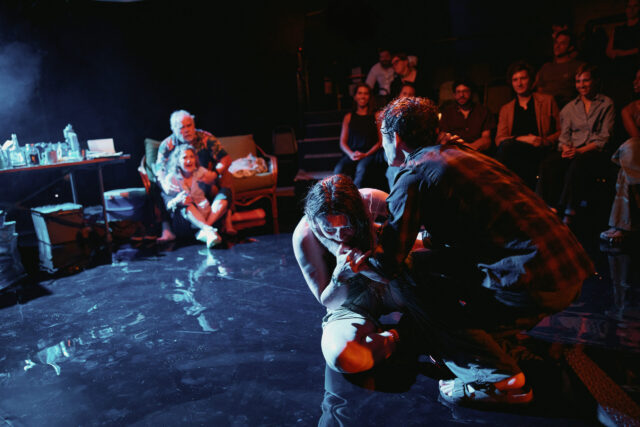
Gus Birney stars as Nico in Eli Rarey and Sasha Molochinikov’s Seagull: True Story at the Public Theater (photo by Kir Simakov)

SEAGULL: TRUE STORY
LuEsther Hall, the Public Theater
425 Lafayette St. at Astor Pl.
Tuesday – Sunday through May 3, $109
publictheater.org

In Seagull: True Story, Eli Rarey and Alexander Molochnikov’s dark comedy about a Russian troupe trying to stage Anton Chekhov’s 1896 classic tragicomedy in the midst of Russia’s invasion of Ukraine, Masha, portraying Nina in the play-within-a-play, asks, “Why is it so dark?” The part is played by Gus Birney, and, for her, the future is nothing but bright.

At the age of twenty-six, Birney is a rising star, and not just because she was named one by Porter magazine. Best known for her roles as Jane Humphrey in Dickinson and Gaynor Phelps in Shining Vale, she is now creeping out horror fans as Portia in the Netflix series Something Very Bad Is Going to Happen. She excelled as a call girl in Anne Kaufman’s revival of Lorraine Hansberry’s The Sign in Sidney Brustein’s Window at BAM and on Broadway, was heartbreaking as Dora, a Russian Jew who dreams of becoming a movie star, in Igor Golyak’s brilliant Our Class at BAM. then played Jessica, Shylock’s daughter, in Golyak’s wild and woolly adaptation of Shakespeare’s The Merchant of Venice at Classic Stage.

Birney hails from acting royalty; her father is Tony and Drama Desk Award winner Reed Birney (The Humans, House of Cards), her mother is SAG Award nominee Constance Shulman (Orange Is the New Black, Well, I’ll Let You Go), and her older brother, Ephraim (Chester Bailey), is a writer and actor as well.

In The Seagull, Nina Zarechnaya is an ingenue who falls for writer Boris Trigorin while wannabe playwright and director Konstantin Treplev, the son of once-beloved actress Irina Arkadina, is desperately in love with her. A dreamer, Konstantin declares, “I am increasingly convinced that it’s not about old or new forms, but about the fact that what a person writes, not thinking about forms at all, they write because it flies freely from their soul!” That is the same attitude Rarey and Molochnikov bring to Seagull: True Story, a vastly entertaining, thrillingly unpredictable, and insightful exploration of theater, family, and war, running at the Public though May 3, inspired by real events that happened to Molochnikov. Birney shines as Masha and Nico, offering two different interpretations of Nina, opposite Eric Tabach as Kon, Zuzanna Szadkowski as Kon’s mother, Elan Zafir as the dramaturg Anton, and a “fantastic” Andrey Burkovskiy as the MC and other roles. (On April 12, Molochnikov will play Kon, his onstage alter ego, and participate in a postshow Q&A.) At one point, Nico, as Nina, says, “I’m the seagull. No, that’s not right, I’m an actress.”

An actress ready, willing, and able to take chances, Birney recently Zoomed with me from her parents’ New York City apartment, discussing Russian theater, her latest streaming venture, family, pets, and acting.

twi-ny: How are things? Because you’re really busy right now, aren’t you?

gus birney: Oh my gosh, I know! It’s been a really cool period of time, because I have this TV show that just came out right alongside doing this play. It’s been so exciting. This is like an alternate reality of my life where, Oh, there’s a lot going on, but it’s nice to be in a high for a second.

twi-ny: I wanted to start by delving right into Seagull: True Story. I remember speaking with you last May at the opening at La MaMa. It was an all-star opening; Igor Golyak was there, Mikhail Baryshnikov, and various Russian dignitaries. What were your thoughts about the play when you saw it that night? Did you have any inkling that you were going to be in it later?

gb: Well, to answer your first question, when I saw it I was incredibly jealous that I was not in it. I was like, this is so cool. Everyone up there looks like they’re having so much fun. It just felt like an explosion of color and life and passion. I think I hadn’t finished Our Class. I can’t remember if I was still doing it. It had finished, but Our Class was in that same world, but it was so heavy and depressing and dark.

And so it felt like the lighter version of Our Class where it was the same kind of colorfulness, but just so much dance and music, even though this play explores very heavy subjects as well. I had auditioned for a workshop of it with Sasha, and we kept having conversations about me doing it, but the timing never worked out for either of us.

And I saw Stella [Baker] do it and she’s fantastic in the show. And I thought, this is so great. I’m jealous that I’m not in it. And then, about a month ago, they called me and said Stella has a conflict, would you be willing to jump in? It was around the time that Something Very Bad was going to come out. So I knew I’d be limited on timing. And they were incredible because they made it work. I had seven days of rehearsal; I’d never done anything like that — it was so fast. But it’s been a blast. I really have had such a good time; I love it.

Gus Birney takes a break during rehearsals for The Merchant of Venice at Classic Stage (photo by twi-ny/mdr)

twi-ny: The rehearsal process sounds like the play itself, sort of all over the place, in a good way, fast and furious, nonstop.

gb: Yes, definitely.

twi-ny: Have you ever done Chekhov before?

gb: No, I’ve never done it, and now I’ve read The Seagull and I’m dying to be in the Chekhov Seagull; I would love to play Nina. But I do feel like this is great because I get a little touch of that and I’m exploring it in a totally different way.

twi-ny: In a November 2022 essay in Rolling Stone, Sasha wrote, “The world loves Russian theater.” It seems right now that Russian theater loves you. You’ve previously appeared in Igor’s Our Class and The Merchant of Venice. Both directors have unique visions of classic plays and how to adapt them to today’s world. I’m thinking also of Dmitry Krymov, another Russian émigré who’s doing a Vanya adaptation at La MaMa, which I don’t know if you’ll get to see because they’re running at the same time as Seagull. You’re of Polish descent, as we’ve talked about before, but how did you come to fit into this Russian theater niche in New York?

gb: You tell me; I don’t know what happened. Two and a half years ago, I got the audition for Our Class and had no idea what to expect. I read it. I thought it was a beautiful piece, but on paper, it is a completely different experience than what the outcome ended up being. I feel like that’s the same with Sasha’s Seagull. On paper, it looks like one thing, but then you see the finished product and it’s, like, whoa.

Honestly, I don’t know. I feel like I walked into this magical world that I had never thought I would be entering into and that now I never want to leave. I did Sidney Brustein right before I did Our Class, and I learned so much. I was also so terrified and felt way over my head with what I was doing because I didn’t go to acting school, and I felt I was, like, Oh my gosh, I’m entering into this world blind, and I felt like there was this right way and wrong way to do things.

Then I did Our Class and there was no such thing as a mistake. There was no such thing as a wrong move. What I love so much about this Russian world is that mess is right. Mistakes are correct. As someone who’s a very anxious performer, it’s given me this whole new sense of freedom. Like, Oh my gosh, the things you don’t like about yourself and the days that you’re, like, I was bad, or I screwed up this, or I said this line instead of this. No, that’s interesting. It’s different. It’s exciting. And it’s given me this whole newfound confidence in myself.

twi-ny: That’s a great way to put it, because being in the audience for these shows feels the same way. You’re from New York City acting royalty. You’ve been acting since you were three, when you were an elephant in a parade.

gb: Oh my gosh, you know this? Did I tell you this?

twi-ny: You did not tell me this, but I leave no stone unturned. By ten, you’re in Thoroughly Modern Millie, singing “Jimmy.” Your father is Reed Birney, your mother is Constance Shulman; I’ve seen them both many times onstage. I loved your mother in a play called Shhhh. I don’t know if you saw it.

gb: I loved her in that too! It’s one of my favorites!

twi-ny: I love that show. And I’ve also seen them many times in the audience. So when they’re not onstage or filming a movie or television series, they’re going to the theater. And your brother is also a terrific actor. Here’s something that you wrote a few years ago:

“The least interesting thing about my parents is the fact that they’re actors. They’re multifaceted, complicated, curious, hilarious, full of life human beings who also sometimes yell at me to be less self-involved.”

So what is the most interesting thing about your family, and what’s the most important lesson you’ve learned from them?

gb: Oh, wow.

twi-ny: Is that too big a question?

gb: No. I’m going to answer with a cliché answer, but my parents are genuinely extraordinarily kind human beings. And they really instilled that in us. Not to pat myself on the back, but I do think that, in my head, kindness and respect, from top to bottom on a set for whoever’s there, was always the number one priority in their heads. We’re an incredibly close family. I’m literally at their apartment right now, and I have my own, but I stay here almost every night. Yeah, we’re all best friends. My mom used to say, Treat every person in a conversation like they’re the only person in a room. And I hope and strive to do that. They do that constantly. Whether they quit acting tomorrow or they continue, it doesn’t matter. It’s about being a kind human being in this world, which I don’t think we have enough of sometimes.

Gus Birney stars as Portia in Haley Z. Boston’s Something Very Bad Is Going to Happen (photo courtesy Netflix)

twi-ny: Definitely. The last time I spoke with you, you said that your father was considering retirement. Maybe it was after Lunar Eclipse.

gb: You know, he’s always saying that. I’m sure if you see him, he would be saying that to you, but he’s not going to.

twi-ny: Good. I’ve seen him and your brother, Ephraim, in Chester Bailey. Although I didn’t see it in Williamstown, you’ve acted with your mother in The Rose Tattoo. Which brings me to a favorite cult film of mine, Strawberry Mansion. Your cousin Albert makes this film and all the Birneys are in it except for you. Where are you?

gb: I don’t know! Why wasn’t I there! There wasn’t a part for me, I guess.

twi-ny: It’s a crazy movie.

gb: Yeah, it is crazy. Albert’s insane. He’s amazing, but he lives in his own crazy world.

twi-ny: Well, you’re in so many other things. At sixteen, you start doing TV, theater, and films. You’ve already amassed more than forty credits in ten years. So you’re incredibly busy. Now you’ve got Something Very Bad Is Going to Happen. What’s it like going from these three different media, at such a fast pace?

gb: Yes, yes. You know, I learn something through each medium. I have such a respect for theater because that’s how I was raised. I feel like it’s the best way to start out as an actor because it just rounds you in your body and your voice. I feel so lucky to be able to dive into each of these specific worlds of what it is to be an actor. They all feel so different.

I don’t know, you said forty credits and in my head I’m like, Really, have I done that much? But no, it’s so cool. I’m twenty-six now and I still feel like I’m thirteen so much of the time. But it’s good to have moments where I’m really proud of myself.

The show that just came out yesterday is one of the most exciting jobs I’ve ever had. I had such a good time doing it. I’m so happy that the world can see it now. And I feel a little protective over it, because who knows how it’s going to do? Who knows? It’s so crazy what catches on and what doesn’t. And I’m kind of just like, it doesn’t matter what happens with it. I’m so proud of the show. And I’m so happy that it’s out in the zeitgeist and anyone can see it.

twi-ny: Do you have a dream role?

gb: Oh, wow. I don’t know. Someone asked me the other day and I had such a strange answer. They asked, What role would you want adapted to screen from a book? And I said I’d want to play Sally in the live-action version of The Nightmare Before Christmas, because something I get a lot is that I look like a Tim Burton character. And so I would love to play a Tim Burton character. But in a play, definitely right now, the Nina thing is kind of forefront in my head; I would love to play this part and do my little spin on it.

I love The Glass Menagerie; I always talk about that play. I would love to be Laura in that. I did a reading of Who’s Afraid of Virginia Woolf? recently; I would love to be Honey. So we’ll see. There’s so many things I want to do.

Kon (Eric Tabach) and Nico (Gus Birney) meet cute in Seagull: True Story (photo by Kir Simakov)

twi-ny: You’ve mentioned how anxious you get as an actress, but I have a feeling maybe a little bit in real life as well, and you used to describe yourself as shy and strange, particularly when thinking back on your childhood. Today, with all these things going on, can I ask how you feel about yourself, particularly about the confidence you’re building with each performance?

gb: Yeah! Definitely still shy and strange. I did an interview this morning on New York Live and I rewatched it before talking to you and I was, like, Oh my gosh, Gus, you’re so strange. But no, I think what’s happened is I am shy and strange and I also feel such confidence in what I am now.

Oh my gosh, who is this?

twi-ny: This is our kitty, Tuki. She gets in on every Zoom call.

gb: I’m so glad; she can stay for the rest of it. She’s the cutest. I feel like the world is trying to tell me to get an animal because I saw these puppies this morning and now I see this little sweetie and it’s like I just need to.

twi-ny: New York City apartments are not the same without an animal, but you’re not spending enough time in your own apartment to have an animal, a pet.

gb: It’s true. Yeah, that’s what will force me to grow up. Yes, but anyway, I feel like I have a whole other level of confidence in whatever I am at this point in my life, so yes.

twi-ny: One last thing. Having met you several times, seeing you onstage and television, and watching some of your interviews, I can’t help but notice that one of the words that comes up over and over again is fun. You just look like you are having the most fun time. Being in your presence brings happiness. That seems to be your approach to life.

gb: Yes, I think so. I try. I am definitely anxious. We’ve talked about this, but I do think I’m a really positive, optimistic person, and I really love that about myself. Yeah, like how cool is my job — or our job, because you’re also in this artistic crazy world.

You know, it is terrifying what is going on at this point in history, so let’s enjoy the moments where it’s light. In this play I get to dance, I get to sing, I get to run around, and it’s the coolest thing to just compartmentalize for two hours out of your day and just be free. So yes, I appreciate you saying that. That’s what I would strive to be: happy.

[Mark Rifkin is a Brooklyn-born, Manhattan-based writer; you can follow him on Substack here.]
BETTER RED THAN DEAD? COLD WAR CHOIR PRACTICE AT MCC THEATER

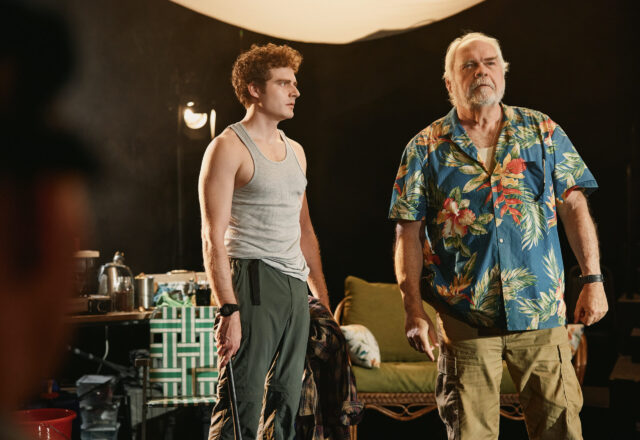
A three-person choir (Grace McLean, Suzzy Roche, and Nina Ross) has important information to share with Meek (Alana Raquel Bowers) and Smooch (Will Cobbs) in Cold War Choir Practice (photo by Maria Baranova)

COLD WAR CHOIR PRACTICE
Newman Mills Theater
Robert W. Wilson MCC Theater Space
511 West Fifty-Second St. between Tenth & Eleventh Aves.
Tuesday – Sunday through April 5, $35-$85
mcctheater.org

Ro Reddick dreams up a red Christmas in her Susan Smith Blackburn Prize–winning fresh, delightfully dark comedy Cold War Choir Practice. Afsoon Pajoufar’s set, a Roll-a-Rama in Syracuse in December 1987, is bathed in red, Brenda Abbandandolo’s costumes of the three-person choir are red, the holiday lights and neon sign are red, the program is red, even the Christmas tree is red.

Better red than dead?

Meek (Alana Raquel Bowers) is a forward-thinking ten-year-old girl in a choir with three grown women (Grace McLean, Suzzy Roche, and Nina Ross) who sing such lyrics as “Reaganomics, / cold war, Soviets, supply-side, Wellspring, / nuclear war, eighty-seven, armageddon! / Merry merry merry merry merry merry! Ah!”

For Christmas, Meek, who helps her father, Smooch (Will Cobbs), at the roller disco he owns and operates, wants “a pound puppy, a Speak & Spell, and a nuclear radiation detector.” Smooch, struggling to keep the business out of the red, is not concerned with geopolitics as much as just getting by every day. He tells the audience, “You think I ain’t notice Meek the only one of us up in this little choir? PSSHHH up in here beggin’: ‘Mister president, please. Please, mister president’ — what kind of song is that? You need to be tellin that muhfuckr: ‘We want freedom. We want employment. We want education’ — That’s three lyrics right there, got seven more ready to go.”

Smooch’s mother, Puddin (Lizan Mitchell), hangs around the rink, sharing her thoughts with the choir about the state of the world while focusing on finances. “Y’all might wanna find something more positive to sing. And no. I do not have any money, so don’t even fix ya mouth to ask,” she says. “You gon’ be charging folks, you need to put a little more effort into them lyrics — and don’t fall on that ice! I know ya mama don’t got good insurance — I seen her car. Don’t nothin’ get past Puddin — see now you got me lettin’ all the heat out.”

Smooch’s estranged brother, Clay (Andy Lucien), a dyed-in-the-wool Republican who recently denigrated the family in the New York Times, calls unexpectedly, telling Puddin that is being ushered to Washington for an important meeting and needs to drop off his wife, Virgie (Crystal Finn), to stay with the family while he’s away. Virgie is in a kind of daze; Clay and Virgie believed she was at a Wellspring Women’s Optimization Workshop, but it turned out to be a Russian indoctrination camp, although neither of them knows that. Smooch doesn’t want to do any favors for Clay and Virgie, but Clay trumpets his importance at being needed at a secret treaty meeting, for which he is carrying critical classified documents in his briefcase that Virgie has been programmed to steal.

Meanwhile, Meek gets a Soviet pen pal through the choir leader (Ellen Winter, who is also the Roll-a-Rama DJ), who sends her a Speak & Spell that teaches her the Russian words for “revolution” and “government official” and apparently comes with a spy (Ross) who tells the girl, “I have a friend, a very good friend. She wants to meet you. She will tell you what it is you can do for Mother Russia. And if you agree, you will come and live in peace in Ural Mountains with your family.”

The plot unfurls with such choir songs as “Milkshake for Peace,” “Lay Down Your Arms,” and “One America,” interspersed with news reports and quotes from Ronald Reagan (“In the Communist world, we see failure.” “Mister Gorbachev, tear down this wall!”) as the choir prepares for a holiday concert — which will be exactly twenty-eight minutes, since it takes thirty minutes for a Soviet long-range ICBM to reach America — and the battle over the briefcase gets serious.

Meek (Alana Raquel Bowers) gets more than just a Speak & Spell for Christmas (photo by Maria Baranova)

A coproduction from MCC, Clubbed Thumb, and Page 73, Cold War Choir Practice was inspired by Reddick’s childhood, when she was in a children’s choir that sang about nuclear war and world peace. The play became her thesis at Brown and has been extended at the Newman Mills Theater through April 5.

Directed with a sharp edge and incisive humor by Tony nominee Knud Adams (English), Cold War Choir Practice is an involving, intriguing, and thoroughly enjoyable ninety-five minutes that feel as relevant as ever, considering what is happening right now with the United States, Russia, Ukraine, Cuba, Iran, and other nations. The play is one of several current or recent shows staring down the face of communism from the 1980s to today, including Mother Russia, Chess, and Seagull: True Story.

Bowers (Chicken & Biscuits), who is in her early thirties, is a genuine delight as Meek, an intelligent, if innocent, young girl who is cheerful even as she worries about the future. When Virgie thinks that Meek is more concerned with nuclear proliferation than school, Meek says, “After armageddon there won’t be any schools. Our toys will be the bones of the dead, slick with blood and warm with radiation.”

Finn (Deep Blue Sound) has a field day as Virgie, an at-times catatonic woman who has lost control of her mind. Cobbs (Is This a Room) and Lucien (The Last Seder) excel as the very different battling brothers, Smooch ready, willing, and able to fight for his rights, Clay satisfied to be in the room where it happens.

McLean (Suffs), Roche (the Roches, the Wooster Group), and Ross (To Kill a Mockingbird) are fun and bouncy as the choir, which serves as a kind of Greek chorus, with a fine if underused Winter (The Beastiary) as their leader. And Mitchell (On Sugarland) takes over every scene she’s in as the lovable Puddin, who pulls no punches, saying whatever is on her mind.

Donald Trump and Vladimir Putin may not exactly be Ronald Reagan and Mikhail Gorbachev, but nuclear war is back in the discussion and it’s getting uglier by the day; thank goodness we have such shows as Cold War Choir Practice to let us see it through the eyes of a child.

[Mark Rifkin is a Brooklyn-born, Manhattan-based writer; you can follow him on Substack here.]
LIVING FOREVER: SPARE PARTS AT THEATRE ROW

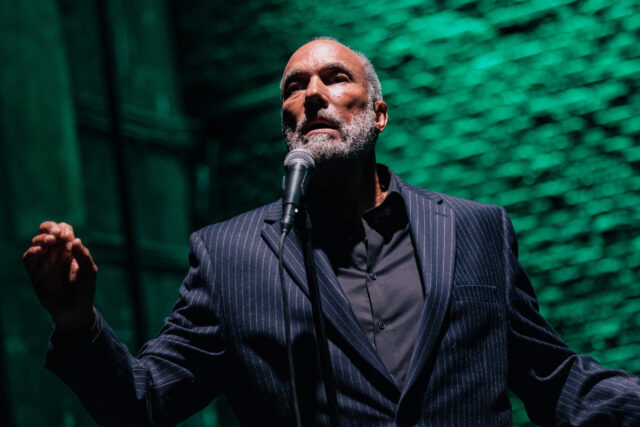
Assistant professor Chris Coffey (Rob McClure) swabs billionaire Zeit Smith (Michael Genet) as grad student Jeffrey Jordan (Matt Walker) watches and Smith assistant Ivan Shelley (Jonny-James Kajoba) checks his phone in Spare Parts (photo by Russ Rowland)

SPARE PARTS
Theatre Row
410 West 42nd St. between Ninth & Tenth Aves.
Tuesday – Sunday through April 30, $39-$89
www.sparepartsplay.com
www.theatrerow.org

In January, Elon Musk told Peter Diamandis on the Moonshots podcast, “You’re preprogrammed to die. And so if you change the program, you will live longer.” A week later, at Davos, he said that aging is a “very solvable problem.”

That’s the concept behind David J. Glass’s gripping biotech thriller, Spare Parts, a true sleeper making its world premiere through April 30 at Theatre Row.

“I want to live,” self-made billionaire Zeit Smith (Michael Genet) tells his assistant, Ivan Shelley (Jonny-James Kajoba), about halfway through the show. “I feel mortality creeping up on me.” Zeit, who is in his early sixties, has dangerously high blood pressure and is at risk of a stroke, motivating him to do something before his time runs out.

Zeit and Ivan recruit Columbia professor Chris Coffey (Rob McClure) and his grad student, Jeffrey Jordan (Matt Walker), to try to make life extension a reality, at any cost. While Jeff is instantly interested, Chris is hesitant, insisting they follow ethical guidelines accepted by the university and scientific community and resist the whims of a rich tech bro, relying on government grants instead — money that is rapidly disappearing. Zeit is all about breaking the rules and doing whatever is necessary to get what he wants. But Chris reconsiders when Zeit offers them salaries of one million dollars apiece and a five-million-dollar budget.

Chris: The money doesn’t mean anything, Jeff, if it stops us from doing what we should be doing. All these great scientists have been taking cash from these guys, and then working on nonsense. Nonsense. I want to work on what really matters — so we’ll make progress.
Jeff: Chris, how can we make progress without any funding at all?
Chris: . . . This is why government funding exists — to keep big money out of things . . . so that scientists can just focus on figuring out the truth.
Jeff: Nice story. How is that working out?

Soon the four men are discussing a two-way plasma exchange in which Zeit would be connected to a younger person so they can exchange blood; the theory is that the younger blood would extend Zeit’s life, but they’re not sure what would happen to the donor — and Zeit doesn’t care.

“This is really the most psychotic thing I’ve ever heard,” Chris tells Jeff privately. But they proceed, attempting to find a match for Zeit and go ahead with the procedure.

David J. Glass’s Spare Parts is a gripping biotech thriller (photo by Russ Rowland)

Novels, movies, and television shows have long explored the issue of longevity and immortality, using science fiction and horror in such works as Oscar Wilde’s The Picture of Dorian Gray, the Twilight Zone episode “The Self-Improvement of Salvadore Ross,” Natalie Babbitt’s Tuck Everlasting, Bram Stoker’s Dracula, and Mary Shelley’s Frankenstein. (Perhaps that’s why Glass gives Ivan the last name “Shelley” in the script, although it is never mentioned in the play itself.) The 2025 Netflix documentary Don’t Die: The Man Who Wants to Live Forever follows tech entrepreneur Bryan Johnson as he spends millions of dollars fighting the aging process.

One of the scariest things about Spare Parts is that the science is real; plasmapheresis and plasma exchange are already happening, but not to make humans live forever — or at least not yet. Glass is a biomedical scientist who is vice president of research at a pharmaceutical company, a senior lecturer at Harvard, an adjunct professor of genetics and development at Columbia, and author of Experimental Design for Biologists. His previous play, Love + Science, was about two gay medical students during the AIDS crisis and also starred Walker, who trained at Juilliard before studying neurobiology at Harvard and pursuing his PhD at Columbia as a National Science Foundation fellow.

Superbly directed by Michael Herwitz (Job, Cold Water), Spare Parts has much in common with Data, Matthew Libby’s chilling play about the ethics surrounding AI. Both ask questions about money, power, government, and technology in an ever-more-precarious world. Just because humans are able to do something never before thought possible doesn’t mean we should.

Scott Penner’s impressive set features two small labs on either side of a central section that has oddly shaped small sculptural chairs, somewhat evoking chess pieces, on a thick white shag carpet in front of a large oval screen on the back wall that gently changes pastel colors, representing Zeit’s all-knowing AI named George; the expert sound, by Ryan Gamblin, includes interstitial techno-drone music; the lighting is by Zack Lobel, with costumes by Amanda Roberge, from casual wear to slapdash professor suits and white lab coats.

Two-time tony nominee McClure (Mrs. Doubtfire Chaplin) is touchingly understated representing the old guard not ready yet to break the mold, Kajoba (Oratorio for Living Things, Twelfth Night) brings a sweet charm to the extremely competent but underappreciated assistant, Genet (A Few Good Men, Choir Boy) is bold and magnetic as the billionaire who thinks the world is his to do with as he wishes, and Walker (The Play That Goes Wrong) is charismatic and engaging as a young man willing to push boundaries, personally and professionally.

Glass takes on current issues with a mix of solemnity and humor without becoming didactic, cleverly hitting his targets, although he can’t help but throw in this one-liner from Zeit, who, like a certain someone, is from Queens: “You hear a guy has some money, so you immediately think he wants to put his name on a building?”

In this case, the billionaire is seeking a very different kind of legacy.

[Mark Rifkin is a Brooklyn-born, Manhattan-based writer; you can follow him on Substack here.]