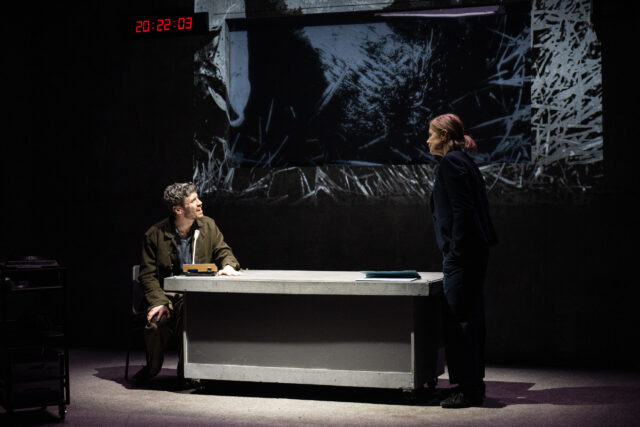
Suspect John McKay (Luke Murphy) is interrogated by Detective Alison Kerr (Sarah Dowling) in Scorched Earth (photo by Teddy Wolff)
SCORCHED EARTH
St. Ann’s Warehouse
45 Water St.
Through April 19, $74
stannswarehouse.org
www.atticprojects.com
Writer, director, choreographer, dancer, and actor Luke Murphy returns to St. Ann’s Warehouse, following 2024’s sci-fi gem Volcano, with the searing Scorched Earth.
I called the nearly four-hour Volcano “an eruption of ingenuity, a multimedia, multidisciplinary melding of past, present, and future bathed in mystery.” The same can be said of the ninety-minute Scorched Earth.
“What does it take to be from somewhere?” Detective Alison Kerr (Sarah Dowling) asks while discussing a questionable case, setting the stage for a play steeped in humans’ relationship with one another and the land.
The show takes place in a small, tight-knit, unnamed Irish town where the body of a wealthy man, William Dean (Will Thompson), was found on a ten-acre plot of land he had just won at auction, outbidding John McKay (Murphy), a tenant farmer who had worked on the property for eight years. Ten years after the death, Kerr has reopened the case. She brings in McKay for twenty-four hours of interrogation, a digital clock on the wall counting down the time.
The fractured narrative shifts kaleidoscopically in time and space, between the interrogation, re-creations of past events, and a radio talk show where host Leanne Meany (Tyler Carney-Faleatua) speaks with Dean, both before and after his death. Alyson Cummins’s stark set is a bleak, gray, angled room in which the cast of five moves around tables and chairs, an open door morphs into a telephone booth where Sergeant Leahy (Ryan O’Neill) calls Kerr, and a rectangular section of the back wall slides open to reveal other elements. Patricio Cassinoni’s slide projections depict crime-scene photos, pages from official reports, and aerial views of the contested land while putting the murder in context of other similar disputes through Irish history.
Much of the story is told through captivating movement that takes the story in fascinating directions, brilliantly expanding the tense atmosphere as the police procedural unfolds. McKay dances with a grass body (Carney-Faleatua) that is less a green monster than a piece of the land. The deceased Dean writhes around on the floor, his body like a limp, boneless creature. There’s even a country line dance where, as Leahy announces, “no one has to touch each other,” a sly reference to the previously accepted claim that Dean died because of a fall, not at the hands of a murderer.
Meanwhile, the townsfolk seem far more concerned about John O’Donnell’s missing donkey than what happened to Dean, which they seek to remain buried in the cold earth.
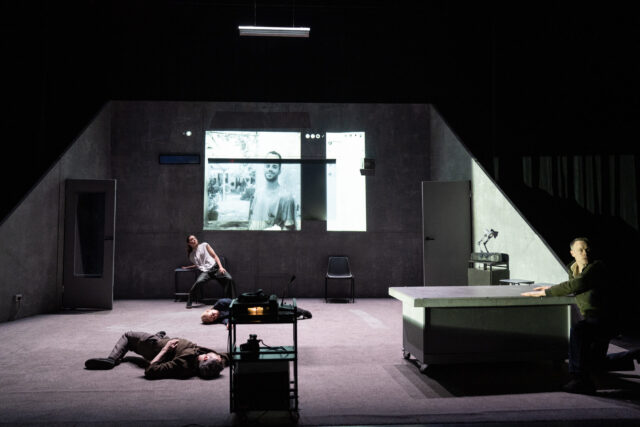
Scorched Earth incorporates thrilling dance in police-procedural narrative (photo by Teddy Wolff)
Scorched Earth was inspired by John B. Keane’s 1965 play The Field, which was adapted into a 1990 film by Jim Sheridan that featured an Oscar-nominated Richard Harris as an elderly Irish tenant farmer who is fighting to own the land his family has worked on for generations, as well as by Mark O’Connell’s A Thread of Violence: A Story of Truth, Invention, and Murder, Myles Dungan’s Land Is All That Matters: The Struggle That Shaped Irish History, and Andrew Jarecki’s The Jinx, the Peabody-winning docuseries about real estate heir Robert Durst and a long-unsolved murder.
Cork-born Murphy (Sleep No More, Pass the Blutwurst, Bitte) is magnetic as McKay, a deeply conflicted man who firmly believes the land should have been his. Dowling, who portrays a bartender and a bank teller in addition to Kerr, is cool and calm as the determined detective. Thompson, who starred opposite Murphy in Volcano, brings nuance to Dean, a rich mogul who can afford to buy whatever he wants. (Perhaps the character was also based partly on William K. Dean, a doctor who retired to a New Hampshire farm where he was murdered in 1918; the case, investigated by a private detective named Wilhelm DeKerlor — oddly similar to “Kerr” — remains unsolved.) O’Neill and Carney-Faleatua provide expert support.
Scorched Earth is a scintillating success all the way around, including Cummins’s costumes, Stephen Dodd’s stark lighting, which beams in from the sides of the set, and composer Rob Moloney’s wide-ranging score. Everything merges beautifully for an exhilarating, powerful surprise Sisyphean conclusion where it all comes tumbling down, no matter who you are or where you’re from.
[Mark Rifkin is a Brooklyn-born, Manhattan-based writer; you can follow him on Substack here.]