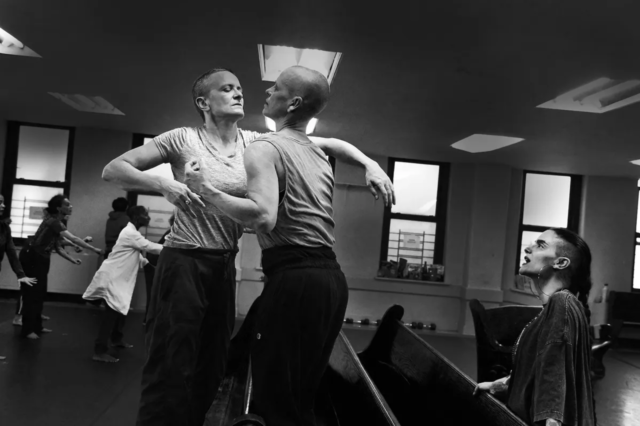
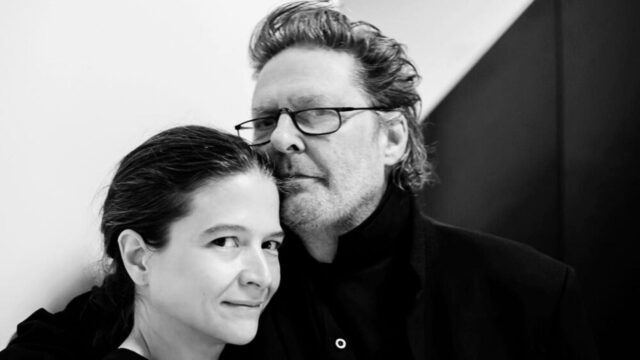
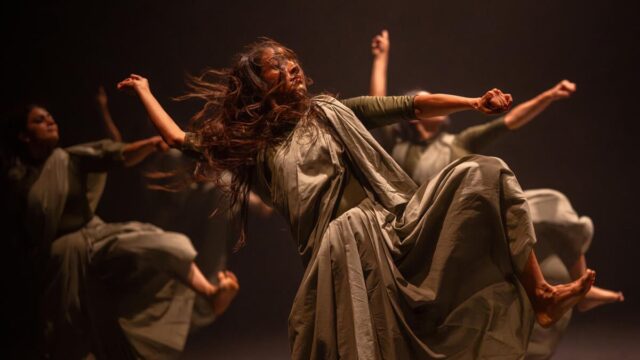
The Surge: An Ode to Sinéad O’Connor celebrates the life and legacy of controversial singer-songwriter (photo by Kate Garner)
THE SURGE: AN ODE TO SINÉAD O’CONNOR
Joyce Theater
175 Eighth Ave. at 19th St.
September 16-27, $97-$112
212-645-2904 www.joyce.org
Tickets are going fast for the North American premiere of Tony-winning, Emmy-nominated Sonya Tayeh’s The Surge: An Ode to Sinéad O’Connor, running at the Joyce from September 16 to 27. A coproduction with Factory International in Manchester, England, the show pays tribute to the Dublin-born singer-songwriter who rose to stardom in the last 1980s and early 1990s with such albums as The Lion and the Cobra and I Do Not Want What I Haven’t Got before getting mired in a series of political and religious controversies, experiencing health problems, and disappearing from public view for extended periods of time before dying by suicide in July 2023 at the age of fifty-six.
The seventy-minute show features Betsy Cooper, Alison Clancy, Gabrielle Malone, Mor Mendel, Amy Miller, Jennifer Nugent, Karine Plantadit, Lisa Race, Monique Smith, and Jin Ju Song-Begin dancing to more than a dozen O’Connor songs, from “Troy” and “Mandinka” to “Never Get Old” and “Feels So Different,” as well as audio excerpts from her 2021 memoir, Rememberings.
“Her death was generating these feelings and I was dancing in my loft, surrounded by this grief and joy,” director and choreographer Tayeh says in a program note. “The Joyce and I had been thinking about what we could make together, and not finding the right thing yet, and two things began boiling in my mind. One was about how ahead of her time she was, the volume of her voice, not just as a singer but with a belief system about people, those denied, closed off and mocked. The other was about curiosity, about where all the dance artists were that were my age and older. Where are the women over forty, and why did they disappear?”
Ever since her death, O’Connor and her legacy have been going through a metamorphosis and reevaluation; The Surge should add to that grief and joy.
[Mark Rifkin is a Brooklyn-born, Manhattan-based writer; you can follow him on Substack here.]
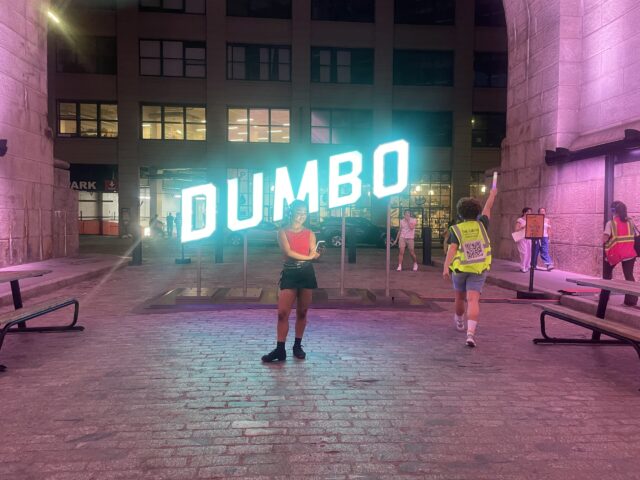
Danielle Louise Bowen portrays the guest in site-specific immersive DUMBO dance journey The Circuit (photo by twi-ny/mdr)
THE CIRCUIT
Begins at Superfine restaurant
126 Front St., Brooklyn
Through September 7, $39.62-$82.20 www.nytheatrecompany.com
So let me get this straight: New York Theatre Company’s The Circuit is a site-specific immersive journey through several of DUMBO’s most spectacular locales, inspired by Arthur Schnitzler’s 1920 play, La Ronde, and Max Ophüls’s classic 1950 film? I’m in! And you should be too.
Ophüls’s French adaptation begins with a new character not in the play, a master of ceremonies elegantly portrayed by Anton Walbrook. In the famous five-minute opening scene, filmed in one continuous take, the emcee walks along the streets of Vienna, telling the audience, “You can tell from the scent in the air that love is just around the corner, can’t you?” Approaching a carousel he calls “the merry-go-round of love” while revealing he is on a movie set, he says, “Love comes calling, sudden and fleeting. And they all dance to love’s same tune.” La Ronde depicts a series of couples meeting up in the city, with one person from each pas-de-deux heading off and encountering another potential romantic partner.
The Circuit: An Immersive Silent Disco Ballet reimagines La Ronde for DUMBO, taking full advantage of the area’s cobblestone passages, iconic views, and unique landscape. Audience members put on silent disco headphones, through which they hear dialogue and EDM, and follow guides who lead them from site to site using multicolored LED batons, as characters find each other, dance while engaging in various aspects of hooking up — or not — and then go on their way.
The tale of bisexual love and loneliness, betrayal and ecstasy, written by Connor Wentworth, starts with the guest (a terrific Danielle Louise Bowen, who alternates with Manatsu Aminaga), who performs a solo in a plaza before joining dancers in the Archway (swing ensemble Kaitwan Jackson, Kurt Horney, dance captain Anna Nader, and Katie Baik). Soon she becomes involved with the doll (Luke Swaller), who harbors a secret; next, the doll chances upon the almighty (Tessa Fungo), who confronts the keeper (Gigi Hausman), who happens upon the gentleman (Fabricio Seraphin), who has a rendezvous with the lover (Arzu Salman). Each couple moves to an original score by Jacob Ryan Smith and choreography by Josh Zacher, who codirects with John Kroft.
It’s part walking tour, part silent disco, part flash mob as the group makes its way among tourists, random passersby, native New Yorkers, and others going about their business, snapping pictures in and around Brooklyn Bridge Park, walking their dog, pushing their baby in a stroller, knitting on a bench, or picking up dinner. Some immediately take videos of the proceedings, some completely ignore them, and others appear to think, well, this is just another night in the city with who-knows-what going on. At one point a young woman was grooving atop a small DOT orange-and-white traffic barricade; a few of us went toward her, believing she was the next character, but it turned out she was simply having fun with friends, perhaps dancing to love’s same tune. With darkness descending, the guides use handheld colored lights and the cast’s smartphones glow, as text messages are incorporated into the plot.
The main independent elements of The Circuit — the narrative, the music, and the choreography — might not necessarily stand out on their own, but they merge beautifully in the tremendously fun and thoroughly engaging show. The title relates to making connections, between people as well as electrical devices, which essentially are running our lives in 2026. A deep connection is also made between the audience, the performers, and DUMBO itself, with a gorgeous, contemplative finale occurring under the Brooklyn Bridge.
Yes, it’s a site-specific immersive silent disco ballet, but it also has a lot of heart as it explores coming together and breaking apart in a city that can be difficult to navigate when one is alone, although love could be waiting right around the corner.
[Mark Rifkin is a Brooklyn-born, Manhattan-based writer; you can follow him on Substack here.]
BALLET FESTIVAL
Joyce Theater
175 Eighth Ave. at 19th St.
August 4-16, $87-$102
212-645-2904 www.joyce.org
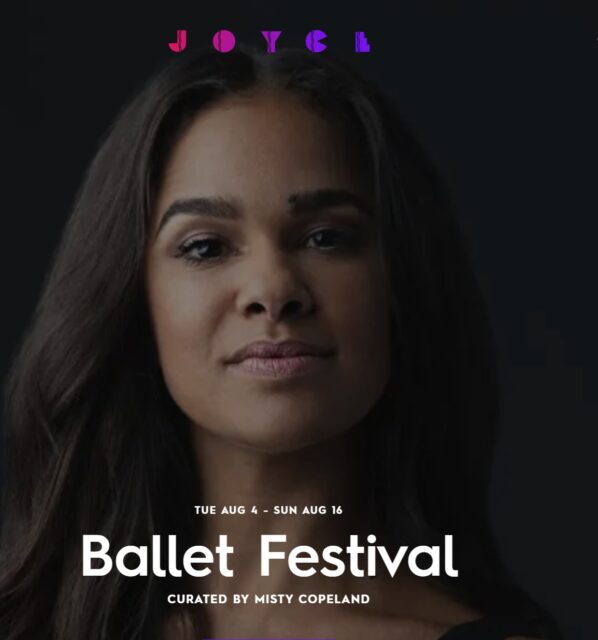
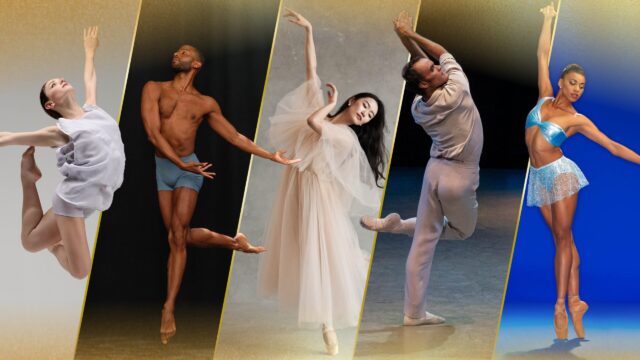
On October 22, 2025, Misty Copeland retired from American Ballet Theatre after a twenty-five year career that included her becoming the first Black female principal dancer in the company’s history. But that hasn’t appeared to slow down the forty-three-year-old Kansas City native.
In December, she had hip replacement surgery. In March, she performed in a musical tribute to the film Sinners at the Oscars. In April she was honored at the Misty Copeland Foundation Spring Benefit as part of the Celebrating Misty Campaign. In May she received the Medal for Distinguished Service from Teachers College at Columbia and walked the red carpet at the Met Gala as a member of the host committee. In June she was named the inaugural recipient of the Lincoln Center Luminary Award, received the Golden Plate Award from the American Academy of Achievement for “exceptional accomplishment in the sciences, the professions, business, industry, arts, literature, sports, entertainment, and public service,” and delivered the keynote commencement address at the Success Academy Charter Schools graduation. In July she attended the FIFA World Cup Final in her role as a skin-care spokesperson. And on August 25, her latest children’s book, Firebird Waltz, will be published.
If that were not enough, she is also curating this year’s Ballet Festival, which runs August 4–16 and features dancers from American Ballet Theatre, New York City Ballet, Paris Opera Ballet, Dance Theatre of Harlem, Houston Ballet, and Complexions Contemporary Ballet, performing works by Ingrid Silva, Kyle Abraham, Bob Fosse, Houston Thomas, José Limón, Rudolf Nureyev, Dwight Rhoden, and Aleisha Walker the first week and Stanton Welch AM, Andrea Miller, Alonzo King, John Taras, Roland Petit, James Whiteside, and Ilo the second. Among the dancers are Madison Brown, Guillaume Diop, Joe Gonzales, Babatunji Johnson, Sae Eun Park, Taylor Stanley, April Watson, and Harper Watters.
“At the heart of my curation for The Joyce Ballet Festival is a celebration of Black, Brown, and Queer voices,” Copeland wrote on Instagram. “Ballet has a remarkable history, and I believe it grows stronger when we create space for a wider range of artists and perspectives. This festival honors that history while celebrating the artists expanding what ballet can be. I’m so excited to share these extraordinary performances with you.”
There will be a Summer Soirée on August 4, a Curtain Chat with Copeland and Complexions cofounder Desmond Richardson on August 5, and a teen ballet workshop on August 8 at New York Center for Creativity & Dance.
So what are you up to in your retirement?
[Mark Rifkin is a Brooklyn-born, Manhattan-based writer and editor; you can follow him on Substack here.]
Lincoln Center’s Summer for the City features numerous events tied to the World Cup
SUMMER FOR THE CITY: TOGETHER, WE MOVE
Lincoln Center
June 10 – August 8, free or choose-what-you-pay www.lincolncenter.org
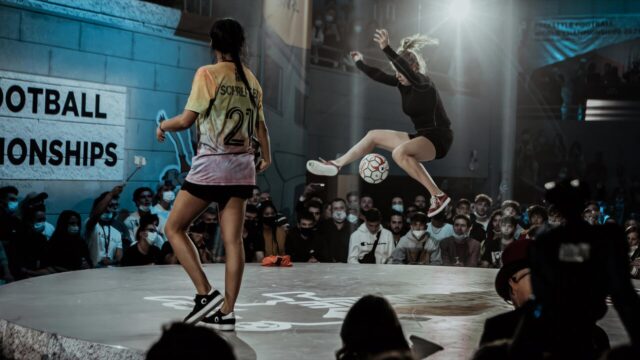
The fifth iteration of Lincoln Center’s Summer for the City features art, film, music, comedy, workshops, discussions, meditation, silent discos, and more, but its focus is on dance — along with World Cup–related soccer programs.
Describing the series, which features an outdoor installation by Clint Ramos, Chief Artistic Director Shanta Thake explains, “Lincoln Center becomes a celebration of bodies in motion — dancing, gathering, and connecting people from all walks of life.” There are hundreds of events, with performers from around the globe.
All presentations are free or choose-what-you-pay, and some require advance RSVP; below are twi-ny’s don’t-miss highlights.
Reg Bloor will conduct her late husband Glenn Branca’s symphony for one hundred guitars at Lincoln Center on June 12 (photo by Maria Jose Govia)
Glenn Branca’s Symphony No. 13 (Hallucination City) for 100 Guitars
Wu Tsai Theater, David Geffen Hall
Friday, June 12, choose-what-you-pay, 7:30 www.lincolncenter.org
On June 13, 2001, avant-garde composer Glenn Branca premiered Symphony No. 13 (Hallucination City) for 100 Guitars on the plaza at the World Trade Center. Writing about the piece for Sound American, Reg Bloor, guitarist Reg Bloor, Branca’s wife, explained, “This is the first time Glenn had done anything like this with volunteers, so we had no idea if anyone was going to show up. I’ll never forget walking around the corner of the North Tower onto the World Trade Center Plaza for the first rehearsal and seeing people sitting there on their amps waiting for us. This was really going to work. . . . The piece was a swirling cauldron of consonance and dissonance, like a giant swarm of bees trapped in a cyclone, the single movement a long, gradual build of dynamics, pitch, and tempo to a crescendo bouncing off the towers and ringing through the plaza, spilling out onto the streets of Lower Manhattan. It’s a sound that stays with you for the rest of the day after the piece is over. You hear it coming out of the subway tunnel or in the air conditioning. You can’t get it out of your ear until whole world starts to sound like Glenn.” Bloor will conduct the symphony at David Geffen Hall on June 12 at 7:30, with one hundred guitarists along with drummer Greg Fox.
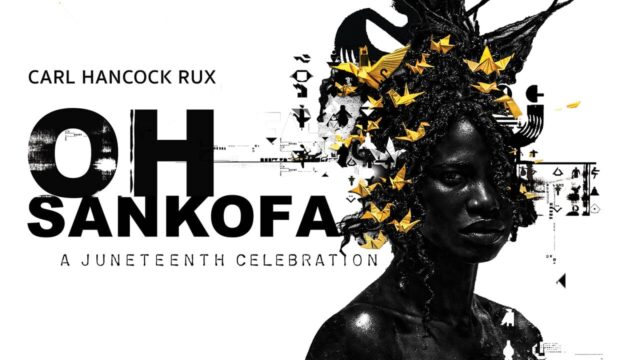
Lincoln Center honors Juneteenth with three special performances that, unfortunately, overlap one another: Carl Hancock Rux’s Oh Sankofa at Hearst Plaza at 7:00, boasting a talented cast exploring the importance of folklore during the Transatlantic Slave Trade; Jeremy Nedd’s from rock to rock . . . aka how magnolia was taken for granite at Alice Tully Hall at 7:30, which looks at the Milly Rock; and Pulitzer Prize winner Suzan-Lori Parks’s The Tune Up at the David Rubenstein Atrium at 7:30, directed by the Flea’s Niegel Smith.
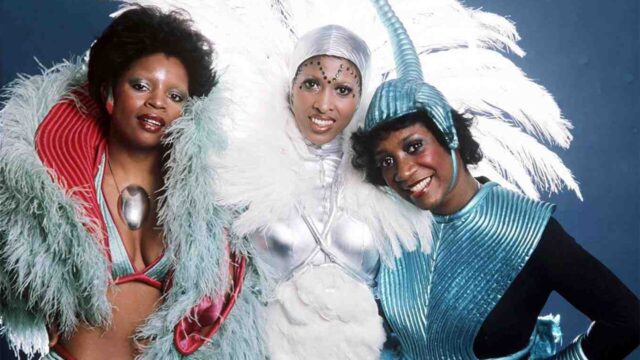
The music of Labelle is celebrated by original member Nona Hendryx at David Geffen Hall
Nightbirds, the Music of Labelle
Wu Tsai Theater, David Geffen Hall
Sunday, June 28, choose-what-you-pay, 7:30 www.lincolncenter.org
In 1974, Patti LaBelle, Nona Hendryx, and Sarah Dash, known as LaBelle, took the country by storm with the monster hit “Lady Marmalade.” The trio had been together in other forms since 1961, broke up in lurid circumstances in 1976, the re-formed from 2005 to 2009. On June 28, Dream Machine Studio is presenting “Nightbirds, the Music of Labelle” at David Geffen Hall, led by Hendryx, joined by the original Labelle backing trio of guitarist Eddie Martinez, bassist Carmine Rojas, and percussionist Jose Rossy, along with Tony winner Adrienne Warren, Kimberly Nichole, Ledisi, and Sandra St. Victor.
Shen Wei Dance Arts and Guangdong Modern Dance Company team up for site-specific MindScape on Hearst Plaza (photo by Gabe Palacio)
Shen Wei Dance Arts | Guangdong Modern Dance Company: MindScape
Hearst Plaza
July 1-3, free, 5:00 www.lincolncenter.org
Chinese-born, NYC-based choreographer, director, and painter Shen Wei brings together Shen Wei Dance Arts (SWDA) and Guangdong Modern Dance Company for MindScape, a forty-five-minute piece that incorporates poetry, calligraphy, painting, and movement on Hearst Plaza. SWDA has presented dazzling dances in the Park Ave. Armory Drill Hall, at the Prospect Park Bandshell, in the Met’s Charles Engelhard Court, and other unique locations, so it should be fascinating to see what they’ll be doing outdoors at Lincoln Center. MindScape is part of Lincoln Center’s Dance Encounters series, which also has performances by Omari Wiles / Les Ballet Afrik (New York Is Burning), Ogemdi Ude (Major), Anna Sperber (Bow Echo), Benjamin Akio Kimitch (Tiger Hands), and Vangeline (Naiad Metal), which takes place in and around the Milstein Reflecting Pool, as well as Chinese Arts Week, which also includes Chinese-born, NYC-based Pulitzer Prize winner Du Yun’s family-friendly The Ocean Etched in the Forest.
Akram Khan’s Thikra is part of Summer for the City at Lincoln Center
Akram Khan Company: Thikra: Night of Remembering
Alice Tully Hall, 1941 Broadway
Thursday, July 2, 7:30; Friday, July 3, 7:30; Sunday, July 5, 2:00, choose-what-you-pay www.lincolncenter.org
English choreographer Akram Khan, who melds the Indian kathak form with contemporary dance, collaborates with visual director Manal AlDowayan on Thikra: Night of Remembering, a piece for between nine and eleven women set to “Gyura Beli Belo Platno” by the London Bulgarian Choir and “The Elephant’s Funeral” by Sushma Soma with Aditya Prakash. “As I stand humbled within the vastness of this epic desert known as AlUla, I feel the urge to unearth the many cultures that have passed through here,” Khan says about the work, which explores the ancient Saudi Arabia desert civilization. Thikra: Night of Remembering is part of the Lincoln Center Contemporary Dance Festival, which also features Jeremy Nedd, Yinka Esi Graves, Sung Im Her / Her Project, Rachid Ouramdane / Compagnie de Chaillot, and others.
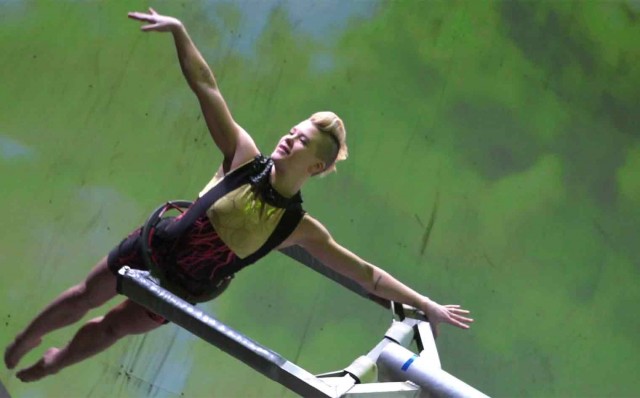
Documentary reveals how Elizabeth Streb and her Extreme Action Company (including Jackie Carlson, seen here) take dance to a whole new level
For more than fifteen years, New Yorkers have gotten the chance to see Elizabeth Streb’s Extreme Action Company perform such dazzling works as Ascension at Gansevoort Plaza, Kiss the Air! at the Park Avenue Armory, and Human Fountain at World Financial Center Plaza as her team of gymnast-dancer-acrobats risk their physical well-being in daring feats of strength, stamina, durability, and grace. In addition, Streb herself walked down the outside wall of the Whitney as part of a tribute to one of her mentors, Trisha Brown. Catherine Gund takes viewers behind the scenes in the exhilarating documentary Born to Fly: Elizabeth Streb vs. Gravity, going deep into the mind of the endlessly inventive and adventurous extreme action architect and the courage and fearlessness of her company. Gund follows Streb as she discusses her childhood, her dance studies, the formation of STREB in 1985, and her carefully thought out views on space, line, and movement as her work stretches the limits of what the human body can do. “I think my original belief and desire is to see a human being fly,” Streb says near the beginning of the film, which includes archival footage of early performances, family photos, and a warm scene in which the Rochester-born Streb and her partner, Laura Flanders, host a dinner party in their apartment, cooking for Bill T. Jones, Bjorn Amelan, Anne Bogart, Catharine Stimpson, and A. M. Homes. Gund also speaks with current and past members of the talented, ever-enthusiastic company — associate artistic director Fabio Tavares, Sarah Callan, Jackie Carlson, Leonardo Giron, Felix Hess, Samantha Jakus, Cassandre Joseph, John Kasten, and Daniel Rysak — who talk about their dedication to Streb’s vision while using such words as “challenge,” “velocity,” “endurance,” “magic,” “invincibility,” and “risk” to describe what they do and how they feel about it. The film is screening on Hearst Plaza on July 10 at 6:00 as part of Lincoln Center’s Dance Encounters series, which also includes “Movement on Film: Athletic Shorts” July 15–17.
Double Dutch Fusion Freestyle & Open Jump
The Dance Floor, Josie Robertson Plaza
Thursday, July 16, free, 5:00 www.lincolncenter.org
One of the most exciting events of every summer at Lincoln Center is the National Double Dutch League strutting its stuff with breathtaking displays of athleticism. It’s three hours of exhilarating movement, including an open jump where visitors are encouraged to participate.
Five troupes come together for annual BAAND Festival (Francesca Levita by Rachel Neville, Christopher R. Wilson by Andrew Eccles, Fangqi Li by Karolina Kuras, Taylor Stanley by Paul Kolnik, DTH Company Artist Kamala Saara by Nir Arieli)
BAAND Together Dance Festival
David H. Koch Theater
Tuesday, July 28, through Sunday, August 1, choose-what-you-pay www.lincolncenter.org
The sixth BAAND Together Dance Festival takes place July 28 thorugh August 1, with five exciting troupes performing in the David H. Koch Theater: Ballet Hispánico New York, Alvin Ailey American Dance Theater, American Ballet Theatre, New York City Ballet, and Dance Theatre of Harlem. It doesn’t get much better than that. Each company will also host a family-friendly dance workshop every day.
[Mark Rifkin is a Brooklyn-born, Manhattan-based writer; you can follow him on Substack here.]
Fourth consecutive AAADT BAM season features company premiere of Medhi Walerski’s Blink of an Eye (photo by Georgia Modi)
ALVIN AILEY AMERICAN DANCE THEATER
BAM Howard Gilman Opera House
30 Lafayette Ave. between Ashland Pl. & St. Felix St.
June 4–7, $46-$156 www.bam.org ailey.org
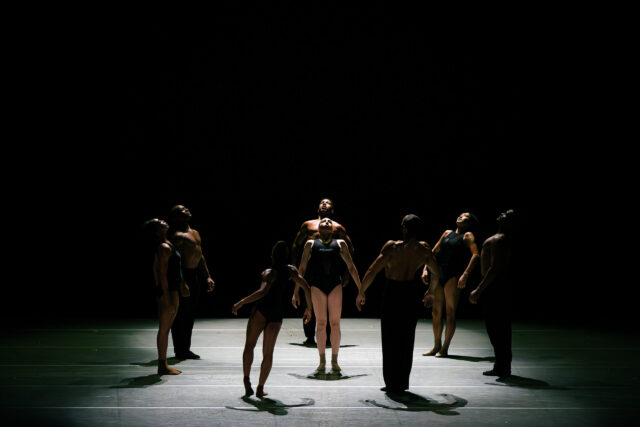
New Alvin Ailey American Dance Theater artistic director Alicia Graf Mack leads the company into its fourth consecutive visit to BAM with an exciting program running June 4–7. A mix of the old and the new concludes Mack’s inaugural season, which included a terrific December/January season at City Center that featured the world premiere of Cuban American theater director and arts educator and activist Maija García’s dazzling, fabulously costumed Jazz Island, a fable celebrating the Afro-Caribbean diaspora, inspired by Geoffrey Holder’s book Black Gods, Green Islands, about Trinidad and Tobago, with original music by jazz trumpeter Etienne Charles; Matthew Neenan’s Ailey debut, Difference Between, set to emotive choral music by MacArthur fellow and two-time Obie winner Heather Christian; Jamar Roberts’s compelling narrative solo Song of the Anchorite, a reimagining of Alvin Ailey’s 1961 solo Hermit Songs, set to jazz trumpeter Avishai Cohen’s interpretation of a Ravel adagio; Fredrick Earl Mosley’s Embrace, which incorporates tunes by Stevie Wonder, Kate Bush, Etta James, Maxwell, Ed Sheeran, Des’ree, and P!nk in exploring the intimacy of human connection as a group of dancers in everyday dress make inventive use of tables; and the company premiere of Medhi Walerski’s Blink of an Eye, set to J. S. Bach’s violin sonatas and partita performed by Itzhak Perlman.
At BAM, AAADT will present a new production of Judith Jamison’s Emmy-winning Hymn, the 1993 thirty-seven-minute tribute to Ailey set to music by Robert Ruggieri and text by Anna Deavere Smith that uses the words of Ailey dancers and Ailey himself; the fifteen-minute Blink of an Eye; and the thirty-six-minute 1960 classic Revelations, a cultural touchstone inspired by Ailey’s childhood.
“I definitely can say to the audience to be present as much as our dancers because it will be over in the blink of an eye,” stager Valentina Scaglia says about Walerski’s piece in the above video. “I think it’s important to just be there and just breathe it in and see what it does. I think the music and the dancers together will bring it over in the most wonderful way.”
On June 4 at 6:00, there will be a free roundtable discussion with the original cast of Hymn in the Adam Space; you can RSVP here.
[Mark Rifkin is a Brooklyn-born, Manhattan-based writer; you can follow him on Substack here.]
The annual Israel Day parade will march up Fifth Ave. on May 31 (photo by twi-ny/mdr)
ISRAEL DAY ON 5th
62nd to 74th St. up Fifth Ave.
Sunday, May 31, free, 11:30 am – 4:00 pm israeldayon5th.com
On May 14, 1948, “The Declaration of the Establishment of the State of Israel” proclaimed, “The State of Israel will be open for Jewish immigration and for the Ingathering of the Exiles; it will foster the development of the country for the benefit of all its inhabitants; it will be based on freedom, justice, and peace as envisaged by the prophets of Israel; it will ensure complete equality of social and political rights to all its inhabitants irrespective of religion, race, or sex; it will guarantee freedom of religion, conscience, language, education, and culture; it will safeguard the Holy Places of all religions; and it will be faithful to the principles of the Charter of the United Nations.” Israel’s existence has been fraught with controversy since the very beginning, but especially now since the October 7 attacks by Hamas and Benjamin Netanyahu’s military response in Gaza, but the nation perseveres, and on May 31 its seventy-eighth birthday will be honored with the annual Israel Day parade. This year’s theme does not back away from the growing vitriol, making a point: “Proud Americans, Proud Zionists.”
On Sunday, tens of thousands of marchers are expected to make their way from Sixty-Second to Seventy-Fourth Sts. up Fifth Ave., including members of synagogues and youth organizations, musicians, dancers, political figures (but not Mayor Zohran Mamdani), community and advocacy groups, civil servants, with lots of flag waving and singing, but the specific roster of entertainers is not being made public in advance of the event. There will be tighter security than ever, for participants as well as viewers; you can check out the details here. As a sign of the times, the grand marshal is police commissioner Jessica Tisch, who said in a press conference, “To be blunt, we are not messing around with security at this year’s parade.”
Onlookers. celebrants, and well-wishers can enter on Madison Ave. at Sixty-First, Sixty-Third, Sixty-Sixth, Seventieth, and Seventy-Third Sts.; the parade will also be broadcast on MY9 and livestreamed here.
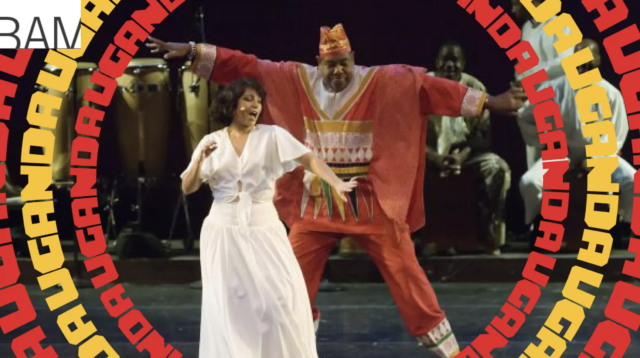
Who: Abdel R. Salaam, Ndere Troupe, Asase Yaa African American Dance Theater, the Billie’s Youth Arts Academy Dance Ensemble, DanceAfrica Spirit Walkers, DJ YB, more What:DanceAfrica Festival 2026 Where:BAM Howard Gilman Opera House, BAM Rose Cinemas, 30 Lafayette Ave. When: May 22-28, many events free, Gilman dances $21-$86, film screenings $17 Why: The coming of the summer season means the arrival of one of the best festivals of every year, BAM’s DanceAfrica. The forty-ninth annual iteration focuses on Uganda, with four companies performing “Umoja/Mirembe/Obulungi (Unity/Peace/Beauty)!” in BAM’s Howard Gilman Opera House: DanceAfrica Spirit Walkers, Asase Yaa African American Dance Theater, the Billie’s Youth Arts Academy Dance Ensemble, and Ndere Troupe, highlighting movement and music from the Pearl of Africa. Curated by artistic director Abdel R. Salaam, the festival also includes the DanceAfrica Bazaar with more than 150 vendors, dance workshops and master classes at the Mark Morris Dance Center, Sanaa Gateja’s “Voices of Peace” art installation, the Council of Elders Roundtable: Legacy & Preservation moderated by Dyane Harvey-Salaam, the Memorial Room, which offers a place to honor festival ancestors, and a late night dance party with DJ YB.
This year’s FilmAfrica screenings and cinema conversations, held in conjunction with the New York African Film Festival, are highlighted by Mohamed Ahmed’s A Tribe Called Love (2025), Maia Lekow and Chris King’s How to Build a Library (2025), Ossie Davis’s Black Girl (1972), Olive Nwosu’s Lady (2026), and Awam Amkpa’s The Man Died (2024) all followed by Q&As with the directors and/or others.
“Thousands of years of African cultural development were interrupted by centuries of colonialism, which gave rise to a sociopolitical movement that led to Uganda’s independence on October 9, 1962, and its formal nationhood in 1963. In the decades since, a powerful artistic movement has emerged to reclaim and celebrate Ugandan identity and intelligence through cultural expression, a force that continues to this day,” Salaam said in his mission statement. “Today, ancient Uganda is considered a cradle of human evolution and early civilization in the East African region of Lake Nalu Baale, the traditional name of what became Lake Victoria. In Luganda, a Bantu language, ‘Nalu Baale,’ translates to ‘Mother of the Ancestral/ Guardian Spirits.’ I am honored to share more of these ancient dances and songs, mixed with shades of contemporary visions of East Africa.”
[Mark Rifkin is a Brooklyn-born, Manhattan-based writer and editor; you can follow him on Substack here.]