live performance

MARTHA CLARKE, BETH HENLEY, AND JOHN KELLY BRING HENRY DARGER TO LIFE: BUGHOUSE AT THE VINEYARD

John Kelly stars as Outsider artist Henry Darger in Bughouse (photo by Carol Rosegg)(photo by Carol Rosegg)

BUGHOUSE
Vineyard Theatre
Gertrude and Irving Dimson Theatre
108 East 15th St. between Union Square East & Irving Pl.
Tuesday – Sunday through April 5, $63.72-$118.80
www.vineyardtheatre.org

“Just because there’s questions, that does not mean there are answers,” Kiyoko Lerner, Henry Darger’s last landlady and caretaker of his art, says in Jessica Yu’s 2004 documentary In the Realms of the Unreal: The Mystery of Henry Darger.

The same can be said about Bughouse, an intriguing play about Darger (pronounced with a hard g) conceived and directed by Martha Clarke, written by Beth Henley, and starring solo specialist and downtown legend John Kelly.

An isolated, reclusive, hard-edged man, Darger died in a Chicago nursing home on April 13, 1973, at the age of eighty-one. He never married and had no children. His mother died when he was three after giving birth to a daughter who was put up for adoption. His disabled father, an easygoing tailor, was moved to a poorhouse when Henry was eight; the boy was first sent to an orphanage, then to the Illinois Asylum for Feeble-Minded Children.

He later worked as a hospital janitor and seems to have had only one friend, an immigrant named William Schloeder.

But he left behind a remarkable legacy in his cramped Chicago apartment. Amid piles and piles of newspapers, magazines, books, religious icons, clippings, a crank record player, a radio, a handmade “No Smoking” sign, and art supplies, Kiyoko and her husband, Nathan, discovered large-scale watercolors, a five-thousand-page memoir, a six-volume weather journal, and the fifteen-thousand-page illustrated novel The Story of the Vivian Girls, in What Is known as the Realms of the Unreal, of the Glandeco-Angelinian War Storm, Caused by the Child Slave Rebellion, an epic fantasy set on a different planet, where the Abbieannians, led by the seven Vivian Girls, battle the Glandelinians over their enslavement of children. It was in part inspired by the 1911 abduction of Elsie Paroubek, who Darger transforms into the heroic Annie Aronburg.

Two-time Obie winner Clarke (Angel Reapers, The Garden of Earthly Delights) and Pulitzer winner Henley (Crimes of the Heart, The Miss Firecracker Contest) incorporate those elements and more into Bughouse, which includes Darger sharing his story directly with the audience, typing out his autobiography to prerecorded dialogue, and talking to visions he sees in windows and mirrors. He trudges around his apartment with a slight limp, muttering to himself about history and the weather and relating tales from his past. “Why have you not answered my prayers?” he asks God at the very beginning.

The voices of the Vivian Girls often deliver quotes from Darger’s novel. “I have received warnings that I am in danger of assassination, but as horrible as it is to be murdered in cold blood, I defy my enemies before God to do it,” Annie says. One of the other girls tells him, “All Blengiglomenean Serpents are the greatest lovers of children of all nations, whether good or bad, and children of bad nations have been carried away by these enormous creatures so that their souls would not be ruined by the sinful ways of the government or their parents.”

When Darger talks about his life, black-and-white footage of the Chicago street outside are projected in the back windows. When the girls speak, animated depictions of them, based on Darger’s art, float around the set, their voices emanating from speakers placed throughout the theater. Storms occasionally rattle the space. The lighting is by Christopher Akerlind, with sound by Arthur Solari, projections by John Narun, cinematography by Fred Murphy, and animation by Ruth Lingford. The exquisite set and props are by Neil Patel and Faye Armon-Troncoso, re-creating the controlled chaos of Darger’s strange world.

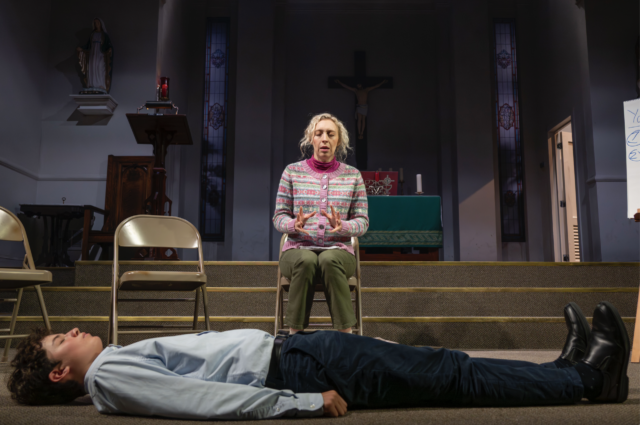
Bughouse re-creates a day in the life of Henry Darger (John Kelly) (photo by Carol Rosegg)

Kelly, a multimedia artist and performer who has portrayed Egon Schiele in Pass the Blutwurst, Bitte, Caravaggio in The Escape Artist, Joni Mitchell in Paved Paradise, Antonin Artaud in Life of Cruelty, and Samuel Steward in Underneath the Skin, embodies Darger with an air of creepy mystery and unsettling angst; Darger is not a man most people would want to spend a lot of time with, and mercifully the play is barely more than an hour.

But as creative as Clarke, Henley, and Kelly are, the play is likely to be difficult for those who don’t know much about Darger. In the lobby are cards that share information about the Vivian Girls and Darger’s life, which are recommended reading for audience members who know little or nothing about either. We never get to see the real images Darger drew, only animated versions, nor his handwriting, which lends insight into his character. The play also forces connections between Darger’s personal experiences and his art, but they are not as direct as Clarke and Henry posit.

I’ve been to several Darger exhibitions and saw the documentary when it came out, and they all left me feeling a combination of disgusted, confused, and blown away by Darger’s sheer talent; unfortunately, the play does not zero in enough on his extraordinary artistic abilities.

The show’s art history consultant, Michael Bonesteel, contributes a biographical program note in which he writes, “Henry Darger is viewed today as probably the greatest Outsider artist in the art brut canon. He was an autodidactic world-builder of the first order and the ultimate poster child for savant syndrome. He will be remembered as an indomitable creative genius who, single-handedly and against all odds, imaginatively transformed his tragic, impoverished life into a mythic wonderland within the confines of his one-and-a-half-room boardinghouse flat.”

You won’t learn much of that from the play itself, but spending an hour in the presence of Kelly is always worthwhile.

[Mark Rifkin is a Brooklyn-born, Manhattan-based writer; you can follow him on Substack here.]
KILLING AN EVENING WITH EDGAR ALLAN POE: JOHN KEVIN JONES RETURNS TO MERCHANT’S HOUSE WITH SPECIAL GUESTS

(photo by Joey Stocks)

John Kevin Jones pays tribute to Edgar Allan Poe at historic Merchant’s House Museum (photo by Joey Stocks)

KILLING AN EVENING WITH EDGAR ALLAN POE
Merchant’s House Museum
29 East Fourth St. between Lafayette St. and the Bowery
March 25 – April 5, $65-$75
merchantshouse.org
summonersensemble.org

John Kevin Jones is back for his annual residency at the historic Merchant’s House Museum on East Fourth St. with Killing an Evening with Edgar Allan Poe: Murder at the Merchant’s House. Jones has gained a kind of cult fan club for his unique one-man shows, which also include his unique version of A Christmas Carol at the historic museum, a home built in 1831-32 that was occupied continuously by the Tredwell family from 1835 to 1933. The nineteenth century feels very present in the house, which was one of the first twenty buildings to gain landmark status under the city’s 1965 law and functions as a museum, preserving the Tredwell family’s furnishings as they would have appeared when Poe, coincidentally, lived nearby for a time at 85 West Third St. and later in a cottage in the Bronx. Dressed in nineteenth-century-style jacket, vest, top hat, and ascot, Jones celebrates Edgar Allan Poe with three of his most popular writings, preceded by short introductions about each work and Poe’s career.

Forty people are squeezed into the Tredwells’ candlelit double parlor — with a coffin at one end and a dining table at the other — and Jones walks up and down the narrow space between, where the audience is seated on three sides, boldly delivering several classic Poe tales of treachery and murder, “The Tell-Tale Heart,” “The Angel of the Odd,” and “The Cask of Amontillado,” from memory. His deep, theatrical voice resonates through the room as he catches the eye of audience members, adding yet more chills and thrills to the mystery in the air. He then sits down with a book for the long poem “The Raven,” evoking the great Poe actor Vincent Price. Jones, director Dr. Rhonda Dodd, and stage manager Dan Renkin, the leaders of Summoners Ensemble Theatre, keep the focus on Poe’s remarkable narrative technique; you might be watching one man, but you’ll feel like you’re seeing each of Poe’s characters in vivid detail.

Killing an Evening with Edgar Allan Poe runs March 25 through April 5, and for select performances there will be a “Raise a Glass to Edgar” preshow reception option ($30) in which Jones will recite “Annabel Lee” and “Alone,” Natalia “Saw Lady” Paruz will perform, and the kitchen, family room, and garden will be open. In addition, medium Heather Carlucci will give psychic readings after both Sunday shows.

There is also a concerted public effort to save the Merchant’s House from construction next door that could negatively impact its structural future; find out how you can help here.

[Mark Rifkin is a Brooklyn-born, Manhattan-based writer and editor; you can follow him on Substack here.]
ALL IN THE TELLING: SAUL RUBINEK AT THE MUSEUM OF JEWISH HERITAGE

Saul Rubinek will be at the Museum of Jewish Heritage for two very special, deeply personal evenings

Who: Saul Rubinek, Annette Insdorf, Caroline Aaron
What: “All in the Telling — a somewhat true story”
Where: Museum of Jewish Heritage, Edmond J. Safra Plaza, 36 Battery Pl.
When: Wednesday, March 25, and Thursday, March 26, $18, 7:30
Why: Last fall, Genie Award winner Saul Rubinek brought his one-man show, Playing Shylock, a melding of the Bard’s Merchant of Venice and Rubinek’s own life, to the Polonsky Shakespeare Center in Fort Greene. The Jewish Canadian Rubinek, who was born in a German refugee camp in 1948 and later raised in Canada — and whose parents were Holocaust survivors — is now coming to Manhattan to present two special evenings at the Museum of Jewish Heritage. On March 25 and 26, he will perform excerpts from and sign copies of his new novel, All in the Telling: a somewhat true story (Redwood, $24.99), described as “a true story of miraculous survival, a murder mystery, an operatic family drama, and undying romance,” inspired by his parents’ real-life experiences.

The reading will be accompanied by clips from his 1987 documentary, So Many Miracles, in which Rubinek takes his mother and father back to Poland to reunite with the farmers who hid them during the Holocaust. The first night will be followed by a conversation with Columbia University School of the Arts film professor Annette Insdorf (Indelible Shadows: Film and the Holocaust), while the second night will conclude with a discussion with actress Caroline Aaron (The Marvelous Mrs. Maisel, Between the Temples). Rubinek, who has starred in such films as Joel and Ethan Coen’s The Ballad of Buster Scruggs, Clint Eastwood’s Unforgiven, Tony Scott’s True Romance, and Ralph L. Thomas’s Ticket to Heaven, is a master storyteller who knows how to command an audience, so these programs promise to be memorable events.

[Mark Rifkin is a Brooklyn-born, Manhattan-based writer; you can follow him on Substack here.]
TAKING ACTION TO SAVE DEMOCRACY: ART AT A TIME LIKE THIS SIXTH ANNIVERSARY CELEBRATION

Who: Janet Biggs, Mary Lucier, Shaun Leonardo, Marka27, Pablo Helguera
What: Public art campaign benefit for Art at a Time Like This
Where: Cristin Tierney Gallery, 49 Walker St.
When: Thursday, March 27, minimum donation $150 ($75 for artists), 6:00 – 9:00
Why: Only a few days into the pandemic lockdown in March 2020, independent curator and author Barbara Pollack and artist agent Anne Verhallen took action, starting the nonprofit Art at a Time Like This (ATLT), dedicated to the idea that “art can make a difference and that artists and curators can be thought-leaders, envisioning alternative futures for humanity.” Art at a Time Like This has presented two dozen online and in-person exhibitions and programs since then, including “Dangerous Art, Endangered Artists,” “Rupture: Interventions of Possibility,” and “Don’t Look Now: A Defense of Free Expression.”

On March 27, ATLT will be celebrating its sixth anniversary, at the Cristin Tierney Gallery on Walker St., with a three-hour evening of cocktails, conversation, and a call to action, featuring four impressive speakers: artists Janet Biggs, Mary Lucier, Shaun Leonardo, and Marka27, with Pablo Helguera serving as moderator. The event is hosted by Leonardo Bravo, Andy Cushman, Helina Metaferia, Marilyn Minter, Gina Nanni, Megan Noh, Eric Shiner, and Cristin Tierney.

“At the very beginning of a worldwide pandemic, we asked a simple question: How can you think of art at a time like this?” Pollack tells twi-ny. “The question is now more relevant than ever, which presents both a tragedy and an opportunity for creative solutions.”

The next creative solution for ATLT is the exhibition “Take One Action,” which the organization considers “an antidote” for what is happening around the globe today. All artists are invited to submit one artwork, along with a suggested action to help protect and preserve our democracy — with an eye toward the midterm elections. Select contributions will be printed and wheatpasted across the city and/or appear in an ever-growing digital exhibit.

“Barbara and Anne responded to the pandemic with amazing speed, care, and inclusiveness by asking a question: ‘How can you think of art at a time like this?’ The overwhelming response was: ‘How can you not?’” explains Biggs, a research-based interdisciplinary artist known for her immersive work in video, film, and performance. “They have continued to ask that question in the face of ongoing trauma, injustice, and upheaval, and artists have continued to answer with work that is engaged, compassionate, and necessary. That is why Art at a Time Like This — and its programming — is so essential.”

Admission is a minimum donation of $150 ($75 for artists) for what should be a fascinating gathering of thought-leaders who will not just be honoring the success of ATLT but continuing the fight to use art to make a difference.

[Mark Rifkin is a Brooklyn-born, Manhattan-based writer; you can follow him on Substack here.]
STOP THAT PIGEON: BIDDING A FOND ADIEU TO DINOSAUR ON THE HIGH LINE

Iván Argote’s Dinosaur will be flying off from the High Line soon (photo by twi-ny/mdr)

FAREWELL, DINOSAUR
High Line Plinth on the High Line Spur
Thirtieth St. at Tenth Ave.
Friday, March 21, free, noon – 4:00
www.thehighline.org

It promises to be the biggest send-off for a New York City pigeon ever.

On June 14, 2025, the High Line welcomed Iván Argote’s High Line Plinth commission, Dinosaur, with “Pigeon Fest,” a festival celebrating pigeons, urban ecology, and public art on National Pigeon Appreciation Day. The High Line is now saying goodbye to the seventeen-foot-tall, one-ton aluminum pigeon sculpture on March 21 with another party, “Farewell, Dinosaur,” consisting of games, photo ops, and more, with Argote, DJ Tommy Sparks, and Miriam Abrahams, the British multidisciplinary artist who won the Pigeon Impersonation Pageant at the opening. Visitors are encouraged to again come in feather-brained costumes as they play bingo and have Argote sign limited-edition posters.

“The name Dinosaur makes reference to the sculpture’s scale and to the pigeon’s ancestors who millions of years ago dominated the globe, as we humans do today,” the Colombia-born, Paris-based Argote said in a statement. “The name also serves as a reference to the dinosaur’s extinction. Like them, one day we won’t be around anymore, but perhaps a remnant of humanity will live on — as pigeons do — in the dark corners and gaps of future worlds. I feel this sculpture could generate an uncanny feeling of attraction, seduction, and fear among the inhabitants of New York.”

The attraction, seduction, and fear will continue through early April, when Dinosaur will go extinct on the High Line, replaced by Tuan Andrew Nguyen’s The Light That Shines Through the Universe.

[Mark Rifkin is a Brooklyn-born, Manhattan-based writer; you can follow him on Substack here.]
CELEBRATING WIFREDO LAM AT MoMA WITH DANCE, MUSIC, AND POETRY

Wifredo Lam with the unfinished Bélial, empereur des mouches in his garden, Havana, 1947 (courtesy Archives SDO Wifredo Lam, Paris / photo by Ylla © Pryor Dodge)

Who: Ballet Hispánico New York, Aruán Ortiz, Yaissa Jimenez
What: A Special Evening Celebrating “Wifredo Lam: When I Don’t Sleep, I Dream”
Where: Museum of Modern Art, 11 West Fifty-Third St. Between Fifth & Sixth Aves.
When: Thursday, March 19, free with advance RSVP, 6:30
Why: “I knew I was running the risk of not being understood either by the man in the street or by the others,” Cuban-born artist Wifredo Óscar de la Concepción Lam y Castilla said, “but a true picture has the power to set the imagination to work, even if it takes time.” The wide-ranging MoMA retrospective “Wifredo Lam: When I Don’t Sleep, I Dream” paints a fascinating portrait of Lam, the son of a Chinese immigrant and the grandson of a Congolese former slave mother. It’s a marvelous collection of paintings, drawings, archival photographs, sketches, books, and ephemera tracing Lam’s career, which took him from Cuba, Spain, and France to Martinique, Haiti, and New York as his imagination turned to Spanish modernism, Surrealism, and Afro-Cuban tradition. Among the highlights of the exhibition, which runs through April 11, are the 1943 gouache on paper masterpiece The Jungle, a trio of dazzling abstracts, and a collection of plates.

On March 19 at 6:30, MoMA will be hosting “A Celebration of ‘Wifredo Lam: When I Don’t Sleep, I Dream,’” as Ballet Hispánico New York, Cuban-born, Brooklyn-based pianist, violist, and composer Aruán Ortiz, and Dominican writer and poet Yaissa Jimenez will perform specially commissioned new works in the exhibition galleries, paying tribute to Lam and his legacy. Admission is free with advance RSVP.

[Mark Rifkin is a Brooklyn-born, Manhattan-based writer; you can follow him on Substack here.]
THE PLUCK OF THE IRISH: THE US PREMIERE OF ULSTER AMERICAN

Director Leigh Carver (Max Baker), playwright Ruth Davenport (Geraldine Hughes), and actor Jay Conway (Matthew Broderick) meet for the first time in David Ireland’s Ulster American (photo by Carol Rosegg)

ULSTER AMERICAN
Irish Repertory Theatre, Francis J. Greenburger Mainstage
132 West Twenty-Second St. between Sixth & Seventh Aves.
Wednesday – Sunday through May 24, $55-$125
irishrep.org

Among the topics raised in the US premiere of David Ireland’s Ulster American are the n word, rape, murder, the Troubles, car crashes, religion, Brexit, alcoholism, and self-identity.

Oh, did I mention that it’s a comedy — and a hilarious one at that?

The eighty-minute play takes place in real time on a Sunday night in the cozy living room of British theater director Leigh Carver’s (Max Baker) London home, decorated by set designer supreme Charlie Corcoran, with two armchairs, a couch, several small tables, a writing desk, a window in a rear nook, theater posters for The Mousetrap, Camelot, London Assurance, Macbeth, and the National Theatre, and several bookcases filled with tomes about Noël Coward, Samuel Beckett, and other theater legends.

Leigh is meeting with Jay Conway (Matthew Broderick), an Oscar-winning American actor who is starring in a new work Leigh is directing, by Irish playwright Ruth Davenport (Geraldine Hughes). Rehearsals are set to begin the next day, and Leigh wants the three of them to get to know each other more first. Jay is on the couch, in the middle of a conversation with Leigh, telling him, “Is there homophobia in Hollywood? Of course. And misogyny? How can we deny it? It’s reflected in so much of our output. Narrative upon narrative centered around the abuse of women, the violent abuse of women. And racism? Only a fool could pretend otherwise.”

Leigh is surprised when Jay asks, “You ever use the n word?” After discussing James Baldwin, power dynamics, and the Bechdel test — a measure, proposed by cartoonist Alison Bechdel, that judges a fictional work based on whether it includes scenes in which at least two women talk about something other than men — Jay adds, “Why should I, a man, dictate to Bechdel, a woman, what should or should not be part of her fucking theory? This is me, learning from my mistakes, learning to shut the fuck up. . . . And that’s what I’m saying, this is where we’re at. Guys like me and you taking a back seat. Allowing the Ruth Davenports of the world to have their say. Fucking white heteronormative, privileged fucking uh . . . cis . . . motherfuckers like you and I who have to stand aside now. We have a moral responsibility to . . . I mean not me. Obviously. I’m Irish Catholic, so I can’t . . . I’m not part of that – the equation of – . . . I have an intersectional exemption.”

Jay speaks in a calm manner but with an undercurrent of excitement as he attempts to show off what he believes to be his supreme knowledge of society and his allyship with women and people of color. Leigh gets bored quickly but jumps in every once in a while to agree with Jay or correct a mistake, but nothing is going to stop Jay from making his points. He’s clearly a superstar who is used to being coddled and listened to.

Leigh is then shocked when Jay determinedly asks, “Do you think there are any circumstances where it’s morally acceptable to rape someone?” The audience is shocked as well as Jay describes a situation, inspired by a movie plot, when it might actually benefit a certain kind of woman; he names the person he would rape, then forces Leigh to choose his victim. The director squirms in his chair as they debate the validity of the question, but Jay is not about to give up until Leigh finally gives him a name, trapped by his need to suck up to Jay, since a lot is riding on this play.

A few minutes later, Ruth arrives, and things get really bizarre. She apologizes for being late, explaining that her mother had just gotten into an accident and is in the hospital. Her mother was driving Ruth to the airport and they were arguing about a friend of Ruth’s who was killed in the Troubles. Ruth tells the men, “I just lost it with her and — I don’t know what came over me, I just said, ‘Mummy — why do you always have to be such a cold-souled, blackhearted thoughtless fucking bitch?’” That was followed by the crash.

Initially, the three of them heap praise on one another. Ruth gushes that she’s Jay’s biggest fan and feels like she already knows him. Jay thanks her for writing him the role of a lifetime, saying, “Your script. Your fucking script, Ruth. Is the single best script I’ve read for ten fucking years.” Leigh believes that, given the quality of the script and the beloved star, they are critic-proof. “Hey, fuck the critics, I don’t give a fuck about the critics,” Jay declares. “They’re fucking animals, Leigh. They’re animals, Ruth. And we should do with them what we do with animals. Kill them and eat them. And the good ones keep as pets.”

But when Ruth says that, although she is from Northern Ireland, she considers herself British and that the protagonist of her play is the same, both Jay and Leigh are infuriated, and the real fireworks begin.

Jay: Are you British because Britain used to own Ireland? So they used to own you, like a slave, so you’re British?
Leigh: Exactly!
Ruth: They never owned me. I was never a slave!
Jay: It’s confusing because to me you sound Irish.

The confusion only increases as the battle lines are drawn.

History and identity collide in superb dark comedy at Irish Rep (photo by Carol Rosegg)

Ulster American debuted at the 2018 Edinburgh Fringe and had a highly touted 2023 London revival starring Woody Harrelson, Louisa Harland, and Andy Serkis. Director Ciarán O’Reilly’s (The Weir, The Emperor Jones) adaptation is a sizzling slow build, balancing humor with pathos and bravado until all hell breaks loose. Leigh, Ruth, and Jay dig deep into their personal sense of identity while also judging the others’. “You don’t get to decide who’s British and who isn’t,” Ruth says to Leigh, who replies, “Well, we sort of do. That’s the point.” A bewildered Jay chimes in, “This is more complicated than I thought.”

The argument relates to what is happening in the United States right now, as liberals and conservatives, both in the government and private citizens, feud over the status of legal and illegal immigrants.

The three characters also all bring up the subject of history, as if that will provide the answers they are seeking. “History is so important to this. For this play, I feel like I need to know the history of Ireland like I know my own ball sack,” Jay says. But even history is subjective these days.

Tony winner and New York City native Broderick (Shining City, Evening at the Talk House) is brilliant as Jay; his singsong delivery and stiff posture imbue the Hollywood icon with a sense of invulnerability, but in this case he is on his own, not surrounded by a sycophantic entourage he is probably used to. He glories in stating his opinions and flaunting his progressive ideals, but they are essentially only lip service, with curses casually thrown in not for emphasis but just because.

The Belfast-born Hughes (Molly Sweeney, Jerusalem) is a powder keg as Ruth, who is beyond thrilled to be working with Leigh and Jay until she starts learning more about them and some of their views; she’s not about to just sit back and let them run all over her, instead going toe-to-toe.

And Baker (Continuity, The Low Road), who hails from Baton Rouge, Louisiana, is completely convincing as the British Leigh, who has to walk the fine line between Jay and Ruth but is more conniving than he likes to admit, unable to remain neutral even as he attempts to befriend and care about each of them.

Ireland (What The Animals Say, Most Favoured) and O’Reilly (The Weir, The Emperor Jones) know what of they speak; both are from the north of Ireland, but the former is from Belfast and Ballybeen in Northern Ireland, while the latter is from Cavan, in the Republic of Ireland. In one of his previous, plays, the darkest of dark comedies Cyprus Avenue, Ireland also examines the issue when the protagonist insists, after calling another character the n word, “The last thing I am is Irish. I am anything but Irish. I am British. I am exclusively and non-negotiably British. I am not nor never have been nor never will be Irish.”

Ireland and O’Reilly take that to the next level in Ulster American, along with a sensational cast, critics be damned.

[Mark Rifkin is a Brooklyn-born, Manhattan-based writer; you can follow him on Substack here.]