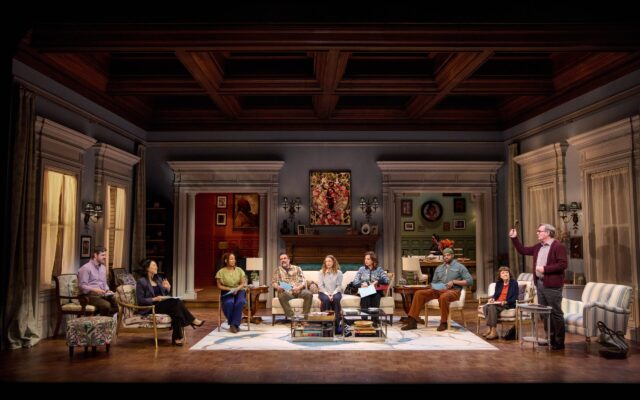
A series of meetings of the Vernon Point Neighborhood Association opens up old and new wounds in The Balusters (photo by Jeremy Daniel)
THE BALUSTERS
Samuel J. Friedman Theatre
261 West Forty-Seventh St. between Broadway & Eighth Ave.
Tuesday – Sunday through May 24, $58-$347
www.manhattantheatreclub.com
Yesterday afternoon I bumped into Richard Thomas on the Upper East Side. I told him how fabulous I thought The Balusters, the new Broadway play he’s starring in, is and what a great cast he’s working with. But as much fun as I had at the show, it appears that he is having even more, if that’s possible, gushing about David Lindsay-Abaire’s script and the entire ensemble. His smile was even bigger than mine.
Making its world premiere at MTC’s Samuel J. Friedman Theatre, The Balusters takes on a kitchen sink of contemporary issues, from homophobia, racism, classism, and corruption to toxic masculinity, privilege, bigotry, and furniture. And it does so in hilarious ways; I can’t remember the last time I laughed so long and hard during a play or clapped so often after side-splitting, sparkling lines of dialogue.
The hundred-minute comedy is set at several meetings of the Vernon Point Neighborhood Association, where a group of nine people regularly gather to discuss the state of their beloved community, a peaceful, old-fashioned enclave steeped in history, boasting well-manicured lawns, comfortable, attractive porches, and an overall flavor of Victorian elegance. The host is the newest member, Kyra Marshall (Anika Noni Rose), who has recently moved from Baltimore with her husband and their twin daughters. She lives in a beautifully designed home with fashionable chairs and couches, fancy china, and paintings of and by distinguished Blacks on the walls, as if overseeing the coming shenanigans, including, in the foyer, a print of George DeBaptiste’s 1978 portrait of Toussaint L’Ouverture, who was born a slave and went on to be a leader of the Haitian Revolution, and, above the fireplace, a flower-laden portrait of a Black feminist that evokes the work of contemporary Black American artists Harmonia Rosales and Kehinde Wiley. (The elegant set is by two-time Tony and two-time Emmy winner Derek McLane.)
The gavel-wielding president of the association is Elliot Emerson (Thomas), a fuddy-duddy real-estate broker intent on protecting the legacy of Vernon Point. The other members are Latino contractor Isaac Rosario (Ricardo Chavira); the acerbic, antagonistic Jewish treasurer, Ruth Ackerman (Margaret Colin); Willow Gibbons (Kayli Carter), a young, white vegan who sees microaggressions everywhere; Brooks Duncan (Carl Clemons-Hopkins), a gay Black travel writer who is married and has a son; the somewhat hapless Alan Kirby (Michael Esper), a white man in his fifties who considers himself an ally and doesn’t understand why he is so often ignored; Melissa Han (Jeena Yi), an ambitious Asian American lesbian and lawyer who is the vice president; and Penny Buell (Marylouise Burke), the elderly white secretary who used to work for Elliot and is not nearly as doddering as she might let on, surprising everyone with sharply focused acerbic quips. Also present is Luz Baccay (Maria-Christina Oliveras), Kyra’s ultra-efficient Filipino housekeeper who left the Emersons’ employ for unstated reasons.
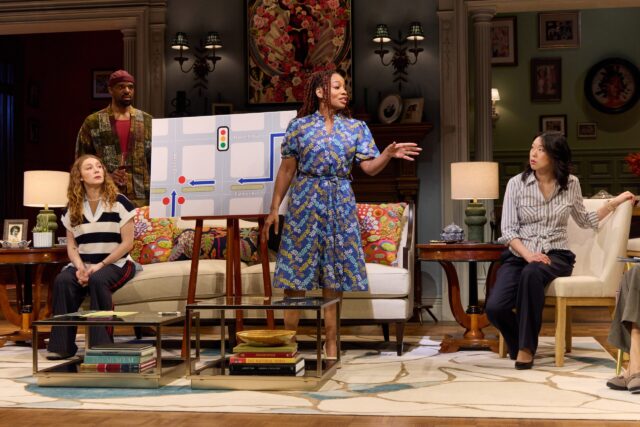
New resident Kyra Marshall (Anika Noni Rose) has no idea what she’s in for after joining group (photo by Jeremy Daniel)
Among the topics of discussion are expanding the hours of the safety van to catch porch pirates, how to handle kids who don’t live in Vernon Point but hang out there, and the plain, ahistorical balusters the Crawfords may be installing, which insult Elliot and lead to the following exchange, which helps define the characters while establishing the play’s central metaphor.
Elliot: Farmhouse balusters aren’t true to the period or style of the original railing. They’d look ridiculous on that Queen Anne.
Melissa: But we don’t police our neighbors.
Elliot: It’s not policing. If you live here, you’ve agreed to certain guidelines.
Kyra: I hate to ask, but what exactly are balusters?
Elliot: I’m sorry, Kyra. We should’ve started with that.
Isaac: They’re the posts that support a railing. They’re like spindles but with footings.
Kyra: Okay, I’m gonna nod and pretend I know what that means.
Melissa: You’re gonna learn so much useless information here.
Elliot: It’s not useless. The balusters are important. They hold everything up. A porch’ll fall to pieces without the right support.
Ruth: As riveting as this is, may we move on?
When Kyra suggests that the group request stop signs for a corner where numerous accidents have occurred, heated arguments ensue, eventually becoming personal over the course of several meetings and leaving no one unscathed, their biases revealed via revenge, gossip, and carelessness.
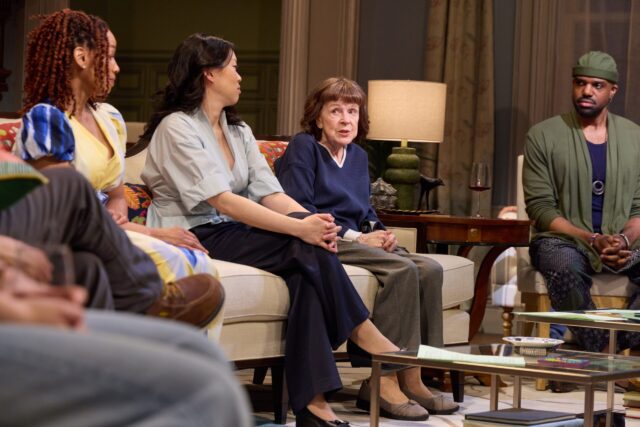
Penny Buell (Marylouise Burke) is deceptively clever and prescient in brilliant new Broadway comedy (photo by Jeremy Daniel)
The Balusters is brilliantly written by Tony and Pulitzer winner Lindsay-Abaire (Rabbit Hole, Kimberly Akimbo) and expertly directed with a wry sense of humor by Tony winner Kenny Leon (Purlie Victorious: A Non-Confederate Romp Through the Cotton Patch, Home). It is reminiscent of both Bruce Norris’s Tony- and Pulitzer-winning Clybourne Park and Jonathan Spector’s Tony-winning Eureka Day, two plays that explore what can go wrong when small groups of people think they can decide what’s right and wrong for others. It will also likely remind New Yorkers of why they don’t want to be on their coop board.
Five-time Tony nominee Emilio Sosa’s costumes are impeccable, and four-time Tony nominee Allen Lee Hughes’s lighting and six-time Tony nominee Dan Moses Schreier’s sound — he also composed the excellent interstitial music, which features a rap bent — are in sync throughout, especially when thunder and lightning strike at just the right instances.
The terrific ensemble forms an outrageously funny extended family, led by Emmy winner Thomas (Our Town, The Little Foxes) as an older man seeing his carefully curated life slip away and Tony winner Rose (Caroline, or Change, A Raisin in the Sun) as a younger woman who is not afraid to get in Elliot’s way, but theater treasure Burke (Ripcord, Infinite Life), in her seventh collaboration with Lindsay-Abaire, steals the show as Penny, who always knows just what to say.
“I’d just like to remind us that everyone in this room is a decent person,” Penny interjects at one point when things are threatening to get out of hand. “We wouldn’t be here if we didn’t care about our neighbors. At the same time, no one is perfect, and sometimes people make mistakes.”
Now, where’s my gavel?
[Mark Rifkin is a Brooklyn-born, Manhattan-based writer; you can follow him on Substack here.]