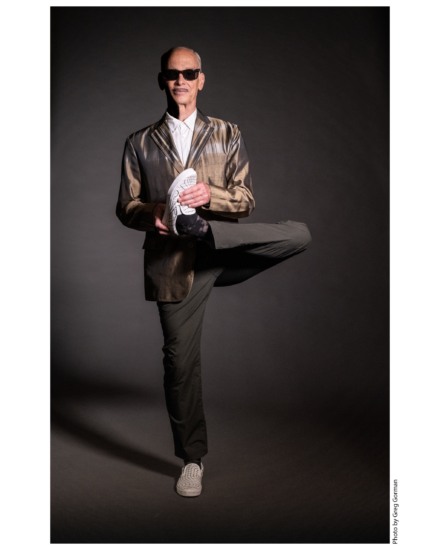
John Waters loosens up in preparation for his eightieth-birthday shows, coming to the Society for Ethical Culture on April 19
GOING TO EXTREMES: A JOHN WATERS 80th BIRTHDAY CELEBRATION
Adler Hall at the New York Society for Ethical Culture
2 West Sixty-Fourth St. & Central Park West
Sunday, April 19, $87.97 – $130.69, 7:30
ethical.nyc
www.dreamlandnews.com
“Secretly I think that all my films are politically correct, though they appear not to be. That’s because they’re made with a sense of joy,” filmmaker, actor, writer, visual artist, and monologist John Waters has said.
After having spoken with him, I now feel that John Waters himself is made with a sense of joy.
Over a career lasting more than sixty years, the Baltimore native, who turns eighty on April 22, has brought joy to a ravenous public that devours his eclectic movies, books, talk-show appearances, and solo performances. He broke through in the early 1970s with the counterculture trio of Multiple Maniacs, Pink Flamingos, and Female Trouble, all starring the drag queen Divine, and scored more mainstream success later with Polyester, Hairspray, Cry-Baby, and Serial Mom.
His writings include 1981’s Shock Value: A Tasteful Book About Bad Taste, in which he explains, “To me, bad taste is what entertainment is all about. If someone vomits watching one of my films, it’s like getting a standing ovation.”; the 2014 nonfiction Carsick, which details his 2012 cross-country hitchhiking trip; and his first novel, 2022’s Liarmouth . . . A Feel-Bad Romance, about a pair of con artists, luggage, and a chatty penis. Among his numerous acting jobs, he portrayed the Groom Reaper on the based-on-fact legal drama ’Til Death Do Us Part and made a cameo as Jesus in Ash Christian’s Mangus!
A master of the spoken-word lecture, he has performed such solo shows as This Filthy World, Naked Truth, Make Trouble, and A John Waters Christmas. His latest, Going to Extremes: A John Waters 80th Birthday Celebration, comes to the Society for Ethical Culture on April 19.
Waters, who is always impeccably dressed and styled, usually in a sports jacket and tie, highlighted by his famous pencil-thin mustache, is utterly charming on the phone, laughing often as we discuss the ins and outs of showbiz, holiday-themed monologues, Howdy Doody, airplane etiquette, and ethical culture.
twi-ny: Hello, John.
john waters: Hey, Mark.
twi-ny: I met you many, many years ago. You would never, ever remember it, but it was at “Outsider Porn,” a marvelous show you curated with Dian Hanson in Chelsea of photos of erect penises by David Hurles.
jw: Yeah, I did that at the Marianne Boesky Gallery. Yes.
twi-ny: I had never seen anything like that kind of show and I just loved it.
jw: It was pretty brave of my gallery to do it.
twi-ny: Yes, but you know what, it was like all of your work, all the things you’re involved in: It makes people experience a different part of the world or a different kind of beauty that they’re not used to seeing.
jw: I’m coming to New York for my eightieth.
twi-ny: How great is that? So when you were a boy and you started doing puppet shows at children’s birthday parties, did you ever think that you would be working harder than ever in the entertainment business when you were eighty?
jw: I didn’t ever think that, but I never thought I wouldn’t do that either. I always was ambitious. My parents taught me I could be anything I wanted, even when what I wanted to be is not what they wanted me to be. So I would say, no. When you’re twelve years old, it seems like it takes a hundred years to be thirteen. When you’re seventy-nine, it takes one second until you’re eighty. So that’s the difference.
twi-ny: I wrote a piece last month about three artists who were all in their nineties, two painters and an actress. They’re doing some of their best work now.
jw: I always say, I’m afraid if I stop, I drop dead. I’m busier than I’ve ever been in my whole life. And I say in my show, I’m not going to give it all away, but I do say if I do drop dead, you can do selfies. I don’t do selfies in real life because I got Covid from doing it.
twi-ny: I read that at some show you were throwing masks around.
jw: I don’t think that’s true. It was before Covid even started; I wouldn’t have ever done that. I read that somewhere online too. It might have been in the very beginning, but I’m not so sure I did do that. Well, if it was ever, it would have been just once. I’ve thrown poppers into the audience. I’ve thrown anal bleach packets into the audience. I’m fine admitting the things I throw. Ground beef I’ve thrown, but I don’t think I ever threw that.
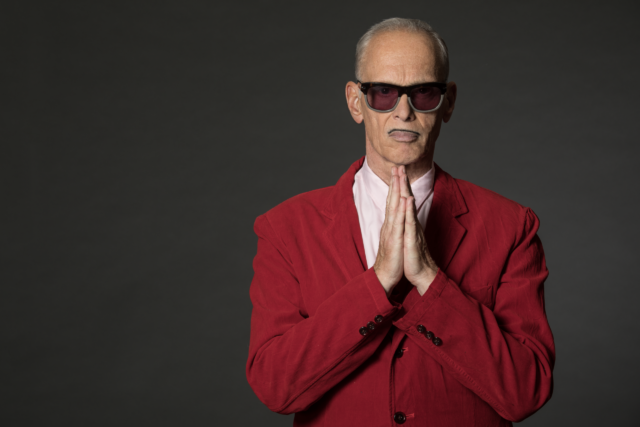
John Waters refers to his solo shows as “sermons” (photo by Greg Gorman)
twi-ny: In Carsick, you wrote that Brigid Berlin said to you, “How can I be bad at seventy? She’s got a point. I’m sixty-six years old, for Christ’s sake.” Now that you’re turning eighty — and, unfortunately, we lost Ms. Berlin in 2020 when she was eighty — can you still be bad at eighty? I’m thinking that you can still be bad at eighty.
jw: I guess, but what do you mean by bad? If anything, trying to be bad may never be good. What she meant by bad was . . . Brigid Berlin changed so much in movies and the conception of a rich girl, of a fag hag, of a junkie, of all the different bad labels. She ended up being a Republican, which is kind of funny.
twi-ny: Right?
jw: Yeah. I think she did find out how to be bad at eighty. She became a Trump supporter.
I hitchhiked across the country by myself at sixty-six. I took LSD with Mink [Stole] at seventy, and I always joked I was gonna turn heterosexual at eighty.
twi-ny: Well, now you’ve got something to look forward to — or not. When you were a kid, your parents took you to see Howdy Doody in New York City.
jw: Yep, I was in the Peanut Gallery at NBC Studios, where later I did David Letterman.
twi-ny: How would you describe that experience? Was that your first trip to New York City?
jw: No, not my first trip, but it was an earth-shattering one that changed my life because I was obsessed by Howdy Doody, as everybody was. It was the first television show in America, practically. My uncle knew someone at NBC Studios; it was not easy to get on that show. There were only, I forget, like twenty kids in the audience, but I remember walking into the studio. It was this giant studio with this tiny little puppet stage surrounded by fifty cameras. There were five Howdy Doody puppets, five of each character.
There was Buffalo Bob, who was mean to us and told us to shut up or we wouldn’t get anything when it was over. I looked around and realized this was all a big lie. And rather than be disillusioned, I knew this was what I wanted to do for the rest of my life.
twi-ny: You got a taste of what was going on behind the scenes, how it’s done.
jw: I saw the illusion, I saw the whole thing, and I knew this would be the only thing I could ever really do.
twi-ny: And it really set in motion everything that you’ve done afterward. Staying in New York for a bit, you live here and in Baltimore and San Francisco?
jw: And Provincetown. And, more than any of them, airports. I did fifty-nine shows last year.
twi-ny: And you have a whole lot more coming up this year. One of my favorite things you’ve said was, “It’s hard to imagine how great and scary Times Square was.” Now, over the years, starting with Giuliani specifically, it’s gone through so many changes.
jw: No, it’s scary now because it’s suburbia.
twi-ny: They sort of Disney-fied it, right?
jw: Not even Disney-fied; it’s not even that good. It’s just people sitting in lawn chairs. I like Times Square, but I miss the . . . no, Times Square got so terrible at the end it had to change. But still, it’s amazing to walk by and think, Oh my God, I had sex in a movie theater in there. That place used to be the most insane place where both homeless and gay people went.
People would be trying to sleep and they’d accidentally put their arm through a glory hole. You think back on these memories and they’re long gone. Even the ghosts are in hell.
twi-ny: You’ll be at the Society for Ethical Culture on April 19. How has the concept of ethical culture changed from from the beginning of your career?
jw: I played there before; it’s an amazing place. Well, ethical culture — what ethnic am I? The filth world. I guess I am filth culture, which is a subculture of radical entertainment. Yes, basically, I’m a carny. That’s what I am.
twi-ny: Many of your shows are built around holidays. You’ve done, in addition to the birthday shows, Valentine’s Day, Christmas, Halloween shows. Is that just a coincidence or are you drawn to holidays?
jw: I’ve done July 4 shows, I’ve done Valentine’s Day, I’ve done all of them. I tell you, I’m going to do Groundhog Day and do my old material.
I rewrite the show completely once a year, which is like writing a short book, because it’s a seventy-minute monologue.
twi-ny: Everybody loves holidays, but do you feel a special connection to holidays, or is it just a good way to give you an idea of how to change the show?
jw: It’s exploitation, that’s all. People always say, What are you doing on Halloween? I say, I’m like a common drag queen; I gotta work. I mean, on the holidays, even at Christmas, when I’m touring around, I think, Where am I supposed to do Christmas shopping, in airports? I try to get people gift certificates for Hudson News but they don’t have them; they looked at me like I was crazy when I asked.
twi-ny: Only certain people would understand that.
jw: I think it’s funny. Of course, now a $50 gift certificate for Hudson News wouldn’t buy you a package of Kleenex. How much is a coffee? Eleven dollars for a small coffee to go?
twi-ny: Is there anything on your birthday that you specifically love to do?
jw: That’s something in my private life that I never share. I’m going to a foreign country and have a vacation. So much of my life is shared with the public, if you don’t keep some things private, you’re oversharing.
twi-ny: That’s a great point, because the films you’ve made, the books you’ve written, your shows, they’re very, very open. They’re not necessarily confessional, but you’re not hiding a lot as far as we can tell. So I would imagine that means people think they can tell you anything or ask you anything.
jw: It doesn’t mean I have to tell you everything.
twi-ny: Definitely not!
jw: They do tell me everything. I’ll sit on an airplane and a stranger next to me will tell me, You know, my parents fucked me in an Easter basket when I was five years old. Please don’t share that with me. I’m sorry for that, but I don’t know what I can do about it.
twi-ny: We’re going put the headphones on and watch that movie, I think.
jw: I read; that’s better. Anne Tyler said she used to always take the longest book on a plane so that she’d never be finished. I used to read a book called Lesbian Nuns and that would stop conversation usually. Now that would make people talk more. People would say, Oh, my sister’s one of them.
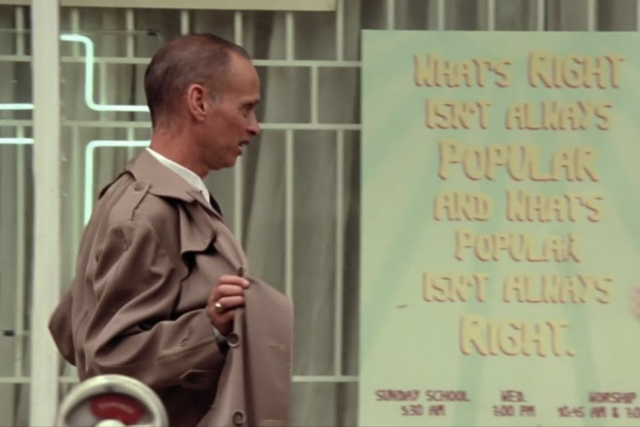
John Waters makes a key cameo in his 1988 hit Hairspray
twi-ny: Now that you’re reaching a certain age, does the number mean anything?
jw: How could I be eighty years old? It’s impossible to even imagine, yet here I am. I’m glad, I’m lucky, alive, to see and be able to be the busiest I’ve ever been in my life.
twi-ny: You’ve made a dozen feature films and many shorts, published ten books, you’re a photographer, you do voiceovers, you do your tours. Are there things in your professional life that you haven’t done yet that you’re itching to try?
jw: And my first poem is being published in The Atlantic this month.
twi-ny: Congratulations!
jw: So there’s one; the only thing left is to write a play. I’ve never done that.
twi-ny: I would love for you to challenge Broadway.
jw: I think I’d have a better chance off Broadway.
twi-ny: What might it be about?
jw: I wouldn’t tell. You never talk about something before you do it. After you do it you have to talk about it for the rest of your life.
twi-ny: You do a lot of interviews. I’m thrilled that you agreed to do this. Does it ever get tiring? Or, like you said before, is it all part of the exploitation?
jw: For every show I do, I’m contracted to do at least two interviews to promote it. It’s part of my job to do the press. I get ten newspapers a day and read about eight more. I like the press. I feel bad what they’re going through right now. So to me, why would you ever be in show business and say you hate the press? I use you to sell tickets and you use me to get people to read you and so that’s fair.
twi-ny: It’s a fair deal. I will say that in my case, I do this so people will know that John Waters is coming to New York City.
jw: You’re a social worker.
twi-ny: You’re most associated with Baltimore, where you filmed all your movies. One of my favorite movies last year was The Baltimorons.
jw: Yes, I liked it. I thought it was a very good religious romantic comedy. Not my favorite genre. They did it really well. The acting was really good in it. It was well shot. I liked it very much.
twi-ny: I imagine you might have been to that holiday Christmas market in the film.
jw: I avoid gatherings of Christmas glee, except my own — I have to be in a show every night. But certainly it fit in very well with films that are made in Baltimore, and I was very glad it’s a success.
twi-ny: I love the title.
jw: That’s a thing people always say here; it’s not negative.
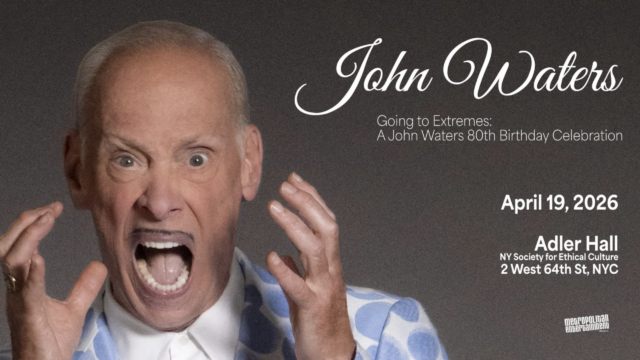
John Waters is ready to scream at New York City show (photo by Greg Gorman)
twi-ny: Getting back to the show. In all the cities you go to, do audiences in different places react differently to John Waters? I’m sorry for talking about you in the third person.
jw: The same. They’re smart. They get dressed up for me. If they don’t get the jokes, they have homework to look it up. They’re very cool, all ages and all sexuality. I did a show this week in Phoenix. I did one in Santa Fe. In El Paso. And in New York. The audiences, I couldn’t tell the difference. And I mean that in a good way.
It was probably elitist of me to think that New York and LA get you but Phoenix and El Paso don’t.
jw: It’s a worldwide infected religion. I’m thankful. I even call my show sermons now.
twi-ny: So for New York, would you want people to come dressed any specific way?
jw: Don’t come dressed like you might on an airplane.
I see people on airplanes in an old filthy T-shirt and shorts in the middle of winter. Get dressed, pig! Really disgusting. So yes, people get dressed for me. I don’t have to tell them. No one wears a dirty sloppy T-shirt and baggy shorts to see me ever; it’s never happened.
twi-ny: I’ve seen that on Broadway.
jw: They know better.
twi-ny: You’re laughing through this entire interview. Every time I see you on talk shows or other programs, you just seem like a happy guy.
jw: Well, I’m not walking around like a lunatic. If you want to know the truth, I’m sick today. I have a really bad cold.
I am an actor. But I am who I say I am in interviews. That is the real me completely. But I’m not always like that all day.
twi-ny: I want to thank you for taking the time to speak with me despite you’re not feeling well.
jw: Thank you for your support. I couldn’t get away with it without people like you.
twi-ny: I’m looking forward to the show.
jw: Thank you. And laugh loudly when you’re there.
[Mark Rifkin is a Brooklyn-born, Manhattan-based writer; you can follow him on Substack here.]