this week in theater

THE TWI-NY PANDEMIC AWARDS: PART III

White Snake Projects’ Death by Life: A Digital Opera in One Act redefined what live online opera could be

On July 4, 2020, I published Part I of the twi-ny Pandemic Awards, hoping that it would be the first of hopefully only two such postings celebrating the amazing innovation and creativity in dance, film, theater, food, opera, art, literature, music, and other forms of entertainment made online since March 2020.

As the pandemic lockdown proceeded, I followed that up with Part II on January 1, 2021. And now, a year later, comes the third — and final — edition of twi-ny’s Pandemic Awards, honoring the best, and most unusual, online presentations of 2021. To see some of the video highlights from March 2020 through last May, check out the “twi-ny at twenty” anniversary gala here.

Even as the omicron variant tears through New York City and the world, entertainment venues are back open, and more people are visiting museums, theaters, sports venues, and other forms of indoor and outdoor entertainment. Meanwhile, there is still much happening exclusively online. This Week in New York will continue to track virtual and hybrid productions of all kinds from across the globe, in addition to live performances happening in the five boroughs, so keep following this space for the best, and the worst, in live and recorded in-person and virtual events.

Happy 2022 to all — may you and your friends, family, and loved ones stay safe and healthy!

BEST FUTURISTIC PLAY
Edward Einhorn’s Alma Baya, Untitled Theater Company No. 61, A.R.T./New York. Edward Einhorn delves into isolation and living in pods in this in-person/online show about what might happen next.

BEST IMMERSIVE HISTORICAL DRAMA
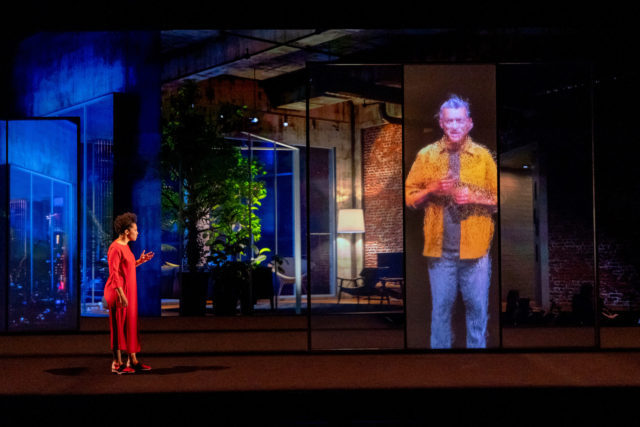
Arlekin Players Theatre, Witness. Igor Golyak uses Arlekin’s Zero Gravity Lab to place viewers aboard the MS St. Louis in this interactive exploration of antisemitism.

BEST SHORT PLAY SERIES BY ONE PLAYWRIGHT
Steppenwolf Now, “Three Short Plays by Tracy Letts”: Night Safari, The Old Country, The Stretch. Steppenwolf did exemplary online work during the pandemic lockdown, including this triple crown of short one-acts by Tracy Letts, featuring Rainn Wilson, Letts, and William Petersen and Mike Nussbaum voicing puppets in a diner.

BEST GIFT ACCOMPANYING AN ONLINE PLAY
Third Rail Projects, Return the Moon. Immersive site-specific theater experts Third Rail Projects sent viewers a package including an exquisite little cut-paper diorama in conjunction with its interactive virtual show.

BEST FILMED OUTDOOR PLAY
Amy Berryman’s Walden, TheaterWorks Hartford. Twin sisters and an Earth Advocate argue over the future of the planet in Amy Berryman’s superb play about loss, loneliness, and reconnection, filmed in front of a socially distanced live audience in the woods by the Connecticut River.

BEST ZOOM PLAY TAKING PLACE ON ZOOM
Jake Shore’s Adjust the Procedure, Spin Cycle and JCS Theater Company. Zoom fatigue had not quite settled in yet when Jake Shore’s play about a university facing a crisis over the course of several Zoom meetings was released.

BEST USE OF LIVE CHAT IN A PLAY
Arlekin Players Theatre, chekhovOS /an experimental game/. The audience gets to vote on which Chekhov play Arlekin will perform, then argue in the chat about anything they want, including the quality of the production itself, with administrators encouraging all responses.

BEST ACTOR
Jason Alexander, Rob Ulin’s Judgment Day, Barrington Stage Company; Wendy Wasserstein’s The Sisters Rosensweig, Spotlight on Plays. Jason Alexander was a riot in two virtual readings, as a greedy lawyer whose life is changed by a near-death experience in Judgment Day, which had an encore streaming in July, and as Mervyn Kant in Sisters, playing to his home camera with effusive glee.

Kathleen Chalfant elegantly performs Joan Didion’s The Year of Magical Thinking for Keen Company benefit

BEST ACTRESS
Kathleen Chalfant, Joan Didion’s The Year of Magical Thinking, Keen Company; Karen Malpede’s Blue Valiant, Theatre Three Collaborative. Theater treasure Kathleen Chalfant read directly from the published book of Joan Didion’s poignant memoir with an exquisite elegance, performed from her home, lending it a mesmerizing intimacy. She went outside for Blue Valiant, a play about a horse and a mother’s relationship with her daughter that was written by Karen Malpede specifically for Chalfant, who was lovely acting alongside George Bartenieff as pianist Arthur Rosen gave life to the horse in an unusual way.

BEST ACTRESS IN A FILMED PLAY ON A STAGE
Charlayne Woodard, The Garden, Baltimore Center Stage. Charlayne Woodard, who presented a stellar online version of her one-woman show Neat for MTC, returned to the stage for her two-character play The Garden, in which she and Caroline Stefanie Clay starred as a daughter and a mother trying to reconnect after a series of tragic events.

BEST SUPPORTING ACTRESS IN A VIRTUAL PLAY
Elizabeth Heflin, Michael Gotch’s Tiny House, Westport Country Playhouse. Elizabeth Heflin was wonderful as a cynical mother visiting her daughter and her environmental-nut husband in the mountains on the Fourth of July, as fireworks fly.

BEST PLAYWRIGHT FINALLY GETTING HER DUE
Adrienne Kennedy, “The Work of Adrienne Kennedy: Inspiration & Influence,” Round House Theatre / McCarter Theatre Center. If you didn’t know much about hugely influential playwright Adrienne Kennedy, Round House Theatre and McCarter Theatre Center changed that with excellent virtual productions of He Brought Her Heart Back in a Box, Sleep Deprivation Chamber, Ohio State Murders, and Etta and Ella on the Upper West Side, along with a series of online discussions celebrating the now-ninety-year-old experimental legend.

BEST NONTHEATRICAL INDOOR LOCATION FOR A PLAY
Sharon Karmazin’s home, George Street Playhouse. George Street board member Sharon Karmazin generously turned over her house to the New Jersey company for excellent virtual filmed productions of Theresa Rebeck’s Bad Dates and Becky Mode’s Fully Committed, allowing each one-person show to shine.

BEST OLD-FASHIONED RADIO PLAY
Lucille Fletcher’s 1943 Sorry, Wrong Number, Keen Company. Keen Company made it feel like you were listening to the radio in 1943 with its audio production of while Lucille Fletcher’s Sorry, Wrong Number, in which Marsha Mason thinks she has overheard a murder plot and desperately wants to stop the potential killing.

BEST ILLUSTRATED SHORT PLAY
Rajiv Joseph’s Red Folder, Steppenwolf Now. Carrie Coon narrates Rajiv Joseph’s devilishly clever and insightful short Red Folder, a kind of graphic novel come to life about being different.

BEST PLAY FILMED WITH AN AUDIENCE
Ryan J. Haddad’s Hi, Are You Single?, Woolly Mammoth Theatre Company. Ryan J. Haddad’s autobiographical one-man show was recorded in front of a small, socially distanced audience of crew members at Woolly Mammoth; the moment when he is joined onstage by a man wearing a mask was as alarming as it was invigorating.

BEST PLAY ABOUT PARANOIA
X the Experience. Aaron Salazar and Jason Veasey’s interactive online show casts the viewer as a trainee for the mysterious conglomerate known as WE, which appears to disdain individuality in favor of a faceless collective, touching a nerve as vaccines started promising an eventual return to normalcy.

BEST SCIENTIFIC PLAY
Jake Broder’s UnRavelled. This virtual collaboration between the Global Brain Health Institute and Trinity College Dublin told the true story of a doctor who started channeling composer Maurice Ravel through extraordinary paintings that had her husband worried about her mental stability; the play was accompanied by a discussion featuring the doctor who treated her.

BEST USE OF SOCIAL MEDIA IN A PLAY
The Javaad Alipoor Company’s Rich Kids: A History of Shopping Malls in Tehran. Javaad Alipoor and Peyvand Sadeghian used Instagram Live to relate the true story of a 2015 fatal car accident in Tehran, going backward in time to explore government corruption, unchecked capitalism, climate change, and the impact social media has on the younger generation.

BEST SOCIAL DISTANCING IN A PLAY
Mike Bartlett’s Cock, Studio Theatre; Kelli Goff’s The Glorious World of Crowns, Kinks and Curls, Baltimore Center Stage. As companies started filming theatrical productions back on their stages, without an audience, they still kept the actors apart from one another, which was done intuitively in Mike Bartlett’s Cock and Kelli Goff’s The Glorious World of Crowns, Kinks and Curls, both of which are structured to involve touch and physical closeness.

STRANGEST ONLINE PLAY
Sloppy Bonnie: A Roadkill Musical (for the Modern Chick!), No Puppet Co., OZ Arts. Leah Lowe, Krista Knight, and Barry Brinegar add goofy cartoonish animation to the online version of this full-tilt campy musical about a road trip that leaves dead bodies in its wake, filmed live in front of a Nashville audience that can’t know what fun we are having watching it at home.

Odd Man Out offers a theatrical journey in a box to be experienced at home (photo by twi-ny/ees)

BEST AT-HOME INTERACTIVE EXPERIENCE
Martín Bondone’s Odd Man Out, Teatro Ciego and theatreC. Writer Martín Bondone and codirectors Carlos Armesto and Facundo Bogarín’s immersive memory play arrives at your home in a box containing elements for four of the senses as you listen on headphones while blindfolded, following the story of a blind musician returning to Argentina.

BEST COMEDY FILMED ON A STAGE
Terrence McNally’s It’s Only a Play, George Street Playhouse. After presenting two excellent online solo shows, Bad Dates and Fully Committed, filmed in a board member’s home, George Street Playhouse returned to its New Jersey stage for a stellar rendition of Terrence McNally’s hysterical comedy about theater that had me laughing out lout time and time again.

BEST SURPRISE ENDING OF A VIRTUAL PLAY
Christopher Chen’s Communion, American Conservatory Theater (A.C.T.). It would be unfair to reveal what Stacy Ross tells us at the conclusion of Christopher Chen’s online, interactive Zoom show, which comes complete with breakout rooms and is skillfully directed by Tony winner Pam MacKinnon.

BEST REVIVAL SERIES
MTC’s Curtain Call, The Niceties, Three Days of Rain, The Past Is the Past, Neat. Manhattan Theatre Club looked back in presenting virtual versions of past productions, in most cases reuniting the original casts, including the late Lisa Banes and Jordan Boatman in Eleanor Burgess’s The Niceties, about an allegation of racism at a prestigious university, as well as Patricia Clarkson, John Slattery, and Bradley Whitford in Richard Greenberg’s family mystery Three Days of Rain and Charlayne Woodard re-creating her one-woman autobiographical show Neat.

BEST MUSICAL FILMED ON A STAGE
Heather Christian’s Animal Wisdom, Woolly Mammoth and San Francisco’s American Conservatory Theater. Heather Christian reimagined her 2017 show, Animal Wisdom, for online viewing, recording it with her band onstage at DC’s Woolly Mammoth, incorporating aspects of the pandemic while Christian faces ghosts from her past.

BEST SITE-SPECIFIC INDOOR FILMED MUSICAL
Jason Robert Brown’s The Last Five Years, Out of the Box Theatrics, Holmdel Theatre Company, and Blair Russell. Jason Michael Webb’s adaptation of Jason Robert Brown’s 2001 two-character sung-through musical about the end and beginning and end of a relationship follows Nasia Thomas and Nicholas Edwards through a cramped New York City apartment as concepts of time and space are obliterated.

BEST REIMAGINING OF A ONE-WOMAN PLAY
Studio Theatre, Dael Orlandersmith’s Until the Flood. Studio Theatre associate artistic director Reginald L. Douglas reimagines Dael Orlandersmith’s gripping one-woman show about the police killing of Michael Brown as a piece for three Black women actors of different ages, who portray multiple characters as they move about the empty DC theater.

Dan Lauria and Wendie Malick are warm and welcoming in Sitting and Talking

BEST TWO-CHARACTER ZOOM PLAY ABOUT CONNECTING
Lia Romeo’s Sitting and Talking, Miles Square Theatre. Dan Lauria and Wendie Malick are delightful as two older single people attempting to connect through online dating, trying to dig themselves out of the loneliness they are both experiencing, and not just because of the pandemic.

BEST SOLO SHAKESPEARE PLAY
Patrick Page, All the Devils Are Here: How Shakespeare Invented the Villain, Shakespeare Theatre Company. Patrick Page gives a master class in Shakespeare, focusing on his many villains in this triumphant one-person show filmed onstage at STC.

BEST PODCAST PLAYS
Wallace Shawn’s Grasses of a Thousand Colors and The Designated Mourner, Gideon Media. The original casts of these two prescient plays by Wallace Shawn reunited for outstanding audio versions, with Julie Hagerty, Jennifer Tilly, Emily Cass McDonnell, Deborah Eisenberg, and Larry Pine joining Shawn.

BEST ONLINE FILM FESTIVAL
DOC NYC 2021. The twelfth annual DOC NYC festival went hybrid, presenting more than two hundred films online and in theaters that look at where we are as a society today, in the midst of a pandemic that has killed more than five million people around the world, including several important films about Covid-19 and how we have responded to it.

BEST INTERACTIVE FILM
Republique, the Interactive Movie. Created by director Simon Bouisson and writer Olivier Demangel, Republique puts the viewer in control of the action, choosing which of several unfolding scenes to watch during a terrorist attack in the Paris Metro.

Bob Dylan’s bizarre Shadow Kingdom delighted and confounded fans

BEST INCOMPREHENSIBLE MUSIC PRESENTATION
Shadow Kingdom: The Early Songs of Bob Dylan. Leave it to the enigma that is Bob Dylan to present a virtual production that had fans wondering whether any of it was recorded live, as microphones hid Dylan’s mouth throughout and the unidentified masked musicians might or might not have been actually playing their instruments; the lively chat ranged from angry fans wanting their money back to devotees proclaiming it was the best twenty-five bucks they had spent during the pandemic.

BEST DUET
Dorit Chrysler and Alexander Calder, “Calder Plays Theremin,” Museum of Modern Art. Berlin-based composer and sound artist Dorit Chrysler activated two works in MoMA’s “Alexander Calder: Modern from the Start” exhibition by using four theremins and a Moog Model 15 analog synthesizer to create a gorgeous eight-minute suite in four movements.

BEST BIRTHDAY TRIBUTE TO A LATE ROCK STAR
“A Bowie Celebration: Just for One Day!,” Rolling Live Studios. Pianist Mike Garson transformed the annual David Bowie birthday tribute into a superstar online event, with Bowie songs performed by such Bowie acolytes as Yungblud, Michael C. Hall, Ian Hunter, Anna Calvi, Boy George, Trent Reznor, Perry Farrell, Macy Gray, Adam Lambert, Andra Day, Duran Duran, Peter Frampton, David Sanborn, Rick Wakeman, Ian Astbury, William Corgan, Gary Oldman, Gavin Rossdale, Joe Elliott, Bernard Fowler, Corey Glover, and Catherine Russell, among others.

Robyn Hitchcock played a series of home gigs in Nashville and London, joined by his partner and pets (including Perry the lobster)

BEST INFORMAL AT-HOME MUSIC SERIES
Robyn Hitchcock, Live from Tubby’s House. Taking a page out of British raconteur Richard Thompson’s book, who performed living-room concerts from his Jersey home with his partner, singer-songwriter Zara Phillips, fellow British raconteur Robyn Hitchcock performed a series of home concerts from Nashville and London over Mandolin and StageIt, accompanied by his wife, singer-songwriter Emma Swift, her pup Daphne, and their beloved cats, Ringo Baez and Tubby Grossman, a follow-up to their 2020 Live from Sweet Home Quarantine shows.

BEST INDOOR DANCE FILMED ON A STAGE
Yin Yue Dance Company, Ripple, 92nd St. Y. Harkness Promise Award recipient Yin Yue’s Ripple, filmed live in front of an audience at 92Y’s Kaufmann Concert Hall, was a gorgeously flowing multipart work that was followed by a fascinating talk with the company.

BEST OUTDOOR DANCE FILMED ON A STAGE
STREB Extreme Action, Jacob’s Pillow. Elizabeth Streb and her Extreme Action team returned to Jacob’s Pillow for the first time in twenty years, presenting twelve repertory works filmed live on the outdoor stage in front of an audience, with Streb offering commentary between pieces, an excellent aperitif to the company’s stirring live show at Manhattan West.

Stephen Petronio Co. remimagines Trisha Brown’s Group Primary Accumulation for its digital Joyce season

BEST OUTDOOR DANCE NOT ON A STAGE
Stephen Petronio Company, Accumulation, Joyce Digital Season. As part of its digital season at the Joyce, Stephen Petronio continued his Bloodlines program, in which he interprets seminal works by important choreographers, with a mesmerizing outdoor mixed-gender performance of Trisha Brown’s Group Primary Accumulation, filmed from high above, as if the four dancers are just another part of the natural world.

BEST DANCE ABOUT EMERGING FROM LOCKDOWN
Stefanie Batten Bland, Kolonial, Baryshnikov Arts Center. For her BAC digital commission, Stefanie Batten Bland contributed the filmed piece Kolonial, in which she and six other dancers try to burst out of a trapped isolation.

BEST ONLINE DANCE FESTIVAL
“WOMEN / CREATE! A Virtual Festival of Dance,” New York Live Arts. The ninth annual “WOMEN / CREATE!” festival went digital with impressive works by Karole Armitage, Meagan King, Sidra Bell, Jennifer Muller, Tatiana Desardouin, and Jacqulyn Buglisi, followed by a rousing discussion.

BEST BALLET FILMED ONSTAGE
George Balanchine’s Emeralds, San Francisco Ballet. I let out a gasp as the curtain rose on San Francisco Ballet’s glorious version of George Balanchine’s Emeralds, the most dancers I had seen onstage together since the pandemic lockdown had started, and then gasped over and over again at the beautiful production, with stunning costumes and spectacular movement.

BEST ONLINE ART PROGRAM
David Zwirner, Program; Hauser & Wirth, .Philip Guston: On Edge. David Zwirner’s all-day online symposium featured discussions with artists, critics, curators, filmmakers, designers, and others, including Barry Jenkins, Hilton Als, Emily Bode, and Peter Schjeldahl, along with visits to Zwirner galleries around the world. Meanwhile, in conjunction with its superb exhibition “Philip Guston 1969-1979,” Hauser & Wirth hosted “Philip Guston: On Edge,” a symposium at the SVA Theatre that included William Kentridge responding to Guston’s The Studio as well as other strong presentations by Trenton Doyle Hancock and Rachel Rossin and conversations with Charles Gaines, Art Spiegelman, Max Hollein, Massimiliano Gioni, George Condo, Katy Siegel, Randy Kennedy, and Jasmine Wahi.

BEST ART MEDITATION
Pace Gallery, Monday Meditation at the Rothko Chapel. Pace offered a lovely opportunity to reflect on life from wherever you were while watching a peaceful shot inside Houston’s nondenominational Rothko Chapel as part of its fiftieth anniversary.

BEST ONLINE ARTS DISCUSSION SERIES
The New Museum, “Grief and Grievance: Art and Mourning in America.” Even if you weren’t ready yet to venture into arts institutions, the New Museum supplemented its outstanding “Grief and Grievance” exhibition with a series of talks with more than a dozen of the participating artists, all of which are still available online for free.

BEST LIVESTREAMED OPERA
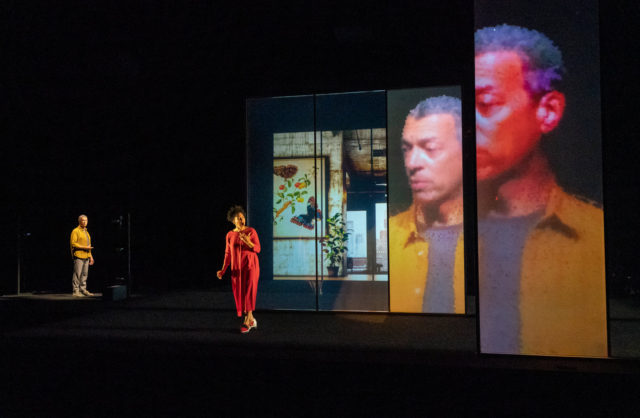
White Snake Projects, Death by Life: A Digital Opera in One Act and A Survivor’s Odyssey: The Journey of Penelope and Circe. Cerise Lim Jacobs’s activist opera company, White Snake Projects, continued its inspiring, barrier-breaking livestreamed digital presentations with Death by Life, which dealt with systemic racism and mass incarceration, and A Survivor’s Odyssey: The Journey of Penelope and Circe, an inventive take on Odysseus which places the power in the hands of the women characters.

BEST DIGITAL OPERA FILMS
Opera Philadelphia, Soldier Songs, The Island We Made, We Need to Talk, Blessed, Save the Boys. Opera Philadelphia redefined what opera could be in an online world during the pandemic lockdown, presenting a series of spectacular filmed operas about loneliness, legacy, and personal identity in these hard times; The Island We Made contained some of the most stunning visuals of the year.

Audience members take photos of themselves using props sent to their home in The Wandering

BEST PARTICIPATORY OPERA
The Wandering, Actor and curator Calista Small, baritone and actor Jeremy Weiss, designer Charlotte McCurdy, theater artist Christine Shaw, filmmaker Lara Panah-Izadi, and animator Zach Bell took a unique look at the life of Austrian composer Franz Schubert in a multipart, multidisciplinary immersive production that included props sent to the at-home audience.

BEST OPERA MINISERIES
Boston Lyric Opera, Desert In. Boston Lyric Opera’s Desert In is a tantalizing and titillating eight-part soap opera that combines loss and loneliness with the supernatural, with Justin Vivian Bond as the lounge singer, Jon Orsini as the son, Jesus Garcia as Rufus, Edward Nelson as his new husband, Ion, Alan Pingarrón as Federico, Isabel Leonard as Cass, and Talise Trevigne as Sunny, all delighting in the delicious dastardly doings.

MOST ADVENTUROUS OPERA ADAPTATION
Boston Lyric Opera / Operabox.tv, The Fall of the House of Usher. Director James Darrah’s inventive virtual adaptation of Philip Glass and Arthur Yorinks’s 1988 opera, The Fall of the House of Usher, combined puppets, stop-motion animation, the refugee crisis, and a mysterious host in retelling Edgar Allan Poe’s classic tale of the demise of a once-prominent family.

Uncle Floyd is back with Tuesday night watch parties of clips from old episodes

BEST VIRTUAL TV WATCH PARTY
This Was the Uncle Floyd Show. David Bowie, John Lennon, Iggy Pop, Paul Simon, and the Ramones were among the fans of The Uncle Floyd Show, a faux-kiddie program that ran on various outlets, from local cable access channels to NBC, from 1974 to 1998, a supremely low-budget panoply of improvised sketches, music parodies, beloved puppets, and appearances by internationally renowned rock stars; the shows were never rerun and will never be available on DVD, so Floyd and his right-hand man, Scott Gordon, are hosting fifty-minute livestreamed clip compilations over StageIt hosted by tech Luddite Uncle Floyd Vivino himself, with a rousing, worshipful chat featuring longtime fans and some of the original cast and crew members. Snap it, pal!!

COMPANY

Bobbie (Katrina Lenk) is not exactly thrilled about turning thirty-five in Company (photo by Matthew Murphy)

COMPANY
Bernard B. Jacobs Theatre
242 West 45th St. between Broadway & Eighth Ave.
Tuesday – Sunday through July 31, $59 – $299
companymusical.com

Originally slated to open on Broadway on March 22, 2020 — Stephen Sondheim’s ninetieth birthday — Marianne Elliott’s reimagining of composer and lyricist Sondheim and book writer George Furth’s beloved Company finally arrives at the Bernard B. Jacobs Theatre, two weeks after Sondheim’s sad, sudden passing just as we all could use, er, a little company. Having never seen the iconic musical before — it debuted on Broadway in 1970 and was revived in 1995 and 2006 — I cannot compare it to any of those editions or focus on the well-publicized changes to this new version, primarily involving several gender switches, most importantly to the main character, who has gone from Bobby the man to Bobbie the woman. But what I can report is that Elliott’s inventive adaptation has a fine first act and an utterly spectacular second.

Bobbie, played with a nagging trepidation by Katrina Lenk, is turning thirty-five and none too happy about it. After receiving a flurry of birthday messages, she says, “How many times do you get to be thirty-five? Eleven? Okay, come on. Say it and get it over with. It’s embarrassing. Quick. I can’t stand it.”

Harry (Christopher Sieber) and Sarah (Jennifer Simard) battle as Bobbie (Katrina Lenk) and Joanne (Patti LuPone) look on in Sondheim-Furth revival (photo by Matthew Murphy)

Bobbie is tired of being the third wheel. She puts a mylar “35” balloon on her wall and it ticks like a biological clock. Her married and engaged friends, some with kids, attempt to entertain her but they have their own lives away from her. She is spending more and more time with bottles of Maker’s Mark to try to make her forget her loneliness. She’s attracted to a dimwitted flight attendant, Andy (Claybourne Elder), who doesn’t exactly fulfill her needs.

She visits with Sarah (Jennifer Simard) and Harry (Christopher Sieber), who get into a riotous jiu-jitsu battle; Susan (Rashidra Scott) and Peter (Greg Hildreth), who, on their terrace, announce they’re getting divorced; Jenny (Nikki Renée Daniels) and David (Christopher Fitzgerald), who get high and discuss Bobbie’s possible fear of being hitched (“It’s not like I’m avoiding marriage. It’s avoiding me, if anything. I’m ready,” she insists); Jamie (Matt Doyle) and Paul (Etai Benson), who are getting married but Jamie is suddenly having doubts; her former lover Theo (Manu Narayan), who has made the kind of important decision Bobbie is unable to; her friend P.J. (Bobby Conte Thornton), who is in love with New York itself; and the older Joanne (Patti LuPone) and her third husband, Larry (Terence Archie), who party at a nightclub. “The phone is a phenomenon. Really. The best way for two people to be connected and detached at the same time,” Bobbie says. Joanne responds, “Second only to marriage.”

The story goes back and forth in time — the script explains, “The narrative is conveyed in a stream of consciousness technique and time moves both backwards and forwards, encompassing the past, present and future” — as Bobbie contemplates the state of her existence as she turns thirty-five, alone in the big city. “One’s impossible, two is dreary, / Three is company, safe and cheery,” she tries to convince herself. “Here is the church, / Here is the steeple, / Open the doors and / See all the crazy, married people!”

Friends gather to celebrate Bobbie’s (Katrina Lenk) birthday in Company (photo by Matthew Murphy)

Two-time Tony winner Elliott (The Curious Incident of the Dog in the Night-Time, Angels in America) has reconceptualized Company in ways that go beyond mere gender switching and diverse casting; this Company emphasizes individuality, confinement, isolation, and fear through magnificent staging constructed around Bunny Christie’s ingenious set; much of the action takes place in and around claustrophobic rectangular spaces framed by fluorescent lights. (The lighting is by Neil Austin.) Bobbie, wearing a sensational sexy red pantsuit (Christie also designed the costumes), is trapped physically and psychologically in each scenario, from a tiny room in her apartment to the club to a street where every door is numbered “35.” Turning thirty-five and still being single is a nightmare that follows her wherever she goes.

Bobbie’s friends represent parts of herself as well as a potential companion. “Someone is waiting, / Sweet as David, / Funny and charming as Peter. Larry . . . / Someone is waiting, / Cute as Jamie, / Sassy as Harry / And tender as Paul,” she sings in “Being Alive,” adding, “Did I know him? Have I waited too long? / Maybe so, but maybe so has he.”

As portrayed by Tony winner Lenk (The Band’s Visit, Indecent), Bobbie is not after our sympathy or even our compassionate understanding; no mere old maid, she serves as a reminder of the uncertainty and isolation we all experience, whether coupled or not, regardless of how happy we might be. The scene in which Bobbie, in bed with Andy, sees one possible outcome of her life unfold before her is horrifyingly funny, whether you live alone or are married with kids; it’s a tour de force for both Elliott and the ensemble.

Joanne (Patti LuPone) has a bit of important advice for Bobbie (Katrina Lenk) in Broadway revival (photo by Matthew Murphy)

Two-time Tony winner LuPone (Evita, Gypsy) brings the house down just by saying, “I’d like to propose a toast,” prior to singing “The Ladies Who Lunch.” The signature role of Joanne has previously been performed by Elaine Stritch, Debra Monk, Sheila Gish, Lynn Redgrave, and Barbara Walsh, while the roll call of male Bobbys includes Dean Jones, George Chakiris, Larry Kert, Boyd Gaines, Adrian Lester, Raúl Esparza, and Neil Patrick Harris.) The rest of the cast is exemplary as well, with shout-outs to Simard’s brownie-desiring Sarah, two-time Tony nominee Fitzgerald’s puppy-dog-eyed David, and Doyle’s breathlessly fast-paced rendition of “Getting Married Today.”

Liam Steel’s choreography is fun, as are illusions by Chris Fisher. One oddity is that characters often enter and exit the stage through the aisles, which are also frequented by theater staffers holding signs telling the audience to keep their masks on, momentarily diverting our attention while also reminding us of the situation we’re still in.

David Cullen’s orchestrations honor Sondheim’s complex melodies, performed by a fourteen-piece band conducted by Joel Fram that hovers above the stage. The second act explodes with an electrifying “Side by Side by Side” and never lets up through Bobbie’s closing soliloquy, “Being Alive,” an able metaphor for what we all need right now. Winner of three Olivier Awards — for Set Design (Christie), Supporting Actress in a Musical (LuPone), and Musical Revival — Company is more than just grand company in these troubled times, when we can all benefit from being together once again.

WITNESS

Lauren Elias, Anna Gottlieb, Gene Ravvin, and Nathan Malin discuss antisemitism while on board the virtual MS St. Louis in Witness

WITNESS
Arlekin Players Theatre
Livestreamed select days through January 23, $25
www.arlekinplayers.com/witness

It’s been three quarters of a century since the Holocaust ended, so there are fewer and fewer survivors and witnesses alive to tell the true stories of what happened in the camps of Eastern Europe during WWII. Meanwhile, antisemitism continues to surge around the world amid Holocaust deniers and politicians who misuse and abuse the horror for soundbites and social media memes. Arlekin Players Theatre investigates these issues in its latest interactive online show, Witness. An immersive work that explores antisemitism and desperate migration, the play relates the fate of the MS St. Louis, the German ship that carried more than nine hundred Jewish refugees in May 1939, to the problems of today.

The luxury liner was transporting men, women, and children fleeing the approaching Holocaust, but the ship was turned away by Cuba, Canada, and the United States. Conceived and directed by Arlekin founder and Russian Jewish immigrant Igor Golyak and written by Moscow-based Nana Grinstein with Blair Cadden and Golyak, Witness puts the audience on board the St. Louis, where it begins with a talent show that is based on actual events.

The emcee (Gene Ravvin) believes he is in the present, in a green-screen studio, as he introduces the parade of performers: Liesl Joseph (Esther Golyak) and Gisela Klepl (Elizabeth Sarytchev), who perform “Skating on Glass!” as older versions of themselves (Rimma Gluzman and Polina Vikova) recall Kristallnacht in voice-over; Fritz Buff (Alex Petetsky), who constructs a house of cards and anticipates “joyful days” ahead; Fira (Julia Shikh), who boils a book banned in the USSR; a magician named Marik (Misha Tyutyunik) and his assistant (Jenya Brodskaia); and superheroes Anna (Anna Furman), Olga (Olga Aronova), and Vika (Vika Kovalenko), who call themselves the Elusive Avengers. The audience at home votes on each performance and gains points as they participate.

During each skit, the audience can click on pop-ups to learn more about the contestants, all of whom were real, as well as the actors portraying them. Short biographical sketches include their immigration status and, in the case of the passengers, their fate after the ship was refused entry to America. News crawls onscreen range from the 1930s to the 1990s, which initially confuse the emcee until he figures out what is going on. “The good news is that not only those Jews who left Hamburg in 1939 are sailing with us but also all the Jews that left anywhere are also here,” he explains. “First wave, second wave, third wave. A whole ocean of waves. From USSR, from Germany, from Spain, from Hungary. Yesterday, today, tomorrow, and always. We are all together, ladies and gentlemen. We’re all together. If there is a place to leave, the Jews will find a way.”

After the talent show, the emcee walks through a long, narrow hallway on the ship, encountering people discussing antisemitism, assimilation, the Tree of Life synagogue shooting, dual loyalty, and Israel’s right to exist and defend itself as well as frightening vignettes occurring in some of the cabins. Every word of dialogue is based on interviews Golyak conducted with nearly a hundred people; the narrative is smartly organized to avoid clichés, stereotypical rhetoric, and didactic moralizing.

“So basically what they are is Jews who think if we just bend over a little more, if we just assimilate a little bit better than we did in Germany, that somehow miraculously everything will be different than it was in Germany,” Leah (Lauren Elias) says. “And it’s not going to be. I mean, come on. It feels like the only acceptable party line for Israeli people and Jewish people right now is like, ‘Oh my god. We’re sorry we didn’t all die in World War Two. We know that would have been so much easier for you. We are so sorry for the inconvenience.’”

Joseph (Nathan Malin), talking with Leah and Rachel (Anne Gottlieb) about the public reaction to the real-life stabbing of an Orthodox rabbi in Brighton, admits, “Unless you want to tar yourself as unwanted and as a bad person, you keep your mouth shut and you just duck your head, you know?”

Camera operator Austin de Besche films some of the cast during the making of Witness

Lady Liberty (Darya Denisova) occasionally appears to share her thoughts as the emcee repeats, “This can’t happen here. This can’t happen here!” Leah responds, “No, no, no, it can. And it does.”

Arlekin, which has previously dazzled viewers with the one-woman State vs. Natasha Banina and the daring hybrid chekhovOS /an experimental game/ (featuring Jessica Hecht and Mikhail Baryshnikov), a pair of livestreamed interactive shows that pushed the boundaries of online productions, again breaks new ground through its Zero Gravity (zero-G) Virtual Theater Lab with Witness. Set designer and costumer Anna Fedorova, virtual designer Daniel Cormino, sound designer Viktor Semenov, and director of photography and editor Anton Nikolaev make it feel like it’s all taking place on board the St. Louis, with rolling waves and flying birds outside as the ocean liner heads toward its supposed destination.

During the talent show, the audience on the ship looks like ghosts, which in essence is what they are today. At one point, the screen goes dark for several minutes as binaural recordings play through your headphones, as if you’re a passenger, not knowing what’s coming next, or from where. It sent chills through my bones.

As always with Arlekin’s works, each presentation is followed by a talkback in which members of the cast and crew delve into the making of the work, although Golyak is careful not to give away too many secrets. Some of the discussions include experts on antisemitism and the Holocaust, and the audience is encouraged to share experiences in the lively chat. The night I saw Witness, numerous people (including me) described instances of antisemitism they have encountered. At Yad Vashem, the Holocaust Remembrance Center in Jerusalem, it is noted, “Bearing witness, so they will know, until the last generation.” A compelling and necessary piece of sociopolitical documentary theater, Witness reminds us all just how important that is.

CANDACE BUSHNELL: IS THERE STILL SEX IN THE CITY?

Candace Bushnell holds nothing back in charming journey through her life and career (photo by Joan Marcus)

IS THERE STILL SEX IN THE CITY?
Daryl Roth Theatre
101 East Fifteenth St. at Union Square
Tuesday – Sunday through February 6, $69 [ed. note: show closed December 19 due to Covid]
istherestillsexinthecity.com
www.darylroththeatre.com

“Good news only” is how Candace Bushnell always answers the phone in her one-woman show, Is There Still Sex in the City? Good news only it will be.

The ninety-minute play is an endearing, self-aware production in which Bushnell, now sixty-three, shares intimate details of her life and career, centering around the gargantuan success she has had with the creation of Carrie Bradshaw (Sarah Jessica Parker), Samantha Jones (Kim Cattrall), Charlotte York (Kristin Davis), and Miranda Hobbes (Cynthia Nixon), the fictional characters on the HBO smash Sex and the City, based on her series of columns and 1996 book of the same name. The play might be timed to capitalize on the return of Carrie, Charlotte, and Miranda in the brand-new follow-up, And Just Like That . . . ,” but Is There Still Sex in the City? stands on its own as an entertaining, appropriately gossipy public confessional from a writer who changed the way the country looked at the lifestyles of women of all ages, sexual and otherwise.

Bushnell, who prefers to be known as Candi (“with a little circle where the dot goes”), leads us from her childhood in Connecticut, where her father pitied her because she was flat-chested — “I’m afraid no man is ever going to love you,” he warns — to her freshman-year flight to New York City when she was nineteen, determined to abandon college and become a writer and win the Pulitzer Prize.

At first she relates, “This New York is not my boyfriend. Pimps stalk Penn Station looking for runaways. Heroin addicts are nodding out on the streets. There’s three card monte, pickpockets, boomboxes, and Hare Krishna parades. It’s dirty. There’s no pooper scooper law, and there’s dog poop everywhere.” But it isn’t long before she is hanging out with the rich and famous, partying at Studio 54, jetting off to Europe, reveling in the abundant sex and drugs — and eventually telling everybody about it, first as Stripe Savage, writing such pieces as “How to Act in a Disco,” then under her real name in a must-read column for the New York Observer.

Candace Bushnell answers the question Is There Still Sex in the City? in one-woman show (photo by Joan Marcus)

“This New York is my boyfriend,” she says later. “Who needs a man when Manhattan itself is abuzz? Maybe it’s the cosmos. Maybe it’s the cocaine.” Her bestselling book, Sex and the City, becomes a hot HBO show, but that doesn’t necessarily result in personal fulfillment as her relationships with Melrose Place creator Darren Star, a much older famous writer, the unnamed actual Mr. Big, and others ultimately fizzle. But she learns to take matters into her own hands as she shares what she is doing today, which is a long jump from where she thought she would be — while still working toward that Pulitzer.

Directed by choreographer Lorin Lotarro (A Taste of Things to Come) with a spicy sweet sense of humor, Is There Still Sex in the City? answers many of the questions people have about Bushnell and her life. It features popular period songs by Sheryl Crow, Cyndi Lauper, Donna Summer, MC Hammer, and Right Said Fred, a parade of fantastic outfits courtesy of costume designer Lisa Zinni, an adorable set by Anna Louizos with an elegant royal couch, a monitor with projections (old photos, TV clips, animation) by Caite Hevner, and stacks of cubes with books, knickknacks, and shoes — lots and lots of shoes, all of which, Bushnell admits, are from her own closet — colorfully lit by Travis McHale.

Bushnell occasionally plays “Real or Not Real,” asking the audience to call out their responses to such questions as “Did I sleep with the hot Calvin Klein underwear model from episode 2?” She doesn’t mind receiving random hoots and hollers and shouts of support, particularly as she reveals her ten life lessons, the first of which is: “I’m a feminist. A mini Gloria Steinem. Have been ever since kindergarten, where I discovered women could only have four jobs: nurse, teacher, secretary, or librarian.”

Bushnell is so warm and gracious that you will forgive a missed line reading here and there, and the Daryl Roth Theatre in Union Square is far too big for such an intimate production. But Is There Still Sex in the City? is a fab treat, a funny and candid New York story that everyone can relate to in one way or another, whether you are a fan of Sex and the City or have never watched or read it. And before or after the show, you can enjoy a cosmo in the downstairs Candi Bar. Like Bushnell says, “Good news only!”

[ed. note: The good news only went so far, as the show had to close on December 19 after Bushnell contracted Covid-19. The plan is for it to eventually return to New York City when the tour gets up and running again.]

MRS. DOUBTFIRE

Daniel Hillard (Rob McClure) goes to extreme measures to see his kids in Mrs. Doubtfire (photo by Joan Marcus)

MRS. DOUBTFIRE
Stephen Sondheim Theatre
124 West 43rd St. between Sixth & Seventh Aves.
Tuesday – Sunday through May 8, $79 – $229
mrsdoubtfirebroadway.com

Robin Williams and Stephen Sondheim must be turning over in their graves — or urns. The musical adaptation of Chris Columbus’s overrated hit 1993 movie, Mrs. Doubtfire, in which Williams plays the title character, a divorced actor who dresses up as an older Scottish nanny in order to spend more time with his children, opened earlier this month at the Stephen Sondheim Theatre on West Forty-Third St., less than two weeks after the musical genius passed away at the age of ninety-one. Williams died in 2014 at the age of sixty-three.

Mrs. Doubtfire the musical is a labored, inorganic embarrassment, a jaw-droppingly inauthentic mess that is scheduled to run for at least six months on the Great White Way. Tony nominee Rob McClure, the talented star of such duds as Chaplin and Honeymoon in Vegas, dives into the shtick headfirst, but four-time Tony-winning director Jerry Zaks is trapped by Karey Kirkpatrick and John O’Farrell’s leaden book and Karey and Wayne Kirkpatrick’s trite music and lyrics. Williams was able to make the film somewhat palatable, but McClure never has a chance with the Broadway version.

Just as the movie felt like a retread of Sydney Pollack’s 1982 romantic comedy, Tootsie, in which Dustin Hoffman plays an unemployed actor who dresses up as an unfashionable older woman in order to get a part on a soap opera, Mrs. Doubtfire the musical offers little we haven’t already seen in the 2019 musical adaptation of Tootsie, which earned ten Tony nominations, winning two awards.

Andre (J. Harrison Ghee) and Frank (Brad Oscar) preen for Wanda Sellner (Charity Angél Dawson) as Daniel (Rob McClure) looks on in Mrs. Doubtfire (photo by Joan Marcus)

Nearly every musical number feels forced and unnatural, as if Zaks (La Cage aux Folles, Hello, Dolly!), choreographer Lorin Lotarro (Waitress, Merrily We Roll Along), and the Kirkpatricks (Something Rotten!) looked around David Korins’s set to find random objects to incorporate into the dancing. When Daniel and the kids start playing air guitar with brooms, well, I considered jumping onstage and sweeping them all away, for the benefit of the audience as well as the performers. Meanwhile, the Spanish restaurant where a critical late scene occurs should be shut down for improper use and storage of musical theater.

The show is primarily set in the Hillard home, where father Daniel (McClure) has plenty of time to hang around with his three kids, Lydia (Analise Scarpaci), Christopher (Jake Ryan Flynn), and Natalie (Avery Sell). While his wife, Miranda (Jenn Gambates), is working hard, putting together a fashion line with her hunk of a partner, Stuart Dunmire (Mark Evans), Daniel is like a fourth child, running around the house with the three of them and breaking things. Lydia finally has had enough and throws him out; when the judge awards full custody to Lydia, Daniel is distraught, ready to do whatever he can to spend time with them again. He is watched closely by court liaison officer Wanda Sellner (Charity Angél Dawson), who will ultimately report back to the judge whether Daniel has an acceptable place to live and a regular job and, therefore, should be allowed to have shared custody.

But it all gets turned upside down and inside out when Daniel hatches the plan to pretend he’s Mrs. Euphegenia Doubtfire — and gets the job as his children’s nanny, taking care of them every weekday afternoon. He has to keep his secret from Lydia as well as the kids, but Wanda is on the prowl, suspicious that something nefarious is going on.

A game cast never has a chance in Mrs. Doubtfire (photo by Joan Marcus)

Brad Oscar and J. Harrison Ghee, as Daniel’s brother, Frank, and Frank’s partner, Andre, respectively, are supposed to provide comic relief (it’s already a comedy, right?) as the designers behind Daniel’s transformation into Mrs. D, but their jokes quickly become repetitive (for example, how Frank has to speak extra loudly every time he tells a lie), and laughing at flamboyant gay minor characters is not as much fun as it was once upon a time. And the scenes with Peter Bartlett as hapless kids’ show host Mr. Jolly (accompanied by Jodi Kimura as humorless channel president Janet Lundy) are not very jolly, unless you find laughing at doddering elderly men hysterical.

“What’s wrong with this picture?” the opening number prophetically asks. The show had to shut down for more than a week because of positive Covid cases; for those of you who had tickets during that time, consider yourselves lucky. [Ed. note: The musical is going on hiatus from January 10 to March 14 “out of concern for the potential long-term employment of everyone who works on Mrs. Doubtfire, and the extended run of the show.”]

THE STREETS OF NEW YORK

Irish Rep revival of The Streets of New York shines a light on greed, poverty, and the power of love (photo by Carol Rosegg)

THE STREETS OF NEW YORK
Irish Repertory Theatre, Francis J. Greenburger Mainstage
132 West 22nd St. between Sixth & Seventh Aves.
Wednesday – Sunday through January 30, $50-$70
212-727-2737
irishrep.org

As the pandemic lockdown lifted and the city opened back up, Irish Rep artistic director Charlotte Moore decided to revisit the company’s 2002 hit, The Streets of New York. “In this time of Covid, I was sure it would be appropriate to rewrite my original director’s note,” Moore explains in the program. “But upon rereading the original, so many things are exactly the same that I have changed my mind. There is still great poverty and hunger, and the heartbreak of lost love never changes. Add to that a worldwide pandemic and a masked society and Boucicault’s eighteenth-century world seems to fit right into our twenty-first with its darkness and restrictions.”

Moore adapted Dublin-born Dion Boucicault’s 1857 play The Poor of New York, itself based on Édouard Louis Alexandre Brisebarre’s Les Pauvres de Paris, adding more than a dozen songs to the Dickensian tale of greed and hardship. The result is a delightful, indelible tale that feels just right for this moment in time, one that I can envision becoming an annual holiday tradition.

The show begins on the eve of the Panic of 1837, which led to an economic depression. “The poor man’s home is a filthy street / You sell your shoes for a scrap of meat,” a man sings. An older couple adds, “The violence of poverty breeds everywhere / And a cloud of injustice hangs in the air/ And till it clears / It could be years / But till it clears / We must survive / And stay alive / On these unholy, shadowy, crime ridden, black hearted, / Blood sodden, filthy, mean / Streets of New York!”

Wealthy banker Gideon Bloodgood (David Hess) is preparing to abscond with his Nassau St. bank’s money when sea captain Patrick Fairweather (Daniel J. Maldonado) arrives after hours to entrust Bloodgood with his life savings before going on a voyage, seeking the banker’s protection of the financial security of his wife and two children. Fairweather departs but returns moments later, changing his mind and demanding his fortune back. But the greedy Bloodgood is not about to surrender his newfound gains, and when Fairweather suddenly drops dead, Bloodgood decides to dump the body and keep the money — but not before one of his clerks, Brendan Badger (Justin Keyes), grabs the signed deposit receipt, hiding it away for a rainy day.

The Puffy family (Polly McKie, Richard Henry, and Jordan Tyson) find a way to smile amid their drudgery in The Streets of New York (photo by Carol Rosegg)

Twenty years later, Bloodgood, accompanied by his ever-faithful butler, Edwards (Price Waldman), is basking in his vast success, built on the cash he stole from Fairweather. While Bloodgood is looking for a suitable husband for his spoiled daughter, Alida (Amanda Jane Cooper), Fairweather’s children, Lucy (DeLaney Westfall) and Paul (Ryan Vona), and widow, Susan (Amy Bodnar), are living in abject poverty in the dangerous area of New York City known as Five Points. Their poor but goodhearted landlord, Dermot Puffy (Richard Henry), has fallen behind on his mortgage payments, so the heartless Bloodgood threatens to evict Puffy, his wife, Dolly (Polly McKie), and their daughter, Dixie (Jordan Tyson), which would leave the Fairweathers homeless as well.

The Fairweathers hope to be saved by Lucy’s childhood love, Mark Livingstone (Ben Jacoby), scion of a well-heeled, prosperous society family, while Alida plots to marry Mark herself to restore the Bloodgood name to respectability even as she fools around with the philandering Duke Vlad (Maldonado). Like her father, it’s only money and appearances that matter. “Isn’t it wonderful to be in control / Who cares if Daddy has to sell his soul / To keep me in accoutrements / To keep me in the things I want / To keep me happy,” Alida selfishly admits. “Allowed to be horrid and rude to everyone / A sense of entitlement is so much fun / I ride whilst poorer people walk, (with a frown) or run! / Oh! How I love being rich!”

As Christmas approaches, some are destined to be showered with yet more wealth while others seem bound for anonymity, struggling to survive day by day in the perilous gutters of an uncaring metropolis. The very best kind of mustache-twirling melodrama ensues as the plot leaps and twists to its conclusion.

Robber baron Gideon Bloodgood (David Hess) and his obnoxious daughter (Amanda Jane Cooper) boss around their butler (Price Waldman) in The Streets of New York (photo by Carol Rosegg)

Moore, who with Irish Rep producing director Ciarán O’Reilly created some of the most compelling and innovative online shows during the pandemic, goes back to the basics with The Streets of New York. Linda Fisher’s period costumes feel authentic, and Hugh Landwehr’s set, covered with giant bills and help wanted ads, is centered by a large wall that the actors and masked staff members move around, magically morphing into the Bloodgoods’ opulent home and office as well as doomed tenements in Five Points.

The five-piece orchestra is partially visible offstage right, consisting of Melanie Mason on cello, Jeremy Clayton on woodwinds, Karen Lindquist on harp, Sean Murphy on bass, and Joel Lambdin on violin, performing lovely orchestrations by music director Mark Hartman and associate conductor Yasuhiko Fukuoka.

Two-time Tony nominee Moore, who previously directed Boucicault’s London Assurance in addition to plays by O’Casey, Yeats, Friel, and Synge and such musicals as Meet Me in St. Louis and Love, Noël: The Letters and Songs of Noël Coward, gives ample room for the material, which often evokes operetta, to breathe on the cramped stage, the two and a half hours (with intermission) never slowing down for a minute. Moore’s lyrics do what they’re supposed to, help develop the narrative and give depth to the characters; nary a word is extraneous. Barry McNabb’s choreography shines in the vaudevillian duet “Villains,” a riotous showstopper featuring Hess and Keyes. Cooper brings down the house in her engaging solo, “Oh, How I Love Being Rich,” her obnoxious coquettishness channeling Bernadette Peters and Kristen Chenoweth. (She’s worked onstage with Chenoweth several times.) Hess stands out as the scoundrel Bloodgood, reveling in his egomaniacal affairs, while Jacoby is heart-wrenching as a man who just wants to do the right thing but is thwarted at every turn.

Still caught up in a pandemic and social justice movement that have magnified the sorry state of income inequality in America, The Streets of New York doesn’t feel old-fashioned as much as fresh and prescient. We all want a “taste of the good life,” as the Puffys explain, but it’s not always within reach. However, the power of love — and a delightful musical — has the ability to transcend suffering and bring light to lead us out

CAROLINE, OR CHANGE

Caroline, or Change returns to Broadway in marvelous revival at Studio 54 (photo by Joan Marcus)

CAROLINE, OR CHANGE
Studio 54
254 West 54th St. between Eighth & Ninth Aves.
Tuesday – Sunday through January 9, $49-$250
212-719-1300
www.roundabouttheatre.org

A few days before seeing Michael Longhurst’s Broadway revival of Caroline, or Change at Studio 54, I was at another theater waiting for a play to begin when the two men next to me started talking about the show, saying that friends of theirs considered it the best musical of the young century. Who am I to disagree?

I was sucked in from the opening moments, when Black maid Caroline Thibodeaux, spectacularly portrayed by Sharon D Clarke, is downstairs in the basement of the Gellman home in Lake Charles, Louisiana, in late 1963. She’s doing the laundry and listening to the radio, explaining, “Nothing ever happen under ground in Louisiana / Cause they ain’t no under ground in Louisiana / There is only under water.” She is joined by the Washing Machine (Arica Jackson, in a bubbly costume), who tells her, “Consequences unforeseen. / Consequences unforeseen. / Put your faith and clothes in me, / a brand-new nineteen-sixty-three / seven-cycle wash machine,” and the Radio (a 1960s-style girl group consisting of Nasia Thomas, Nya, and Harper Miles in matching sparkling outfits and antennae), who agree, “Tough and dreary and all dishevel, / sixteen feet below sea level.” The demonic Dryer (a devilish Kevin S. McAllister) declares, “Laundry mine now! / You know the story: / Let’s make this basement a purgatory. / Time has come / Time has come / Time has come to suffer heat!”

Caroline is an unhappy single mother raising four kids on the thirty dollars a week she makes working tirelessly for the Gellmans, who are Jewish: The recently widowed Stuart Gellman (John Cariani), who prefers to play the clarinet rather than to say much or face reality; his new wife, Rose Stopnick Gellman (Caissie Levy), who can’t help feeling like an unloved replacement for the deceased, beloved Betty and who misses her old Upper West Side neighborhood; and Stuart’s eight-year-old son, Noah (alternately played by Gabriel Amoroso, Adam Makké, or Jaden Myles Waldman), who has developed a secret relationship with Caroline. He goes down to the basement to hang out with her, lighting her cigarettes and watching her work, even though, as she tells him, “I got no use for you. This basement too darn hot for two.”

Maid Caroline Thibodeaux (Sharon D Clarke) has some sharp words for Noah Gellman (Adam Makké) in poignant, prescient show (photo by Joan Marcus)

When Rose catches Noah leaving change in his pocket yet again, she chastises him and decides to let Caroline keep whatever she finds, to both punish Noah and supplement Caroline’s meager wages. But Caroline does not want any charity, instead collecting the money in a bleach cup and returning it to the boy — until she doesn’t, and things take a sharp turn.

Pulitzer and Tony-winning book writer Tony Kushner (Angels in America, Homebody / Kabul) references change in many ways throughout the show’s one hundred and fifty minutes (with intermission). As Caroline, three-time Olivier winner Clarke (Death of a Salesman, The Amen Corner) carries the weight of 1960s racism and inequality on her shoulders; Caroline is thirty-nine, while Clarke is fifty-five, and it’s easy to believe that the constant wear and tear on Caroline’s daily existence has aged her unfairly.

She is deeply unsatisfied with her position in life but also feels that there is no way out, that she has no choice but to play the role of the lowly black maid. While waiting for the bus (McAllister) with fellow maid Dotty Moffett (Tamika Lawrence), who is going to night school to better herself, Caroline says, “I don’t like the way you do. You change.” Dotty responds, “You the one that change! . . . Sorry you is sick and shame. Sorry you drinking misery tea. Sorry your life ain’t what it should be.”

As they continue to talk, the Moon (N’Kenge, in a dazzling round seat dangling from the rafters), a celestial presence watching from above, finally appears, promising, “Change come fast and change come slow / but change come, Caroline Thibodeaux.” Caroline replies, “Nothing ever changes under ground in Louisiana.”

At the Gellmans’ Chanukah party where Caroline, her sixteen-year-old daughter, Emmie (Samantha Williams), and Dotty are preparing dinner, Rose’s father, the progressive Mr. Stopnick (a scene-stealing Chip Zien), shouts, “The old world’s ending! Negroes marching! Change is coming! Down with the filthy capitalist chazzerim!” But Stuart’s parents (Joy Hermalyn and Stuart Zagnit) are having none of that, pleading, “Let’s not dwell on ugly things! Let’s thank God for the joys He brings! Watch the colored candles melt! Spin the dreidel for Chanukah gelt!”

During Chanukah, children often receive chocolate gelt, shaped like change: nickels, dimes, quarters, and half-dollars. Earlier, when Caroline is considering keeping the money Noah has been leaving in his pocket, she opines that her ten-year-old son, Jackie (Alexander Bello or Richard Alexander Phillips), has to see the dentist, her eight-year-old son, Joe (Jayden Theophile), wants candy, and her oldest son, Larry, who is fighting in Vietnam, needs a care package with cookies. Chanukah gelt, both real and confectionary, is not going to solve their problems.

A Chanukah party leads to trouble in Caroline, or Change (photo by Joan Marcus)

The outstanding score by Tony-winning composer Jeanine Tesori (Fun Home, Thoroughly Modern Millie), who previously teamed up with Kushner on the opera A Blizzard on Marblehead Neck for Glimmerglass, ranges from R&B, soul, and gospel to blues, klezmer, and folk, with orchestrations by Rick Bassett and Buryl Red that avoid treacly sentimentality. The multilevel set, by Fly Davis, who also designed the costumes, sometimes separates into two parts, creating a gap between Noah’s upstairs bedroom and the other half of the house, but the space it creates is often confusing and uncomfortable. However, the depiction of the washer/dryer and radio is hilarious, their playful movement choreographed by Ann Yee.

Longhurst (Constellations, Europe) keeps the action proceeding at an exciting pace that does not allow pauses for applause after songs, which works beautifully, although the audience can’t help but shower praise on Clarke after a showstopping solo in which Caroline finally asserts herself, proclaiming, “Ya’ll can’t do what I can do / ya’ll strong but you ain’t strong like me.”

Seventeen years after its debut, the semiautobiographical Caroline, or Change is both prescient and timely. Kushner — who grew up in a Jewish family in Lake Charles, with a father who played the clarinet, a mother who had cancer (but did not pass away when he was a child), and a Black maid named Maudie Lee Davis to whom the show is dedicated — makes references to the Spanish flu and a Confederate statue being torn down, and the repeated refrains about being underwater came just before Katrina struck Louisiana in 2005. The Covid-19 crisis and murder of George Floyd brought racial injustice and inequity to the forefront of America yet again, recalling the 1960s civil rights movement.

Caroline, or Change doesn’t provide any easy answers or celebrate any heroes; it is instead a potent reminder that while things have changed over the last sixty years, a whole lot more still needs to change. The best new musical of the twenty-first century? Who am I to disagree?