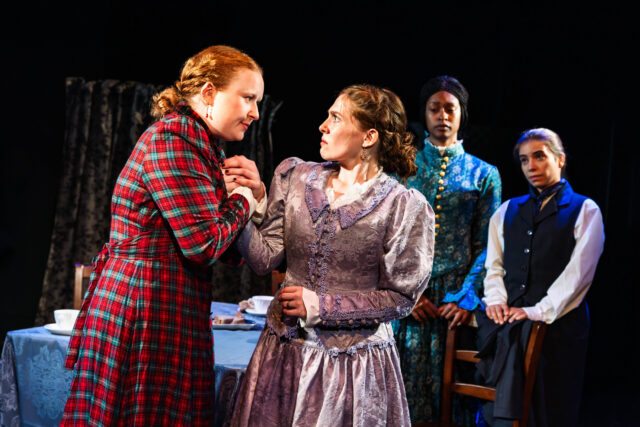
Melissa Maney’s Hungry Women looks at what happens when all the males in a small town suddenly die (photo by Rebecca J Michelson)
HUNGRY WOMEN
SoHo Playhouse
15 Vandam St. between Varick St. & Sixth Ave.
Thursday – Sunday through August 30, $50-$75.50
www.sohoplayhouse.com
hungrywomenplay.com
Melissa Maney’s Hungry Women makes no bones about where it’s heading well before it starts. First, there is the title, which on the program is accompanied by a grisly image of a woman’s fist squeezing a strawberry, red liquid dripping from the palm. And second, the entrance music includes Dove Cameron’s “Breakfast” (“I eat boys like you for breakfast”), Chloe Moriondo’s “I Eat Boys” (“Yeah, I eat boys and I get them bloody”), and Florence + the Machine’s “Just a Girl,” the theme from the cable series Yellowjackets, in which a high school girls soccer team makes some tough choices in order to survive a plane crash in the mountains and must eventually face the consequences decades later.
Unfortunately, the night I went, the Black Watch Theatre production, which opened this evening at SoHo Playhouse, had some lighting difficulties that became representative of the narrative as a whole.
Hungry Women begins in a small town in Massachusetts in 1890, shortly after all the males have dropped dead in their tracks. Initially, the ladies are hungry for food, as, without men, there are no butchers, no markets, no shops, only, it seems, potatoes. Ruth (Julia Lester), her sister, Mary (Zoe Dean), Eden (Mariyea), and her sister, Victoria (Sophie Zmorrod), have gathered to discuss their growing dilemma. Ruth is prim and proper, believing that women need men, who must be around somewhere else in the country. Mary feels lost, explaining that her husband was her entire world. The more independent-minded Eden is mourning the loss of her sons while trying to feed her daughters. And Victoria, who now wants to be known as Vic, donning some of her husband’s clothing, is ready to move on, apparently thrilled that her husband is now dead. It’s no coincidence that three of the women’s names refer to the Old Testament, while Vic’s comes from the mythical Roman goddess of victory.
“I’m not a sentimental person. Wearing George’s clothes doesn’t make me feel closer to him. They make me feel closer to me,” she tells the audience in a short monologue. “My late husband viewed life as a presentation. If there was a speck of dirt, a utensil askew, a hair astray, uproar would follow. So, when the maid told George I’d been wearing his clothes around the house, his punishment was unyielding. Each time she’d lace up my corset, he’d demand, ‘Tighter. Tighter. Tighter.’ Until my waist became as small as he wanted me to feel. But now, he’s gone. And I’m much more handsome than he ever was.”
When Vic serves the ladies sandwiches and, eventually, admits what they’re made of, the other women are not prepared at first to partake as each of them also gets their moment in the spotlight, delivering revealing mini-speeches addressed directly to the audience. “She may think she holds the power now, but the kings return. They always return,” Ruth says about Vic. Suddenly having sexual thoughts about Vic, Mary admits, “The danger of it all feels oh so delicious.” And Eden, recalling going hunting with her father, proclaims, “I despise motherhood.”
Aside from the spotlights unable to properly shine on the actors during their monologues, which is distracting, the first act works beautifully, setting up an engaging and fascinating premise. But as the action moves to 1991 (“Curious Women”), which takes place in an AP class, and 2091 (“Scared Women”), the story runs off the rails as it explores the whitewashing of history (or herstory), holds an improbable séance, and turns to global surveillance and control.
Be careful what you wish for.
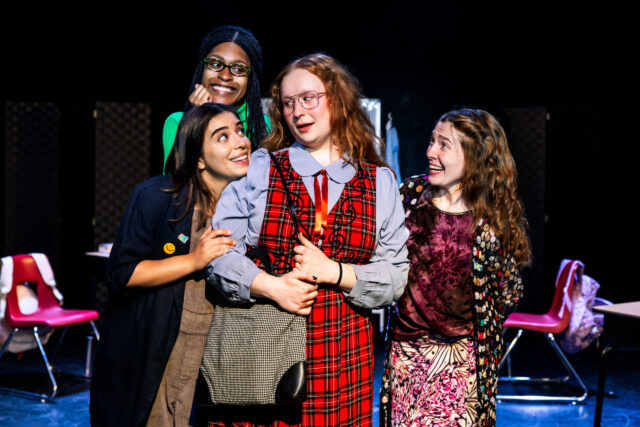
Melissa Maney’s Hungry Women moves from 1890 to 1991 and 2091 (photo by Rebecca J Michelson)
Directed by Daniella Caggiano, Hungry Women promises an exciting and unique feast but ends up serving unsatisfying grub. Jokes fall flat, and portraits of famous women(?) on either side of the stage are impossible to identify.
The always excellent, Tony-nominated Lester (Into the Woods, All Nighter) might have her name above the title, but Zmorrod (The Kite Runner, Odyssey) steals the show as Vic (1890), Valerie (1991), and Violet (2091), the three meatiest roles. Dean (The Trouble with Dead Boyfriends) and Mariyea (Miss Bushwig 2025, On Sugarland) offer strong support even as things descend into the maelstrom.
In one interstitial scene, Bikini Kill’s “Rebel Girl” blasts through the space, reminding me in the end that what was missing was more of a sense of rebellion or revolution. Perhaps that was the point, that women have been too tamed and domesticated by men, unable to grab sex, power, individuality, and independence, but, if so, it makes for a much less tasty and insightful meal.
Maybe I just thought that a world without men would be a lot more fun, at least for a little while.
[Mark Rifkin is a Brooklyn-born, Manhattan-based writer; you can follow him on Substack here.]