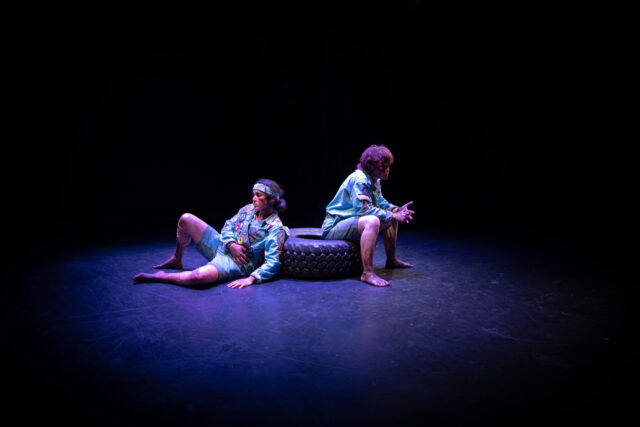
Natasha Roland and Xhloe Rice return to SoHo Playhouse with remarkable award-winning production (photo by Morgan McDowell)
A LETTER TO LYNDON B. JOHNSON OR GOD: WHOEVER READS THIS FIRST
SoHo Playhouse
15 Vandam St. between Varick St. & Sixth Ave.
Wednesday – Sunday through June 29, $45.50
www.sohoplayhouse.com
www.xhloeandnatasha.com
Xhloe Rice and Natasha Roland’s A Letter to Lyndon B. Johnson or God: Whoever Reads This First is back for an encore run at SoHo Playhouse, with good reason: It’s one of the best, most innovative and thoroughly satisfying shows of the year.
Rice and Roland met in high school eleven years ago and have been creating unique and inventive two-character plays and short films ever since, offering funny and poignant views of American history and culture and the elusive American dream.
Developing their own form of absurdist physical clown theater, they’ve portrayed Lewis and Clark in a pair of short films, satirized violence in the thirteen-minute Caramel Apples, and, onstage, played a rodeo clown and his shadow who want to become cowboys in And Then the Rodeo Burned Down and scrutinized the desires of 1950s housewives in What If They Ate the Baby?
They shocked the Edinburgh Fringe by winning the Fringe First award in 2022 for Rodeo, 2023 for Baby, and 2024 for Lyndon B. Johnson, their first three works, a feat never before accomplished.
A Letter to Lyndon B. Johnson or God: Whoever Reads This First packs a lot into its fast-moving sixty-five minutes; in addition to starring in the show, Rice and Roland are responsible for the writing, directing, choreography, costumes, set, and sound design, a legitimate DIY effort. Their regular collaborator Angelo Sagnelli is credited with lighting and technical management.
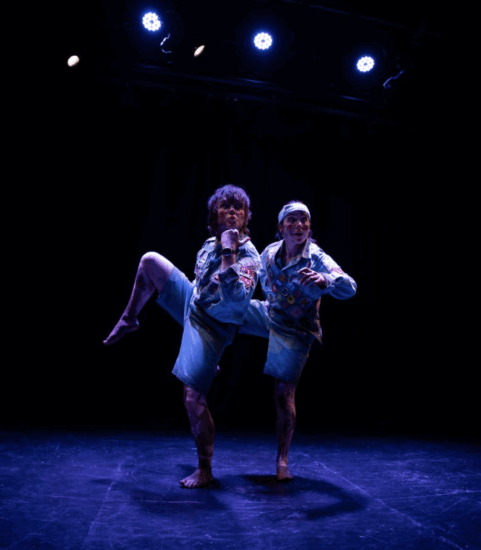
Xhloe Rice and Natasha Roland explore America in A Letter to Lyndon B. Johnson or God: Whoever Reads This First (photo by Morgan McDowell)
Twenty-four audience members sit on the stage in single rows of eight on the two sides and the back; the rest of the audience is in standard seating. The only prop is a large Mudstar radial M/T all-terrain tire with optimized traction; although it was chosen somewhat randomly by Roland’s father, it fits the concept of the show, in which Ace (Roland) and BFF Grasshopper (Rice) share stories of their past in small-town America and their service in Vietnam as they equate President Lyndon B. Johnson with G-d.
Ace is the tough one, from a military family, while Grasshopper is more gentle and vulnerable, raised by his grandmother. They both are barefoot and wearing Boy Scout uniforms, Ace’s covered in many more patches — evoking battle medals — than Grasshopper’s. Their faces, arms, and legs are thick with dirt and grime; Ace also has a bandanna around his head and a bandage on one calf that look like war wounds but, as we learn, aren’t.
“Stay with me,” Grasshopper says at the beginning; we’re not about to go anywhere. Running across the stage, jumping on each other, lying down on the floor, rolling and balancing on the tire, and spit-shaking, Ace and Grasshopper talk about the time Hillbilly had a problem with a high rope swing, relate an evening when their proposed prank of putting snakes in camp counselor Davis’s pillowcase went awry, and prepare for Ace to play the trombone for the president as his train passes through town. Although the trombone scene eerily recalls the 1954 thriller Suddenly, in which Frank Sinatra plays a hit man hired to assassinate the president when his train is scheduled to stop in a small California town, Ace and Grasshopper worship LBJ. They alter the Pledge of Allegiance to include him and offer their own version of the Our Father, as if praying to Johnson and G-d is the same thing; they often swear to Johnson, as if he’s in charge of it all, amid numerous references to religion. Ace has a dream in which his father becomes LBJ.
Throughout the play, Grasshopper tells a multipart fable about “a young boy who lived in a mountain village and . . . wanted nothing more than to be a man.” A witch advises that he must undertake a long, dangerous journey to find a lake filled with leeches that will suck his blood and make him a man; it loosely parallels Ace and Grasshopper’s story as they go from kids to soldiers fighting an ill-defined war in Southeast Asia, one that their hero, LBJ, escalated.
Rice and Roland are utterly charming as Grasshopper and Ace; through direct eye contact with the audience and physically reaching out with various gestures and incorporating the tire, they not only humanize the characters but instantly make them our friends. We all feel a part of the group, enhancing our emotional investment in what happens to them. Their goofing around as kids helps us reminisce about our goofing around as kids:
Ace: I’m what they call “highly decorated.”
Grasshopper: You’re what they call “highly annoying.”
Ace: [puts Grasshopper in a headlock] And what do they call your mom’s brother?
Grasshopper: Uncle! Uncle!
But their faith is tested, as shown in this brief exchange:
Grasshopper: Do you think they’ll let him be president forever?
Ace: They have to.
Grasshopper: He’ll love us.
Ace: He has to.
The immersive sound features nature and music — three Beatles songs play a prominent role, with Rice and Roland performing on that war-movie staple, the harmonica, replacing the words with notes, beginning with “Ob-La-Di, Ob-La-Da,” which contains the refrain “Ob-la-di, ob-la-da, life goes on, brah / La-la, how their life goes on.” The sound and lighting ultimately explode in a gripping, unforgettable finale.
Winner of SoHo Playhouse’s International Fringe Encore Series Overall Excellence award, A Letter to Lyndon B. Johnson or God: Whoever Reads This First captures the America of the late 1960s as well as today, as politics, religion, and the military become intertwined and the everyday struggles of the common people are completely misunderstood or purposely ignored. Rice and Roland remind us who we were, who we are, and who we still can be. I can’t wait to see where they’ll take us next.
[Mark Rifkin is a Brooklyn-born, Manhattan-based writer and editor; you can follow him on Substack here.]