twi-ny recommended events

MACY’S FOURTH OF JULY FIREWORKS: LIVE FROM THE BROOKLYN BRIDGE

macys 2019

Televised live on NBC-TV beginning at 8:00 pm
Broadcast live on WINS 1010
Thursday, July 4, free, 9:25 pm (approx.)
212-494-4495
www.macys.com

Macy’s July Fourth extravaganza celebrates its forty-third anniversary of lighting up the night sky on Thursday, with four barges around the Brooklyn Bridge and the Seaport District on the East River to honor America’s 243rd birthday. The festivities will be hosted by Ciara and Derek Hough, with live performances by Jennifer Hudson, Luke Bryan, Khalid, Maren Morris, Brad Paisley, and Hough and Ciara. Sixty pyrotechnicians have developed more than seventy thousand effects, including a sixteen-hundred-foot-long waterfall of fireworks between the bridge’s towers. New images to watch out for during the twenty-five-minute explosion are wolf whistle, little snakes, hidden happy faces, revolving dragons, and multicolor meteor mines. The score this year focuses on famous instrumental tunes from ten classic American movies, from Star Wars, Superman, and E.T. to Casablanca and The Wizard of Oz, in addition to “America the Beautiful” and “Stars & Stripes Forever” as part of “Macy’s Salutes Those Who Serve” and the familiar “20th Century Fox Fanfare.” Hudson will sing “Over the Rainbow” for Oz’s eightieth birthday.

The best viewing areas are at Broad St. & Water St., Pearl St. & Dover St., Robert F. Wagner Sr. & St. James Pl., Pearl St. & St. James Pl., and Montgomery St. & Cherry St., with access to the Lower Promenade at Pike Slip & Cherry St. and Market St. & Cherry St.; it is suggested that Battery Park, Battery Park City, Brooklyn Bridge Park, Hunter’s Point South Waterfront Park, and Roosevelt Island be avoided. Large backpacks, lawn chairs, lawn blankets, large coolers, umbrellas, and alcoholic beverages are not permitted in the official viewing areas.

TWENTIETH-ANNIVERSARY RESTORATION: AUDITION

Model Eihi Shiina makes a stunning debut in Takashi Miike’s Audition

Model Eihi Shiina makes a stunning debut in Takashi Miike’s Audition

AUDITION (ÔDISHON) (Takashi Miike, 1999)
Metrograph
7 Ludlow St. between Canal & Hester Sts.
Opens July 3
212-660-0312
metrograph.com

When Audition opened in 1999 at Film Forum, it was New Yorkers’ major introduction to the work of Japanese director Takashi Miike — and some cineastes ran out of the theater faster than they lined up around the block to get in in the first place. The shocking, unconventional psychosexual horror classic, which won the FIPRESCI Prize and the KNF Award at the Rotterdam International Film Festival, is now back in a 2K twentieth-anniversary restoration that will likely have people lining up at Metrograph, where it opens July 3. But this is a different (#MeToo, social-media-obsessed) era, so don’t expect many walkouts, although there will be plenty of head-turning and face-covering. There also will be a critical reevaluation of the film’s central concept, a misogynistic male fantasy that evolves into torture/revenge porn.

Yoshikawa Yasuhisa (Jun Kunimura) and Aoyama Shigeharu (Ryo Ishibashi) get more than they bargained for in Audition

Yoshikawa Yasuhisa (Jun Kunimura) and Aoyama Shigeharu (Ryo Ishibashi) get more than they bargained for in Audition

Written by Daisuke Tengan based on the novel by Ryu Murakami, Audition begins like a Japanese family melodrama. The gentle-hearted Aoyama Shigeharu (Ryo Ishibashi) watches his wife, Ryoko (Miyuki Matsuda), die in a hospital, leaving him to raise their young son, Shigehiko. Seven years later, the teenage Shigehiko (Tetsu Sawaki) thinks it’s time for his father to find a new wife, as does Aoyama’s best friend, filmmaker Yoshikawa Yasuhisa (Jun Kunimura). Yoshikawa and Aoyama decide to hold fake auditions so the lonely widower can find just the right new romantic partner. He is immediately drawn to the younger, damaged Asami Yamazaki (Eihi Shiina in her stunning film debut), a suicidal former ballerina with a sketchy past filled with questions that worry Yoshikawa. But Aoyama starts dating her anyway, and what starts out sweetly ends up something entirely different as he meets a onetime music executive (Ren Osugi) and an old dance teacher (Renji Ishibashi) who — well, you’ll just have to see that for yourself. The last half hour is so brutal, so grotesque, so disturbing, so violent that you should hang on only at your own risk as it travels “deeper, deeper, deeper” into the psyche, among other things.

There’s something not quite right with Asami Yamazaki (Eihi Shiina) in Takashi Miike’s Audition

There’s something not quite right with Asami Yamazaki (Eihi Shiina) in Takashi Miike’s Audition

Intimately photographed by Hideo Yamamoto and featuring an ominous score by Kōji Endō, Audition has lost none of its power to thrill and chill, right down to the bone. The film has always raised issues of misogyny and male guilt, but, viewed in 2019, those elements come to the fore. The scene in which Yoshikawa and Aoyama interview numerous women contains more than a few cringeworthy stereotypes, and the flashbacks of the abuse suffered by Asami as a child feel more manipulative in 2019. Essentially, Audition is a film that could spring only from a male brain. That said, it is still terrifying twenty years later. Miike (Ichii the Killer, The Happiness of the Katakuris), who has directed nearly a hundred films in his three-decade career, from Westerns and yakuza movies to children’s fare and superhero flicks, is best known for the graphic violence in his films, but he also has a wild sense of humor and a knack for making audiences think, “Oh no he won’t,” and then he does. And it’s Audition that cemented that well-earned reputation.

CORPSE FLOWER

Another corpse flower has bloomed at New York Botanical Garden (photo by twi-ny/ees)

The amazing, and aromatic, corpse flower has bloomed at New York Botanical Garden (photo by twi-ny/ees)

The New York Botanical Garden
Enid A. Haupt Conservatory
2900 Southern Blvd., Bronx
Saturday, June 29, and Sunday, June 30, $12 children two to twelve, $28 adults, 10:00 am – 8:00 pm
718-817-8700
www.nybg.org

For the third time in four years, one of the New York Botanical Garden’s rare corpse flowers has bloomed, aerating its funky aroma (rotting garbage!) in an honored position at one end of the Enid A. Haupt Conservatory. It’s a special privilege to be able to see (and smell!) the titan-arum (Amorphophallus titanum) in person, whether in its full glory — it started flowering on Thursday, was at its peak on Friday, and will fade away on Saturday and Sunday — so get over to the NYBG as soon as you can (remember, it’s only twenty-two minutes from Grand Central via Metro-North) to watch the tall, central spadix fall over as the lovely, colorful spathe surrounding it withers. You can follow the progress of the largest unbranched inflorescence in the plant world — well, now its demise — on the garden’s livestream here. The NYBG is also home to the excellent current exhibition “Brazilian Modern: The Living Art of Roberto Burle Marx,” so the trip will be well worth it.

Soho Rep.’s FAIRVIEW

(photo by Henry Grossman)

Beverly (Heather Alicia Simms) and Dayton (Charles Browning) get ready for a family affair in Jackie Sibblies Drury’s Fairview (photo by Henry Grossman)

Theatre for a New Audience, Polonsky Shakespeare Center
262 Ashland Pl. between Lafayette Ave. & Fulton St.
Tuesday – Sunday through August 11, $55-$115
866-811-4111
www.tfana.org
sohorep.org/fairview

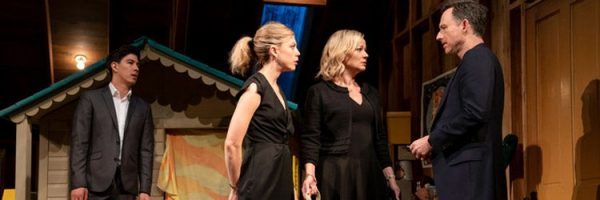
At the beginning of Jackie Sibblies Drury’s Pulitzer Prize–winning Fairview, which has successfully transitioned from Soho Rep. to the much bigger Theatre for a New Audience, a black woman onstage approaches the fourth wall as if it were a mirror, checking her hair and applying lipstick, but she’s not seeing herself, of course; what she is looking at is a space filled primarily with white people who have paid good money to watch her and the other actors/characters in the dark. It’s an incendiary concept that gets more radical — and openly angry and confrontational — as the story makes its way through four ever-more-antagonistic acts, taking a recent theme to a whole new level of supreme discomfort.

There might be an explosion of high-quality plays on and off Broadway by black men and women about the black experience — think Suzan-Lori Parks, Branden Jacobs-Jenkins, Lynn Nottage, Tarell Alvin McRaney, Dominique Morisseau, Jocelyn Bioh, Jeremy O. Harris, Lydia R. Diamond, and Dael Orlandersmith, among others, as well as such directors of color as Kenny Leon, Liesl Tommy, Ruben Santiago-Hudson, Lileana Blain-Cruz, and Leah C. Gardiner — but the audience for these shows is still predominantly white, something that has not gone unnoticed by black artists. In the Flea’s 2015 interactive Take Care, written by the white Todd Shalom and the black Niegel Smith, who also directed, an audience member is given the job of pointing out all the black and brown people in the room and telling them to gather in a corner, as if being rounded up for nefarious purposes. (I had that responsibility when I attended.) In Jordan E. Cooper’s 2019 Ain’t No Mo’, in which all of the people of color in America are being sent back to Africa, a minister tries to get the mostly white audience to shout out the N-word, with no success save for one black woman the night I went.

(photo by Gerry Goodstein)

Sisters Beverly (Heather Alicia Simms) and Jasmine (Roslyn Ruff) do battle in Pulitzer Prize winner (photo by Gerry Goodstein)

In Thomas Bradshaw’s 2019 revival of Southern Promises at the Flea, also directed by Smith, a mini-Roots-like tale is performed by an all-person-of-color cast, playing slaves as well as slave owners and a white preacher; at the curtain call, much of the white audience stood and applauded, but a handful of blacks were silent, appearing distraught by what they had just witnessed. And in Triptych (Eyes of One on Another), a multimedia production about Robert Mapplethorpe’s photos of, among other subjects, black male bodies, with a score by the white Bryce Dessner and a libretto by the black Korde Arrington Tuttle, a black actor watches from the front of the stage, never speaking, until at one point he sits down in the primarily white audience and claps and cheers by himself, leaving the crowd to wonder if they just aren’t getting it. All of the above incidents are deeply uncomfortable moments involving race and, more specifically, the “segregation” that still exists in the theater.

“In America you are obsessed with race, and you never never never think about class,” a character says in Fairview. “The rich profit from the racism. The poor get nothing from it.” The play takes place on Mimi Lien’s almost blindingly white stage, a huge, fancy dining room / living room that feels like The Jeffersons meets The Cosby Show by way of Edward Albee and Noël Coward. At the front of the stage is a black border, a few feet high, that makes it look like the Frasier family (a nod to Kelsey Grammer’s popular Frasier sitcom?) is on a television screen while also serving as a small barrier keeping actors and audience separate. At the start, Beverly (Heather Alicia Simms) sings along with Sly & the Family Stone’s 1971 disco hit “Family Affair” on the radio, but the station changes a few times by itself, as if reminding the audience — and Beverly — that someone else is in charge.

(photo by Henry Grossman)

Keisha (MaYaa Boateng) and her aunt Jasmine (Roslyn Ruff) do some celebrating in Fairview (photo by Henry Grossman)

Beverly and Dayton (Charles Browning) are getting ready for a dinner celebrating her mother’s birthday; they are joined by their daughter, graduating high school senior Keisha (MaYaa Boateng), and Beverly’s gossipy sister, Jasmine (Roslyn Ruff). In the second act, the action is repeated, but silently, as four white people in voiceover (Hannah Cabell as Suze, Jed Resnick as Mack, Natalia Payne as Bets, and Luke Robertson as Jimbo) discuss the loaded question “If you could choose to be a different race, what race would you be?” It gets even whiter in the third act, when Beverly’s brother and his wife finally arrive and the matriarch comes downstairs, followed by a finale in which all hell breaks loose and theatrical conventions are turned inside out and upside down. What might be exhilarating at first quickly becomes something else as Drury (Marys Seacole,; We Are Proud to Present a Presentation About the Herero of Namibia, Formerly Known as South West Africa, from the German Südwestafrika, Between the Years 1884-1915), director Sarah Benson (In the Blood, An Octoroon), and Boateng/Keisha go where no play has gone before, particularly involving gender, class, and stereotyping in addition to race.

The stellar production, which has been extended at the Polonsky Shakespeare Center in Brooklyn through August 11, is ingeniously directed by Benson, who navigates the changing emotional temperatures of the four distinct acts, with terrific lighting by Amith Chandrashaker, sound by Mikaal Sulaiman, and costumes by Montana Levi Blanco, fully immersing everyone in the ever-darker proceedings. Fairview — the name itself can be broken into two words, explaining part of Drury’s mission — offers a very different experience to white audiences as compared to black and brown theatergoers. Regardless of your color, however, there’s nothing you can do to prepare yourself for what happens, or for your ultimate reaction, as white privilege and white guilt take center stage without apology.

DYING CITY

(photo by Joan Marcus)

Mary Elizabeth Winstead and Colin Woodell star in two-actor, three-character play at Second Stage (photo by Joan Marcus)

2econd Stage Theater
Tony Kiser Theater
305 West 43rd St. between Eighth & Ninth Aves.
Through June 30, $30-$125
2st.com/shows

With President Trump threatening to attack Iran and Congress fighting over whether to fully fund ailing 9/11 first responders, Christopher Shinn’s 2007 Pulitzer Prize finalist, Dying City, takes on added relevance in its intense Second Stage revival at the Tony Kiser Theater, where it runs through June 30. The two-actor, three-character play shuttles between July 2005 and January 2004 as Gold Star wife Kelly (Mary Elizabeth Winstead) examines her relationship with her husband, Craig (Colin Woodell), upon the sudden arrival of Craig’s twin brother, Peter (Woodell), late one night at her Manhattan apartment. It’s been nearly a year since Craig was killed in the Iraq war, and Peter, an actor on the rise, needs to connect with Craig’s widow, Kelly, a therapist who has not been returning his calls or emails.

(photo by Joan Marcus)

Mary Elizabeth Winstead makes a strong theater debut as a Gold Wife widow in Christopher Shinn’s Dying City (photo by Joan Marcus)

“It’s — yeah, it’s. — I’ve been meaning to call you and — it’s — I just haven’t. I’ve been so busy,” Kelly stumbles, offering excuses. “I wanted to make sure I had the, that I had enough — energy, mental space, before I called.” Kelly seems to want to put everything behind her and get on with her life, but Peter, who is starring in a New York City production of Eugene O’Neill’s Long Day’s Journey into Night — a prime example of family dysfunction — insists on dredging up the past, insinuating that something may be wrong with the story of Craig’s death. Peter is also facing problems with his boyfriend, Tim.

Meanwhile, in 2004, it’s Craig’s last night at home before heading to Fort Benning in the morning, and Kelly is not having the touching goodbye she expected as he criticizes Peter’s choice of movies and lovers and how she is handling one of her patients, a man who claims to be a fierce animal in bed. “You’re so passive,” Craig tells Kelly. “This always happens when we talk seriously about my work,” she responds. “We don’t talk seriously about your work,” he replies. “Exactly,” she shoots back. As that final night gets rehashed, Kelly, Peter, and Craig enter some harsh territory.

(photo by Joan Marcus)

Colin Woodell plays very different identical twin brothers in Dying City revival (photo by Joan Marcus)

Obie winner Shinn (Where Do We Live, Now or Later), who also directed this version, has said that he structured Dying City like a trauma; in many ways, it feels like Kelly and Peter are suffering through their own forms of PTSD over what happened to Craig and how that has impacted their lives. Dane Lafrey’s comfortable, uncluttered apartment-house set — a sharp contrast to the characters’ inner turmoil — consists of an L-shaped couch at the center, with an unseen kitchen off stage left, a hallway in the back that leads to the bedroom, and a television in the front corner, often tuned to The Daily Show with Jon Stewart. The barefoot Winstead wears the same clothing throughout the ninety-minute play, while Woodell makes slight changes as he morphs from Craig to Peter and back again, usually walking out of view as one character and then returning as another, darkness and a flash of light accompanying the shifting scenes. (The costumes are by Kaye Voyce, with lighting by Tyler Micoleau.)

Winstead (Fargo, All About Nina) is terrific in her stage debut, embodying Kelly’s extreme unease at having to speak with Peter and look at the past, while Woodell (Unsane, Masters of Sex), who did in fact recently appear in a revival of Long Day’s Journey into Night (in LA), excels at keeping his portrayals of the twin brothers separate, the needy Peter insecure and sensitive, the brash Craig more concerned with his manhood. Dying City is a breadcrumb play; the plot and its many intricacies — among the topics that get covered are sexual assault, the military, political leanings, guns, homosexuality, the theater, lies, violence, love, and war — unfold slowly in bits of dialogue that require close concentration. However, following the crumbs does not lead to a fairy-tale ending but to a devastating finale.

GRIT AND GLITTER — BEFORE AND AFTER STONEWALL: MULTIPLE MANIACS / TROPICAL MALADY

MULTIPLE MANIACS

Divine is the star of “Cavalcade of Perversions” in John Waters’s splendidly lurid Multiple Maniacs

MULTIPLE MANIACS (John Waters, 1970),
Museum of the Moving Image
35th Ave. at 36th St., Astoria
Friday, June 28, 7:00
Series continues through July 6
718-777-6888
www.movingimage.us

In conjunction with the fiftieth anniversary of the Stonewall riot, the Museum of the Moving Image is presenting “Grit and Glitter: Before and After Stonewall,” a thirteen-film series guest curated by Donal Mosher and Michael Palmieri (October Country, Peace in the Valley) consisting of queer-cinema works that have inspired them. The seventeen-day festival began with such films as Jack Smith’s Flaming Creatures, Tony Richardson’s A Taste of Honey, and Pier Paolo Pasolini’s Teorema and continues June 28 with one of John Waters’s craziest early works, when the King of Bad Taste, serving as writer, director, producer, cinematographer, and editor, was only twenty-three. The extremely low budget romp Multiple Maniacs begins with barker Mr. David (David Lochary) inviting people into Lady Divine’s Cavalcade of Perversions, proclaiming, “This is the show you want. . . . the sleaziest show on earth. Not actors, not paid imposters, but real, actual filth who have been carefully screened in order to present to you the most flagrant violation of natural law known to man.” Of course, that is an ideal introduction to the cinematic world of Waters, one dominated by the celebration of sexual proclivities, fetish, salaciousness, indecency, violence, and marginalized weirdos living on the fringes of society. Lady Divine, played by Divine, turns out to be a cheat, the freak show just a set-up for a robbery. Soon Divine is jealous of David’s relationship with Bonnie (Mary Vivian Pearce), hanging out with her topless daughter, Cookie (Cookie Mueller), and being led into a church by the Infant of Prague (Michael Renner Jr.), where she’s brought to sexual ecstasy by Mink (Mink Stole). There’s also rape, murder, Jesus (George Figgs), the Virgin Mary (Edith Massey), and the famed Lobstura. Shot in lurid black-and-white, Multiple Maniacs is a divine freak show all its own, an underground classic that redefined just what a movie could be, a crude, disturbing tale that you can’t turn away from.

“The outrageously subversive Multiple Maniacs could easily be mistaken as mere freak show sentiment and gross-out comedy, but at heart it’s a defiantly angry rejection of all things mainstream,” Palmieri explains in a program note. “Shot in the summer of Stonewall in Baltimore in 1969 and released in 1970, the film begins with Mr. David installed on a quiet wooded suburban street luring unsuspecting passersby to dare to attend Lady Divine’s Cavalcade of Perversion, in which all hell breaks loose. The audience is made complicit in this transgression, and appropriately assaulted for it for the rest of the production. As punk and queer as film gets.”

Apichatpong Weerasethakul’s TROPICAL MALADY was both booed and celebrated at the 2004 Cannes Film Festival

Apichatpong Weerasethakul’s Tropical Malady was both booed and celebrated at the 2004 Cannes Film Festival

TROPICAL MALADY (SUD PRALAD) (Apichatpong Weerasethakul, 2004)
Museum of the Moving Image
35th Ave. at 36th St., Astoria
Saturday, June 29, 7:00, and Sunday, June 30, 2:00
Series continues through July 6
718-777-6888
www.movingimage.us

“Grit and Glitter: Before and After Stonewall” takes quite a turn from Multiple Maniacs with Thai director Apichatpong Weerasethakul’s Tropical Malady, a beautiful, mystical work that won the Jury Prize at Cannes and will thoroughly engage you — if you allow it to. Part tender love story between a country boy (Banlop Lomnoi) and a soldier (Dakda Kaewbuadee), part folktale set in the deep forests of Thailand, Tropical Malady is like a visual poem in which details are not as important as the overall effect, which is intoxicating. The unorthodox film features ghosts, a shape-shifter, unusual characters, and a playful sense of humor that come together to form a subtle meditation on life and love. Weerasethakul once again displays the gentle, captivating narrative technique that lies at the heart of his oeuvre, which also includes such works as Blissfully Yours, Syndromes and a Century, and 2010 Palme d’Or winner Uncle Boonmee Who Can Recall His Own Lives. Some people at Cannes walked out on Tropical Malady and others stuck around to boo it; Quentin Tarantino headed the group that awarded it the Jury Prize regardless. You can decide to cheer or boo, or merely just experience it, when it screens on June 29 and 30 at the Museum of the Moving Image.

“Blissfully beyond categorization, Apichatpong Weerasethakul’s breathtaking Tropical Malady is a sui generis romance told in two parts: a gentle courtship between two men that transforms into a mind-altering tale of a soldier stalked by a shaman in the form of a tiger,” Palmieri writes. “Mysterious on just about every level possible, Apichatpong explores the complicated nuances of desire through this magical and haunting parable, where playful evasiveness eventually gives way to total surrender. Come for the love story, stay for the talking monkey.”

The series runs through July 6 with such other films as Sidney Lumet’s Dog Day Afternoon, Stephen Frears’s My Beautiful Laundrette, and Pietro Marcello’s The Mouth of the Wolf. “Being a rural gay kid, my source of queer presence and history mostly came from viewing media stereotypes and news reports about AIDS — save for the rare films that were illuminated windows into a queer world happening, waiting, and calling from the other side,” Mosher notes. “Since then I’ve spent my life seeking and, hopefully, on occasion, creating such illuminated moments. We now live in a time when LGBTQ+ representation is so mainstream that the Stonewall riot can be rewritten as a triumph of whiteness and the life of Freddie Mercury can be retooled to support normative family values. To me, though, the films in this program shine with a disruptive, beacon-like power. Some are celebratory, some problematic. Some are highly crafted, some crudely made. Some are all of these things, which is why the light they radiate is not a single reductive beam but a necessary iridescence — multifaceted, shifting, reflecting the visions of both vast communities and the single, lonely viewer in the dark.”

Palmieri adds, “With this series, we’re interested in the films and filmmakers whose ideas reflected the cultural shifts bubbling under the surface that led to Stonewall, as well as the effect it had on the cinema and culture that followed. In these films you’ll find a multitude of approaches, even contradictions, but they all share a subversiveness, a strain of rage, a rejection of social and cinematic norms, and a deep well of empathy. These films are clarion calls to me as a filmmaker, and they serve as a constant reminder that rage and empathy can coexist, and that they are powerful tools to work with.”

LITTLE WOMEN

(photo by James Leynse)

Kate Hamill adapts Little Women for the twenty-first century and plays Meg (far left) (photo by James Leynse)

Cherry Lane Mainstage Theatre
38 Commerce St.
Tuesday – Sunday through June 29, $82-$152
212-989-2020
primarystages.org
www.cherrylanetheatre.org

Kate Hamill strips down Louisa May Alcott’s classic semiautobiographical children’s book, Little Women, to its bare essentials in her self-described “radical adaptation,” a Primary Stages production continuing at the Cherry Lane through June 29. Hamill, who previously wrote and starred in dynamic versions of Jane Austen’s Sense and Sensibility and Pride and Prejudice and William Makepeace Thackeray’s Vanity Fair, explores gender identity and traditional male and female roles as it relates to both the mid-to-late nineteenth century and today. The story zooms in on Jo March (Kristolyn Lloyd), a tomboy who wants to break out of her family’s small world by going to college, becoming a writer, and traveling through Europe. She lives with her mother, known as Marmie (usually Maria Elena Ramirez, although I saw Mary Bacon, who also plays Aunt March), who understands the significant differences among her children; the oldest sister, Meg (Kate Hamill), already a spinster at sixteen; the sweet but sickly thirteen-year-old Beth (Paola Sanchez Abreu); the youngest, twelve-year-old Amy (Carmen Zilles), who is determined to find her Prince Charming; and their maid, Hannah (Ellen Harvey, who also portrays Mrs. Mingott), who is pitching in more than ever while the family patriarch, Robert March (John Lenartz), is off fighting for the Union in the Civil War.

Fifteen-year-old Jo develops an intimate friendship with their new neighbor, Laurie (Nate Mann), an effeminate piano-playing orphan who lives on a large estate with his wealthy grandfather, Mr. Laurence (Lenartz), and is being tutored by John Brooks (Michael Crane, who also plays the nasty parrot). The tutor is preparing Laurie for upper-middle-class manhood: college followed by heading up the family business, which he is loathe to do. “I’m not very good at being a, you know, a ‘lady,’” Jo, who shortened her name from the more feminine Josephine, says to Laurie, who prefers being called that instead of his more masculine given name of Theodore. “I’m not very good at being a ‘gentleman.’ So perhaps we should — be ourselves,” he says. They are mirror images of each other, both wanting to further their education and travel overseas while just being their not-so-cisgender selves, an option open to them in 2019 but not in the 1860s.

(photo by James Leynse)

The March family needs a group hug in Primary Stages production at the Cherry Lane (photo by James Leynse)

Hamill has excised many supporting characters and changed several key plot points in order to focus more on the family dynamic and the individual sisters’ relationships. “You’re all growing up so fast,” Marmie says. In fact, the word “grow” is used extensively throughout the play. “In this story, they never grow up. They just stay the same, and it lasts forever,” Jo tells Beth when she’s about to read her one of her tales. “Nothing lasts forever,” Jo responds. “We all grow up, eventually,” Laurie says later with a tinge of sadness. “One isn’t better than the other. They just need different things to grow,” Marmie says about flowers but referring to her children as well. Meanwhile, Hannah explains, “Took care of all of you since you were babies. Each one of you growing different than the other.” In Hamill’s view, as kids head toward adulthood, they don’t have to follow societal norms and do what’s expected of them; they can make their own choices, follow their dreams.

Purists shouldn’t be worried; this is still Alcott’s Little Women, even as it’s reclaimed by Hamill, whose mother first gave her the book when Kate was reaching puberty. She is not reinventing or reimagining it so much as bringing a contemporary perspective that is refreshing while still remaining true to the heart of the novel. The play, which, even with its changes, sticks more to the original story than Hamill’s previous works, is briskly directed by Sarna Lapine on Mikiko Suzuki MacAdams’s two-level set, the upstairs containing Jo’s writing desk and Beth’s bed, the main floor serving as multiple locations with very minor adjustments. Lloyd (Dear Evan Hansen, Paradise Blue) is superb as Jo, prancing about with a fake mustache, wearing men’s clothes (the fine period costumes are by Valérie Thérèse Bart), and determined to make something of herself, but as a person, not specifically as a woman. In his New York debut, Mann, a recent Juilliard grad, is wonderful; he and Jo practically melt into each other. And Hamill is a cool Meg, giving her more weight in this adaptation. The play also features a lovely piano score by Deborah Abramson, which works its way into the narrative. We can’t get enough of Hamill’s ingenuity and can’t wait to see which classic she tackles next.