Who: Baba Israel, AMYRA, Drew Drake, Dizzy SenZe, Freakquencee, DJ Reborn, Jade Charon What: Live music, dance, and spoken word performances centered around Aṣẹ Where:BAM Fisher, Fishman Space, 321 Ashland Pl. When: April 7—9, $25, 7:30 Why: BAM’s annual celebration of spoken word and hip-hop features a stellar lineup of performers honoring the power of Aṣẹ, the Yoruba philosophical concept of affirmation, life force, and verbal creation. Artist, producer, educator, and consultant Baba Israel will host “Word. Sound. Power. 2022,” which takes place April 7-9 at BAM Fisher’s intimate Fishman Space. The impressive gathering brings together Bronx-born lyrical assassin Dizzy SenZe, Newark vibe curator Freakquencee, NYC-based poet and actor Drew Drake, and Harlem musician, author, and director AMYRA, with music by Brooklyn-based DJ Reborn and choreography by Brooklyn-based multidisciplinary artist Jade Charon. The seventy-minute showcase, exploring agency, creativity, resilience, and more, also includes student poets from Brooklyn public schools, part of a BAM in-school residency program, and will conclude with a twenty-minute Q&A with the artists.
Who: Branjae, John Fullbright, David Amram, Red Dirt Rangers, Deana McCloud What: Livestreamed concert from the Woody Guthrie Center in Tulsa Where:Morgan Library & Museum online When: Wednesday, April 6, free, 7:00 Why: The Morgan Library exhibition “Woody Guthrie: People Are the Song” takes visitors on a deep dive into the life and career of Oklahoma-born singer-songwriter Woodrow Wilson “Woody” Guthrie, the folk music legend who fought for everyday Americans through his staunch activism and protest songs. The outstanding show, continuing through May 22, features hundreds of items, from Woody’s instruments, records, letters, and notebooks to photographs, postcards, lyrics, and artworks, including a rare painting. The audioguide is narrated by country folk rock troubadour Steve Earle and features snippets of songs and archival interviews with Guthrie. Talking about moving to the West Coast, Guthrie says, “They called us ‘dust bowl refugees.’ But then there’s more than one kind of a refugee. There’s refugees that take refuge under railroad bridges, and there is refugees that take refugee and . . . take refuge in public office. But when we was out in California, all that the native sons and daughters called us was just ‘dust bowl refugees.’”
Guthrie, who was born in the small town of Okemah on July 14, 1912, and died of Huntington’s disease on October 3, 1967, in Coney Island, left behind a legacy that reaches around the world, impacting such musicians as Bob Dylan, Bruce Springsteen, Billy Bragg, Wilco, John Mellencamp, Pete Seeger, and so many others. On April 6 at 7:00, the Woody Guthrie Center in Tulsa will present the live concert “Oklahoma Sings Woody!,” with performances by Branjae, John Fullbright, David Amram, and Red Dirt Rangers, playing three songs each, their own as well as Woody’s. While the in-person show is sold out, the event will be livestreamed for free by the Morgan, supplemented with a brief virtual tour of the center by founding executive director and chief curator Deana McCloud. Throughout his too-short career, Guthrie revealed the power that music can have on politics and the populace; as he famously carved into a guitar, “This machine kills fascists.” Yes, people are the song.
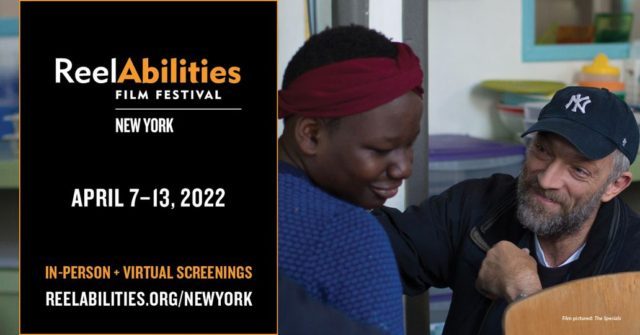
Who:ReelAbilities Film Festival: New York What: Annual festival of films celebrating stories of people with disabilities Where:Marlene Meyerson JCC Manhattan and other venues as well as online When: April 7-13, free – $15 Why: Since 2007, the ReelAbilities Film Festival has been showcasing shorts, features, and animated works from around the world to continue its mission “dedicated to promoting awareness and appreciation of the lives, stories, and artistic expressions of people with disabilities.” The fourteenth annual event takes place at the host venue, the Marlene Meyerson JCC Manhattan, as well as Lincoln Center, the IAC Building, the Museum of the Moving Image, the Maysles Documentary Center, the Intrepid Sea, Air & Space Museum, and online. The opening-night selection is Olivier Nakache and Éric Toledano’s The Specials, about caregivers of autistic youths in underprivileged areas, starring Vincent Cassel, Reda Kateb, and Hélène Vincent; Victor Calise, former commissioner of the New York City Mayor’s Office for People with Disabilities, will be the guest honoree. The closing-night film is Brian Malone and Regan Linton’s imperfect, about a theater group staging Chicago; the screening will be followed by a Q&A with the directors moderated by actor Gregg Mozgala and the presentation of the ReelAbilities Spotlight Award to deaf actress Lauren Ridloff.
Among the other full-length films are Marc Schiller’s deeply personal No Bone: Scars of Survival, Jim Bernfield’s Me to Play, Margaret Byrne’s Any Given Day, Lynn Montgomery’s Amazing Grace, Teemu Nikki’s The Blind Man Who Did Not Want to See Titanic, Linda Niccol’s Poppy, and Jack Youngelson’s Here. Is. Better.; the films deal with such issues as stroke, Parkinson’s disease, mental illness, Acute Flaccid Myelitis, multiple sclerosis, Down syndrome, deafness, ADHD, and PTSD. In addition, there will be workshops on film puppetry and storytelling, an accessibility summit, a solo musical by Anita Hollander, a conversation with Deaf Utopia author Nyle DiMarco, the panel discussion “Just Do It?: The Impact of Perfectionism & Productivity on Mental Health and Disability,” and such shorts programs as “Out of the Box,” “Relationships,” and “Autism.” Many of the screenings will be followed by a Q&A with the filmmakers, actors, documentary subjects, and health experts.
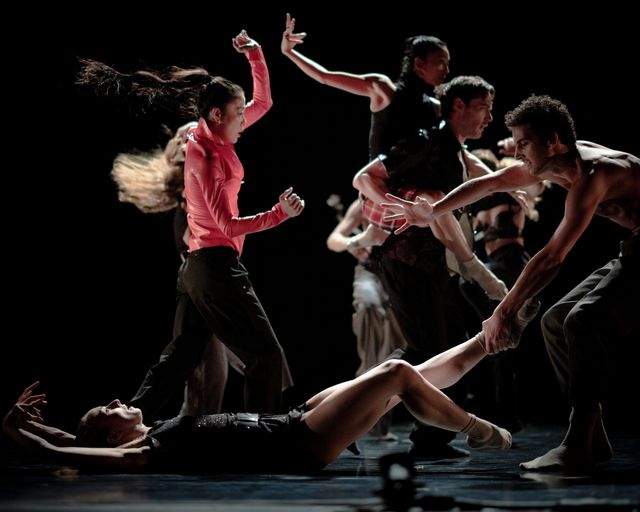
Martha Graham Dance Company will present world premiere of Hofesh Shechter’s CAVE at inaugural City Center Dance Festival (photo by Brian Pollock)
Who:Martha Graham Dance Company What:City Center Dance Festival Where:New York City Center, 131 West Fifty-Fifth St. between Sixth & Seventh Aves. When: April 6-10, $35-$125 Why: Celebrating the long-awaited return to the stage in front of in-person audiences following two years of lockdown, the inaugural City Center Dance Festival kicked off March 24 with Paul Taylor Dance Company followed by Ballet Hispánico, with Dance Theatre of Harlem coming in April 5-10. DTH will be performing concurrently with Martha Graham Dance Company, which is presenting three programs April 6-10. “It’s staggering to think that we are premiering nine new creations by nine exciting and diverse choreographers at New York City Center in April,” Graham Company artistic director Janet Eilber said in a statement. “Creating new work has never been more challenging than in the past many months, which makes the accomplishments of the choreographers, our dancers, and the entire creative team even more resonant. Each of these dances provides a visceral, ecstatic, and even cathartic response to the restrictions the world has endured.”
Program A (April 6 and 9) consists of the 1936 anti-Fascist classic Chronicle, choreographed by Graham, originally about Hitler’s Germany but now relating to Putin’s Russia, with music by Wallingford Riegger (performed live by the Mannes Orchestra); the New York premiere of the reconceived version of 1952’s Canticle for Innocent Comedians for its seventieth anniversary, with a new score by Jason Moran (who will play live on opening night) and choreography by Sonya Tayeh, Kristina and Sadé Alleyne, Sir Robert Cohan, Jenn Freeman, Juliano Nunes, Micaela Taylor, Yin Yue, and Graham, for the vignettes “Sun,” “Moon,” “Earth,” “Water,” “Fire,” “Stars,” “Wind,” and “Death”; and the world premiere of Hofesh Shechter’s CAVE, with music by Shechter and Âme.
Program B (April 10) begins with Graham’s 1944 masterwork Appalachian Spring, featuring a marvelous score by Aaron Copland for a thirteen-piece chamber orchestra and set design by Isamu Noguchi, and concludes with Canticle for Innocent Comedians. On April 7, MGDC’s gala is highlighted by Ritual to the Sun, the final section of Graham’s 1981 Acts of Light, set to music by nineteenth-century Danish composer Carl Nielsen, in addition to CAVE and excerpts from the new Canticle. The works will be performed by MGDC members So Young An, Alessio Crognale, Laurel Dalley Smith, Natasha M. Diamond Walker, Lloyd Knight, Jacob Larsen, Devin Loh, Lloyd Mayor, Marzia Memoli, Anne O’Donnell, Lorenzo Pagano, Kate Reyes, Anne Souder, Richard Villaverde, Leslie Andrea Williams, and Xin Ying.
Award-winning production of Cyrano de Bergerac swashbuckles into BAM April 5 to May 22 (photo by Marc Brenner)
Who:Jamie Lloyd Company What: US premiere of award-winning production of Edmond Rostand play Where:Harvey Theater at the BAM Strong, 651 Fulton St. When: April 5 – May 22, $45-$310 Why: It’s not always clear why an old classic suddenly becomes sizzling hot; this time around, it’s Edmond Rostand’s 1897 favorite, Cyrano de Bergerac, about a relatively unattractive soldier in love with a beautiful woman who falls for a not-too-bright handsome gent who gets his poetic, romantic words from Cyrano. In 2012, the Roundabout staged a version at the American Airlines Theatre on Broadway directed by Jamie Lloyd and starring Douglas Hodge as the title character. In Theresa Rebeck’s 2018 Bernhardt/Hamlet, at the same theater, Rostand is a minor character who is rewriting Hamlet for Sarah Bernhardt but turns his attentions instead to Cyrano. Franco-British actor, writer, and director Alexis Michalik made Cyrano, My Love, in 2018, following his stage version of Edmond in 2016. In 2019, the New Group presented a musical version at the Daryl Roth Theatre starring Peter Dinklage as Cyrano, adapted and directed by his wife, Erica Schmidt, that was turned into a 2021 film directed by Joe Wright. Also in 2021, Andrey Cheggi Chegodaev performed My Cyrano, a melding of Cyrano de Bergerac and Tanya Lebedinskaya’s poem “My Cyrano,” at the Center at West Park.
Now the Dorset-born Lloyd, whose other acclaimed works include Betrayal,Macbeth,Three Days of Rain,Passion, and Evita, comes to BAM for the first time for the US premiere of his Olivier-winning production of Cyrano de Bergerac. This new adaptation by Martin Crimp stars Scottish actor James McAvoy (The Ruling Class,The Last King of Scotland) in the role previously performed by Ralph Richardson, Derek Jacobi, Richard Chamberlain, Christopher Plummer, Gérard Depardieu, Steve Martin, and Kevin Kline, among others over the last century-plus. Eben Figueiredo is Christian, with Michele Austin as Ragueneau, Adam Best as Le Bret, Sam Black as Armand, Tom Edden as De Guiche, Adrian Der Gregorian as Montfleury, and Evelyn Miller as Roxane. The set and costumes are by Soutra Gilmour, with lighting by Jon Clark and music and sound by Ben and Max Ringham. The 170-minute show, which won the Olivier Award for Best Revival (in addition to four other nominations), runs April 5 through May 22.
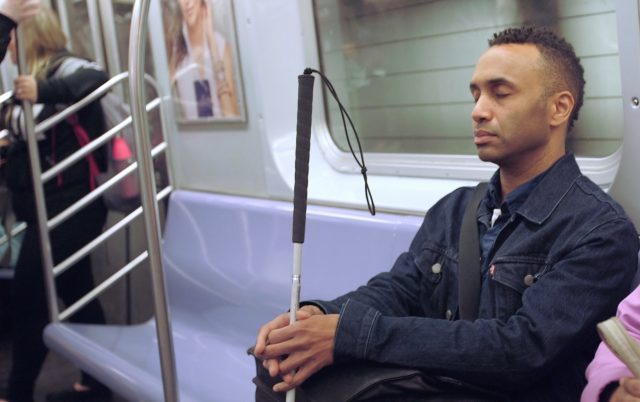
Dancer Kayla Hamilton is not about to let visual impairment get in the way of her career in Vision Portraits (photo by Kjerstin Rossi)
Who:Moving Body — Moving Image What:ScreenDance Film Festival Where: Barnard College Department of Dance Movement Lab, Glicker Milstein Theatre in the Diana Center, 3009 Broadway at 116th St., and online When: Sunday, April 3, free with advance RSVP, noon – 6:00 pm (festival continues through April 11) Why: The Moving Body — Moving Image Biennale Festival was founded in 2018 by choreographer, dancer, teacher, filmmaker, and curator Gabri Christa to “give voice to social and social justice themes,” two years before dance films began reaching new heights of creativity during the pandemic lockdown, with a concerted focus also on social justice. The third iteration, “The Moving Body with Disabilities,” is underway now at Barnard College, with an international collection of six installation films, eight shorts, one feature, and three online-only works. On Sunday, April 3, Barnard’s Glicker Milstein Theatre will host a full in-person afternoon at its Morningside Heights home, with screenings of all films in addition to a panel discussion. “We are stunned by how much demand there was for the festival films among the global audiences,” Christa, whose now-wheelchair-bound mother was a special ed teacher, said in a statement. “Also, I hope that the pandemic isolation brought greater awareness around social inequity and perhaps more understanding of racism, ageism, and ableism.” The themes of the previous festivals were “Moving Brown Body” in 2018 and “Aging & Othering” in 2020.
The festival begins at noon with welcome remarks, followed by two shorts programs, at 12:30 and 2:00. Part I consists of Robert Dekkers’s Flutter (with AXIS Dance Company and others), Stephen Featherstone’s Stopgap in Stop Motion (with Stopgap Dance Company), Katrina MacPherson’s Uath Lochans (with Marc Brew), and Karina Epperlein’s Phoenix Dance (with Homer Avila, Andrea Flores, and choreographer Alonzo King). The second program comprises Ralph Klisiewicz’s Moods in Three Movements (with Kris Lenzo), Pioneer Winter’s Gimp Gait (with Marjorie Burnett and Pioneer Winter), Alison Ferrao’s From Me (with the Dancer Development Course at Magpie Dance), and Katherine Helen Fisher’s One + One Makes Three (with Jerron Herman, Laurel Lawson, Brandon Kazen-Maddox, Catherine Nelson, and choreographer Alice Sheppard). The feature presentation at 3:00 is Rodney Evans’s 2019 documentary, Vision Portraits, about three artists with vision impairment, made by the blind Evans. Admission is free with advance registration. If you can’t make it to Barnard, all of the films and events will be available online through April 11, including Anna-Lena Ponath’s Eudaimonia, Yannis Bletas’s How to Train an Antihero, and Alexandros Chantzis’s Who Is Honorine Platzer?
Filmmaker Rodney Evans explores his increasing blindness in Vision Portraits (photo by Kjerstin Rossi)
VISION PORTRAITS (Rodney Evans, 2019)
Barnard College, Glicker Milstein Theatre in the Diana Center, 3009 Broadway at 116th St.
Sunday, April 3, free with advance RSVP, 3:00 www.thefilmcollaborative.org
“In a lot of ways, I feel like I’m just looking for guidance in how to be a blind artist,” filmmaker Rodney Evans says in Vision Portraits, his remarkable documentary. Evans follows three artists as they deal with severe visual impairment but refuse to give up on their dreams as he seeks experimental treatment for his retinitis pigmentosa. Manhattan photographer John Dugdale lost most of his eyesight from CMV retinitis when he was thirty-two but is using his supposed disability to his advantage, taking stunning photos bathed in blue, inspired by the aurora borealis he sees when he closes his eyes. “Proving to myself that I could still function in a way that was not expected of a blind person was really gonna be the thing,” he says. “It’s fun to live in this bliss.” Bronx dancer Kayla Hamilton was born with no vision in one eye and developed iritis and glaucoma in the other, but she is shown working on a new piece called Nearly Sighted that incorporates the audience into her story. “How can I use my art form as a way of sharing what it is that I’m experiencing?” she asks.
Canadian writer Ryan Knighton lost his eyesight on his eighteenth birthday due to retinitis pigmentosa, but he teaches at a college and presents short stories about his condition at literary gatherings. “I had that moment where I had a point of view now, like, I realized blindness is a point of view on the world; it’s not something I should avoid, it’s something I should look from, and I should make it my writerly point of view,” Knighton explains. Meanwhile, Evans heads to the Restore Vision Clinic in Berlin to see if Dr. Anton Fedorov can stop or reverse his visual impairment, which is getting worse.
Vision Portraits is an intimate, honest look at eyesight and art and how people adapt to what could have been devastating situations. Evans, who wrote and directed the narrative features Brother to Brother and The Happy Sad, also includes animated segments that attempt to replicate what the subjects see, from slivers of light to star-laden alternate universes. The Moving Body — Moving Image screening at Barnard will be followed by a discussion with Evans and Hamilton.
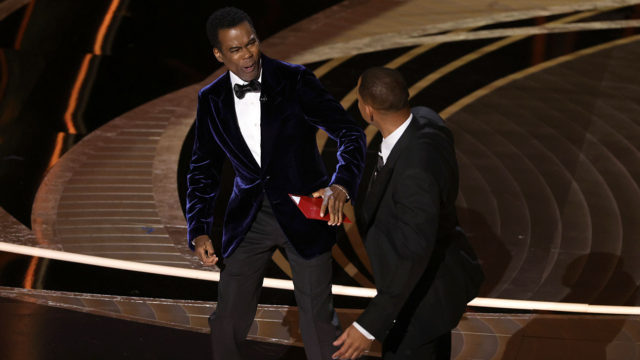
Chris Rock and Will Smith will face off against each other at Madison Square Garden on October 1 (photo by Neilson Barnard/Getty Images)
THE REMATCH
Madison Square Garden
31st – 33rd Sts. between Seventh & Eighth Aves.
Saturday, October 1, $99-$999 www.SmithVsRockThe Rematch.com
I wasn’t planning on writing anything about the Will Smith / Chris Rock debacle at this year’s Oscars, but this is just too good to pass up, especially for those who thought that the whole Slap Heard Round the World was staged. In another confrontation that no one saw coming, Smith, who won the Best Actor Oscar for his portrayal of the father of Venus and Serena Williams in King Richard, and Rock, a former Oscar host who wrote, directed, and starred in Top Five, are actually stepping into the ring in a rematch taking place October 1 at Madison Square Garden. (Rock is currently on his Ego Death national tour that brings him to Radio City Music Hall October 6-7.) They won’t be donning gloves and fighting at the bell, but they will be entering the famous squared circle and going at it Eminem style, attacking each other with raps, spoken word, and jokes.
Judging ringside will be Dwayne “the Rock” Johnson, Michael “Are You Ready to Rumble!” Buffer, and Robin Givens, who was married to former heavyweight champ Mike Tyson for one tumultuous year. The exact details, including the specific rules, have not been announced, but there are rumors that the national anthem will be performed by Whoopi Goldberg. Tickets go on sale today (April 1) at noon; there are VIP packages for $999 in which guests can get a photo with Rock, who was born in South Carolina in 1965, and Smith, who was born in Philly in 1968, surrounded by Smith’s Oscar and Grammy and Rock’s three Grammys and four Emmys.