live performance

SANDBLASTED

Odessa (Marinda Anderson) and Angela (Brittany Bellizeare) try to keep things together in sandblasted (photo by Carol Rosegg)

SANDBLASTED
Vineyard Theatre
Gertrude and Irving Dimson Theatre
108 East 15th St. between Union Square East & Irving Pl.
Tuesday – Sunday through March 13, $26.25-$103.95
www.vineyardtheatre.org

Charly Evon Simpson’s engaging, if undercooked, sandblasted is no mere day at the beach or breath of fresh air in a freezing cold winter, with Covid still upon us and masks necessary at the theater. The hundred-minute play, which opens today at the Vineyard, takes place on a stage filled with more than seventeen tons of sand, alternately representing the beach or the desert; there are doors in the back and stage right, a window stage left, and a ceiling of fluffy white clouds and blue sky. Matt Saunders’s set offers the characters warm and sunny relaxation, where they can sit in a chair and have a cold drink, as well as a space for unsteady traction, an arid, treacherous landscape. In both locales, Black women struggle to keep themselves together, literally and figuratively.

Thirtysomethings Angela (Brittany Bellizeare), a bundle of fear and anxiety, and the much cooler and hipper Odessa (Marinda Anderson) meet at the beach; brushing off sand, Odessa sees her left arm fall off. She is more disappointed than horrified; it turns out that women, particularly as they age, start losing pieces of their body. They are soon joined by the older and wiser Adah (Rolonda Watts), who offers perspective.

“I thought it would take a while longer for the larger parts of us to . . . to fall,” Angela says almost matter-of-factly. “Longer?” Adah asks. Angela replies, “Yeah, a lot of breaths, months of stewing, soaking, simmering, months of incubation. I thought it would take a large number of sleepless nights for a part so large to . . .” Adah says, “Just like you to trust in something like time and sense.” Angela concludes, “I just trust that time will get us, that time will outlive us.”

Rolonda Watts excels as a celebrity wellness guru in Vineyard/WP world premiere (photo by Carol Rosegg)

Adah is a famous celebrity wellness guru who may or may not have Black lady magic, supplying answers to many of the questions Black women have. When Angela mentions how inconvenient so much of their lives are, Adah explains, “But isn’t it always inconvenient? Isn’t it always the wrong place, wrong time?”

Angela and Odessa, a sort of Alpha and Omega themselves, believe it will take more than sun, tape, glue, spinach, and exercise to hold them together. Thinking that it might be easier to just hide her head in the sand, Angela says, “Sometimes I want to walk around in like one of those bubbles, just be a bubble walker.” Odessa responds, “No life that way, just a bubble life. What’s the point in living?” The allusion to Covid-19, which inequitably affects communities of color, is not lost on the audience. (And there are a few more to come.)

Angela’s hunk of a brother, Jamal (Andy Lucien), accompanies her to an Adah seminar entitled “Girls, stop falling apart!” but Adah doesn’t show up. Angela and Odessa decide to find her, hoping she can provide a cure; they set off on a journey seeking hope, understanding, and resolution, but it’s not going to be easy.

A coproduction with WP Theater, sandblasted evokes Samuel Beckett’s Happy Days and Waiting for Godot and Edward Albee’s Seascape and The Sandbox as well as Chiori Miyagawa’s America Dreaming, the 1994-95 Vineyard play that also took place on sand and dealt with otherness. Simpson’s (Behind the Sheet, Jump) writing is often poetic and works best when the story has a more existential, nonspecific nature, making references to skin color, grief, isolation, and systemic misogyny instead of putting them front and center.

Angela (Brittany Bellizeare) and her brother, Jamal (Andy Lucien), attend a seminar in sandblasted (photo by Carol Rosegg)

There are many beautiful, penetrating lines: “I think getting older isn’t about losing the fears you had as a kid. I think it is about having new fears that overtake them,” Angela theorizes. “Some say they don’t want to learn any new names, meet any new people, because then it is just another person to miss, to worry about, to grieve,” Odessa asserts. “I don’t know which of the many possible fights we’re in the middle of. Is the fight we should be fighting to heal? And no one else seems to know either,” Angela explains. And Odessa admits, “Some nights I think I’m the epitome of Black girl magic, and other nights I think I’m just another version of a magical negro and I wonder what it would be like to just live between the two.”

Anderson and Bellizeare make a classic comic duo, albeit with a very serious edge, as the fun and fancy-free Odessa and the tightly wound Angela, respectively, two women who might not have become friends at another time or another place. Watts, the longtime New York City television journalist and talk show host, is extraordinary as Adah, displaying an infectious confidence that glitters at every turn; she adds sparkle every time she’s onstage. Lucien does what he can as Jamal, a character who quickly becomes superfluous; I’m not sure he was necessary at all, save for providing a forced link between Angela and Odessa.

In her NYC debut, director Summer L. Williams can’t quite steady herself in the sand. The jumps back and forth in time are confusing, and several subplots never come full circle, falling away like body parts that are never reattached. In addition, Simpson can’t quite figure out how to end the show, which feels about ten or fifteen minutes too long; several of the last scenes feel extraneous, as they turn from the existential aspects of the story to provide more specific pathways for the future.

At one point, Angela talks about fulgurites, fragile tubes of glass that are formed when lightning strikes sand; some believe they have magical qualities. “I spent all this time being careful, treated myself like a fucking fulgurite for god’s sake,” Angela says. “So I’d live long, so I’d succeed, so I’d . . . and now this.” The resolution of the fulgurite thread in the play is too firm, too solid; some things are better left unsaid, onstage and on sand.

ENGLISH

Sanaz Toossi’s English takes place in a TOEFL class in Iran (photo by Ahron R. Foster)

ENGLISH
Atlantic Theater Company
Linda Gross Theater
336 West 20th St. between Eighth & Ninth Aves.
Tuesday – Sunday through March 20, $76.50
866-811-4111
atlantictheater.org

Concepts of home and personal identity lie at the heart of Sanaz Toossi’s poignant and involving English, which opens tonight at the Atlantic’s Linda Gross Theater. A coproduction with Roundabout Underground, the play is set in a small classroom in Karaj, Iran, in 2008, where Marjan (Marjan Neshat) is teaching basic English to four students who are planning on taking the TOEFL, the Test of English as a Foreign Language, for very different reasons. Marjan insists that they speak only English in the class rather than Farsi, their native tongue.

Roya (Pooya Mohseni) wants to be able to speak with her new granddaughter, who lives in Canada with Roya’s son and his wife and is not being raised to speak Farsi. “I hope you not forget. Nate is not your name,” she tells her son, who used to be known as Nader.

Elham (Tala Ashe) has passed her MCATs but needs to learn English so she can study gastroenterology in Australia. “My accent is a war crime,” she angrily admits.

Omid (Hadi Tabbal) has an upcoming green card interview in Dubai, but his English is already excellent, nearly accentless. When asked why people learn language, he says, “To bring the inside to the outside.”

Goli (Ava Lalezarzadeh) is an eighteen-year-old girl who wants to speak like Shakira. “People like accent,” she says, not ashamed of who she is.

After a presentation by Goli doesn’t go particularly well, Marjan, a married woman who spent nine years in Manchester before moving back to Iran with her family, says, “Don’t be sorry! We were speaking English with each other. I think it’s one of the greatest things two people can do together.”

Four students and a teacher learn about life and language in English (photo by Ahron R. Foster)

They play word games, do show-and-tell, and discuss English vs. Farsi. “I want to speak English. Before I speak Farsi good, I know I want to speak English,” Goli says. “English does not want to be poetry like Farsi. It is like some rice. English is the rice. You take some rice and you make the rice whatever you want.”

Roya resents having to learn English and is furious that her son has turned away from his culture, projecting that rage onto her teacher. “You talk about Farsi like it’s a stench after a long day’s work. Tell me, Marjan, what is it about where we’re from that you find so repulsive?” she argues.

As Elham’s frustration with English builds — she repeatedly uses Farsi in class, accumulating negative points — she gets into disagreements with everyone else, speaking frankly, without apology. “Goli, people hear your accent and they go oh my god it is so funny you are so stupid. . . . Okay if I have accent, bad TOEFL score. Omid has accent, no green card. Roya’s accent? Disaster.” Some of them equate the attempted erasure of their Iranian accent when speaking English with the loss of who they are, as if they are surrendering their unique culture. “Don’t you think people can do us the courtesy of learning our names?” Elham says to Marjan, who went by “Mary” when she lived in England.

“English isn’t your enemy,” Marjan insists. “English is not to be conquered. Embrace it. You can be all the things you are in Farsi in English, too. I always liked myself better in English.” But Marjan won’t acknowledge to herself that that is exactly the problem. “I feel like I’m disappearing,” she says later to Omid.

Goli (Ava Lalezarzadeh), Elham (Tala Ashe), and Roya (Pooya Mohseni) think about their futures in Atlantic world premiere (photo by Ahron R. Foster)

English is beautifully written by Toossi and gracefully directed by Knud Adams (Paris, The Headlands), giving each character room to develop. Although they go back and forth between English and Farsi, the latter is never heard; whenever they speak English, the actors use Iranian accents, but when they talk in Farsi, they lose the accent, sounding like plain old longtime Americans, a device that serves as a metaphor for colonialism, nation-building, and ethnocentrism. It’s no coincidence that the song Goli plays for show-and-tell is Shakira’s “Whenever, Wherever,” in which the Colombian-born singer and dancer proclaims, “Lucky you were born that far away so we could both make fun of distance / Lucky that I love a foreign land for the lucky fact of your existence.”

Marsha Ginsberg’s revolving cube set is open on two sides, evoking the inside and the outside. Enver Chakartash’s costumes meld traditional Iranian clothing, like head scarves, with American accents. The cast is exceptional, quickly forming a cohesive unit; it probably wouldn’t be too much of a stretch to assume they have each had to deal with the issue of making sacrifices to learn a new language and culture in some way, as all of them, in addition to the bilingual Toossi, were either born in Iran or Lebanon or their parents were. English was actually Toossi’s NYU thesis, written in response to Donald Trump’s Muslim travel ban and anti-immigration policies.

About halfway through the play, Marjan tells the class, “If you are here to learn English, I am going to ask you to agree that here in this room we are not Iranian. We are not even on this continent. Today I will ask you to feel any pull you have to your Iranian-ness and let it go. Keep it outside the wall of this classroom. In this room, we are native speakers. We think in English. We laugh in English. Our inhales, our exhales — we fill our lungs in English. No more Farsi. Can we agree to that? Yes? Thank you.” Toossi understands the kind of sacrifices it takes to make a new life in a new country while also realizing that the play’s audience is likely to be predominantly white non-Farsi speakers.

English continues at the Atlantic through March 20; Toossi’s Wish You Were Here, about a group of women (including one played by Neshat) facing tough choices as the 1978 revolution approaches, begins previews April 13 at Playwrights Horizons.

THE DAUGHTER-IN-LAW

The strained marriage between Minnie Hetherington (Amy Blackman) and Luther Gascoyne (Tom Coiner) is at center of D. H. Lawrence tale (photo by Maria Baranova)

THE DAUGHTER-IN-LAW
New York City Center Stage II
131 West 55th St. between Sixth & Seventh Aves.
Tuesday – Sunday through March 20, $35 – $80
minttheater.org
www.nycitycenter.org

D. H. Lawrence was best known for such novels as Sons and Lovers, Women in Love, and Lady Chatterley’s Lover, but he was also a poet, a painter, and a playwright. The Mint, which specializes in resurrecting long-forgotten, seldom-performed works, returns to the postlockdown stage with a revival of its 2003 adaptation of Lawrence’s 1913 drama, The Daughter-in-Law, which opened tonight at New York City Center Stage II, where it runs through March 20.

The two-act, two-and-a-half-hour show is part of the Nottingham-born Lawrence’s Eastwood Trilogy, which also includes 1909’s A Collier’s Friday Night and 1911’s The Widowing of Mrs. Holroyd. Collier’s and The Daughter-in-Law were not performed in his lifetime; Lawrence died in France in 1930 at the age of forty-four.

Most of the play is a gossipy delight. It takes place during the Great Unrest, as a strike threatens to close down a coal mine in Eastwood (Lawrence’s hometown in Nottingham). Joe Gascoyne (Ciaran Bowling) has broken his arm at the mine fooling around — there’ll be no disability pay for him. He lives with his mother, the domineering Mrs. Gascoyne (Sandra Shipley), who is no fan of marriage, instead preferring to have her boys around her. “Marriage is like a mouse trap, for either man or woman — you’ve soon come ter th’ end o’ th’ cheese,” she tells Joe, who responds, “Well, ha’ef a loaf’s better’nor no bread.” To which his mother advises, “Why, wheer’s th’ loaf as tha’d like ter gnawg a’ thy life.”

Mrs. Gascoyne (Sandra Shipley) and Mrs. Purdy (Polly McKie) have some unpleasantries to discuss in The Daughter-in-Law (photo by Maria Baranova)

Prim and proper Mrs. Purdy (Polly McKie) stops by the Gascoynes, where she beats around the bush before announcing that Mrs. Gascoyne’s oldest son, Luther (Tom Coiner), has impregnated her daughter, Bertha. An engaging conversation ensues, with the upshot being that Mrs. Purdy will get a payoff to save everyone’s reputation and preserve Luther’s weeks-old marriage to Minnie Hetherington (Amy Blackman). Minnie has what is considered a small fortune, acquired from a deceased uncle, and the Gascoynes believe she will have no choice but to cough up the cash for them.

The brutish Luther, covered in dirt and grime from the mine, comes home to Minnie, who likes pretty things and wants everything in its place, from the table and chairs to the silverware and fancy dishes. She has settled for Luther because no one else asked for her hand; she tells her husband, “You’ll be a dayman at seven shillings a day till the end of your life — and you’ll be satisfied, so long as you can shilly-shally through. That’s what your mother did for you — mardin’ you up till you were all mard-soft.” Luther replies, “Tha’s got a lot ter say a’ of a suddin. Thee shut thy mouth.” Minnie: “You’ve been dragged round at your mother’s apron-strings, all the lot of you, till there isn’t half a man among you.” Luther: “Tha seems fond enough of our Joe.” Minnie: “He is th’ best in the bunch.” Luther: “Tha should ha’ married him then.” Clearly, their union is not all sunshine and roses.

Over the course of two weeks, the Gascoynes bicker among themselves as they assume that Minnie will just pay the money and all will be well, with Joe, Luther, and their mother refusing to take responsibility for any of their actions while Minnie recalculates her future. It all leads to a ridiculously overblown, unbelievable, sentimental finale that turns the tables on just about everything that led up to it.

Joe (Ciaran Bowling) explains his situation to this mother (Sandra Shipley) in Mint revival of Lawrence play (photo by Maria Baranova)

Directed again by Martin Platt (The Power of Darkness, A Bold Stroke for a Wife), the production is pristine, a staple of the Mint. Bill Clarke’s set changes neatly from Mrs. Gascoyne’s rickety kitchen and dining room to Minnie’s far more presentable home. Holly Poe Durbin’s period costumes set the mood, along with Jeff Nellis’s soft lighting and Lindsay Jones’s sharp sound design. The play, performed with one intermission, is told primarily in the Ilson dialect, featuring such words as “blackleg,” “butty,” “clunch,” “wringer,” “mard,” “morm,” and “wallit”; it’s worth checking out the glossary in the program in advance.

The Daughter-in-Law often crackles, with a fine cast led by Blackman portraying a kind of early working-class feminist. The story is not complicated, nor is it clichéd; Lawrence told his editor, “It is neither a comedy nor a tragedy — just ordinary.” While the play is not autobiographical, Lawrence’s father was a miner, and his mother died of cancer in 1910; in 1912, he eloped with a married woman who had three children. Thus, the relationships of a son with his mother and lover are an interesting side note while not being definitive. And then comes the ending, which will have you feeling icky as you leave the theater, covered in dirt and grime that you won’t be able to easily wash off.

THE SAME

Walsh sisters Eileen (foreground) and Catherine (background) team up for first time in The Same (photo by Nir Arieli)

THE SAME
Irish Arts Center
726 Eleventh Ave. between Fifty-First & Fifty-Second Sts.
Wednesday – Sunday through March 6, $25-$65
irishartscenter.org

Prior to The Same, the closest award-winning Irish actresses and sisters Catherine and Eileen Walsh had come to working together was in Eugene O’Brien’s Eden; Catherine starred as Breda Farrell in the 2001 play, while Eileen, who is eight years younger, took over the role in the 2008 film. They cannot get much closer than they are in The Same, which opened yesterday at the Irish Arts Center’s lovely new 21,700-square-foot home in Hell’s Kitchen.

The two-character play was written specifically for the siblings by Tony winner Enda Walsh (Ballyturk, The Walworth Farce,) who is not related to them. The show, from the Cork-based site-specific specialist Corcadorca company, premiered in 2017 at the decommissioned Old Cork Prison, then later was staged at Galway Airport; both are fitting locations for the fifty-minute work, an intense psychological drama that explores complex issues of time and place, confinement and freedom, focusing on conceptions of past and present particularly as it relates to loss.

The New York City premiere, which runs through March 6, is set in an intimate space filled with randomly arranged cushioned chairs on a plush rug centered by a rectangular carpet. It’s general admission seating, so you can choose a spot right up front or in one of the rows behind. Around the room are two television monitors, a bingo machine, a bookcase with a boombox, and tables with a fishbowl, plants, magazines, games, and puzzles. Overhead is a light grid of 105 squares, some empty, hanging extremely low, as if closing in on the protagonists. (The immersive scenic design is by Owen Boss, with lighting by Michael Hurley and sound and music by Peter Power.)

All audience members must wear masks, but two women’s faces are not covered as you enter the room; even if you are unfamiliar with Catherine and Eileen Walsh, you instantly realize them as the performers. In character already, they fidget uncomfortably in their seats, looking unhappy and distressed while avoiding eye contact with anyone.

Lisa (Eileen Walsh) tries to figure out just where she is in Enda Walsh play (photo by Nir Arieli)

We soon learn that we are in some kind of medical facility or halfway house where Lisa (Eileen Walsh) is recovering from trauma that led to mental instability. In her opening monologue, she speaks of feeling alarm and apprehension as she arrived in a new city. “The dread was real — was felt real,” she says. “Right at the back of my throat and it slid further and grabbed my heart — and further still it slid and sat in my stomach like a bomb.”

The two women talk about personal choice, destiny, rain, and marzipan, mention such other characters as Claire, Gavin, Howard, and Avril, and serve food at a funeral. As time goes on, they begin to share memories, which include a childhood birthday party and the death of a mother. They engage in lyrical conversations that are as existential as they are poetic.

Lisa: Don’t you think we look the same?
Other Woman: No.
Lisa: Not the exact same — just the…
Other Woman: What?
Lisa: There’s similarities, I said.
Other Woman: No there isn’t.
Lisa: In the eyes — and the head too — and maybe the chin and the nose.
Other Woman: Talking fast.
Lisa: Facially we’re very similar me and you. But not the exact same — but similar only, don’t you see that at all?
Other Woman: No not at all.
Lisa: Or maybe just…
Other Woman: What, I said.
Lisa: Something else — something invisible — don’t you see that?
Other Woman: Don’t I see something invisible?
Lisa: “See” meaning sense, I mean. Don’t you sense a similarity between us?
Other Woman: She said.
Lisa: I felt it immediately when I was in that dead woman’s kitchen — didn’t you feel it too — it started just when I said my mother just died?
Other Woman: Maybe you need to eat something, I said, wanting it to stop.

Walsh sisters Catherine (foreground) and Eileen (background) sizzle in The Same at the new Irish Arts Center (photo by Nir Arieli)

In between scenes, bingo balls fly out of the machine, the radio blasts music, or the television turns on Judge Judy and game shows, which feature winners and losers. The sound of water emanates from various speakers as Lisa tries to keep her psyche from drowning. It might all feel random but it’s not necessarily, evoking the kinds of thoughts and memories that can cloud anyone’s mind. “Where is the start and end of me?” Lisa wonders. It’s a question all of us have asked ourselves.

Original director Pat Kiernan, who helmed Enda Walsh’s 1996 debut, Disco Pigs, starring Eileen Walsh, in addition to his later Misterman and The Ginger Ale Boy, keeps the audience guessing as the characters examine themselves. Nothing comes easy in the intricate plot, which takes so many subtle twists and turns you won’t be able to catch them all. The sisters sizzle together, Eileen (The Merchant of Venice, Phaedra’s Love, both also directed by Kiernan) practically collapsing into her body, Catherine (Sharon’s Grave, Enda Walsh’s The New Electric Ballroom) much more physically open. It all fits into a tight, emotional fifty minutes that feels like a bomb about to go off in your stomach, a play that benefits from being performed by a pair of extraordinary actresses who know each other so well.

THE FRIGID FESTIVAL

Eleanor Conway’s Vaxxed & Waxxed is part of 2022 FRIGID Festival

FRIGID Festival
The Kraine Theater
85 East Fourth Street between Second Ave. & Bowery
UNDER St. Marks
94 St. Marks Place between First Ave. & Ave. A
February 16 – March 6, $10-$20
www.frigid.nyc

Baby, it was cold outside, but it looks like winter will be warming up just as the sixteenth annual FRIGID Festival comes to town, taking place February 16 through March 6 at the Kraine Theater and UNDER St. Marks in the East Village as well as online. This year’s hybrid presentation from FRIGID New York features nearly two dozen shows, running the gamut from comedy, improv, performance art, and stand-up to storytelling, music, drama, and clowning. Among the mostly solo shows are Mark Levy’s Blockbuster Guy, about when Levy was a nerd working for Blockbuster in Florida; Jude Treder-Wolff’s Human Flailings, about psychotherapist and storyteller Treder-Wolff’s reaction to unexpected betrayal; Brian Schiller’s autobiographical Three Funerals and a Chimp, dealing with family loss; Matt Storrs’s Portly Lutheran Know-It-All, which goes back to Storrs’s days at a religious middle school; Grant Bowen’s A Public Private Prayer, in which Bowen discusses his relationship with God; and Amanda Erin Miller’s Smile All the Time, which includes puppets in prison.

In addition, As You Will provides improvised Shakespeare, two brothers travel back to the American Southwest in 1680 in Dillon Chitto’s Pueblo Revolt (which asks the critical question “Can we keep the pigs?”), Melody Bates’s immersive A Play for Voices is set in the dark, Megan Quick portrays a dog actress performing cabaret in And Toto Too, and Howie Jones challenges the audience in That sh$t don’t work! Does it? Also on the bill are Jean Ann Le Bec’s The Last to Know, Mike Lemme’s Bathroom of a Bar on Bleecker, Ellie Brelis’s Driver’s Seat, Daniel Kinch’s The Story of Falling Don, Molly Brenner’s The Pleasure’s Mine, Will Clegg’s The Lonely Road, George Steeves’s Love & Sex on the Spectrum, Julia VanderVeen’s My Grandmother’s Eye Patch, Mikaela Duffy’s StarSweeper, Keith Alessi’s Tomatoes Tried to Kill Me But Banjos Saved My Life, and Theatre Group GUMBO’s Are You Lovin’ It? Eleanor Conway’s Vaxxed & Waxxed should be interesting since everyone has to show proof of vaccination to get in, meaning she might have to amend her usual question, “Do we have any anti-vaxxers in?”

LaGUARDIA HIGH SCHOOL: ALL SHOOK UP

Who: Students of Fiorello H. LaGuardia High School of Music & Art and Performing Arts
What: First-ever livestream of all-school production
Where: LaGuardia High School online
When: February 13, noon & 5:00, February 16-17, 7:00, free with RSVP
Why: Instead of watching Fame next week, Alan Parker’s 1980 fiction film about teens auditioning for coveted spaces at the High School of Performing Arts in New York City, you can watch the read deal when the institution, now known as the Fiorello H. LaGuardia High School of Music & Art and Performing Arts, performs its all-school musical, streaming it live for the first time ever. Because of the pandemic, the show was canceled in 2020 and 2021; the 2022 production will take place at the school, which is located on Amsterdam Ave. at Sixty-Fifth St., in front of a limited audience of students, faculty, cast, crew, and family members. Four of the six performances will also be available as a free livestream.

The students will be presenting All Shook Up, the rousing musical that premiered at the Palace Theatre on Broadway in 2005; it features the music of Elvis Presley, with book by Tony winner Joe DiPietro, who has also written the book and lyrics for such shows as Memphis, The Toxic Avenger, Diana, and I Love You, You’re Perfect, Now Change and the book for Nice Work If You Can Get It and They All Laughed. The show will be performed by fifty-one students from across all five boroughs, with eleven students in the pit orchestra and another ninety-one working tech in addition to choreography by three 2016 graduates, Dharon Jones, Adriel Flete, and Victoria Fiore. Everyone onstage and off- will be wearing masks. “It’s so exciting to see these kids have this opportunity to revisit their passion for onstage performance and to watch them recapture the love and talent that’s so much a part of them,” LaGuardia drama teacher and show director Lee Lobenhofer said in a statement.

All Shook Up is set in the summer of 1955 in, according to the script, “a small you-never-heard-of-it town somewhere in the Midwest.” In the Shakespearean plot, parents and children, the sheriff and the mayor, and the rest of the townspeople confront segregation and racism and battle over the Mamie Eisenhower Decency Act while mechanic Natalie swoons for leather-jacketed parolee Chad, Dean has the hots for Lorraine, and Sylvia runs the local honky-tonk, but everyone faces obstacles that threaten their freedom in different ways. The first act is heavy with Presley hits, from “Jailhouse Rock,” “Love Me Tender,” and “Heartbreak Hotel” to “Follow That Dream,” “It’s Now or Never,” and “Don’t Be Cruel,” while the second act does a deeper dive into the Elvis songbook.

There will be two casts; “Rock” features Aaron Syi as Chad, Elena Salzberg as Natalie, Isaac Braunfeld as Dennis, Mairéad O’Neill as Sandra, Nolan Shaffer as Dean, Camille Henri as Lorraine, Eason Rytter as Jim, Cipa Frost as Matilda, Nigel Swinson as Earl, and Avery Palmer as Sylvia, while “Roll” has Michael Sanchez as Chad, Kahlea Hsu as Natalie, Jaxon Ackerman as Dennis, Charlotte Compo as Sandra, Carter Van Vliet as Dean, Bailey Emhoff as Lorraine, Otto Grimwood as Jim, Ani Kabillio as Matilda, Conor Picard as Earl, and Savannah Alvira as Sylvia. The livestreams are scheduled for February 13 at noon and 5:00 and February 16-17 at 7:00, free with advance RSVP here. You can also donate to support the musical by participating in a raffle starting at twenty dollars; among the prizes you can win are tickets to the Metropolitan Opera, Aladdin, or Come from Away, gift certificates to Charlie Palmer Steak or Ellen’s Stardust Diner, a ten-minute call with Mets world champion Dwight Gooden, and other items.

TWI-NY TALK: RICHARD TOPOL — PRAYER FOR THE FRENCH REPUBLIC

Rich Topol plays nonreligious narrator Patrick Salomon in Manhattan Theatre Club world premiere (photo by Matthew Murphy)

PRAYER FOR THE FRENCH REPUBLIC
Manhattan Theatre Club
MTC at New York City Center – Stage I
131 West 55th St. between Sixth & Seventh Aves.
Tuesday – Sunday through March 27, $99
212-581-1212
www.manhattantheatreclub.com

About seven years ago, I was sitting in the audience at a play when I recognized the man in front of me, actor Richard Topol. I tapped him on the shoulder during intermission and told him that I had just seen him at the Signature in A. R. Gurney’s The Wayside Motor Inn and had enjoyed his performance. He thanked me, saying that he was actually the understudy and that was the only time he had gone on. He was even more thankful when I told him that I had included him in my review.

Since then we’ve bumped into each other a few other times at the theater and discussed various shows we’d seen. He’s an extremely amiable mensch who clearly loves his chosen profession. Even if you don’t recognize his name, you’re likely to know his face; he has approximately fifty television and film credits, including portraying lawyer and politician James Speed in Steven Spielberg’s Lincoln, a recurring role on The Practice, and multiple parts on several Law & Order iterations.

But his true love is theater, which he also teaches. He has appeared extensively on and off Broadway, in such plays as The Merchant of Venice with Al Pacino, Julius Caesar with Denzel Washington, Alice Birch’s Anatomy of a Suicide with Carla Gugino, and Paula Vogel’s Tony-nominated Indecent with Katrina Lenk as well as Tony-winning revivals of Clifford Odets’s Awake & Sing! and Larry Kramer’s The Normal Heart. He is currently starring in Joshua Harmon’s Prayer for the French Republic, a scintillating three-hour exploration of anti-Semitism that travels between 1944 and 2016; Topol plays Patrick Salomon, a nonreligious Jew who has decided not to go into the family piano business.

Topol was raised in Mamaroneck and lost his father when he was twelve. He is married to actress Eliza Foss; they have one daughter, and Richard was close with his father-in-law, the late German-American composer, pianist, and conductor Lukas Foss.

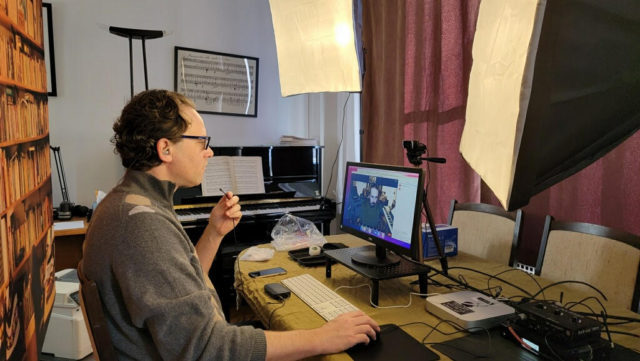
During our wide-ranging Zoom conversation, Topol is thoughtful and generous, laughing and smiling a lot. Behind him in his living room is a landscape by his mother-in-law, the painter and teacher Cornelia (Brendel) Foss.

He admits that the most nervous he’s been in his life was when he hung out with Paul McCartney following a performance of Larry David’s Fish in the Dark, in which Topol played Dr. Stiles; after that, the Cute Beatle went from being his third favorite mop top — behind John and George — to his second.

A few days after Prayer for the French Republic opened at Manhattan Theater Club’s Stage I at City Center, we talked about one-person shows, getting Covid, baseball, and what it’s like being an actor in lockdown, including a detailed description of mounting a play as a pandemic continues.

Rich Topol starred as stage manager Lemml in Indecent (photo by Carol Rosegg)

twi-ny: During the pandemic, you appeared in several virtual and audio productions: You were in Melisa Annis’s Beginnings, Anne Washburn’s Shipwreck, Craig Lucas’s More Beautiful — and you played a chicken in Jimonn Cole’s Chickens.

richard topol: Oh my God! That was so much fun.

twi-ny: That was crazy.

rt: I loved Michael Potts in that.

twi-ny: You guys were great. Did you enjoy working on Zoom?

rt: No, no, no. I mean, I enjoyed working as opposed to not working. Shipwreck was the closest we got to working on a play because we rehearsed for a couple of weeks and it felt like, Okay, I’m going to rehearsal today. We did the kind of work that you do in a play before you get up on your feet. [Director] Saheem Ali was great and it was a great cast, obviously in a really interesting play. And we spent enough time with it to dig in the way you do in a play.

I mean, I also shot some TV shows over the course of the pandemic, so all of the Zoom stuff felt more like the way an actor like me connects to short-term work. You don’t develop a through-line, you don’t understand the arc of things. You’re not invested in a team, the whole idea of a team creating a thing and living together and becoming a version of a theater family, or whatever it is. Shipwreck was the closest to that.

twi-ny: As a listener, I felt it Shipwreck was one of the audio plays that worked the best during the lockdown. I got the feeling that this was a group of actors working in tandem.

rt: Right. I think because they had intended originally to produce it live, they had invested in it as fully and fulsomely as you do for a whole theater piece. There had been a lot of preparation. There was a sense of having more in the heads of the director and the producers, what we could imagine this great thing being, that infused the development and the rehearsal and experience of doing it. The Public took a lot of care in making it.

twi-ny: You finally returned to the stage in November in Portland with Searching for Mr. Moon, which is about fathers and sons, particularly about how you lost your father when you were very young and eventually found a father figure in Lukas Foss. This is your first one-man show, which you wrote with Willy Holtzman, a two-time Pulitzer nominee. What was the experience like sharing your life, in person, in front of people, back onstage? It’s a short question, right?

rt: The short answer is it was great. It was so satisfying. I remember at the time talking with people and saying, Oh my God, this is the longest period of time between . . . I was doing Anatomy of a Suicide at the Atlantic Theater Company.

twi-ny: Which was excellent. Loved it.

rt: Thank you. Yeah, I love that play. Intense. So that was the very last performance you could do in New York. And we were shut down. And so from March 12 of 2020 to November 3, 2021, was the longest period of time I hadn’t been onstage in my adult life. And I’ve been an actor for over three decades.

So it was thrilling to be back in a theater on a stage with a live audience, even though they were masked. So on the one hand, it was incredibly thrilling. And on the other hand, it was incredibly scary because it was the first play that I’d ever cowritten with anybody, and it was about my life. I felt more exposed than I’d ever felt before in my life. Willy and I had been talking about this play for a number of years. And then because the pandemic happened, we both had the time to really work on it. And that’s how it came to pass, and Anita Stewart, the artistic director of Portland Stage, was just a real cheerleader for the piece.

We did a developmental workshop in June up in Maine. That theater had stayed open through the pandemic because Maine had so few cases, because of the regulations, and because of their skill at keeping people safe. They produced a lot of one-person shows. They produced Lanford Wilson’s Talley’s Folly — they cast a married couple who played the two parts.

But even though they’re being Covid careful, they have diminished audiences because there are a lot of people who feel, I’m not going to see a play. I’m not going to risk that.

twi-ny: A lot of people still feel that way.

rt: But Willy and I had a lot of time over the pandemic because there wasn’t much else to do to finish the play. And then Anita gave us a shot. We did the workshop, we did a live reading in front of people. It went really well and they’re, like, We want to produce this and we have a slot.

But because it’s about one of the hardest things and most personal struggles that I’ve experienced for the last forty-six years of my life, since my father died, it was scary to share, but it felt worth sharing. Willy was like, I want to write a one-man show for you. I’m like, Okay, sure. First of all, I don’t like one-person shows, I don’t like seeing one-person shows; they’re not interesting to me. I love acting with other people, and it can’t be about me because I’m not interesting. So what could it be about.

twi-ny: Three strikes and you’re out.

rt: Right. It was a total strikeout. And then Willy’s like, Come on, come on. And so initially we decided it would be about Lukas Foss, who was my father-in-law, a really interesting man who had a really interesting life. He escaped the Nazis. Like in Josh’s play, he was one of those people, a German Jew in Berlin who got out. Even though he wasn’t Jewish; he didn’t think of himself as a Jew. He had a really interesting life and a really challenging death.

He had Parkinson’s disease. He had a mind that was brilliant and fingers that could play — I don’t know if you’ve ever heard him play or listened to something. It’s unbelievable. If you can listen to him playing on Lenny Bernstein’s “Age of Anxiety,” listen to the piano on that. It is unbelievable. And so the guy lost his physical abilities and his mental abilities. We thought, Okay, that’s an interesting idea for a play.

I’ve always had this obsession with searching for a father and he was my father-in-law, so let’s do that. And the play started to be about that. And the first two drafts of it were about that. It was this biodrama about Lukas and it was missing something.

Rich Topol debuted his intimate one-person show at Portland Stage in November (photo by No Umbrella Media LLC)

twi-ny: It needed more of you, probably.

rt: Yes, well, that’s what Willy said. And so, kicking and screaming, it became more and more about my relationship to Lukas and then my relationship to fatherhood. Then when my wife told the story to Willy about when she gave birth — the opening scene of the play is her giving birth to our daughter — and Eliza’s parents, in black tie, come in from a gala, bursting into the delivery room because they thought she was about to have a baby — she was about to have a baby — we’re like, What are you doing here? Get the fuck out of here. That seemed like a good starting-off point, discussing my becoming a father and my seeing the best potential father to me to help me learn how to be a father.

It was really satisfying to do. I was really glad to do it at Portland Stage, where most of the people who were watching knew nothing about me and I didn’t have to feel so exposed. I’m hoping to bring the show to New York, but I think doing it here, that’ll be scary.

Although my mother came and saw the show. My wife came and saw the show. People who know me and my life saw it. And I survived.

twi-ny: And they all want you to keep doing it. Since these are your lines and they’re about you, if a joke didn’t quite take or something emotional didn’t register with the audience, is it more or less upsetting than when you’re reciting somebody else’s words and something might not go as expected?

rt: Oh, less upsetting because I know I’m not a professional. I’m no Josh Harmon. Josh is a writer. I’m just some guy —

twi-ny: The third guy from the left.

rt: Exactly, the third guy from the left. At least in that experience I can cut myself some slack. It was the first production of the first play that I’ve ever cowritten. Willy did most of the writing. So that’s the sort of glib answer.

The truth is, most of the play, I play other people. I play my father-in-law. I play my mother, I play my wife, I play my mother-in-law. And in the scenes where I play myself, most of that writing is me, having written down my versions of stories that I’ve experienced. And so the ones that I was willing to share were the ones that couldn’t be avoided and, I guess, were the most important. Maybe I’m fooling myself. The play was well received, so I didn’t have the experience of Oh, that sucked. Right. Why am I doing this play?

twi-ny: Who talked you into this?!

rt: Who let me do this thing?

Let’s take that idea of writing and switch over to Prayer for the French Republic, which is exquisitely written. The language is so beautiful. What was the rehearsal process like?

rt: Well, it started actually in August of 2019, when Josh had been commissioned by Manhattan Theater Club to write a play. He came in with his finished draft and we did a reading of it, prepandemic and in-person. They hand delivered the scripts to everybody’s homes. They bicycled around Manhattan delivering the scripts because they didn’t want to email them. Josh was holding it close. I read it to myself and I thought, this is the best play I’ve read in ten years. And I mean, I haven’t read every play in the last ten years, but I’ve read a lot of plays and I’ve seen a lot of plays, and I thought, this is astoundingly amazing.

And so I was so excited to be part of the beginning of it. We did that reading and I think it confirmed for Manhattan Theatre Club and for Josh that he had latched on to something incredible. Then we did a couple of workshops that fall and then at the end of February of 2020. At that time I was reading Charles, actually.

Rich Topol is third guy from the right in cast and crew photo from Prayer for the French Republic opening night (photo © 2022 by Daniel Rader)

twi-ny: That’s really interesting to me, because you fit so well as Patrick.

rt: Yeah, I know. I was like, No, no, no. When they said, Will you read Patrick? I was like, No, no, no, no, no. I love Charles. No, no, please don’t. They’re like, To be honest, Charles should be, if not actually North African, at least more Sephardic, more Middle Eastern. And so I was like, Okay, fine.

Now, of course, I’m totally madly in love with Patrick and I wouldn’t have it any other way. We did a workshop right before the pandemic hit in-person. And Josh had done some incredible things. And that’s when [director David] Cromer came on board. We’re already verklempt about it. So then the pandemic hit and immediately I got the virus.

The show closed on March 12. I had symptoms on the ides of March, on the 15th of March, and I was in bed for nineteen days with Covid-19.

twi-ny: So it was bad.

rt: It was miserable. I didn’t have it like Danny Burstein; I didn’t have to go to the hospital. Or Mark Blum, a lovely man who lost his life to it. And so it was the worst it could be without being bad. And then the symptoms were gone. We have a place upstate that we escaped too, and I got a call two days later from my agents. I’m like, Why is my agent calling me? The business is entirely shut down.

And she said, You just got an offer from Manhattan Theatre Club for Prayer for the French Republic. They want to do a workshop in July and then we’ll go into rehearsal in September and run till Christmas. And I thought, Oh, that’s perfect. This is the kind of play that should be running during the election. It felt to me that it was really important that this play be put up during the election. And then, of course, a month later, they’re, like, Yeah, we’re not going to do the workshop in July. But we’re still on track for the fall. And then a month later, it’s, Yeah, we’re not going to do the play in September. It’ll be sometime in 2021. We don’t know when but we’re still committed to doing the play.

And then we did a couple of Zoom workshops. We would do a weeklong workshop with the first act of the play, then the second act. And then another few months later we did the third. So we had a lot of time processing it with Josh and helping him wrangle this epic piece into what you saw. Then we got into the rehearsal space in December. And for those of us who’d been with it for two years, we’re like, Oh my God, we’re finally getting to do it. But still there was that sense of, Who’s producing a new eleven-person play, with nobody famous? It doesn’t have any songs —

twi-ny: And it’s about the Holocaust.

rt: Exactly. So kudos to them for sticking with it. And putting it up and investing in it, saying, I’m sorry, this is too important. We’re going to put this play up. We started first day of rehearsal learning about the Covid protocols, getting tested regularly.

twi-ny: Masked?

rt: We were wearing masks around the table. And then when we started up on our feet, we were unmasked, for those who were comfortable with that. And then one of our stage managers tested positive, and luckily she didn’t give it to anybody else. But at that point we’re like, Okay, we’re just wearing masks the whole time. We do not want to be shut down.

So this was the middle of December now, right before Christmas, and shows were going down left and right. We’re like, You know what, it’s not worth it. We do not want to shut this play down. Here we have been waiting for so long to do it. Let’s do what we can. And there were conversations among the cast about, Well, what do we do at home? Some of us have children and partners, but there was a real commitment to being safe so that we could get it up on our feet. And then Josh tested positive right before tech. And so actually the last few days of rehearsal and through tech, he watched the play like this.

twi-ny: On Zoom?

rt: There was a computer open and his computerized voice would come through. And again, he didn’t give it to anybody else. And then the testing protocols, we’re getting tested every day, and you can’t come into the room until you’ve tested negative, and, knock wood, that’s been it.

For the last six and a half weeks, we have been safe and we’ve been able to do it. And audiences have come. I am pleasantly surprised at how many hundreds of people are coming to see the show every day. I had seen a number of shows when I came back from Maine, and some had nobody in the audience and some were jam packed.

twi-ny: It’s been very strange. I went to a concert where everybody had to be masked and there were some empty seats, but it was pretty much sold out. But then I went to a hockey game and sixteen thousand people are screaming, no masks, lots of eating and drinking.

rt: Yeah. And I’m not going to any of that stuff. I did go see Hot Tuna and David Bromberg.

twi-ny: I love Bromberg.

rt: I looooove Bromberg.

twi-ny: How was he?

rt: He was great, for a seventy-year-old man. He was beautiful. He was really amazing. It was a really great time.

I’ve been to some plays where I’m sitting right next to total strangers and everybody has their mask on, and this was the same. Everybody did keep their masks on, but there were some drinking and eating. So we’ve been careful and thoughtful and fortunate, and I hope we continue to be so. Because it’s a great joy to do this play. It is a really challenging piece of theater and really satisfying to act in.

Rich Topol poses with a hot car on set of EPIX series Godfather of Harlem

twi-ny: Throughout your career, and especially more recently, you’ve played a lot of Jews: Sam Feinschreiber in Awake & Sing, Fritz Haber in Genius: Einstein, Lemml in Indecent, and now Patrick, who is a nonreligious Jew. Are you Jewish, or is it just a coincidence that you play a lot of Jews?

rt: I was born a Jew. I got bar mitzvahed. I think of myself as Jew-ish. I was in The Chosen a couple of times [There’s a knock at the door and Topol gets up to answer it, then returns.] That’s the exterminator, not exterminating Jews but exterminating bugs that Nazis would think are like Jews.

I’ve also actually played a lot of Jewish narrators who step into the play. I don’t think I’m as extreme as Patrick; Patrick is a Jew who doesn’t know anything about his Judaism and is happy to not know anything about his Judaism and is somebody who thinks of organized religion as what he says in the play, which is “bullshit.”

twi-ny: Which the character Molly agrees with.

rt: Right. I don’t subscribe there. But I’m also not religious. I think of myself as spiritual and, not to be too woo-woo, I believe in the earth. I’m a tree worshiper. I’m a tree hugger. Where I feel most soulful and spiritual is when I’ve climbed a mountain and I feel small in relation to a large, amazing thing. That’s the way I connect to religion. I think that most of the major religions are about feeling good to be small under the umbrella of something that’s bigger than our oneness, that connects us all.

twi-ny: I felt that that Josh really attacked the numerous angles of how to look at anti-Semitism and Israel and American Jewry. He covered everything. And without, I think, insulting anyone and without becoming didactic and preachy.

rt: He does a great job of giving everybody a valid argument. He’s really, really, really kind to all his characters. And thoughtful in allowing them to be really articulate people who have really strong opinions, and those opinions are different. And I think that’s one of the greatest things about the play, because it leaves the audience getting to consider those ideas that you’ve mentioned from a lot of perspectives. No, not from all perspectives, but certainly from a lot of perspectives within the Jewish community.

I’m always curious about what my non-Jewish friends who come and see the show think of it. I feel like the Jews, the Jews get it, the New York Jews get it, or they have really strong opinions about it.

twi-ny: Jon Stewart would ask, is it too Jewy?

rt: I have asked that of my non-Jewish friends. I’ve actually asked that of some of my Jewish friends too. Is this too Jewy? Is it just Jewy enough? Or is it not? The ones who are not Jews often say how the Jews in the play are just a specific example of the larger issue of otherness.

Look, we live in a world where the hate for other has been unleashed. And so what to do about that? If you’re a WASP from white privilege, maybe you look at this play and think, like Patrick, What’s the big deal, you know? Even those people understand, given what we’ve lived with, at least certainly for the last few years. But the larger questions that Josh asks in the play relate to almost everyone.

twi-ny: If Lukas were still around to see you in the show, would he be happy with your piano playing?

rt: I think he would be disappointed. And I’m slightly disappointed myself too, because I knew I was going to do this part for a long time and I knew that these songs were in the piece. But I feel like he shouldn’t be a better piano player than I am in this play. He doesn’t take over the family business. He shouldn’t be a lounge singer. I sing well, and maybe I’m justifying, but I feel like I play and sing just well enough but not too well for who he is. I love the progression of the piano in the play. It goes from Molly just clinking one note to me playing something schematic to Peyton [Lusk] playing that lovely Chopin piece to the end; the piano has a journey too. It’s a symbol, a metaphor for the journey of our family.

Rich Topol meets Yogi Berra on opening night of Bronx Bombers (photo © David Gordon)

twi-ny: Okay, for my last question, I have a sort of bone to pick with you. You were a Mets fan, then you switched over to the Yankees. I mean, come on.

rt: Did I say that out loud somewhere?

twi-ny: I have my sources.

rt: Actually, it sort of timed out pretty well, you know? Because when I became a Yankees fan, the Yankee sucked. It’s interesting because it connects to the father thing.

My father died in 1975; I don’t remember whether I jumped ship in ’74 or ’75. I know I was a Mets fan in ’73, and then we moved, and my next-door neighbor was a Yankees fan. And I wanted to be his friend.

twi-ny: Right before Reggie.

rt: Exactly. So you can’t pick a bone with me if it was because my father had just died and my next-door neighbor was a Yankees fan. The Mets had been to the World Series, right?

twi-ny: Yes they had, with Yogi Berra as manager. You played Yogi in Bronx Bombers. I think a lot of people forget that. I met him once at a Mickey Mantle Foundation dinner at Gracie Mansion. He was by himself and I went over to him and said, I’m going to ask you something that no one probably ever asks you about. And I asked him about managing the ’73 Mets. He looked up, put on a big smile, and said in that Yogi way, “No one’s asked me about that in years. So I’ll tell you.” And he told me about how much fun it was doing that.

rt: That’s when I was a Mets fan. That was Buddy Harrelson, Wayne Garrett, Tommie Agee, Jerry Grote. I’m a lefty, so Tug McGraw was my hero.

twi-ny: So you played Yogi, and then you met him on opening night of the show. What was that like?

rt: He was really sweet and really happy to be there and to be seeing this play with his wife, Carmen, having this stuff brought to life.