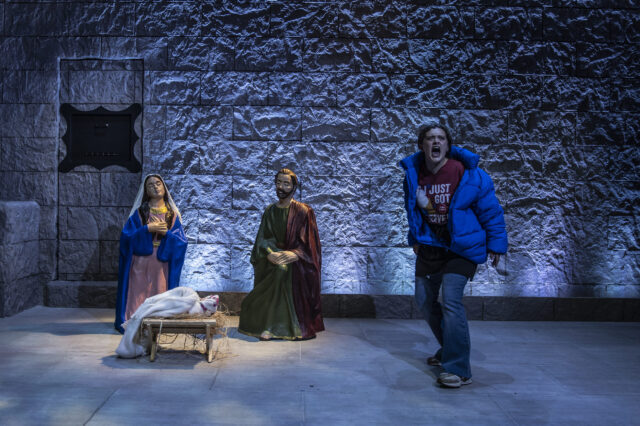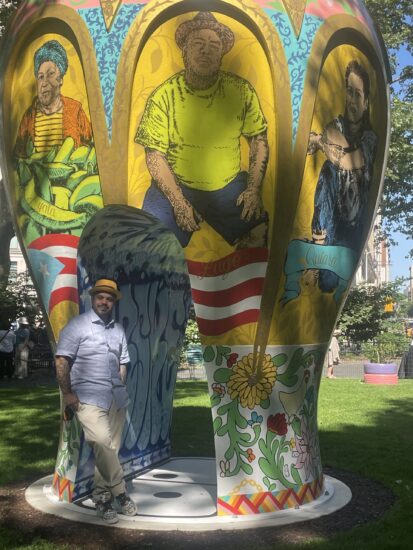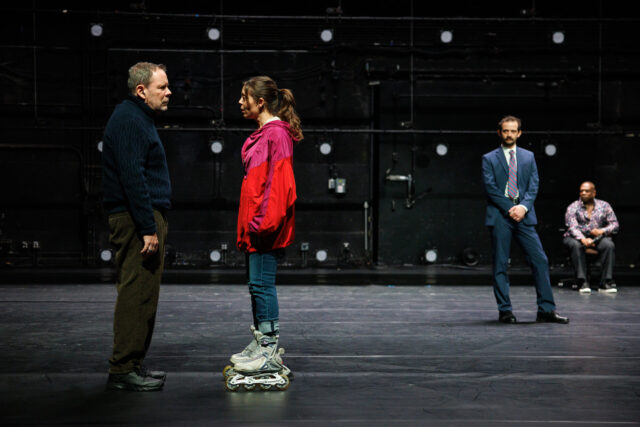
featured

TAKING ACTION TO SAVE DEMOCRACY: ART AT A TIME LIKE THIS SIXTH ANNIVERSARY CELEBRATION

Who: Janet Biggs, Mary Lucier, Shaun Leonardo, Marka27, Pablo Helguera
What: Public art campaign benefit for Art at a Time Like This
Where: Cristin Tierney Gallery, 49 Walker St.
When: Thursday, March 27, minimum donation $150 ($75 for artists), 6:00 – 9:00
Why: Only a few days into the pandemic lockdown in March 2020, independent curator and author Barbara Pollack and artist agent Anne Verhallen took action, starting the nonprofit Art at a Time Like This (ATLT), dedicated to the idea that “art can make a difference and that artists and curators can be thought-leaders, envisioning alternative futures for humanity.” Art at a Time Like This has presented two dozen online and in-person exhibitions and programs since then, including “Dangerous Art, Endangered Artists,” “Rupture: Interventions of Possibility,” and “Don’t Look Now: A Defense of Free Expression.”

On March 27, ATLT will be celebrating its sixth anniversary, at the Cristin Tierney Gallery on Walker St., with a three-hour evening of cocktails, conversation, and a call to action, featuring four impressive speakers: artists Janet Biggs, Mary Lucier, Shaun Leonardo, and Marka27, with Pablo Helguera serving as moderator. The event is hosted by Leonardo Bravo, Andy Cushman, Helina Metaferia, Marilyn Minter, Gina Nanni, Megan Noh, Eric Shiner, and Cristin Tierney.

“At the very beginning of a worldwide pandemic, we asked a simple question: How can you think of art at a time like this?” Pollack tells twi-ny. “The question is now more relevant than ever, which presents both a tragedy and an opportunity for creative solutions.”

The next creative solution for ATLT is the exhibition “Take One Action,” which the organization considers “an antidote” for what is happening around the globe today. All artists are invited to submit one artwork, along with a suggested action to help protect and preserve our democracy — with an eye toward the midterm elections. Select contributions will be printed and wheatpasted across the city and/or appear in an ever-growing digital exhibit.

“Barbara and Anne responded to the pandemic with amazing speed, care, and inclusiveness by asking a question: ‘How can you think of art at a time like this?’ The overwhelming response was: ‘How can you not?’” explains Biggs, a research-based interdisciplinary artist known for her immersive work in video, film, and performance. “They have continued to ask that question in the face of ongoing trauma, injustice, and upheaval, and artists have continued to answer with work that is engaged, compassionate, and necessary. That is why Art at a Time Like This — and its programming — is so essential.”

Admission is a minimum donation of $150 ($75 for artists) for what should be a fascinating gathering of thought-leaders who will not just be honoring the success of ATLT but continuing the fight to use art to make a difference.

[Mark Rifkin is a Brooklyn-born, Manhattan-based writer; you can follow him on Substack here.]
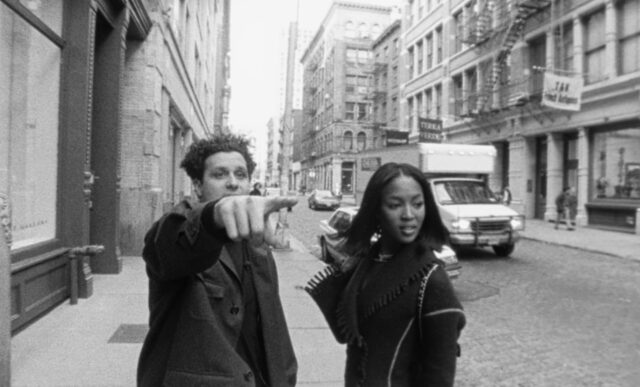
THE ART OF FILM: THE INAUGURAL CINEMA WEEK

Christian Petzold will discuss Miroirs No. 3 as part of Art House Cinema Week

ART HOUSE CINEMA WEEK NEW YORK
Multiple venues
March 20-26
www.arthouseny.org

Frustrated by how many Oscar-nominated films you never heard of? Well, that means you don’t frequent many of New York’s art houses, where you can find the best in foreign-language films, documentaries, indies, and more.

The city is trying to rectify that with the inaugural Cinema Week, sponsored by the NYC Mayor’s Office of Media and Entertainment (MOME) and Art House New York (AHNY). Running March 20-26, the festival comprises special events and low-priced screenings at nearly thirty local institutions, including Alamo Drafthouse Brooklyn, the Angelika, Anthology, DCTV’s Firehouse Cinema, the Marlene Meyerson JCC Manhattan, Maysles Documentary Center, Metrograph, Nitehawk Cinemas, and the Paris Theater.

“Cinema Week is a chance to celebrate the local, curated, and community-oriented cinemas across our city that help New York feel like New York,” AHNY cofounder Allason Leitz said in a statement. “We look forward to welcoming new and returning audiences and together making Cinema Week a reminder of why these spaces matter as a cultural cornerstone of New York City. Our cinemas’ unwavering commitment to gathering people in real life, around complex stories and collective discussion, is an essential element to the future of our city, democracy, and daily lives.”

A central initiative is offering five thousand free tickets to New Yorkers, which can be picked up at the box office. You can also buy tickets in advance.

“These tickets will make it easier for working New Yorkers to enjoy these incredible films, and they will provide a boost for our local theaters and small businesses supporting the festival. Access to arts, culture, and entertainment should be a right for every New Yorker, not a luxury for the few,” Deputy Mayor for Economic Justice Julie Su added.

Below are only some of the highlights.

Friday, March 20
Sad Girl Cinema Club: Melancholia (Lars Von Trier, 2011), Alamo Drafthouse Brooklyn, $19.18, 11:10 am

Tales of the Immigrant City: In America (Jim Sheridan, 2002), with guest speaker Colum McCann, Uptown Film Center at the New York Historical, free – $12, 6:30

Black and White (James Toback, 1999), followed by a Q&A with filmmakers and cast members, Cinema Village, $16.19, 7:00

Esta Isla (Cristian Carretero & Lorraine Jones, 2025), followed by a Q&A with the directors, Village East by Angelika, $21.19, 7:20

Saturday, March 21
The Murray Center at 10: Future of Documentary Secret Screening, followed by a panel discussion with Sergei Loznitsa, Stephen Maing, Meg Vatterott, Farihah Zaman, Chris Boeckmann, Jason Ishikawa, and Yance Ford, moderated by Robert Greene, Metrograph, $18, 1:00

Miroirs No. 3 (Christian Petzold, 2025), followed by a Q&A with Christian Petzold and discount concessions, Film at Lincoln Center, $21, 6:00

Stephanie Barber: Jhana and the Rats of James Olds or 31 Days / 31 Videos, with a talk and performance by Stephanie Barber, Anthology Film Archives, $14, 7:00

Sunday, March 22
Debra Granik: Unseen America — Conbody vs Everybody (Debra Granik, 2024), With Debra Granik in person, Cinema Arts Centre, $18, noon

Stink-O-Vision show: Dead Lover (Grace Glowicki, 2025), followed by a Q&A moderated by John Early, IFC Center, $19.95, 7:00

Monday, March 23
“Built to Move: NYC Subway on Film Series” — The Wreck of the New York Subway (1969 newsreel), Elevator Pitch (Martyna Starosta, 2020), and End of the Line (Emmett Adler, 2021), DCTV’s Firehouse Cinema, $10, 7:00

Sneak Preview Screening: Something Very Bad Is Going to Happen (Netflix, 2026), followed by a conversation with series creator Haley Z. Boston and cast members Camila Morrone and Adam DiMarco, moderated by Josh Horowitz, Paris Theater, free tickets available in advance, 7:00

Tuesday, March 24
Will (Jessie Maple, 1981), followed by a Q&A with E. Daniel Butler and Audrey Maple Snipes, Maysles Documentary Center, free – $15, 7:00

Wednesday, March 25
The Young Film Forum (YFF) Archive Dive: The Same River Twice (Robb Moss, 2003), introduced by Joel Coen and Frances McDormand, Film Forum, $17, 6:30

Reel Sisters & BAM present An Evening of Shorts Honoring Women’s History Month, BAM, $17, 7:00

Early Access: The Six Billion Dollar Man: Julian Assange and the Price of Truth (Eugene Jarecki, 2025), followed by a Q&A with Eugene Jarecki, Angelika, $21.99, 7:30

Brooklyn Horror Film Festival — Live Sound Cinema: Faust (F. W. Murnau, 1926), with live score by the Flushing Remonstrance, Nitehawk Williamsburg, $24, 9:30

Thursday, March 26
March Melodrama: All About My Mother (Pedro Almodóvar, 1999), introduced by filmmaker Tristan Scott-Behrends, Quad Cinema, $20.19, 6:10

[Mark Rifkin is a Brooklyn-born, Manhattan-based writer; you can follow him on Substack here.]
STOP THAT PIGEON: BIDDING A FOND ADIEU TO DINOSAUR ON THE HIGH LINE

Iván Argote’s Dinosaur will be flying off from the High Line soon (photo by twi-ny/mdr)

FAREWELL, DINOSAUR
High Line Plinth on the High Line Spur
Thirtieth St. at Tenth Ave.
Friday, March 21, free, noon – 4:00
www.thehighline.org

It promises to be the biggest send-off for a New York City pigeon ever.

On June 14, 2025, the High Line welcomed Iván Argote’s High Line Plinth commission, Dinosaur, with “Pigeon Fest,” a festival celebrating pigeons, urban ecology, and public art on National Pigeon Appreciation Day. The High Line is now saying goodbye to the seventeen-foot-tall, one-ton aluminum pigeon sculpture on March 21 with another party, “Farewell, Dinosaur,” consisting of games, photo ops, and more, with Argote, DJ Tommy Sparks, and Miriam Abrahams, the British multidisciplinary artist who won the Pigeon Impersonation Pageant at the opening. Visitors are encouraged to again come in feather-brained costumes as they play bingo and have Argote sign limited-edition posters.

“The name Dinosaur makes reference to the sculpture’s scale and to the pigeon’s ancestors who millions of years ago dominated the globe, as we humans do today,” the Colombia-born, Paris-based Argote said in a statement. “The name also serves as a reference to the dinosaur’s extinction. Like them, one day we won’t be around anymore, but perhaps a remnant of humanity will live on — as pigeons do — in the dark corners and gaps of future worlds. I feel this sculpture could generate an uncanny feeling of attraction, seduction, and fear among the inhabitants of New York.”

The attraction, seduction, and fear will continue through early April, when Dinosaur will go extinct on the High Line, replaced by Tuan Andrew Nguyen’s The Light That Shines Through the Universe.

[Mark Rifkin is a Brooklyn-born, Manhattan-based writer; you can follow him on Substack here.]
CELEBRATING WIFREDO LAM AT MoMA WITH DANCE, MUSIC, AND POETRY

Wifredo Lam with the unfinished Bélial, empereur des mouches in his garden, Havana, 1947 (courtesy Archives SDO Wifredo Lam, Paris / photo by Ylla © Pryor Dodge)

Who: Ballet Hispánico New York, Aruán Ortiz, Yaissa Jimenez
What: A Special Evening Celebrating “Wifredo Lam: When I Don’t Sleep, I Dream”
Where: Museum of Modern Art, 11 West Fifty-Third St. Between Fifth & Sixth Aves.
When: Thursday, March 19, free with advance RSVP, 6:30
Why: “I knew I was running the risk of not being understood either by the man in the street or by the others,” Cuban-born artist Wifredo Óscar de la Concepción Lam y Castilla said, “but a true picture has the power to set the imagination to work, even if it takes time.” The wide-ranging MoMA retrospective “Wifredo Lam: When I Don’t Sleep, I Dream” paints a fascinating portrait of Lam, the son of a Chinese immigrant and the grandson of a Congolese former slave mother. It’s a marvelous collection of paintings, drawings, archival photographs, sketches, books, and ephemera tracing Lam’s career, which took him from Cuba, Spain, and France to Martinique, Haiti, and New York as his imagination turned to Spanish modernism, Surrealism, and Afro-Cuban tradition. Among the highlights of the exhibition, which runs through April 11, are the 1943 gouache on paper masterpiece The Jungle, a trio of dazzling abstracts, and a collection of plates.

On March 19 at 6:30, MoMA will be hosting “A Celebration of ‘Wifredo Lam: When I Don’t Sleep, I Dream,’” as Ballet Hispánico New York, Cuban-born, Brooklyn-based pianist, violist, and composer Aruán Ortiz, and Dominican writer and poet Yaissa Jimenez will perform specially commissioned new works in the exhibition galleries, paying tribute to Lam and his legacy. Admission is free with advance RSVP.

[Mark Rifkin is a Brooklyn-born, Manhattan-based writer; you can follow him on Substack here.]
INAUGURAL COFFEE HOUSE FRIDAY LUNCH AT THE NATIONAL ARTS CLUB WITH RODD CYRUS AND CARL RAYMOND

Who: Rodd Cyrus, Carl Raymond
What: Inaugural Friday lunch conversation
Where: The Coffee House at the National Arts Club, 15 Gramercy Park South
When: Friday, March 20, $85, 11:30 am
Why: Back in November, I wrote in a Substack post about meeting actor Rodd Cyrus after seeing Ragtime at Lincoln Center; I was there with a group of women from Wellesley organized by Rodd’s mother. Cyrus plays Harry Houdini, who enters by dangling on a wire and declaring, “He made his mother proud.”

Now you can meet Cyrus as well when he is the special guest at the inaugural Coffee House Club lunch at the National Arts Club. He will be interviewed by writer, lecturer, tour guide, and social and culinary historian Carl Raymond, host of the Gilded Gentleman podcast.

Cyrus was born in Boston and raised in the San Francisco Bay Area and is of Iranian-English-Irish-Welsh-Italian-American heritage. In addition to starring in Ragtime, he is a regular on Elsbeth, has appeared in such plays as James Joyce’s Exiles and Maija García’s Valor and such films as Doctor, Doctor and 72 Hours, and portrayed Giuseppe Naccarelli in The Light in the Piazza at Encores!

“Rodd’s story is not only a great theatrical story; it’s a uniquely American story,” Raymond told twi-ny. “To be playing the role of immigrant superstar Harry Houdini in this revival along with his own personal story makes his portrayal unique and deeply important.”

The prix fixe lunch includes beet and mixed green salads, a choice of a turkey club sandwich, mushroom power bowl, rigatoni alla Bolognese, or chicken Marsala, and nostalgic sweets for dessert.

Only a few tickets remain to be part of this exciting event.

[Mark Rifkin is a Brooklyn-born, Manhattan-based writer; you can follow him on Substack here.]
THE PLUCK OF THE IRISH: THE US PREMIERE OF ULSTER AMERICAN

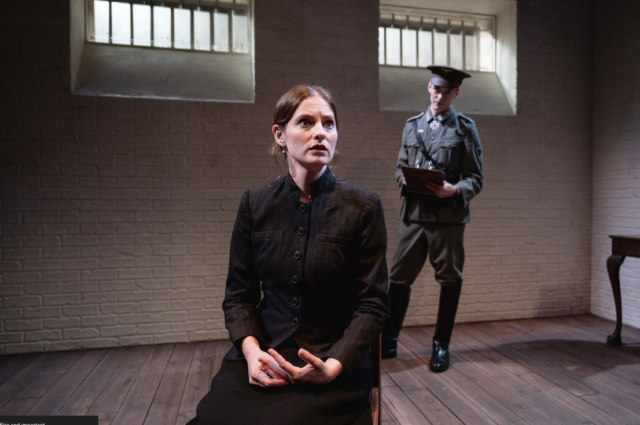
Director Leigh Carver (Max Baker), playwright Ruth Davenport (Geraldine Hughes), and actor Jay Conway (Matthew Broderick) meet for the first time in David Ireland’s Ulster American (photo by Carol Rosegg)

ULSTER AMERICAN
Irish Repertory Theatre, Francis J. Greenburger Mainstage
132 West Twenty-Second St. between Sixth & Seventh Aves.
Wednesday – Sunday through May 24, $55-$125
irishrep.org

Among the topics raised in the US premiere of David Ireland’s Ulster American are the n word, rape, murder, the Troubles, car crashes, religion, Brexit, alcoholism, and self-identity.

Oh, did I mention that it’s a comedy — and a hilarious one at that?

The eighty-minute play takes place in real time on a Sunday night in the cozy living room of British theater director Leigh Carver’s (Max Baker) London home, decorated by set designer supreme Charlie Corcoran, with two armchairs, a couch, several small tables, a writing desk, a window in a rear nook, theater posters for The Mousetrap, Camelot, London Assurance, Macbeth, and the National Theatre, and several bookcases filled with tomes about Noël Coward, Samuel Beckett, and other theater legends.

Leigh is meeting with Jay Conway (Matthew Broderick), an Oscar-winning American actor who is starring in a new work Leigh is directing, by Irish playwright Ruth Davenport (Geraldine Hughes). Rehearsals are set to begin the next day, and Leigh wants the three of them to get to know each other more first. Jay is on the couch, in the middle of a conversation with Leigh, telling him, “Is there homophobia in Hollywood? Of course. And misogyny? How can we deny it? It’s reflected in so much of our output. Narrative upon narrative centered around the abuse of women, the violent abuse of women. And racism? Only a fool could pretend otherwise.”

Leigh is surprised when Jay asks, “You ever use the n word?” After discussing James Baldwin, power dynamics, and the Bechdel test — a measure, proposed by cartoonist Alison Bechdel, that judges a fictional work based on whether it includes scenes in which at least two women talk about something other than men — Jay adds, “Why should I, a man, dictate to Bechdel, a woman, what should or should not be part of her fucking theory? This is me, learning from my mistakes, learning to shut the fuck up. . . . And that’s what I’m saying, this is where we’re at. Guys like me and you taking a back seat. Allowing the Ruth Davenports of the world to have their say. Fucking white heteronormative, privileged fucking uh . . . cis . . . motherfuckers like you and I who have to stand aside now. We have a moral responsibility to . . . I mean not me. Obviously. I’m Irish Catholic, so I can’t . . . I’m not part of that – the equation of – . . . I have an intersectional exemption.”

Jay speaks in a calm manner but with an undercurrent of excitement as he attempts to show off what he believes to be his supreme knowledge of society and his allyship with women and people of color. Leigh gets bored quickly but jumps in every once in a while to agree with Jay or correct a mistake, but nothing is going to stop Jay from making his points. He’s clearly a superstar who is used to being coddled and listened to.

Leigh is then shocked when Jay determinedly asks, “Do you think there are any circumstances where it’s morally acceptable to rape someone?” The audience is shocked as well as Jay describes a situation, inspired by a movie plot, when it might actually benefit a certain kind of woman; he names the person he would rape, then forces Leigh to choose his victim. The director squirms in his chair as they debate the validity of the question, but Jay is not about to give up until Leigh finally gives him a name, trapped by his need to suck up to Jay, since a lot is riding on this play.

A few minutes later, Ruth arrives, and things get really bizarre. She apologizes for being late, explaining that her mother had just gotten into an accident and is in the hospital. Her mother was driving Ruth to the airport and they were arguing about a friend of Ruth’s who was killed in the Troubles. Ruth tells the men, “I just lost it with her and — I don’t know what came over me, I just said, ‘Mummy — why do you always have to be such a cold-souled, blackhearted thoughtless fucking bitch?’” That was followed by the crash.

Initially, the three of them heap praise on one another. Ruth gushes that she’s Jay’s biggest fan and feels like she already knows him. Jay thanks her for writing him the role of a lifetime, saying, “Your script. Your fucking script, Ruth. Is the single best script I’ve read for ten fucking years.” Leigh believes that, given the quality of the script and the beloved star, they are critic-proof. “Hey, fuck the critics, I don’t give a fuck about the critics,” Jay declares. “They’re fucking animals, Leigh. They’re animals, Ruth. And we should do with them what we do with animals. Kill them and eat them. And the good ones keep as pets.”

But when Ruth says that, although she is from Northern Ireland, she considers herself British and that the protagonist of her play is the same, both Jay and Leigh are infuriated, and the real fireworks begin.

Jay: Are you British because Britain used to own Ireland? So they used to own you, like a slave, so you’re British?
Leigh: Exactly!
Ruth: They never owned me. I was never a slave!
Jay: It’s confusing because to me you sound Irish.

The confusion only increases as the battle lines are drawn.

History and identity collide in superb dark comedy at Irish Rep (photo by Carol Rosegg)

Ulster American debuted at the 2018 Edinburgh Fringe and had a highly touted 2023 London revival starring Woody Harrelson, Louisa Harland, and Andy Serkis. Director Ciarán O’Reilly’s (The Weir, The Emperor Jones) adaptation is a sizzling slow build, balancing humor with pathos and bravado until all hell breaks loose. Leigh, Ruth, and Jay dig deep into their personal sense of identity while also judging the others’. “You don’t get to decide who’s British and who isn’t,” Ruth says to Leigh, who replies, “Well, we sort of do. That’s the point.” A bewildered Jay chimes in, “This is more complicated than I thought.”

The argument relates to what is happening in the United States right now, as liberals and conservatives, both in the government and private citizens, feud over the status of legal and illegal immigrants.

The three characters also all bring up the subject of history, as if that will provide the answers they are seeking. “History is so important to this. For this play, I feel like I need to know the history of Ireland like I know my own ball sack,” Jay says. But even history is subjective these days.

Tony winner and New York City native Broderick (Shining City, Evening at the Talk House) is brilliant as Jay; his singsong delivery and stiff posture imbue the Hollywood icon with a sense of invulnerability, but in this case he is on his own, not surrounded by a sycophantic entourage he is probably used to. He glories in stating his opinions and flaunting his progressive ideals, but they are essentially only lip service, with curses casually thrown in not for emphasis but just because.

The Belfast-born Hughes (Molly Sweeney, Jerusalem) is a powder keg as Ruth, who is beyond thrilled to be working with Leigh and Jay until she starts learning more about them and some of their views; she’s not about to just sit back and let them run all over her, instead going toe-to-toe.

And Baker (Continuity, The Low Road), who hails from Baton Rouge, Louisiana, is completely convincing as the British Leigh, who has to walk the fine line between Jay and Ruth but is more conniving than he likes to admit, unable to remain neutral even as he attempts to befriend and care about each of them.

Ireland (What The Animals Say, Most Favoured) and O’Reilly (The Weir, The Emperor Jones) know what of they speak; both are from the north of Ireland, but the former is from Belfast and Ballybeen in Northern Ireland, while the latter is from Cavan, in the Republic of Ireland. In one of his previous, plays, the darkest of dark comedies Cyprus Avenue, Ireland also examines the issue when the protagonist insists, after calling another character the n word, “The last thing I am is Irish. I am anything but Irish. I am British. I am exclusively and non-negotiably British. I am not nor never have been nor never will be Irish.”

Ireland and O’Reilly take that to the next level in Ulster American, along with a sensational cast, critics be damned.

[Mark Rifkin is a Brooklyn-born, Manhattan-based writer; you can follow him on Substack here.]
THE TASTE OF CAPITALISM: MOTHER RUSSIA AT THE SIGNATURE

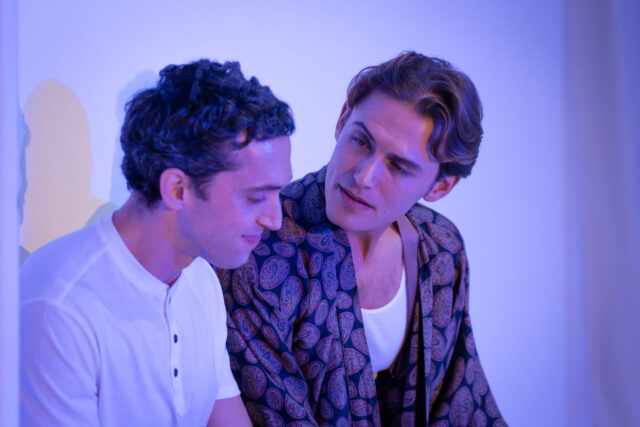
David Turner stars as the title character in Lauren Yee’s Mother Russia (photo by HanJie Chow)

MOTHER RUSSIA
The Pershing Square Signature Center
The Romulus Linney Courtyard Theatre
480 West 42nd St. between Tenth & Eleventh Aves.
Tuesday – Sunday through March 22, $74-$162
signaturetheatre.org

Asian American playwright Lauren Yee continues her geographic theatrical journey with the New York premiere of Mother Russia at the Signature, the third of what she calls her “cycle of communism plays in Asia in the twentieth century and its intersection with Western pop culture.” Cambodian Rock Band was a play with music about the second-generation immigrant experience and the Cambodian genocide of 1975–79, while The Great Leap was a culturopolitical fantasy about a basketball “friendship game” between American and China in 1981 that delved into the Chinese Cultural Revolution and the Tiananmen Square uprising.

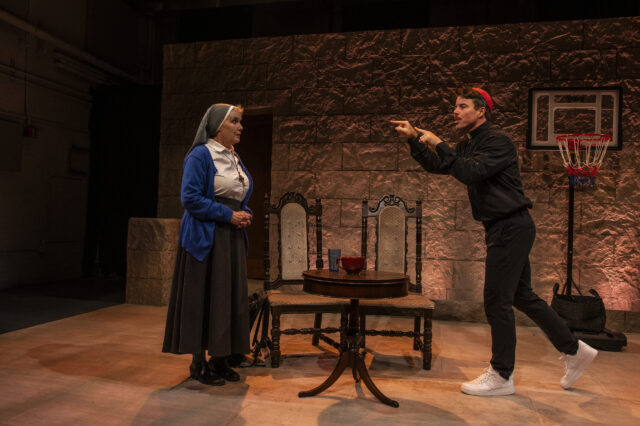
In Mother Russia, Yee explores that nation’s conversion to capitalism in the wake of Mikhail Gorbachev’s introduction of Glasnost and Perestroika in the mid-1980s, the tearing down of the Berlin Wall in 1989, and the 1991 collapse of the Soviet Union. It’s 1992, and the character Mother Russia, hilariously portrayed by David Turner in an all-red nun’s habit / opera clown costume, prepares the audience for what’s to come.

“Do not bother to check. I am not in program. So you will not find me. Don’t worry, I am no one,” she says by way of introduction. “They think I will die before long. But! What do they know? . . . I have been let down by so many shitty men. Have you ever loved a shitty man? My life — if you can call this a life — has been one shitty man after another. So now I am here. With you sluts. You have kids? Never have kids. You are only as happy as your unhappiest child, and me? I have so many. And no matter what you do, they will never be happy.”

The only son of a lowly widow, twenty-five-year-old Dmitri Petrovich (Steven Boyer) thinks he is happy and successful; he runs a little metal-shack kiosk in St. Petersburg, selling condoms, bullets, candy bars, Nestlé’s Quik, Heinz Ketchup, Marlboro cigarettes, Coca-Cola, and other American goods, and he is in love with his girlfriend, Masha, the name of characters in Russian playwright Anton Chekhov’s Three Sisters and The Seagull. The shack has an ad for Folger’s coffee on its facade, in Russian except for the company logo, an example of the intrusion of capitalism. Meanwhile, Dmitri still dreams of being a spy for the KGB. One day a man enters the shop and Dmitri instinctively pulls a (Chekhovian) gun on him until he recognizes it is his old pal Evgeny Evgenievich (Adam Chanler-Berat), who had moved to Moscow three years earlier with his father, a powerful party leader who has now become “a burgeoning capitalist.”

“Oh, seems like just yesterday my mom was scrubbing the horseshit out of the floor of your dad’s government dacha!” Dmitri proclaims.

However, it turns out that Evgeny is not there to say hello to Dmitri but to shake him down, which is the job his father has forced him to do even though he is no good at it. Nonetheless, the naive Dmitri trusts Evgeny enough to let him in on a secret: that he is being paid handsomely in vouchers to secretly record the comings and goings of Yekaterina Mikhailovna Shevchenko (Rebecca Naomi Jones), a former famous activist and singer known as Katya M who defected to the West but has now returned as a quiet teacher whose past has been forgotten — except for the man who is paying Dmitri to track her.

Evgeny declares that he is a big fan of Katya M’s and wants to participate in the surveillance, begging Dmitri to hire him. “You want to be my servant?” Dmitri asks. Evgeny responds, “More like an employee,” having a hard time forming that last word.

Soon Evgeny is not only listening in on Katya at home and school but also following her on the bus, where they strike up a conversation. His obsession grows as he seeks relationship advice from Dmitri while hiding his identity from Katya. Both he and Katya are plagued by unseen fathers: Evegeny seeks approval from his ever-silent father, closed off from him behind a door, while Katya wants the truth about what happened to her father, a poet who was disappeared many years before.

In one of the funniest moment of the play, Dmitri and Evgeny devour a McDonald’s “filettofish” sandwich together. “Is this what capitalism tastes like?” Dmitri says with a rush of excitement.

It isn’t long before everyone is getting a taste of capitalism and Western society, filtered through Adam Smith’s theory of the invisible hand.

Dmitri (Steven Boyer) and Evgeny (Adam Chanler-Berat) spy on Katya (Rebecca Naomi Jones) in New York City premiere at the Signature (photo by HanJie Chow)

“There is not enough of me in this play,” Mother Russia says at one point. “Have you noticed this? Right?”

We noticed; there’s not enough of Mother Russia, and David Turner, in the play. She shows up in various places in interstitial scenes — sitting in the audience or on the ledge of Dmitri’s shack — to share her wisdom about the nation, embodying it with humor and angst while delving into history. “Back in the day, we would all have same couch. This is true!” she recalls. “Now you go to store, and all you see are choices.” After Evgeny claims that these are “unprecedented times,” Mother Russia goes into a riotous monologue about the history of Russia, arguing, “What bullshit. You know what was a hard year? Seven. Seven was a hard year.”

Turner (By the Way, Meet Vera Stark, Arcadia) is enchanting as the acerbic Mother Russia; he also portrays Katya’s mother in one critical scene. Boyer (Hand to God, Moscow Moscow Moscow Moscow Moscow Moscow) is sweetly appealing as the not-too-smart Dmitri, Chanler-Berat (Next to Normal, Nantucket Sleigh Ride) is steady as the deeply conflicted Evgeny, and Jones (Big Love, Oklahoma!) is alluring as Katya, although her story has a few key plot holes. As funny as the play is, there are several overly goofy and silly scenes and awkward moments, but it all works out in the end.

Western pop culture is central to the play, more than in just Katya’s former life as a pop star. Outside the theater, in the lobby, is a poster for “The Mother Russia Mixtape,” which notes, “The musical genre heightened the appeal of anti-Soviet countries, causing dissent and the rise of counterculture among Russian youth.” It includes sixteen influential tracks, from the Beatles’ “Back in the USSR” and Prince’s “Ronnie, Talk to Russia” to Sting’s “Russians” and Billy Joel’s “Leningrad” along with Sergey Kuyokhin’s “Intro Pop-Mechanics” and Kino’s “I Want Changes.”

The preshow music features such late-1980s, early 1990s Russian rock songs as Mumiy Troll’s “Медведица” (“A Bear”) and Kombinatsiya’s “Бухгалтер” (“Accountant”); Yee and director Teddy Bergman (KPOP, Empire Travel Agency) shape the play like a pop song, with Mother Russia serving as a kind of chorus and bridge to the stanzas by Dmitri, Evgeny, and Katya, with a bonus dance number set to a pumped-up version of the theme from Swan Lake. The play also references Vanilla Ice, Die Hard, Rambo, Robert De Niro, American baseball teams, and Meryl Streep as well as Anton Chekhov and his wife, Olga Knipper.

“I miss communism!” Dmitri shouts near the grand finale.

In today’s world, maybe that’s what capitalism tastes like.

[Mark Rifkin is a Brooklyn-born, Manhattan-based writer; you can follow him on Substack here.]