Volunteers are needed for special public art project on Saturday (artwork: Join Together, 2026, by Debra Pearlman)
TAKE ONE ACTION
Cristin Tierney Gallery, 49 Walker St., and other locations
Saturday, October 3, free, noon – 6:00
Volunteers needed: info@artatatimelikethis.com artatatimelikethis.com cristintierney.com
Two weeks ago, Art at a Time Like This (ATLT) kicked off its “Take One Action” public art project programming with a panel discussion in Brooklyn, focusing on how to resist current US immigration policies. The next phase launches on October 3, when six mobile LED trucks hit the streets, featuring original work by Shaun Leonardo, Marilyn Minter, Robert Longo, Sasha Stiles, Jonathan Allen, Marka27, Janet Biggs and Terry Berkowitz, Debra Pearlman, Autumn Savage, Kiyo Gutiérrez, and Julian Alexander, as part of Fall of Freedom, “an open instigation to artists, venues, and institutions across all disciplines to put your work in the world on October 2, 3, and 4, countering fascist repression and censorship with joyful communities of defiant creativity.” The ATLT works examine patriotism, immigration, the climate crisis, and a call to participate.
The day begins at noon at Cristin Tierney Gallery on Walker St., where many of the artists will be available for a meet-and-greet. The other trucks will depart from the Studio Museum in Harlem, Brooklyn Bridge Park, and MoMA PS1 at 11:00, and Columbia University and the Bronx at noon. Each truck will follow a unique route; maps will be available.
“I often hear people say, but what can we do? We believe that taking one small action can make a difference, create a snowball effect, and restore a sense of empowerment and hope,” ATLT cofounder and director Barbara Pollack said in a statement.
ATLT considers the project “an antidote” for what is happening around the globe today, where freedom finds itself facing more frightening barriers every day. The organization, which was formed at the beginning of the pandemic, is looking for volunteers to be onsite and share information about the project with pedestrians and viewers and take photographs at two of the stops. If interested, please send an email to info@artatatimelikethis.com.
The event concludes at Cristin Tierney at 6:00, where people will gather for a celebration amid Biggs’s terrific “Path of Totality” exhibition, which includes two stunning short films, the 2022–24 Eclipse (Antarctica, December 4, 2021) and the 2025 three-channel Eclipse (Amazon, September 7, 1858), in addition to fascinating related ephemera.
What can you do? You can volunteer for this exciting project and/or check out several of the trucks as they campaign for change one month before the extremely consequential midterm elections.
As Pollack told twi-ny a few months ago, “At the very beginning of a worldwide pandemic, we asked a simple question: How can you think of art at a time like this? The question is now more relevant than ever, which presents both a tragedy and an opportunity for creative solutions.”
[Mark Rifkin is a Brooklyn-born, Manhattan-based writer; you can follow him on Substack here.]
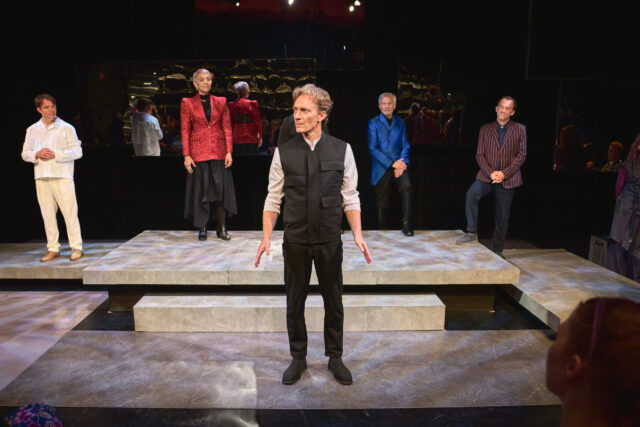
Damon Horowitz’s Becoming Hamlet gives him and the audience the opportunity to portray the tragic Danish prince (photo by Valerie Terranova Photography)
BECOMING HAMLET
Five Angels Theater
789 Tenth Ave. at Fifty-Second St.
Tuesday – Sunday through October 3, $29-$79 becominghamlet.com
To be Hamlet, or not to be Hamlet: That is the question posed in Becoming Hamlet, which continues at Five Angels Theater through October 3.
If you are a purist who wants to see Hamlet, perhaps William Shakespeare’s most famous tragedy, this play is not the thing. However, if you’ve ever wanted to portray the Dane, for a few seconds or a minute or two, then this show just might be the thing, a fun participatory event for those who have dreamed of at least temporary stardom.
Adapted by Damon Horowitz and directed by Sybille Bruun, Becoming Hamlet has streamlined the often-three-hour-play to about a hundred bumpy minutes. The audience has the choice of watching in standard riser seating or participating, in which case they sit on a chair on the floor. Everyone is considered to be Hamlet, as if the conflicted prince has been divided into dozens of beings and personalities. The night I attended, there were about twenty-five Hamlets on the floor and approximately fifteen people in the risers, with plenty of empty seats.
As you enter the theater, characters engage you in conversation — a man in a regal blue suit walked up to me and was surprised when I correctly addressed him as Polonius, so we spoke about whether I was being faithful to Ophelia while studying in Wittenberg. Facilitators in dark cloaks (Tristan Andre, Emily Jackoway, Addy Jenkins, Sevans Martinez) approach you and ask what kind of a role you want, from reading a line on a card to going onstage for something more. I was given the line “I am constant to my purposes” from act five, scene two, and told that I would be led around the right side of the space, then walk slowly to the center, where I would face the audience and make my Shakespearean debut.
While waiting for my moment in the sun — or, in this case, darkness — I couldn’t help but recall two recent dreams in which I was an actor in a play and completely blanked out on my lines, intense fear and embarrassment overwhelming me. So I studied the card relentlessly, even as I occasionally was tapped to deliver other bits of dialogue. Some audience members were led onstage and read lines that were projected on the walls at the right and left.
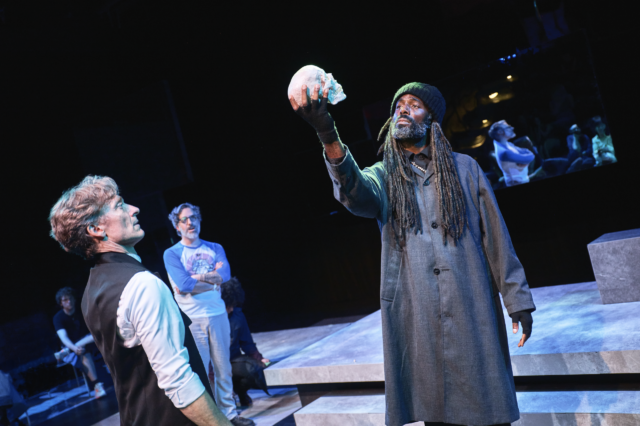
Alas, a gravedigger (Equiano Mosieri) introduces poor Yorick in classic Shakespeare scene (photo by Valerie Terranova Photography)
The production features fine costumes by Amit Gajwani, with Gertrude (Desiree Baxter) and Ophelia (Jude Feingold) standing out in fabulous shoes. The story has been whittled down to the basics: Hamlet (Horowitz) has returned home to see his recently widowed mother, Gertrude, marry his dead father’s brother, Claudius (David Littleton), who has assumed the crown. Accompanied by his best friend, Horatio (Tyler Moss), Hamlet is told by his father’s ghost (Equiano Mosieri) that Claudius in fact murdered King Hamlet, and he considers revenge. He is in love with Ophelia, whose father, Polonius (Jim Pratzon), is chief counsel to Claudius and whose brother, Laertes (Steven Lamon), is suspicious of Hamlet. As Hamlet appears to be going mad, Claudius summons his nephew’s childhood friend, Guildenkrantz (Truman Gaudoin) — Rosencrantz and Guildenstern have been turned into one person — to be spies for him. There’s a play-within-the-play and a visit to a graveyard, but otherwise various other subplots and minor characters have been excised.
The pacing is inconsistent, since it is dependent on the skills of several dozen nonprofessional actors. Various words are repeated in ways that seem random. The show doesn’t provide new insight into the work; instead, if feels more like a vanity project for Horowitz and the audience, arranged just so they can all play the tormented Danish prince. If you go with that as your goal, not caring about the intricate emotional and psychological aspects of Shakespeare’s story, then you will most likely be fine with what you get.
As my time approached, I devised a plan: Since I was going to deliver my line center stage, only a few feet from my chair, I placed the card facing out. I was tapped on the shoulder, and a facilitator led me on my journey. Finally standing at my spot, I began my very brief soliloquy: “I am constant,” I said defiantly, and then forgot the next word. I looked out at the audience, then, attempting a natural maneuver, at my chair, where I could read the large type. I firmly, proudly stated, “to my purposes,” as if the pause was, well, on purpose.
I sat back down and breathed a huge, silent sigh of relief.
Later, as I was heading for the bus, three women who had been at the show called out to me, “Congratulations!”
I felt like a star.
[Mark Rifkin is a Brooklyn-born, Manhattan-based writer; you can follow him on Substack here.]
A new production of Václav Havel’s Unveiling comes to Chelsea this month (photo courtesy Untitled Theater Company No. 61)
UNVEILING
Torn Page
435 West Twenty-Second St. between Ninth & Tenth Aves.
Thursday – Saturday, October 1–17, general admission $2, suggested donation $25 untitledtheater.com tornpage.org
In honor of what would have been Václav Havel’s ninetieth birthday — the first president of the Czech Republic and acclaimed dissident playwright died in 2011 at the age of seventy-five — Edward Einhorn and Untitled Theater Company No. 61 are bringing a revival of Havel’s 1975 absurdist one-act play Unveiling (Vernisáž) to Torn Page in Chelsea, in association with the Czech Center New York. Part of the Vaněk Trilogy that also includes Audience and Protest, the work continues the story of Ferdinand Vaněk, a kind of Havel alter ego who battles authoritarianism.
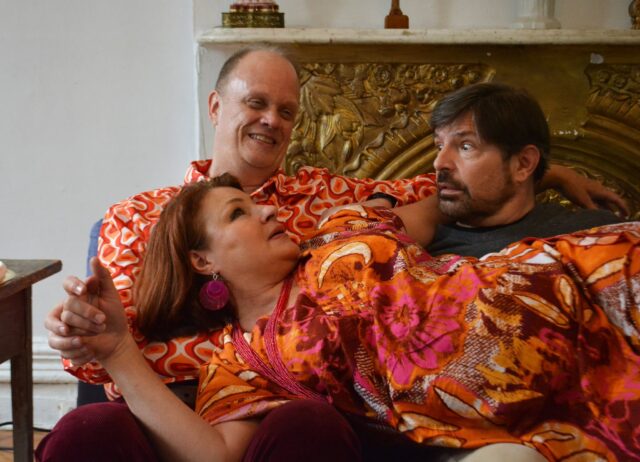
In Unveiling, running October 1–17 in a production directed by Einhorn using a translation by Jan Novák, Vaněk is invited to see how two of his friends, Vera and Michael, have upgraded their apartment, where they get caught up in a debate about moral integrity and Communism in a way that relates to what is happening today, when Americans are faced with ever-more-ethical choices nearly every day. When the couple shows him their new confessional, he asks, “What do you do with it?” The cast features Craig Anderson, Bob Brader, and Yvonne Roen, with costumes by Ramona Ponce.
On October 5 ($27.50), the play will move to the Bohemian National Hall on the Upper East Side for one night only, with live ASL translation, followed by a panel discussion and a reception with goulash.
And on October 12 at Torn Page, Untitled Theater Company No. 61 will present a staged reading of Einhorn’s Frida Vaněk, a modern sequel to Unveiling starring Vas Eli, Nalina Mann, Alyssa Simon, and Richard Toth, about Ferdinand’s niece, whose mother dies, leaving behind a file that contains some surprising information. General admission is $2, with a suggested donation of $10. Seats are limited for all performances.
As Havel himself said, “Truth and love must overcome lies and hatred.”
[Mark Rifkin is a Brooklyn-born, Manhattan-based writer; you can follow him on Substack here.]
Milford Graves enjoys a bite in his garden in documentary about the unique percussionist and philosopher
MILFORD GRAVES FULL MANTIS (Jake Meginsky, 2018)
Maysles Documentary Center
343 Lenox Ave./Malcolm X Blvd. between 127th & 128th Sts.
Sunday, September 27, $7-$15, 2:00, free Q&A 4:30 maysles.org fullmantis.com
Jake Meginsky’s unconventional documentary of unconventional musician Milford Graves begins with the following epigraph from Graves: “Look at the room downstairs / Look at the garden outside / Don’t try to analyze it / Just take it in.” That is not only Graves’s life philosophy but also the best way to experience Milford Graves Full Mantis, which is screening September 27 at 2:00 at the Maysles Documentary Center. Born in 1941 in South Jamaica, Queens, where he resided until his death in February 2021, Graves was an avant-garde free jazz percussionist who played and lived to his own beat. In 2004, Meginsky knocked on Graves’s door, asked to study with him, and soon became the Professor’s assistant and documentarian; the film, codirected by drummer Neil Young, who also edited and photographed it with Meginsky, features compelling live footage along with peaceful moments in Graves’s basement and expansive garden. Early on, Meginsky shows a wild excerpt from a 1973 concert at the Jazz Middelheim Festival in Antwerp in which Graves performs with Joe Rigby and Hugh Glover on reeds and Arthur Williams on trumpet; the fierce, dissonant music might not be to everyone’s taste, but it serves as a terrific counterpoint to Graves’s calmer side, pontificating on, well, sometimes it’s hard to tell what, but it’s always fascinating.
There are also clips of Graves playing solo at the Brandeis Improv Festival in 2015 and in one of Park Ave. Armory’s historic rooms in 2016; in 2011 in his basement, where he’s surrounded by African sculpture, books, and computers that record his heartbeat and nervous system, which he incorporates into his work; and in Japan in 1981 with dancer Min Tanaka at a school for autistic children, where his unique performance inspired the kids to get up and move to the groove. In his backyard dojo he explains Yara, the discipline he invented based on martial arts, African ritual dance, the Lindy Hop, and the praying mantis and which he refers to as “the black way of self protection.” There are no talking-head experts or Graves acolytes singing his praises; the only voice heard in the film is Graves’s own, and for the first half of its ninety minutes Meginsky doesn’t show the film’s subject as he talks. Instead, while Graves speaks about his past and shares his kaleidoscopic philosophies, the camera slowly focuses on his lush garden or shows some of Graves’s animations.
But eventually Graves is seen sitting in his basement, telling a long, remarkable story of a turning point in his life. He’s an engaging character, bursting with enthusiasm and a unique view of the human body, the five senses, tear ducts, and the parasympathetic nervous system. And throughout, he keeps playing those drums, holding the sticks in his trademark way on a nonstandard kit he put together himself.
The screening at MDC will be followed at 4:30 by “An Afternoon with Ashanti Omowali Alston,” a free Q&A with the revolutionary, orator, writer, organizer, motivator, anarchist, and former Black Panther Party member, in conversation with political philosopher, academic, and author Joy James, focusing on the new book Anarchist Panther: The Selected Writings of Ashanti O. Alston (AK Press, August 2026, $21.99).
[Mark Rifkin is a Brooklyn-born, Manhattan-based writer; you can follow him on Substack here.]
Everything Else Is Noise is one of several NYFF64 films that blend fiction and reality
NYFF64
Film at Lincoln Center
Walter Reade Theater, Alice Tully Hall, Elinor Bunin Munroe Film Center
September 25 – October 12 filmlinc.org/nyff
One of my favorite times of every year comes each September, when I play hooky and spend all day at the New York Film Festival, catching four or five press screenings. This year, I shuttled between the Walter Reade Theater and the Francesca Beale Theater to see four extraordinary gems that fit extremely well together, a quartet of exquisite works that move at the pace of life, mixing fiction and nonfiction as they explore the relationship between cinema and reality in beautiful and unique ways.
Nowhere to Lay My Eyes is another gem from Hong Sangsoo
NOWHERE TO LAY MY EYES (눈둘데가 없네) (Hong Sangsoo, 2026)
Saturday, September 26, 12:30
Wednesday, October 7, 8:45 filmlinc.org
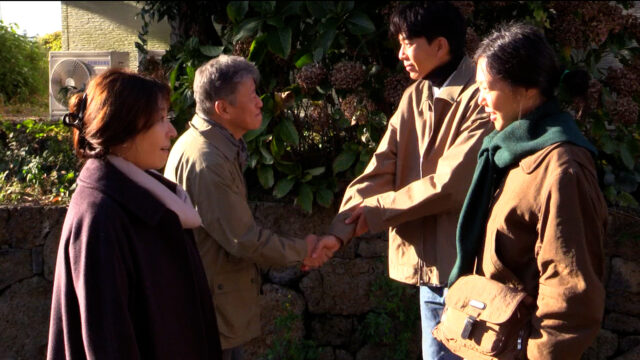
Festival favorite Hong Sangsoo once again has two films in the schedule, both fine examples of his personal style — the South Korean auteur writes, directs, edits, produces, and photographs his films. Since 2015, they usually star his partner, Kim Min-hee, who has appeared in thirteen of his movies and doesn’t act for any other director.
In Nowhere to Lay My Eyes, Kim portrays Sanghee, an experimental filmmaker who visits her mother (Choi Myung-gil) and stepfather (Kwon Hae-hyo) for the first time in ten years; Sanghee is joined by her younger brother (Shin Seok-ho), who is caught between his sister’s and mother’s estrangement. Their mother has made a new life on Jeju Island, where she owns a successful restaurant; meanwhile, her husband is a documentary filmmaker who has been working on the same project for two decades, about chobun, or grass graves, in which bodies are not buried but decompose aboveground. They also meet their stepsister (Park Mi-so), who discusses art with Sanghee.
As in so many Hong films, the well-drawn characters eat, drink, and visit the seashore as they talk about movies, aging, responsibility, and relationships. Hong often keeps the camera still and steady; for example, when Sanghee decides to visit a nearby pond, she walks slowly down a gravel road, her back to the stationary camera, her footsteps crunching gently as she says in voiceover, “It was a pleasant day, with clean air.” It’s a simple yet deeply affecting moment, representative of Hong’s work.
However, other scenes include two of his trademark zoom bursts to remind us that we are not watching real life. “Dramas are a scam,” the stepfather says at one point, a comment not only on his documentaries but on Hong’s oeuvre.
All senses are connected in Nicolás Pereda’s Everything Else Is Noise
EVERYTHING ELSE IS NOISE (LO DEMÁS ES RUIDO) (Nicolás Pereda, 2026)
Saturday, September 26, 4:30
Sunday, September 27, 9:30
Sunday, October 4, Brooklyn Academy of Music, 7:30
Monday, October 5, 1:00 filmlinc.org
Mexican filmmaker Nicolás Pereda’s Everything Else Is Noise is a wonderfully wry feminist comedy about music, family, and the art of filmmaking — as well as patience.
It begins with a long shot of crazy traffic, several minutes in which we follow one car at an intersection where vehicles are moving at a snail’s pace, if at all. This one sedan is having the most difficulty, attempting to make a left turn, but no one is letting it in. It’s both hilarious and frustrating, a terrific opening scene for a fabulously inventive film that requires patience on the part of the characters and the audience.
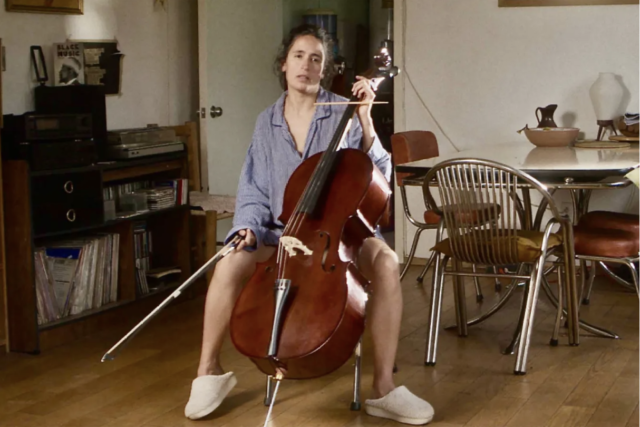
The story takes place in a single apartment, filled to the brim with plants. It is the home of cellist-composer Tere (Teresita Sánchez), who we first encounter when her downstairs neighbor (Andrew Rogers) comes to her door and complains that she is making too much noise. She calmly explains that she is practicing her cello and that she has already reached an agreement with another neighbor that it is fine to do so between nine and five. The man refuses to accept her explanation, repeating his demand again and again, but she insists, over and over in her soft-spoken yet sly manner, that she will continue practicing nonetheless. It’s a marvelously absurd exchange that sets the stage for the hilarious utter nonsense that is to follow.
Tere has let her friend and colleague, cellist and composer Rosa (Rosa Estela Juárez Vargas), borrow her apartment for a television interview about her career. Rosa, who does not want her husband to know about the interview, is nervous and is not the greatest with words, so Tere tries to settle her down by advising her to make up a fake story about her sense of smell. The interviewer, Lázaro (Lázaro G. Rodríguez), finally arrives with Paco (Francisco Barreiro), his cameraman and sound technician; it seems that they were in that car that was stuck in traffic, the first of a series of events that befall them as they try to conduct the interview.
It only gets more complicated when Tere’s daughter, avant-garde cellist Luisa (Luisa Pardo), shows up basically in her pajamas, eventually joined by her father, the famous composer Estevez (José Rodríguez López), who has not publicly acknowledged Luisa as his child, in order to protect his wife and their other, “legitimate” children. Things go wrong in droller and droller ways as Pereda, who wrote the script with Juan Francisco Maldonado and serves as cinematographer, has a blast with clever touches and details that sometimes fly under the radar if you don’t pay attention.
Sánchez, who has appeared in such other Pereda films as Fauna,Minotaur, and Lázaro at Night, is sensational as Tere, imbuing her with a spirited naturalism that brings a realistic quality to the narrative, melding fiction and nonfiction. (Pereda has won awards for both his documentaries and fiction features.) Pardo and Barreiro, also Pereda regulars, ramp up the absurdities to priceless levels.
Everything Else Is Noise is a small gem, making its points about gender inequality, class differences, the media, and the creative process in both subtle and overt ways that will have you shaking with laughter. As Luisa says, “In my opinion, the issue with experiencing this music live, where you can see the performer, is that the visual aspect takes over, and you stop really listening. So, for this to make sense, I’m going to ask you all to close your eyes while I play.” Paco then adjust the camera viewfinder and puts his head in his hands.
And as Tere notes, “The senses are all connected.”
Brava!
Song Sunmi stars as an actress making a comeback in The Day She Returns
THE DAY SHE RETURNS (그녀가 돌아온 날) (Hong Sangsoo, 2026)
Tuesday, October 6, 9:00
Thursday, October 8, 6:15 filmlinc.org
A kind of companion piece to his 2012 drama The Day He Arrives, Hong Sangsoo’s The Day She Returns is a meditative examination of life and art, of the choices we make amid our inherent biases and societal mores.
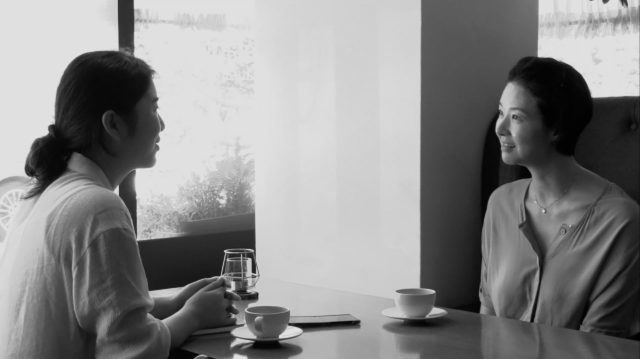
Song Sunmi stars as Bae Jeongsu, a famous actress returning to work after twelve years off raising her daughter. She has chosen a small indie film for her comeback, and she is promoting it through a series of one-on-one interviews with three woman journalists (Kim Seon-jin, Oh Yeon-su, and Kang So-yi) at a local German restaurant.
Instead of merely hyping the film or herself, she first asks what each of the women thought of the film, and they indeed share their thoughts while also delving into their own personal situations and agendas. Bae shows what appears to be genuine interest in them, even as their stories grow more absurd and self-centered, but she hesitates when they ask her about her recent divorce. She also wants them to have a beer with her.
Attempting to be accommodating yet not overly effusive, Bae shares such ideas as “All interpretations ultimately lead to anxiety. If you can see things as they are, then you can actually experience real peace,” “I refuse fake love in my life,” and “How can we maintain an innocent face when our souls are in tatters?” As happens at press junkets, Bae sometimes repeats herself, giving the same answer to similar questions, although the third interview is the most legitimate.
In between interviews, each of which lasts between fifteen and twenty minutes, shot with a still camera (but watch out for those strange trademark zooms), Bae goes outside with her personal assistant (Ha Seong-guk) for a smoke and wonders whether she is being too honest. Sitting on grass, seen in between two parked cars, Bae is a curious figure, provoking questions about whether she is acting for the interviewers, telling the truth, or having trouble discerning reality from fiction. That line is further blurred when she goes to her acting class and her teacher (Cho Yun-hee) gives her a challenging assignment with a fellow student (Park Mi-so).
Hong shoots The Day She Returns in a stark black-and-white that lends the film a ghostly, surreal quality, accompanied by a hypnotic score. (Hong serves as writer, director, cinematographer, editor, producer, and composer.) Sunmi, who played a film professor in The Day He Arrives, is brilliant as Bae, a former star trying to resuscitate her career in her forties but doing things her own way. She may be a well-known actress, but she could be any woman facing a transition, taking stock of where she’s been and trying to decide what comes next, but in her case displaying a vulnerability that may or may not be real, given her profession.
One of the questions asked is “What is a good film?” The answer, of course, is just about anything by Hong Sangsoo.
(The Day She Returns is screening with Kleber Mendonça Filho’s South of Tehran, in which the Brazilian director meets with Iranian auteur Jafar Panahi.)
Beatrice Gibson makes a stunning feature debut in the poetic At Night
CURRENTS: AT NIGHT (Beatrice Gibson, 2026)
Saturday, October 3, 9:00
Sunday, October 4, 5:30 filmlinc.org
“At Night is a film in the shape of a question,” experimental filmmaker and installation artist Beatrice Gibson explains in the director’s note for her feature debut, the poetic, elegiac At Night. That question mixes fiction and reality as six women examine their lives over the course of one evening in Paris, focusing on risk, love, sex, art, and motherhood.
Gibson, who has been celebrated for her short works, stars as B, a filmmaker reaching a creative crisis. Her husband (Nick Gordon) is not happy that she might miss another family event involving their son, Obie (Obie Gordon). She reaches out to an old friend and child minder, Didi (educator, mother, and activist Diocouda Diaoune), who we later see drinking tea by herself in a Chinese restaurant, by a large cerulean aquarium, watching Zheng Lu Xinyuan’s The Cloud in Her Room as she speaks on the phone with her mother (Aissata Ba). Waiting for a train, Didi meets a Metro nightworker (Habib Dembele) who, like Didi, knows Bambara, the national language of Mali.
In an extraordinary scene, B and Didi are joined for drinks by Kátia (psychoanalytic psychotherapist Kátia Belo Cardoso), Sophie (English poet and teacher Sophie Robinson), Amy (British filmmaker, photographer, and electrician Amy Gwatkin), Laida (Spanish artist and filmmaker Laida Lertxundi), Denna (producer Denna Cartamkhoob), and Pauline (visual and performance artist Pauline Curnier Jardin), who discuss their lives and careers, particularly how they try to balance sexual desire and children with their work. Other issues that are brought up in the film are race, class, and gender.
A mime (American-born English model and actress Lily McMenamy) performs a grotesque routine about women’s bodies. At a bus stop, Didi encounters a performer (London-based multimedia artist Adam Christensen) who shares a deeply personal story with her. Kátia shares the tale of Yemaya, the Yoruba ocean mother goddess.
The sounds of the night range from Elvin Brandhi’s haunting score to recited poetry, including excerpts from American poet and essayist June Jordan’s “Poem About My Rights” and Alice Notley’s “The Descent of Alette” (recorded by the American poet shortly before her death; Gibson was hoping Notley would be able to appear in the film) and a poem by Robinson she reads at a record store. (The film was inspired by the writings of Jordan, Notley, and American novelist and poet Kathy Acker.)
A compelling, deeply affecting feminist fantasia, At Night is gorgeously photographed by Ben Rivers, who captures the dark mystery of a Paris night, from bars and cafés to bland hotel rooms and empty streets. Many scenes are set at bus and train stops and in and on the Metro, as characters spend time in transition that only takes them so far. The film hovers over the melding of fiction and reality, as most of the participants — who are not professional actors — crafted their stories and dialogue with Gibson (Deux soeurs qui ne sont pas soeurs,I Hope I’m Loud When I’m Dead), based on their actual lives. Editor Liyo Gong masterfully stitches it all together, resulting in a spellbinding cinematic experience.
[Mark Rifkin is a Brooklyn-born, Manhattan-based writer; you can follow him on Substack here.]
Andrey Burkovskiy and Chulpan Khamatova are delightful in Igor Golyak’s Delirium (photo by Austin Ruffer)
DELIRIUM
The Space at Irondale
85 S. Oxford St., Brooklyn
Monday – Saturday through November 7, $79-$139 deliriumnyc.com
Igor Golyak is one of the most exciting, inventive, and innovative directors working today, and he proves it yet again with the absolutely mind-blowing Delirium.
“I smashed all barriers . . . I flouted all the laws of time and space,” the protagonist Khonen says in Belarus-born S. Ansky’s 1920 play, The Dybbuk. In his unique adaptations of such important works as Anton Chekhov’s The Cherry Orchard, William Shakespeare’s The Merchant of Venice, Tadeusz Słobodzianek’s Our Class, and The Dybbuk, Golyak, whose family fled Kyiv when he was a child, has smashed theatrical barriers and flouted time and space in extraordinarily reimagined adaptations that delve deep into war, antisemitism, and human connection.
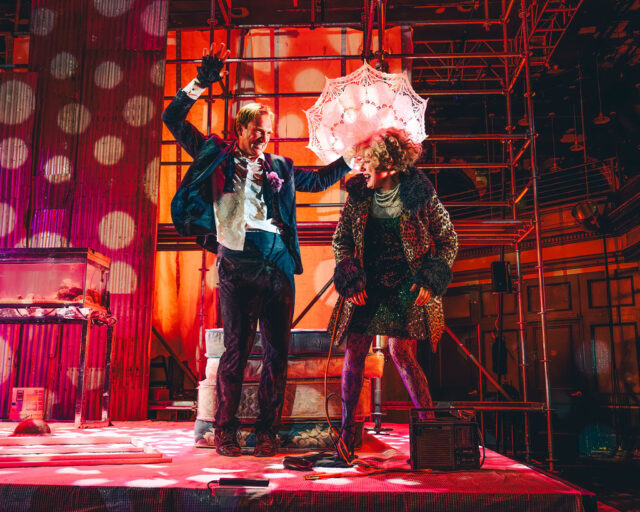
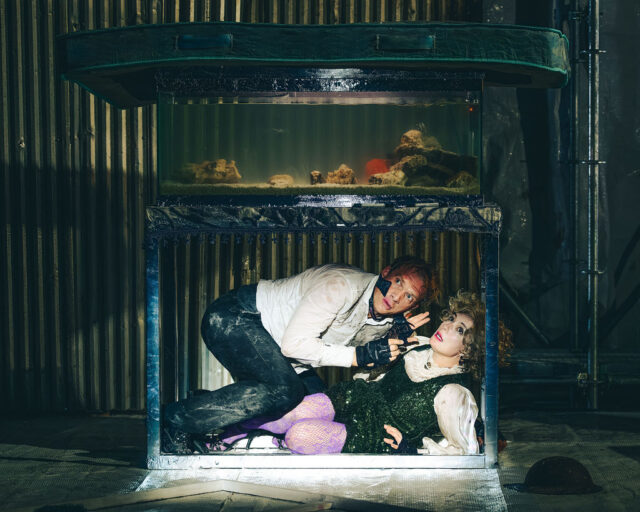
In the deliriously brilliant Delirium, based on Romanian-French playwright Eugène Ionesco’s rarely performed 1962 Frenzy for Two, or More, Golyak, the artistic director of the Massachusetts-based Arlekin company, explores the complex nature of love and the absurd ridiculousness and horrors of war, laying bare the elements of stagecraft in telling the story of an unnamed man (Andrey Burkovskiy) and woman (Chulpan Khamatova) who bicker continuously in their ramshackle apartment in an unidentified country as a fierce military battle rages on outside. Jan Pappelbaum’s set is a marvel of chaos, a center platform with a pile of old, dusty mattresses, a bucket, empty window frames and mirrors, and a large fish tank with a large live goldfish in it, all surrounded by scaffolding tenuously holding aluminum sheets of varying sizes.
During the play’s fast-paced ninety minutes, the couple argues over just about everything, starting off with their decision to be together seventeen years before, immediately establishing the current state of their relationship.
She: The life you promised me! And the life you give me! I left my husband to follow my lover. How romantic! My husband was ten times better, seducer! He didn’t contradict me stupidly! He: I don’t contradict you on purpose. When you say things that aren’t true, I can’t just accept them. I have a passion for the truth. She: What truth? I’m telling you there’s no difference. That’s the truth. There’s no difference. A snail and a turtle, they’re the same thing. He: No they’re not. They’re not the same animal at all. She: Animal yourself. Idiot. He: You’re the idiot. She: You’re insulting me, you imbecile, you’re disgusting, seducer.
The mollusks represent themselves, two beings whose lives move slowly, if at all, trapped within shells that may not be able to protect them from what’s outside. The man and woman may think they’re different, but they’re more similar than they’ll ever admit.
She declares, “Oh, enough! Shut up! You’d better. I can’t stand listening to you ramble anymore.” He responds, “I can’t stand listening to you either. I don’t want to hear anything.” At that instant, an explosion rattles their apartment, a moment that’s both funny and frightening. They debate whether a plaster fragment is the Venus de Milo or the Statue of Liberty, signifying the loss of love and/or freedom. He’s hot, she’s cold. He says “yes,” she says “no.” Their constant disagreements over insignificant things pale in comparison to the war, which they take seriously only when they believe they are in immediate danger, like so many people around the globe — and especially in America.
A buzzer rings, and they worry that they’re coming for them. We never find out who “they” are — the good guys, the bad guys, ICE. In this case, it doesn’t matter, as the whole world has gone to hell, and there’s no place left to hide.
“We’re caught between two fires. What made you pick this place at the border of two neighborhoods?” she complains. He snaps back, “You’re the one who wanted this place. . . . You wanted this apartment for the beautiful view.” Today, it feels like we’re all living on the border of two combative neighborhoods, perhaps sacrificing safety for the illusion of beauty.
As the war grows closer to the man and the woman, they have to think fast, and stop quarreling, if they want any kind of future.
An unnamed man (Andrey Burkovskiy) and woman (Chulpan Khamatova) seek a place to hide in deliriously entertaining Ionesco adaptation (photo by Austin Ruffer)
Golyak directs with a masterful hand, leaving no stone unturned; he takes advantage of every word, every punctuation mark, never wasting an opportunity to add to the maelstrom. He makes ingenious use of the props, from a movable door and the mattresses to a radio and the aluminum sheeting; even Sasha Ageeva’s costumes get in on the act. An early scene involving the man’s hat and the woman’s wig is like a vaudeville skit, while other scenes recall silent comedy. Jeff Adelberg’s lighting, Denis Zabiyaka’s sound, and Anna Drubich’s music take expert advantage of the space, following the man and the woman as they make their way into the audience, onto the scaffolding, and across the balcony.
Burkovskiy (Seagull: True Story, Khonen in The Dybbuk) and Khamatova (Ivanov,Shushkin’s Stories), who appeared together in the San Francisco production of Our Class, are superb as the longtime lovers, reminding me of a younger Christopher Lloyd and Carol Kane, with touches of Ricky and Lucy, Ralph and Alice, and George and Martha. They both display expert comic improv chops and occasionally relate directly to the audience, particularly as the play progresses. Burkovskiy has an electric stage presence, while Khamatova wonderfully balances innocence and petulance.
Amid all the frenzied hilarity and increasing rubble, Golyak injects some key points that may seem obvious but are being ignored by too many of us. Talking about the approaching soldiers, the man says, “Whether they’re going up or down, it’s about the same. Next time they’ll come for us.” After a missile flies past, he admits, “Yes, it’s impossible to have peace; but it’s beyond our control. It’s objectively impossible.” And a few moments later, when the bombing appears to have stopped, she says, “Probably intermission.”
In Delirium, as in real life, there is no intermission, not even for that poor fish, who just keeps swimming around his tank, oblivious, just trying to survive until tomorrow.
[Mark Rifkin is a Brooklyn-born, Manhattan-based writer; you can follow him on Substack here.]
Mairéad O’Neill and Thomas Ellenson star in Thomas & Me (photo by Douglas J. Cohen)
THOMAS & ME
Frank Shiner Theater
Sheen Center for Thought and Culture
18 Bleecker St. between Mott & Elizabeth Sts.
September 24-28, $20-$75 sheencenter.org
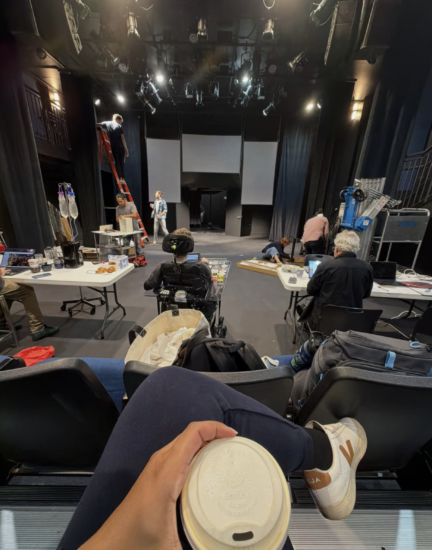
“I love acting. It’s the only place people stare at me for the right reasons,” award-winning actor, writer, and director Thomas Ellenson says on his website. Ellenson, who has cerebral palsy, uses a power wheelchair, and communicates through an iPad, will be the center of attention when he brings his new play, Thomas & Me, to the Frank Shiner Theater at the Sheen Center, where it runs from September 24 to 28.
In the ninety-minute autobiographical show, Ellenson portrays a man who reevaluates his life as he considers proposing to his girlfriend. The cast also features Mairéad O’Neill (I and You,Soft Star) and Tyler Austin White (The Full Monty,Legally Blonde), with music and lyrics by composer-lyricist Douglas J. Cohen (No Way to Treat a Lady,The Opposite of Sex) and choreography by Megan Loomis.
“Thomas has created a truly heartwarming and moving story that invites both artists and audiences to reconsider how we tell stories about disability — and, in fact, about all our lives. It is a powerful, deeply human piece that has the potential to inspire meaningful change in how we all see ourselves,” codirector Stephen Santa said in a statement. Cohen added, “I’m excited to be working on such a unique, surprising, and theatrical piece with such a wonderful team of artists. In Thomas & Me, so much resonates emotionally for me, and Thomas has a gift for finding humor and universality in his storytelling. That made my job as a songwriter especially rewarding.”
Among the songs performed in the show are “I Am Not a Morning Person,” “Yes, But . . . ,” and “Waiting in the Wings”; Sujin Kim-Ramsey is the musical director.
Thomas & Me opens runs September 24 to 28 at the Frank Shiner Theater (photo courtesy Thomas Ellenson)
Ellenson previously won Best Production at United Solo in 2025 for Well, Life Sucks and Best Production at the One Festival in 2017 for It Is What It Is.
“If you can’t laugh at cerebral palsy, you really need to develop a sense of humor. And here it is,” Ellenson recently posted on Instagram.
The short run is almost sold out, so you better act fast if you want to stare at Ellenson for all the right reasons.
[Mark Rifkin is a Brooklyn-born, Manhattan-based writer; you can follow him on Substack here.]