featured

THE RISE AND FALL, THEN BRIEF AND MODEST RISE FOLLOWED BY A RELATIVE FALL OF . . . JEAN CLAUDE VAN DAMME AS GLEANED BY A SINGLE READING OF HIS WIKIPEDIA PAGE MONTHS EARLIER

Joe Cordaro and John Harlacher star in Timothy Haskell’s semibiographical play about Jean Claude Van Damme (photo by Nathaniel Nowak)

THE RISE AND FALL, THEN BRIEF AND MODEST RISE FOLLOWED BY A RELATIVE FALL OF . . . JEAN CLAUDE VAN DAMME AS GLEANED BY A SINGLE READING OF HIS WIKIPEDIA PAGE MONTHS EARLIER
The Pit Loft
154 West Twenty-Ninth St. between Seventh & Eighth Aves.
Friday – Sunday through July 17, $24.99 with discount code JCVD22, 7:30
thepit-nyc.com

I’ve seen so many meticulously researched plays about real-life figures and situations, wondering what is actually true and what has been tweaked — or just plain made up — for dramatic effect, that Timothy Haskell’s new work is a breath of fresh air. The title explains exactly what you’re in for: The Rise and Fall, Then Brief and Modest Rise Followed by a Relative Fall of . . . Jean Claude Van Damme as Gleaned by a Single Reading of His Wikipedia Page Months Earlier. Haskell checked out Jean Claude Van Damme’s relatively lengthy Wikipedia entry, then, a few months later, wrote a play based only on what he could remember, without doing any further reading or fact checking. “Absolutely no research was put into learning anything about the subject at hand,” we are told early on. “It was all gleaned from one cursory glance at his Wikipedia page, and just general knowledge of the man based on tabloid headlines.”

The result is a breezy, extremely funny look at fame, ambition, gossip, and celebrity, gleefully codirected by Haskell, set designer Paul Smithyman, and puppet master Aaron Haskell (Timothy’s brother). For about an hour at the Pit Loft, John Harlacher and Joe Cordaro, standing behind makeshift podiums, share the not-necessarily-true story of the Muscles from Brussels. Between them is an angled table with slots where they place cardboard cutouts on Popsicle sticks of Van Damme and people who have been part of his personal life and professional career — or have nothing to do with him. Behind them is a small “screen” on which they project photos and a few choice film clips, including a fantastic moment from 1984’s Breakin’ with Van Damme as an uncredited background extra.

Both actors play multiple roles, but the hirsute Harlacher (Bum Phillips, Dog Day Afternoon) is mainly the narrator, meandering through his overstuffed, disorganized notebook, while Cordaro (The Foreigner, The Tiny Mustache) is mostly the former Jean-Claude Camille François Van Varenberg, reacting to what the narrator says and occasionally taking center stage to act out various scenes, including JCVD’s infamous barfight with Chuck Zito.

Timothy Haskell and the narrator make no bones about what went into the scattershot though chronological show, which has a proudly middle school DIY aesthetic. Introducing the Breakin’ clip, the narrator explains, “There’s a pretty fun YouTube remix our author was lucky enough to stumble upon while limply researching another play about the movie Breakin’ that some guy did that looks like this.” The two actors dance along with JCVD, after which the narrator rhetorically asks, “Isn’t that fun?” Yes it is!

Repurposed action figures play a pivotal role in JCVD show at the Pit Loft (photo courtesy Aaron Haskell)

Commenting on JCVD’s battle with drugs, the narrator admits, “As for Jean Claude, he did that stupid thing in Breakin’ and then toiled away some more and did a ton of bullshit and got all kinds of high. Not on life either, brother. The man was a straight up smack head if smack head means you did lots of cocaine which the author is now not sure it does. Fed up and high as a Romanian glue-huffer he decided to make some bold moves. He decided to case Joel Silver’s office. Joel Silver was the producer of Road House starring Patrick Swayze that was later turned into a hit play by Timothy Haskell who thought after that he could do serious work but was wrong.”

As JCVD’s career rises and falls and rises and falls and so on, we (sort of) learn about his siblings, his wives, his martial arts mentors and heroes, his perhaps partially fabricated tournament record, and his hotly anticipated confrontation with Steven Seagal. We go behind the scenes of such films as Bloodsport, Kickboxer, Universal Soldier, and Timecop. Oh, and there is plenty of fighting, carried out by Cordaro and Harlacher with repurposed action figures, designed by Aaron Haskell, battling it out on a long, narrow fencing piste at the front of the stage. It’s like watching two young friends playing in the basement with their GI Joe dolls — the ones with kung fu grip, of course.

As a founding member of Psycho Clan, Haskell has presented such immersive horror experiences as This Is Real, Santastical, and I Can’t See. He has also directed James and the Giant Peach, Fatal Attraction: A Greek Tragedy, Road House: The Stage Play, and the upcoming graffiti drama Hit the Wall.

In an April 2014 twi-ny talk about his interactive Easter-themed eggstravaganza, Full Bunny Contact, I asked him, “What happened to you as a child? Based on the kinds of shows and events you write, produce, direct, and create, there had to be some kind of major trauma involved.” He replied, “Nothing unusual. My mother says she dropped a toy Ferris wheel on my head, and anytime I do something unusual she blames herself for dropping a heavy toy on my noggin.” That could explain this new work as well.

The show concludes with an extended monologue by JCVD, who begins by warning, “I know what happened. I am me. I don’t need to read a Wikipedia page to know who I am. I did, however. Thoroughly. Ya know, for safety.”

There’s nothing safe about The Rise and Fall, Then Brief and Modest Rise Followed by a Relative Fall of . . . Jean Claude Van Damme as Gleaned by a Single Reading of His Wikipedia Page Months Earlier. But there is a whole lot that is hilariously entertaining. And that person sitting behind you, laughing even harder than you, just might be Timothy Haskell himself.

CASCANDO

Pan Pan’s Cascando takes cloaked and hooded audiences through the Village (photo by Ian Douglas)

CASCANDO
NYU Skirball
566 LaGuardia Pl.
Through July 3, $35
nyuskirball.org
www.panpantheatre.com

“What are they!?” a young woman shouted on a recent early evening in Washington Square Park as we marched in a slow procession, more than a dozen people wearing long black cloaks and hoods. She wasn’t the only one confused by what was happening. As we took off from NYU Skirball, we had to wind past graduating seniors in purple robes celebrating with friends and family; hopefully they didn’t take our silent appearance as a sign of impending doom.

A few months ago, I experienced Chasing Andy Warhol, Manhattan-based Bated Breath’s immersive production in which a guide led an audience of no more than sixteen on a walk through Greenwich Village, encountering different manifestations of the Pop artist that played out in vignettes on the streets, where passersby could stop and watch and take photos and video even if they didn’t quite know exactly what was going on, though the multiple Warhols were obvious.

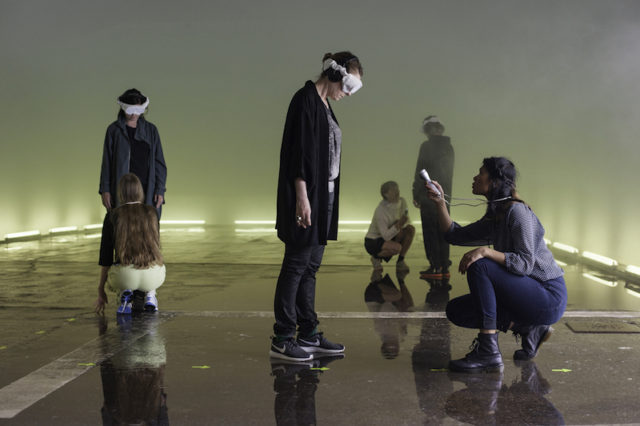
I went on a very different kind of theatrical walk last week, Dublin-based Pan Pan theater’s immersive, mysterious adaptation of Samuel Beckett’s early 1960s “radio piece for music and voice,” Cascando. We gathered, put on robes and headphones (under our hoods), and sauntered in formation as we listened to two thick, Irish-accented voices read Beckett’s words. In 1936, Beckett had written a love poem with the same title, which American poet Robert Pinsky, in comparing it to William Butler Yeats’s “Adam’s Curse,” explained in Slate, “More passionate than dismissive, too dire and skeptical to be read at weddings, yet ardent, these poems are explicitly in conflict with writing itself, yet embrace it.” Just like Warhol’s films, such as Kitchen and Empire, where narrative storytelling conventions are hard to find, much of Beckett’s work, including Cascando, does not incorporate standard plotting devices either. In essence, Cascando is about the art of storytelling itself, but only as Beckett can tell it.

The half-hour tale is told by Dan Reardon as Opener, Andrew Bennett as Voice, and Jimmy Eadie as Music, as Beckett equates voice and music, the former about meaning, the latter feelings. The first words we hear are Opener saying, “It is the month of May . . . for me,” as if it might not be for the rest of us. That is about as specific as the piece gets as it deals with starting and finishing, getting lost, vague memories, an abstract sense of place, and what goes on inside one’s head. The words spoken by Bennett lead right into Eadie’s tense, dramatic instrumentals, sometimes with extended breaks that can make you wonder whether the narration is over. (Marcel Mihalovici composed the original score.)

In their book The Collected Poems of Samuel Beckett, editors Seán Lawlor and John Pilling elucidate that the term “‘cascando’ is (rarely) used in music to distinguish a diminuendo in volume and/or tempo,” particularly as the end approaches. The repetitive text, however, doesn’t really have a beginning, middle, or finale, or at least not in the way theatergoers generally expect.

In a low panting, Voice begins, “—story . . . if you could finish it . . . you could rest . . . sleep . . . not before . . . oh I know . . . the ones I’ve finished . . . thousands and one . . . all I ever did . . . in my life . . . with my life . . . saying to myself . . . finish this one . . . it’s the right one . . . then rest . . . sleep . . . no more stories . . . no more words . . . and finished it . . . and not the right one . . . couldn’t rest . . . straight away another . . . to begin . . . to finish . . . saying to myself . . . finish this one . . . then rest . . . this time . . . it’s the right one . . . this time . . . you have it . . . and finished it . . . and not the right one . . . couldn’t rest . . . straight away another . . . but this one . . . it’s different . . . I’ll finish it . . . then rest . . . it’s the right one . . . this time . . . I have it . . . I’ve got it . . . Woburn . . . I resume . . . a long life . . . already . . . say what you like . . . a few misfortunes . . . that’s enough . . . five years later . . . ten . . . I don’t know . . . Woburn . . . he’s changed . . . not enough . . . recognizable . . . in the shed . . . yet another . . . waiting for night . . . night to fall . . . to go out . . . go on . . . elsewhere . . . sleep elsewhere . . . it’s slow . . . he lifts his head . . . now and then . . . his eyes . . . to the window . . . it’s darkening . . . earth darkening . . . it’s night . . . he gets up . . . knees first . . . then up . . . on his feet . . . slips out . . . Woburn . . . same old coat . . . right the sea . . . left the hills . . . he has the choice . . . He has only—” Opener responds, “And I close. . . . I open the other.” Then music.

Much of the rest of the text continues that pace and language, a story about a story about Woburn that opens and closes and veers off into puzzling tangents that occasionally relate to the procession. “Don’t lose him . . . follow him . . . waiting for night . . . night to fall,” Voice says, as if reminding us to stay right behind the person in front of us (our own personal Woburn, who is described as wearing the “same old coat”?) as, indeed, dusk approaches. “It’s in his head,” Opener points out, and of course, this is all happening inside our heads. The back-and-forth language is reminiscent of what the anonymous protagonist declares in Beckett’s 1953 novel The Unnamable: “You must go on. I can’t go on. I’ll go on.”

Poetic procession passes people who are perplexed, take pictures, or are simply nonplussed (photo by Ian Douglas)

As we go on, getting closer to the conclusion and are ambling determinedly through Greenwich Village back to Skirball, Opener says, “Then the return. Where? To the village.” During the journey, a few people stopped and took pictures or video, some cast sideways glances, curious about who we were and what we were doing, but mostly passersby just ignored us, as if there was nothing strange or different about our ceremony. One graduate laughed, put his purple robe over his head, and joined in for a few steps. Fortunately, no one threw rocks, which creator and director Gavin Quinn said had occurred when Cascando was presented in Düsseldorf. (It has also been performed at the Barbican London, the Beckett Festival in Enniskillen, the Galway International Arts Festival, and the Samuel Beckett Theatre in Dublin.)

I highly recommend fully immersing yourself into the walk and embracing designer Aedín Cosgrove’s costume; if you bring a purse, pocketbook, or shoulder bag, make it a black one, and try to keep it inside the cloak to avoid any bits of color forming a distraction. Also, even though you’ll be outside, wear a black mask to cover much of whatever part of your face is visible to others; it will add to the anonymity and enigma of it all as passersby ponder whether you’re in a demonic cult or en route to an Eyes Wide Shut sex party.

Beckett himself called Cascando “an unimportant work but the best I have to offer. It does I suppose in a way show what passes for my mind and what passes for its work.” Pan Pan, which has staged such other Beckett concoctions as Endgame, Quad, Embers, and All That Fall in addition to adaptations of William Shakespeare, Bertolt Brecht, Anton Chekhov, Henrik Ibsen, Aldous Huxley, and Oscar Wilde, has put together a unique pilgrimage with Cascando, a personal journey as well as an homage to Beckett, a melding of the interior and the exterior, held in an area of New York City bubbling over with life, promise, and hope.

SigSpace: EMANCIPATED STORIES

Who: Quiara Alegría Hudes, Sean Ortiz, Sean Carvajal, Dominic Colón, Kenyatta Emmanuel, Suave Gonzales, Renee Goust, David Zayas, Kenyatta Emmanuel, Renee Goust, Jamie Maleszka, more
What: Installation and pop-up events
Where: Signature Theatre, the Pershing Square Signature Center Lobby, 480 West Forty-Second St. at Tenth Ave.
When: June 29 – July 24, Tuesday – Sunday, noon – 5:00, free
Why: Last summer, the Signature Theatre reopened with the immersive installation The Watering Hole, which included Vanessa German and Haruna Lee’s “This Room Is a Broken Heart,” part of which involved choosing a postcard designed by an incarcerated individual and sending a note to someone living behind bars. This summer the Signature has taken that a step further by teaming with the Fortune Society and Emancipated Stories to present an installation focusing on words and art by incarcerated people. Founded in 1967, the Fortune Society’s mission is “to support successful reentry from incarceration and promote alternatives to incarceration, thus strengthening the fabric of our communities . . . through believing, building lives, and changing minds.” Emancipated Stories was started by prison reform activist and playwright Quiara Alegría Hudes and her cousin Sean Ortiz, who spent ten years behind bars, as a way for incarcerated people to have their voices heard through handwritten letters that are shared on Instagram and in special installations.

Hudes, the Signature’s premiere writer-in-residence and author of such works as In the Heights, Water by the Spoonful, Daphne’s Dive, and Miss You Like Hell, explained in a statement, “The thing that’s fun and safe about theater is that the basic rule of engagement is one of listening. The fundamental contract is: I’m going to listen, I’m going to pay attention. Similarly, what we’re seeking to create is a communal space of sharing and openness. Within this installation and the events we’ve planned, the lines between audience and performer are more porous; it’s more of a gathering, and there’s no fourth wall, and we put the original letters in people’s hands. When you hold someone’s piece of paper and it’s handwritten — and you feel the grooves — it’s like holding someone’s hand. It’s an instant connection that’s part of the liveness of it. Surprising heart doors come open in these moments.”

“The Fortune Society is thrilled to be in community and collaboration with Signature Theatre and Quiara Alegría Hudes to help bring this insightful and moving project to life,” Fortune Society director of creative arts Jamie Maleszka added. “The goal of Emancipated Stories is to center and celebrate the full humanity of community members who are currently and formerly incarcerated and to grow meaningful connections through storytelling. The project perfectly aligns with our mission to build people, not prisons, and invest in more just collective futures.”

“SigSpace: Emancipated Stories” will be open in the theater lobby Tuesday through Sunday from June 29 through July 24, from noon to 5:00; admission is free. In addition, there will be four pop-up events, free with advance RSVP, featuring actors, artists, activists, musicians, writers, and members of the Fortune Society activating the installation, which was designed by Yazmany Arboleda with Emmanuel Oni, through music, discussions, readings, and writing letters in response to those from incarcerated individuals.

Wednesday, June 29
Kick-off, with actors David Zayas and Sean Carvajal, artist and activist Suave Gonzales, and Felix Guzman and Daniel Kelly of the Fortune Society, hosted by playwright Quiara Alegría Hudes, free with RSVP, 5:00 – 7:00

Wednesday, July 13
Music Night, with composer Kenyatta Emmanuel, singer-songwriter Renee Goust, writer and actor Dominic Colón, and others, hosted by Quiara Alegría Hudes, free with RSVP, 5:00 – 7:00

Sunday, July 17
Family Day, with Fortune Society community members and actor Sean Carvajal, moderated by Fortune Society director of creative arts Jamie Maleszka and Quiara Alegría Hudes, free with RSVP, noon – 2:00

Wednesday, July 20
Quiet Writing Time, free with RSVP, 5:00 – 7:00

PAUL MAHEKE: A FIRE CIRCLE FOR A PUBLIC HEARING

Paul Maheke rehearses A fire circle for a public hearing before US debut on the High Line this week (photo by twi-ny/mdr)

Who: Paul Maheke, Morgan “Emme” Bryant, Lucy Hollier, Rafaelle Kennibol-Cox
What: High Line Art live performance
Where: The High Line at Fourteenth St.
When: June 28-30, free (advance RSVP recommended), 7:00
Why: “My work is always in reaction or in response to a certain space, a certain context,” multidisciplinary French artist Paul Maheke said in a 2018 discussion about his installation A fire circle for a public hearing at Chisenhale Gallery in London. “Often in my exhibitions, there is this notion of welcoming people in the space, whether they are collaborators or members of the audience.” Maheke is reimagining A fire circle for a public hearing for its US debut, taking place in the Fourteenth St. tunnel passage on the High Line June 28-30 at 7:00. He will be joined by dancers Morgan “Emme” Bryant and Rafaelle Kennibol-Cox and trombonist Lucy Hollier. The piece combines music, movement, and spoken word as Maheke explores marginalization, hypervisibility, erasure, and identity.

Paul Maheke’s A fire circle for a public hearing premiered at Chisenhale Gallery in London in 2018 (photo by Mark Blower)

“Paul’s work asks important questions about what it means to be a body onstage, and how a single person is able to hold many shared and overlapping histories in a single gesture. He encourages us to think about what is seen and what is not seen, both in the performance of a single person, but also in our wider cultures and histories at large,” High Line Art associate curator Melanie Kress said in a statement. Judging from a rehearsal I saw a few days ago, this is a powerful work with a lot to say about where we are at this moment in history.

FAT HAM

Marcel Spears stars as a different kind of Hamlet in James Ijames’s Pulitzer-winning Fat Ham (photo by Joan Marcus)

FAT HAM
Anspacher Theater, the Public Theater
425 Lafayette St. at Astor Pl.
Tuesday through Sunday through July 31, $50-$80
212-539-8500
publictheater.org

There’s no “To be or not to be” in James Ijames’s rousing, spirited adaptation of one of William Shakespeare’s most famous tragedies, Hamlet. In the Pulitzer Prize–winning Fat Ham, continuing at the Public’s Anspacher Theater through July 31, there’s no “To thine own self be true,” no “There are more things in Heaven and Earth, Horatio,” no “Good-night, sweet prince,” no “Something is rotten in the state of Denmark.” But to give you the tasty flavor of Ijames’s big queer Black take on the familiar tale, his Hamlet, known as Juicy (Marcel Spears), says, “Ah, there’s the rub” only after Rev (Billy Eugene Jones) shares the secret to smoking pork.

The ninety-five-minute show, coproduced by the National Black Theatre and the Public, takes place in the backyard of, according to the script, “a house in North Carolina. Could also be Virginia, or Maryland or Tennessee. It is not Mississippi, or Alabama or Florida. That’s a different thing all together.” The time is “a kind of liminal space between the past and the present with an aspirational relationship to the future that is contingent to your history living in the south. All that to say . . . I’m writing this play from inside the second decade of the twenty-first century. This world aesthetically sits anywhere in the four to six decades preceding the current moment.”

At its core, the story echoes the original. Juicy’s father, the king (Claudius; Jones), has been murdered by his brother, Rev, who then married his brother’s widow, Tedra (Gertrude; Nikki Crawford). Juicy hangs out with his best friend, Tio (Horatio; Chris Herbie Holland). Everyone assumes that Juicy is destined to wed his supposed true love, Opal (Ophelia; Adrianna Mitchell). Her very protective brother, Larry (Laertes; Calvin Leon Smith), is in the military and suffers from PTSD. Tedra’s best friend, Rabby (Polonius; Benja Kay Thomas), Larry and Opal’s mother, loves drinking and celebrating the Lord.

The play opens with Juicy on the back porch of a suburban home helping prepare for a barbecue party for Rev and Tedra’s bethrothal as Tio watches porn on his phone. “Your daddy ain’t been dead a week and he already Stanley steamering your mom. Cold,” Tio says. “Stanley steamering your mom . . . ,” Juicy quizzically repeats. Tio clarifies, “Eating your momma’s box? Doing the nasty with your mom? That better?” This is not your grandparents’ Hamlet.

Rev (Billy Eugene Jones) leads a prayer before family and friends partake of barbecue in Fat Ham (photo by Joan Marcus)

A few minutes later, Juicy is visited by the ghost of his father, Pap, dressed in white, eerie smoke drifting around his neck and shoulders. Pap wants his son to avenge his death — and to stop eating candy bars unless he wants to get “the suga,” which runs in the family. Pap orders Juicy to split Rev open: “Make his thighs into hams. His intestines into chitlins. Pickle his feet and boil his head down to a skull! Crisp up his belly and dry out his balls and grind them up into a fine powder. Lay that all out on the table, invite over your nearest and dearest, and feast. And then make me a plate.” Pap also belittles his son’s education choices, studying human resources at the University of Phoenix. “Scam. Who goes to college online to learn how to manage human beings. Them things don’t go,” he scolds.

The potential relationship between Juicy and Opal has a bit of a problem that only the two of them are aware of: They are both gay. Meanwhile, Larry has a dark secret of his own. But the party goes on, as Rev sings Teena Marie and Juicy warbles Radiohead’s “Creep,” a kind of replacement for the “To be or not to be” soliloquy: “I don’t care if it hurts / I wanna have control / I want a perfect body / I want a perfect soul / I want you to notice / When I’m not around / So fuckin’ special / I wish I was special / But I’m a creep / I’m a weirdo / What the hell am I doin’ here? / I don’t belong here.” The lyrics represent what so many young queer Black men experience, not wanting to be made to feel invisible and less than.

Juicy uses charades to tell his uncle he knows what he did: “The play’s the thing / Wherein I’ll catch the conscience of . . . the . . . King. Cook. He is a cook in this play,” he tells the audience. The game is on as Rev and Juicy battle it out.

Juicy (Marcel Spears) and Opal (Adrianna Mitchell) are not destined to fall in love in reimagining of Shakespeare’s Hamlet (photo by Joan Marcus)

Fat Ham is outrageously funny, featuring superb over-the-top performances by the ensemble. Spears (Othello, A Midsummer Night’s Dream) has a tender gentleness, a softness, to his every move; dressed in all black (the contemporary costumes are by Dominique Fawn Hill), he would fit right in as Usher in Michael R. Jackson’s A Strange Loop, another “big Black queer” character with a complicated relationship with his family and other people who’s trying to figure out just who he is and what he wants out of life. Human resources is probably not Juicy’s best career path. Perhaps Ijames named him after the Notorious B.I.G. song “Juicy,” in which Biggie Smalls declares, “You know very well / Who you are / Don’t let ’em hold you down / Reach for the stars / You had a goal / But not that many / ’Cause you’re the only one / I’ll give you good and plenty.”

Ijames (White, Kill Move Paradise) interjects Shakespeare at just the right moments, as when, after Larry and Juicy share an intimate moment, the latter turns to the audience and delivers one of the Bard’s masterpieces, the poetic speech that begins “What a piece of work is a man!” But Ijames keenly changes one pronoun, and the meaning of the prose is altered following the scene we just watched,

Stacey Derosier’s lighting keeps things bright and cheery, as does Darrell Grand Moultrie’s choreography on Maruti Evans’s backyard set. Director Saheem Ali (Nollywood Dreams, Merry Wives) ably balances the wackiness with the serious nature of so much of Ijames’s dialogue alongside whimsical references to Ms. Cleo, OnlyFans, and sexy muppets. But it’s not all lighthearted fun.

At one point, Tio, talking about what he is learning from his therapist, explains to Juicy, “He said . . . These cycles of violence are like deep. Engrained. Hell, engineered. Hard to come out of. Like, your Pop went to jail, his Pop went to jail, his Pop went to jail, his Pop went to jail, and what’s before that? Huh? Slavery. It’s inherited trauma. You carrying around your whole family’s trauma, man. And that’s okay. You okay. But you don’t got to let it define you.”

Juicy is determined not to follow in his father’s footsteps, trying to overcome the systemic institutional racism that dooms so many Black men and tears apart families. That’s not exactly the same thing as the handing down of the crown from generation to generation of white men and boys —but it has the potential to become the half-million-dollar crown Biggie was famous for wearing.

CORSICANA

Justice (Deirdre O’Connell), Christopher (Will Dagger), and Ginny (Jamie Brewer) watch Mariah Carey in Glitter in Corsicana (photo by Julieta Cervantes)

CORSICANA
Playwrights Horizons, Mainstage Theater
416 West 42nd St. between Ninth & Tenth Aves.
Tuesday – Sunday through July 17, $35-$99
www.playwrightshorizons.org

In her acceptance speech for winning the Tony for Best Actress for her performance in Dana H., Deirdre O’Connell said, “I would love this little prize to be a token for every person who is wondering, ‘Should I be trying to make something that could work on Broadway or that could win me a Tony Award? Or should I be making the weird art that is haunting me, that frightens me, that I don’t know how to make, that I don’t know if anyone in the whole world will understand?’ Please let me standing here be a little sign to you from the universe to make the weird art.”

O’Connell has followed up Dana H., in which she never speaks but instead remarkably conveys a prerecorded true story told by playwright Lucas Hnath’s mother, with Will Arbery’s Corsicana, which has its fair share of weird, starting with the word itself, which is spoken two dozen times by the four characters, each of whom lives in their own reality.

Corsicana takes place in the Texas town named after the island of Corsica. Thirty-three-year-old Christopher (Will Dagger) is a teacher and an aspiring filmmaker who lives with his thirty-four-year-old half sister, Ginny (Jamie Brewer), in the family’s ranch house. They are often visited by the sixtysomething Justice (Deirdre O’Connell), who was best friends with their recently deceased mother.

After her mom’s death, Ginny, who has Down syndrome, is looking for something new to do. She doesn’t want to go back to her job at the nursing home or rejoin the choir because she feels she doesn’t belong. “I’m worried. I can’t find my heart,” she tells her brother.

Ginny had suggested that Ginny meet her friend Lot (Harold Surratt), a sixtysomething reclusive artist and musician who has just been “discovered” via a magazine article; Christopher thinks it might be good for Ginny to write a song with Lot, who previously played an original song for Christopher called “Weird.” (The original music is by singer-songwriter and visual artist Joanna Sternberg.)

A self-taught outsider artist, Lot is a loner who has trouble communicating directly with others, speaking in a sharp, straightforward manner, using few words and prone to non sequiturs; he has no phone or computer. He doesn’t want to interact with either the virtual or real world. And although he believes he may be neurodivergent, he is not about to be a babysitter for a woman with special needs.

Justice (Deirdre O’Connell) pleads with Lot (Harold Surratt) in new Will Arbery play (photo by Julieta Cervantes)

He tells Christopher: “Yeah, I know ‘special needs.’ Why’d you come here? I know the place in the high school. The hallway in the high school. You know I’m not one of them, right?” Christopher replies, “What?” Lot: “I’m not special needs.” Christopher: “Oh — I didn’t think you were. I assumed the opposite.” Lot: “What’s the opposite? I was only a couple years in that hallway. And they knew I didn’t belong. Got a graduate degree in my forties. So don’t worry about me.” Christopher: “Oh, cool. In what?” Lot: “Experimental mathematics. I proved the existence of God.” Christopher: “Are you serious? Can I see?” Lot: “I threw it away. Art’s a better delivery system.”

Art may be a better delivery system, but Lot prefers not to show anyone his work or exhibit in a gallery, or to even sell it. When Justice, who believes she is being trailed by a ghost, asks to see his latest sculpture, he declares, “No, it’s not ready! You’re not allowed to look back there.” The audience is not allowed to look either; none of Lot’s work is ever revealed. He later compares capitalism and consumption as a “prison . . . a man-made evil.” He also claims that they are all surrounded by dinosaur ghosts.

As the characters continue to interact with one another, Lot is fearful about becoming part of something. “You trying to get me to believe in community?” he asks Justice, who replies, “No. I have no agenda.” Lot: “Uh-huh.” Justice: “What do you have against community?” Lot: “I don’t have to have all the same opinions as you,” as if choosing to spend time with people is an opinion.

But he does find common ground with Ginny, explaining that the two of them are “so complicated, people don’t want to think about it. So they make us more simple. In their brains. They don’t think about it, and they call us simple. And everything is about our needs. All our little needs. Our special needs. Everyone around us becoming burdened by our constant need. And if there’s something that we want? Well, it’s for them to decide if we really need it.”

Over the course of the play, all the characters find some form of commonality with the others while also maintaining barriers, particularly when it comes to physical contact of any kind. “People have to understand touch, and ask for permission, and respect boundaries,” Ginny tells Lot. “Touch can cause problems.”

Obie- and Tony-winning director Sam Gold, who has helmed such marvelously inventive productions as Fun Home, John, and A Doll’s House, Part 2 in addition to critically lambasted versions of King Lear, Hamlet, and Macbeth, injects Corsicana with, well, a weird edge throughout. Laura Jellinek and Cate McCrea’s stage consists of a pair of rotating brown couches set against a white backdrop and ceiling, but Justice and Lot spend time sitting on the floor. Often, when two characters are interacting, one or both of the other actors watch from the far corners. Several times, two of the actors push poles to move part of the set toward the audience in order to change Isabella Byrd’s canopy lighting. Meanwhile, the long, horizontal, slanted back white wall serves as the entrance to Lot’s studio, which he often locks to keep people out of his space — and head.

Christopher (Will Dagger) and Ginny (Jamie Brewer) seek connections in Corsicana (photo by Julieta Cervantes)

There is a lot of repetition in the play, which could use a significant amount of trimming from its two-and-a-half-hour length (including intermission). The terrific cast is led by Surratt’s (Familiar, Serious Money) powerful performance as the antisocial Lot — evoking the biblical figure who lived in Sodom, “a righteous man who was tormented in his soul by the wickedness he saw and heard day after day” — primarily standing stiffly upright when talking as he, Justice, Christopher, and Ginny form a kind of found family. Arbery (Pulitzer finalist Heroes of the Fourth Turning, Plano), who is from Texas and Wyoming, based Christopher and Ginny on himself and one of his seven sisters, who has Down syndrome. He also knows about unique families, having served as executive consultant on the third season of Succession.

Brewer (American Horror Story, Amy and the Orphans) brings an unfettered honesty to Ginny, Dagger (Among the Dead, The Antelope Party) is appropriately offbeat as Christopher, and O’Connell (Circle Mirror Transformation, In the Wake) is just the right kind of quirky as the, um, weird Justice, who is writing a book that echoes the subject of Arbery’s play. She explains to Christopher:

“Well, it’s about anarchism and gifts. About the belief that humans are fundamentally generous, or at least cooperative. That in our hearts, most of us really do want the good. It’s about the evils of centralized power, specially in a country as massive as the USA, let alone a state as big as Texas. It’s about an unforgiving land. It’s about unrealized utopias. It’s about how failing is the point. It’s about surrender. It’s about small groups. It’s about community. It’s about the right to well-being. It’s about family. It’s about the dead. It’s about ghosts. It’s about gentle chaos. It’s about contracts of the heart. And the belief that when a part of the self is given away, is surrendered to the needs of a particular time, in a particular place, then community forms. From the ghosts of the parts of ourselves we’ve given away. A new particular body. Born of our own ghosts. I don’t know. It’s about Texas.”

And there’s nothing weird about that. (Is there?)

ECHOES OF THE EMPIRE: BEYOND GENGHIS KHAN

Robert H. Lieberman’s Echoes of the Empire is a love letter to Mongolia

ECHOES OF THE EMPIRE: BEYOND GENGHIS KHAN (Robert H. Lieberman, 2021)
Streaming on demand
www.echoesoftheempire.com

I recently spent two weeks in Mongolia, traveling across the steppes and the Gobi Desert before finishing our journey in the capital city of Ulaanbaatar, known as UB. I’d never experienced anything like that; for most of our time there, we saw more animals (sheep, goats, horses, cows, gazelles, camels) than people, meeting nomadic herders, staying in gers (Mongolian yurts), and learning about Chinggis Khan, the famous Mongol warrior known to the West as Genghis Khan. His name and image are everywhere: statues and monuments, museums, beer bottles, paintings, the airport.

Shortly after returning to bustling New York City, I watched filmmaker and novelist Robert H. Lieberman’s beautiful documentary Echoes of the Empire: Beyond Genghis Khan, which is now available for online streaming after playing the festival circuit. The film, the conclusion of a trilogy that began with Angkor Awakens and They Call It Myanmar, wonderfully captures the Mongolia I had just toured as it explores the land’s history, from its unique topography and weather (particularly the wind) and Chinggis Khan’s power in the thirteenth century to the Soviet influence beginning in 1921 and the arrival of democracy and a new constitution in 1992. Essentially, Mongolia today is a very young country, barely thirty years old, with a very old culture. There’s a lot to learn as it reclaims its culture — Mongolians were not allowed to even say the name “Chinggis Khan” under the Soviets — and develops much-needed infrastructure as nomads who live as their ancestors have done for more than a thousand years now head to the big city to make a new life.

Echoes opens with gorgeous aerial shots by Michael Roberts of animals moving through vast landscapes of grass, sand, and mountains before the camera reveals UB, the past meeting the present and future as lush traditional music plays.

“As a child, I grew up on horseback leading camel caravans on the steppe,” poet G.Mend-Ooyo fondly remembers. “The nomadic life is the closest lifestyle to nature. During the summer, my family left our ger’s door open. Through the door frame, the outside always looked as if it were a painting, changing from dawn to dusk. It was like I was looking at a framed painting. This was my childhood art gallery as I grew up in a nomadic family.” I felt the same thing numerous times during my trip.

Jack Weatherford, author of Genghis Khan and the Making of the Modern World, notes, “The people move constantly, and the air moves constantly. When you’re crossing the steppe, you can go for hours and sometimes days without seeing a human habitation, but you always look for the animals, because once you see the animals, you know there are going to be people somewhere close by.” He describes the basic conventions of the ger and how herders live. “You walk into the ger and you smell family; you know that you’re home.”

Rutgers scholar Simon Wickhamsmith points out, “Mongolia today seems to me a very modern society on the surface, but just below the surface there is a feeling of great antiquity and a tremendous respect for the history and the traditional culture.”

Lieberman also speaks with journalist and filmmaker Peter Bittner, former US ambassador to Mongolia Jonathan Addleton, Mongolia Quest director D.Gereltuv, ecologist and conservation biologist T.Batbayar, Cornell biologist Allen MacNeill, economist and teacher S.Unur, University of Delaware ethnomusicologist Sunmin Yoon, and others, giving wide-ranging perspectives of Mongolia, from its land to its politics.

Activist and former Parliament member Oyungerel Tsedevdamba talks about the importance of song in nomadic culture. “That’s the only entertainment they have,” she says. When we were invited into a ger by a herder, he and his friends sang a traditional song for us. (After we had lunch, they also showed us how to tame a wild horse.)

Weatherford shares the details of Chinggis Khan’s early life, from the death of his father, the shunning of his widowed mother, and the abduction of his wife to his growing expertise in battle and his successful invasions, told with animation by Camilo Nascimento. “We remember the conquests, and the conquest was harsh, it was brutal, and it was bloody,” Weatherford states. “But no empire survives on war. War is only one phase. Empire survives when the people prosper in some way from it.” Weatherford discusses the growth of commerce, the spreading of information, religious freedom, women’s rights, diplomatic immunity, and international law that came to be under the Mongol warrior’s leadership.

Echoes of the Empire focuses on both the humans and the animals of Mongolia

As Lieberman turns to the current day, the documentary delves into problems with coal, the untenable population growth surrounding UB with districts that lack running water or paved streets, the constant traffic and pollution, and the need to reinvent the ger now that so many Mongolians are using them as permanent homes.

“Sadly, we live on a tiny part of our vast territory, which led to density and a stressful life,” G.Mend-Ooyo opines. “In fact, living in the wilderness and steppe is nowhere near as stressful as city life, but rather it is freedom.”

Gracefully edited by David Kossack and photographed by Lieberman, who produced the film with Deborah C. Hoard, Echoes of the Empire is a love letter to the extraordinary country of Mongolia, from its past to its present, but it comes with a warning about its immediate future, which was evident during my travels there as well. I highly recommend the film — and a trip to Mongolia, an experience like no other.