featured

VIRTUAL DUMBO DANCE FESTIVAL

Who: Sixty companies and more than three hundred and fifty artists from around the world
What: Virtual Dumbo Dance Festival
Where: White Wave Dance online
When: June 23-26, $15 per performance, $20 for finale, $100-$250 for gala
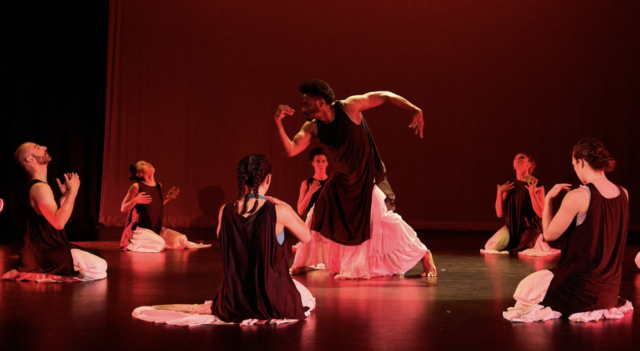
Why: The twenty-first annual Dumbo Dance Festival will take place online June 23-26, kicking off with the gala featuring speakers Gerald Appelstein, Danni Gee, Jennifer Muller, Ludo Scheffer, Thera Marshall, Pascal Rekoert, and Young Soon Kim and presentations by Buglisi Dance Theatre, A.L.A.H., Limón2, Hyonok Kim Dance Arts, achagmu center|KIM / MEA JA, UBIN Dance|Na-Hyun Lee, and WHITE WAVE Young Soon Kim Dance Company. Performances continue June 24-26, along with a free Zoom dance class and a family-friendly program.

“This is a festival about opportunities,” Young Soon Kim said in a statement. “The DUMBO Dance Festival — now virtual — provides an opportunity for over 350 performing artists to showcase their work. Further, it offers New York and global audiences the chance to experience one of the most diverse displays of leading-edge choreography and excellence at an affordable price.” Among the dozens of other participating troupes are Jody Oberfelder Projects, David Appel, Ballaro Dance, Alison Cook Beatty Dance, Meg Kirchhoff, Amanda Selwyn Dance Theatre, and Taylor Graham from New York, Flamencodanza Aylin Bayaz from Spain, Ramona Sekulovic from Germany, Lisa D. Long and Lauren Blair Smith Dance Company from California, Theatre Mucheon from Korea, and Cristina Ruberto from Italy.

THE THREADS PROJECT #1 “UNIVERSAL DIALOGUES”

Blakely White-McGuire (photo by Nan Melville) and Buglisi Dance Theatre (photo by Deb Fong) bring world premiere to Chelsea Factory this week

Who: Buglisi Dance Theatre
What: World premiere dance
Where: Chelsea Factory, 547 West Twenty-Sixth St. between Tenth & Eleventh Aves.
When: Wednesday, June 22, and Thursday, June 23, $15-$40, 7:30
Why: This week Buglisi Dance Theatre presents the world premiere of The Threads Project #1 “Universal Dialogues,” taking place June 22-23 at 7:30 at Chelsea Factory. The sixty-minute piece is a collaboration between founding artistic director Jacqulyn Buglisi and choreographers Alexander Anderson, Jennifer Archibald, Sidra Bell, PeiJu Chien-Pott, Daniel Fetecua, Loni Landon, Jesse Obremski, and Blakeley White-McGuire, searching for poetic truths, gaining hope and inspiration from the 1948 Universal Declaration of Human Rights. The work will be performed by White-McGuire, Ben Schultz, Lauren Jaeger, Jessica Sgambelluri, Ashley Merker, Greta Campo, Aoi Sato, Rayan Lecurieux-Durival, Sierra Sanders, Zachary Jeppsen, Kate Reyes, Esteban Santamaria, Gabrielle Willis, Isabella Pagano, and Jai Perez, with costumes by Lauren Starobin, projections by Joey Moro, and sets and lighting by Jack Mehler. The June 22 show will be followed by a talkback with members of the company, while there will be a reception for gala ticketholders after the June 23 performance.

SIGSPACE X THEATRE FOR ONE: DÉJÀ VU

Kareem M. Lucas portrays a man sharing a terrible moment from his past in Lynn Nottage’s #Five (photo by Jonathan George)

SIGSPACE X THEATRE FOR ONE: DÉJÀ VU
The Pershing Square Signature Center
480 West 42nd St. between Tenth & Eleventh Aves.
Thursday – Sunday through June 26, free with advance RSVP
www.signaturetheatre.org
theatreforone.com

“It’s déjà vu all over again,” Yogi Berra famously said. But that’s not necessarily a bad thing, as evidenced by the welcome return of Theatre for One.

Since 2010, Christine Jones’s Theatre for One has been on the move in New York City, offering microplays performed by one actor (“performer”) for one audience member (“audiencer”) at a time in a mobile four-by-eight-foot repurposed equipment container (with the addition of a floor-to-ceiling plexiglass barrier added because of the pandemic). The specially commissioned works, generally running between five and seven minutes each, have been presented in Times Square, Brookfield Place, the Signature Theatre, and Manhattan West Plaza (“Here Is Future”) as well as at the University of Arkansas, Princeton, Fairfield University, Cork in Ireland, the Abbey Theatre in Dublin, and NYU Abu Dhabi. During the pandemic, “Here We Are” provided a thrilling, much-needed live, online connection between performer and audiencer, both able to see and hear the other and interact.

Theatre for One is now back at the Signature with its latest iteration, “Déjà Vu,” featuring five previously presented short works and one world premiere that can be experienced June 23–26; reservations can be made starting June 21, but you won’t know which play you’ll see until you arrive. (If you’ve already seen at least one play, the friendly staff will try to make sure you see something different if at all possible.) The small booth is bathed in red, with red flowers behind the performer, who often is seated in a chair. (The sets and costumes are by Camilla Dely, with lighting by Domino Mannheim and sound by Matt Stine.) There are no rules, as there are at Broadway and off-Broadway houses; if you want to interact with the performer, you can do so, within limits, of course, always respecting the actor and the playwright.

Stephanie Berry is electric as Pearl in Regina Taylor’s Déjà Vu, an expansion on Taylor’s previous Vote! (The Black Album). “You ever get the feeling that you’ve been here before,” Pearl says. She relates that feeling to the history of women’s voting rights in America after learning that her twenty-one-year-old great-great-granddaughter chose not to cast a ballot in the 2020 presidential election. She recalls the struggle to achieve the right to vote for women, then Blacks, and puts that in context with other societal ills that discriminate against women and people of color. “Time is funny,” she says. “It moves forward and sideways and bends back — over and around again — and again.” Director Tiffany Nichole Greene can barely keep Berry inside the small space as the actor’s voice echoes into the lobby.

“Do you remember the first time you understood the significance of voting? I’m not talking about the first time you voted, but the first time the weight of it hit you?” Sequoyah Jolene Sevenstar (Wyandotte writer, fundraiser, and consultant Maddie Easley) asks in DeLanna Studi’s Before America Was America, an earlier version of which was part of the online “Here We Are.” Directed by Rudy Ramirez, the play discusses women’s rights and equality going back to the Cherokees in the eighteenth century.

Tony winner and two-time Pulitzer finalist David Henry Hwang revisits a terrifying moment from his past, which he also dealt with in his 2019 play Soft Power, in My Anniversary, smartly directed by Greene. Ariel Estrada portrays Hwang, who shares what happened to him on November 29, 2015, and the harrowing aftermath. “I turned around, and thought I saw the shadow of someone, across the street, on the better-lit corner running away,” he remembers. “But as I started in that direction, I noticed something strange. I couldn’t walk straight. . . . I put my hand up to where I’d been hit. When I pulled it away, I saw my palm covered in blood.” The play is particularly potent with the current rise in anti-Asian hate crimes in New York City.

Two-time Pulitzer Prize winner Lynn Nottage also deals with an unprovoked act of horrific violence in #Five, directed by Greene with a tense foreboding. Kareem M. Lucas portrays an unsteady man on a job interview, clarifying why there are five unaccounted-for years on his resume. “I just wanna be upfront,” he says to the audiencer, who is a stand-in for the interviewer. “Things happen, sometimes with little explanation, but I promise you I’m a worker. And to be straight, I’m unhoused, but not for the reasons you probably imagine. I’m telling you, cuz folks are quick to jump to crazy conclusions.” You’re likely to jump to conclusions as well until you hear the full, captivating story.

Theatre for One welcomes one audience member at a time to a live microplay at the Signature (photo by twi-ny/mdr)

José Rivera’s Lizzy, directed by Ramirez, puts you opposite the title character (Sara Koviak) at a restaurant as you both prepare to order. “A lot’s happened that you missed,” she says. “I’m not blaming you for missing anything, I know it’s not your fault, but, you know, it was so sudden. No one told me how sick she really was. Not for a long time.” Although she never specifically mentions Covid-19, it is a potent reminder of how many older people have been lost during the coronavirus crisis. Lizzy focuses on her mother’s hands, on the human need for physical touch, which was not permitted during the height of the pandemic — and, of course, is not allowed between performer and audiencer.

Samuel D. Hunter follows up his extraordinary A Case for the Existence of God, which ran at the Signature this past spring, with the brand-new, gentle Brick, directed by SRĐA. Peter Mark Kendall plays Brick, who holds up an old photograph from the 1940s as he recalls his time in the army and when he found out that Hunter was gay. He self-referentially explains why the microplay exists: “I’m just saying it now in this monologue that my grandson Sam wrote, trying his best to remember how I talked, ’cause I always believed that when you go through something bad you just never talk about it and eventually you feel better — which, this is Sam talking now, is a multigenerational toxic trait that I hope to end with my own daughter.” Kendall delivers the lines in a near-whisper, emphasizing how unsure the character is of wanting to share his personal tale. But Sam and Brick leave you with a final, compassionate thought about how we all should approach life in these difficult times.

In his 2001 novel, Choke, Chuck Palahniuk wrote, “There’s an opposite to déjà vu. They call it jamais vu. It’s when you meet the same people or visit places, again and again, but each time is the first. Everybody is always a stranger. Nothing is ever familiar.” In many ways, this iteration of Theatre for One is a kind of unique melding of déjà vu and jamais vu, offering an unforgettable experience, like the best of theater can do.

THE ORCHARD

Arlekin Players Theatre presents a hybrid multimedia adaptation of Anton Chekhov’s The Cherry Orchard (photo by Maria Baranova)

THE ORCHARD
Baryshnikov Arts Center, Jerome Robbins Theater
450 West 37th St. between Ninth & Tenth Aves.
Tuesday – Sunday through July 3, $39-$125 in person, $29 virtual
646-731-3200
bacnyc.org
www.theorchardoffbroadway.com

During the pandemic lockdown, Arlekin Players Theatre reinvented what online theater could be. The Needham, Massachusetts–based company presented three works that offered people sheltering in place the opportunity to experience and participate in live productions incorporating videogame technology: State vs. Natasha Banina, a one-woman Zoom play in which the audience votes on the ultimate verdict; Witness, which takes viewers on board the MS St. Louis, the German ship carrying nearly a thousand Jewish refugees in May 1939 escaping the approaching Holocaust; and chekhovOS /an experimental game/, a virtual, interactive reimagining of scenes from The Cherry Orchard, a combination of live and prerecorded segments and an integral live chat, with Tony nominee Jessica Hecht as Madame Lyubov Andreievna Ranevskaya and Mikhail Baryshnikov as Anton Chekhov.

Arlekin founding artistic director Igor Golyak has steered full steam ahead with The Orchard, a bumpy two-hour intermissionless adaptation of Chekhov’s tragicomedy that can be seen live and in person through July 3 at the Baryshnikov Arts Center’s Jerome Robbins Theater and/or livestreamed with interactive elements. The best way to experience The Orchard is to first go to the theater, then follow it up virtually, as the two iterations feed off each other, filling in gaps that can form if you see only one of the formats. Yes, it’s a four-hour commitment, but seeing both brings it all together; viewing only the in-person version is likely to leave you impressed but scratching your head too much.

Hecht is phenomenal as Ranevskaya, a lost soul who has returned from Paris to try to save her beloved cherry orchard and estate, which is being put up for auction because the family is in debt. Also back from chekhovOS are Mark Nelson as Gaev, Ranevskaya’s brother, who, like his sister, doesn’t seem to understand the situation they’re in, and Nael Nacer as Lopakhin, whose father and grandfather were serfs toiling for the siblings’ ancestors and who is now trying to convince these faded nobles that their only option is to cut down the orchard and sell off plots for summer vacation homes, which will make them rich again.

But Ranevskaya and Gaev are like children, stuck in the past, refusing to acknowledge reality. They play with balls and spinning tops, marvel at governess Charlotta’s (Darya Denisova) magic shows, and pretend they’re playing billiards. The estate itself is represented by a tiny model of a house, as if everyone is living inside a toy. Ranevskaya is hoping that her teenage daughter, Anya (Juliet Brett), will marry perpetual student and tutor Trofimov (John McGinty) and that her adopted daughter, Varya (Elise Kibler), who manages the estate, will become betrothed to Lopakhin, who is actually in love with Ranevskaya herself. Meanwhile, the aging, ever-more-feeble servant Firs (Baryshnikov) putters about, mumbling to himself and attempting to carry out his longtime duties.

Firs (Mikhail Baryshnikov) and Madame Ranevskaya (Jessica Hecht) watch over the family estate in The Orchard (photo by Maria Baranova)

Carol Rocamora’s translation has eliminated landowner Boris Borisovich Simeonov-Pishchik, estate clerk Yepikhodov, maid Dunyasha, servant Yasha, and other minor characters to focus on the main figures as Chekhov explores the changing sociopolitical times that are going to leave the family behind. Meanwhile, the homeless passerby has been turned into a tough-talking soldier who threatens the others in Russian, evoking the current war in Ukraine. (Earlier references to Mariupol, Kharkiv, and Kyiv also remind the audience of the invasion; Golyak was born in Ukraine and has done charitable work with the company to help the people in his native country.)

But Golyak, who has also established the Zero Gravity (zero-G) Virtual Theater Lab, has added two key “characters”: a robot dog that sticks around Charlotta and, just off center, a large white Clicbot robot, resembling some kind of newfangled medical machine, that serves as a tree, a bookcase, and a mobile camera. It is big and bulky and sometimes gets in the way of the story, but it also is a kind of omniscient narrator, disruptor, and even safe haven. When the soldier confronts the others, they huddle on the robot’s platform, as if that will protect them. (Tom Sepe is the robotics designer.)

Once the auction is over, the family still won’t face the truth as the end of their legacy approaches.

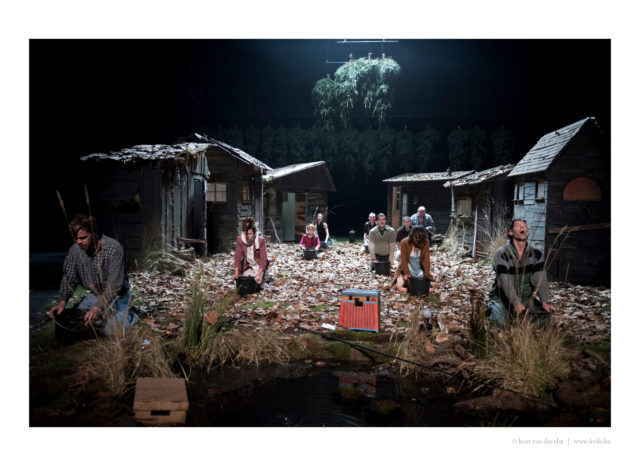
Anna Fedorova’s set consists of robin’s-egg-blue benches and thousands of blue cherry blossoms scattered across the floor. The backdrop is reminiscent of thin, interconnected tree roots reconfigured as lightning strikes. Words and images are projected onto a front translucent screen, but they are often unnecessary, repeating what we are already seeing or confusingly blurry. (The projections are by Alex Basco Koch, with dramatic lighting by Yuki Nakase Link, fine period costumes by Oana Botez, music by Jakov Jakoulov, and sound by Tei Blow.)

Family and friends huddle as the end approaches in hybrid world premiere at BAC and online (photo by Pavel Antonov)

Several scenes feel extraneous, but their inclusion becomes clearer when you watch the livestream, which kicks off with a virtual tour of BAC rechristened as the Orchard and up for sale; a Zillow page shares the details of the property, which you can navigate through as a 360-degree environment. Amid rain and thunder, a prerecorded Chekhov, portrayed by the seventy-four-year-old Baryshnikov, enters the building. You move through hallways and enter various doors, behind which are six rooms, three of which you should have time to wander in: The Operation Room allows you to remove items from Chekhov’s body as he suffers from tuberculosis; peepholes let you see inside the Orchard Room, where Chekhov and his wife, Olga Knipper (Hecht), converse, in text from actual letters; and the Labyrinth Room is a kind of maze with numerous Chekhovs speaking in different videos. There are also the Winter Fishing Room, the Train Room, and the Space Room, where Chekhov/Baryshnikov cheekily notes, “I am tired as a ballet dancer after five acts and eight tableaux.” (Chekhov completed The Cherry Orchard while facing serious illness; he died of TB in 1904, six months after the show opened.)

Soon the stream links up with the live action occurring in the theater, which is shown through multiple static cameras as well as the soldier’s helmet cam, Charlotta’s handheld camera, and, mostly, the robotcam positioned at the end of the robot’s head. During these moments, you can choose which camera to watch through, offering varying perspectives of what’s happening onstage, with differing levels of visual quality. (Adam Paikowsky is the designer of emerging technologies, Alexander Huh the interactivity designer, Athomas Goldberg the technical designer, Alexey Prosvirnin the virtual sound designer, Daniel Cormino the 3D environment artist, and Yu-Jun Yeh the Unreal technical artist.)

In the scene in which Varya asks Trofimov to tell everyone about the stars and the planets, images are visible on the scrim, but online the effect is far more dynamic, as if the characters are surrounded by these colorful orbs and constellations. While Charlotta performs magic tricks onstage, which feels superfluous, it is relegated to the backdrop of the stream, where Ranevskaya, in real time, is responding to bidders’ questions about the estate and cherries.

This Orchard is very much about communication and connection, particularly at the intersection of major technological advances. In three successive scenes, the in-person audience is left at least partially in the dark as Lopakhin converses in untranslated French, the soldier speaks in untranslated Russian, and Trofimov, portrayed by the deaf McGinty, uses sign language that might not be interpreted perfectly by Anya. Ranevskaya gets a series of letters from Paris but chooses to rip them up instead of reading them. Meanwhile, throughout the play, Firs often speaks in non sequiturs, not always making sense although occasionally sharing the wisdom of a life long-lived.

Shortly after returning from Paris, Raneveskaya says, “Thank you, Firs, thank you, my darling old man. I’m so glad you’re still alive.” Firs responds, “The day before yesterday.” Gaev explains, “He’s hard of hearing.” But when Charlotta asks, “Who I am, and where I’m from — I don’t know . . . Who were my parents, were they ever married — I don’t know that, either. I don’t know anything,” Firs says, “You know more than you think you know.”

The deep dive into how we communicate is an issue that emerged during the coronavirus crisis as people used Zoom, social media, and other platforms to stay in touch when actual touch was either not allowed or too risky. Golyak and Arlekin came up with unique ways to stay connected with audiences by employing and expanding on cutting-edge technology to present interactive productions to a population starving for live entertainment. In trying to walk the fine hybrid line, The Orchard has its stumbles, particularly in its ambitious in-person staging, but the virtual aspect prepares us for what might come — and don’t forget to scan that final barcode for an AR bonus.

soft

Donja R. Love’s soft takes place in a juvenile correction center (photo © Daniel J. Vasquez)

soft
Susan & Ronald Frankel Theater, the Robert W. Wilson MCC Theater Space
511 West 52nd St. between Tenth & Eleventh Aves.
Tuesday – Sunday through July 17, $39-$68
mcctheater.org/tix/soft

As Donja R. Love’s gorgeous, hard-hitting soft began, I couldn’t help but notice that the crowd at MCC’s Susan & Ronald Frankel Theater was about eighty percent Black and brown, which thrilled me, a white cis male. For the last ten years, I have been closely observing the racial makeup of New York City audiences, particularly as the breakthrough success of so many Black and brown playwrights and directors is helping theater become more diverse. In such works as David Harris’s Tambo & Bones, Jordan E. Cooper’s Ain’t No Mo’, and Jackie Sibblies Drury’s Pulitzer Prize–winning Fairview, the fourth wall gets shattered as the characters acknowledge and confront, in serious and/or comic ways, what is most often a significantly majority white audience.

Love’s play transpires over the course of a semester in a classroom in a correctional center for juveniles, offering them the opportunity to excel in schoolwork and avoid going to prison. Mr. Isaiah (Biko Eisen-Martin) is the caring teacher, determined to help his students thrive. Antoine (Dharon Jones), Dee (Essence Lotus), Bashir (Travis Raeburn), Kevin (Shakur Tolliver), Jamal (Dario Vazquez), and Eddie (Ed Ventura) are realistic Black, Afro-Latino, and Dominican teenagers dealing with drug and alcohol abuse, homophobia, poverty, systemic racism, and other societal ills. Mr. Cartwright (Leon Addison Brown) is the no-nonsense superintendent who advises Mr. Isaiah not to get too involved with the kids.

Mr. Isaiah is returning their papers on Othello, noting that several students are improving by being tutored by Kevin. Antoine gets lost in his drawings — “I’m Picasso out this bitch,” he tells Mr. Isaiah — while Eddie sleeps in the back and Bashir gets angry at just about everything. Jamal is disappointed when he doesn’t get the highest grade on the essay; that honor belongs to Kevin, who brags, “I’m so smart my genius transcends. Like, I prolli analyzed Othello better than Shakespeare dead ass could ever analyze Othello.”

When Mr. Isaiah asks Mr. Cartwright for new textbooks to replace the dilapidated old ones, even suggesting to dig into his own salary to afford them, the latter explains, “I’ve seen your paychecks. So no pay cuts for you, kid. Look, I know we call this place a juvenile boarding school to try and get whatever grants we can but don’t be fooled; this is a correctional center that houses delinquents. . . . Just like you are now, every teacher here, at some point, was . . . hopeful. But hope, Isaiah, can be a very dangerous thing if you let it. It can blind you from reality. You can get lost in hope.”

That sense of hope changes dramatically after one of the students commits suicide, causing the others to reevaluate who they are and where they are going in life as Mr. Isaiah desperately attempts to hold it all together, for him and them.

Mr. Cartwright (Leon Addison Brown) and Mr. Isaiah (Biko Eisen-Martin) have a difference of opinion in marvelous play at MCC (photo © Daniel J. Vasquez)

The play is beautifully directed by Whitney White (On Sugarland, Our Dear Dead Drug Lord), allowing each character to develop at their own pace and making room for Love’s poetic language to build organically; at times it is choreographed like a dance, with aggressive movement juxtaposed with tender moments. The cast is exceptional, from the six young students to the steadfast Eisen-Martin (In the Southern Breeze, Strange Courtesies) and the unshakable Addison Brown (“Master Harold” . . . and the boys, The Train Driver).

Adam Rigg’s set is a horizontal classroom, with the audience sitting in three rows of seats facing each other across the two long, open sides. This is the third play this year I’ve seen that takes place in an open-sided classroom, all exploring racial and ethnic identity and broken-down systems: Sanaz Toossi’s English deals with four Iranians learning English for various reasons, while Dave Harris’s Exception to the Rule is a Beckett-esque twist on The Breakfast Club as six Black teenagers are trapped in detention.

In soft, flowers separate the stage from the seats, as if a barrier of love, inspired by Kehinde Wiley’s series of paintings of young Black men stretched out on beds and couches, surrounded by colorful flowers on the wallpaper and sheets and floating through the air (Femme Piquée par un Serpent II, The Virgin Martyr St. Cecilia). Love writes in the script, “They stretch as far as the eyes can see. It’s all we see. We should get so lost in their beauty that we forget this is a play. Until . . . Flower petals start to fall from the sky.”

Cha See’s lighting allows everyone to see each other in the theater, which in a play such as soft is an added bonus, especially the night I went, when there was a clear divergence between the white and Black/brown audience members; the latter were vocal in response to numerous sharp lines and powerful situations, calling out in agreement — or disagreement — and snapping when a character made an important point. When I saw MJ on Broadway, I was not happy that the family sitting behind me was munching away on noisy potato chips and talking throughout the first act, but what was happening at soft felt so right, so natural. I also knew that I should not participate in the snapping and vocalizing, that it was definitely not my place. (The sound is by Germán Martínez, with original music by Mauricio Escamilla.)

Mr. Isaiah (Biko Eisen-Martin) and Bashir (Travis Raeburn) don’t always see eye to eye in soft (photo © Daniel J. Vasquez)

That feeling was increased during a fourth-wall-breaking magic-realism coda in which the racial makeup of the audience was made central and magnified. It was only during the postshow talkback with White that I realized it was Black Theater Night; White pointed out that the coda is very different on other nights, when there are far fewer Black and brown people in the audience. The sense of exclusion of the white playgoers was made even more palpable when White explained that they should not speak during the discussion, should not ask a question or share their experience of the play. (The next Black and Brown Theater Night is June 17; the June 18 matinee will be followed by a mental health awareness conversation, and there will be a free Spoken Word Open Mic on June 18 at 5:30 addressing the question “What does softness mean to you?”)

It reminded me of an earlier work directed by White to which only Black and brown critics were invited because of the subject matter. It also brought me back to one of my most unforgettable nights at the theater, at the Flea in 2015, during the Bats’ participatory Take Care. Audience members were assigned varied actions, and I was given the task of telling all the Black and brown people in the audience to gather in a corner. You can only imagine how that went.

There’s a reckoning happening in theater, and it’s long overdue. I’m not about to complain about feeling excluded, given the shameful history of racial injustice and LGBTQIA+ discrimination in this country. I’m also not going to complain when the reparative work results in such marvelous and meaningful productions as soft, the title of which refers to the hope and joy, the basic humanity, that can be found even in hard times. Love, a queer Black Philadelphia native living and “thriving” with HIV, is a phenomenal playwright with his finger on the pulse of this transformation, as shown in such previous impressive works as one in two and Fireflies. I’m excited to see whatever Love and White do next, no matter how inclusive or exclusive it may be.

SCHOMBURG CENTER LITERARY FESTIVAL 2022

Who: Harambee Dance Company, Jason Reynolds, Roxane Gay, Roger Reeves, Jennifer Mack Watkins, Akwaeke Emezi, A. J. Verdelle, Linda Villarosa, Jacqueline Woodson, more
What: Schomburg Literary Festival
Where: Schomburg Center for Research in Black Culture, 515 Malcolm X Blvd. at 135th St.
When: Saturday, June 18, 10:30 am – 5:00 pm, free
Why: The fourth annual Schomburg Literary Festival takes place on Saturday, June 18, with poetry readings, live music, workshops, discussions, book signings, and more on Malcolm X Blvd. Among the highlights are appearances by Jason Reynolds, Roxane Gay, Jennifer Mack Watkins, and Jacqueline Woodson. Below is the full schedule; all events are free. In addition, the Marketplace features booths from the Center for Fiction, the Reading Team, Subsume, Harlem Writers Guild, Total Equity Now, Countee Cullen Library, New York Urban League, and others.

Woke Baby! Festival, with Theo Gangi, Cathy Linh Che, Max Michael Jacob, Soré Agbaje, Stephanie Pachecho, Miah Prescod, Oluwatoyin Kupoluyi, Ayonnah Sullivan, and Jasmine Dabney, curated and hosted by Mahogany L. Browne, Adam Clayton Powell Jr. Stage, 10:30

Reading, an Act of Rebellion and Joy, procession and discussion with Harambee Dance Company, Jason Reynolds, and Roxane Gay, Langston Hughes Auditorium, Schomburg Center for Research in Black Culture, 11:00

Workshop: The Art of Creating Historical Fiction, facilitated by Minnette Coleman, American Negro Theatre, 12:00

​Poetry for Our Time, with Kemi Alabi, Zora Neale Hurston Stage, 12:15

Mateo Askaripour, with moderator Rahshib Thomas, Aaron Douglas Reading Room, 12:30

Health and Racism in America, with Linda Villarosa, moderated by Rebecca Carroll, Langston Hughes Auditorium, 12:45

Poetry for Our Time, with Akwaeke Emezi, Zora Neale Hurston Stage, 12:45

Literary Monuments, Friendship, and Toni Morrison, with A. J. Verdelle, moderated by Tiphanie Yanique, Adam Clayton Powell Jr. Stage, 1:00

​Black Food Stories, with Bryant Terry, Zora Neale Hurston Stage, 1:30

Cleyvis Natera and Jacinda Townsend, with moderator Leslie-Ann Murray, Aaron Douglas Reading Room, 1:45

Black Manhattan in and out of the Archives, with Kia Corthron and Kevin McGruder, moderated by Eric K. Washington, Langston Hughes Auditorium, 2:00

Workshop: Intro to Personal Storytelling, American Negro Theatre, 2:00

To Be Brave and in Love, with Akwaeke Emezi, moderated by Nicole Dennis-Benn, Adam Clayton Powell Jr. Stage, 2:15

Poetry for Our Time, with Roger Reeves, Zora Neale Hurston Stage, 2:15

Featured Literary Festival Artist: Jennifer Mack Watkins, Zora Neale Hurston Stage, 3:00

Caleb Gayle, with moderator Joy Bivins, Aaron Douglas Reading Room, 3:00

Embracing Desire, A Debut Author’s Journey, with Mecca Jamilah Sullivan, moderated by Jacqueline Woodson, Langston Hughes Auditorium, 3:15

Crafting Community in Short Stories, with Sidik Fofana and Ladee Hubbard, moderated by Ainehi Edoro, Adam Clayton Powell Jr. Stage, 3:30

​Poetry for Our Time, with Harold Green III, Zora Neale Hurston Stage, 3:45

The Last Poet’s Abiodun Oyewole, listening session and conversation, Langston Hughes Auditorium, 4:30

¡VIVA MÉXICO!

Ballet Folklorico Mexicano de Nueva York will perform with Mariachi Real de Mexico at cultural festival at National Arts Club

Who: Ballet Folklorico Mexicano de Nueva York, Mariachi Real de Mexico
What: Celebration of Mexican culture
Where: The National Arts Club, 15 Gramercy Park South
When: Saturday, June 18, free with advance RSVP, 1:00
Why: The National Arts Club and the Mexican Cultural Institute are teaming up for “¡Viva México!,” a celebration of Mexican culture, with a special free program on June 18 at 1:00. Part of Festival New York, it begins with Mariachi Real de Mexico playing on the stoop of the club on Gramercy Park South, then heading indoors with dancers from Ballet Folklorico Mexicano de Nueva York, where they will perform traditional works from Veracruz, Jalisco, and the Isthmus of Tehuantepec. In addition, costumes from the eight regions of Oaxaca will be on view. Admission is free with advance registration.