Tag Archives: Manhattan Theatre Club

ANNA ZIEGLER: LOVE, ACTUALLY

(photo © Matthew Murphy)

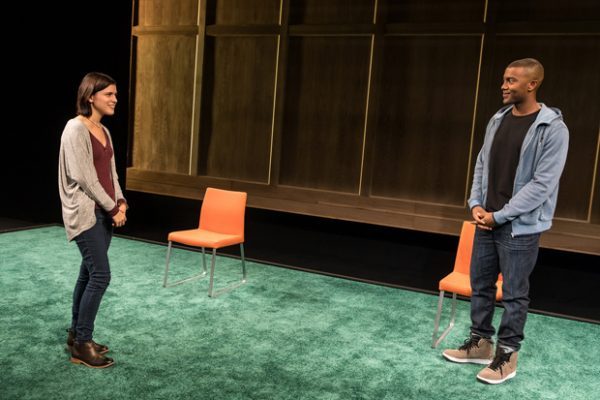
Tom (Joshua Boone) and Amber (Alexandra Socha) cannot quite agree what happened one night in Actually (photo © Matthew Murphy)

ACTUALLY
Manhattan Theatre Club
New York City Center: The Studio at Stage II
Tuesday – Sunday through December 10, $30
212-581-1212
manhattantheatreclub.com
actuallyplay.com

Watching a talky play with relatively few characters, say, only two or four, can be like watching a tennis match. When the writing and directing is exceptional, it’s like seeing a championship bout between Nadal and Federer, Borg and McEnroe, Evert and Navratilova, your head going back and forth as the shifting dialogue consists of aces, expert passing shots, exciting net play, and thrilling overhead smashes. Of course, just as every play is not going to qualify for award status, not every tennis match is going to be memorable, something I can vouch for, having attended the U.S. Open for more than twenty years. Brooklyn-born playwright Anna Ziegler serves up both ends of the spectrum with two current off-Broadway shows, Actually and The Last Match, both of which involve the characters breaking the fourth wall and speaking directly to the audience, with very different results. The Manhattan Theatre Club production of Actually, continuing at City Center’s Stage II through December 10, is a timely, intense look at what actually happened the night two Princeton freshmen, Tom (Joshua Boone) and Amber (Alexandra Socha), hooked up at a party. While Tom believed their coupling was completely consensual, Amber thinks it turned into rape and reported it to the university.
Alexandra Socha and Joshua Boone star in gripping play by Anna Zielger

Alexandra Socha and Joshua Boone star in gripping play by Anna Ziegler (photo © Matthew Murphy)

Tom is a black classical pianist who says, “In some ways, I’ve been on trial my entire life.” Amber is white and Jewish, a mediocre squash player who explains, “We all fill some stupid niche, which reduces us to something much less than what we are, but that’s the way it goes.” The play begins with them playing the game Two Truths and a Lie; Tom is reluctant, but Amber demands he participate if he wants to sleep with her. For ninety taut minutes, they reenact events from that night and share their thoughts with the audience, discussing consent, race, religion, Title IX, gender, and other key topics, turning viewers into a kind of jury of public opinion. When Amber says that her default state is “this zone of wanting something and not wanting it at the same time,” it really hits home, getting to the core of how so many people feel. Boone (Holler If You Hear Me, Mother Courage and Her Children) and Socha (Spring Awakening, Fun Home) are outstanding caught up in a long deuce, each one taking, then losing, the advantage as they volley back and forth. Ziegler’s (Photograph 51, Boy) dialogue is sharp and focused, while Obie winner Lileana Blain-Cruz (Pipeline, The Death of the Last Black Man in the Whole Entire World) directs with pinpoint accuracy on Adam Rigg’s spare set. Actually is no mere Bobby Riggs vs. Billie Jean King, he said / she said contest; it is a powerful exploration of possible sexual misconduct in an age when Americans learn more and more about the issue every day, as more and more predators are revealed.

(photo by Joan Marcus)

The Last Match takes place during the semifinals of the U.S. Open (photo by Joan Marcus)

THE LAST MATCH
Laura Pels Theatre
Harold and Miriam Steinberg Center for Theatre
111 West 46th St. between Sixth & Seventh Aves.
Tuesday – Sunday through December 23, $79
212-719-1300
www.roundabouttheatre.org

Unfortunately, the Roundabout production of The Last Match, running at the Laura Pels Theatre through December 23, is not nearly as incisive and gripping as Actually. It’s the semifinals at the U.S. Open, and six-time champion Tim Porter (Wilson Bethel), who might be on the downside of his career at the tender age of thirty-four, is playing younger up-and-comer Sergei Sergeyev (Alex Mickiewicz), a hotheaded Russian who wants to dethrone the even-tempered American star and crowd favorite. They serve and volley on Tim Mackabee’s tennis court set, with the familiar blue, white, and green colors of the Open and scoreboards on either side, while Bray Poor’s audio design includes the sound of imaginary swinging rackets striking imaginary yellow balls. In between and during points, Tim and Sergei argue with each other in ways that don’t feel real during a live match; share their thoughts directly with the audience; and reenact scenes from their past, primarily Tim’s relationship with fellow tennis player Mallory (Zoë Winters) as they marry and try to have a baby, and Sergei’s courtship of the fiery Galina (Natalia Payne). The women cheer their partners on from the sides of the stage as the men fight it out. But whereas Amber and Tom in Actually were complex characters who had their charms along with their shortcomings, both gaining the audience’s sympathy at different times, only Mallory is able to elicit much catharsis in The Last Match.

(photo by Joan Marcus)

Tim Porter (Wilson Bethel) and Sergei Sergeyev (Alex Mickiewicz) battle it out on court and off in Anna Ziegler play (photo by Joan Marcus)

“You don’t want people to know you’re an asshole. But anyone who does this sport at this level is gigantic asshole of worst gigantic asshole variety,” Sergei says early on, adding, “You have to care only for yourself.” It’s hard to care about Sergei, Galina, and Tim, who are self-obsessed; Ziegler (A Delicate Ship, The Wanderers) and director Gaye Taylor Upchurch (Animal, The Year of Magical Thinking) give them back stories that don’t help humanize them but turn each one into more of a caricature. While Actually made smart, subtle references to societal issues and did not proclaim any grand statements about who was right, The Last Match is melodramatic and obvious, like a love match in tennis. “So many game points, on my racquet,” Sergei says. “This should be my game so many times over. I have earned it! But life does not actually work that way. You actually have to win.” But you’re likely to decide who you want to win from the very start, rendering the competition relatively mute. “Some people don’t even love their babies right away so it’s just relentless and boring. And we already have tennis for that, right?” Mallory asks Tim, who replies. “Well, I don’t find tennis boring.” But any tennis match, like any sporting event, can be relentless and boring. Just like any play.
THE PORTUGUESE KID

(photo by Richard Termine 2017)

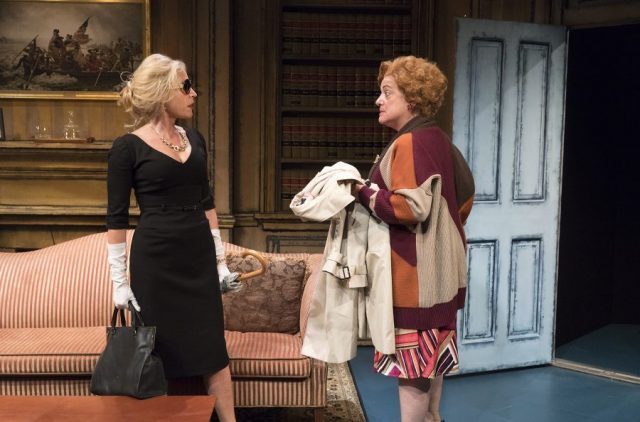
Atalanta Lagana (Sherie Rene Scott) and Mrs. Dragonetti (Mary Testa) are at odds throughout John Patrick Shanley’s The Portuguese Kid (photo by Richard Termine 2017)

Manhattan Theatre Club
MTC at New York City Center – Stage I
Tuesday – Sunday through December 3, $95-$112.50
212-581-1212
theportuguesekid.com

Tony, Oscar, and Pulitzer Prize winner John Patrick Shanley was feeling down in the dumps about the state of the world, so he decided it was time for an old-fashioned Neil Simon-style romantic farce; the result is the hilarious, if bumpy, comedy The Portuguese Kid, which opened last night at Manhattan Theatre Club’s Stage I at City Center. Grieving widow Atalanta Lagana (Sherie Rene Scott) is in the Providence, Rhode Island, home office of her lawyer and childhood friend, Barry Dragonetti (Jason Alexander), reviewing the estate of her recently deceased second husband, Vinny, “a passive aggressive fascist” foot surgeon who voted for Donald J. Trump. ESP-obsessed Atalanta is wearing a sexy black mourning dress and sunglasses, pummeling Barry, who seems to have forced himself into a too-tight, too-blue business suit, with a barrage of brutal one-liners. They’ve been at odds for forty years, ever since ten-year-old Atalanta saved fifteen-year-old Barry when he was mugged by a Portuguese kid, leading to his lifelong horror of anything Portuguese. Atalanta slyly reveals that she’s now seeing Freddy Imbrossi (Pico Alexander), a twenty-nine-year-old carefree would-be poet and real estate agent — and the former passionate lover of Patty (Aimee Carrero), Barry’s hot, sexy, and sensitive young Puerto Rican wife. “What is it? You got a problem with Freddy?” Atalanta says to a disgruntled Barry, who responds, “You got a problem. Freddy Imbrossi? You’d be better off with Lyme disease!” Atalanta then explains that she’s been calling out Barry’s name during sex for years (with both her deceased husbands), which confuses Barry but infuriates his nine-toed mother (Mary Testa), who has been listening in by the door. Barry recuses himself from Atalanta’s case, which fills Mrs. Dragonetti with glee. “I pray to God I never have to violate these eyes with the sight of you again,” she says to the two-time widow.

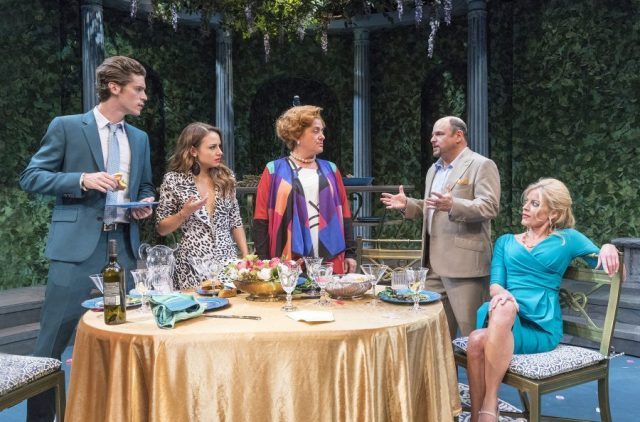
Clever, witty, and, sometimes a little roughly, the next three scenes in this intermissionless one-act move from Atalanta’s corny but lush bedroom to Barry’s well-appointed backyard, where Patty and Mrs. Dragonetti go at it next, no holds barred, leaving Barry torn between his fiery young wife, who remembers fondly how they met and fell in love, and his hotheaded, nasty mother, who thinks no one is good enough for her baby. The final scene takes place in Atalanta’s garden, where all of the characters gather for a lunch they’ll never forget.

Everyone gathers for a frenetic feast in Manhattan Theatre Club world premiere (photo by Richard Termine 2017)

Everyone gathers for a frenetic feast in Manhattan Theatre Club world premiere (photo by Richard Termine 2017)

The Bronx-born Shanley (Doubt, Moonstruck, Prodigal Son,) wrote and directed The Portuguese Kid, making changes to the second and fourth scenes up to the very last minute during previews, and it unfortunately shows; those scenes are more chaotic and unformed than the fabulous first and third scenes, in which the characters are well developed, the actors get to strut their stuff, and the plot thickens in wonderfully acerbic ways. Alexander (Seinfeld, Merrily We Roll Along) excels in a role written with him in mind, all pent-up anger waiting to explode, while three-time Tony nominee Scott (Everyday Rapture, Dirty Rotten Scoundrels) is simply fab as the unpredictable, tough-talking Atalanta (loosely inspired by the virgin huntress in Greek mythology), who regularly admits to having “a darkness.” And there’s little left of the scenery after Drama Desk Award winner Testa (First Daughter Suite, Queen of the Mist) gets through with it; her physical presence is the center of gravity around which her galactic verbal barrages fly. Alexander (Punk Rock, What I Did Last Summer) and Carrero (Young & Hungry, What Rhymes with America) have their moments, but their roles are not as fully fleshed out as Jason Alexander’s and Scott’s; in some ways, the quartet evokes Edward Albee’s Who’s Afraid of Virginia Woolf? The snazzy production features a movable set by John Lee Beatty, fun, colorful costumes by William Ivey Long (Scott’s dresses are too die for), and original music and sound by MTC stalwart Obadiah Eaves. “You underestimate women,” Atalanta tells Barry, who answers, “I’m glad you think so.” In The Portuguese Kid, Shanley most certainly does not underestimate women — or his audience.

PRINCE OF BROADWAY

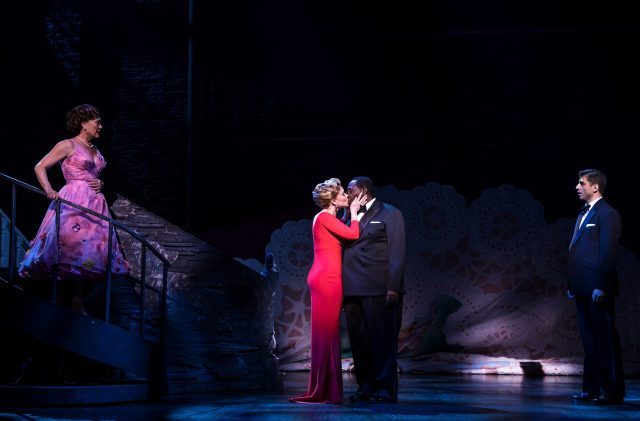
(photo by Matthew Murphy © 2017)

Prince of Broadway features three songs from Follies (photo by Matthew Murphy © 2017)

Manhattan Theatre Club at the Samuel J. Friedman Theatre
261 West 47th St. between Broadway & Eighth Aves.
Tuesday – Sunday through October 22, $89-$165
princeofbway.com
www.manhattantheatreclub.com

Less is certainly not more in Manhattan Theatre Club’s production of the surprisingly slight Prince of Broadway. Continuing at the Samuel J. Friedman through October 22, the show is a tribute to legendary icon Hal Prince, who has won twenty-one Tony Awards during a grand career going back to his days as an assistant stage manager in 1950 through directing and/or producing many of the greatest musicals in Broadway history. Prince himself directs the talented cast of nine — Chuck Cooper, Janet Dacal, Bryonha Marie Parham, Emily Skinner, Brandon Uranowitz, Kaley Ann Voorhees, Michael Xavier, Tony Yazbeck, and Karen Ziemba — who all portray him, glasses on top of their heads, as he discusses brief, mostly unilluminating snippets from his history, many of them self-aggrandizing platitudes that serve as introductions to some of the numbers, although there are a few choice tidbits, including his meeting Stephen Sondheim. The crew is just about as good as it gets, with a book by two-time Tony nominee David Thompson, arrangements and orchestrations by two-time Tony winner Jason Robert Brown, sets and projections by Tony winner Beowulf Boritt, costumes by six-time Tony winner William Ivey Long, lighting by two-time Tony winner Howell Binkley, and codirection and choreography by five-time Tony winner Susan Stroman. And the show has several memorable moments, including Cooper bringing the house down with “If I Were a Rich Man” from Fiddler on the Roof, Parham belting out the theme song from Cabaret, Xavier and Dacal camping it up on “You’ve Got Possibilities” from It’s a Bird…It’s a Plane…It’s Superman, and Skinner delivering a moving “Send in the Clowns” from A Little Night Music. But as Ziemba sings as Fräulein Schneider from Cabaret, “So what?”

(photo by Matthew Murphy © 2017)

Chuck Cooper brings the house down as Tevye from Fiddler on the Roof (photo by Matthew Murphy © 2017)

Too many of the production numbers are not introduced by name; how many people are likely to know that “This Is Not Over Yet” is from Parade? Prince’s specific contributions, whether director or producer, are not indicated onstage (only in the program), so it is often difficult to grasp how much we’re seeing is from the man himself. With limited or no background information, most of the songs exist in a kind of vacuum, where the audience doesn’t know enough about the characters to get involved in their tales, except for the numbers that have more exposition in them. Even such beloved songs as “Something’s Coming” and “Tonight” from West Side Story feel lost amid the other hits and non-hits; it’s not fair for Stroman and Prince to assume the crowd is already familiar with the songs, a disservice particularly to younger generations or newcomers of any age to musical theater. And although Prince worked on nearly sixty shows, a mere sixteen are represented here, with three or four songs from certain musicals; it would have been fascinating to see tunes from such less-well-known works as Zorba, A Family Affair, Flora, the Red Menace, or even A Doll’s Life, which closed after five performances, instead of multiple numbers from Evita and The Phantom of the Opera. An earlier version did have other songs, including “All I Need Is One Good Break” from Flora, but numerous delays and financial issues led to many changes. (For example, in March 2012 it was announced that the Broadway production would open that November with Sebastian Arcelus, Linda Lavin, Richard Kind, LaChanze, Shuler Hensley, Sierra Boggess, Josh Grisetti, Amanda Kloots-Larsen, Daniel Breaker, Caroline O’Connor, David Pittu, and Skinner.) In a program note, Prince writes, “I doubt if anyone today can duplicate the life I’ve been lucky enough to live.” That’s very likely true, but the eighty-nine-year-old master deserves better than Prince of Broadway.

THE LITTLE FOXES

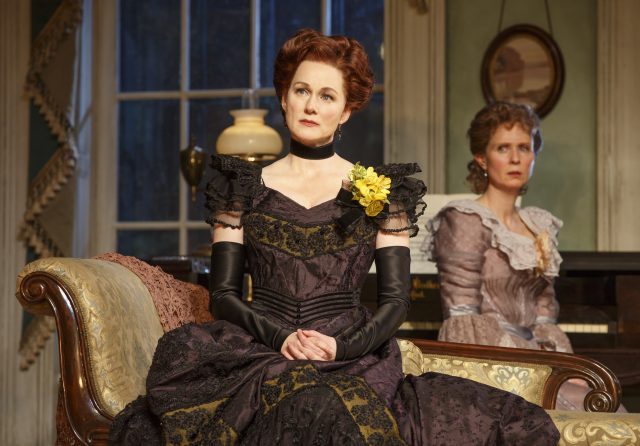
Laura Linney and Cynthia Nixon alternate roles as Regina and Birdie in MTC Broadway revival of Lillian Hellmans The Little Foxes (photo by Joan Marcus)

Laura Linney and Cynthia Nixon alternate roles as Regina and Birdie in MTC Broadway revival of Lillian Hellman’s The Little Foxes (photo by Joan Marcus)

Manhattan Theatre Club at the Samuel J. Friedman Theatre
261 West 47th St. between Broadway & Eighth Aves.
Tuesday – Sunday through July 2, $89-$179
littlefoxesbroadway.com
www.manhattantheatreclub.com

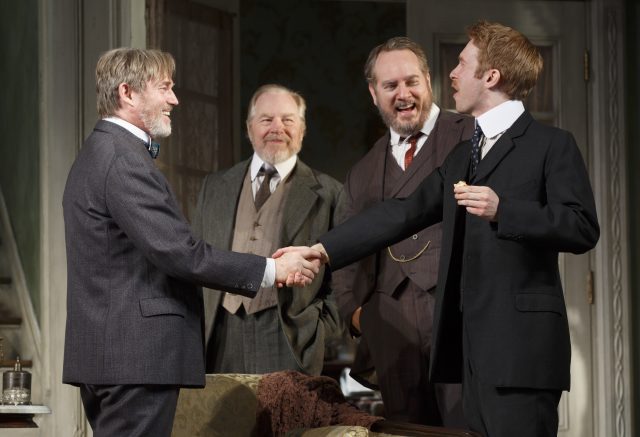
Daniel Sullivan’s Broadway revival of Lillian Hellman’s 1939 drawing-room classic, The Little Foxes, is exquisitely rendered in every detail in this gorgeous Manhattan Theatre Club production, continuing through July 2 at the Samuel J. Friedman Theatre. It’s an intricate tale of the business of family, and the family business, in the South in the spring of 1900, but it never feels old-fashioned or dated; instead it highlights the play’s freshness and relevance to today’s world. The conniving Hubbard clan — older brother Ben (Michael McKean), younger brother Oscar (Darren Goldstein), and sister Regina (portrayed alternately by Laura Linney and Cynthia Nixon) — are wining and dining Mr. Marshall (David Alford), a wealthy Chicago industrialist about to partner with Hubbard Sons in a cotton mill deal. “It’s very remarkable how you Southern aristocrats have kept together. Kept together and kept what belonged to you,” Mr. Marshall says. “You misunderstand, sir. Southern aristocrats have not kept together and have not kept what belonged to them,” Ben points out. “You don’t call this keeping what belongs to you?” Mr. Marshall asks, looking around the impressive room. “But we are not aristocrats. Our brother’s wife is the only one of us who belongs to the Southern aristocracy,” Ben explains, referring to Oscar’s wife, Birdie (alternately Nixon or Linney). In a classic new money/old money transaction, Oscar married the soft-spoken, timid Birdie for her bloodline and the family plantation, her beloved Lionnet. Once Lionnet and Birdie were both Hubbard property, he began beating and mistreating her, leading her to retreat into a haze of alcohol. Meanwhile, Oscar is grooming their bumbling, would-be-playboy son, Leo (Michael Benz), to join Hubbard Sons and to marry his first cousin, Alexandra (Francesca Carpanini), the teenage daughter of Regina and Horace (Richard Thomas). But to secure the deal with Mr. Marshall, Ben and Oscar need Horace, a seriously ill banker who has spent the past five months at Johns Hopkins, to contribute his share in the partnership; otherwise, they will have to bring in a stranger, something they are loathe to do. But Regina proves herself to be another shrewd Hubbard when she starts negotiating for her absent husband. Unable to execute the necessary partnership investment herself, Regina sends Alexandra to Maryland to bring back Horace, setting up an intense battle of wills over Union Pacific bonds owned by Horace, who just happens to be Leo’s boss at the bank. Watching everything unfold are the Hubbards’ servants, Addie (Caroline Stefanie Clay) and Cal (Charles Turner), who understand exactly what is going on as the post-Reconstruction South moves from its plantation slave agriculture economy to a mill-based industrial one — all the while keeping up its brutal foundation of labor exploitation. It all culminates in a spectacularly grand finale that is as wickedly funny as it is unpredictable.

talk family and business in The Little Foxes (photo by Joan Marcus)

Richard Thomas, Michael McKean, Darren Goldstein, and Michael Benz discuss family business in Daniel Sullivan’s Broadway revival of Lillian Hellman classic (photo by Joan Marcus)

A magnet for big stars, The Little Foxes was first presented on Broadway in 1939, with Tallulah Bankhead as Regina and Frank Conroy as Horace. William Wyler’s Oscar-nominated 1941 film starred Bette Davis as Regina, Herbert Marshall as Horace, and Teresa Wright as Alexandra. It was previously revived on Broadway in 1967 by Mike Nichols (with Anne Bancroft, Richard A. Dysart, E. G. Marshall, and George C. Scott), in 1981 by Austin Pendleton (with Elizabeth Taylor, Maureen Stapleton, and Anthony Zerbe), and in 1997 by Jack O’Brien (with Stockard Channing, Frances Conroy, and Brian Murray). The cast for the 2017 revival is simply brilliant: McKean (All the Way, Superior Donuts) is devilishly regal as the cigar-smoking, full-bearded Ben; Goldstein (Bloody Bloody Andrew Jackson, Abigail’s Party) is deliciously devious as Oscar, the least well mannered of the siblings; and Thomas (Incident at Vichy, You Can’t Take It with You) is explosive as Regina’s ailing, henpecked husband who has some tricks up his sleeve. But the play’s real power lays in the roles of Regina and Birdie, two very different women, each with their own strengths and flaws, representative of both the past and the future of their gender. At Linney’s suggestion, she and Nixon alternate playing Regina and Birdie; I saw it with four-time Emmy winner, three-time Oscar nominee, and four-time Tony nominee Linney (Time Stands Still, Sight Unseen) as Regina and Tony, Grammy, and Emmy winner Nixon (Rabbit Hole, Wit) as Birdie. The two women are magical together, Linney strong and determined as the duplicitous, calculating Regina, who wants a better life for herself no matter how it impacts the others, while Nixon is delightful as the unassuming, fragile, abused Birdie, who knows more than she is letting on. Scott Pask’s set is divine, with lovely period furniture, a Hazelton Brothers piano, lush drapery, and a shadowy, ominous staircase in the back, while Jane Greenwood’s costumes are utterly transcendent, the men’s tuxes bold and impressive, the women’s dresses luxuriously elegant and revealing of their inner being. Tony winner Sullivan (Rabbit Hole, Proof) directs with impeccable attention to detail; nary the smallest matter is overlooked, and the pacing is wonderful, with two well-timed intermissions over two and a half hours. “I could wait until next week. But I can’t wait until next week,” Ben says at one point, referring to Horace’s delay in contributing his share of the investment, but he just as well could be talking to those who are still contemplating whether to see the show. “I could but I can’t. Could and can’t. Well, I must go now,” he concludes. The Little Foxes must go on July 2; don’t miss it.

COST OF LIVING

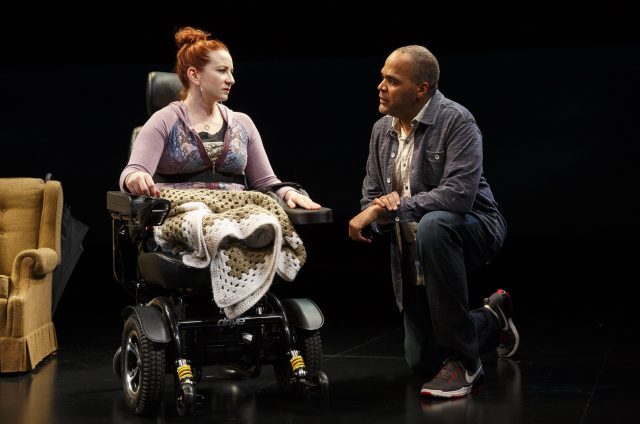
(photo by Joan Marcus 2017)

Ani (Katy Sullivan) and Eddie (Victor Williams) wonder if they have a future together in Cost of Living (photo by Joan Marcus 2017)

Manhattan Theatre Club
New York City Center Stage 1
Tuesday – Sunday through July 16, $79
212-581-1212
costoflivingplay.com
www.nycitycenter.org

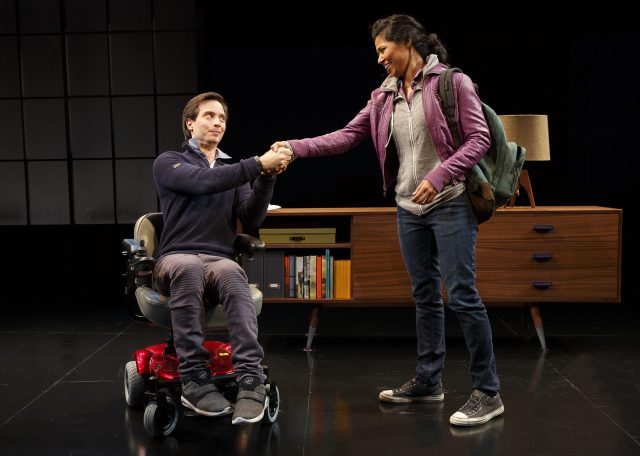
Martyna Majok’s Cost of Living is a tender, emotional play about four lonely people seeking connections, which in and of itself is not an unusual scenario. But what is unusual about the play, which opened last night at Manhattan Theatre Club’s City Center space, is that two of the characters have disabilities and, per the playwright’s specific instructions, must be portrayed by actors with disabilities. Despite that setup, Cost of Living is not some kind of activist production trying to make a politically correct statement about people with disabilities; instead, it’s an intimate story about two men and two women facing the daily challenges that life brings them. The play begins with a long monologue by Eddie (Victor Williams), a poetic truck driver who has lost his license because of a DUI; he has also lost his wife, Ani (Katy Sullivan), who died as a result of some kind of accident that he might have been responsible for. Now sober, Eddie is in a bar, sitting in a chair and facing the audience, as if talking directly to us. Looking back at what he used to have, he says, “That life is good for people. I was thankful for every day they ain’t invented yet the trucker-robots. That life is good. The road. Sky. The scenery. Except the loneliness. Except in the case of all the, y’know, loneliness. This was what my wife was good for. Not that this was the only thing. . . . Cuz, y’know, you married a person. And a person’s gonna be a person even if they’re married. That’s a lesson. That’s a lesson for yer LIFE right there.” It’s critical that Eddie refers to Ani as a “person” here, because when we soon see her in a flashback, she is a quadriplegic confined to a wheelchair. She is a woman who is not defined by her physical situation, even though it is severe. Meanwhile, the secretive Jess (Jolly Abraham), a twenty-five-year-old bartender who has just graduated from Princeton, is interviewing for a job as caregiver to John (Gregg Mozgala), a hoity-toity Harvard man who has cerebral palsy and is also confined to a wheelchair. Jess’s main responsibilities are to help John shower and shave every morning, which turns out to be no easy task. “Why do you want this job?” John asks. “I thought, the experience and I — it’d be a very Meaningful Experience,” she replies. “Why do you want —” John starts to ask again but is cut off by Jess, who says, “The money.” “Good,” John adds, appreciative of the honesty. As the play goes back and forth between the two stories — which eventually come together in an unexpected way — subtle parallels are drawn between them, as Jess washes John as they grow closer, and Eddie washes Ani as they grow apart.

(photo by Joan Marcus 2017)

John (Gregg Mozgala) and Jess (Jolly Abraham) come to an understanding in Martyna Majok’s latest play (photo by Joan Marcus 2017)

Expanded from Majok’s short play John, Who’s Here from Cambridge, which debuted in Ensemble Studio Theatre’s Marathon of One-Act Plays in late spring 2015, Cost of Living is carefully constructed by Majok (Ironbound, Mouse in a Jar) and her “dream” director, Obie winner Jo Bonney (Father Comes Home from the Wars; By the Way, Meet Vera Stark). They avoid sentimentality or sympathy — although the drama is deeply involving — while treating all four people as equals. “Self-pity has little currency in these characters’ worlds,” Majok writes in her notes to the play. “Humor, however, has much.” Wilson Chin’s set rotates between John’s stylish apartment, the hipster bar, and Ani’s home, after she and Eddie have split. The cast is uniformly excellent — with a particularly moving performance by Williams (The King of Queens, Sneaky Pete) — as they face their unique challenges, all four making distinct connections. Majok, who was inspired by such writers as Danny Hoch, Raymond Carver, and Sarah Kane, also explores class, something that can be found in much of her work, influenced by her mother’s experience after immigrating to America from Poland when Majok was five. (Among other jobs, her mother was a caregiver for an elderly woman.) But most of all, Cost of Living is not about disabilities or about actors with disabilities; it’s not about race either, although of the two non-disabled characters, one is black and the other Latino in this production. It follows the lead of Deaf West Theatre’s 2015 revival of Spring Awakening, in which Ali Stoker, as Anna, became the first wheelchair-bound actor to ever appear on Broadway, and Sam Gold’s version of The Glass Menagerie, in which Madison Ferris, who has muscular dystrophy, portrayed Laura Wingfield, giving more opportunities to actors with disabilities, whether the role calls for it or not. The play also has one truly terrifying moment, causing the audience to gasp in unison and, most likely after the show, reconsider their initial thoughts regarding disabilities, especially during the curtain call, which features an added surprise. At one point, Ani asks Eddie, “If I weren’t like this right now, would you be here?” The reason to go to City Center to see Cost of Living is not because two of the actors are “like this right now”; it’s because it’s a well-written, well-directed, well-acted story about everyday life.

LINDA

(photo by Richard Termine)

Linda (Janie Dee) faces down older daughter Alice (Jennifer Ikeda) as younger daughter Bridget (Molly Ranson) looks on in LINDA (photo by Richard Termine)

Manhattan Theatre Club
New York City Center Stage 1
Tuesday – Sunday through April 2, $79-$90
212-581-1212
www.lindaplay.com
www.nycitycenter.org

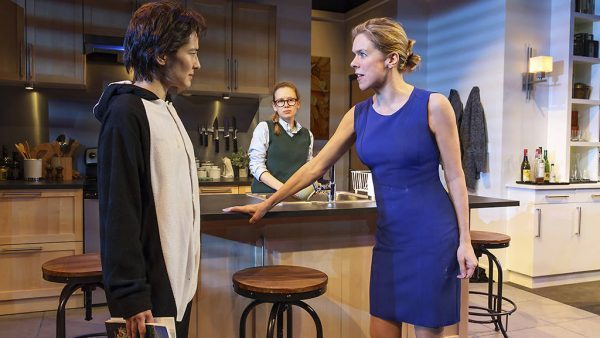
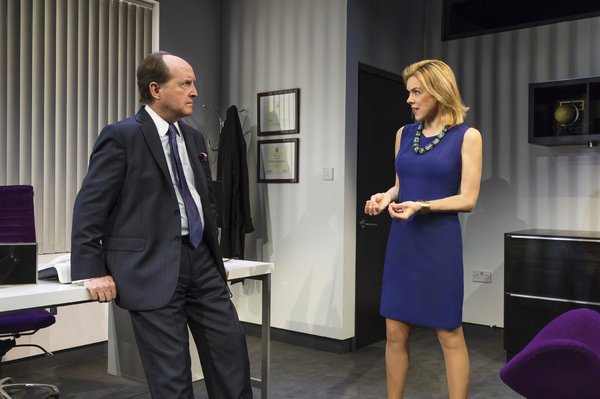
I’m writing this on International Women’s Day, when women around the world came together “to help forge a better working world — a more gender inclusive world,” which is particularly relevant to Penelope Skinner’s Linda, making its New York debut at City Center Stage I through April 2. Two-time Olivier Award winner Janie Dee gives a breathless, whirlwind performance as the title character in an otherwise lackluster, kitchen-sink production from Manhattan Theatre Club. It appears that Linda, a fifty-five-year-old marketing executive at Swan with a devoted husband and two daughters, has it all. The play opens with her making an impressive multimedia pitch for a new campaign for an anti-ageing cream, aiming it at older women who are often overlooked by the beauty market, unless they’re Helen Mirren. “Let’s make these invisible women feel seen again,” she says. “Let’s say to them: ‘Ladies? We know you’re out there! We see you! You exist!’” However, the head of the company, Dave (John C. Vennema), decides instead to go with a campaign aimed at social-media-savvy millennials presented by Amy (Molly Griggs), an ambitious and aggressive twenty-five-year-old who has her eyes set on Linda’s office and job. Meanwhile, temp Luke (Maurice Jones) finds Linda quite attractive. Back at home, Linda’s daughter from her first marriage, Alice (Jennifer Ikeda), spends most of her time in her room, wearing a skunk costume to try to make herself invisible to others because of a cyber-shaming incident that occurred ten years before, when she was fifteen. Linda’s other daughter, fifteen-year-old Bridget (Molly Ranson), from her second marriage to Neil (Donald Sage Mackay), is agonizing over which monologue to deliver at an audition to get into a prestigious acting academy. Her parents want her to do Ophelia, but Bridget is more interested in a stronger role, perhaps Macbeth or Lear, instead of the suffering, victimized female character. And Neil is in a new band with inexperienced young singer Stevie (Meghann Fahy). “I’m an award-winning businesswoman. I’m happily married with two beautiful daughters and I still fit in the same size ten dress suit I did fifteen years ago,” Linda proudly says several times, but her carefully constructed world is about to come tumbling down. “I will not disappear!” she declares, even as she is becoming a footnote in her own life.

(photo by Richard Termine)

Linda (Janie Dee) encounters unexpected problems at the office with company founder Dave (John C. Vennema) (photo by Richard Termine)

Titling the play after the protagonist’s first name places the character front and center, as if she’s on her own, battling stereotypes all by herself. She’s threatened not only by men but by women who want what she has and knowingly or unknowingly undermine her to taste at least a little bit of her power. Dee (Carousel, Comic Potential) is exceptional as Linda, a role originated in London by Noma Dumezweni after Kim Cattrall had to drop out for health reasons. She looks sexy and glamorous in Jennifer von Mayrhauser’s sharp, boldly colored outfits, but she stands out too much, overwhelming the other characters, who are more like caricatures. Walt Spangler’s revolving set drags down the narrative, as does Fitz Patton’s uninspired music. MTC artistic director Lynne Meadow can’t find a natural pace to the proceedings, which stagger from scene to scene. Skinner (The Village Bike, The Ruins of Civilization) packs Linda with far too many subplots, taking on too many women’s issues in a mere two hours. Each one is important in its own way, but they get lost in the shuffle. “I used to be the protagonist of my life and now suddenly I’m starting to feel irrelevant,” Linda admits; that statement also relates to the play itself, especially in the shadow of the International Women’s Day marches also known as “A Day without a Woman.”

AUGUST WILSON’S JITNEY

(photo © 2017 Joan Marcus)

August Wilson’s dazzling JITNEY finally makes its long-awaited Broadway debut (photo © 2017 Joan Marcus)

Manhattan Theatre Club at the Samuel J. Friedman Theatre
261 West 47th St. between Broadway & Eighth Aves.
Tuesday – Sunday through March 12, $79-$169
jitneybroadway.com
www.manhattantheatreclub.com

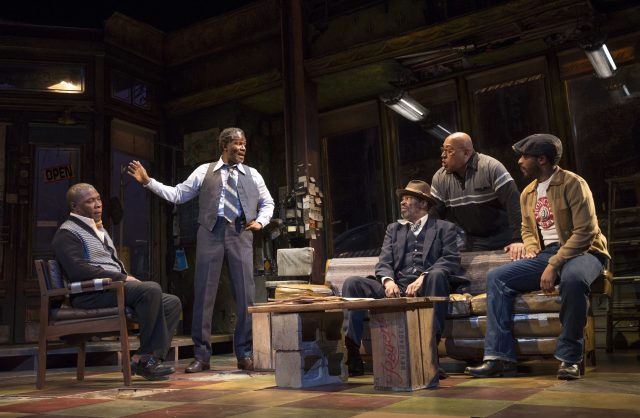
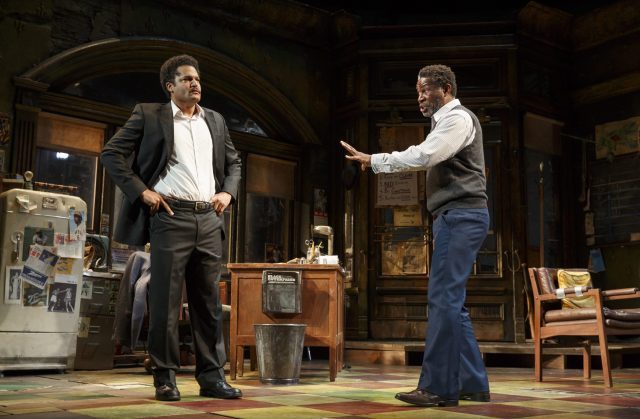
August Wilson’s Jitney, the first play he wrote in the American Century Cycle, also known as the Pittsburgh Cycle, is the last of the ten plays to reach Broadway, and all one can ask is, What took so long? Jitney is another masterpiece from the Pittsburgh-born playwright, whose cycle comprises ten plays, each set in a different decade of the twentieth century, capturing the black experience in America over one hundred years with grace, honesty, dignity, humor, and a soul-searching reality. Coincidentally, the film version of Wilson’s second play to hit Broadway, the Tony- and Pulitzer Prize-winning Fences, was released in December; the first movie based on a Wilson play, Fences garnered Oscar nominations for Best Picture, Best Actor (director Denzel Washington), Best Supporting Actress (Viola Davis), and Best Adapted Screenplay (Wilson). A Manhattan Theatre Club production at the Samuel J. Friedman Theatre, Jitney takes place in a ramshackle car service office in 1977 in Pittsburgh’s Hill District, where taxis won’t go. The gypsy cab company is run by the soft-spoken, straightforward Becker (John Douglas Thompson). His motley group of drivers consists of Turnbo (Michael Potts), a confrontational gossip who can’t stay out of other people’s business; YoungBlood (André Holland), an angry Vietnam vet trying to provide for his wife, Rena (Carra Patterson), and baby; Fielding (Anthony Chisholm), an aging, stumbling alcoholic who’s been separated from his wife for twenty-two years; and the practical, sensible Doub (Keith Randolph Smith), who is a kind of den father, keeping the peace while spouting such sage phrases as “Time go along and it come around.” Stopping by often is the sharply attired Shealy (Harvy Blanks), who takes phone calls at the station for his numbers racket, and Philmore (Ray Anthony Thomas), a regular customer who drinks himself into oblivion and then needs a ride home. Tensions rise when Becker eventually lets everyone know that the city will be tearing down the building soon, leaving them all jobless, and Becker’s son, Booster (Brandon J. Dirden), arrives after spending twenty years in prison, desperate to reestablish a relationship with his estranged father.

(2017 Joan Marcus)

Son Booster (Brandon J. Dirden) and father Becker (John Douglas Thompson) face each other after twenty years in JITNEY (photo © 2017 Joan Marcus)

The Olivier Award-winning Jitney is a glorious play, a spectacular blending of poetic, incisive dialogue, powerful, soaring performances, and intimate, seamless staging by director Ruben Santiago-Hudson, who won a Tony for his role in Wilson’s Seven Guitars, later directed that work as well as the recent Signature revival of the Pulitzer Prize-winning The Piano Lesson (starring Dirden), and was Wilson’s personal choice to portray him in the playwright’s autobiographical one-man show, How I Learned What I Learned. As with virtually every Wilson play, the cast is exceptional, bringing the beautifully developed characters to life in ways that make them feel like they’re your friends or acquaintances. Most of the actors have appeared in previous Wilson shows, including Thomas, who played Becker in Jitney at the Cincinnati Playhouse, and Chisholm, who has been playing Fielding since 1996 and once toured the Hill District with Wilson, who died in 2005 at the age of sixty. So every Wilson show has a welcoming family aspect surrounding it, and Jitney is no exception. When the play ended, I felt a tinge of sadness, wanting to spend more time with every one of these characters. The appropriately musty, messy set, by Tony-winning designer David Gallo (Wilson’s King Headley III, Gem of the Ocean, Radio Golf, 2000 production of Jitney at Second Stage), features ratty chairs and couches, newspaper clippings of Pittsburgh sports teams, an old pot-bellied stove, and large windows across the back of the stage that tantalizingly reveal who’s coming into the station next. Originally written in 1979 and rewritten in 1996, Jitney is very much about taking control of one’s life and being part of something bigger, regardless of the odds. At one point, Doub questions why Becker took so long to tell him about the station being torn down. “That ain’t what I mean, Becker,” Doub says. “It’s like you just a shadow of yourself. The station done gone downhill. Some people overcharge. Some people don’t haul. Fielding stay drunk. I just watch you and you don’t do nothing.” “What’s to be done?” Becker responds, adding “I just do the best I can do,” to which Doub boldly replies, “Sometime your best ain’t enough.” Like the rest of the dialogue, those words hit hard, resonating loud and clear in this stunning triumph.