Tag Archives: Manhattan Theatre Club

CHOIR BOY

(photo © Matthew Murphy, 2018)

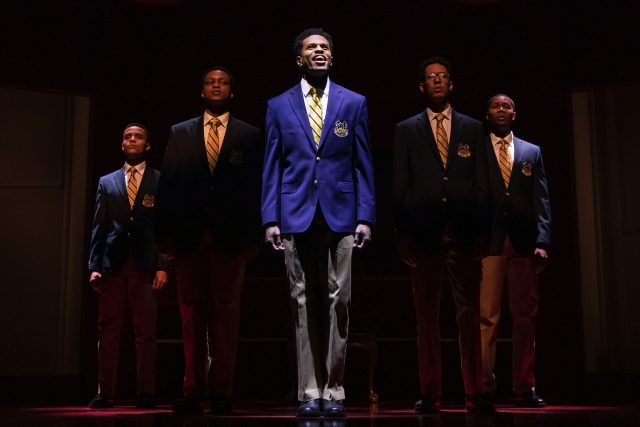
Pharus Jonathan Young (Jeremy Pope) pursues his singing dreams in Choir Boy (photo © Matthew Murphy, 2018)

Manhattan Theatre Club at the Samuel J. Friedman Theatre
261 West 47th St. between Broadway & Eighth Aves.
Tuesday – Sunday through February 24, $79-$169
choirboybroadway.com
www.manhattantheatreclub.com

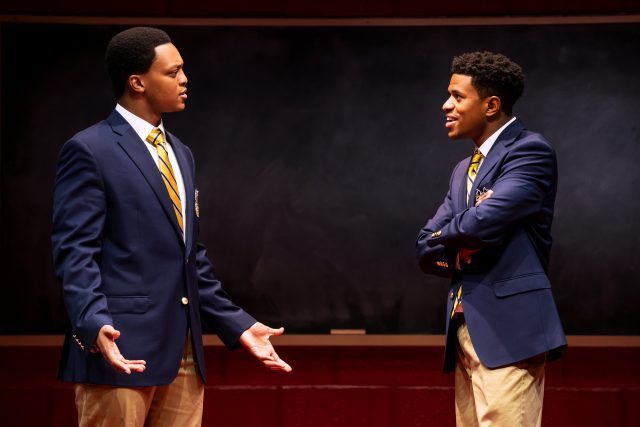
Oscar-winning screenwriter Tarell Alvin McCraney’s Broadway debut, Choir Boy, offers a new twist on a classic dramatic trope: life at an all-male boarding school. But Charles R. Drew Prep School is not quite like the schools depicted in such well-regarded films as Rushmore, Dead Poets Society, Tom Brown’s School Days, Heaven Help Us, or If… The students and the teachers at Drew are all men of color. “My daddy say they used to let you get away with a lil bit because they know how hard it is to be a black man out there,” student Bobby Marrow (J. Quinton Johnson) tells fellow student David Heard (Caleb Eberhardt). “Now, everything got to be watched, gotta be careful, gotta be cordial. Don’t say nothing, don’t say that word, don’t look like that, this shit Pandemic.” Bobby, whose uncle is Headmaster Marrow (Chuck Cooper), is one of several young men in the school’s prestigious choir, along with Pharus Jonathan Young (Jeremy Pope), Junior Davis (Nicholas L. Ashe), Anthony Justin “AJ” James (John Clay III), and David. The show opens with Pharus singing the school song, a much-coveted opportunity, but he takes an unfortunate pause when he is secretly harassed by Bobby, who questions Pharus’s sexual orientation. Afterward, in explaining why he stopped but without snitching on Bobby, Pharus asks the headmaster, “Would you rather be feared or respected?” which becomes an underlying theme of the play as the boys deal with issues of race, gender, homophobia, family, class, and education.
(photo © Matthew Murphy, 2018)

Bobby Marrow (J. Quinton Johnson) and Pharus Jonathan Young (Jeremy Pope) are at odds in boarding-school drama (photo © Matthew Murphy, 2018)

The play suffers dramatically upon the arrival of Mr. Pendleton, a former teacher at the school who has been brought back by the headmaster for inexplicable reasons, unless it is merely to force racial conflict, as Pendleton is white and, oddly, played by the ubiquitous Austin Pendleton, blurring the line between theater and real life in an obtrusive way. The scenes with Mr. Pendleton, who uses racist cracks to supposedly educate the kids, bring the show to a screeching halt and are best forgotten as the story proceeds. Fortunately, there is much to enjoy in the rest of the Manhattan Theater Club production, which has been extended at the Samuel J. Friedman Theatre through February 24.

Pope (Ain’t Too Proud, Invisible Thread) makes a dazzling Broadway debut as Pharus, a proud, flawed, young gay man who refuses to muzzle himself while often disregarding the feelings of others; it’s an electrifying performance of a role given complex subtleties by McCraney, who cowrote the Oscar-winning Moonlight with Barry Jenkins. The supporting cast portraying the other teens are terrific as well, including Clay III (Encores’ Grand Hotel) as AJ, Pharus’s roommate, who is sensitive to his friend’s situation; Johnson (Hamilton) as the troubled Bobby, who is dealing with his mother’s death; Eberhardt (Is God Is) as David, who is hiding his own secrets; and Ashe (Kill Floor) as Junior, a follower who makes questionable decisions. They might have their share of disagreements, but when they sing such spirituals as “Keep Your Eyes on the Prize” and “Rockin in Jerusalem” they show just what they can accomplish together. (Alas, “There’s a Rainbow ’round My Shoulder” feels a bit too obvious and heavy-handed.) Tony winner Cooper (The Life) is splendidly august as the headmaster, who only gets involved when truly necessary, understanding that the students grow when they figure things out for themselves, even if that’s sometimes painful. Thoughtfully directed by Trip Cullman (Lobby Hero, Six Degrees of Separation), Choir Boy is ultimately about tolerance, about the basic human dignity everyone deserves, while for the most part steering clear of grand statements and politically correct sentimentality.
THE NAP

(photo by Joan Marcus)

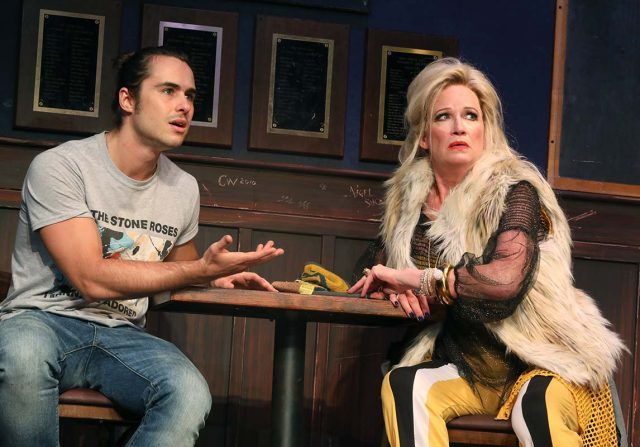
Dylan Spokes (Ben Schnetzer) is none too happy with what his mother (Johanna Day) has gotten him into in The Nap (photo by Joan Marcus)

Manhattan Theatre Club at the Samuel J. Friedman Theatre
261 West 47th St. between Broadway & Eighth Aves.
Tuesday – Sunday through November 11, $79-$199
thenapbroadway.com

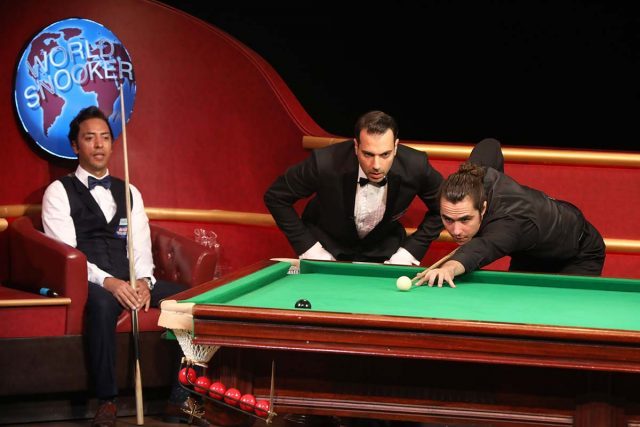
You don’t have to know the slightest bit about snooker to have a jolly good time at The Nap, the rousing London transfer making its American premiere at Manhattan Theatre Club’s Samuel J. Friedman Theatre through November 11. Written by Olivier Award nominee Richard Bean, who wrote the uproarious hit One Man, Two Guvnors, which exploded the career of a young James Corden, The Nap is a tense and very funny crime thriller built around the highly contested world of snooker, the nineteenth-century cue sport similar to pocket billiards and pool. Twenty-three-year-old Dylan Spokes (Ben Schnetzer) is on the rise, preparing for a big-time match. He’s practicing in the British Legion basement in Sheffield with his grumpy, not-too-bright father, the numbers-challenged and ersatz snooker historian Bobby (John Ellison Conlee). Dylan is an easygoing fellow who believes in self-actualization. “It’s the highest possible state of human happiness, when your mind and body come together in, like, a beautiful symphony,” he tells his father, a former amateur snooker player who doesn’t get it at all, responding, “Do you want an orange? Got a bag full.” They are unexpectedly visited by Mohammad Butt (Bhavesh Patel), who identifies himself as an integrity officer for the International Centre for Sport Security, and Eleanor Lavery (Heather Lind), of the National Crime Agency.

(photo by Joan Marcus)

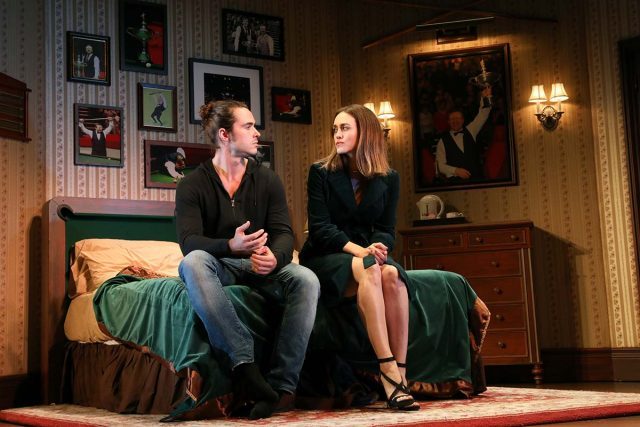
Dylan Spokes (Ben Schnetzer) gets a little too cozy with crime investigator Eleanor Lavery (Heather Lind) in Richard Bean’s The Nap (photo by Joan Marcus)

They claim that Dylan is involved in match fixing and global illegal betting, a charge he adamantly denies. “I am not vulnerable. I honour my game,” he declares. “Snooker is the result of a century of human negotiation. A celebration of cooperation and civilisation. It doesn’t exist other than in the hearts of players and fans.” After Mo and Eleanor leave, Dylan and Bobby are first joined by Dylan’s oh-so-stylish, fast-talking manager, Tony DanLino (Max Gordon Moore), then by Dylan’s wacky mother, Stella (Johanna Day), and her new boyfriend, Danny Killeen (Thomas Jay Ryan), a boring driving instructor. It turns out that Stella, Bobby’s ex, needs money, and she wants Dylan to get it for her — by going against his principles and throwing a frame. It turns out that Dylan has financial issues he wasn’t aware of; he’s in deeper than he ever realized, and the only way out is to listen to transgender gangster Waxy Bush (Alexandra Billings), who has a way with words. “Dylan, let me give you some advice,” she says. “Life, for us vertebrates, is a series of disappointments and appointments. The key to happiness is to forget your disappointments and remember your appointments; in fact, write them down, preferably in a dairy.” As Dylan’s matches with Abdul Fattah and Baghawi Quereshi (both played by former snooker champion Ahmed Aly Elsayed) approach, he has to decide where his loyalties lie and what he is willing to risk, and for whom.

(photo by Joan Marcus)

The Nap features a pair of very tense, live snooker matches with champion Ahmed Aly Elsayed (photo by Joan Marcus)

The title of the show is a snooker term referring to the smoothness of the table, which Dylan explains to Eleanor early on. “Playing with the nap, the ball will run straight with the natural line,” he says. “Playing against the nap, the ball can deviate and drift off line. I play straight. I honour the god of snooker, and he, or let’s be fair, she, looks after me.” Bean (The Heretic, Harvest) and Tony-winning director Daniel Sullivan (The Little Foxes, Proof) honour the god of the stage in this triumphant comedy while not being afraid to deviate and drift off line. Snooker might be an individual sport, but theater requires significant collaboration, and The Nap demonstrates that in all facets. The ensemble, which also includes Ethan Hova as Seth and a snooker referee, is terrific, with a particular shout-out to American actor Ryan (Dance Nation, The Amateurs), one of the city’s most underrated and understated treasures. David Rockwell’s sets rotate from the dank legion basement to a historic hotel room, from a country hideout to a championship snooker match, complete with riotously funny voice-over commentary that is partially improvised. The snooker matches themselves are tense and exciting, occurring live onstage. But once again, it doesn’t matter what you think about sports and gambling, as Bean has plenty to say about dysfunctional families, straight and LGBTQ romance, the criminal element, and vegetarianism. The Nap is a champion on all counts, clearing the table, knocking every ball into the right pocket.

INDIA PALE ALE

(photo by Joan Marcus)

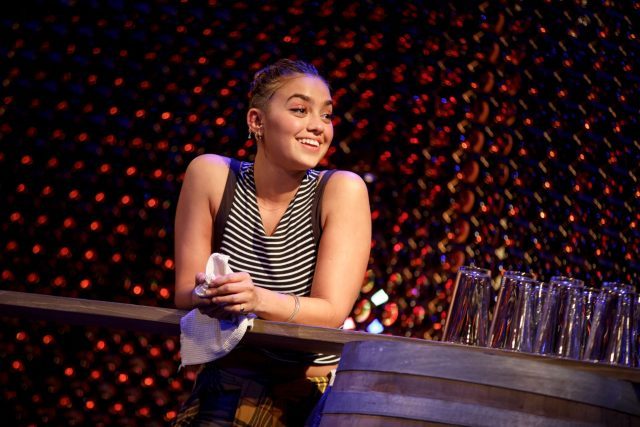
Basminder “Boz” Batra (Shazi Raja) dreams of owning a bar in Madison, Wisconsin, in Jaclyn Backhaus’s India Pale Ale (photo by Joan Marcus)

Manhattan Theatre Club
MTC at New York City Center – Stage I
Tuesday – Sunday through November 18, $69-$89
212-581-1212
indiapalealeplay.com
www.manhattantheatreclub.com

Jaclyn Backhaus’s India Pale Ale takes on even greater meaning in the wake of the synagogue shooting that left eleven Jewish worshipers dead in Pittsburgh on October 27. Her follow-up to Men on Boats, which was about an 1869 expedition to the Grand Canyon, India Pale Ale, a Manhattan Theatre Club production that opened last week at City Center, shuttles between the current day in Raymond, Wisconsin, and a pirate ship traveling from Calcutta to England in 1823. Desperate to try something new, twenty-nine-year-old Basminder “Boz” Batra (Shazi Raja) is secretly planning on leaving her extremely close Punjabi community to open a bar in Madison, Wisconsin, near the college. She dreams of being like one of her ancestors, Brownbeard (Alok Tewari), a wild pirate and explorer who led a mutiny of an East India Company ship two centuries before. “His cargo was beer / as mine’ll be! / In my bar / in Madison, Wisconsin,” she declares in a pirate accent. “Aye, the lineage is full circle now. / Oim leaving home to see the world. / The world in this yar instance: / a bar that sells alcoholic drinks / in a place that is not here.” Boz, who recently broke off an engagement with Vishal Singh (Nik Sadhnani), has not yet told her rather traditional parents, Deepa (Purva Bedi) and Sunny (Tewari), or her younger brother, Iggy (Sathya Sridharan), who is engaged to Lovi (Lipica Shah), about the bar. Deepa actually finds out about Boz’s plans from her gossipy cousin, Simran Rayat (Angel Desai). Overseeing it all is the family matriarch, Sunny’s mother, Dadi Parminder (Sophia Mahmud), who imparts wisdom as necessary.

(photo by Joan Marcus)

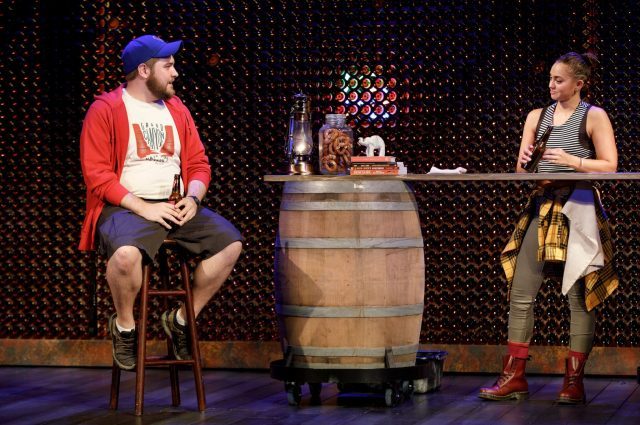
The Batra family prepares for langar following horrific tragedy in India Pale Ale (photo by Joan Marcus)

A year later, Boz is tending bar with only one patron, who she finds out is the lonely Tim (Nate Miller), described in the script as “just so white it’s honestly painful.” Tim is a stand-in for much of white society (and much of the City Center audience) when he assumes that Boz is an immigrant, not a second-generation American born and raised in Wisconsin, and she doesn’t make it easy for him to get out of the hole he keeps digging. “So like your family / what are they . . . like what are you / what are they / where are they from,” he says, stumbling over the words. She eventually decides to be friendly, as Tim seems to be harmless, not a dangerous bigot. It’s a powerful, critical scene that beautifully lays out what so much of the play is about. Their conversation is ultimately cut short when Vishal unexpectedly shows up to bring Boz back to Madison, as there’s been a terrible tragedy in their Sikh community. They return home, where the family is preparing langar, a traditional feast that will try to bring the community together following the awful event.

(photo by Joan Marcus)

A scene between Tim (Nate Miller) and Basminder “Boz” Batra (Shazi Raja) plays a central role in Jaclyn Backhaus drama (photo by Joan Marcus)

Backhaus was inspired to write the play by the Muslim travel ban executive order Donald Trump signed as well as a real tragedy that took place in Oak Creek, Wisconsin, in 2012. The contemporary scenes are poignant, funny, and heartfelt, but Backhaus and director Will Davis spend too much time on Brownbeard and his dancing pirates. Neil Patel’s set switches from the spare langar hall, with chairs and tables brought in and out, to the dark bar Boz runs, to a disco-like stage for the pirates; Arnulfo Maldonado has fun with the costumes, ranging from traditional Punjabi clothing to wild pirate apparel. Raja (Milk Like Sugar) excels as Boz, avoiding the stereotypical transitional figure that is found in so many plays involving a clash between the old and the new. She and Bedi (Dance Nation, An Ordinary Muslim) develop a wonderful rapport as the daughter-mother characters. The play is dragged down by late pedantic speeches by Deepa and Sunny that are wholly unnecessary, merely explaining what we’ve already seen. Otherwise, India Pale Ale is a compelling drama that offers new ways to look at shocking, all-too-real events that continue the hatred overwhelming America.

DAN CODY’S YACHT

(photo by Joan Marcus)

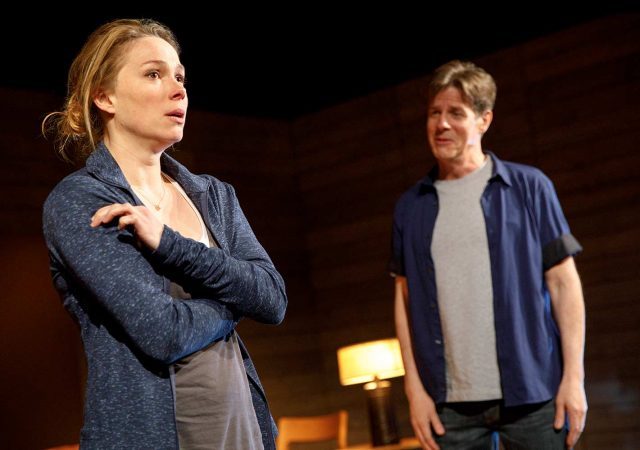
Cara Russo (Kristen Bush) is unsure what to do when Kevin O’Neill (Rick Holmes) offers her an unexpected opportunity in Dan Cody’s Yacht (photo by Joan Marcus)

Manhattan Theatre Club
MTC at New York City Center – Stage I
Tuesday – Sunday through July 8, $90
212-581-1212
dancodysyacht.com
www.manhattantheatreclub.com

Anthony Giardina’s Dan Cody’s Yacht has several gaping holes you could, well, pilot a luxury boat through. However, the Manhattan Theatre Club world premiere, which opened last night at City Center’s Stage I, still offers an intriguing ride despite the choppy waters it navigates through income and education inequality. The two-hour, two-act play begins in September 2014 in the suburbs of Boston, as smarmy financial wizard Kevin O’Neill (Rick Holmes) tries to bribe high school English teacher Cara Russo (Kristen Bush) to change his son’s failing grade on a paper on F. Scott Fitzgerald’s The Great Gatsby, the book that altered the course of his own life. “Incorruptible Cara Russo. I’ve heard about it, now I’ve seen it for myself,” he says, clunkily establishing the core of the narrative. “Chosen by her peers to be the powerful voice of the teachers in our town’s current, ill-advised plunge into liberal American mediocrity. The proposal to meld the two school districts — depressed Patchett, thriving Stillwell. To join the drug addicted, poverty ridden, low achieving children of your little town to the drug addicted but still high achieving children of mine.”

Cara, a divorced single mother, lives in Patchett, where her teenage daughter, Angela (Casey Whyland), goes to school, but she teaches in Stillwell, where Kevin’s teenage son, Conor (John Kroft), is slacking off. Cara is an important member of the committee that will decide whether the merging of the two very different schools, one filled with the haves, the other the have-nots, will be put to a public vote. Cara’s friend Cathy Conz (Roxanna Hope Radja), a working mother whose daughter, Britney, has just made the Patchett debate team, is not so sure that the plan to combine the schools is a good one. “Our high school is our town. We lose that, what have we got?” she says. “We ship our kids over the river to become second class citizens, they come back, how do they respect anything here?” Kevin invites Cara to join his small investing group, where he and other Stillwell parents, Geoff and Pamela Hossmer (Jordan Lage and Meredith Forlenza) and Alice Tuan (Laura Kai Chen), meet monthly, pooling their money to play the market as they drink wine and eat sushi. Cara argues that she doesn’t have any excess cash to get involved in “financial chicanery,” but Kevin convinces her to give it a try, and it all goes well, until it doesn’t.

(photo by Joan Marcus)

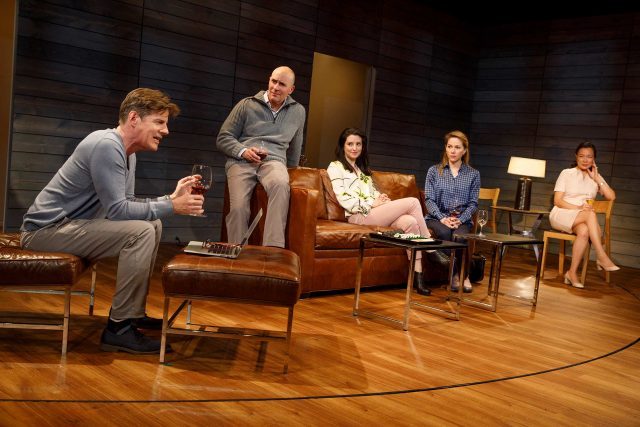
Kevin O’Neill (Rick Holmes) heads an investment club with Geoff Hossmer (Jordan Lage), Pamela Hossmer (Meredith Forlenza), Cara Russo (Kristen Bush), and Alice Tuan (Laura Kai Chen) in MTC world premiere (photo by Joan Marcus)

Giardina (Living at Home) and Tony-winning director Doug Hughes (Doubt, The Father), who previously collaborated on the Drama Desk–nominated Lincoln Center production The City of Conversation, which also featured Bush, steer the ship through an extremely bumpy first act with several key flaws. The discussion about getting Angela into Stillwell seems moot, as it is way too late for her to switch schools in time to affect her chances to go to a better college. There is a serious ethical question about Kevin, who works professionally in private equity, running an investment club, even though the prospect of illegally sharing inside information is brought up. And it seems impossible for Cara to make enough money to afford to move out of Patchett as quickly as she plans to. But the second act is stronger than the first, delving deeper into the characters’ motivations and what they want out of life, which is more complicated than just more money and better education.

“Nobody told us to care about ourselves first,” Cara tells Cathy as she explains why she joined Kevin’s club. “Nobody told us that. And say what you will about that man, that is what he is saying to me.” Later, she adds, “Tell me. Go ahead, say it. You don’t want this. You want mediocrity. You’re happy with mediocrity. You’re happy with this,” referring to their dreary lives in Patchett. Kevin treats finance like sex; when he talks about the opportunities that can open up for Cara, he is practically seducing her. Kevin himself was inspired by the section of The Great Gatsby when the protagonist, then known as James Gatz, rows out to a yacht owned by the much older Dan Cody and becomes his personal assistant; Kevin believes that Gatsby and Cody had a sexual relationship, something that might have ultimately influenced his own life and career. Meanwhile, Angela is reading a worn copy of Leon Uris’s Exodus, more than hinting at the potential exodus of Patchett students across the river to Stillwell. It is small touches like these that rescue the play from drowning itself in murkiness.

(photo by Joan Marcus)

Conor O’Neill (John Kroft) and Angela Russo (Casey Whyland) are caught in the middle of adult shenanigans in new play by Anthony Giardina (photo by Joan Marcus)

The main players, making their way across John Lee Beatty’s effective living-room, classroom, and kitchen sets, give solid performances, particularly Bush (The Common Pursuit, Taking Care of Baby), representing a middle class seeking to improve its lot in life against the odds. Holmes (Junk, Matilda) manages to avoid being a completely unlikable villain, although Kevin says some very hurtful things without regret. Whyland, a 2018 NYU graduate, and Kroft, in his New York debut, are both sympathetic as the teens caught in the middle, not fully understanding, or caring, about the towns’ battle over their future. It also brings to light another central focus of the play: fear. Various characters express being afraid they haven’t done enough for their children (or they’ve done too much), being afraid of change, being afraid of believing they deserve better, even being afraid of money itself. “I am still a little afraid of missing something if I forget that, as my father snobbishly suggested, and I snobbishly repeat, a sense of the fundamental decencies is parcelled out unequally at birth,” Nick Carraway explains at the beginning of The Great Gatsby. In Dan Cody’s Yacht, Giardina attempts to explore that inequality specifically relating to the education gap in contemporary society, though emerging with decidedly mixed test results.

SAINT JOAN

(photo by Joan Marcus)

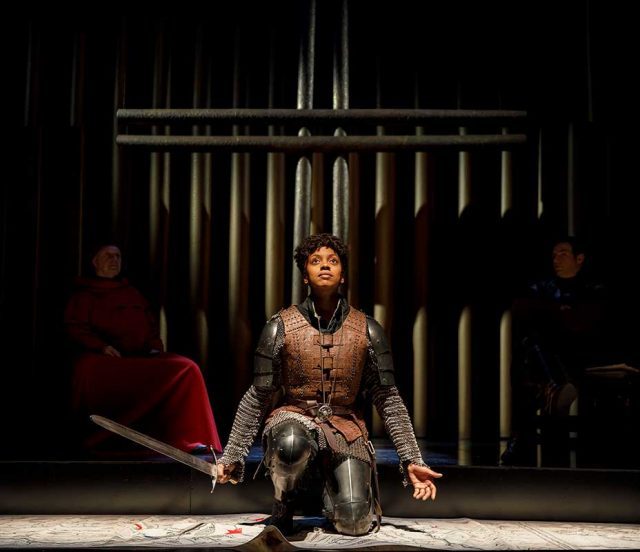
A teenage farm girl (Condola Rashad) is on a mission from God in Bernard Shaw’s Saint Joan (photo by Joan Marcus)

Manhattan Theatre Club at the Samuel J. Friedman Theatre
261 West 47th St. between Broadway & Eighth Aves.
Tuesday – Sunday through June 10, $65-$159
saintjoanbroadway.com
www.manhattantheatreclub.com

“There is something about her,” men say of Saint Joan, the title character in Bernard Shaw’s 1923 play. There is also something about Condola Rashad, who portrays Joan in the current Manhattan Theatre Club revival at the Samuel J. Friedman Theatre. Rashad has now appeared in five Broadway shows, earning four Tony nominations, for Stick Fly, The Trip to Bountiful, A Doll’s House, Part 2, and Saint Joan. (She was also nominated for a Drama Desk Award for her 2009 off-Broadway debut, Ruined, but got shut out as Juliet in a misbegotten Broadway revival of Romeo and Juliet in 2013.) The thirty-one-year-old Rashad is charming as Joan, a teenage farm girl in 1429 who claims that Saint Margaret and Saint Catherine speak to her and that God has commanded her to lead the French to victory in Orleans against the occupying English so the hapless Dauphin (Adam Chanler-Berat) can claim the throne as King Charles VII. She joins a luminous roster of actresses who have played Saint Joan, including Wendy Hiller, Uta Hagen, Joan Plowright, Jean Seberg, Imelda Staunton, Imogen Stubbs, Amy Irving, and Diana Sands, the only other black woman to portray Joan in a major production, at Lincoln Center in 1968. Rashad’s Joan is sweet-natured but determined, gentle yet forceful, a kind of hero just right for the #MeToo and #BlackLivesMatter generation. Joan goes about the world of men — Rashad is the only woman in the cast, among twelve actors, save for a brief appearance by Mandi Masden as the Duchess de la Trémouille — with an ease that emanates from her faith.

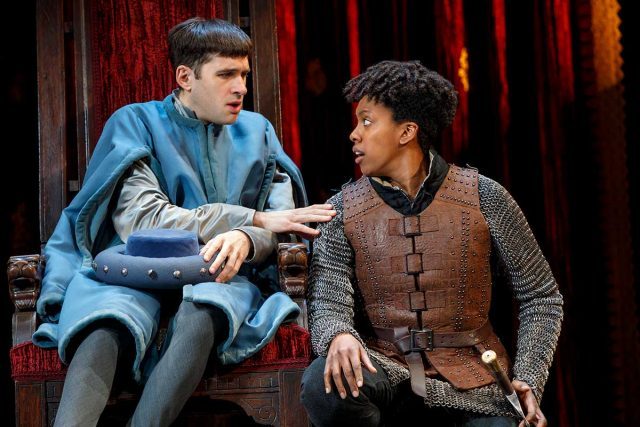
Military squires, royals, and religious leaders disparage Joan until they meet her, slowly falling under her captivating spell. Robert de Baudricourt (Patrick Page) brags about how he “burns witches and hangs thieves,” but Joan tells him, “They all say I am mad until I talk to them, squire. But you see that it is the will of God that you are to do what He has put into my mind,” and he does. Captain La Hire (Lou Sumrall) calls her “an angel dressed as a soldier.” Charles might not want to be king, but Joan is on a holy mission to see that he is crowned at Rheims Cathedral. “If the English win, it is they that will make the treaty: and then God help poor France!” she tells Charles. “You must fight, Charlie, whether you will or no. I will go first to hearten thee. We must take our courage in both hands: aye, and pray for it with both hands too.” But after she impossibly takes Orleans despite being massively outnumbered and then urges the campaign continue on to recapture Paris, the military, the church, and the monarchy realize her power and turn on her, trying her for sins that could get her burned at the stake.

(photo by Joan Marcus)

The Dauphin (Adam Chanler-Berat) finds a savior in Joan (Condola Rashad) in Manhattan Theatre Club Broadway revival (photo by Joan Marcus)

Scott Pask’s set is dominated by large gold pipes hanging from above, as if the entire play takes place inside a giant church organ, spreading Joan’s religious message. “It is in the bells I hear my voices,” Joan tells Jack Dunois (Daniel Sunjata), who ably fights by her side. “Not today, when they all rang: that was nothing but jangling. But here in this corner, where the bells come down from heaven, and the echoes linger, or in the fields, where they come from a distance through the quiet of the countryside, my voices are in them.” Shaw (who preferred not to use the first name George) famously said, “I’m an atheist and I thank God for it”; in writing the play, he was trying to neither convert anyone nor convince them to leave the fold, nor was he creating a biblical-style story of good versus evil. In a preface to the published edition, Shaw wrote, “There are no villains in the piece. . . . It is what men do at their best, with good intentions, and what normal men and women find that they must and will do in spite of their intentions, that really concern us.” Shaw, who also wrote such works as Pygmalion, Major Barbara and Man and Superman and won the Nobel Prize shortly after Saint Joan, does not include any superheroes either. “I am not a daredevil: I am a servant of God,” Joan says to Dunois. “My heart is full of courage, not of anger. I will lead; and your men will follow: that is all I can do. But I must do it: you shall not stop me.”

The exemplary cast also features Max Gordon Moore as Bluebeard, Walter Bobbie as the Bishop of Beauvais, John Glover as the Archbishop of Rheims, Matthew Saldivar as Bertrand de Poulengey, Robert Stanton as Baudricourt’s steward, Russell G. Jones as Monseigneur de la Trémouille, and Jack Davenport as the Earl of Warwick. Most of the actors play more than one role; Page is particularly impressive as Baudricourt and the Inquisitor. Daniel Sullivan’s (The Little Foxes, Proof) direction can get a little bumpy though there are several deft touches, and at nearly three hours, the show can be a little trying. Which brings us to the rather campy epilogue. Shaw wrote Saint Joan in 1923, three years after her canonization, something he deals with in the somewhat surreal, comic, and arguably out-of-place conclusion. “As to the epilogue, I could hardly be expected to stultify myself by implying that Joan’s history in the world ended unhappily with her execution, instead of beginning there,” Shaw wrote. “It was necessary by hook or crook to shew the canonized Joan as well as the incinerated one; for many a woman has got herself burnt by carelessly whisking a muslin skirt into the drawing-room fireplace, but getting canonized is a different matter, and a more important one. So I am afraid the epilogue must stand.” And so it does, for better or worse.

IN THE BODY OF THE WORLD

(photo ©Joan Marcus 2018)

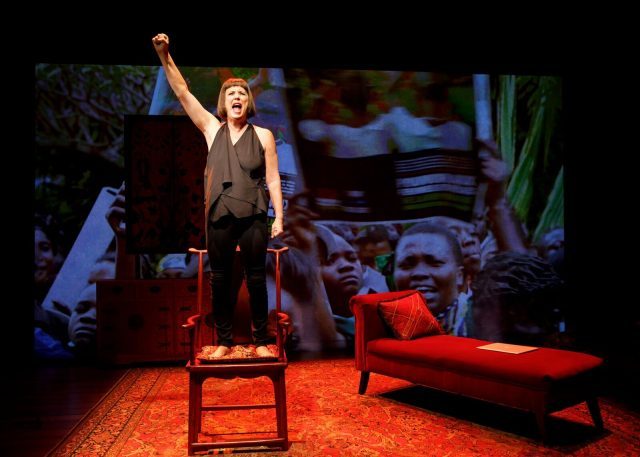
Eve Ensler stands up against cancer in new one-woman show (photo © Joan Marcus 2018)

Manhattan Theatre Club
New York City Center Stage 1
Tuesday – Sunday through March 25, $90
212-581-1212
bodyoftheworldplay.com
www.nycitycenter.org

In the wake of losing my mother to lung cancer just after Thanksgiving, one of the last things I wanted to do was see a play about a woman fighting the cursed disease. But Eve Ensler’s daring, delightful one-woman show, In the Body of the World, which opened tonight at Manhattan Theatre Club’s Stage I at City Center, is bursting with the affirmation of life and the celebration of joy. In 2010, the Tony- and Obie-winning writer of The Vagina Monologues and The Treatment was diagnosed with cancer; she first wrote about it in her 2013 memoir, In the Body of the World, which she has now successfully adapted for the stage. Ensler divides the eighty-minute performance, directed with flair by two-time Tony winner Diane Paulus (Pippin, The Gershwins’ Porgy and Bess), into three sections, “Somnolence,” “Burning,” and “Second Wind,” as she honestly and often poetically talks about her childhood and her family and relates her cancer to things much bigger than herself. “A mother’s body against a child’s body makes a place. It says you are here. I have been exiled from my body. I was ejected at a young age and I got lost,” she says at the beginning. “For years I have been trying to find my way back to my body, and to the earth. I guess you could say it’s a preoccupation.” Ensler strides about Myung Hee Cho’s set, consisting of a wooden chair, a credenza with an altar/cabinet on top, and a chaise longue, which serves as Ensler’s loft, her hospital room, and her hotel room in what she calls Cancer Town, the Mayo Clinic in Rochester, Minnesota. Ensler, a twice-divorced vegetarian and activist who was fifty-six at the time of her diagnosis, had stopped drinking in her twenties and quit smoking in her thirties, so the cancer came as somewhat of a shock, especially when she learned she would have to have her “mother parts,” her uterus, cervix, fallopian tubes, ovaries, and some of her vagina, removed. “Do you have any idea who I am? Do you have any fucking sense of irony?” she tells the doctor.

(photo ©Joan Marcus 2018)

Eve Ensler bonds with nature as she fights for her life in MTC’s In the Body of the World (photo © Joan Marcus 2018)

Ensler exposes her body and her soul as she goes through chemo and becomes involved in the creation of City of Joy, a community of women survivors of rape and violence in Bukavu, Eastern Democratic Republic of Congo, run by Dr. Denis Mukwege and Mama C, aka Christine Schuler-Deschryver. (The amazing work they do is documented in Madeleine Gavin’s extraordinary 2016 film, City of Joy.) Ensler says that Dr. Mukwege “was literally sewing up the vaginas of rape survivors as fast as the militias were tearing them apart. . . . There were hundreds of these stories. They all began to bleed together. The destruction of vaginas. The pillaging of minerals. The raping of the earth. But inside these stories of unspeakable violence, inside the women, was a determination and a life force I had never witnessed.” Refusing to feel sorry for herself, Ensler reexamines her place in the greater world, continually working to teach people to stop sleepwalking through life and start taking responsibility for themselves and others, using this stage as a wake-up call for all of us.

Occasionally projections by Finn Ross cover the stage and the back wall, depicting protests, scenes of nature, people at City of Joy, certain key words, and a tree that deeply impacts Ensler’s recovery. She sometimes flirts with new agey ideas and twelve-step jargon — and she tries to get everyone up and dancing at one point in a rather goofy moment — but, being Eve Ensler, she also finds time to briefly fire away at political and social injustice. And then, at the end, she offers a magical surprise that every audience member should experience instead of rushing to get home; I wouldn’t dare give it away, but you can get a look at what it is here if you can’t help yourself. Ensler, a New York City native, is also a founder of V-Day, “a global activist movement to end violence against women and girls” that in 2018 is celebrating the twentieth anniversary of The Vagina Monologues with special events on and around Valentine’s Day. This year’s V-Day motto is “Rise, Resist, Unite,” which is also the route Ensler took in her fight against cancer, as depicted in this warm and very funny performance. I wish my mother were around to have experienced it for herself.

THE CHILDREN

(photo © Joan Marcus 2017)

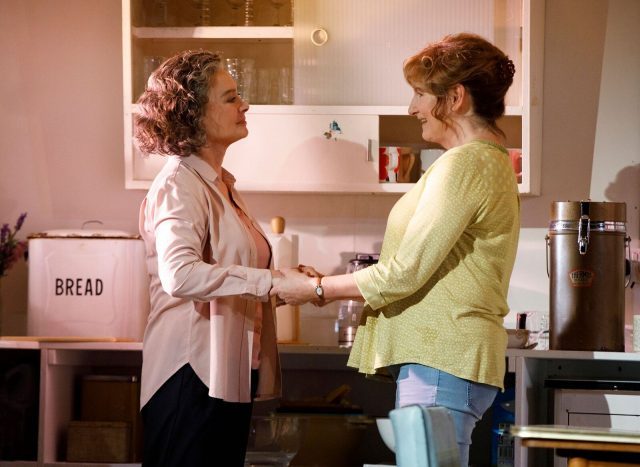
Old friends Rose (Francesca Annis) and Hazel (Deborah Findlay) reunite in Lucy Kirkwood’s The Children (photo © Joan Marcus 2017)

Manhattan Theatre Club at the Samuel J. Friedman Theatre
261 West 47th St. between Broadway & Eighth Aves.
Tuesday – Sunday through February 4, $60-$149
www.manhattantheatreclub.com
thechildrenbroadway.com

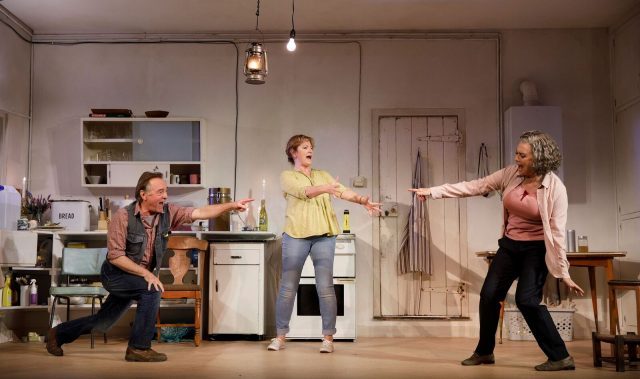
Amid all the splashy musicals, wacky comedies, and star-driven vehicles currently on Broadway, the British import The Children stands apart, a breath of fresh air in this winter season. Well, maybe that’s not the best way to classify this fiercely taut drama, which takes place shortly after a devastating nuclear accident on the East Coast of Britain. The fictional event appears to have even rattled the stage at Manhattan Theatre Club’s Samuel J. Friedman Theatre, which is severely tilted, creating a bit of an uphill or downhill climb when the characters move to the right or left. The play opens as Rose (Francesca Annis) pays a surprise afternoon visit to her old friend and colleague, Hazel (Deborah Findlay), who is living with her husband, Robin (Ron Cook), in a small cottage just outside the contaminated exclusion zone. “We heard you’d died!” Hazel announces; it’s been thirty-eight years since the two women, both nuclear engineers, last saw each other. While Hazel has settled into the domestic life of a retiree, with four children and four grandchildren, Rose has been gallivanting around the world, never settling down or getting married. When Rose asks Hazel why they haven’t moved farther away from the radiation, Hazel responds, “It’s just that little bit extra but it makes a world of difference to our peace of mind. . . . I would’ve felt like a traitor. Besides, retired people are like nuclear power stations. We like to live by the sea.” They are soon joined by Robin, who goes to their old farm every day, tending to the cows, even though it’s in the exclusion area. Where Hazel is very direct and to the point, Robin is more rambunctious and freewheeling, cracking jokes, asking Rose for a squeeze, and offering her some of his homemade wine. But when Rose reveals the reason she has returned — and secrets emerge — the trio has to reexamine their purpose in life and their future.

(photo © Joan Marcus 2017)

Robin (Ron Cook), Hazel (Deborah Findlay), and Rose (Francesca Annis) remember the good old days in U.S. premiere at Manhattan Theatre Club’s Broadway house (photo © Joan Marcus 2017)

Originally produced at the Royal Court Theatre, The Children is brilliantly written by Olivier Award winner Lucy Kirkwood (Chimerica, Mosquitoes), who has created three complex characters who are genuine and unpredictable. The play takes a hard look at ageing and death, examining the responsibility the old have to the young. “How can anybody consciously moving towards death, I mean by their own design, possibly be happy? People of our age have to resist — you have to resist, Rose,” Hazel says. “If you’re not going to grow: don’t live.” It is also about blood, both literally and figuratively. When Rose first enters the house, a shocked Hazel turns defensively and hits Rose, giving her a bloody nose. One of Hazel and Robin’s children suffers from mental illness, thinking she is a bloodsucking vampire. And, of course, radiation poisons the blood. James Macdonald, who has directed numerous works by Caryl Churchill (Escaped Alone, Top Girls) and Sarah Kane (4.48 Psychosis, Blasted), among others, keeps things balanced even as the actors have to deal with Miriam Buether’s angled set, which is framed as if a tilted picture on a wall come to life. Olivier nominee Annis (Cranford, Troilus and Cressida), Olivier winner Findlay (Stanley, Coriolanus), and Olivier nominee Cook (Juno and the Paycock, Faith Healer) reprise their roles from the London production, all three delivering warm, heartfelt performances, with a special nod to Cook for having to ride a tricycle uphill despite a bad back. And Max Pappenheim’s sound design stands out as well, from a Geiger counter to church bells. Despite its title, The Children is the most adult show in New York City right now, a marvelously resonant, intelligent, and engaging play that continually defies expectations as the plot twists and turns while something threatening hangs just past the horizon.