Tag Archives: Manhattan Theatre Club

VIETGONE

(photo by Carol Rosegg)

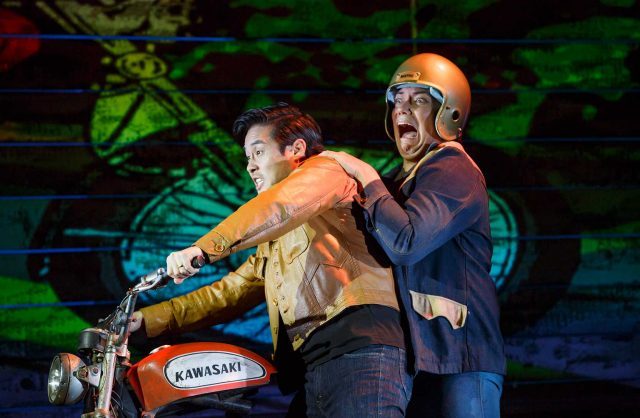
Quang (Raymond Lee) and Nhan (Jon Hoche) take readers on a wild ride in Qui Nguyen’s VIETGONE (photo by Carol Rosegg)

Manhattan Theatre Club
New York City Center Stage 1
131 West 55th St. between Sixth & Seventh Aves.
Tuesday – Sunday through December 4, $90
212-581-1212
vietgoneplay.com
www.nycitycenter.org

In such works as She Kills Monsters, Six Rounds of Vengeance, Alice in Slasherland, Aliens versus Cheerleaders, and Living Dead in Denmark, Arizona-born Vietnamese American playwright and screenwriter Qui Nguyen brings a fresh perspective to the stage, incorporating martial arts, horror, and irreverent humor within a comic-book sensibility. (He’s also a writer for Marvel Studios and founder of the New York-based Vampire Cowboys troupe.) He gets more serious, but no less wild, in his latest drama, Vietgone, a semiautobiographical look at the Vietnam War inspired by his family’s real experiences. “All characters appearing in this work are fictitious. Any resemblance to real persons, living or dead, is purely coincidental,” the playwright (Paco Tolson) announces to the audience at the very beginning. “That especially goes for any person or persons who could be related to the playwright. Specifically his parents. Who this play is absolutely not about. Seriously, if any of you peeps repeat or retweet anything you’ve seen to my folks tonight, you’re assholes.” Nguyen and director May Adrales then tell the story of “a completely made-up man named Quang” (Raymond Lee), a former South Vietnamese soldier who is living in a refugee camp at the Fort Chaffee military base in Arkansas. A married man with two children he has not seen in several years, Quang is trying to get out of America and go back to Vietnam to be with them. “In Saigon / City in Vietnam / Shot up by the Viet Cong / They stole my peep’s freedom / so I’m coming to kill them / Call me their arch villain / Can’t stop me I’m willin’ / to die for this vision / Of a Vietnam that’s free / from those evil VC,” he raps. “You can’t stop me / I’m like a pissed off Bruce Lee / With a hi-ya, a kick, and a kung fu grip / We’ll come out swinging / We don’t give no shits.”
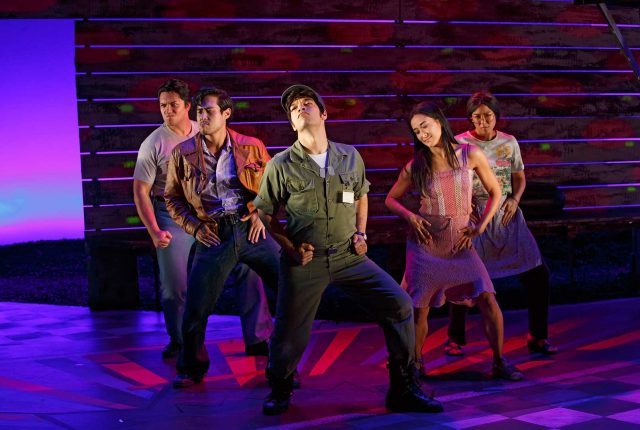
The cast of Qui Nguyen’s VIETGONE struts its stuff in Manhattan Theatre Club production at City Center (photo by Carol Rosegg)

The cast of Qui Nguyen’s VIETGONE struts its stuff in Manhattan Theatre Club production at City Center (photo by Carol Rosegg)

Quang is heading to California on a motorcycle with his friend Nhan (Jon Hoche), where they’ll catch a flight home. The time shifts between April and July 1975, as Quang and Nhan get out during the fall of Saigon and Quang develops a sexual relationship at Fort Chaffee with the cold and carefree Tong (Jennifer Ikeda), despite the protests of her grandmother, Huong (Samantha Quan). But through it all, Quang just wants to reunite with his family. “We don’t belong here. We belong there,” he tells Nhan. “There, we’re heroes. We’re sons. We’re men. There, we count for something. Here, however, we ain’t shit.” On their travels, they encounter a hippie dude (Tolson), a flower girl (Quan), and a redneck biker (Tolson); meanwhile, flashbacks reveal the tough decisions Tong had to make when she chose to leave Vietnam for America. “The communists are going to be rolling into our streets any day now with the mind to make dead all of us who aren’t waving red flags and you’re going to stick around to get riddled with bullets?” she says to her brother, who won’t leave his girlfriend. “I’m not going to let you die here. I can’t. I can’t. That would destroy me. It would absolutely destroy me.” Quang and Tong might be sleeping together in America, but they are both after something they may not be able to find again.
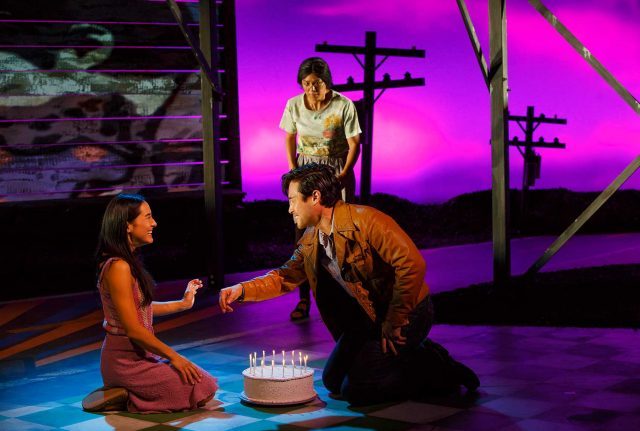
Quang (Raymond Lee) and Tong (Jennifer Ikeda) have something to celebrate while Tong’s unhappy grandmother (Samantha Quan) looks on (photo by Carol Rosegg)

Quang (Raymond Lee) and Tong (Jennifer Ikeda) have something to celebrate while Tong’s unhappy grandmother (Samantha Quan) looks on (photo by Carol Rosegg)

A production of Manhattan Theatre Club in association with South Coast Repertory, where the play debuted, Vietgone turns genre clichés inside out while toying with stereotypes, including who speaks with what accent. Passionately directed by Adrales with a frenetic warmth, the hip-hop immigrant tale — with a sweet nod to Hamilton — is colorful and energetic, taking place on Tim Mackabee’s impressive set, featuring a giant billboard, a horizon backdrop, and tiny telephone poles that represent the American road, creatively lit by Justin Townsend. Jared Mezzocchi’s projections, including graphic-novel-like drawings, set the time and the tone; the scene in which Quang and Nhan race for the helicopter to escape Saigon is absolutely breathtaking. Lee (tokyo fish story, Four Clowns) and Ikeda (Love and Information, Marie Antoinette) have a strong chemistry, while Vampire Cowboys artistic associate Hoche (Soul Samurai, The Inexplicable Redemption of Agent G), Quan (Masha No Home, An Infinite Ache), and longtime Nguyen collaborator Tolson (Fight Girl Battle World, Men of Steel) have a ball in multiple roles. The play is not as polished as it could be; several moments could be tightened up, and its clever but unusual storytelling techniques are not for everyone, obviously, as a chunk of older people left at intermission. But they should have stuck it out, as the rest of us did, who were caught up in this compelling love story about home that is both funny and moving, historical and contemporary, given the current debate over immigrants and refugees from around the world.


HEISENBERG

(photo © Joan Marcus 2016)

Butcher Alex Priest (Denis Arndt) and quirky Georgie Burns (Mary-Louise Parker) meet in a London tube station in HEISENBERG (photo © Joan Marcus 2016)

Manhattan Theatre Club at the Samuel J. Friedman Theatre
261 West 47th St. between Broadway & Eighth Aves.
Tuesday – Sunday through December 11, $70-$150
heisenbergbroadway.com
www.manhattantheatreclub.com

Simon Stephens’s Heisenberg, which transferred to Broadway last month shortly after his extraordinary The Curious Incident of the Dog in the Night-Time ended a two-year run at the Ethel Barrymore, might reference the quantum theory uncertainty principle that proves the impossibility of precisely measuring position and momentum at the same time, but there’s no uncertainty that the British playwright is an exceptional storyteller bursting with both position and momentum. Stephens’s Tony-winning adaptation of Mark Haddon’s children’s book was turned into a multimedia marvel by Marianne Elliott. Heisenberg explores some of the same territory, the nature of establishing connections and communication between people, but could not otherwise be more different; it’s a spare, minimal tale directed with a graceful simplicity by Mark Brokaw (The Lyons, After Miss Julie). Mary-Louise Parker and Denis Arndt are magnetic as Georgie Burns and Alex Priest, respectively, two loners who meet one afternoon in a London tube station. Georgie is a forty-two-year-old fast-talking American with a tenuous grasp on the truth, while Alex is a seventy-five-year-old Irish butcher who just wants to be left alone. As the play opens, she kisses the back of his neck, mistaking him for someone else, then starts babbling to him. “Why are you talking to me?” he asks sternly. “I’m sorry. I’m really weird. I know. You don’t need to tell me. I’ll go,” she replies. But she can’t leave; she is drawn to him, sharing intimate details of her life that might or might not be true. When she shows up at his shop five days later, tracking him down through Google, he coldly declares, “My privacy has been violated.” She responds, “‘Violated’ is a bit strong. ‘Violated’ is a bit hyperbolic.” “Nice word,” he says. “Thank you. Ha. ‘Nice word.’ Patronizing fucker,” she answers. As these two extremely particular and rather odd strangers get to know each other, they attempt to fill in the missing parts of their lives.

heisenberg-2

The awe-inspiring technology behind Curious Incident is completely absent in Heisenberg, a streamlined production that relies on basic, almost workshoplike elements. Mark Wendland’s (Next to Normal, The Merchant of Venice) sparse stage features two chairs and two tables that the actors occasionally move around as the scenes change; there is a riser of seats behind the stage, placing the characters in the middle of the audience. Despite the show’s title, Stephens’s script does not delve deeply into physics, although at one point Georgie explains, “If you watch something closely enough you realize you have no possible way of telling where it’s going or how fast it’s getting there. Did you know that? That’s actually the truth. That’s actually scientifically been proven as the truth. By scientists. They all got together and they completely agreed on that. If you pay attention to where it’s going or how fast it’s moving, you stop watching it properly.” Those words also apply to how one can experience theater, including this Manhattan Theatre Club production. There’s no need to pay special attention to where this charming two-actor character sketch is going, or how fast it will get there; just watch it properly, immersed in the moment and the flow, in the lightning-quick pace and dizzying spectacle of Parker’s (Proof, Weeds) splendidly quirky performance or the subtle, sly, sublimely powerful work of Oregon Shakespeare Festival veteran Arndt (The Ballad of Soapy Smith, Basic Instinct) as he almost imperceptibly builds the quietly heartbreaking figure of Alex. “You need to follow it. The melody,” Alex tells Georgie when teaching her how to listen to a Bach sonata. “Try to predict what will happen to it next. It will completely take you by surprise.” The same can be said for this beautifully constructed show.

INCOGNITO

(photo by Joan Marcus)

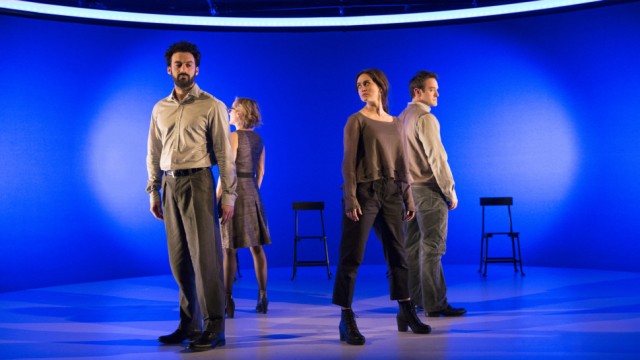
Morgan Spector, Geneva Carr, Heather Lind, and Charlie Cox play multiple roles in Nick Payne’s ingenious INCOGNITO (photo by Joan Marcus)

Manhattan Theatre Club
New York City Center Stage 1
Extended through July 10, $105
212-581-1212
incognitoplay.com
www.nycitycenter.org

Some entertainments let us check our brains at the door when we enter a theater, seeking mindless, feel-good entertainment to take us away from the drudgery and complications of modern life. However, thirty-two-year-old British playwright Nick Payne not only forces audiences to use their noggins but uses the human brain as the catalyst and centerpiece of his ingenious play Incognito, which has been extended at City Center through July 10. In such previous works as Constellations, If There Is I Haven’t Found It Yet, and Elegy, science plays a major role as Payne examines such topics as climate change, time, death, string theory, and the multiverse. Loosely inspired by several real stories, Incognito features four actors playing twenty parts built around three intertwining scenarios. Dr. Thomas Harvey (Spector) has performed the autopsy on Albert Einstein, cutting out his brain and bringing it home with him for further study. (Yes, this is based on fact.) “I got the professor in fronta me, I already opened him up and I’m looking at this . . . brain, and I’m thinking to myself: this could be the biggest moment of my life. So I took it,” the pathologist tells his incredulous wife, Elouise (Carr). Meanwhile, Dr. Victor Milner (Spector) is meeting with his patient, pianist Henry Maison (Cox), an epileptic who, following a brain operation to try to stop his seizures, now suffers from short-term memory loss, essentially restarting every forty-five seconds. His devoted wife, Margaret Thomson (Lind), is attempting to use musical therapy to help him, but Henry seems to have forgotten how to play the piano as well. In the third arc, Dr. Martha Murphy (Carr) is a divorced clinical neuropsychologist going on her first date with a woman, the free-spirited Patricia Thorn (Lind). Over the course of eighty-five breathless minutes, the stories overlap and intertwine either directly or conceptually as Payne explores love, grief, memory, identity, and time-and-space relativity.

(photo by Joan Marcus)

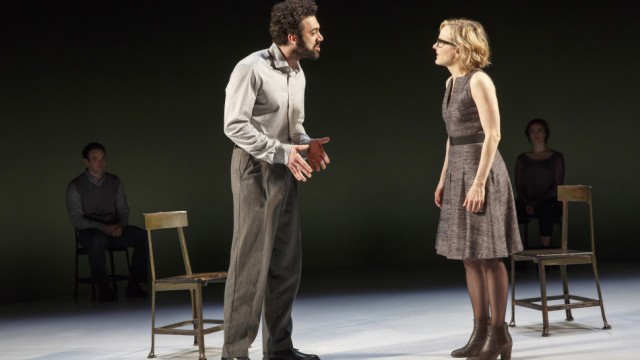
Morgan Spector and Geneva Carr face off while Charlie Cox and Heather Lind watch in dazzling play by Nick Payne (photo by Joan Marcus)

Divided into three sections — Encoding, Storing, and Retrieving — Incognito takes place on Scott Pask’s essentially simple set, a circular platform with four chairs. The characters and multiple plotlines change instantly, like the firing of neurons in the brain, often in the middle of a conversation or sentence, the actors, wearing the same clothes throughout, using different accents and manners of speaking to indicate the sudden shifts in time and place, along with lighting cues from Ben Stanton. In addition, there is occasional abstract movement set to music by David Van Tieghem. It’s all seamlessly directed by Tony winner Doug Hughes (Doubt, The Father) and expertly acted by Carr, Cox, Lind, and Spector, who effortlessly slide from one role to another as the stories weave together in this Manhattan Theatre Club production. “Our brains are constantly, exhaustively working overtime to deliver the illusion that we’re in control, but we’re not,” Martha tells Patricia. “The brain builds a narrative to steady us from moment to moment, but it’s ultimately an illusion. There is no me, there is no you, and there is certainly no self; we are divided and discontinuous and constantly being duped. The brain is a storytelling machine and it’s really, really good at fooling us.” The same can be said for Payne’s marvelously constructed play, which makes audiences’ brains work overtime, but it’s well worth it. “Imagination is more important than knowledge. Knowledge is limited. Imagination encircles the world,” one of Martha’s patients, Anthony (Spector), tells her, quoting Einstein. Incognito is riveting theater, with knowledge and imagination to spare.

THE FATHER

(photo by Joan Marcus)

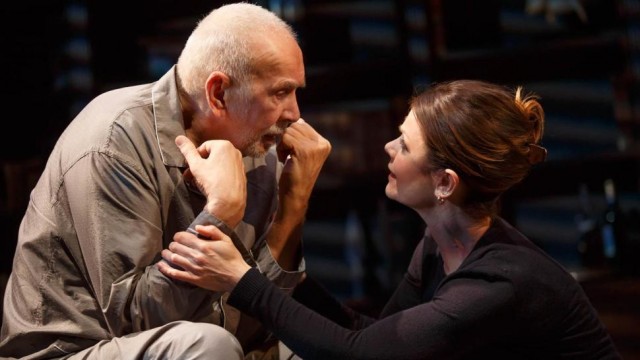
André (Frank Langella) doesn’t make it easy for his daughter, Anne (Kathryn Erbe), to help him in THE FATHER (photo by Joan Marcus)

Manhattan Theatre Club at the Samuel J. Friedman Theatre
261 West 47th St. between Broadway & Eighth Aves.
Tuesday – Sunday through June 12, $70-$150
thefatherbroadway.com
www.manhattantheatreclub.com

In early 2014, Frank Langella played King Lear at BAM, a thought-provoking counterpoint to his latest show, the U.S. premiere of Florian Zeller’s The Father. As Lear, the seventy-eight-year-old Langella, who has won three Tonys and two Obies, battled his failing mind and body while two of his three daughters fought over his wealth and power and the third only wanted to love and care for him. As eighty-year-old André in Zeller’s Olivier-nominated, Molière Award–winning play — not to be confused with August Strindberg’s The Father, currently running at Theatre for a New Audience — Langella is an elegant Paris gentleman dealing with the early stages of Alzheimer’s disease while his loving daughter, Anne (Kathryn Erbe), tries to care for him despite his mistreatment of her. After scaring off yet another home nurse, André yells at Anne, “I don’t need her! I don’t need her or anyone else! I can manage very well on my own!” But it’s becoming more and more apparent that he can’t, as he gets lost in a psychological maze of the past and the present, not knowing who is who and where he is while refusing to acknowledge what is happening to him, instead turning the tables on those around him. “I’m worried about you,” he says to a woman (Kathleen McNenny) who claims to be Anne but he does not recognize. “Don’t you remember? She doesn’t remember. Are you having memory lapses or what? You’d better go and see someone, my dear.” He also mixes up Anne’s significant others, either boyfriends or husbands (Charles Borland and Brian Avers) who may or may not be moving to London with her. And he compares his latest caretaker, Laura (Hannah Cabell), to his beloved other daughter, Elise, whom he wildly praises while disparaging Anne. “You have two daughters?” Laura asks suspiciously. “That’s right,” he says. “Even though I hardly ever hear from the other one. Elise. All the same, she was always my favourite. . . . I don’t understand why she never gets in touch. Never.” In addition, André seems to be forgetting whose apartment he’s in and whether he’s living on his own or with Anne, which makes him angry and upset. “I don’t need any help from anyone and I will not leave this flat,” he firmly declares. But he’s of course in dire need of help.

(photo by Joan Marcus)

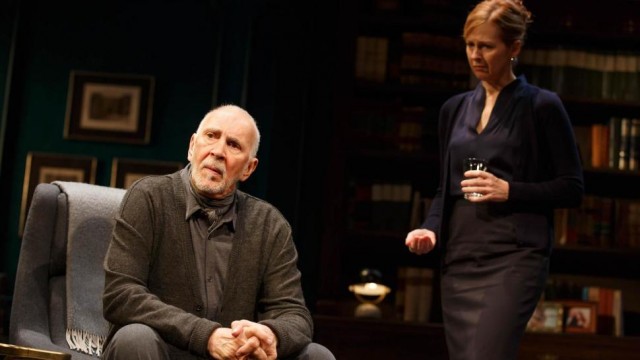
André (Frank Langella) ponders his frightening future in Florian Zeller play (photo by Joan Marcus)

Translated from the French by two-time Tony winner Christopher Hampton (Les Liaisons Dangereuses, Sunset Boulevard) and directed by Tony winner Doug Hughes (Frozen, The Royal Family), Zeller’s play, a companion piece to The Mother, uses clever stagecraft to depict André’s heartbreaking descent. Scenes sometimes repeat or overlap, and having multiple actors play Anne and her partners transfers André’s confusion to the audience, which is also sometimes not sure who is who or if what is happening is only in André’s fading mind. Each scene ends with a sudden darkness, and when the lights come back on (courtesy of lighting designer Donald Holder), bits of Scott Pask’s fashionable French-flat set, from books to furniture, have disappeared, echoing the cognitive losses inside André’s head. André is also obsessed with time, as if, deep down, he really does understand the fate that awaits him but is unwilling to face the truth. He keeps thinking someone has stolen his watch, and he continually refers to time. “Time passes so fast,” he says wistfully. Later he opines, “If this goes on much longer, I’ll be stark naked. Stark naked. And I won’t even know what time it is.” Langella (Frost/Nixon, Dracula) goes from bold and confused to touchingly gentle as André, imbuing him with a Lear-like regalness and an aristocratic refinement even when tap-dancing; it’s a beautifully moving performance from one of America’s finest actors. Zeller, Hampton, and Hughes avoid genre clichés or sentimentality, using clever subtlety to tell a very sad, unfortunately increasingly common tale.

PRODIGAL SON

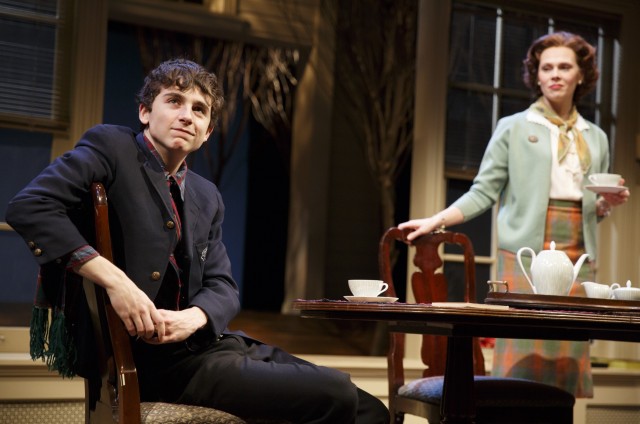
Jim Quinn (Timothée Chalamet) shares his dreams with Louise Schmitt (Annika Boras) in John Patrick Shanley’s latest memory play (photo © 2016 by Joan Marcus)

Jim Quinn (Timothée Chalamet) shares his hopes and dreams with Louise Schmitt (Annika Boras) in John Patrick Shanley’s latest memory play (photo © 2016 by Joan Marcus)

Manhattan Theatre Club
New York City Center Stage 1
Through March 27, $90
212-581-1212
prodigalsonplay.com

John Patrick Shanley’s Prodigal Son is exactly the kind of play that makes us love the theater: a beautifully written, directed, and acted work about believable people we can respect, in realistic situations that entertain and educate us about ourselves and others. Prodigal Son, which Shanley both wrote and directs, is the culmination of his unofficial autobiographical trilogy, which began with 1991’s Beggars in the House of Plenty and continued with 2004’s Doubt: A Parable; all three have been first presented by Manhattan Theatre Club. In this world premiere, which opened last night at City Center, Timothée Chalamet stars as Jim Quinn, a bright but confused adolescent from the Bronx who is off to the Thomas More Preparatory School in New Hampshire after having problems at previous educational institutions. “Do you remember fifteen? For me, it was a special, beautiful room in hell,” he tells the audience at the start. The school’s founder and director, Carl Schmitt (Chris McGarry), a devout Catholic, decides to take a chance on the tough-talking, working-class Jim. “We don’t have another boy like him,” he explains to Alan Hoffman (Robert Sean Leonard), the head of the English department who becomes a mentor to Jim. A lonely kid obsessed with poetry, Nazis, and defending and supporting his older brother who is a soldier in Vietnam (the play takes place from 1965 to 1968), Jim gets into fights with fellow students, steals odd objects, drinks apricot brandy, and breaks other rules that should get him expelled, but Mr. Schmitt sticks with him. “He’s the most interesting mess we have this year,” he says to Mr. Hoffman. But as much trouble as he is, Jim is also an extremely clever young dreamer with fascinating insight into life. “It’s a prison to think things are impossible,” he says to his math-nerd roommate, Austin Lord Schmitt (David Potters), Mr. Schmitt’s nephew. Later, meeting with Louise Schmitt (Annika Boras), Mr. Schmitt’s wife and an English teacher at the school, Jim says, “People are born somebody. They don’t choose who they are. I was born me. I don’t get to be somebody else, even if I want to be someone else.” “Do you want to be somebody else?” Mrs. Schmitt asks. “What’s it matter? I can’t be,” he responds. “I’m Jim Quinn. I was born Jim Quinn and I’ll die Jim Quinn.” It all comes to a head as graduation nears and Jim’s immediate future is very much in doubt.

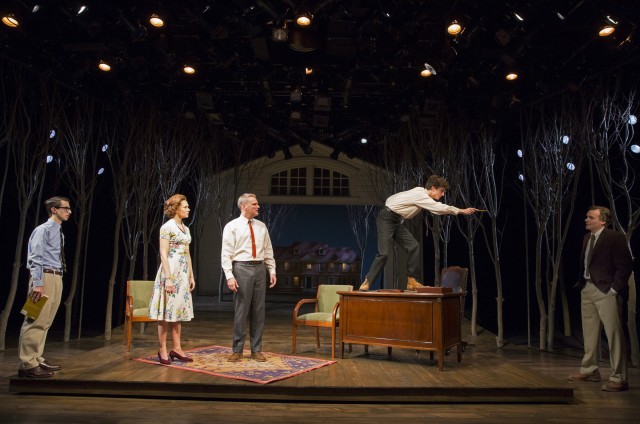
John Patrick Shanley goes back to prep school in PRODIGAL SON (photo © 2016 by Joan Marcus)

John Patrick Shanley goes back to prep school in PRODIGAL SON (photo © 2016 by Joan Marcus)

Prodigal Son is a deeply personal story, based on Shanley’s real experiences at the real Thomas More school, which was founded and run by the real Mr. Schmitt. (In fact, a special preview of the play was recently held for current and former students and faculty members.) It’s no surprise that the show is highly literate, with discussions of “The Rubaiyat of Omar Khayyam,” Plato and Socrates, Pierre Teilhard de Chardin and Sigmund Freud, and T. S. Eliot’s “The Wasteland” that avoid getting overly pedantic. The five characters are extremely well drawn, avoiding genre stereotypes while including several shocking plot twists. Chalamet (Homeland, Interstellar), a graduate of the LaGuardia High School of Performing Arts and who was born and raised in Hell’s Kitchen, is a whirlwind as Jim, gesticulating wildly — much of which was inspired by Shanley’s (Moonstruck, Outside Mullingar) own proclivities — and approaching the world with eyes wide open, hopeful for the possibilities it offers while worried he might never find his place in it. McGarry, who has previously appeared in Shanley’s Doubt, Defiance, Dirty Story, and Where’s My Money?, is steadfast as Mr. Schmitt, a God-fearing man whose convictions are severely tested by Jim. Boras (Chair, The Broken Heart) is radiant as Mrs. Schmitt, a bright and charming woman who is much more than a mere appendage of her husband; her involvement with Jim is critical to his potential success. Santo Loquasto’s engaging set includes a miniature version of the school in the back and bare trees on the sides that move as various rooms slide in and off the stage; the interstitial music is by Paul Simon, with lighting by Natasha Katz. But at the center of it all is the Tony-, Pulitzer-, and Oscar-winning Shanley himself, finally sharing a story he’s wanted to tell for decades. “I wish you could have been there,” Shanley writes in a program note. After experiencing Prodigal Son, you’ll feel like you were.

OUR MOTHER’S BRIEF AFFAIR

(photo by Joan Marcus)

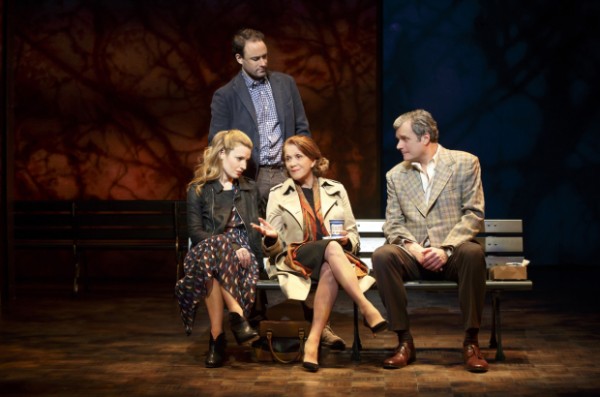
A park bench is the main setting in Richard Greenberg’s OUR MOTHER’S AFFAIR (photo by Joan Marcus)

Manhattan Theatre Club at the Samuel J. Friedman Theatre
261 West 47th St. between Broadway & Eighth Aves.
Tuesday – Sunday through March 6, $60-$140
ourmothersbriefaffairbroadway.com
www.manhattantheatreclub.com

Our Mother’s Brief Affair, Richard Greenberg’s eleventh collaboration with Manhattan Theatre Club, starts off promisingly enough, but a bizarrely bombastic reveal shortly before intermission derails the rest of this quiet family drama. Tony winner Linda Lavin stars as Anna, a variation of a character previously introduced in Greenberg’s Everett Beekin and played by Bebe Neuwirth in 2001 at Lincoln Center. On one of her many deathbeds yet again, the Burberry-loving Anna tells her son, Seth (Greg Keller), that she had an affair with a man (John Procaccino) back in 1973, when she took Seth to Juilliard for his weekly music class. Although Seth, an obituary writer used to examining people’s lives in death, thinks she’s just making up another story, his twin sister, Abby (Kate Arrington, in her seventh Greenberg work), confirms its truth. Anna’s confession becomes even more shocking when she tells them who the man is, a minor but real person in the Cold War and a figure of revulsion to New York’s Jewish intelligentsia. The name is less than well known enough to require a sort of extended live footnote, so the show comes to a screeching halt as Seth and Abby explain who he is and what he did. Greenberg’s choice of partner for Anna is so head-scratchingly strange that the play simply can’t get back on track.

(photo by Joan Marcus)

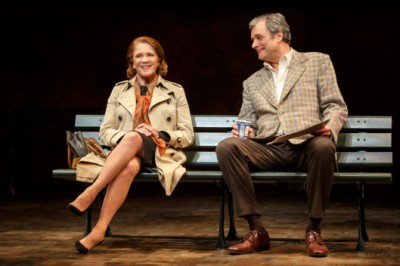
Anna (Linda Lavin) and her lover (John Procaccino) recall the good old days in Richard Greenberg play (photo by Joan Marcus)

Lavin (The Lyons, The Tale of the Allergist’s Wife), at seventy-eight, adds some sex appeal to her role as a mother with secrets of her own that are finally coming out, as she claims once again to be facing the end. Procaccino (Incident at Vichy, Nikolai and the Others), one of New York theater’s busiest, and most dependable, actors, is laden down with playing a historical figure that overwhelms his presence. Keller (The Who and the What, Of Good Stock) and Arrington (Grace, The Iceman Cometh), as dysfunctional gay twins, are expository characters who never quite develop their own personalities. Santo Loquasto’s easygoing set consists of a few chairs and a park bench, where Seth, Abby, Anna, her husband (also played by Procaccino), and her lover go back and forth between 1973, 2003, and 2006, with everyone watching what unfolds regardless of what time period they are from, which is occasionally unnerving. MTC artistic director Lynne Meadow never quite pulls together the time shifts and plot reveals; despite a fine lead performance by Lavin, Our Mother’s Brief Affair — which was originally staged as a slightly shorter one-act in 2009 by South Coast Rep, with Jenny O’Hara, Arye Gross, Marin Hinkle, and Matthew Arkin and directed by Pam MacKinnon — feels more like a short story, or a subplot from another play, unable to sustain itself, particularly because it just can’t support the major twist that pulls the rug out from under whatever possibilities it might have had.

RIPCORD

(photo © 2015 Joan Marcus)

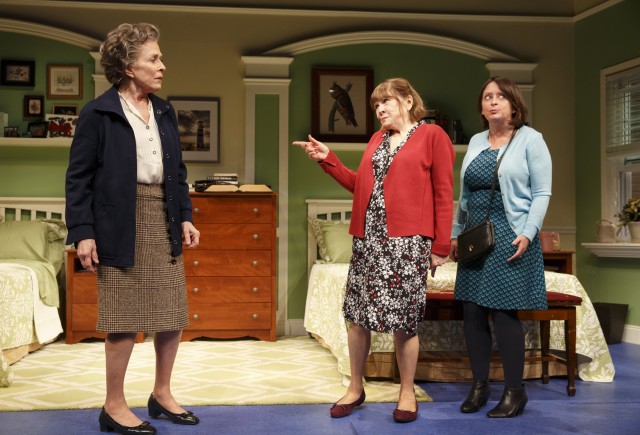
Abby (Holland Taylor) and Marilyn (Marylouise Burke) do battle as Colleen (Rachel Dratch) looks on in RIPCORD (photo © 2015 Joan Marcus)

Manhattan Theatre Club
New York City Center Stage 1
Tuesday – Sunday through December 6, $90
212-581-1212
ripcordplay.com
www.nycitycenter.org

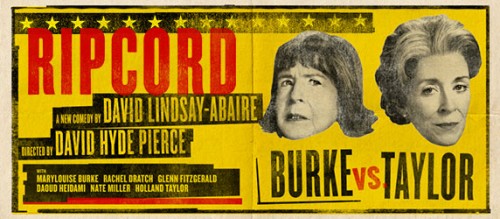
Pulitzer Prize winner David Lindsay-Abaire’s sixth collaboration with Manhattan Theatre Club is a hilarious battle of wits between two unlikely combatants: a pair of elderly ladies in a suburban New Jersey nursing home. Abby Binder (Holland Taylor) is a nasty, mean-spirited, and spiteful woman filled with vitriol she pours on everyone and everything, just wanting to be left alone. Marilyn Dunne (Marylouise Burke) is a kind, sweet-natured soul who loves life and wants only happiness for all. Marilyn explains that she has reached a point in her life where she no longer gets angry. “There’s really no point. It always leads to an ugly place. And I don’t care for ugly places,” she states. Meanwhile, Abby claims she doesn’t get scared: “Haven’t been in years. That’s what happens when you live long enough. Things disappear. Just like my taste buds. Just like your anger. Everything goes eventually.” Abby has chased off her previous roommates at the Bristol Place Assisted Living Facility and wants Marilyn gone as well, but Marilyn is determined to stay no matter what. So the two make a bet: If Abby can make Marilyn angry first, she gets the room to herself, but if Marilyn frightens Abby first, she gets the bed by the window, with a view of the park. So the gloves come off and the two go at it fiercely, with nothing off limits as they each try to win at any cost.

ripcord 2

Lindsay-Abaire, whose previous works include Rabbit Hole, Fuddy Meers, and Good People, has written a tight, smartly crafted story that calls to mind both The Gin Game and The Odd Couple (with a wee bit of Jackass) while feeling wholly fresh. It’s tons of fun, and it doesn’t let up for the full two hours (with intermission). Alexander Dodge’s (A Gentleman’s Guide to Love and Murder, Present Laughter) sets change from the shared bedroom to a haunted house and an airplane, the latter two working surprisingly well. Tony nominee Taylor (Ann, Bosom Buddies) and Obie winner Burke, in her sixth Lindsay-Abaire play, are utterly delightful as the two very different senior citizens resorting to ever-dirtier tricks, ranging from very funny to very serious, determined to be the victor. Nate Miller (Of Good Stock, Love and Information) is charming as Scotty, the gentle, courteous nursing-home attendant. SNL veteran Rachel Dratch (Tail! Spin!, Love’s Labour’s Lost) does double duty as an actress portraying a creepy mother in a haunted house as well as Marilynn’s daughter, Colleen, who gets involved in the bet despite the misgivings of her husband, Derek (Daoud Heidami). Heidami (American Hero, Aftermath) and Glenn Fitzgerald (Ivanov, Lobby Hero) play several small roles, including Heidami as a zombie butler and Fitzgerald as a killer clown in the house of horrors. Director David Hyde Pierce (It Shoulda Been You, Vanya and Sonia and Masha and Spike) keeps it all from getting too sitcom-y, something he knows a thing or two about; Ripcord had every right to turn into an expanded episode of The Golden Girls, but instead it’s one of the best comedies of the season, a deliciously clever, and ultimately poignant, look at family, old age, and the human need for companionship.