Tag Archives: Manhattan Theatre Club

GOLDEN SHIELD

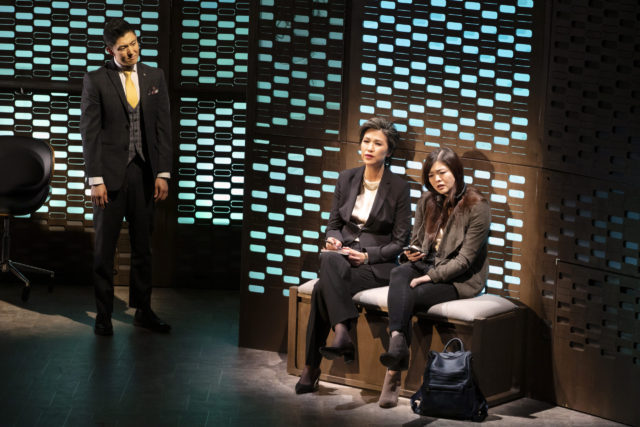
Anchuli Felicia King’s Golden Shield questions language and communication by individuals, corporations, and governments (photo by Julieta Cervantes)

GOLDEN SHIELD
Manhattan Theatre Club
MTC at New York City Center – Stage I
131 West 55th St. between Sixth & Seventh Aves.
Tuesday – Sunday through June 12, $59-$89
www.manhattantheatreclub.com

Anchuli Felicia King uses a volatile court case as a battleground for complex ideas about communication and translation involving family, corporations, governments, and the internet in Golden Shield, which opened tonight at MTC at New York City Center – Stage I.

The two-and-a-half-hour play (including intermission) begins with the Translator (Fang Du) laying some of the ground rules. Discussing the difficulty of translating a Chinese proverb into English, he tells the audience, “I can try to find an English equivalent, if one exists. But of course, I risk making false parallels, unwittingly engaging in an act of . . . linguistic imperialism. Or I can really spell it out. . . . But you do lose some of the beauty of the original. It’ll be much the same with this job, I suspect. . . . Just settle into it. Trust that your mind is a machine. Eventually, it’ll find a focal point. Having said that, it is essential that you concentrate.”

The Translator is speaking about the language in the play as much as the language of the play, which takes place nonchronologically between 2006 and 2012 in Washington DC, Beijing, Yingcheng, Dallas, Palo Alto, and Melbourne. In fact, he’s only a character in the plot a few times; instead, he is primarily an observer, standing off to te side, making certain things clearer for the audience, including filling in details of some characters’ pasts. He also has the innate ability to know when someone is lying.

As lawyer Julie Chen (Cindy Cheung) points out, “There’s a lot of jargon in this case. A lot of legal jargon and a lot of technical jargon.” She’s not kidding, so we need the Translator.

Julie, a managing partner in a firm with Richard Warren (Daniel Jenkins), also needs a translator, for a class-action lawsuit in which eight Chinese dissidents are charging ONYS Systems with criminal collusion with the Chinese government, based on a single bullet point in a document regarding the Golden Shield, a real-life surveillance project involving the Great Firewall of China.

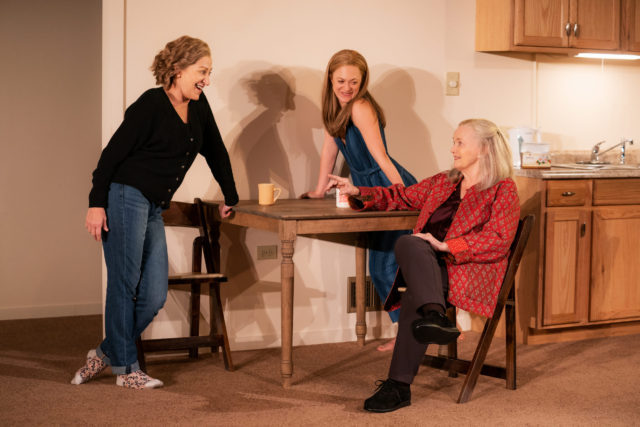
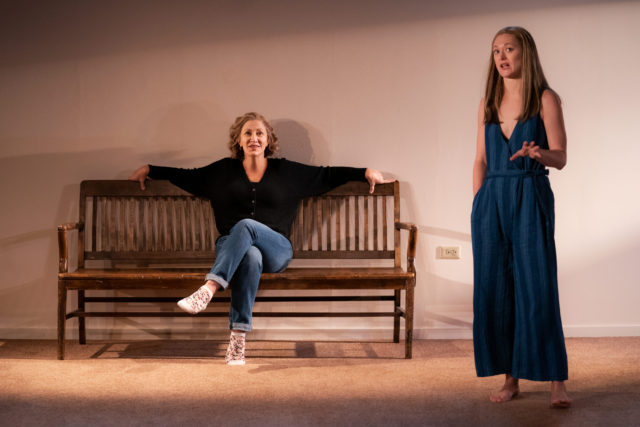
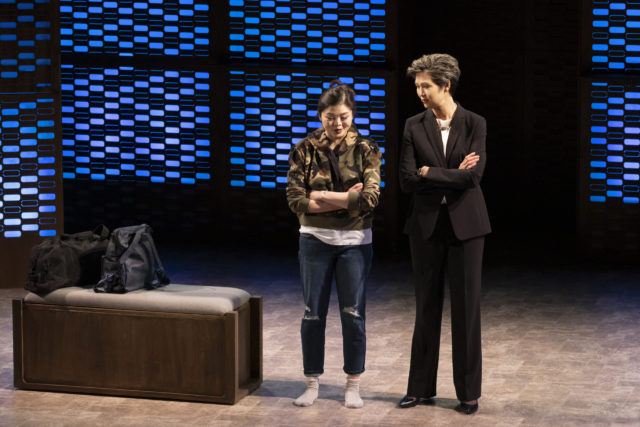
Sisters Eva (Ruibo Qian) and Julie Chen (Cindy Cheung) consider working together in Golden Shield (photo by Julieta Cervantes)

Julie wants to hire her younger sister, Eva (Ruibo Qian), who is in the midst of a long bad streak, as her translator. Eva balks at first — something happened at their mother’s recent funeral that has driven them further apart than they already were — but she ultimately signs on. Their main task is to find one of the eight dissidents to be willing to testify in the United States; their last hope is Li Dao (Michael C. Liu), a professor at the Beijing Institute of Science and Technology who has kept his actual activities secret from his devoted wife, Huang Mei (Kristen Hung). Accompanying the legal team as an adviser on their journey is Amanda Carlson (Gillian Saker) of the Digital Freedom Fund.

The trial is scheduled to be held in Dallas, using the Alien Tort Statute in the Judiciary Act of 1789, implemented, in part, because of piracy on the seas. ONYS is attempting to avoid responsibility — the “onus,” as it were — for its part in the creation of a decentralized firewall that was ultimately, surprise surprise, used by the government to track down citizens they believe to be traitors.

Marshall McLaren (Max Gordon Moore), the smarmy ONYS president of China operations, has no respect for the Chinese and their culture and traditions, refusing to keep quiet even when his VP, Larry Murdoch (Daniel Jenkins), begs him to stay in line as they meet with deputy minister of public security Gao Shengwei (Kristen Hung). He’s the classic ugly American, looking to profit off of others, no matter the cost. “They’re giving us shit,” he tells Larry. “It’s polite Chinese shit, but it’s shit nonetheless, and what I’m saying is, is — if we could have a meeting, one meeting, in an office, in an office with desks, I don’t need another, another fucking five pots of steamed whatever or a fucking egg that’s been fermented for a hundred years in a silk basket at the foothills of Mountain Fing-fong-fang.”

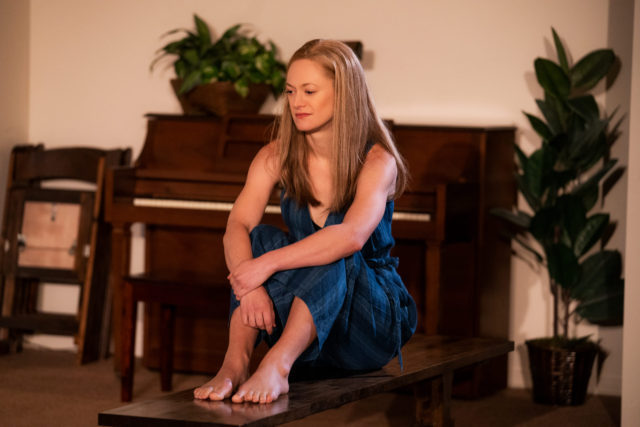
Li Dao (Michael C. Liu) and Huang Mei (Kristen Hung) face dangerous consequences in MTC world premiere (photo by Julieta Cervantes)

ONYS’s chief legal officer, Jane Bollman (Gillian Saker), wants to just buy off the plaintiffs, but Julie wants this case to make a point, to have an impact on international law and take big business and big government to task.

Through it all, the Translator keeps the audience apprised of what is really going on. When Eva tells her sister in English, “Like, I’m okay,” he translates that to “I’m not okay.” When Larry, listening to Marshall read from the document in question, says, “I think it’s a bit of a mistranslation,” the Translator says to us, “It’s not.” As the trial continues, the importance of language and communication remain at the heart of the play and not just from a legal standpoint. “There’s enough miscommunication in the world,” Amanda tells Eva. “I don’t want to spend all night reading between the lines and, like, searching for a sign, or symbol, like, a sexual visual metaphor, because if you just like say, upfront, what you mean, then like, you don’t need to translate, you know?”

Developed at MTC’s Australia-based Next Stage Writers’ Program, Golden Shield is masterfully directed by May Adrales (Vietgone, Letters of Suresh), guiding us through the ever-shifting time periods and locations, with scene changes indicated by furniture rolling on- and offstage and different colors flashing behind walls with cut-out patterns. (The set design is by Dots, with lighting by Jeanette Oi-Suk Yew, original sound and music by Charles Coes and Nathan A. Roberts, and costumes by Sara Ryung Clement.)

King (White Pearl) does an excellent job defining the characters and sifting through the jargon to make her points about communication, and not just in the digital age. There’s a kind of poetry to the language, a melding of corporate- and tech-speak, legalese, English, Chinese, and everyday talking. King has called the play itself “a valuable political act,” and that’s just what it is.

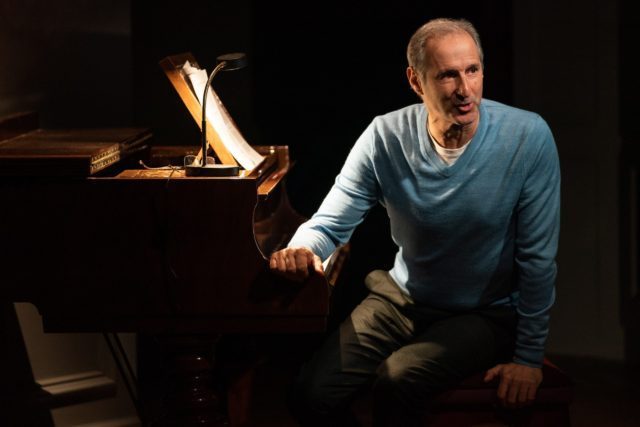
The Translator (Fang Du) keeps the audience informed as he watches the action onstage (photo by Julieta Cervantes)

And it all starts with Fang Du (Golem, Low Power), who is eminently likable as the Translator, a kind of version of the Stage Manager in Thornton Wilder’s Our Town. If he doesn’t capture our attention, it becomes a completely different experience. In the script, King notes, “The Translator is an intermediary between the audience and the action. They intervene in the action only when their presence becomes essential. They are otherwise engaged in an act of self-abnegation.” That self-abnegation stands in direct counterpart to the desires of most of the characters, who can be selfish, grating, mean-spirited, uncaring, passive-aggressive, and self-defeating. In this digital surveillance age where less and less communication occurs in person, face-to-face, Fang Du’s good-natured portrayal of the bright and cheery, ever-smiling Translator is a necessary respite from the hard points the narrative makes. That’s why we need the Translator.

HOW I LEARNED TO DRIVE

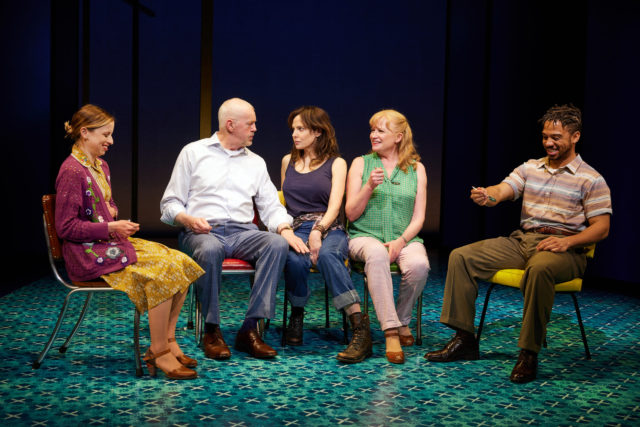
David Morse, Mary-Louise Parker, and Johanna Day (center three) reprise their roles in Broadway debut of How I Learned to Drive (photo © Jeremy Daniel 2022)

HOW I LEARNED TO DRIVE
Samuel J. Friedman Theatre
261 West Forty-Seventh St. between Broadway & Eighth Ave.
Tuesday – Sunday through June 12, $79-$299
www.manhattantheatreclub.com

“I’m just a very ordinary man,” Peck says in Paula Vogel’s How I Learned to Drive, making its stunning Broadway debut at MTC’s Samuel J. Friedman Theatre through June 12.

“I’ll bet your mother loves you, Uncle Peck,” his teenage niece, Li’l Bit, replies.

The beauty of Vogel’s Pulitzer-winning drama is in its simplicity, the very ordinariness of a complex story about child sexual abuse and its lasting effects on the survivor.

In 1997, forty-three-year-old David Morse and thirty-two-year-old Mary-Louise Parker starred in How I Learned to Drive, he as Peck, she as Li’l Bit, both named after their genitalia. The play primarily takes place in backward chronology from 1969, when he is fifty-two and she is seventeen, except for two key detours to 1970 and 1979. Twenty-five years later, the actors have returned to the parts they originated, joined by the same director, Mark Brokaw, and Johanna Day, who, as Female Greek Chorus, also portrays Li’l Bit’s mother; joining the cast is Alyssa May Gold as Teenage Greek Chorus and Li’l Bit’s grandmother, and Chris Myers as Male Greek Chorus and Li’l Bit’s grandfather, among other characters.

Having Morse and Parker reprise their roles is a stroke of genius; over the last quarter century, their stature as consummate actors has grown, so we are immersed in their characters immediately. Parker, in particular, is a wonder, embodying the teenage Li’l Bit with small gestures and movements that make us forget that she is some forty years older. But the casting also reminds us that in the last twenty-five years, child abuse and pedophilia is still one of society’s most shameful ills, brought to light again in the #MeToo era.

When Peck tells Li’l Bit, “I have loved you every day since the day you were born,” the audience lets out an audible gasp.

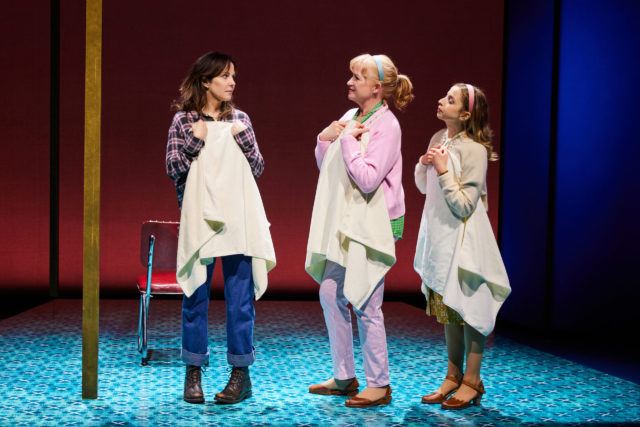
Li’l Bit (Mary-Louise Parker) gets life lessons from Female Greek Chorus (Johanna Day) and Teenage Greek Chorus (Alyssa May Gold) (photo © Jeremy Daniel 2022)

Inspired by Nabokov’s Lolita as well as the sexual abuse that she herself suffered, Vogel uses driving lessons as a metaphor for Peck’s grooming of Li’l Bit as his potential victim. The Greek Chorus announces shifts in scenes with such phrases as “Safety First — You and Driver Education,” “Idling in the Neutral Gear,” “You and the Reverse Gear,” and “Implied Consent,” along with subtle changes in lighting by Mark McCullough and sound and original music by David Van Tieghem.

Rachel Hauck’s streamlined set features constantly changing furniture — chairs, tables, a bed — with the only constant a tall wooden post that evokes telephone poles along the road as well as a cross. Dede Ayite’s costumes are straightforward dress; the characters can be anyone, at any recent time.

Li’l Bit’s dilemma is exacerbated when she begins growing breasts, larger than her classmates’. She is teased and made fun of not only by the boys and girls in school but by her own family, who sexualize her with dangerous lessons. “I told you what my mother told me! A girl with her skirt up can outrun a man with his pants down!,” her grandmother says. Her grandfather warns, “If Li’l Bit gets any bigger, we’re gonna have ta buy her a wheelbarrow to carry in front of her.” Her mother teaches her, “Never mix your drinks. Stay with one all night long, like the man you came with . . . damn the torpedoes, full speed ahead!”

Li’l Bit knows from the very start that what Uncle Peck is doing is wrong, but he is so calmly persuasive that she keeps sticking around him. In a key scene, she watches as Peck teaches her cousin Bobby how to fish, essentially a primer for how a man can lure a woman into something she doesn’t want to do. “We’re going to aim for some pompano today — and I have to tell you, they’re a very shy, mercurial fish. Takes patience, and psychology. You have to believe it doesn’t matter if you catch one or not,” he says.

In a car, Uncle Peck tells Li’l Bit, “Put your hands on the wheel. I never want to see you driving with one hand. Always two hands.” After hesitating, she replies, “If I put my hands on the wheel — how do I defend myself?”

Uncle Peck (David Morse) grooms Li’l Bit (Mary-Louise Parker) in powerful revival of Paula Vogel’s Pulitzer winner (photo © Jeremy Daniel 2022)

Peck is a knowledgeable fisherman, understanding just how to approach his prey. Tony nominee Morse (The Iceman Cometh, The Unavoidable Disappearance of Tom Durnin) is so successful in the role that, at the talkback that followed the matinee I saw, several women embarrassingly admitted that they were taken in by his character, that they had trouble seeing him as a predator but instead thought he was just a nice guy. That’s precisely what sexual abusers do, fool the observers, and Morse nails it. We want to like him, want him to be our cool uncle too, until we don’t.

Tony winner Parker (The Sound Inside, Proof) is astonishing as Li’l Bit; her timeless, youthful qualities once again shine as she ages seventeen years in the play. Our hearts ache for Li’l Bit as her uncle’s pursuit of her intensifies, but Parker, as ravishingly beautiful as ever, uses her age and experience to give the teenage girl added depth; the audience can’t help but feel her every emotion and search their own lives to examine mistakes they might have made or situations in which they looked the other way. It’s one of the best performances of an adult as a child you’re ever likely to see.

Day (Sweat, The Nap) is excellent as always as the enabler in all of us, while Gold (Taking Woodstock, Our Dear Dead Drug Lord) is a marvel in multiple roles, including a powerful surprise at the end.

Vogel (Indecent, The Baltimore Waltz) and Brokaw (Heisenberg, The Lyons) have done a superb job reimagining this hard-hitting yet delicate, crucial work for these times, a play that in itself is a primer for how to recognize sexual abuse and, hopefully, be able to reach for the brakes. As Li’l Bit warns us, “Sometimes to tell a secret, you first have to teach a lesson.”

TWI-NY TALK: RICHARD TOPOL — PRAYER FOR THE FRENCH REPUBLIC

Rich Topol plays nonreligious narrator Patrick Salomon in Manhattan Theatre Club world premiere (photo by Matthew Murphy)

PRAYER FOR THE FRENCH REPUBLIC
Manhattan Theatre Club
MTC at New York City Center – Stage I
131 West 55th St. between Sixth & Seventh Aves.
Tuesday – Sunday through March 27, $99
212-581-1212
www.manhattantheatreclub.com

About seven years ago, I was sitting in the audience at a play when I recognized the man in front of me, actor Richard Topol. I tapped him on the shoulder during intermission and told him that I had just seen him at the Signature in A. R. Gurney’s The Wayside Motor Inn and had enjoyed his performance. He thanked me, saying that he was actually the understudy and that was the only time he had gone on. He was even more thankful when I told him that I had included him in my review.

Since then we’ve bumped into each other a few other times at the theater and discussed various shows we’d seen. He’s an extremely amiable mensch who clearly loves his chosen profession. Even if you don’t recognize his name, you’re likely to know his face; he has approximately fifty television and film credits, including portraying lawyer and politician James Speed in Steven Spielberg’s Lincoln, a recurring role on The Practice, and multiple parts on several Law & Order iterations.

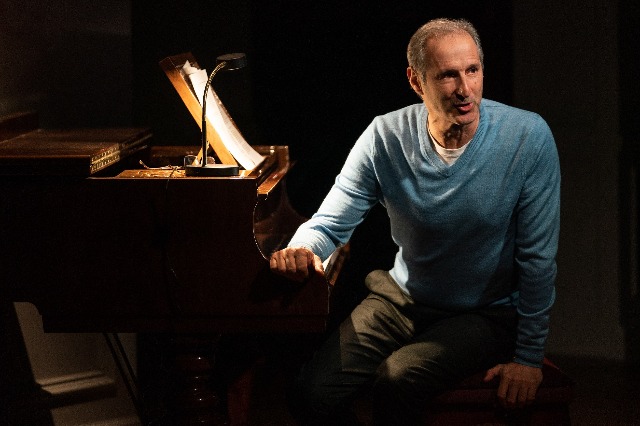
But his true love is theater, which he also teaches. He has appeared extensively on and off Broadway, in such plays as The Merchant of Venice with Al Pacino, Julius Caesar with Denzel Washington, Alice Birch’s Anatomy of a Suicide with Carla Gugino, and Paula Vogel’s Tony-nominated Indecent with Katrina Lenk as well as Tony-winning revivals of Clifford Odets’s Awake & Sing! and Larry Kramer’s The Normal Heart. He is currently starring in Joshua Harmon’s Prayer for the French Republic, a scintillating three-hour exploration of anti-Semitism that travels between 1944 and 2016; Topol plays Patrick Salomon, a nonreligious Jew who has decided not to go into the family piano business.

Topol was raised in Mamaroneck and lost his father when he was twelve. He is married to actress Eliza Foss; they have one daughter, and Richard was close with his father-in-law, the late German-American composer, pianist, and conductor Lukas Foss.

During our wide-ranging Zoom conversation, Topol is thoughtful and generous, laughing and smiling a lot. Behind him in his living room is a landscape by his mother-in-law, the painter and teacher Cornelia (Brendel) Foss.

He admits that the most nervous he’s been in his life was when he hung out with Paul McCartney following a performance of Larry David’s Fish in the Dark, in which Topol played Dr. Stiles; after that, the Cute Beatle went from being his third favorite mop top — behind John and George — to his second.

A few days after Prayer for the French Republic opened at Manhattan Theater Club’s Stage I at City Center, we talked about one-person shows, getting Covid, baseball, and what it’s like being an actor in lockdown, including a detailed description of mounting a play as a pandemic continues.
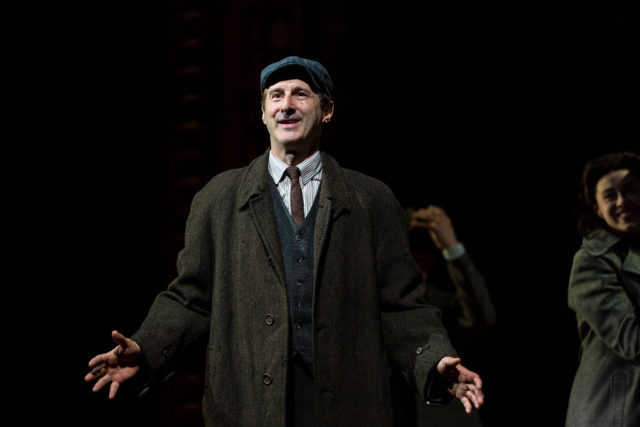
Rich Topol starred as stage manager Lemml in Indecent (photo by Carol Rosegg)

twi-ny: During the pandemic, you appeared in several virtual and audio productions: You were in Melisa Annis’s Beginnings, Anne Washburn’s Shipwreck, Craig Lucas’s More Beautiful — and you played a chicken in Jimonn Cole’s Chickens.

richard topol: Oh my God! That was so much fun.

twi-ny: That was crazy.

rt: I loved Michael Potts in that.

twi-ny: You guys were great. Did you enjoy working on Zoom?

rt: No, no, no. I mean, I enjoyed working as opposed to not working. Shipwreck was the closest we got to working on a play because we rehearsed for a couple of weeks and it felt like, Okay, I’m going to rehearsal today. We did the kind of work that you do in a play before you get up on your feet. [Director] Saheem Ali was great and it was a great cast, obviously in a really interesting play. And we spent enough time with it to dig in the way you do in a play.

I mean, I also shot some TV shows over the course of the pandemic, so all of the Zoom stuff felt more like the way an actor like me connects to short-term work. You don’t develop a through-line, you don’t understand the arc of things. You’re not invested in a team, the whole idea of a team creating a thing and living together and becoming a version of a theater family, or whatever it is. Shipwreck was the closest to that.

twi-ny: As a listener, I felt it Shipwreck was one of the audio plays that worked the best during the lockdown. I got the feeling that this was a group of actors working in tandem.

rt: Right. I think because they had intended originally to produce it live, they had invested in it as fully and fulsomely as you do for a whole theater piece. There had been a lot of preparation. There was a sense of having more in the heads of the director and the producers, what we could imagine this great thing being, that infused the development and the rehearsal and experience of doing it. The Public took a lot of care in making it.

twi-ny: You finally returned to the stage in November in Portland with Searching for Mr. Moon, which is about fathers and sons, particularly about how you lost your father when you were very young and eventually found a father figure in Lukas Foss. This is your first one-man show, which you wrote with Willy Holtzman, a two-time Pulitzer nominee. What was the experience like sharing your life, in person, in front of people, back onstage? It’s a short question, right?

rt: The short answer is it was great. It was so satisfying. I remember at the time talking with people and saying, Oh my God, this is the longest period of time between . . . I was doing Anatomy of a Suicide at the Atlantic Theater Company.

twi-ny: Which was excellent. Loved it.

rt: Thank you. Yeah, I love that play. Intense. So that was the very last performance you could do in New York. And we were shut down. And so from March 12 of 2020 to November 3, 2021, was the longest period of time I hadn’t been onstage in my adult life. And I’ve been an actor for over three decades.

So it was thrilling to be back in a theater on a stage with a live audience, even though they were masked. So on the one hand, it was incredibly thrilling. And on the other hand, it was incredibly scary because it was the first play that I’d ever cowritten with anybody, and it was about my life. I felt more exposed than I’d ever felt before in my life. Willy and I had been talking about this play for a number of years. And then because the pandemic happened, we both had the time to really work on it. And that’s how it came to pass, and Anita Stewart, the artistic director of Portland Stage, was just a real cheerleader for the piece.

We did a developmental workshop in June up in Maine. That theater had stayed open through the pandemic because Maine had so few cases, because of the regulations, and because of their skill at keeping people safe. They produced a lot of one-person shows. They produced Lanford Wilson’s Talley’s Folly — they cast a married couple who played the two parts.

But even though they’re being Covid careful, they have diminished audiences because there are a lot of people who feel, I’m not going to see a play. I’m not going to risk that.

twi-ny: A lot of people still feel that way.

rt: But Willy and I had a lot of time over the pandemic because there wasn’t much else to do to finish the play. And then Anita gave us a shot. We did the workshop, we did a live reading in front of people. It went really well and they’re, like, We want to produce this and we have a slot.

But because it’s about one of the hardest things and most personal struggles that I’ve experienced for the last forty-six years of my life, since my father died, it was scary to share, but it felt worth sharing. Willy was like, I want to write a one-man show for you. I’m like, Okay, sure. First of all, I don’t like one-person shows, I don’t like seeing one-person shows; they’re not interesting to me. I love acting with other people, and it can’t be about me because I’m not interesting. So what could it be about.

twi-ny: Three strikes and you’re out.

rt: Right. It was a total strikeout. And then Willy’s like, Come on, come on. And so initially we decided it would be about Lukas Foss, who was my father-in-law, a really interesting man who had a really interesting life. He escaped the Nazis. Like in Josh’s play, he was one of those people, a German Jew in Berlin who got out. Even though he wasn’t Jewish; he didn’t think of himself as a Jew. He had a really interesting life and a really challenging death.

He had Parkinson’s disease. He had a mind that was brilliant and fingers that could play — I don’t know if you’ve ever heard him play or listened to something. It’s unbelievable. If you can listen to him playing on Lenny Bernstein’s “Age of Anxiety,” listen to the piano on that. It is unbelievable. And so the guy lost his physical abilities and his mental abilities. We thought, Okay, that’s an interesting idea for a play.

I’ve always had this obsession with searching for a father and he was my father-in-law, so let’s do that. And the play started to be about that. And the first two drafts of it were about that. It was this biodrama about Lukas and it was missing something.

Rich Topol debuted his intimate one-person show at Portland Stage in November (photo by No Umbrella Media LLC)

twi-ny: It needed more of you, probably.

rt: Yes, well, that’s what Willy said. And so, kicking and screaming, it became more and more about my relationship to Lukas and then my relationship to fatherhood. Then when my wife told the story to Willy about when she gave birth — the opening scene of the play is her giving birth to our daughter — and Eliza’s parents, in black tie, come in from a gala, bursting into the delivery room because they thought she was about to have a baby — she was about to have a baby — we’re like, What are you doing here? Get the fuck out of here. That seemed like a good starting-off point, discussing my becoming a father and my seeing the best potential father to me to help me learn how to be a father.

It was really satisfying to do. I was really glad to do it at Portland Stage, where most of the people who were watching knew nothing about me and I didn’t have to feel so exposed. I’m hoping to bring the show to New York, but I think doing it here, that’ll be scary.

Although my mother came and saw the show. My wife came and saw the show. People who know me and my life saw it. And I survived.

twi-ny: And they all want you to keep doing it. Since these are your lines and they’re about you, if a joke didn’t quite take or something emotional didn’t register with the audience, is it more or less upsetting than when you’re reciting somebody else’s words and something might not go as expected?

rt: Oh, less upsetting because I know I’m not a professional. I’m no Josh Harmon. Josh is a writer. I’m just some guy —

twi-ny: The third guy from the left.

rt: Exactly, the third guy from the left. At least in that experience I can cut myself some slack. It was the first production of the first play that I’ve ever cowritten. Willy did most of the writing. So that’s the sort of glib answer.

The truth is, most of the play, I play other people. I play my father-in-law. I play my mother, I play my wife, I play my mother-in-law. And in the scenes where I play myself, most of that writing is me, having written down my versions of stories that I’ve experienced. And so the ones that I was willing to share were the ones that couldn’t be avoided and, I guess, were the most important. Maybe I’m fooling myself. The play was well received, so I didn’t have the experience of Oh, that sucked. Right. Why am I doing this play?

twi-ny: Who talked you into this?!

rt: Who let me do this thing?

Let’s take that idea of writing and switch over to Prayer for the French Republic, which is exquisitely written. The language is so beautiful. What was the rehearsal process like?

rt: Well, it started actually in August of 2019, when Josh had been commissioned by Manhattan Theater Club to write a play. He came in with his finished draft and we did a reading of it, prepandemic and in-person. They hand delivered the scripts to everybody’s homes. They bicycled around Manhattan delivering the scripts because they didn’t want to email them. Josh was holding it close. I read it to myself and I thought, this is the best play I’ve read in ten years. And I mean, I haven’t read every play in the last ten years, but I’ve read a lot of plays and I’ve seen a lot of plays, and I thought, this is astoundingly amazing.

And so I was so excited to be part of the beginning of it. We did that reading and I think it confirmed for Manhattan Theatre Club and for Josh that he had latched on to something incredible. Then we did a couple of workshops that fall and then at the end of February of 2020. At that time I was reading Charles, actually.
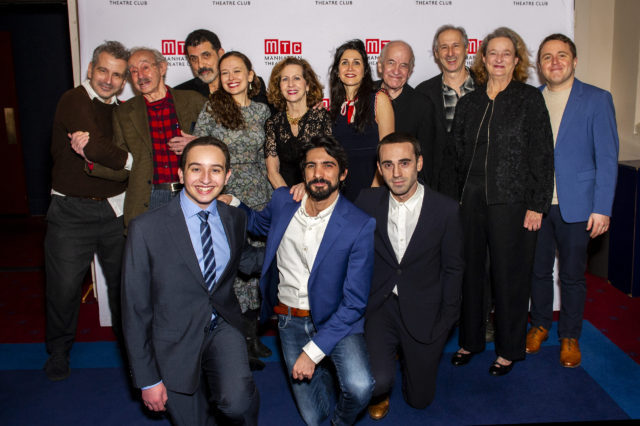
Rich Topol is third guy from the right in cast and crew photo from Prayer for the French Republic opening night (photo © 2022 by Daniel Rader)

twi-ny: That’s really interesting to me, because you fit so well as Patrick.

rt: Yeah, I know. I was like, No, no, no. When they said, Will you read Patrick? I was like, No, no, no, no, no. I love Charles. No, no, please don’t. They’re like, To be honest, Charles should be, if not actually North African, at least more Sephardic, more Middle Eastern. And so I was like, Okay, fine.

Now, of course, I’m totally madly in love with Patrick and I wouldn’t have it any other way. We did a workshop right before the pandemic hit in-person. And Josh had done some incredible things. And that’s when [director David] Cromer came on board. We’re already verklempt about it. So then the pandemic hit and immediately I got the virus.

The show closed on March 12. I had symptoms on the ides of March, on the 15th of March, and I was in bed for nineteen days with Covid-19.

twi-ny: So it was bad.

rt: It was miserable. I didn’t have it like Danny Burstein; I didn’t have to go to the hospital. Or Mark Blum, a lovely man who lost his life to it. And so it was the worst it could be without being bad. And then the symptoms were gone. We have a place upstate that we escaped too, and I got a call two days later from my agents. I’m like, Why is my agent calling me? The business is entirely shut down.

And she said, You just got an offer from Manhattan Theatre Club for Prayer for the French Republic. They want to do a workshop in July and then we’ll go into rehearsal in September and run till Christmas. And I thought, Oh, that’s perfect. This is the kind of play that should be running during the election. It felt to me that it was really important that this play be put up during the election. And then, of course, a month later, they’re, like, Yeah, we’re not going to do the workshop in July. But we’re still on track for the fall. And then a month later, it’s, Yeah, we’re not going to do the play in September. It’ll be sometime in 2021. We don’t know when but we’re still committed to doing the play.

And then we did a couple of Zoom workshops. We would do a weeklong workshop with the first act of the play, then the second act. And then another few months later we did the third. So we had a lot of time processing it with Josh and helping him wrangle this epic piece into what you saw. Then we got into the rehearsal space in December. And for those of us who’d been with it for two years, we’re like, Oh my God, we’re finally getting to do it. But still there was that sense of, Who’s producing a new eleven-person play, with nobody famous? It doesn’t have any songs —

twi-ny: And it’s about the Holocaust.

rt: Exactly. So kudos to them for sticking with it. And putting it up and investing in it, saying, I’m sorry, this is too important. We’re going to put this play up. We started first day of rehearsal learning about the Covid protocols, getting tested regularly.

twi-ny: Masked?

rt: We were wearing masks around the table. And then when we started up on our feet, we were unmasked, for those who were comfortable with that. And then one of our stage managers tested positive, and luckily she didn’t give it to anybody else. But at that point we’re like, Okay, we’re just wearing masks the whole time. We do not want to be shut down.

So this was the middle of December now, right before Christmas, and shows were going down left and right. We’re like, You know what, it’s not worth it. We do not want to shut this play down. Here we have been waiting for so long to do it. Let’s do what we can. And there were conversations among the cast about, Well, what do we do at home? Some of us have children and partners, but there was a real commitment to being safe so that we could get it up on our feet. And then Josh tested positive right before tech. And so actually the last few days of rehearsal and through tech, he watched the play like this.

twi-ny: On Zoom?

rt: There was a computer open and his computerized voice would come through. And again, he didn’t give it to anybody else. And then the testing protocols, we’re getting tested every day, and you can’t come into the room until you’ve tested negative, and, knock wood, that’s been it.

For the last six and a half weeks, we have been safe and we’ve been able to do it. And audiences have come. I am pleasantly surprised at how many hundreds of people are coming to see the show every day. I had seen a number of shows when I came back from Maine, and some had nobody in the audience and some were jam packed.

twi-ny: It’s been very strange. I went to a concert where everybody had to be masked and there were some empty seats, but it was pretty much sold out. But then I went to a hockey game and sixteen thousand people are screaming, no masks, lots of eating and drinking.

rt: Yeah. And I’m not going to any of that stuff. I did go see Hot Tuna and David Bromberg.

twi-ny: I love Bromberg.

rt: I looooove Bromberg.

twi-ny: How was he?

rt: He was great, for a seventy-year-old man. He was beautiful. He was really amazing. It was a really great time.

I’ve been to some plays where I’m sitting right next to total strangers and everybody has their mask on, and this was the same. Everybody did keep their masks on, but there were some drinking and eating. So we’ve been careful and thoughtful and fortunate, and I hope we continue to be so. Because it’s a great joy to do this play. It is a really challenging piece of theater and really satisfying to act in.
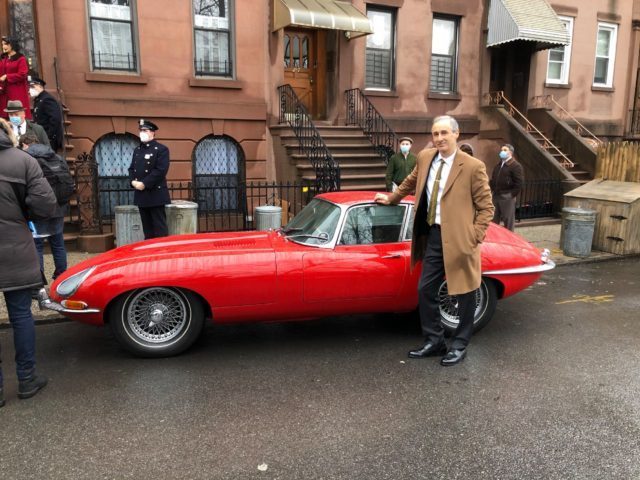
Rich Topol poses with a hot car on set of EPIX series Godfather of Harlem

twi-ny: Throughout your career, and especially more recently, you’ve played a lot of Jews: Sam Feinschreiber in Awake & Sing, Fritz Haber in Genius: Einstein, Lemml in Indecent, and now Patrick, who is a nonreligious Jew. Are you Jewish, or is it just a coincidence that you play a lot of Jews?

rt: I was born a Jew. I got bar mitzvahed. I think of myself as Jew-ish. I was in The Chosen a couple of times [There’s a knock at the door and Topol gets up to answer it, then returns.] That’s the exterminator, not exterminating Jews but exterminating bugs that Nazis would think are like Jews.

I’ve also actually played a lot of Jewish narrators who step into the play. I don’t think I’m as extreme as Patrick; Patrick is a Jew who doesn’t know anything about his Judaism and is happy to not know anything about his Judaism and is somebody who thinks of organized religion as what he says in the play, which is “bullshit.”

twi-ny: Which the character Molly agrees with.

rt: Right. I don’t subscribe there. But I’m also not religious. I think of myself as spiritual and, not to be too woo-woo, I believe in the earth. I’m a tree worshiper. I’m a tree hugger. Where I feel most soulful and spiritual is when I’ve climbed a mountain and I feel small in relation to a large, amazing thing. That’s the way I connect to religion. I think that most of the major religions are about feeling good to be small under the umbrella of something that’s bigger than our oneness, that connects us all.

twi-ny: I felt that that Josh really attacked the numerous angles of how to look at anti-Semitism and Israel and American Jewry. He covered everything. And without, I think, insulting anyone and without becoming didactic and preachy.

rt: He does a great job of giving everybody a valid argument. He’s really, really, really kind to all his characters. And thoughtful in allowing them to be really articulate people who have really strong opinions, and those opinions are different. And I think that’s one of the greatest things about the play, because it leaves the audience getting to consider those ideas that you’ve mentioned from a lot of perspectives. No, not from all perspectives, but certainly from a lot of perspectives within the Jewish community.

I’m always curious about what my non-Jewish friends who come and see the show think of it. I feel like the Jews, the Jews get it, the New York Jews get it, or they have really strong opinions about it.

twi-ny: Jon Stewart would ask, is it too Jewy?

rt: I have asked that of my non-Jewish friends. I’ve actually asked that of some of my Jewish friends too. Is this too Jewy? Is it just Jewy enough? Or is it not? The ones who are not Jews often say how the Jews in the play are just a specific example of the larger issue of otherness.

Look, we live in a world where the hate for other has been unleashed. And so what to do about that? If you’re a WASP from white privilege, maybe you look at this play and think, like Patrick, What’s the big deal, you know? Even those people understand, given what we’ve lived with, at least certainly for the last few years. But the larger questions that Josh asks in the play relate to almost everyone.

twi-ny: If Lukas were still around to see you in the show, would he be happy with your piano playing?

rt: I think he would be disappointed. And I’m slightly disappointed myself too, because I knew I was going to do this part for a long time and I knew that these songs were in the piece. But I feel like he shouldn’t be a better piano player than I am in this play. He doesn’t take over the family business. He shouldn’t be a lounge singer. I sing well, and maybe I’m justifying, but I feel like I play and sing just well enough but not too well for who he is. I love the progression of the piano in the play. It goes from Molly just clinking one note to me playing something schematic to Peyton [Lusk] playing that lovely Chopin piece to the end; the piano has a journey too. It’s a symbol, a metaphor for the journey of our family.
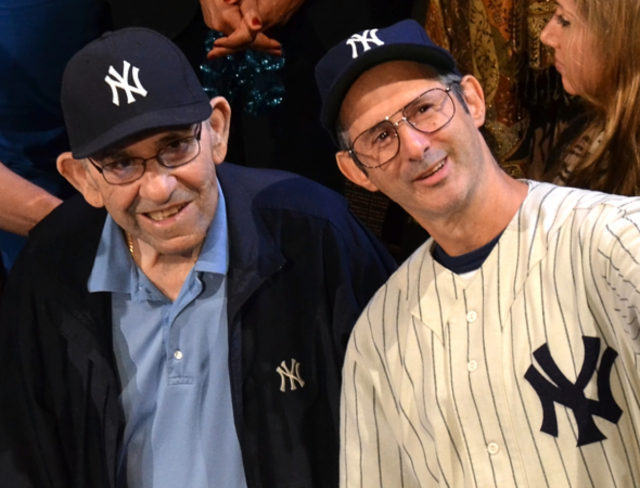
Rich Topol meets Yogi Berra on opening night of Bronx Bombers (photo © David Gordon)

twi-ny: Okay, for my last question, I have a sort of bone to pick with you. You were a Mets fan, then you switched over to the Yankees. I mean, come on.

rt: Did I say that out loud somewhere?

twi-ny: I have my sources.

rt: Actually, it sort of timed out pretty well, you know? Because when I became a Yankees fan, the Yankee sucked. It’s interesting because it connects to the father thing.

My father died in 1975; I don’t remember whether I jumped ship in ’74 or ’75. I know I was a Mets fan in ’73, and then we moved, and my next-door neighbor was a Yankees fan. And I wanted to be his friend.

twi-ny: Right before Reggie.

rt: Exactly. So you can’t pick a bone with me if it was because my father had just died and my next-door neighbor was a Yankees fan. The Mets had been to the World Series, right?

twi-ny: Yes they had, with Yogi Berra as manager. You played Yogi in Bronx Bombers. I think a lot of people forget that. I met him once at a Mickey Mantle Foundation dinner at Gracie Mansion. He was by himself and I went over to him and said, I’m going to ask you something that no one probably ever asks you about. And I asked him about managing the ’73 Mets. He looked up, put on a big smile, and said in that Yogi way, “No one’s asked me about that in years. So I’ll tell you.” And he told me about how much fun it was doing that.

rt: That’s when I was a Mets fan. That was Buddy Harrelson, Wayne Garrett, Tommie Agee, Jerry Grote. I’m a lefty, so Tug McGraw was my hero.

twi-ny: So you played Yogi, and then you met him on opening night of the show. What was that like?

rt: He was really sweet and really happy to be there and to be seeing this play with his wife, Carmen, having this stuff brought to life.
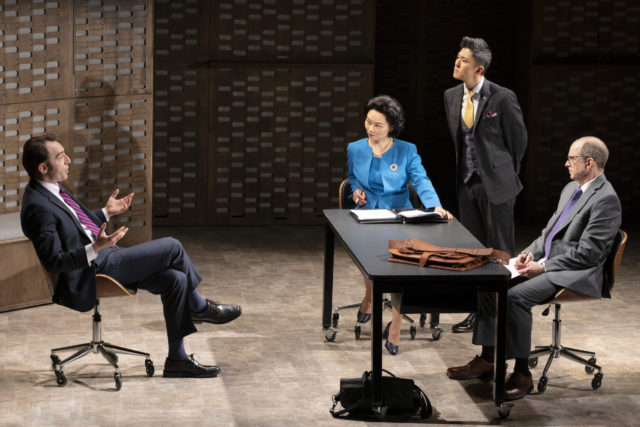
SKELETON CREW

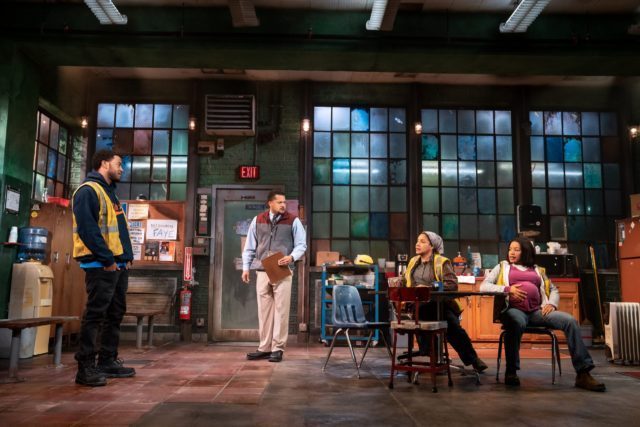
Dominique Morisseau’s Skeleton Crew takes place in an auto stamping plant on the brink in 2008 (photo by Matthew Murphy)

SKELETON CREW
Samuel J. Friedman Theatre
261 West Forty-Seventh St. between Broadway & Eighth Ave.
Tuesday – Sunday through February 20, $59-$159 ($49-$99 with code FAFCREW)
www.manhattantheatreclub.com

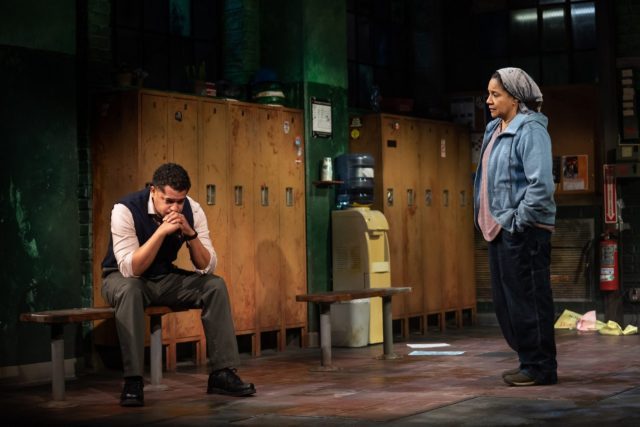
When the audience enters MTC’s Samuel J. Friedman Theatre for the Broadway premiere of Dominique Morisseau’s Skeleton Crew, a sizzling tale of socioeconomic ills in 2008 Detroit, they see Michael Carnahan’s set, the dingy, dirty breakroom of an auto stamping plant, filled with handwritten and preprinted signs detailing various rules and regulations, advising employees that there is no smoking, when the next union meeting is, what their OSHA rights are, what they can and can’t do with the refrigerator, coffeemaker, and microwave. However, there are also multiple reminders, on paper and yellow caution floor signs, to wear a mask and turn off cellphones; those warnings are for the audience in 2022, of course, but the effect is an immediate feeling of equality between the performers and the characters they portray. We are them, and they are us, especially as we all continue to deal with a global pandemic.

The cast then heads onstage and removes all the contemporary signs with a resolute vigilance that, we soon find out, applies to the company admonitions that still remain. “I don’t abide by no rules but necessity. I do what I do til’ I figure out another thing and do that. And that’s all I got to say about it,” Faye (Phylicia Rashad) declares.

Rumors are swirling that the plant might be on the chopping block, which would wreak havoc in a city that we know is about to pay dearly during the coming subprime mortgage crisis. Faye, a divorced single mother, is the union leader with twenty-nine years on the job, intent on making it to thirty to receive more substantial retirement benefits. Despite having survived breast cancer, she smokes constantly; she also has a penchant for gambling with her much younger colleagues: Dez (Joshua Boone), a loose cannon hoping to start his own repair garage, and Shanita (Chanté Adams), a pregnant woman who is one of the line’s best workers. Both in their mid-to-late twenties, Dez ceaselessly flirts with Shanita, whose baby daddy is absent.

Their foreman, Reggie (Brandon J. Dirden), a close family friend of Faye’s since he was a child, used to be one of them before being promoted. He often finds himself in the middle, caught between the employees and his bosses upstairs, walking a tightrope that becomes even more tenuous when he admits to Faye that the plant will indeed be shutting down within a year.

Reggie (Brandon J. Dirden) and Faye (Phylicia Rashad) face a crisis in Broadway premiere of Skeleton Crew (photo by Matthew Murphy)

He tries to convince her to stay quiet about it, which she is hesitant to do. “It’s my job to protect these folks,” Faye says. Reggie responds, “Faye, I’m confiding in you. I’m putting myself on the line for you cuz I’m on your side. But I need you on mine. I need your guidance. Help me figure this out without sounding the alarm.” She agrees but feels guilty keeping the news from Dez and Shanita, who have their own issues with management.

“You youngins don’t have no respect for the blood been spilled so yo’ ass have some benefits,” Faye says to Dez, who she regularly calls “stupid.” Dez shoots back, “What benefits? I don’t hardly see no benefits.”

When materials start disappearing from the plant, Dez, who brings a gun to work and has been acting suspiciously, is a prime suspect. Meanwhile, Faye has hit some hard times and hides a secret from her colleagues. And Shanita shares her complex dreams with the others and plans on working as long as she can, piling on the overtime, before she gives birth. The tension is so thick that something has to eventually give, and when it does, everybody better stand back.

Skeleton Crew premiered at the Atlantic’s Stage 2 in January 2016, then moved to the bigger Linda Gross Theater in May of that year. It’s the first play of Morisseau’s to be produced on Broadway; she also wrote the book for Ain’t Too Proud to Beg: The Life and Times of the Temptations. The play completes her Detroit Projects trilogy, three works set in her hometown in the twentieth century, beginning with 2013’s Detroit ’67 and continuing with 2015’s Paradise Blue. Seen as a whole, the plays explore the Black experience in America in a way that evokes both August Wilson and Lynn Nottage; specific plays that immediately come to mind are Wilson’s Jitney and Nottage’s Sweat and Clyde’s as well as Erika Dickerson-Despenza’s recent Cullud Wattah, about the Flint water crisis.

Director Ruben Santiago-Hudson shows a firm confidence in Morisseau’s language and themes; he previously directed the world premiere of Paradise Blue at the Signature. He also was a close friend of Wilson’s and starred in and/or directed many of his plays, including Jitney and The Piano Lesson, both of which featured Dirden. In addition, Santiago-Hudson knows the Samuel J. Friedman well; his one-man show, Lackawanna Blues, was the previous production at the theater, completing its run in November.

Adesola Osakalumi dances between scenes in Dominique Morisseau’s Skeleton Crew (photo by Matthew Murphy)

Morisseau (Pipeline, Blood Rot) masterfully avoids any specific discussion about race, instead letting the story play out with that subtext hovering over everything like an ominous cloud. The audience knows that Detroit has had a history of race riots — from 1833 and 1849 to 1943 and 1967 — and in 2007-8, nearly twenty thousand Black men and women lost their jobs in car factories. “African Americans earn much higher wages in auto industry jobs than in other parts of the economy, and the loss of these solid, middle-class jobs would be a devastating blow,” the Economic Policy Institute reported at the time.

Tony winner and six-time Emmy nominee Rashad (A Raisin in the Sun, August: Osage County), who has directed three Wilson plays, is a powerhouse as Faye, a tired but strong-willed woman who is determined to not let a system she’s been fighting against her entire life beat her down. Rashad delivers her quips with an uncanny assuredness, her eyes revealing the wear and tear of years of battle, both personal and professional. Boone (Actually, All the Natalie Portmans) is a fireball as Dez, ready to explode at any moment but with a soft side underneath. Adams (Roxanne, Roxanne, Wilson’s Ma Rainey’s Black Bottom, directed by Santiago-Hudson) is charming as Shanita, who is wise beyond her years. And Dirden, who played Sly in the original New York production of Detroit ’67, gives a rousing performance as Reggie, a kindhearted man who has to make hard decisions that rip him up inside.

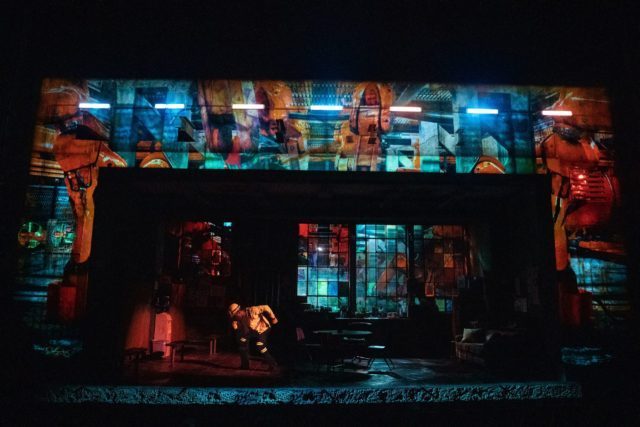
In between scenes, choreographer Adesola Osakalumi (Cullud Wattah, Fela!) dances at the front of the stage or behind the breakroom windows, moving robotically to hip-hop music that mimics the motion of the machines in the plant, which are seen almost abstractly in projections by Nicholas Hussong lit by Rui Rita. (The sound and music is by Robert Klapowitz, with original songs by J. Keys.) It equates humans with automation, as if people are interchangeable with machines. It might not be a new idea, but it is beautifully laid bare in Morisseau’s searing, intimate drama.

(MTC is currently hosting Detroit Week on Broadway, beginning February 4 at 8:00 with “Detroit Comes to Broadway,” celebrating the people and culture of the Motor City. On February 6 at 5:00, Morisseau, Dr. Michael Eric Dyson, and Michael Dinwiddie will take part in the free virtual discussion “Black Theatre: Radical Longevity.” And on February 7 at 6:00, “Morisseau Moment” fêtes the playwright with proclamations and presentations from her three latest shows, Skeleton Crew, Ain’t Too Proud to Beg, and Confederates, livestreaming from the Harlem School of the Arts.)

PRAYER FOR THE FRENCH REPUBLIC

A Jewish family in Paris faces anti-Semitism in Joshua Harmon epic (photo by Matthew Murphy)

PRAYER FOR THE FRENCH REPUBLIC
Manhattan Theatre Club
MTC at New York City Center – Stage I
131 West 55th St. between Sixth & Seventh Aves.
Tuesday – Sunday through March 27, $99
212-581-1212
www.manhattantheatreclub.com

“Why do they hate us?” a Jewish character asks near the end of Joshua Harmon’s extraordinary Prayer for the French Republic, which opened tonight at MTC at New York City Center – Stage I for a limited run (now extended through March 27). The playwright’s characters answer the question without being preachy or, perhaps even more important, preaching to the choir. In this three-hour multigenerational time-traveling epic, Harmon explores the centuries-old scourge of anti-Semitism with exquisite skill through the experiences of one family.

The play goes back and forth between 1944–46 and 2016–17, narrated by Patrick Salomon (Richard Topol), part of a long line of Salomons who have been in France for more than a thousand years. In his fifties, Patrick is part stage manager from Thornton Wilder’s Our Town, part Woody Allen from Annie Hall, watching and interacting with characters from the past and present.

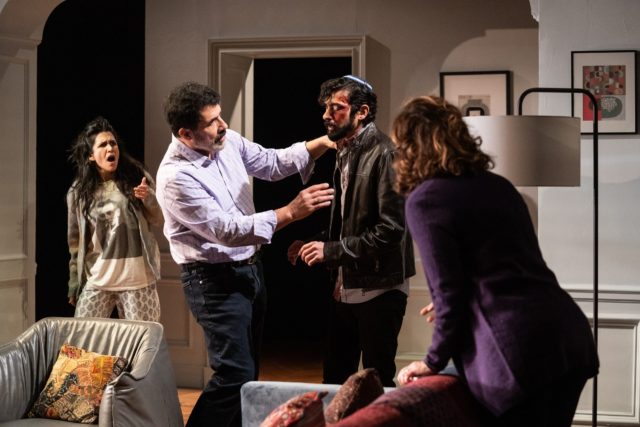
In 2016, Molly (Molly Ranson), a twenty-year-old college student from America, has come to visit her distant cousins in Paris while studying abroad in Nantes. She arrives on a day when Daniel Benhamou (Yair Ben-Dor), the twenty-six-year-old son, comes home beaten and bloodied after an anti-Semitic attack. His mother, Marcelle Salomon Benhamou (Betsy Aidem), wants to call the police and take Daniel to the hospital, but he refuses. His father, Charles Benhamou (Jeff Seymour) — both parents are successful doctors — is calmer, carefully checking his son’s injuries.

Elodie (Francis Benhamou), Daniel’s brilliant manic-depressive older sister, is incensed that Marcelle blames Daniel’s thrashing on his unwillingness to cover his yarmulke. Elodie doesn’t think Jews should have to hide who they are, while Marcelle is more fearful of the consequences. “You put a huge target on your back!” Marcelle shouts. “Oh, so Daniel’s asking for it now? Is that seriously your argument? He’s asking for it?” Elodie asserts.

The play uses that as a jumping-off point, with scenes marked by full-throated disagreements, quiet allusions, and an astonishing amount of smoothly integrated analysis of Israel, religious and secular Jews, and Judaism in France through the ages, encompassing such events as the People’s Crusade in 1096, the Valentine’s Day massacre of 1349 in Strasbourg, and the 1960s postcolonial exodus of Algerian Jews to France. Set pieces incorporate discussions of Israeli and American Jews and the mass shootings at Charlie Hebdo, the Bataclan theater, and a kosher supermarket in Paris. The characters are troubled by the rise of Marine Le Pen and the National Front in France while considering the fate of the family’s last piano store, a legacy that goes back to 1855.

Irma (Nancy Robinette) and Adolphe Salomon (Kenneth Tigar) wonder where their children and grandchildren are in 1944 Paris (photo by Matthew Murphy)

The play is deeply rooted in history, presented in both monologues and flashbacks, particularly to the mid-1940s, when Marcelle’s great-grandparents, the elderly Irma Salomon (Nancy Robinette) and her husband, Adolphe (Kenneth Tigar), are living in Paris despite the occupation, not about to evacuate their home or give up the life they’ve built together. They worry every minute about the fate of their children, Jacqueline, Robert, and Lucien (Ari Brand), and their grandchildren, including Lucien’s son, Pierre Salomon (Peyton Lusk); Jacqueline escaped to Cuba, but Robert and Lucien are missing.

As Irma and Adolphe, who runs the piano business, sit at the dinner table, Patrick wonders about his great-grandparents. “What were they like, as people?” he asks. “What did they talk about? I have to imagine it was hard not to talk about their children, their grandchildren. . . .” Irma responds as if Patrick is right there with them: “We don’t talk about our children that much.” Adolphe then regales his wife with a beautiful fairy tale in which every member of their family is happy, healthy, and safe, an unlikely fantasy.

Over the course of three hours (with two intermissions), Patrick, the son of a Catholic mother and nonreligious Jewish father, wanders between eras, sharing what details he knows, singing at the Salomon piano that his sister Marcelle inherited, and occasionally participating in the modern-day moments, highlighted by a Passover Seder that turns ugly fast.

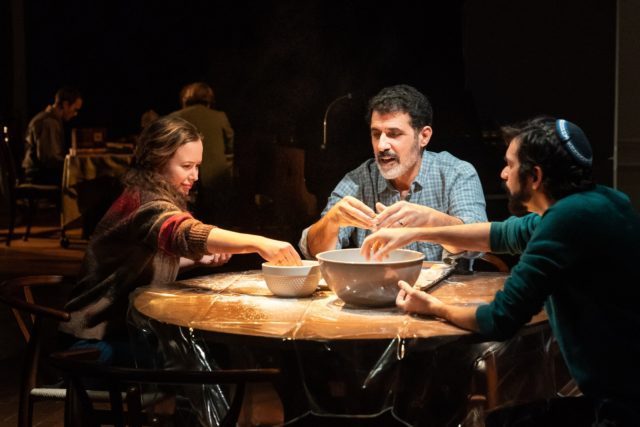
Molly (Molly Ranson), Charles (Jeff Seymour), and Daniel (Yair Ben-Dor) make sufganiyot together in world premiere play from MTC (photo by Matthew Murphy)

Terrorism and fear are perpetually on their minds. In an early exchange, Molly, who represents the current battle over BDS and other Israel-related issues on American college campuses, and Marcelle, who represents, well, one of my mother’s best friends, get into it.

Molly: My parents didn’t want me to come to France at all, but . . .
Marcelle: Why not?
Molly: Just cause of all the, you know. The terrorism.
Marcelle: There’s terrorism everywhere.
Molly: That’s what I said, but they were scared.
Marcelle: Aren’t you from New York? What’s to be scared?
Molly: I agree.
Marcelle: The whole world has terrorism now. There’s nowhere to hide. Either you live in the world, or you live in a cave. Personally, I don’t want to be a caveman.

Charles, whose family escaped Algeria when it became too dangerous, admits, “I’m scared, Marcelle. You lay everything out, you lay it out so rationally, and I hear every word you’re saying, but, I’m scared. We are Jews. We are Jews. The only reason we’re still on this planet is because we learned to get out of dangerous situations before they got the better of us. Something is happening in the world, and it’s happening in our country too — I can feel it.” When he says “our country too,” it’s impossible not to think about how it’s happening in America today, with brutal assaults on Jews from Pittsburgh, Boise, and New York City to Colleyville, St. Petersburg, and Poway.

Francis Benhamou brings down the house in a dazzling monologue when Elodie, in a bar with Molly, rants and rages about American Judaism and misperceptions about Israel. “American Jews . . . feel pretty free,” she explains in a verbal barrage. “So when it comes to Israel, they either despise it, or they’re slavishly devoted to it because they have a deep-seated understanding in their bones that there has never been a country on Earth that hasn’t eventually at some point turned on its Jews, and even in America, that fate awaits them too. Then you have the American Jew who hates Israel or is highly critical of Israel and I would argue part of why they feel able to be so critical of Israel is because they feel so safe in America, because they’ve convinced themselves that they can stay in America forever and maybe that’s true now but if history is our guide and history must always be our guide then you have to ask, so you feel safe today but will that be the case a hundred years from now? Or ten?” It’s a discussion I know I’ve had many times with friends and relatives, and Harmon nails it.

Narrator Patrick Salomon (Richard Topol) goes back and forth in time in Prayer for the French Republic (photo by Matthew Murphy)

Takeshi Kata’s elegant set rotates between the Benhamous’ lovely home and the Salomons’ less-fashionable wartime apartment. Tony, Drama Desk, and Obie–winning director David Cromer, who mounted a groundbreaking adaptation of Our Town on Broadway in 2009 (as well as helming The Band’s Visit, The Sound Inside, Tribes, and many other well-regarded shows), seamlessly integrates the two eras, which are often onstage together, one in the background of the other like a ghost, with superb lighting by Amith Chandrashaker and sound by Lee Kinney and Daniel Kluger.

The cast is uniformly outstanding, with Topol’s (Anatomy of a Suicide, The Normal Heart) naturally calm, likable demeanor alleviating some of the palpable tension until there’s no stopping it; Topol previously starred as Lemml, the immigrant stage manager and narrator, in Paula Vogel’s Tony-nominated Indecent, about the making of Sholem Asch’s controversial 1907 Yiddish play, God of Vengeance. Ranson imbues Molly with an inner strength and confidence that has her going toe-to-toe with her cousins, who have a tendency to be loud and forceful; Ranson similarly portrayed Melody, Liam’s (Michael Zegen) shiksa goddess, in Harmon’s Bad Jews, which also dealt with the Holocaust and family legacy. Ranson and Ben-Dor have an immediate chemistry as they balance fighting and flirtation.

Even Daniel’s fondness for Bob Dylan is no mere affectation, as the Nobel- and Pulitzer-winning troubadour famously went from being Jewish to a born-again Christian and back to Jewish during his fabled career; his 1983 album, Infidels, features several songs about Israel.

But it’s Harmon’s (Significant Other, Admissions) impeccable dialogue and razor-sharp characterizations that take center stage. Every word, every action rings true and hits home; he gets the Jewish American experience just right, even if this is a Parisian family (that speaks English without the hint of a French accent). I’ve been involved in these arguments and know these people well; I’m planning on memorizing a bunch of lines in time for this year’s Seders.

MORNING SUN

Edie Falco, Marin Ireland, and Blair Brown are extraordinary as three generations of one family in Morning Sun (photo © Matthew Murphy 2021)

MORNING SUN
Manhattan Theatre Club
MTC at New York City Center – Stage I
131 West 55th St. between Sixth & Seventh Aves.
Tuesday – Sunday through December 19, $99-$109
212-581-1212
www.manhattantheatreclub.com

Tony winner Simon Stephens’s Morning Sun opened tonight at New York City Center’s Stage I, starring three sensational actresses: Tony winner and Emmy nominee Blair Brown, Emmy winner and Tony nominee Edie Falco, and Tony nominee Marin Ireland. They play three generations of women in the McBride clan: Falco is Charley McBride, Brown is her mother, Claudette, and Ireland is Charley’s daughter, Tessa. The script identifies them as 1, 2, and 3, respectively; while Falco is Charley throughout the hundred-minute Manhattan Theatre Club production, Brown and Ireland also portray numerous other characters, including friends, relatives, and lovers, reenacting moments from the past without changing costumes and altering their demeanor only slightly if at all. It sometimes takes a few lines for the audience to figure out one of these transitions, to discern who is speaking, but that’s part of the play’s attraction.

The structure can’t help but call to mind Edward Albee’s 1991 Pulitzer Prize–winning play, Three Tall Women, in which a trio of sensational actresses — most recently Glenda Jackson, Laurie Metcalf, and Alison Pill in the show’s 2018 Broadway debut — portrayed three generations of unnamed women who the script identifies as A, B, and C. From the very start of Morning Sun, however, Stephens references not only Edward Albee but also artist Edward Hopper, and it’s clear that these women live in a different social class than the triad of Three Tall Women and that Stephens’s project is very different from Albee’s.

The show begins with an obtuse conversation that sets the mood and signals what is to come next:

Charley: Am I safe?
Tessa: You ask yourself.
Claudette: And I can’t really understand your question.
Charley: I want to know if I’m safe.
Claudette: Please be quiet.
Charley: I’m very scared. I’m very confused it’s very bright here please just tell me whether or not I am safe.
Claudette: I don’t understand what you’re trying to tell me.
Tessa: Here. Hold her carefully.
Claudette: The way your face scrunches up and the noise that you make and how I know I’m supposed to feel and the difference between that and how I actually do feel —
Charley: Just tell me.
Claudette: Here. Come here. Come here.
Charley: Am I safe? That’s all I’m asking. It’s not a very difficult question to understand, is it? Is it? It’s not. No. It isn’t.

Charley McBride (Edie Falco) and Brian (Marin Ireland) discuss Edward Hopper in Manhattan Theatre Club world premiere Morning Sun (photo © Matthew Murphy 2021)

In chronological order, Claudette, Charley, and Tessa discuss seminal moments in their lives, reflecting on their successes and failures, as one character often narrates what is happening to the other in the second person. Tessa tells her grandmother, “One morning at the end of summer you take a train to Penn Station walk two blocks up Seventh and get a job in the Macy’s haberdashery department. That night you find a rent controlled fifth floor walk-up on Eleventh Street in the West Village. Two bedrooms. A railroad apartment with a tub in the kitchen and a view of the courtyard to the south side of the building. And if you crane your neck you can see the Hudson.” Claudette says, “I love it completely. . . . And I never live anywhere else. . . . For the rest of my life.”

The women introduce us to Claudette’s brother-in-law, Stanley; her husband, Harold; Charley’s best friend, Casey; an airplane pilot in a bar; a museum guard named Brian; and others, looking back as if they are all ghosts. Indeed, the play takes place in a nonspecific time, a kind of way station, where some of the characters have already passed away. At one point, Uncle Stanley tells Charley that the Cherry Lane Theatre is haunted. “There’s no such thing as ghosts,” Charley says. “Don’t you think?” he responds. “No I don’t. And there’s no way of making me think otherwise. So don’t try,” she says. “If there’s no such thing as ghosts, then why do they need a ghost light?” he asks. Charley: “What’s a ghost light?” Stanley: “It’s a light they keep on in the theater all night to keep the ghosts away.” A moment later, Stanley adds, “A ghost is an interruption,” which evokes the eighteen months of the pandemic lockdown, when theaters were empty, ghost lights on.

Place is essential to the play, which is set in Claudette’s West Village apartment. To the left is a clothes closet, to the right a piano and a working kitchen with running water and electricity, and in the center is a large, open area with a couch, a chair, and a bench, backed by half a dozen high-set windows. (The set is by dots, with lighting by Lap Chi Chu, sound by Lee Kinney and Daniel Kluger, and costumes by Kaye Voyce.) The characters move about the space almost like ghosts, occasionally appearing like they’re in a Hopper painting. The show is named after Hopper’s 1952 canvas Morning Sun, in which a lonely woman (the model is Hopper’s wife, painter Jo Nivison, the only female who ever posed for him) sits on a bed facing an open window, her hands gripping her legs, feet in front of her, the light forming an ominous rectangle on the wall. She peers outside as if there’s something she’s lost, something she can’t get back. It’s reminiscent of such other Hopper works as Cape Cod Morning, Western Motel, Eleven A.M., Morning in a City, and A Woman in the Sun, which all feature women seemingly trapped in an isolation they can’t escape.

Claudette was born and raised in Nyack, Hopper’s hometown in Rockland County. The titular painting plays a key role in the narrative, such as when Charley meets Brian, the museum guard, while looking at it. Charley tells him, “I like finding Edward Hopper paintings and thinking this is where I came from. Morning Sun. I like the strange expression on the woman’s face and wondering what she’s staring at and if she’s thinking about what she’s staring at or if her face is just kind of frozen because she’s gone to somewhere in her head that she can’t ever talk about.” Referring to the edifice that can be seen through the window, Brian points out, “I like trying to figure out what that building is.” Charley offers, “It could be a prison.”

Impeccably directed by Lila Neugebauer (The Wolves, Edward Albee’s At Home at the Zoo, The Waverly Gallery), the show also made me think of Hopper’s New York Movie, in which a woman, bathed in light, hand on chin, stands just outside the seating area of a theater, perhaps contemplating whether she wants to sit down and join the crowd, be part of something. In the age of Covid, it now evokes the pandemic lockdown and the tentative return of audiences to theaters, but it also relates to the loneliness that Claudette, Charley, and Tessa experience in their daily lives; they might have one another in this surreal conversation happening onstage, but they each harbor fears of being alone.

Marin Ireland is extraordinary playing Tessa McBride and several other characters in latest Simon Stephens play (photo © Matthew Murphy 2021)

They rejoice in New York City — among the locations mentioned are the White Horse Tavern, Peter McManus, Shea Stadium, the old Penn Station, Wollman Rink, Washington Square Park the New School, and the High Line — but they bond to Joni Mitchell’s “Song to a Seagull,” in which Mitchell sings, “I came to the city / And lived like old Crusoe / On an island of noise / In a cobblestone sea / And the beaches were concrete / And the stars paid a light bill / And the blossoms hung false / On their store window trees.” The three women are together, but they are alone.

Brown (Copenhagen, Arcadia, Mary Page Marlowe), Falco (The True, Frankie and Johnny in the Clair de Lune), and Ireland (Reasons to Be Pretty, Blue Ridge, On the Exhale) are exquisite, portraying their complex characters with a gentle ease that is intoxicating, as if we’re spending quality time in front of a great painting. The drama leisurely but compellingly proceeds at a calm pace as the characters move about the stage, sometimes gathering at the small table in the kitchen, other times sitting so far apart it is as if they are in separate canvases, hung nearby on a wall.

Stephens is a writer with breathtaking skill, whether penning a charming two-character drama about a pair of loners who meet at a London Tube station (Heisenberg), a major spectacle about the murder of a pooch (The Curious Incident of the Dog in the Night-Time), an intimate one-man show dealing with horrific tragedy (Sea Wall), a postapocalyptic nightmare told with blindfolds and through headphones (Blindness), or a profound exploration into the lives of three generations of New York women. Morning Sun is a masterful artistic rendering of three ordinary, intertwined lives continually trying to find their unique path while battling solitude, like an Edward Hopper painting come to life, the subjects ever peering out the window, considering what is, what was, and what could have been.

Talking with Casey about Tessa, Charley says, “I want her to look back on me when she’s an adult and know that I did my best for her and that I always tried even if sometimes I let her down.” Casey replies, “We all let each other down,” to which Charley responds, “But that I did my very, very best.” What more can we ask of each other, in life and in art?

LACKAWANNA BLUES

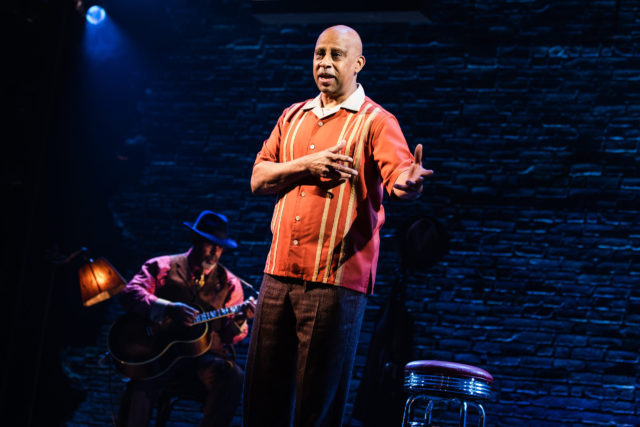
Ruben Santiago-Hudson shares childhood memories in Lackawanna Blues (photo © 2021 Marc J. Franklin)

LACKAWANNA BLUES
Samuel J. Friedman Theatre
261 West Forty-Seventh St. between Broadway & Eighth Ave.
Tuesday – Sunday through November 12, $59
www.manhattantheatreclub.com

In 2006, the HBO film of Lackawanna Blues earned John Papsidera an Emmy for Outstanding Casting for a Miniseries, Movie, or Special and S. Epatha Merkerson won an Emmy and a Golden Globe for her portrayal of Rachel “Nanny” Crosby. But in the Broadway debut of Ruben Santiago-Hudson’s one-man show, which premiered at the Public in 2001 and continues at Manhattan Theatre Club’s Samuel J. Friedman Theatre through November 12, Santiago-Hudson proves once again that he can do it all by himself.

In the ninety-minute play, Santiago-Hudson, serving as actor, writer, and director, portrays more than two dozen characters that were part of his childhood growing up in the steel town of Lackawanna in upstate New York, focusing on his five-year-old self and the woman left in charge of his care, the beloved Miss Rachel, also known to the tight-knit community as Nanny. Ruben’s mother had financial problems stemming from drug abuse, and his father did not live with them. Through the age of eleven, he often lived with Miss Rachel, who ran a pair of boardinghouses, one at 32 Wasson Ave., where young Ruben met such fanciful figures as Numb Finger Pete, Sweet Tooth Sam, Ol’ Po’ Carl, Small Paul, Mr. Lucious, Freddie Cobbs, and Mr. Lemuel Taylor; Santiago-Hudson embodies each of them with shifts in his voice and physical movement as he relates funny and poignant anecdotes about fishing, baseball, and domestic violence.

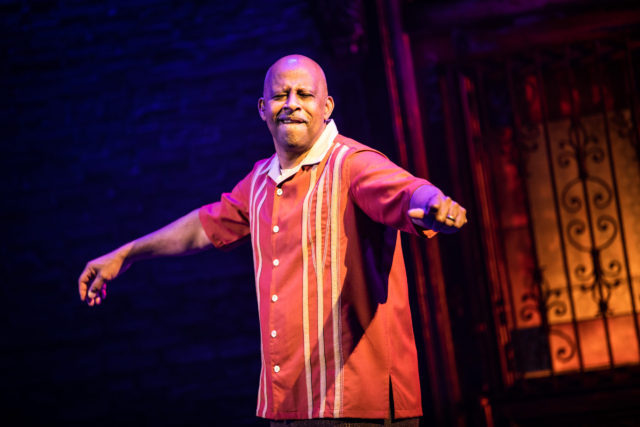
Ruben Santiago-Hudson shows off some sharp moves in Broadway debut of Lackawanna Blues (photo © 2021 Marc J. Franklin)

He wanders across Michael Carnahan’s intimate set, consisting of a few chairs, a small table, the front door of 32 Wasson Ave., a hanging window, and a back wall that evokes the boardinghouse, beautifully lit by Jen Schriever (with several cool surprises). Sitting in one corner is New York Blues Hall of Fame guitarist and Grammy nominee Junior Mack, playing music composed and originally performed onstage by Bill Sims Jr.; Mack previously performed in Sims’s band, so it is a natural hand-off. He interacts well with Santiago-Hudson, sometimes coming to the forefront, other times whispering under Santiago-Hudson’s dialogue. Occasionally, Santiago-Hudson whips out a harmonica and blasts away with verve. (The warm sound design is by Darron L West.)

Lackawanna Blues is a celebration of a town that was enjoying the fruits of prosperity, not a dirge about marginalized people suffering hard times. The play begins with Santiago-Hudson declaring, “Nineteen fifty-six. Lackawanna, New York, like all Great Lakes cities, was thriving! Jobs everywhere, money everywhere. Steel plants, grain mills, railroads, the docks. Everybody had a new car and a conk. Restaurants, bars, stores, everybody made money. The smell of fried fish, chicken, and pork chops floating in the air every weekend. In every bar the aroma of a newly tapped keg of Black Label, Iroquois, or Genesee beer, to complement that hot roast beef-on-weck with just a touch of horseradish. . . . You could get to town on a Monday and by Wednesday have more jobs than one man can take. These were fertile times.” There were problems, but the people knew how to take care of one another, with Miss Rachel at the center. “Nanny was like the government if it really worked,” Santiago-Hudson says.

Santiago-Hudson is no stranger to one-man shows; in 2013 at the Signature, he portrayed his mentor and friend, the late August Wilson, in How I Learned What I Learned. He has directed and/or starred in numerous Wilson works, winning a Tony for his role as Cantwell in Seven Guitars and earning a Drama Desk Award for directing Jitney and an Obie for helming The Piano Lesson. He won an Obie Special Citation for the original production of Lackawanna Blues, while Sims earned an Obie for his music.

On Broadway, Santiago-Hudson makes you think you see every character, smell every smell, witness minute details of every scene even though he never changes his costume or introduces props. It’s a compelling, deeply personal performance that feels right at home in the 622-capacity theater as he marvelously succeeds in inviting the audience into his past. When asked at a talkback about what happened to his mother, he said that would be a show unto itself while sharing some of the specifics of her tragic yet hope-filled life. Sounds like a heckuva sequel.