Tag Archives: Manhattan Theatre Club

JOHN PATRICK SHANLEY: DOUBT: A PARABLE / BROOKLYN LAUNDRY

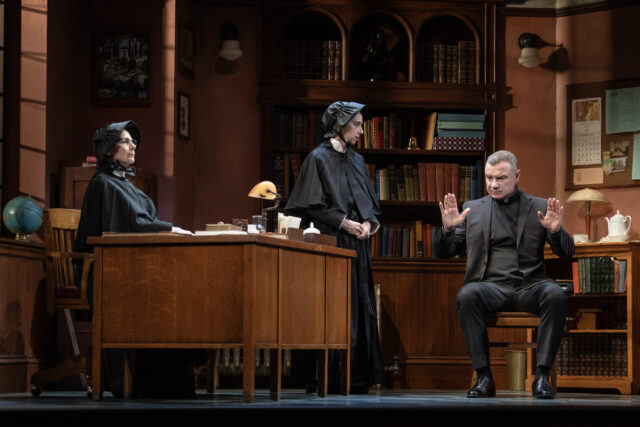
Sister Aloysius (Amy Ryan), Sister James (Zoe Kazan), and Father Flynn (Liev Schreiber) have a serious talk in Doubt (photo by Joan Marcus)

DOUBT: A PARABLE
Todd Haimes Theatre
227 West Forty-Second St. between Broadway & Eighth Ave.
Tuesday – Sunday through April 14, $68-$344
212-539-8500
www.roundabouttheatre.org

“What do you do when you’re not sure? That’s the topic of my sermon today. You look for God’s direction and can’t find it,” Father Flynn (Liev Schreiber) says at the beginning of the first Broadway revival of John Patrick Shanley’s 2004 Pulitzer- and Tony-winning Doubt: A Parable. “Doubt can be a bond as powerful and sustaining as certainty. When you are lost, you are not alone.”

Shanley has two plays running concurrently in New York City, both dealing with doubt and certainty. Roundabout’s production of Doubt has been extended at the Todd Haimes Theatre through April 21, while Manhattan Theatre Club’s world premiere of Brooklyn Laundry has been extended at City Center through April 14. (A sold-out revival of Shanley’s 1983 two-character Danny and the Deep Blue Sea, starring Christopher Abbott and Aubrey Plaza, completed a limited run at the Lucille Lortel in January; it covered some of the same themes as the other two.)

Doubt and Brooklyn Laundry both feature four characters, rotating sets, high-powered performances, real-life inspiration, and, with just a few exceptions, a series of scenes between two characters. But while the former flows seamlessly as the plot unfolds, the latter is bumpy and much less structured.

Doubt takes place in St. Nicholas Church in the Bronx in 1964, during the Second Vatican Council, which sought to update Catholicism in response to the modern world, moving away from scholasticism and centuries-old doctrine and theology toward new ways of relating to lay people, priests, and nuns. Not everyone was on board, and some still aren’t sixty years later.
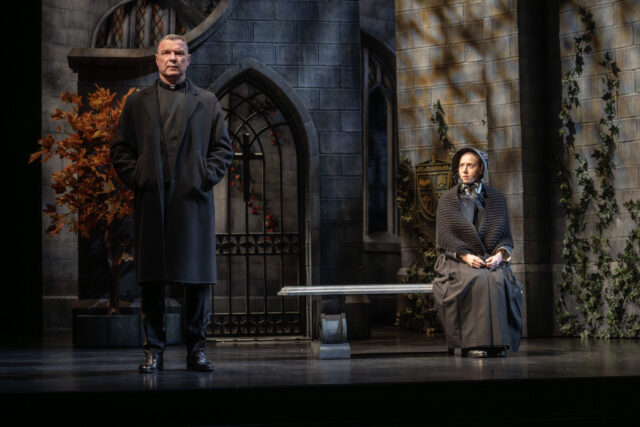
Father Flynn (Liev Schreiber) shares a moment with Sister James (Zoe Kazan) in the church garden (photo by Joan Marcus)

The school is run by the hard-nosed, impossibly strict principal Sister Aloysius (Amy Ryan), a member of the Sisters of Charity, who has no time for art, music, dancing, ballpoint pens, Frosty the Snowman, Father Flynn’s long fingernails, or the monsignor, who she thinks is oblivious. She believes that “satisfaction is a vice” and “innocence is a form of laziness.” When young teacher Sister James (Zoe Kazan) stops by her office, Sister Aloysius starts drilling her on classroom methods, claiming she’s too lenient with her students. She wants her to pay more attention but won’t say exactly what Sister James should be looking for. “I must be careful not to create something by saying it. I can only say I am concerned, perhaps needlessly, about matters in St. Nicholas School,” the older nun says with suspicion.

Later, in the church garden, Sister Aloysius asks about Donald Muller, the first Black student in the school; she is sure that Donald, an altar boy, will get bullied, but when Sister James points out that Father Flynn has taken him under his wing, Sister Aloysius immediately tightens up. “So it’s happened,” she says, as if she has been waiting for this moment.

She learns that Father Flynn had a private talk with Donald in the rectory. Later, in her office, she demands that Father Flynn tell her what happened. The priest refuses, arguing that it was a sensitive, personal matter while understanding exactly what the principal is accusing him of without her saying it out loud. When he is eventually forced to talk about it, he explains that he was only protecting the child and did nothing wrong. That’s not enough for Sister Aloysius, who still suspects him; he storms out, and she tells Sister James, who believes the father, “These types of people are clever. They’re not so easily undone. . . . I’ll bring him down. With or without your help.”

What follows is a tense cat-and-mouse game between the principal and the priest; Sister Aloysius even calls in Donald’s mother (Quincy Tyler Bernstine), who shocks her with her response to learning that her son might be in danger from a predatory priest.
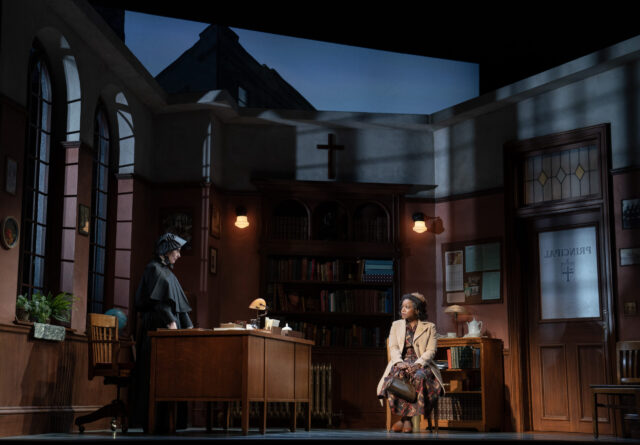
Sister Aloysius (Amy Ryan) has some harsh words for Mrs. Muller (Quincy Tyler Bernstine) in Broadway revival of Doubt (photo by Joan Marcus)

Doubt debuted on Broadway in 2004, with Brían F. O’Byrne as Father Flynn, Cherry Jones as Sister Aloysius, Heather Goldenhersh as Sister James, and Adriane Lenox as Mrs. Muller; all four cast members received Tony nominations, with Jones and Lenox winning, along with awards for Best Play and Best Director (Doug Hughes). In 2008, Shanley adapted the play into a feature film, with Philip Seymour Hoffman as Father Flynn, Meryl Streep as Sister Aloysius, Amy Adams as Sister James, and Viola Davis as Mrs. Muller, all of whom were nominated for Oscars, along with Shanley’s adapted screenplay, which expanded the story to include more than fifty roles.

Director Scott Ellis (Take Me Out, The Assembled Parties) masterfully directs the ninety-minute play, never letting the tension break as the audience wonders whether Father Flynn actually abused Donald. The story was partly inspired by Shanley learning years later that his high school mentor was a sexual predator, as well as his deep respect for nuns. Except for one scene between the two sisters and the father, all the others feature two characters talking about intolerance, faith, gossip, love, God, and what, or who, to believe.

David Rockwell’s sets move between Sister Aloysius’s austere office and the garden, with a projection in the back of buildings next to the church. Everything disappears and windows drop from above when Father Flynn delivers his homilies. Linda Cho’s costumes are primarily dark habits and vestments. Kenneth Posner’s lighting and Mikaal Sulaiman’s sound maintain the eery, mysterious feeling of impending doom.

Bernstine (The Amateurs, Our Lady of 121st Street) is powerful as Mrs. Muller, who is not afraid to make her unique point of view known, and Kazan (Love, Love, Love; A Behanding in Spokane) is wonderful as the doe-eyed innocent who is in over her head.

Two-time Tony nominee Ryan (Love, Love, Love; A Streetcar Named Desire) is almost unrecognizable as Sister Aloysius, the cagey principal who trusts no one except God. She portrays her as diamond-hard, a cold, steely woman without kindness or compassion but she’s not quite a villain, although you’d have to look hard to find a soft spot; you hope she is wrong about Father Flynn not only because he is a more relatable person but because you want her not to win. (Or do you?) Schreiber (Les Liaisons Dangereuses, A View from the Bridge) is utterly brilliant as her prey, his eyes mesmerizing, his gestures works of art; he is almost otherworldly when giving his sermons, then down to earth when teaching the boys basketball.

“Now, the thing about shooting from the foul line: It’s psychological,” Father Flynn explains. “The rest of the game you’re cooperating with your teammates, you’re competing against the other team. But at the foul line, it’s you against yourself. And the danger is: You start to think.”

He’s talking about a lot more than basketball.
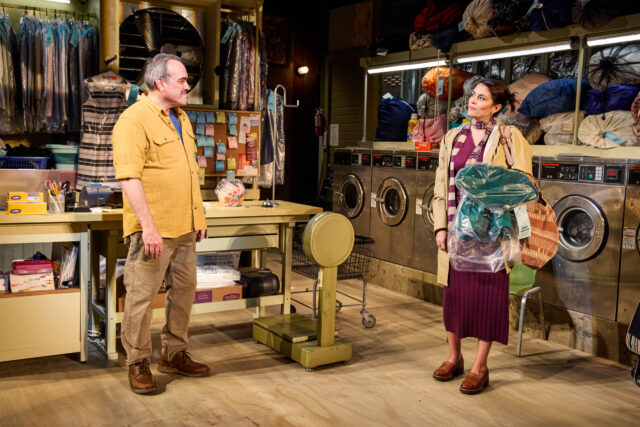
Owen (David Zayas) and Fran (Cecily Strong) take stock of their lives in Brooklyn Laundry (photo by Jeremy Daniel)

BROOKLYN LAUNDRY
Manhattan Theatre Club
MTC at New York City Center – Stage I
Tuesday – Sunday through April 14, $119-$129
212-581-1212
www.manhattantheatreclub.com

“You believe in God?” Fran Costello (Cecily Strong) asks Owen (David Zayas) shortly after meeting him.

“Yeah, why not? You want your dry cleaning?” he responds.

Inspired by having his clothes lost by a local laundromat, John Patrick Shanley’s Brooklyn Laundry is a slight but enjoyable seventy-five-minute trip into a quartet of people facing turning points in their lives. Fran is a cynical thirty-seven-year-old office worker, the youngest of three siblings; her sister Trish (Florencia Lozano) lives in a hospice trailer in Pennsylvania with her two young kids, her ex-husband in jail; her sister Susie (Andrea Syglowski), who lives with her husband and their six-year-old son in the city, is the responsible one; and the fiftyish Owen owns three laundries and hasn’t been with a woman since his fiancée left him two years before.

It’s not exactly love at first sight for Fran and Owen when she comes in to drop off a bag of laundry, where she has a credit because they lost her laundry six months ago. “You’re like my fiancée was,” he says. “She’s . . . ?” Fran begins. “Gone. She was like you. Smart, one inch from terrific, but gloomy,” he continues. She answers, “I don’t think I’m gloomy. I think what I’m suffering from is reality.” Owen: “Some folks look life in the mouth.” Fran: “You’re not one of those people who think I’m manifesting, are you?”

He asks her on a date, and she reluctantly agrees. “Why would you want to have dinner with a person who’s in the middle of an episode?” she asks. He responds, “I don’t know. Everybody has a bad day.”

Fran goes out with Owen and meets up with Trish in Pennsylvania and Susie in Brooklyn as she takes stock of her sad, lonely life; her problems are not about to just come out in the wash.
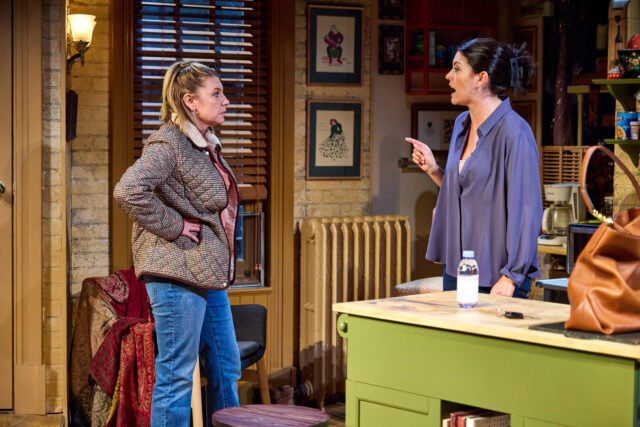
Susie (Andrea Syglowski) and Fran (Cecily Strong) have a family squabble in John Patrick Shanley world premiere for MTC (photo by Jeremy Daniel)

The concept of sleep is an underlying theme of the play. At one point, Susie says to Fran, “It’s a wake-up call,” and Fran responds, “Was I asleep?” Sleep is brought up by all four characters, which harkens back to Doubt. “Oh. I can’t sleep,” Sister Aloysius tells Father Flynn, who asks, “Why not?” The nun says, “Bad dreams. Actually one bad dream and then I haven’t slept right since.” Later, she says to Sister James, “Maybe we’re not supposed to sleep so well.”

Santo Loquasto’s set rotates from Owen’s laundry, which appears to be fully operational, chugging away as the audience enters, to the bedroom in Trish’s trailer, Fran’s studio apartment, and the restaurant where Fran and Owen go to dinner. Suzy Benzinger’s costumes are naturalistic, Brian MacDevitt’s lighting is sharp, particularly in the dinner scene, and John Gromada’s original music and sound maintain the mood, along with Lil Nas X’s “Old Town Road.”

All four actors are exceptional; Lozano (Placebo, One Wet Brain) imbues the dying Trish with a keen sense of humor, Syglowski (Dig, Halfway Bitches Go Straight to Heaven) brings humanity to the angry and frustrated Susie, Strong (The Search for Signs of Intelligent Life in the Universe, Schmigadoon!) empowers Fran through all her awkwardness, and Zayas (Cost of Living, Anna in the Tropics) proves once again why he’s one of the best around, portraying the unpredictable and frightfully honest Owen with charm to spare.

Written and directed by Oscar, Tony, and Obie winner and Emmy nominee Shanley (Outside Mullingar, Prodigal Son), Brooklyn Laundry contains unexpected dialogue with clever undertones. When Owen tells Fran she can keep a quarter that fell on the floor, she says she doesn’t want it, so he asks, “What? You afraid of a little change?” Trish loves the artificial flowers she’s had for twenty years. “You can wash them. They never fade,” she says, as opposed to clothing, or people. When Owen and Fran are at dinner, she is upset that chicken is not on the menu, so he urges her, “This is exactly when reality becomes super important. You must choose from what exists on the menu, Fran, and not choose the invisible thing in your mind.”

However, each scene seems to exist in its own mind; they never come together as a whole, unfolding like loosely connected stories with chapters missing.

“What do you do when you’re not sure?” Father Flynn asks in Doubt, a nearly perfectly executed drama. Meanwhile, Brooklyn Laundry feels unsure of itself, unable to sleep well.

[Mark Rifkin is a Brooklyn-born, Manhattan-based writer and editor; you can follow him on Substack here.]
PRAYER FOR THE FRENCH REPUBLIC / APPROPRIATE

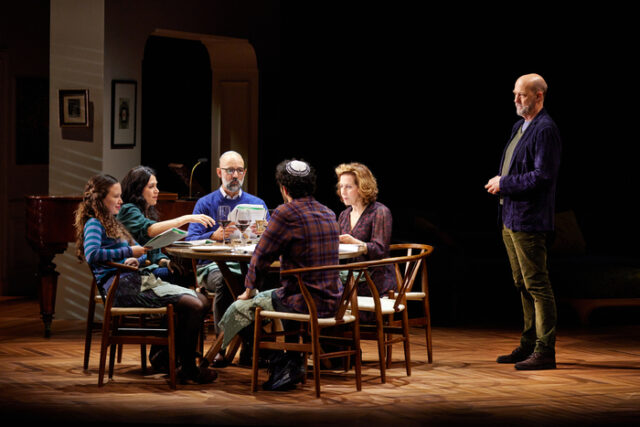
Patrick (Anthony Edwards) watches his family in Joshua Harmon’s Prayer for the French Republic on Broadway (photo by Jeremy Daniel)

PRAYER FOR THE FRENCH REPUBLIC
Samuel J. Friedman Theatre
261 West Forty-Seventh St. between Broadway & Eighth Ave.
Tuesday – Sunday through March 3, $94-$318
www.manhattantheatreclub.com

Success off Broadway is no guarantee of a hit on Broadway. Transferring to a bigger house, the passing of time, tweaking the script, cast changes, and sociopolitical events can all have an impact on a play or musical moving to the Great White Way.

While such shows as Hamilton, The Humans, Fun Home, Sweat, Fat Ham, and Into the Woods were sensational on and off Broadway, others ran into trouble.

Girl from the North Country was inspired at the Public but felt stale at the Belasco. Ntozake Shange’s for colored girls who have considered suicide/ when the rainbow is enuf was electrifying at the Public but was completely reimagined at the Booth, and not for the better. Slave Play was provocative at New York Theatre Workshop but lost its power at the Golden. At Playwrights Horizons in 2018, Larissa FastHorse’s The Thanksgiving Play was a brilliant farce, but five years later at the Helen Hayes, with a new cast and creative team, it was dry and disappointing, like overheated leftovers.

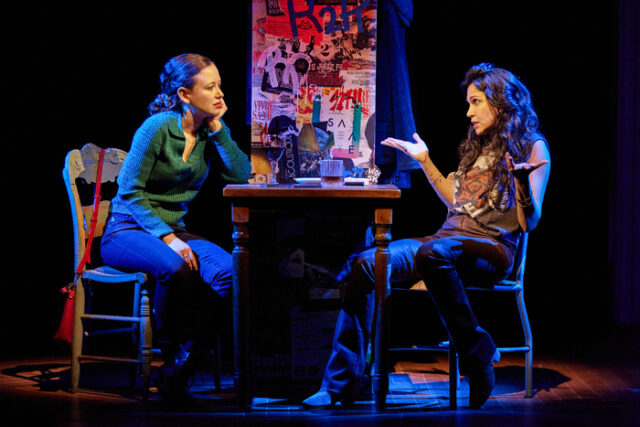
Molly (Molly Ranson) and Elodie (Francis Benhamou) argue about Israel in Prayer for the French Republic (photo by Jeremy Daniel)

I loved Prayer for the French Republic when it debuted at MTC at New York City Center, but two years later, it doesn’t feel as sharp and incisive at the Samuel J. Friedman, and I’ve been scratching my head to try to figure out why. Joshua Harmon’s play is still an impressive piece of work, but it doesn’t have the same power now that it had then. It was named Outstanding Play at the 2022 Drama Desk Awards, receiving my vote, but I wouldn’t have voted for this current version.

The story takes place in Paris in 1944–46 and 2016–17, following the trials and tribulations of the Salomon family, who have been making pianos since 1855. During WWII, Irma and Adolphe choose to remain in France as they worry about the fate of their children. In contemporary times, their descendants face a vicious antisemitism that forces them to question whether they have to leave their home. The script and the creative team are essentially the same, including the director, David Cromer, who guided The Band’s Visit to a slew of awards both on and off Broadway. Only five of the eleven cast members are back, so that could be part of the issue. One is notably stronger than his predecessor, but another sadly falters in a key role.

However, the scintillating scene between Elodie and her distant cousin Molly as they argue about Israel is played by the same actors on the same set, yet it fails to ignite as it previously did. I think it was more than just moving to a bigger venue; the events of October 7 and the aftermath involving Hamas’s terrorist attack and Israel’s military response have impacted everyone’s views of the Middle East. The glue that held the off-Broadway show together was Rich Topol as Patrick, the Salomon brother who also serves as narrator and who has a different view of Judaism than the rest of his family. Notably, Topol just finished a run as a Jew who leaves Poland shortly before a brutal 1941 pogrom in Igor Golyak’s poignant and inventive adaptation of Tadeusz Słobodzianek’s Our Class, which is filled with a frightening sense of urgency.

Two previous Harmon shows — Significant Other and Bad Jews — were just as good, if not better, when they transferred to bigger venues; Prayer is a conundrum.

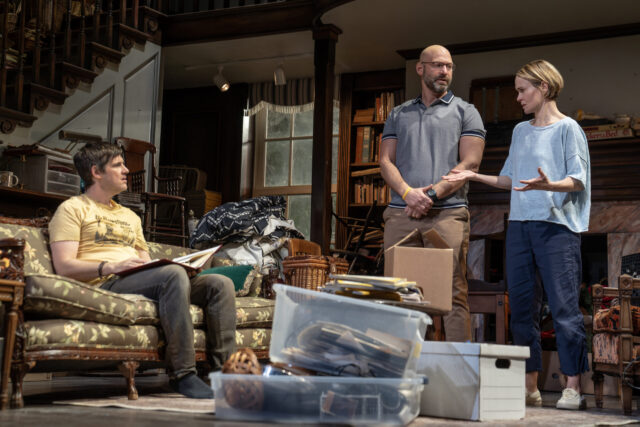
Three siblings battle over their family’s legacy in Appropriate (photo by Joan Marcus)

APPROPRIATE
Helen Hayes Theater
240 West 44th St.
Tuesday – Sunday through March 3, $209-$269
Moving to the Belasco Theatre March 25 – June 30, $79-$318
2st.com

Ten years ago, I saw Branden Jacobs-Jenkins’s Appropriate at the Signature. The play is about three siblings of the white Lafayette family who have returned to the clan’s dilapidated southern plantation to sell it to pay off debts following the death of their father. The siblings are not very close — youngest brother Franz has not been heard from in a decade — but their relationships are further strained when a home-made book of photographs of lynched black men is found in the house. The possibility that their father was a racist infuriates Toni, who cared for the ailing patriarch, and she becomes even more incensed when her Jewish sister-in-law, Rachael, who is married to Bo, claims that he was antisemitic as well.

The Signature show was directed by Liesl Tommy and starred Johanna Day, Michael Laurence, and Maddie Corman as the siblings. In 2014, I wrote, “Appropriate begins with solid character development while raising intriguing social and moral issues without getting didactic. But the story goes off the rails in the second act as various secrets emerge and the vitriol reaches even higher levels. Perhaps most unfortunate, there’s a moment that seems like the perfect ending; the lights go out, and just as the audience is ready to applaud, the play continues through a disappointing, unnecessary coda. Jacobs-Jenkins clutters what is a fascinating premise with too many disparate elements.”

I still feel the same about the ending, even with an insightful added finale, but everything else about the play, at the Helen Hayes through March 3 before moving to the Belasco for three more months, is better this time around. Jacobs-Jenkins (The Comeuppance, An Octoroon), a relentless reviser, has improved the script immensely, with dialogue that hits harder and deeper. Director Lila Neugebauer grabs hold of the complex plot and never lets go; the confrontations among the siblings, their significant others, and the next generation are scintillating; at times it’s so severe and merciless, so intimate, that you feel guilty for watching it unfold but you can’t look away for a second.

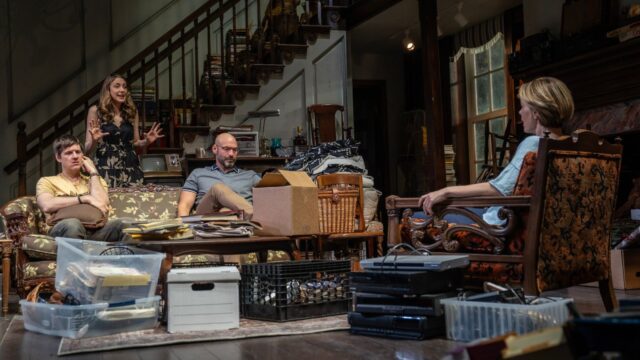
Branden Jacobs-Jenkins’s Appropriate is reborn on Broadway (photo by Joan Marcus)

Sarah Paulson is a force of nature as Toni, an embittered woman with deep scars and no filter, exploding with vitriolic accusations she will never be able to take back. Corey Stoll goes toe-to-toe with her as Bo, who is having financial difficulties that may be affecting his ethics, while Natalie Gold is tough as nails as Rachael, who is not afraid to get in the ring with them. Michael Esper imbues Franz with a gentleness that belies the character’s past, while his younger girlfriend, a flower child named River played sweetly by Elle Fanning, stands firmly by his side. And the set, by dots, becomes more of an integral element, both what’s inside and lurking outside.

The Broadway production of Appropriate, the title of which has several different meanings and pronunciations, feels both of its time and timeless, an intense tale about the Black experience in America that has no people of color in its cast. A lot has changed in the world since 2014: Barack Obama finished his second term, followed by Donald Trump, both having defeated Hillary Clinton, the former in the primary, the latter in the general. The police killing of George Floyd led to the Black Lives Matter protests and a reckoning with this country’s shameful legacy of slavery and racism. And antisemitism is again on the rise, with October 7 only making it worse.

This vital new adaptation of Appropriate captures all of that and more in unforgettable ways.

[Mark Rifkin is a Brooklyn-born, Manhattan-based writer and editor; you can follow him on Substack here.]
POOR YELLA REDNECKS

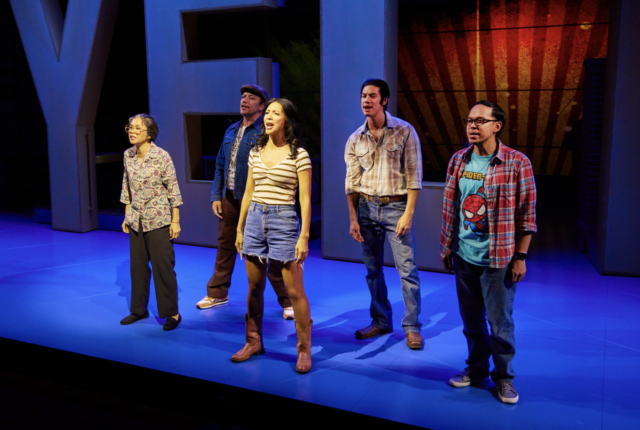
The cast of Poor Yella Rednecks occasionally breaks out into hip-hop songs (photo by Jeremy Daniel)

POOR YELLA REDNECKS
MTC at New York City Center – Stage I
131 West Fifty-Fifth St. between Sixth & Seventh Aves.
Tuesday – Sunday through December 3, $89-$109
212-581-1212
www.manhattantheatreclub.com
www.nycitycenter.org

Arizona-born Vietnamese American playwright and screenwriter Qui Nguyen follows up his semiautobiographical Vietgone with Poor Yella Rednecks, making its New York premiere at MTC at New York City Center — Stage I through December 3.

In praising Vietgone, I wrote, “Passionately directed by [May] Adrales with a frenetic warmth, the hip-hop immigrant tale — with a sweet nod to Hamilton — is colorful and energetic.” I am happy to say the same thing about Poor Yella Rednecks, except it’s even better than its predecessor.

Once again, the play begins with Nguyen (Jon Norman Schneider), called the playwright, explaining that not everything we are about to see actually happened. “This story is based on true events. All heavily researched. All one hundred percent historically accurate. Well, at least according to my mom.”

It’s August 7, 2015, and Nguyen is sitting at a table, interviewing his mother, Tong (Maureen Sebastian), for a play about how she left Vietnam and began a new life in America. But she thinks it’s a terrible idea and the reason why he is poor. “No one want to hear story about old woman who speak bad English with bald son,” she says. She ultimately agrees to talk with him but with a few important rules: “I don’t want you to only tell happy thing. I see your other play. You like to write romantic and funny. But no life is all romance. And it is not all fun. Sometimes it is hard. We Vietnamese. We good at being hard. I want it to be true and hard.” Another rule relates to speech: “If this going to be my play, I want all the white people to sound like the way I hear them. Let them hear all the stupid stuff they say. . . . And finally, I want to talk good.”

Thus, when Vietnamese characters speak with each other, it is in perfect English, substituting for Vietnamese so the audience can understand what they’re saying. But when a Vietnamese character is actually speaking English, it is in broken English. For example, when the older Tong talks to her son in broken English, that is how she is pronouncing the language; however, when she speaks in perfect English, she is actually talking to him in Vietnamese. It’s handled beautifully by Adrales and the cast, a constant reminder of the immigrant experience.

Tong takes him back to Arkansas in 1975, when she met her future husband, Nguyen’s father, Quang, at a relocation camp named Fort Chaffee, then moved to El Dorado. When the playwright says that it must have been love at first sight, Tong replies, “Mm-hmm. And Santa Claus is real, as is the Easter Bunny, and capitalism works for everybody.”

The playwright (Jon Norman Schneider) interviews his mother (Samantha Quan) in Poor Yella Rednecks (photo by Jeremy Daniel)

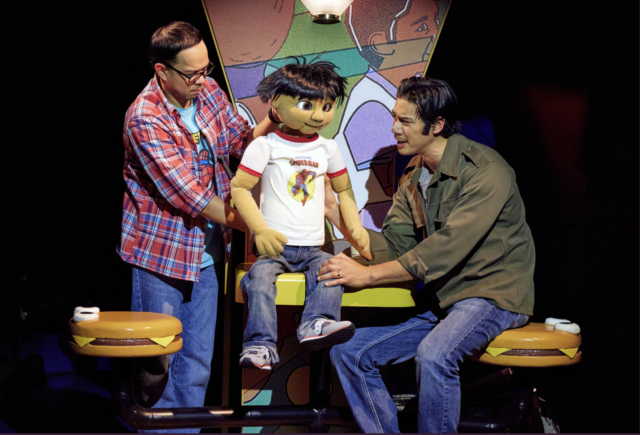
The action then shifts to the past as Tong and Quang (Ben Levin) fall in love even though she is still dating Bobby (Paco Tolson) and he is still married to Thu (Samantha Quan), who is raising their two children in Vietnam. Five years later, Quang and Tong are living in a trailer with her mother, Huong (Quan), a foul-mouthed, cynical smoker who takes care of Quang and Tong’s son, Little Man, while Tong works at a local diner and Quang hangs out with his hapless friends, including his bestie, Nhan (Jon Hoche). In an ingenious move, Little Man is a puppet, designed by David Valentine, that is voiced and operated by Schneider as the playwright, essentially the adult son playing himself as a child. It works wonderfully, especially when Huong teaches Little Man how to defend himself.

When Nhan announces that he’s moving to Houston to find better opportunities and it turns out that Quang hasn’t quite settled things with Thu yet, Tong starts to reevaluate who she is and what she wants out of life.

Tim Mackabee’s set is structured around five large neon letters — Y, E, L, L, A — that occasionally light up in different colors and are moved around to expose smaller sets attached to them, from a living room and a bar to the diner and a fast-food joint. They were designed to evoke the letters in the fabled Hollywood sign; just as that sign beckons wannabe stars to California from all over the world, the Y-E-L-L-A letters represent the American dream that Asians have when they emigrate from their countries to the United States — and encounter hatred, bigotry, language barriers, and other elements that do not make their transition easy. Several scenes also occur in and around a pickup truck, revealing that the vehicle is a favorite not only for a certain stereotyped group of white men who like country music and beer.

The big letters, along with comic-book-like projections by Jared Mezzocchi, are also a nod to Nguyen’s success as a writer for Marvel Studios and founder of the New York–based Vampire Cowboys troupe; Nguyen even has Marvel legend Stan Lee (Tolson, who portrayed the playwright in Vietgone) show up once in a while and deliver statements about heroes. Valérie Thérèse Bart’s costumes hit their target, and Lap Chi Chu’s lighting ranges from bold to intimate.

As in Vietgone, the cast, nearly all of whom appeared in that show at South Coast Rep and/or MTC, displays their vast talents by often breaking out into exciting raps; the original music is by sound designer Shane Rettig, arranged by Kenny Seymour, choreographed by William Carlos Angulo, and with music direction by Cynthia Meng. “I know you think I’m joking — what the hell am I smoking? / But being next to you is what got my heart thumping / Our kiddies will be cuties, bring over that fine bootie / Nothing’s gonna stop us with our combined beauty,” Quang declares. “Let me reintroduce myself / I’m better known as that shorty that you up and left / I must be crazy, baby — thought you were dead / We threw a funeral to commemorate your death,” Thu announces. “Cuz I’m more than just pretty, my brain is damn witty / Gimme one hot second — Imma run this city / Yo, say that I shouldn’t — I’m my own woman / Stronger than any man and twice as good looking,” Tong proclaims. “Even if they mad at you, you gotta be true to you / Every scar you wear, you show the shit that you went through / Ya gotta stand strong, be strong, head strong, ya ain’t wrong / So come on listen close, this here’s our fight song,” Huong tells Little Man.

Jon Norman Schneider (left) portrays the playwright and his younger puppet self in New York premiere from MTC (photo by Jeremy Daniel)

Nguyen (She Kills Monsters, Living Dead in Denmark) and Adrales (The Strangest, Golden Shield) are in total sync; nearly every minute rings true, and the pace never lags. Schneider (The Coast Starlight, Once Upon a (korean) Time) is warm and charming as the playwright, Hoche (King Kong, Life of Pi) is a hoot as Nhan and various rednecks, Levin is hunky as Quang, Quan is cute and lovable as Huong, Tolson (The Knight of the Burning Pestle, Children of Vonderly) gives Bobby an unexpected edge, but Sebastian (The Best We Could: A Family Tragedy, Soul Samurai) steals the show as Tong, who stares adversity right in the face but refuses to give up, in many ways representing the Asian diaspora in America.

Early on, right before the official interview begins, Tong tells her son, “Let me tell you what kind of story white people want to hear.” He asks, “Wait, why only ‘white people?’” She replies, “Because only white people like to watch a play.” He argues, “All sorts of people watch plays, Mom.” To which she counters, “Yes, all sorts of white people. It look like a Fleetwood Mac concert. It so white. . . . Maybe I don’t want to dig up old history just so you can make a few dollar on play white people won’t like.”

At the matinee I saw, the audience appeared to be at least half Vietnamese or Vietnamese American, both young and old, and they and the white people reacted in unison to the unconventional, important story taking place onstage. Eliciting a wide range of emotions, the show accomplishes what theater does best, bringing people of different backgrounds together to focus on the human condition, reaching into the past while giving us hope for the future.

[Mark Rifkin is a Brooklyn-born, Manhattan-based writer and editor; you can follow him on Substack here.]
FRIENDSHIP: SUMMER, 1976 / KING JAMES

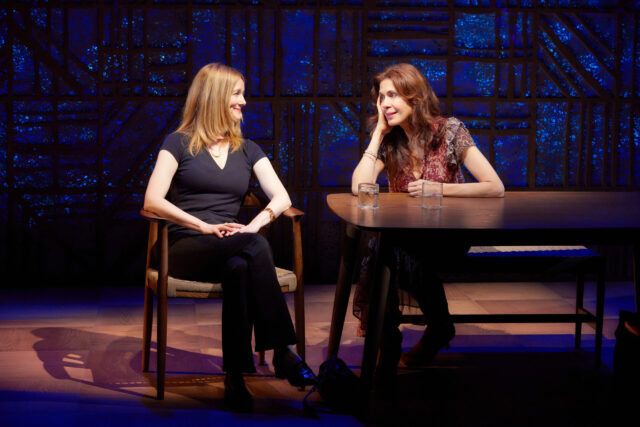
Diana (Laura Linney) and Alice (Jessica Hecht) are forced to become friends in Summer, 1976 (photo © Jeremy Daniel, 2023)

SUMMER, 1976
Samuel J. Friedman Theatre
261 West Forty-Seventh St. between Broadway & Eighth Ave.
Tuesday – Sunday through June 18, $84-$338
www.manhattantheatreclub.com

“Life is an awful, ugly place to not have a best friend,” Sarah Dessen writes in her 1998 young adult novel Someone Like You.

YA novels are often obsessed with portraying teen friendships, while adult friendships generally receive less attention. Two current plays anchored by terrific performances remedy that neglect, focusing exclusively on adult same-sex cisgender platonic relationships. In Pulitzer Prize winner David Auburn’s Summer, 1976 two women meet through their young children, while in Pulitzer Prize finalist Rajiv Joseph’s King James two men bond over their love of basketball star LeBron James. While neither two-character show is a slam dunk, they both got plenty of game.

In MTC’s Summer, 1976 at the Samuel J. Friedman Theatre, Diana (Laura Linney) and Alice (Jessica Hecht) spend most of the ninety-minute play sitting on opposite sides of a long, rectangular table, their chairs facing the audience, who they address directly. At the beginning, Diana, an artist and teacher at Ohio State, tells us how much she doesn’t like Alice’s daughter, Holly. Alice, whose husband, Doug, is an economist at the university, then explains how she “sort of immediately hated” Diana but realizes she will have to put up with her because Alice’s daughter, Gretchen, is getting along with Holly. Diana is a much stricter mother who doesn’t hide what she believes is her superiority over Alice. “Parents who can’t or won’t control their kids aren’t upset when you do it for them. They’re grateful and ashamed,” she says, describing Alice as a “sleepy-eyed little hippie.”

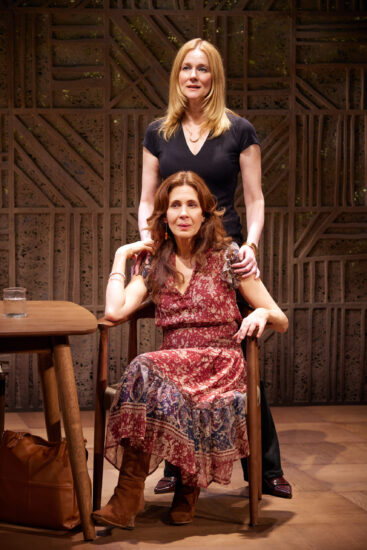
Laura Linney and Jessica Hecht play two very different women in David Auburn world premiere (photo © Jeremy Daniel, 2023)

After passing a joint to the serious, sophisticated Diana, the free-spirited Alice complains, “She fucking bogarted it for like five minutes, and I was like, come on, lady, I only took it out because it was the only way I could imagine getting through the next ten minutes before I could make an excuse and leave.” But soon after that they actually become friends, sharing intimate details about their fears and desires, discussing interior decoration choices, a sexy house painter, the sanctity of marriage, highbrow vs. lowbrow television, music, and literature, and a complicated “cashless, self-sustaining system” Doug has developed to barter baby-sitting time in their community.

The final scene takes place about twenty-five years later, when we learn how their two-month friendship impacted the rest of their lives.

John Lee Beatty’s set features a three-sided gridlike wooden backdrop with two doorways that the characters can use as an exit but don’t, sticking around to hear what the other one has to say. Japhy Weideman’s lighting and Hana S. Kim’s projections change day to night, adding blue sky and twinkling stars. Tony winner Daniel Sullivan (If I Forget, Lost Lake) can’t quite get a firm grasp of Auburn’s (Proof, The Columnist, Lost Lake) narrative, which is too slight and gets bumpier as the conclusion approaches.

Tony nominee and four-time Emmy winner Linney (My Name Is Lucy Barton, The Little Foxes) and Tony nominee Hecht (Letters from Max, The Orchard) form a terrific duo, the former firm and direct, the latter loose and quixotic. For much of the show they are separated by the length of the table, occasionally reaching for each other but unable to make contact.

At a talkback following the matinee I saw, they couldn’t stop touching hands and shoulders, as if they suddenly required meaningful physical connection. It also was clear that the two of them have become real-life friends because of the show, which added a lovely note to the afternoon.

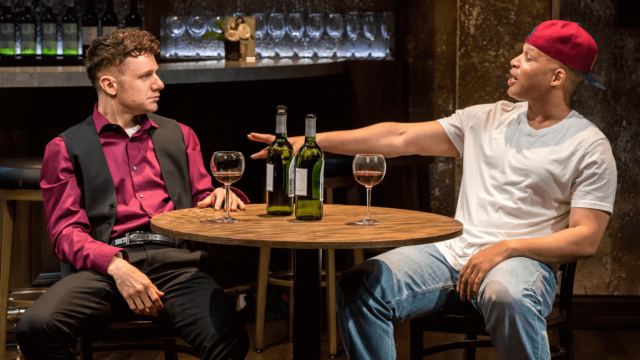
Matt (Chris Perfetti) and Shawn (Glenn Davis) bond over basketball and LeBron in King James (photo by Craig Schwartz)

KING JAMES
MTC at New York City Center – Stage I
131 West Fifty-Fifth St. between Sixth & Seventh Aves.
Tuesday – Sunday through June 18, $79-$99
www.manhattantheatreclub.com

Rajiv Joseph shoots and scores with King James, making its New York premiere at MTC at New York City Center.

The play is divided into four quarters, like a basketball game, as two lonely twenty-one-year-old Cleveland Cavaliers fans unexpectedly come together as they follow the exploits of superstar LeBron James, beginning in 2004 and jumping to 2010, 2014, and 2016, four seasons that served as turning points in the career of the leading scorer in the history of the sport — as well as for the two characters.

In February 2004, during the King’s rookie campaign, inexperienced bartender Matt (Chris Perfetti) is desperate to sell the remainder of his family’s season tickets so he can pay off at least some of his numerous debts. Matt, who wants to open a downtown sports bar, is biding his time at the empty La Cave du Vin, playing around with a ball of newspaper and a trash bin, when wannabe writer Shawn (Glenn Davis) arrives, seeking to purchase the tickets. Both men are from Cleveland Heights, Ohio, not far from LeBron’s hometown of Akron; Matt grew up going to games with his father, while Shawn has never been to the arena to see a Cavs match.

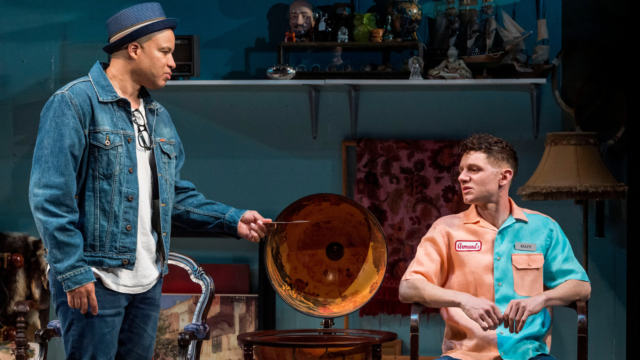
After they come to an agreement, their friendship builds over the years: Shawn gets to know Matt’s parents, who run a curiosity shop called Armand’s, the name of their treasured stuffed armadillo; they argue over whether LeBron is better than Michael Jordan; Matt repeatedly explains what the problem with America is; and LeBron moves on to several different teams, forcing Matt and Shawn to reevaluate their loyalty as well as their relationship.

“Being a fan is like having a religion,” Matt says. Shawn replies, “Yeah, and like most religions, it’s rotten to the core. Like at Sunday school, the way they talked to us about Jesus? That’s exactly how I feel right now. Like I’m being punished because He happened to be a Savior.” Matt wisely asks, “Jesus or LeBron?”

Shawn is always the more introspective of the two, pushing LeBron’s choices onto his own identity. “LeBron for the win. LeBron for the win, all these times, and then he just fucking leaves,” he opines after James signs with the Miami Heat. “And I’m like . . . You get burned and you’re like . . . Who am I? Why am I like this? I don’t know. I think maybe I just need to work on myself for a little bit.” It’s those kinds of rationalizations and realizations that lift King James above a mere play about sports to a drama about anyone searching inside themselves, looking to have a better season; the beauty of the show is that you don’t have to know anything about basketball to appreciate it, although it certainly helps if the names Mark Price, Brad Daugherty, David Robinson, and Isiah Thomas ring a bell.

Unfortunately, it takes one seriously bad bounce when it forces race into the equation — Matt is white and Shawn is Black — but it manages to overcome that miss well before time runs out.

Shawn (Glenn Davis) and Matt (Chris Perfetti) reach a turning point in MTC production (photo by Craig Schwartz)

Todd Rosenthal’s set switches from La Cave du Vin, an elegant wine bar that used to be a church, complete with stained glass that gives it a holy feel, further equating LeBron with Jesus, to Armand’s, a messy shop overstuffed with random tchotchkes and knickknacks that are like lost parts of people’s lives. Samantha C. Jones’s costumes range from Cavs jerseys to the cheesy bowling-style shirts Armand’s employees must wear. DJ Khloe Janel keeps the joint rocking in a booth to the right of the stage, where she pumps tunes by Prince, Fleetwood Mac, and others before and after the show and during halftime — er, intermission — just as if we were at an NBA arena. Feel free to sing and dance and say hello.

Tony-winning director Kenny Leon (Topdog/Underdog, A Soldier’s Play) coaches it all like a champion, keeping the rock in play, slowing things down and then going in for the jam.

Joseph (Bengal Tiger at the Baghdad Zoo, Describe the Night) grew up a Cavaliers fan in the 1980s and ’90s, so he clearly knows his stuff, understanding just how much sports is and isn’t life. (The play arrives in New York City at a fascinating point as James, currently a Los Angeles Laker, might retire following a four-game sweep at the hands of the Denver Nuggets for the Western Conference Championship.)

Joseph wrote the part of Shawn specifically for Davis (Bengal Tiger at the Baghdad Zoo, Downstate), knowing when to shoot and when to dish it off to Perfetti (Moscow x 6, The Low Road), who takes the ball and runs with it, hitting layups and swishing from beyond the three-point line.

Basketball metaphors aside, King James is an all-star (sorry) examination of male friendship, the ups and the downs, the victories and the defeats — which I know only too well, having been a Knicks fan for more than fifty years.

As O. Henry wrote in Heart of the West, “No friendship is an accident,” which is ably demonstrated by both Summer, 1976 and King James.

THE BEST WE COULD (a family tragedy)

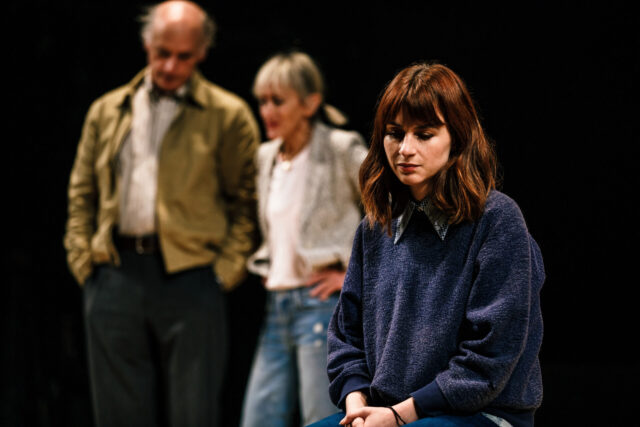
Ella (Aya Cash) considers her future as her parents (Frank Wood and Constance Shulman) worry about theirs in MTC world premiere (photo by Marc J. Franklin)

THE BEST WE COULD (a family tragedy)
Manhattan Theatre Club
New York City Center Stage 1
Tuesday – Sunday through March 26, $79-$99
212-581-1212
www.manhattantheatreclub.com
www.nycitycenter.org

Our Town meets Death of a Salesman in Emily Feldman’s potent and moving The Best We Could (a family tragedy), a Manhattan Theatre Club production running at New York City Center Stage 1 through March 26.

The ninety-minute show is narrated by Maps (Maureen Sebastian), who also occasionally plays different minor roles. “We’re about to get started here,” she says directly to the audience at the beginning. “Could we take some of these lights down a little bit, please?” she asks lighting designer Matt Frey, and he obliges. She sets the pace with an unhurried, relaxed monologue, then introduces the characters: Ella (Aya Cash), a thirty-six-year-old woman still trying to find herself, currently working as a chair yoga instructor at a rehab facility in Los Angeles; her father, Lou (Frank Wood), formerly a senior investigator at a biomedical research institute; her mother, Peg (Constance Shulman), a retired event planner who lives with Lou in New Jersey; and Marc (Brian D. Coats), Lou’s longtime friend and colleague who lives in Denver with his wife.

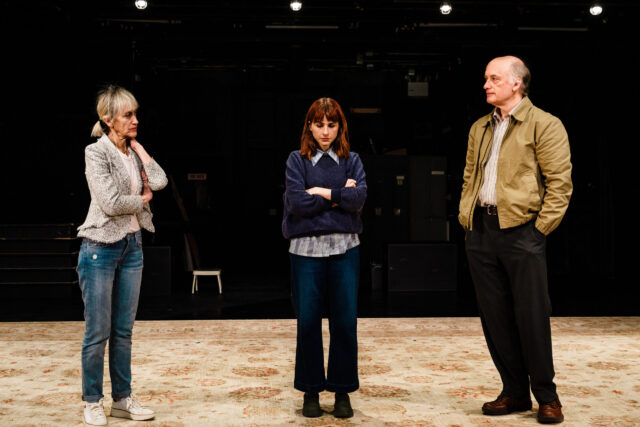
“Marc . . . You’re not really in the first part,” Maps says. “Sorry to make you wait.” Marc walks to a far corner of the stage, which is a large, empty central rug where all the action takes place. When a character is not in a scene, they watch from the sides or from the back, which resembles a garage.

Maureen Sebastian serves as the narrator and plays numerous small parts in The Best We Could (a family tragedy) (photo by Marc J. Franklin)

It’s Ella’s birthday, but she’s been stood up by her girlfriend. Maps directs her: “Wait thirty minutes. Wait an hour. Leave alone. . . . Tell Crystal it’s over. Your mother is calling. Answer the phone.”

After their dog dies, Peg sends Lou to California by plane to pick up a new rescue dog and drive back cross-country with Ella, who ostensibly has a meeting with a children’s book editor in New York City. On the way, Lou and Ella see various national monuments and stop to visit with Marc and his wife, Karen (Sebastian), in Colorado, where Lou discusses his pending job application in Marc’s department.

But the closer they get to home, the more uncomfortable both Ella and Lou seem with, as we eventually find out, good reason.

Feldman (Three Women in Four Chairs, My Lover Joan) and director Daniel Aukin (Fool for Love, Bad Jews) do a superb job conjuring a drive across America without any props other than chairs; when they stop at Mount Rushmore and the Grand Canyon, you feel you are there even though it is two characters sitting or standing on an empty stage. The spare set is by Lael Jellinek, with lighting by Matt Frey and sound by Kate Marvin. The cleverly outlined and believable story about an older man trying to hold his place in a world that that threatens to leave him behind, reminiscent of Willy Loman, gives way to one crucial late plot twist that jolts the narrative ahead toward its tragic conclusion but seems to have come out of nowhere except recent headlines, strangely ungrounded in the characters we’ve been watching for seventy minutes or so.

Peg (Constance Shulman), Ella (Aya Cash), and Lou (Frank Wood) face hard truths in Emily Feldman play (photo by Marc J. Franklin)

Tony winner Wood (Sideman, In the Blood) is wonderfully deadpan throughout, portraying a man who’s living in his own alternate reality. The always terrific Shulman (SHHH, Orange Is the New Black) is very funny as the ever-worried Peg, while Cash (From Up Here, The Pain and the Itch) keeps the deeply troubled Ella appropriately on edge, not necessarily the heroic figure we want her to be; her description of what her book is about is telling: “the inner emptiness of being a person living in a warlike society that, on some level, believes it has no future.” Coats (On the Levee, La Ruta) provides solid support as Lou’s old buddy, who knows more than he admits.

Sebastian (Vietgone, Now Circa Then) is a lovely stage manager, giving direction to the characters, delivering interstitial notes to the audience, and inhabiting several roles, generally in a track suit. (The costumes are by Anita Yavich.) She’s not about to take any nonsense from any of them, nor is she going to let the show drift too far off course. Once Ella and Lou return to Peg, Maps tells Ella, “Get everything out in the open.” Ella hesitates, so Maps adds. “Go ahead.” Ella does, and it’s not pretty. “I’m sorry. But, this is the tragedy part,” Maps tells us.

Despite its major plot misstep, The Best We Could is an involving tale that follows a relatively average, if offbeat, family trying to do the best they can. Sometimes it works out, and sometimes it doesn’t. It’s the American way.

THE COLLABORATION

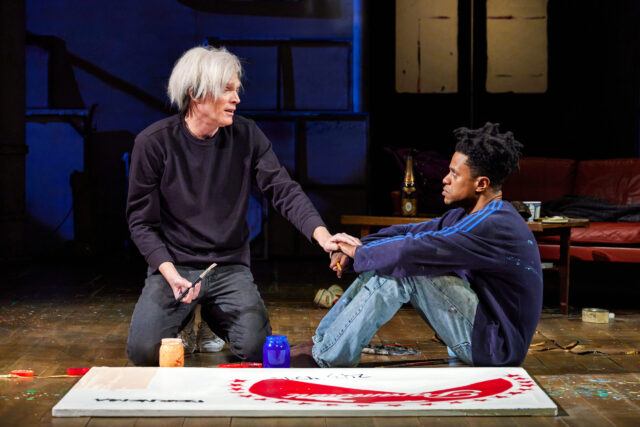
Andy Warhol (Paul Bettany) and Jean-Michel Basquiat (Jeremy Pope) collaborate in new Broadway play (photo by Jeremy Daniel)

THE COLLABORATION
Samuel J. Friedman Theatre
261 West Forty-Seventh St. between Broadway & Eighth Ave.
Tuesday – Sunday through February 11, 474-$318
www.manhattantheatreclub.com

In the fall of 1985, gallerist Tony Shafrazi and art dealer Bruno Bischofberger presented “Warhol Basquiat: Paintings” on Mercer St., an exhibition of works made in tandem by Pop Art maestro Andy Warhol, looking to restore himself to relevance, and rising street-art superstar Jean-Michel Basquiat, who wanted to reach the next level of fame and fortune. The story of this unusual alliance is told in Anthony McCarten’s boldly titled The Collaboration, extended through February 11 at Manhattan Theatre Club’s Samuel J. Friedman Theatre.

While Basquiat and Warhol’s teaming up might have been a lightning strike of an idea in the art world, it’s more than a bit presumptuous to declare that it was the collaboration; if you didn’t know what the play was about, the title wouldn’t make you first think of this unexpected partnership. That aside, it was a fascinating moment in art history, and just as the collaboration was not wholly successful, so goes The Collaboration on Broadway.

In September 1985, Vivian Raynor wrote about the exhibit in the New York Times, “It’s a version of the Oedipus story: Warhol, one of Pop’s pops, paints, say, General Electric’s logo, a New York Post headline, or his own image of dentures; his twenty-five-year-old protege adds to or subtracts from it with his more or less expressionistic imagery. The sixteen results — all ‘Untitleds,’ of course — are large, bright, messy, full of private jokes, and inconclusive.” The same can be said of the play itself.

Alternatively, artist Keith Haring wrote in “Painting the Third Man” in 1988, “Jean-Michel and Andy achieved a healthy balance. Jean respected Andy’s philosophy and was in awe of his accomplishments and mastery of color and images. Andy was amazed by the ease with which Jean composed and constructed his paintings and was constantly surprised by the never-ending flow of new ideas. Each one inspired the other to outdo the next. The collaborations were seemingly effortless. It was a physical conversation happening in paint instead of words. . . . For me, the paintings which resulted from this collaboration are the perfect testimony to the depth and importance of their friendship. The quality of the painting mirrors the quality of the relationship. The sense of humor which permeates all of the works recalls the laughter which surrounded them while they were being made.”

Meanwhile, poet, songwriter, and playwright Ishmael Reed offered little love for Warhol in his recent show, The Slave Who Loved Caviar, feeling that Warhol treated Basquiat like a mascot; Reed wrote, “As Basquiat, the Radiant Child of the downtown art scene of the 1980s, was sacrificed to sustain the dying career of a fading Super Star, Antonius was sacrificed so that Hadrian would recover from a mysterious illness.”

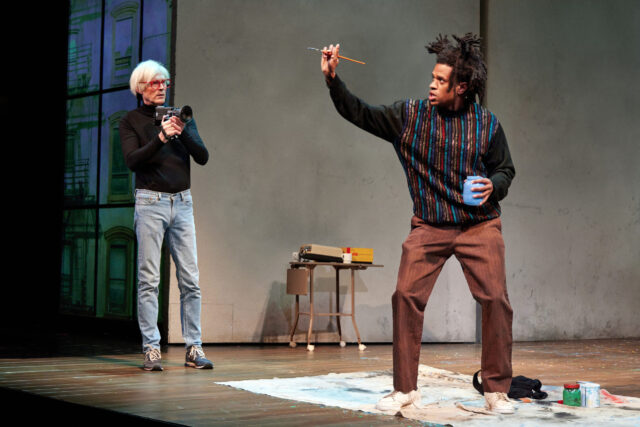
Andy Warhol (Paul Bettany) films Jean-Michel Basquiat (Jeremy Pope) in The Collaboration (photo by Jeremy Daniel)

Part of McCarten’s Worship Trilogy, which also includes The Two Popes and Wednesday at Warren’s, Friday at Bill’s, The Collaboration takes place alternately in Bischofberger’s (Erik Jensen) Manhattan gallery, Warhol’s (Paul Bettany) studio near Union Square, and Basquiat’s (Jeremy Pope) loft apartment and studio on Great Jones St. At first both artists are hesitant to work together; being shown Basquiat’s paintings for the first time by Bischofberger, Warhol, referring to them as “art therapy things,” says, “They’re so . . . busy. Is it too much? Or am I getting old? And so much anger. All these skulls and gravestones everywhere. I thought I was bleak. And all these words and symbols, what’s it all mean? What’s he trying to say? Bruno? Do you know? And why do they have to be so ugly? Did he tell you? Does he talk about that? They’re so ugly and angry and yeah, well, they’re kinda violent. I’d be careful; he’s really in trouble, I think.”

Basquiat is also unsure of the potential partnership, telling Bischofberger, “I’m better than Andy. I don’t need this. . . . And how come he doesn’t paint anymore, you know? Just mechanically reproduces all these prints? There’s no soul. I’m Dizzy Gillespie, blowing a riff, he’s one of those pianos that plays all by itself. The same tune. Over and over. You seen those things? Pink, pink plonk, pinkety pinkety pink.”

Bischofberger, who represents both artists, promises Warhol, “It will be the greatest exhibition ever in the history of art.” Warhol says, “Please don’t exaggerate.” The dealer boasts, “Warhol versus Basquiat.” The Pop maestro wonders, “Oh, versus? Gee, you make it sound so macho, like a contest. I don’t know. I thought you said it would be a collaboration?” Bischofberger answers, “Painters are like boxers; both smear their blood on the canvas.” The promotional posters for the exhibition — which eventually will become more famous than the actual works (one of the original posters hangs in my apartment) — feature Warhol and Basquiat wearing boxing gloves, ready to do battle.

But soon the soft-spoken Warhol, who hadn’t picked up a paintbrush in more than twenty years but has amassed a fortune through his silkscreens, photography, films, and business savvy, is creating canvases with Basquiat, who is far more spontaneous and unpredictable, taking drugs, sleeping around (Krysta Rodriguez plays Maya, a fictionalized version of Basquiat’s girlfriend Suzanne Mallouk), and keeping his cash in the refrigerator.

Once the playwright finally gets Andy and Jean putting paint to canvas, their debates about the purpose of art sound a bit sanctimonious. No one knows what their conversation was really like: Within three years, they would both be dead, Basquiat in 1987 at the age of twenty-seven, Warhol in 1988 at the age of fifty-eight.

Directed by Kwame Kwei-Armah (Things of Dry Hours, One Night in Miami), The Collaboration works best when Warhol and Basquiat get down to brass tacks, exploring what they might do together, each suspicious of the other’s motives and abilities. In roles previously played by David Bowie and Jeffrey Wright, respectively, in Julian Schnabel’s 1996 film, Basquiat (Dennis Hopper was Bischofberger), Bettany (Love and Understanding, WandaVision) and Tony nominee Pope (Choir Boy, Ain’t Too Proud) are phenomenal. Pope embodies Basquiat’s untethered energy, his lust for life, and his social conscience, particularly when learning that his friend, graffiti artist Michael Stewart, is in the hospital after an altercation with the police. Bettany not only looks great in Warhol’s trademark white fright wig and black turtleneck and sneakers (the wigs are by Karicean “Karen” Dick and Carol Robinson, with sets and costumes by Anna Fleischle) but captures his awkward, strange public persona.

Rodriguez (Into the Woods, Seared) does what she can as the underwritten Maya, an amalgamation that stretches the truth of Basquiat’s relationships with women, and Jensen (Disgraced, How to Be a Rock Critic) provides a solid middle ground to highlight the disparity between his two artists.

Andy Warhol (Paul Bettany) watches Jean-Michel Basquiat (Jeremy Pope) paint in The Collaboration (photo by Jeremy Daniel)

The narrative takes a sharp turn beginning at intermission, when large monitors just outside both sides of the stage show footage of Bettany’s Warhol and Pope’s Basquiat collaborating, painting on transparent glass, mimicking the style Warhol uses when filming Basquiat on his 16mm spring-wound Bolex movie camera. As they did prior to the beginning of the show, DJ theoretic spins thumping 1980s music from a booth on the stage as the prerecorded film plays.

During the second act, Kwei-Armah and McCarten, who has written such fact-based films as The Theory of Everything, Darkest Hour, and Bohemian Rhapsody and the book for the current Neil Diamond musical A Beautiful Noise, become obsessed with Warhol’s live footage of Basquiat (the projections are by Duncan McLean), so it’s hard to know where to look. (Oh, what Ivo van Hove has wrought.) A notoriously private person despite his fondness for late-night celebrity-studded parties, Warhol wants to capture the real Basquiat on film, but Basquiat doesn’t want to be seen as a commodity. This dichotomy further emphasizes the difference, and psychological distance, between Basquiat and Warhol, whose shows are still blockbusters today. (For example, Basquiat’s biographical “King Pleasure” in Chelsea last year and the Whitney’s 2018-19 “Andy Warhol — From A to Be and Back Again.”

None of Warhol’s footage exists today, so we don’t know what really happened, but what McCarten and Kwei-Armah depict grows more confusing and annoying by the second. We also don’t see enough of the artists’ collaboration itself, but that output is not considered among either one’s most well regarded works. Alas, the same can be said of the creators of the play. But as Warhol explains to Basquiat, “I don’t think there’s going to be a revolution, but if there is it will be televised, with commercial breaks, cause it’s all about brands now. Even us, we’re not painters, we’re brands. Jean. We’re brands. Well, you’re almost a giant brand, and after this exhibition with me you will be too. Then just watch the language change, Jean.”

The Collaboration concludes on the same note as Eduardo Kobra’s large-scale 2018 mural in Chelsea above the Empire Diner, a reimagined Mount Rushmore with the faces of Andy Warhol, Frida Kahlo, Keith Haring, and Jean-Michel Basquiat, all of whom remain brands to this day.

COST OF LIVING

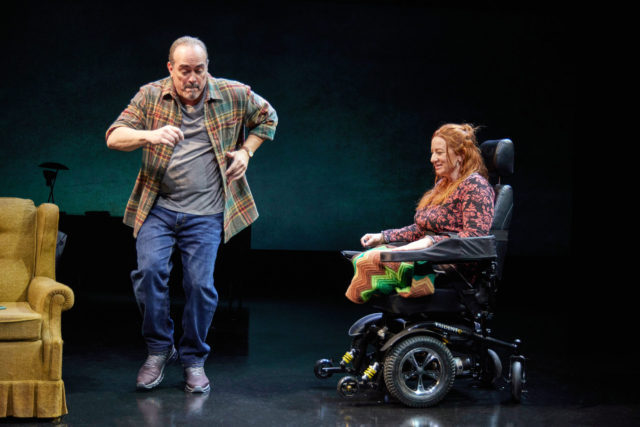
Eddie (David Zayas) and Ani (Katy Sullivan) face adversity in Cost of Living (photo © Jeremy Daniel)

COST OF LIVING
Samuel J. Friedman Theatre
261 West Forty-Seventh St. between Broadway & Eighth Ave.
Tuesday – Sunday through November 6, $74-$298
www.manhattantheatreclub.com

When I saw Manhattan Theatre Club’s production of Martyna Majok’s Cost of Living at New York City Center’s Stage I five and a half years ago, I did not anticipate that it would win the Pulitzer Prize for Drama. I also never imagined that the show, which I called “a tender, emotional play about four lonely people seeking connections,” would eventually transfer to Broadway. But Cost of Living has made a terrific transition to MTC’s Samuel J. Friedman Theatre, with all its tenderness, emotion — and sense of humor — fully intact. In fact, it is now even better.

The play is once again directed by Obie winner Jo Bonney on Wilson Chin’s set, which rotates between the homes of John (Gregg Mozgala), a Harvard grad working on his PhD at Princeton and confined to a wheelchair with cerebral palsy, and Ani (Katy Sullivan), a quadriplegic also in a wheelchair.

While John is looking for a caregiver and interviews and hires Jess (Kara Young), a Princeton grad scrambling to make a living by working multiple jobs and who assures John that despite her slight build she can handle his needs, Ani initially refuses help from her ex-husband, Eddie (David Zayas), a former truck driver with a new girlfriend.

The play opens with Eddie sitting at a bar, talking to an unseen person in what is essentially a long, compelling monologue delivered directly to the audience. “The shit that happens is not to be understood. That’s from the Bible,” he says. “That life is good for people. I was thankful for every day they ain’t invented yet the trucker-robots. That life is good. The road. Sky. The scenery. Except the loneliness. Except in the case of all the, y’know, loneliness. This was what my wife was good for. Not that this was the only thing.”

John (Gregg Mozgala) and Jess (Kara Young) come to an agreement in Cost of Living (photo © Jeremy Daniel)

The loneliness and vulnerability experienced by all four characters is palpable, expressed most effectively in scenes of back-to-back caretaking. In the first, Jess washes John in the shower, moving him out of his chair and then back into it, followed by Eddie giving Ani a bath.

Describing his sensations, John tells Jess that his body feels as if he’s constantly under attack. “That’s what it’s like. Under my skin. From underneath my skin. Like people hitting me from beneath my skin. And that’s what you’ll be working with. Every morning. Is touching, shaving, undressing, washing, and clothing — that. That’s what I’m like.”

Meanwhile, Eddie visits Ani on a day her nurse hasn’t shown up, so Eddie asks Ani to hire him instead. “What do you think’s gonna happen you come take care of me a few hours a day? Huh?” she spurts out. “You brush my teeth a couple mornings, dump my bedpan a few times, and BOOM, conscience — fuck-shit, clap yer hands when I say Boom. . . . Yer not doin’ penance on me.”

The separate storylines merge at the end in an uneasy finale that acknowledges that we all encounter tremendously painful issues in life, regardless of our physical or psychological situations, which is further established during the curtain call.

Both Mozgala (Teenage Dick, Diagnosis of a Faun), who has cerebral palsy, and Sullivan (The Long Red Road, Finish Line), who was born without lower legs, return from the original cast, and both give intense, superb performances again, neither one pulling any punches. Young (Clyde’s, Halfway Bitches Go to Heaven) displays a tenacious fragility as Jess, who might be getting in over her head, while Zayas (Dexter, Anna in the Tropics) proves once more that he is one of New York City’s finest actors, balancing toughness with a sweet gentleness that shines through. Jeff Croiter’s lighting and Rob Kaplowitz’s sound capture the pervasive loneliness playing out onstage.

“Self-pity has little currency in these characters’ worlds. Humor, however, has much,” Majok (Ironbound, Sanctuary City) explains in a script note. Her and Bonney’s (Father Comes Home from the Wars, Fucking A) approach feels honest and unambiguous, as summarized in this exchange between Jess and John:

Jess: Sorry, I never worked with the, differently-abled —
John: Don’t do that.
Jess: What?
John: Don’t call it that.
Jess: Why, I —
John: Don’t call it differently-abled.
Jess: Shit, is that not the right term?
John: It’s fucking retarded. . . .
Jess: So what do I, how do I, refer to you?
John: Are you planning on talking about me?
Jess: No.
John: Why not? I’m very interesting.

The Broadway debut of Cost of Living, which was expanded from Majok’s 2015 short play John, Who’s Here from Cambridge, is a lot more than interesting, and you’ll be sure to be talking about it long after seeing it.