Tag Archives: Justin Ellington

LAURENCE FISHBURNE: LIKE THEY DO IN THE MOVIES

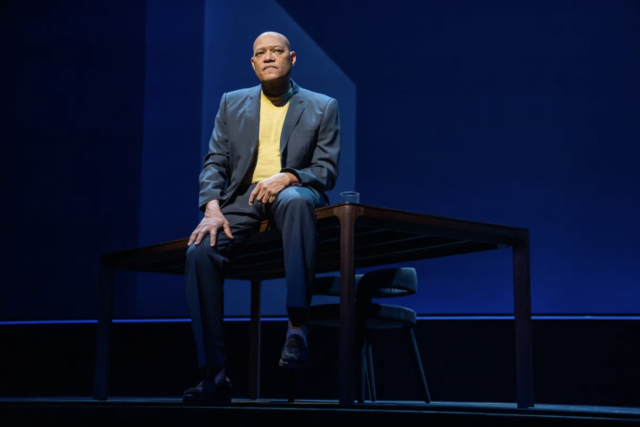
Laurence Fishburne debuts one-man show at PAC NYC (photo by Joan Marcus)

LIKE THEY DO IN THE MOVIES
Perelman Performing Arts Center (PAC NYC)
251 Fulton St.
Through March 31, $64-$158
pacnyc.org

I’ve been closely following the career of Laurence Fishburne since I saw Apocalypse Now when it premiered at the Ziegfeld in the summer of 1979, paying an exorbitant five bucks for a ticket and a special program. Fishburne, who was fourteen when filming got underway, played Mr. Clean, a crew member from the Bronx aboard a Navy river patrol boat heading up the Nùng River on a dangerous secret mission during the Vietnam War. On June 2, 1992, I was at the Walter Kerr Theatre, seeing August Wilson’s Two Trains Running, its first show since Fishburne had won a Tony for Best Performance by an Actor in a Featured Role in a Play two days earlier, only the second Black man to earn that honor, following Zakes Mokae in Master Harold . . . and the Boys ten years earlier. I am not a fan of entrance applause, but that night Fishburne was greeted with one of the longest and loudest ovations I’ve ever been a part of.

So I had high expectations for the world premiere of his one-man show, Like They Do in the Movies, continuing at PAC NYC through March 31. In the nearly two-and-a-half-hour presentation (including intermission), Fishburne once again displays his vast talents as a compelling storyteller; his resume consists of more than 130 film, television, and stage appearances, with five Emmys, the Tony, and an Oscar nomination to his credit.

The show gets off to a terrific beginning as Fishburne, in a black sequined dress and hood, introduces himself after a projection of dozens of his films flash past on a large rectangular screen behind him. He calls his acting career “a polite way of saying I’ve been a bullshit artist all my life.” He then tells the audience that he is going to share a series of stories in which “some are true, some pure fiction, and some are a mix of both.”

Amiable and warm, Fishburne starts by recounting his childhood; he was born in Augusta, Georgia, on July 31, 1960, and later moved to Brooklyn. His mother, Hattie Bell Crawford, was an eccentric character who operated a charm school in their home; his father, known as Big Fish, was a corrections officer and womanizer. Fishburne relates tales about his parents and grandparents as photographs of them appear on the screen. He describes his mother as having narcissistic personality disorder type 2 and says that she was sexually abusive toward him. He ends numerous deeply personal anecdotes by promising, “More about that later.” Alas, that is not always the case.

The center section, which makes up the bulk of the play, comprises five long tales that seem to have been told directly to Fishburne or that he witnessed. He enacts them in exquisite detail, performing multiple roles with great skill and changing costumes, from a casual blazer and slacks to a lush caftan to an ill-fitting sweater and street clothes. No costume designer is credited, so perhaps the duds come from his own closet.

Each of the vignettes, which might or might not be completely true, is engrossing. A tough-talking ex-con named Fitzpatrick who works for the Daily News impersonates a cop on the subway. A homeless man discusses his plans for the future as he washes cars. A lawyer wants to get his family out of New Orleans as Katrina hits but his wife, an OB/GYN nurse, has three patients ready to give birth. A retired policeman rambles on as he attempts to keep fans away from Fishburne while the actor is taking a break on a movie set. And a British ex-pat explains how he is not a pimp as he offers Fishburne his choice of women at an Australian bordello.

Director Leonard Foglia (Thurgood, which earned Fishburne a Best Leading Actor Tony nomination for his portrayal of Thurgood Marshall) keeps Fishburne moving about on Neil Patel’s set, which contains a few chairs and a table that are reconfigured for each segment. Elaine J. McCarthy’s projections display photographic backdrops helping identify locations. Tyler Micoleau’s lighting and Justin Ellington’s sound, with interstitial clips from jazz, R&B, gospel, and rock songs, are on target.

As well done as the scenes are, they don’t lend insight into Fishburne’s own character, his real self; the Australian anecdote is particularly disconcerting as the audience wonders whether Fishburne is relating an actual experience he had at a brothel.

He then returns to his personal narrative, delving into several startling family revelations and his parents’ late-in-life illnesses. He doesn’t talk about his career, and he says nothing about his partners and mentions his son Langston only once. (Fishburne has been divorced twice and has three children.) We already know that Fishburne is one of the best American actors of his generation, through his myriad outstanding performances; we want to learn more about him as an individual, as a human being, especially after he teases us in the first act. He doesn’t tie up enough loose ends, which is of course his prerogative, but days after I saw the play, I’m still wanting more. I had a similar experience at John Lithgow’s 2018 solo show, Stories by Heart, in which too much time was spent on his reenacting — brilliantly — two short stories that his father would read to him and his siblings.

In the program, Fishburne thanks Whoopi Goldberg, John Leguizamo, and Anna Deavere Smith for “showing me the way.” That trio of stalwart solo performers have mastered going between autobiography and exploring the state of contemporary culture and politics. Fishburne is eminently likable and riveting, but Like They Do in the Movies might have benefited from a better balance of the two.

[Mark Rifkin is a Brooklyn-born, Manhattan-based writer and editor; you can follow him on Substack here.]
JAJA’S AFRICAN HAIR BRAIDING

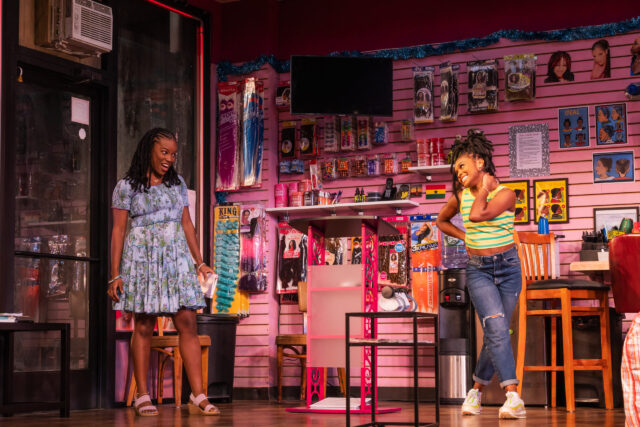
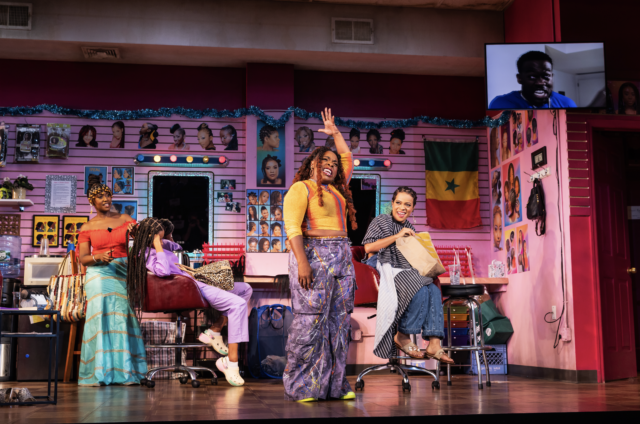
Marie (Dominique Thorne, right) receives an unexpected visitor in Jaja’s African Hair Braiding (photo © Matthew Murphy, 2023)

JAJA’S AFRICAN HAIR BRAIDING
Samuel J. Friedman Theatre
261 West Forty-Seventh St. between Broadway & Eighth Ave.
Tuesday – Sunday through November 19, $74-$205.50
www.manhattantheatreclub.com

“I feel like I moved in for the day,” Jennifer (Rachel Christopher) says in Jocelyn Bioh’s Broadway debut, Jaja’s African Hair Braiding. An aspiring journalist, Jennifer is a kind of doppelganger for the audience; she arrived just as Jaja’s hair salon on the corner of 125th St. and St. Nicholas Ave. in Harlem opened, asked for long micro braids, and has spent the entire morning and afternoon with Miriam (Brittany Adebumola), an optimistic stylist from Sierra Leone. It’s Jennifer’s first time in the shop, and she carefully watches from her chair to the side as people come and go and the stylists laugh, argue, gossip, and wonder what’s next for them. Just as Jennifer starts to feel part of this tight-knit community, so does the audience.

It’s an auspicious, and very hot, July day in 2019, and Senegalese owner Jaja (Somi Kakoma) is getting married that night. Her eighteen-year-old daughter, wannabe writer Marie (Dominique Thorne), is managing the shop and the stylists, who can be a handful: the Ghanaian Sista Bea (Zenzi Williams), a busybody who thinks she’s better than the others and is hoping to open her own salon; the Senegalese Aminata (Nana Mensah), who loves hanging around the shop, especially while she’s having issues with her husband; Miriam, a patient and agreeable young woman with a surprise secret; and the Nigerian Ndidi (Maechi Aharanwa), a fast, talented, fun-loving braider who the older Bea is jealous of.

Over the course of the day, a variety of customers come and go. The nasty and rude Vanessa (Lakisha May) complains about nearly everything, from the way the others look at her to the chair. Chrissy (Kalyne Coleman) is a cheerful young woman who wants to look like Beyoncé. Sheila (May) is a businesswoman who can’t stop talking on her phone. Laniece (Coleman) is a local DJ. And Michelle (Coleman) is a nervous mother who has made an appointment with Ndidi instead of her usual stylist, Bea, who is furious and feels betrayed.

Also stopping by are a series of men, including Franklin the Sock Man, Olu the Jewelry Man, and Eric the DVD Man, selling their wares, in addition to Aminata’s husband, James (all portrayed by Michael Oloyede).

Shortly after Jaja (Somi Kakoma) arrives, the narrative takes a sharp, unexpected turn, forcing everyone to face a hard dose of contemporary reality.

Jocelyn Bioh’s Jaja’s African Hair Braiding takes place in a Harlem salon (photo © Matthew Murphy, 2023)

In School Girls; Or, The African Mean Girls Play, Bioh, who has appeared in such plays as Suzan-Lori Parks’s In the Blood, Branden Jacobs-Jenkins’s Everybody and An Octoroon, and Jaclyn Backhaus’s Men on Boats, follows a group of young Ghanaian students seeking to be selected as a contestant for Miss Ghana, raising issues of jealousy, fairness, and colorism.

She expands on the concept of Black style in Jaja’s African Hair Braiding, celebrating individuality and woman entrepreneurship while also exploring immigration and the African diaspora in America. In a program note, Bioh explains, “To many people, they are just ‘hair braiding ladies,’ random women people pass by on the street, but to me, they are heroes, craftswomen and artists with beautiful, gifted and skilled hands.” Each character has her hopes and dreams, her fears and desires, that feel real, not cartoonish or pedagogic.

At the center is Marie, who, despite being the youngest, is both friend and mother to the other stylists while figuring out how she can afford to go to college and start up her own life. “You know, I really don’t wanna talk about ANY of this anymore, okay?! I don’t want to talk about school or my mother or her ‘connections’ or whatever you saw on the news!” she blurts out, succumbing to the pressure. “Trust me — this is already all I think about every single day. Every single second! For once, can I just have a day where I come here, do my work — in peace — and go home? Is that okay?!”

The show is lovingly directed by Obie winner Whitney White (soft, On Sugarland), balancing uproarious comedy and wit with sincerity and grace. The ensemble cast is outstanding, led by Thorne as Marie, who imbues her with an inner strength that is wise beyond her years yet existing on a knife’s edge. Adebumola is engaging as the warm and caring Miriam, Mensah is hilarious as Aminata, and Oloyede pulls off quite a feat in portraying all four male characters.

Dede Ayite nails the costumes, giving identity, dignity, and humor to each of the women. The effective lighting is by Jiyoun Chang, with lively sound and original music by Justin Ellington. David Zinn’s phenomenal set, a remarkably detailed salon that essentially puts the audience right in Jaja’s shop (and receives its own well-deserved applause), and Nikiya Mathis, who is responsible for the spectacular hair and wigs, are stars in themselves.

You won’t mind spending a lot more time in Jaja’s, moving in for a day or more.

[Mark Rifkin is a Brooklyn-born, Manhattan-based writer and editor; you can follow him on Substack here.]
THE COTTAGE

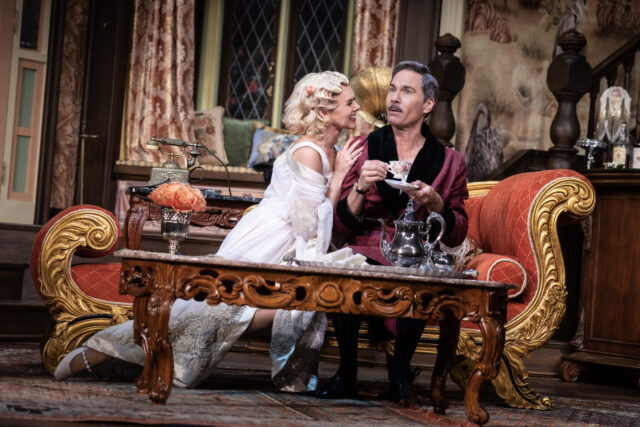
Sylvia (Laura Bell Bundy) and Beau (Eric McCormack) discuss their future in The Cottage (photo by Joan Marcus)

THE COTTAGE
Hayes Theater
240 West Forty-Fourth St. between Broadway & Eighth Ave.
Tuesday – Sunday through October 29, $109-$169
thecottageonbroadway.com

“Why do I have a sense of impending disaster?” a character asks early in Tom Stoppard’s 1981 farce, On the Razzle. “One false move and we could have a farce on our hands.”

The best farces build comedy around impending disasters, usually involving class and romance, from Noël Coward’s Present Laughter and Oscar Wilde’s The Importance of Being Earnest to Michael Frayn’s Noises Off and Molière’s The Miser. But the less-successful farces are hampered by too many false moves.

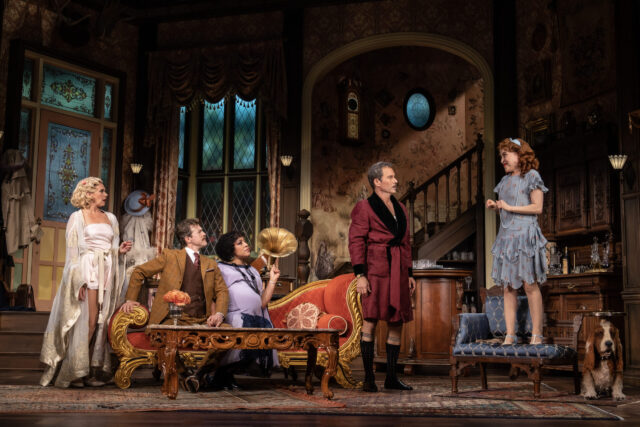
Sandy Rustin’s 2014 drawing room comedy of manners, The Cottage, which opened July 24 at the Hayes Theater on Broadway, starts off well enough. As the audience enters the space, the stage is covered by a screen depicting the image of a colorful, idyllic cottage covered in plants and flowers — as well as several pairs of animals engaged in overt sexual behavior; a bra dangles from a tree branch, hinting at what is going on inside. The screen is then raised to reveal Paul Tate dePoo III’s wonderful set, which deservedly gets its own applause. The large room is filled with elegant furniture, sculptures, books, paintings, a bar, a globe, a gramophone, and seemingly endless knickknacks.

It’s June 1923, and Beau (Eric McCormack) is at his family’s cottage in the English countryside, in the midst of his annual tryst with Sylvia (Laura Bell Bundy), which has been going on for seven years. Sylvia is ready to take their relationship to the next level, but Beau is apprehensive.

An all-star cast cannot save the Broadway debut of The Cottage (photo by Joan Marcus)

“I wish you were my husband,” she says.

“If I were your husband you would despise me just as you despise Clarke and you would spend your evenings wishing to make love to him and not me,” Beau replies, referring to his brother, Clarke (Alex Moffat), who is married to Sylvia. “Romance, my dear, is for fairy tales. This is not a romance. This is sex,” Beau adds. “Un-wifely sex.”

Beau is none-too-thrilled when Sylvia announces that she has sent telegrams to both Clarke and Marjorie (Lilli Cooper), Beau’s wife, revealing the affair. Clarke and Marjorie soon arrive separately with secrets of their own, followed by Dierdre (Dana Steingold), a whirling dervish who is in love with Beau and is worried that her husband, Richard (Nehal Joshi), will find out where she is and kill him — but not before they all have some fun. “I didn’t expect a party. Will there be games?” Dierdre declares. The fun and games take a drastic downturn in the far-less-effective second act.

Subtitled “A Romantic and (Not Quite) Murderous Comedy of Manners,” The Cottage could be renamed The Farce That Goes Wrong. The all–North American cast (McCormack is Canadian) speaks in overly dramatic British accents. Many of the props offer surprise jokes that quickly become repetitive, while others are just plain head scratchers — antlers, I’m talking about you.

The play, gleefully helmed by the Tony-winning, Emmy-nominated Jason Alexander (Seinfeld, Jerome Robbins’ Broadway) in his directorial debut, does have its fair share of amusing exchanges, particularly in the first act, and there were two genuinely funny moments that appeared to be spontaneous, one involving a shoe, the other a bunch of grapes, resulting in the actors trying their best to hold back their own laughter and failing wonderfully. Unfortunately, there was not nearly enough of that.

Sydney Maresca’s costumes are appropriately genteel, from Clarke’s tweed suit to Sylvia’s white negligee to Beau’s smoking jacket. Justin Ellington’s sound design is overwhelmed by the actors speaking way too loud, which often impacts the believability of the plot; numerous times, characters have discussions they don’t want others to hear, but it’s hard to believe that a person knocking at the front door can’t hear what two people are saying as they shout right on the other side.

The cast is all in, but the lack of subtlety drags the show down; it might have worked better as a ninety-minute one-act instead of two hours with intermission. The actors, particularly Saturday Night Live veteran Moffat and Steingold (Beetlejuice, Avenue Q), display a talent for physical comedy, but a gaggle of gags feels tossed in purely for giggles, not organic to the story. A stage farce needs to be clever and witty first, without the pratfalls, in order to capture the audience; otherwise, as with The Cottage, you end up with an overlong episode of a mediocre sitcom or SNL skit.

[Mark Rifkin is a Brooklyn-born, Manhattan-based writer and editor; you can follow him on Substack here.]
ORPHEUS DESCENDING

Valentine Xavier (Pico Alexander) and Lady Torrance (Maggie Siff) are lost in the dark in Orpheus Descending (photo by Gerry Goodstein)

ORPHEUS DESCENDING
Theatre for a New Audience, Polonsky Shakespeare Center
262 Ashland Pl. between Lafayette Ave. & Fulton St.
Tuesday – Sunday through August 6, $97
866-811-4111
www.tfana.org

Imagine an entire season of a nighttime soap opera, set in the south in the 1950s, mercilessly squeezed into two and a half uncomfortable hours and you have Theatre for a New Audience’s adaptation of Tennessee Williams’s Orpheus Descending, which opened Tuesday night at the Polonsky Shakespeare Center.

A rewrite of 1940’s Battle of Angels and loosely based on the Greek legend of Orpheus and Eurydice, Orpheus Descending debuted on Broadway in 1957, arriving during Williams’s most fertile period, the seventeen years that brought the world The Glass Menagerie, A Streetcar Named Desire, The Rose Tattoo, Cat on a Hot Tin Roof, Suddenly Last Summer, Sweet Bird of Youth, and The Night of the Iguana. It ran for only sixty-eight performances and was revived on Broadway by Peter Hall in 1989; otherwise, it has been unseen onstage in New York City, with good reason: It’s a hot mess, particularly in a second act that deteriorates by the minute, and there’s nothing that talented director Erica Schmidt can do to save it.

The play takes place in the Torrance Mercantile Store in a small southern town in the 1950s. The dry goods shop is run by Lady Torrance (Maggie Siff), daughter of an Italian immigrant, a woman thoroughly disappointed with life, married to Jabe Torrance (Michael Cullen), an obstinate, much older racist who seems to be at death’s door. The show opens as Jake is returning from a Memphis hospital with his unpleasant caretaker, Nurse Porter (Fiana Tóibín). Lady’s tragic back story unspools immediately: Her Italian immigrant father died when his wine garden was burned to the ground by the Klan for serving Black customers. In his memory, Lady is building a confectionery adjoined to the store, trying to bring at least some sweetness into her sour existence.

The town is all abuzz when a handsome stranger, Valentine Xavier (Pico Alexander), mysteriously arrives, wearing a snakeskin jacket and carrying an acoustic guitar. The local gossips, Eva Temple (Kate Skinner), Sister Temple (Prudence Wright Holmes), Dolly Hamma (Molly Kate Babos), and Beulah Binnings (Laura Heisler), are all atwitter about Val, serving as a kind of judgmental Greek chorus. Carol Cutrere (Julia McDermott), a sad, oversexed twenty-seven-year-old hellraiser with too much mascara who walks around barefoot in a trench coat and has been banned from town, takes an immediate interest in Val, who asks Carol why she makes such a spectacle of herself. “I’m an exhibitionist!” she declares. “I want to be noticed, seen, heard, felt! I want them to know I’m alive! Don’t you want them to know you’re alive?” Her version of being alive mainly consists of driving up and down the local highway drinking and dancing in every juke joint along the way.

David Cutrere (James Waterston) and Lady Torrance (Maggie Siff) rehash the past in rare Tennessee Williams revival (photo by Gerry Goodstein)

Lady, who once upon a time was in love with Carol’s brother, David (James Waterston), is desperate to be free, in some ways jealous of Carol. When Val tells her about a type of bird that has no legs and so instead must remain perpetually in the air, never touching the ground, Lady is intrigued, as if there is a heaven out there where she can escape her hell on earth. “I don’t think nothing living has ever been that free, not even nearly,” she says.

Vee Talbott (Ana Reeder), the wife of the sheriff (Brian Keane), knows Val is alive, cuddling up to him and showing him her paintings, abstract religious works based on her visions. “I paint a thing how I feel it instead of always the way it actually is. Appearances are misleading, nothing is what it looks like to the eyes. You got to have — vision — to see!” she explains. But nobody in this community can see beyond what they already know.

The more Jabe abuses Lady — upstairs in his room, he often pounds the floor with his cane three times, the sound echoing like a missive from the devil — the more she falls for Val, setting up a space in the store where he can secretly sleep over. Meanwhile, Jabe’s henchmen, Dog Hamma (Matt DeAngelis) and Pee Wee Binnings (Gene Gillette), are ready to do his bidding, eagerly anticipating being able to use their fists and guns. They get their chance in a wildly uneven and incredulous finale that is reimagined by Schmidt, straying from the original with reckless abandon. Oh, and before I forget, and I wish I could forget, there is also a clown (DeAngelis), who is clearly the work of a demon, and a conjurer known as Uncle Pleasant (Dathan B. Williams), who appears from, well, I have no idea.

“Curiosity is a human instinct,” Beulah says at one point, and that’s essentially what this production of Orpheus Descending is, a curiosity. Schmidt has previously directed the unique and unforgettable Shakespeare adaptation Mac Beth for Red Bull, an uneven musical version of Cyrano and the powerful coming-of-age drama All the Fine Boys for the New Group, and the underappreciated and underseen Lucy for Audible. In each of those shows, she displayed a daring feel for narrative, willing to challenge herself and the audience, but her efforts go astray with Orpheus Descending, which is not among Williams’s finest.

Julia McDermott steals the show as Carol Cutrerein TFANA (photo by Gerry Goodstein)

As opposed to the legless bird flying free, the play never gets off the ground. Amy Rubin’s claustrophobic two-floor set features a ceiling and walls that can barely contain the cast; the large, empty spaces to the right and left apparently alternate between the confectionery and Val’s sleeping quarters and places for some actors to sit while waiting to reenter the scene. In addition, the entrances to these areas are inconsistent, with characters sometimes walking through a door and other times around it in what seems like an impossible geography.

The play might not have a great history, but it has attracted marvelous casts. Cliff Robertson was Val, Maureen Stapleton was Lady, and Lois Smith was Carol in its 1957 Broadway bow; Marlon Brando was Val, Anna Magnani Lady, and Joanne Woodward Carol in Sidney Lumet’s 1960 film version, The Fugitive Kind; and Kevin Anderson was Val, Vanessa Redgrave Lady, and Anne Twomey Carol in the 1989 Broadway revival.

At TFANA, only McDermott (Heroes of the Fourth Turning, Epiphany) and Reeder (In the Blood, Sight Unseen) distinguish themselves, the former portraying Carol with a dark sadness, the latter adding an innate, innocent charm to Vee. Alexander (The Portuguese Kid, Punk Rock) is too understated as Val, who barely plays his guitar, while Siff (Billions, Curse of the Starving Class) ably runs the gamut of emotions Lady goes through, but even as the text repeatedly makes her Italian heritage clear, the actress produces an Eastern European accent that befuddles the audience with its incongruity.

Throughout the play, Williams refers to one of his favorite topics, corruption. “I lived in corruption but I’m not corrupted,” Val says. Everyone in Orpheus Descending lives in corruption but most of them are not corrupted as they try to survive in a bardo between heaven and hell. Unfortunately, this version of the story is stuck in the bardo as well; for an irresistible show about Orpheus and Eurydice, you’re much better off heading over to Hadestown at the Walter Kerr on Broadway.

SHAKESPEARE IN THE PARK: HAMLET

Kenny Leon’s Hamlet follows his Much Ado About Nothing at the Delacorte (photo by Joan Marcus)

HAMLET
Central Park
Delacorte Theater
Tuesday – Sunday through August 6, free, 8:00
shakespeareinthepark.org

Don’t let the recent parade of Hamlets stop you from seeing Kenny Leon’s incisive adaptation that opened last week at the Public’s Delacorte Theater in Central Park.

There has been a surfeit of faithful versions and unique reimaginings of William Shakespeare’s 1599–1601 tragedy in New York City since 2015, from Robert Icke’s staging at Park Ave. Armory with Alex Lawther in the title role, Yaël Farber’s variation at St. Ann’s Warehouse starring Ruth Negga, and James Ijames’s Pulitzer Prize–winning Fat Ham at the Public and on Broadway with Marcel Spears to the Public Theater Mobile Unit’s traveling show with Chukwudi Iwuji, Michael Laurence’s Hamlet in Bed at Rattlestick, and Thomas Ostermeier and Theater Schaubühne Berlin’s iteration at BAM with Lars Eidinger.

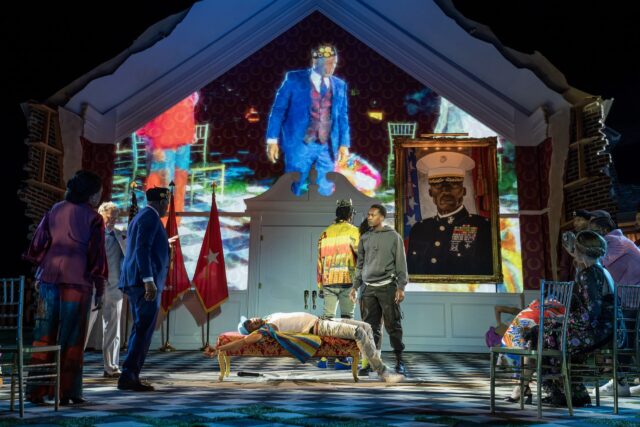
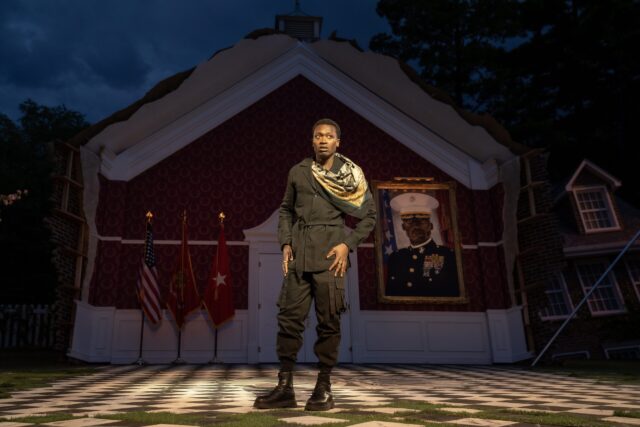
Tony winner Leon turns this Hamlet into a kind of sequel to his 2019 Delacorte triumph, a rollicking modern-day interpretation of Much Ado About Nothing that took place at a Georgia estate prominently displaying “Abrams 2020” banners, referring to two-time former Georgia gubernatorial candidate Stacey Abrams. Set designer Beowulf Boritt is back, tearing the estate in half; one part of the house is sinking into the ground, an Abrams poster sticking out at an angle, like a lonely, overturned grave marker, while a black SUV is stuck in the mud on the other side. It is as if a tornado, or a dangerous presidency, ripped through the land, leaving America in tatters, the white tiles on the grass evoking a cemetery. (The Delacorte itself will be torn down after this summer’s Hamlet and Public Works presentation of The Tempest to undergo a major renovation; it is scheduled to reopen in 2025.)

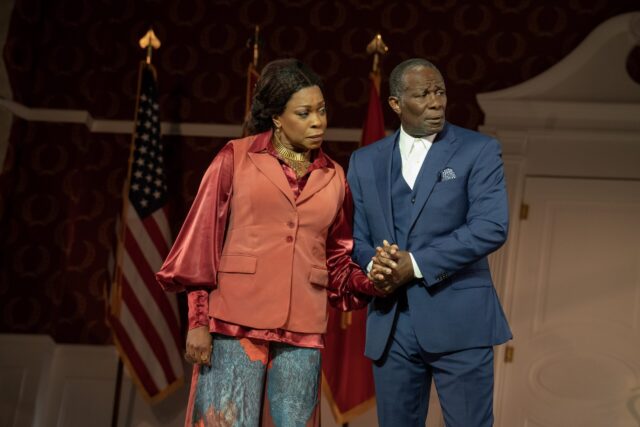
The central facade features a large portrait of a military hero in full dress uniform, looking like a dictator: the previous king’s funeral is just getting underway as a quartet performs three biblical hymns alongside a flag-draped coffin. “When you go, you’ll have to go alone / When you go, you’ll have to go alone / No one in this world / Can take your journey / When you go, you’ll have to go alone,” they sing. Leon adds in Harry Belafonte’s “Day-o,” an out-of-place tribute to the recently deceased artist and activist, but he also gives us a lovely introduction to Ophelia (Solea Pfeiffer), who offers, “You and Me (No Love Stronger).” Ophelia is given more agency than usual in this adaptation as she considers her affection for Hamlet (Ato Blankson-Wood).

Ato Blankson-Wood is impressive as the introspective Hamlet in latest Shakespeare in the Park production (photo by Joan Marcus)

“For Hamlet, and the trifling of his favor, / Hold it a fashion and a toy in blood, / A violet in the youth of primy nature, / Forward, not permanent, sweet, not lasting, / The perfume and suppliance of a minute, / No more,” Laertes (a firm Nick Rehberger) warns his sister before leaving.

Ophelias’s father and Claudius’s chief counsel, Polonius (Daniel Pearce), admonishes, “In few, Ophelia, do not believe his vows, / I would not, in plain terms, from this time forth / Have you so slander any moment leisure / As to give words or talk with the Lord Hamlet. / Look to ’t, I charge you. Come your ways.”

The dead king’s brother, Claudius (John Douglas Thompson), has quickly gained the throne by marrying his brother’s widow, Gertrude (Lorraine Toussaint). Deeply affected by this turn of events, Hamlet feels like he is alone. “A little more than kin and less than kind,” he whispers to the audience about his new stepfather. Blankson-Wood is brilliant as Hamlet slowly descends into madness, with Leon exploring the character’s state of mind more insightfully than I can remember ever seeing before.

Hamlet is soon visited by the ghost of his father, who appears like a distorted monster, projected onto the gable of the house, his otherworldly voice (recorded by Samuel L. Jackson) explaining to his son that Claudius murdered him; he proclaims, “Revenge his foul and most unnatural murder.” At one point Allen Lee Hughes’s lighting casts the shadow of Hamlet’s head across his father’s portrait, suggesting that he will never be able to escape from the former king’s legacy. (The lighting is by Allen Lee Hughes, with sound by Justin Ellington and projections by Jeff Sugg.)

Claudius calls for Hamlet’s old friends Rosencrantz (Mitchell Winter) and Guildenstern (Brandon Gill) to spy on him. Meanwhile, Hamlet arranges for a traveling troupe of players (Mikhail Calliste, Lauryn Hayes, LaWanda Hopkins, and Colby Lewis) to put on a show that will reveal to the king that Hamlet knows that he is a liar and a murderer. “The play’s the thing / Wherein I’ll catch the conscience of the king,” he says. The players perform a rap song, Jason Michael Webb’s “Cold World,” which features such un-Shakespearean lyrics as “Days are precious when you’re livin’ in a warzone / Tryna live, heart heavy like a diamond / City’s cold, but the streets are even colder / Gotta get out ’fore they say my time is over.” When Hamlet describes the plot, with its murder and marriage, Claudius gets up and storms off. The battle is on.

Leon (Topdog/Underdog, A Soldier’s Play) streamlines the play to a mere two hours and forty-five minutes with intermission, eliminating the subplot of the Norwegian crown prince Fortinbras, who mounts a challenge to Hamlet after Hamlet’s father slays his father. We don’t see Barnardo (Trí Lê), Horatio (Warner Miller), and Marcellus (Lance Alexander Smith) initially encounter the ghost. There is no mention of any state being “rotten,” no “to the manner born,” no “thoughts be bloody,” but none of that is missed.

Polonius is wonderfully portrayed by Pearce (Mother of the Maid, Timon of Athens) as a persnickety, bow-tied southern gentleman in a seersucker suit. Thompson, one of our greatest classical actors whether doing Shakespeare (The Merchant of Venice), Eugene O’Neill (The Iceman Cometh), or August Wilson (Jitney), is stirring as Claudius, commanding the stage with a moving vulnerability, while Toussaint (A Midsummer Night’s Dream, Stuff Happens) is a worthy cohort, finding compassion for her son even as her husband grows more combative. Greg Hildreth (Company, Moscow Moscow Moscow Moscow Moscow Moscow) nearly steals the show as the gravedigger, who uses skulls like bowling balls.

Lorraine Toussaint and John Douglas Thompson sparkle as Gertrude and Claudius in Hamlet (photo by Joan Marcus)

The staging does supply some significant problems. As opposed to Leon’s Much Ado About Nothing, which was set in modern-day Atlanta, it is not clear when and where his Hamlet unfolds, in Denmark, Georgia, or a different location. While Much Ado had an all Black and brown cast, Hamlet has several Caucasian actors. There are subtle references to what is happening in Trump-era America, the dialogue is spoken with a flowing style, and Jessica Jahn’s costumes are contemporary dress, from Claudius’s blue suit to Laertes’s dungaree jacket to Hamlet’s hoodie and Ophelia’s revealing bustier. So impressive in Much Ado, the car now seems like an excess prop. Leon might be attempting to meld past with present, but it can cause confusion, as when letters are delivered during a time when SUVs and 2020 placards are present.

Following in the footsteps of such actors as Sarah Bernhardt, Laurence Olivier, Richard Burton, Nicol Williamson, Mel Gibson, Kenneth Branagh, and Ethan Hawke — and, at the Delacorte itself, Michael Stuhlbarg in 2000, Sam Waterston in 1975, Stacy Keach in 1972, and Albert Ryder in 1964 — Blankson-Wood (Slave Play, The Total Bent) is a Hamlet for these times. His journey into madness has a method in it, a young man troubled by what he sees going on all around him, with his parents, his girlfriend, and the ruling class.

“I will be brief. Your noble son is mad. / ‘Mad’ call I it, for, to define true madness, / What is ’t but to be nothing else but mad?” Polonius says to Claudius. Blankson-Wood’s Hamlet is no skulking college student or shy mama’s boy; he is a prince trying to find his way in a complex and dangerous world, one that provides no sympathy. He delivers six of Hamlet’s seven soliloquies (“How all occasions do inform against me” has been cut) with a thoughtful, understated tenderness, not demanding attention to himself but instead to the character’s search for an unreachable inner peace.

It’s heartbreaking but, after all, Hamlet is a tragedy, no matter where or when it is set.

[Mark Rifkin is a Brooklyn-born, Manhattan-based writer and editor; you can follow him on Substack here.]

LUCY

Ashling (Lynn Collins) and Mary (Brooke Bloom) share a fun moment in Lucy (photo by Joan Marcus)

LUCY
Audible Theater’s Minetta Lane Theatre
18 Minetta Lane between Sixth Ave. and MacDougal St.
Monday – Saturday through February 25, $57-$97
www.audible.com

Writer-director Erica Schmidt’s latest work, Lucy, is one of the best plays of the season, a gorgeously rendered story about a single mother, a nanny, and a young girl. Her Mac Beth, a stirring adaptation of the Shakespeare classic reimagined with an all-female cast set at a girls school, was one of the best productions of 2019, and equally feminist. Schmidt now moves from the bloody battles of medieval Scotland to twenty-first-century upscale urban domesticity, but Lucy nevertheless references classic themes.

The nanny is a staple of literature, theater, and film, from Mary Poppins, Mrs. Doubtfire, Maria Reiner (The Sound of Music), and Becky Sharp to Nanny McPhee, Nanny Schuester (The Nanny Diaries), Anna Leonowens (The King and I), and Mrs. Baylock (The Omen). In the 1965 Hammer horror flick The Nanny, Bette Davis starred as the thoroughly wicked title character who remains unnamed; just calling her Nanny is frightening enough.

Lucy, which continues through February 25 at Audible’s Minetta Lane Theatre, opens with pregnant fortysomething Mary (Brooke Bloom) interviewing Ashling (Lynn Collins) to take care of Mary’s six-year-old daughter, Lucy (Charlotte Surak), and soon-to-be-born son, Max. Mary is desperate; she’s a radiologist with a complicated work schedule and is due to give birth in a week. Mary wants to find the right fit, but she overlooks a few possible warning signs during her meeting with Ashling. Both the character and the audience do a double take at several things Ashling says, but nothing seems too ominous.

“I get it. You need a coparent,” Ashling declares after Mary describes her hours. “Someone who is here when you’re at work.” Mary responds, “Who I pay to be here. A nanny,” asserting that she is the mother.

Mary hires Ashling — who is fifty-eight but looks at least two decades younger, and acts even younger than that — and at first everything appears to be great. The nanny goes above and beyond the call of duty, especially with Lucy, who immediately adores her. At one point Ashling is swinging Lucy around as they both sing to Taylor Swift’s “Anti-Hero,” belting out, “I should not be left to my own devices / They come with prices and vices / I end up in crisis (tale as old as time) / I wake up screaming from dreaming / One day I’ll watch as you’re leaving / ’Cause you got tired of my scheming / (For the last time) / It’s me, hi / I’m the problem, it’s me / At teatime, everybody agrees / I’ll stare directly at the sun, but never in the mirror / It must be exhausting always rooting for the anti-hero.”

Mary (Brooke Bloom) watches as Ashling (Lynn Collins) and Lucy (Charlotte Surak) dance to Taylor Swift (photo by Joan Marcus)

As time passes, there are more cracks in the mirror as Mary begins noticing some curious behavior by Ashling, who has a feasible explanation for everything. Is Ashling gaslighting Mary? Is Mary so overworked and stressed that her imagination is getting the best of her? It all comes to a head, leading to an utterly thrilling finale.

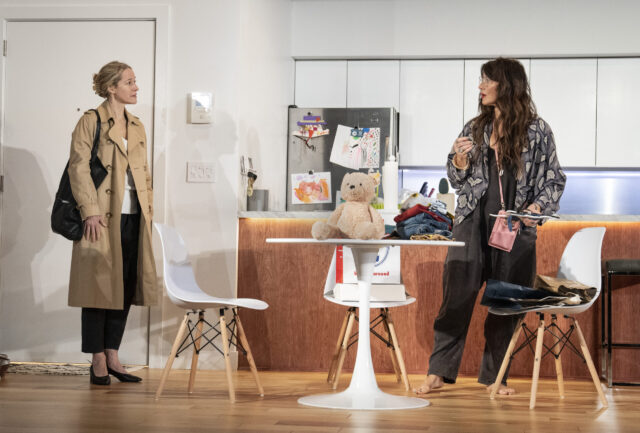
Lucy takes place in Mary’s kitchen/dining room/living room, with shelves filled with books, cabinets with dishes and bottles of wine, and a comfy couch and chair. There is no television anywhere — “I don’t do screens,” Mary tells Ashling. Mary’s bedroom is off stage right, while a hallway at the center back leads to Lucy’s and Max’s rooms. (The clean, mostly white, instantly Instagrammable set is by Amy Rubin.) Mary primarily wears tastefully minimal but obviously expensive black and cream outfits, while the tattooed Ashling is draped in layers of swirly boho prints, every arm and finger sporting inexpensive arty silver jewelry, courtesy costume designer Kaye Voyce.

The creepier the plot gets, the more Cha See’s lighting casts long, eerie shadows, while Justin Ellington’s sound includes plenty of crying and screaming.

(photo by Joan Marcus)

Mary (Brooke Bloom) and Ashling (Lynn Collins) face off in Audible production at the Minetta Lane (photo by Joan Marcus)

Schmidt (Cyrano, All the Fine Boys) has her finger on the pulse of the relationships between Ashling and Mary, Mary and Lucy, and Lucy and Ashling, letting each play out in its own way. The underlying fear Mary has about having hired the wrong nanny is palpable; at least at the start, most mothers are terrified of leaving their children with a complete stranger, references or not.

Bloom (Everybody, Cloud Nine) embodies that fear, evoking the young mother in Rosemary’s Baby, who thinks the devil is after her infant. Collins (Hamlet, The Merchant of Venice) exquisitely captures the many mysteries of Ashling, who harbors plenty of secrets. Schmidt exploits our misgivings by imbuing Ashling with some tantalizing witchlike tendencies. When Mary asks her what she likes most about child care, Ashling proclaims, “It keeps me young!” and it’s an easy leap to the age-old idea that she is somehow sucking the youth from her charges. (Mary responds, “That’s funny. My daughter is definitely making me old. Fast.”)

When Mary asks if she ever wanted her own kids, Ashling replies, “I have kids!” There’s also a perfume that could be a magic potion, a curious substance around Max’s crib, and other subtle touches that make us question whether Ashling is really up to something or if it’s Mary’s paranoia. Mary might be a radiologist who peers inside people’s bodies, but that doesn’t mean she can assess what’s going on in Ashling’s head.

Most of Schmidt’s work has a strong feminist undercurrent, and Lucy is no exception, with Mary a doctor who cannot easily afford a nanny and who gets only four weeks’ maternity leave, which she has chosen not to fight in order to keep her job.

Finally, it’s intriguing that the play is named after the six-year-old girl, who is splendidly portrayed by Surak (Waitress) but has the least amount of stage time. It’s as if Schmidt is telling us that Lucy is the future while also hearkening back to the first fossil skeleton of a human ancestor ever discovered, which archaeologists named Lucy.

In the five years it has been producing plays at the Minetta Lane, Audible has concentrated primarily on one-person shows starring women, including Carey Mulligan in Dennis Kelly’s Girls & Boys, Lili Taylor in Wallace Shawn’s The Fever, Jade Anouka’s Heart, Faith Salie’s Approval Junkie, and DeLanna Studi’s And So We Walked: An Artist’s Journey Along the Trail of Tears. (Men have been represented by Aasif Mandvi’s Sakina’s Restaurant and Billy Crudup in David Cale’s Harry Clarke.) In addition, Laurie Gunderson’s two-character The Half-Life of Marie Curie told the inspiring story of Madame Curie and her friendship with fellow physicist Hertha Ayrton.

Lucy, which passes the Bechdel test with flying colors, follows in that tradition while also reaching the next level. As Swift sings in “Midnights”: “Ladies always rise above.”

OHIO STATE MURDERS

Audra McDonald stars in Adrienne Kennedy’s long-in-coming Broadway debut, Ohio State Murders (photo by Richard Termine)

OHIO STATE MURDERS
James Earl Jones Theatre
138 West Forty-Eighth St. between Sixth & Seventh Aves.
Tuesday – Sunday through January 15, $114-$244
212-362-7600
www.lct.org

One of my favorite virtual presentations during the pandemic lockdown was “The Work of Adrienne Kennedy: Inspiration & Influence,” a collaboration between DC’s Round House Theatre and Princeton’s McCarter Theatre Center, a deep dive into the career of playwright Adrienne Kennedy, who was born in Pittsburgh in 1931 and has only recently become more well known for her outstanding oeuvre. The Round House and McCarter hosted panel discussions and staged excellent recorded productions of He Brought Her Heart Back in a Box, which made its world premiere at TFANA in 2018; Kennedy’s very personal 1996 play, the Obie-winning Sleep Deprivation Chamber, which she wrote with her son, Adam P. Kennedy; the world premiere of Etta and Ella on the Upper West Side, adapted from a 1999 story; and 1992’s Ohio State Murders, one of Kennedy’s Alexander Plays, featuring her alter ego, writer Suzanne Alexander. (Chicago’s Goodman Theatre also put on an exemplary livestreamed version of Ohio State Murders.)

I was excited when I heard that Ohio State Murders would mark Kennedy’s Broadway debut, at the age of ninety-one, in a new production starring six-time Tony winner Audra McDonald and inaugurating the James Earl Jones Theatre (previously the Cort), named after the ninety-one-year-old award-winning actor. And then I was devastated to find out that the show would be closing about a month early, shutting down January 15 instead of February 12 (following a December 8 opening), despite mostly rave reviews, the latest in a series of notable Black plays posting early closing notices since the end of the lockdown, including Ain’t No Mo’, for colored girls who have considered suicide/when the rainbow is enuf, Chicken & Biscuits, and Thoughts of a Colored Man. I was even more shocked after seeing Tony winner Kenny Leon’s splendid production.

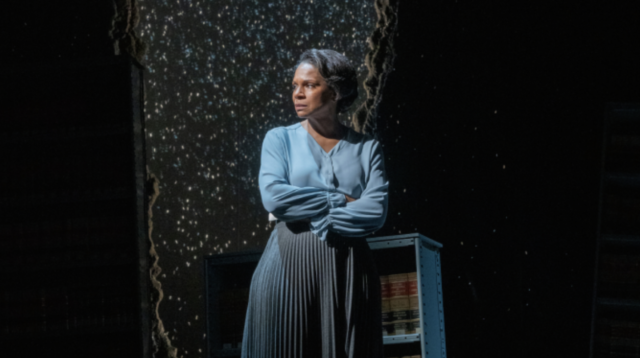
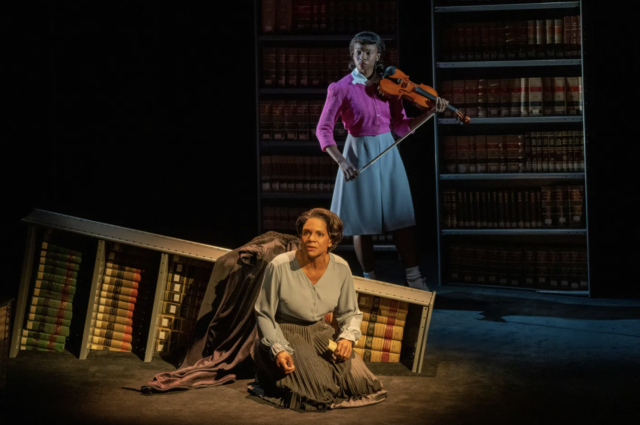
As the audience enters the theater, a recording of a 2015 interview with Kennedy, conducted by her grandson, Canaan Kennedy, plays on a loop, with the playwright talking about her life and career, focusing on having a family and studying and teaching at universities. Beowulf Boritt’s intellectual set consists of more than a dozen bookshelves at multiple angles, on the floor and hanging from the ceiling, as if Alexander is surrounded by an education that will not be available to her or other Black people. A metaphoric chill is in the air from a tear on the back wall through which appears a video projection of falling snow.

Ohio State Murders takes place at Ohio State University in Columbus, where Kennedy earned her BA. The frame story is that Suzanne has returned to Ohio State to give a lecture. She begins: “I was asked to talk about the violent imagery in my work; bloodied heads, severed limbs, dead father, dead Nazis, dying Jesus. The chairman said, we do want to hear about your brief years here at Ohio State but we also want you to talk about violent imagery in your stories and plays. When I visited Ohio State last year it struck me as a series of disparate dark landscapes just as it had in 1949, the autumn of my freshman year.”

Audra McDonald shifts between past and present in Ohio State Murders at James Earl Jones Theatre (photo by Richard Termine)

Suzanne goes on to share a heartbreaking tale of what happened to her at the school, involving a white English professor, Robert Hampshire (Bryce Pinkham), her violin-playing roommate, Iris Ann (Abigail Stephenson), her landlady, Mrs. Tyler (Lizan Mitchell), dorm head Miss Dawson (Mitchell), Aunt Louise (Mitchell), close friend Val (Mister Fitzgerald), and law student David Alexander (Fitzgerald), who will become her husband. Hampshire has a particular fondness for Thomas Hardy’s Tess of the d’Urbervilles, which deals with a rape/seduction and a strong-willed woman, and King Arthur, about whom Hampshire reads, “‘Till the blood bespattered his stately beard. / As if he had been battering beasts to death. / Had not Sir Ewain and other great lords come up, / His brave heart would have burst then in bitter woe: / ‘Stop!’ these stern men said, ‘You are bloodying yourself!’ ” Meanwhile, Suzanne is deeply affected after seeing Sergei Eisenstein’s 1925 silent classic, Battleship Potemkin, about the 1905 Russian Revolution. Tess, Arthur, and the film all relate to Suzanne’s personal experience at college and illuminate the sources of her violent imagery.

McDonald (Lady Day at Emerson’s Bar and Grill, Frankie and Johnny in the Clair de Lune) is marvelous as Suzanne, a role usually performed by two actors, one in the present, one in the past. (The original had Ruby Dee and Bellary Darden, while Lisagay Hamilton and Cherise Boothe shared the part in the New York premiere from TFANA in 2007.) Despite the tragedies and disappointments that hover around Suzanne, McDonald portrays her as remarkably even-tempered, almost to the point of being detached from the horrific truth. She weaves between 1950 and today with a graceful ease and a mere adjustment to her costume (a button-down blouse and long skirt, designed by Dede Ayite). Tony nominee Pinkham (A Gentleman’s Guide to Love & Murder, Love’s Labour’s Lost) is calm and steady as Hampshire, who hides a dark secret. It’s always a pleasure to see Mitchell (On Sugarland, Cullud Wattah), who switches between three roles.

Tony winner Leon (Topdog/Underdog, A Soldier’s Play) maintains a gentle, almost frustrating pace, giving room for Kennedy’s words to tell the story without melodramatic embellishment. Justin Ellington’s sound and Allen Lee Hughes’s lighting enhance the mysterious atmosphere that pervades the play, along with Jeff Sugg’s projections and Dwight Andrews’s original music.

Following the curtain call, which includes the cast honoring a large photograph of Kennedy, the interview starts again. As with the rediscovery of Alice Childress, the Charleston-born Black playwright who made her posthumous Broadway debut last season with 1955’s Trouble in Mind, followed shortly by TFANA’s production of her 1966 drama Wedding Band: A Love/Hate Story in Black and White, Kennedy’s is a voice that deserves to be heard, must be heard; her plays, many of which are experimental and challenge traditional narrative techniques, shine a light on racial injustice in America over the last half century and more, up to today. See Ohio State Murders on Broadway while you still can and help celebrate Adrienne Kennedy while she is still with us.