Tag Archives: Justin Ellington

LEAVING TOMORROW TO TOMORROW: TOM HANKS AT THE SHED

Bert Allenberry (Tom Hanks) meets Virginia (Kayli Carter) and Carmen (Kelli O’Hara) at the 1939–40 World’s Fair in This World of Tomorrow (photo by Marc J. Franklin)

THIS WORLD OF TOMORROW
The Shed’s Griffin Theater
545 West 30th St. at Eleventh Ave.
Tuesday – Sunday through December 21, $169-$299
theshed.org

The 1939–40 World’s Fair was an extraordinary moment in New York City history, as people from around the globe descended on Flushing Meadows to see such attractions as the Trylon and Perisphere, Elektro the Moto Man, the Fountains of Light at the Lagoon of Nations, General Motors’ Futurama, the Life Savers Parachute Jump, the Helicline, the Aquacade, and a Rembrandt self-portrait. It’s been memorialized in books, movies, and museum exhibits, and now it’s the setting of a new play cowritten by and starring Tom Hanks, running at the Shed through December 21.

This World of Tomorrow gets off to a rousing start, with jazzy entrance music by Louis Armstrong, the Dorsey Brothers, Lionel Hampton, Benny Goodman — and Nina Simone, who is from the next generation. In the opening scene, two people from the future, Bert Allenberry (Hanks) and Cyndee (Kerry Bishé), have traveled back in time to the World’s Fair, to June 8, 1939; while Bert is fascinated by everything he is experiencing, Cyndee is less enthusiastic. When looking at four sculptures by Leo Friedlander, Bert reverentially reads to Cyndee, “All citizens of the world are entitled to these four Freedoms: Of Religion, Speech, Assembly, and that one there. The Press. . . . Never has the world held a brighter promise of things to come. The Present is but an instant between an Infinite Past and a Hurrying Future.”

They then meet Carmen Perry (Kelli O’Hara) and her teenage niece, Virginia (Kayli Carter), who are playing hooky from work and school, respectively. Bert is instantly smitten with Carmen as much as he is excited by the fair. When he offers them his VIP pass and pin that says, “I have seen the future,” Virginia turns him down, explaining that she is learning to approach life with patience and so will wait in line like most everyone else. “Enjoy the anticipation,” Bert says, surprised.

Bert and Cyndee return to 2089, where they work at SKAEL, the Salina Kansas Alternating Enterprise Lab, which he runs with M-Dash (Ruben Santiago-Hudson). While Bert gleefully talks about hot dogs, cake, and coffee, which apparently aren’t available in 2089, M-Dash wonders why he didn’t kill Adolf Hitler and reminds him about the racism that was prevalent 150 years before, two classic time-traveling genre tropes. (Other tropes, like how Bert has to avoid changing anything that could impact the space-time continuum, are either ignored or given short shrift.) Bert and M-Dash get caught up in a discussion filled with techno-jargon — Finite Atomic Structure, DODEKA, VOX-PAC, Impulse coding, Inner-Structurals — and seek answers from ELMA (Jamie Ann Romero), an External Learning Machine Associate, a sort of AI robot who speaks without emotion.

The narrative shifts back to the morning of June 8, 1939, as Carmen, a divorced bookkeeper, gets ready to take Virginia to the fair. Carmen lives in the Bronx with her brother, Max (Jay O. Sanders), Max’s wife, Sylvia (Romero), and Virginia in a cramped apartment. Max is a tough-talking butcher, and Sylvia is a nurse who works the late shift at Bellevue. Max plays pinochle with his buddies. Carmen has lunch every day at a Greek diner off Sheridan Square owned by an immigrant named Costas (Sanders), a larger-than-life figure who promises his food is “number one the best.”

After several trips to the past, Bert is warned by Honoria (Michelle Wilson) and Dr. Tanner (Paul Murphy) of Chronometric Adventures that his portal-related Trillic Acid numbers are at dangerous levels and that he should not go on another journey, but his fondness for Carmen makes him consider risking it all.

This World of Tomorrow is like an hourlong episode of The New Twilight Zone (without commercials), except it’s two hours and fifteen minutes (with intermission), along with a dash of the 1980 romantasy Somewhere in Time, more than a hint of Back to the Future, and a touch of the 1985 anthology series Amazing Stories thrown in. (In fact, the 1939 New York World’s Fair is a key plot point in the time-traveling TZ episode “The Odyssey of Flight 33.”) There’s a lot of repetition and explication; it could benefit from being trimmed down to a leaner ninety minutes or so.

The Salina Kansas Alternating Enterprise Lab has an important meeting in 2089 (photo by Marc J. Franklin)

The play is based on two short stories from Hanks’s 2017 collection Uncommon Type, “The Past Is Important to Us” and “Go See Costas,” but Tony-winning director Kenny Leon (Topdog/Underdog, Home) can’t quite merge them on Derek McLane’s ever-shifting set, which switches from a Bronx kitchen and a Greek diner to a conference room and the fair and features archival projections on more than two dozen pillars. Dede Ayite’s costumes help differentiate the various time periods, but it still feels like multiple stories unsuccessfully merged into one.

Oscar and Emmy winner and Tony nominee Hanks is most well known as a television and film star, but he cut his teeth with the Riverside Shakespeare Company in New York and the Great Lakes Shakespeare Festival in Cleveland in the late 1970s; he made his Broadway debut in Lucky Guy in 2013, and he played Falstaff in the Shakespeare Center of Los Angeles’ Henry IV in 2018. Clearly comfortable on the stage, he is as appealing as ever as Bert, an eminently likable man who doesn’t have a bad thing to say about anyone. He has instant chemistry with Tony winner and Emmy and Grammy nominee O’Hara (The Light in the Piazza, The King and I), who mostly appears in musicals but is at home here, lending a working-class elegance to Carmen. You desperately want them to fall in love and be together, but not all the obstacles they face make sense.

The rest of the cast is trapped in thankless roles that only get in the way of the central story. And the dialogue is overladen with scientific concepts that weigh down the narrative with confusing verbiage — it lacks the fun charm of, say, Star Trek’s invented technological language — and Hanks and cowriter James Glossman preach too much about peace and love.

“Let’s leave tomorrow to tomorrow,” Carmen suggests. That’s not necessarily a bad idea.

And as Lee (Lee Aaron Rosen), one of Bert’s colleagues at SKAEL, emphasizes, “Learning that ‘The Past Is Important to Us’ don’t come cheap.”

Neither does learning about the future.

[Mark Rifkin is a Brooklyn-born, Manhattan-based writer and editor; you can follow him on Substack here.]

SUMP’N LIKE OUR TOWN: AMERICA ONSTAGE

The Mint produciton of Lynn Riggs’s Sump’n Like Wings is worthy of much applause (photo by Maria Baranova)

SUMP’N LIKE WINGS
The Mint Theater at Theatre Row
410 West 42nd St. between Ninth & Tenth Aves.
Tuesday – Sunday through November 2, $39-$99
minttheater.org
www.theatrerow.org

In 1938, Thornton Wilder, who was born in Wisconsin in 1897, wrote what many consider one of the greatest American plays, the Pulitzer Prize–winning Our Town. The drama, a perennial favorite in high schools and community theater and off and on Broadway, is set in the small, fictional town of Grover’s Corners, New Hampshire, in 1901, where ordinary people go about their ordinary lives, including going to church, falling in love, and facing tragedy. It can currently be seen in an all-star version at the Ethel Barrymore through January 19. Wilder, who was gay, also won Pulitzers for his 1927 novel, The Bridge of San Luis Rey, and his 1942 play, The Skin of Our Teeth.

In 1925, Lynn Riggs, who was born in Oklahoma in 1899, wrote Sump’n Like Wings, a little-known play that was published in 1928 and premiered in 1931. The rarely performed drama is set in the small, fictional town of Claremont, Oklahoma, where ordinary people go about their ordinary lives, including going to church, falling in love, and facing tragedy. It concluded its too-short run at Theatre Row on November 2. Riggs, who was gay, also wrote the 1931 play Green Grow the Lilacs, which was the basis for the classic musical Oklahoma!, which won a Pulitzer in 1944 in addition to several Tonys and Oscars over the years.

The New York premiere of Sump’n Like Wings is presented by the Mint, the theater world’s finest purveyor of lost, forgotten plays, but this one is a welcome change of pace for the company, which specializes in British and American working-class tales and drawing-room comedies that often explore sociopolitical issues of their time. The splendid two-hour, two-act play takes place in the Old West of the 1910s, where the characters speak in western drawl and rhythm unusual for the Mint but as exquisitely rendered as ever.

The strict Mrs. Baker (Julia Brothers), a widow, operates the dining room of the St. Francis Hotel for Ladies and Gents in Claremont, where she is raising her sixteen-year-old daughter, the wild child Willie (Mariah Lee), with the help of her brother, Jim Thompson (Richard Lear), who owns the hotel. The town is aghast when shoplifter Elvie Rapp (Lindsey Steinert) lets all the prisoners out of the local jail; to rehabilitate her, Sheriff Beach (Andrew Gombas) is forcing her to work for Mrs. Baker. Instead of going to school, Willie waits tables for her mother, but she is being pursued by the married Boy Huntington (Lukey Klein), who wants to run away with her. Judging them all is Jim’s housekeeper, Hattie (Joy Avigail Sudduth).

Talking about why she let the men go, Elvie tells Willie, “You don’t know whut it is to be locked up, locked up away from the sun and the air. You don’t know whut it means not to be free to go and come whenever you please — with no one to stop you, and no iron bars a-shuttin you in like a animal —.” Willie cuts her off, declaring, “I — do — too.” Elvis responds, “You don’t! You cain’t know! And you don’t know how fin’lly you git sick, sick inside of yer head, so you’d do anything — anything at all to git free, to git away. It ain’t that you wanta go anywheres. It’s the idy of the bars that makes you mad. The bars git in yer mind, and you’d do anything to break em down, to git rid of em —.”

Lynn Riggs’s Sump’n Like Wings explores life in a small Oklahoma town in the 1910s (photo by Maria Baranova)

Therein lies the theme of the play; nearly every character is trying to escape something, searching for freedom from the bars that have surrounded them. They hop railroad cars, go to church, fight over a game of checkers, fall in and out of love, bury themselves in the newspaper, or break the law, challenging societal norms or getting swept up in them. In the first scene, Mr. Clovis (Buzz Roddy), Mrs. Clovis (Traci Hovel), and Osment (Mike Masters) are eating in the dining room and gossiping about Elvie. While the Clovises see the former prisoners as “crimernals, ever one of em!,” cowman Osment insists, “They was men, Mis’ Clovis. They was men.

They then hear fierce noises coming from behind a closed door; it’s Willie, screaming to be let out, threatening to kick the door down. Mrs. Baker yells right back at her, threatening her. It ultimately turns out that the door is not locked, that Willie could have opened it at any time by herself. But not everyone in Claremont — or anywhere, in the past, present, or future — knows that.

The Mint is justifiably renowned for its fashionably detailed sets, but Junghyun Georgia Lee keeps it relatively simple this time, employing a handful of unadorned wooden chairs and tables that are moved around as the scene shifts from the dining room to a hotel office to a rooming house, with a closed door at one end and an open one at the other. In the back are rows of horizontal slats with enough space between them that the outside world is temptingly visible, filled with both hope and fear. Emilee McVey-Lee’s period costumes maintain the mostly brown color palette. As always with the Mint, the cast is impeccable, transporting the audience to 1910s Oklahoma. Raelle Myrick-Hodges’s (Dirty White Teslas Make Me Sad, Flyin’ West) intricate direction adds contemporary relevancy to the play nearly a century after it was written; who isn’t seeking some form of escape from something these days?

Riggs, who was part Cherokee and served in the US military, died in New York City in 1954 at the age of fifty-four, leaving behind twenty-one full-length plays, about a dozen screenplays (The Plainsman, Sherlock Holmes and the Voice of Terror), and numerous short stories. He was inducted into the Oklahoma Hall of Fame in 1943 and deserves to be better remembered for more than just one play.

Jim Parsons stars as the Stage Manager in Broadway revival of Our Town (photo by Daniel Rader)

OUR TOWN
Ethel Barrymore Theatre
243 West Forty-Seventh St. between Broadway & Eighth Ave.
Through January 19, $74 – $321
www.ourtownbroadway.com

Two-time Tony winner Kenny Leon’s streamlined adaptation of Thornton Wilder’s Our Town suffers from trying too hard to be all things to all people. Like Sump’n Like Wings, it has a spare, rustic set, with various chairs and tables being moved around and a large distressed wood barn wall in the back, with one door and a pair of windows that open up like the Laugh-In joke wall. Fifteen audience members sit in boxes on either side of the stage, more like a jury than part of the neighborhood being celebrated between them. Meanwhile, rows of lanternlike lights extend like stars over the stage and the audience, as if we’re part of this neighborhood too. (The set is by Beowulf Boritt, with costumes by Dede Ayite, lighting by Allen Lee Hughes, and sound by Justin Ellington.)

The first words we hear are “Shema Yisrael,” which begins the Jewish prayer of affirmation, here from the 2019 Abraham Jam song “Braided Prayer,” which features sacred words from multiple religions; the cover of the album features three silhouetted figures in three doorways, holding different phases of the moon, surrounded by religious-tinged quotes in English, Hebrew, Arabic, and other languages. The Stage Manager, played with frantic charm by Jim Parsons as if he’s trying to end services early — Parsons previously played the Supreme Being in 2015’s An Act of G-d at Studio 54 on Broadway — points out, “Religiously, we’re eighty-five per cent Protestants; twelve per cent Catholics; rest, indifferent.” Thus, there appear to be no Jews (or Muslims) in 1901 Grover’s Corners, New Hampshire, although, near the end of the play, a Jewish star is visible on a gravestone in the cemetery.

In addition, the diverse casting is strongly evident, as if making its own case, including deaf milkman Howie Newsome (John McGinty), who communicates with his customers in sign language. And to insist on the play’s relevance in the twenty-first century — the time and setting in noted as “now” — two characters pull out cell phones, only to be chastised by the Stage Manager. It’s less cute than it is annoyingly disconcerting. And when a belligerent woman, portrayed by Bryonha Marie, who is Black, asks, “Is there no one in town aware of social injustice and industrial inequality?,” it takes on a different meaning today than it would have when performed by a white actor seventy-five years ago. (The question might sound like it’s been added for this production, but it’s in the original script, again revealing Wilder’s talent for the universal.)

George Gibbs (Ephraim Sykes) chats with Mr. and Mrs. Webb (Katie Holmes and Richard Thomas) in Kenny Leon’s Our Town (photo by Daniel Rader)

Wilder populates his imaginary world with mostly respectably people doing mostly respectable things. “Nice town, y’know what I mean?” the Stage Manager says. “Nobody very remarkable ever come out of it, s’far as we know.”

Dr. Gibbs (Billy Eugene Jones), the town MD, chats with the paper deliverer, Joe Junior, while Mrs. Gibbs (Michelle Wilson) tends to her garden and their son, George (Ephraim Sykes), dreams of being a baseball player and is falling for his next-door neighbor, Emily Webb (Zoey Deutch), who lives with her brother, Wallee (Hagan Oliveras), and their parents, Mrs. Webb (Katie Holmes), who also has a garden, and the knowledgeable Mr. Webb (a standout Richard Thomas, yet again), editor of the Grover’s Corners Sentinel. Shorty Hawkins flags the 5:45 train to Boston. The town drunk, Simon Stimson (Donald Webber Jr.), conducts the church choir. State university professor Willard (Shyla Lefner) encapsulates the town’s history.

Constable Warren (Bill Timoney) walks the beat, engaging in small talk with the citizenry. Mrs. Soames (Julie Halston) raves on and on about a wedding. Undertaker Joe Stoddard (Anthony Michael Lopez) hates to supervise when they’re burying a young person.

In Grover’s Corners, people live and people die. There are no spoiler alerts when the Stage Manager tells us what is going to become of some of the characters. Leon has eliminated the two intermissions; the three acts — “Daily Life,” “Love and Marriage,” and “Death and Eternity” — are identified by the Stage Manager, who hustles things along, getting the audience out in a mere hundred minutes. This Our Town is a pleasant experience; there are plenty of untidy edges and few lofty moments. But it doesn’t quite feel like real life either; the manipulation is evident, including at the end, where tears flow.

Wilder, who was Protestant and served in the military, died in Hamden, Connecticut, in 1975 at the age of seventy-eight, leaving behind dozens of full-length and short plays, seven novels, and one screenplay (Shadow of a Doubt), but he will forever be remembered first for Our Town.

[Mark Rifkin is a Brooklyn-born, Manhattan-based writer and editor; you can follow him on Substack here.]

BIG & SMALL SCREEN STARS ON BROADWAY: YELLOW FACE / THE ROOMMATE / McNEAL

Francis Jue and Daniel Dae Kim play father and son in Yellow Face (photo by Joan Marcus)

YELLOW FACE
Todd Haimes Theatre
227 West Forty-Second St. between Broadway & Eighth Ave.
Tuesday – Sunday through November 24, $70-$348
212-539-8500
www.roundabouttheatre.org

Three recently opened shows on Broadway feature television and movie stars either making their Great White Way debut or returning after a long absence, but, was we learn, success on the big and/or small screen does not always guarantee onstage triumph.

In an April 2021 interview in Vulture, actor and anti-Asian-hate activist Daniel Dae Kim said, “I take a great deal of pride in being Korean American. I know that not every representation is 100 percent something we can stand behind all the time, but I choose to look at things as whether they’re moving the needle of progress on a larger scale.” Talking about his and Grace Park’s departure from the successful Hawaii Five-O reboot in 2017 after the seventh season following a contract dispute — the two Asian Americans wanted equal pay with their Caucasian costars — Kim explained, “I had hopes that Hawaii Five-0 would be different because it was a show set in Hawaii, where the majority of people are not white. I thought it was going to be more of an ensemble show, and if you look at the early marketing and promotion for the show, where Grace Park and I were featured equally as prominently as anyone else, it led me to believe that it could be. I was proven to be wrong.”

In the article, he also discusses initially wanting to cast an Asian lead in the American version of the Korean television drama The Good Doctor, which his 3AD company produced, but eventually agreeing with showrunner David Shore and hiring white English actor Freddie Highmore.

Kim, who was born in South Korea, is now back on Broadway in the Great White Way debut of David Henry Hwang’s semiautobiographical 2007 Obie-winning Pulitzer finalist, Yellow Face, at the Todd Haimes Theatre through November 24. Kim plays a version of Hwang, known as DHH, a first-generation Chinese American playwright and activist who gets involved in a series of casting controversies. DHH makes a public stand against producer Cameron Mackintosh’s insistence on casting English actor Jonathan Pryce as a French-Vietnamese pimp known as the Engineer, altering his eyes and skin color to make him look more Asian; Pryce went on to win a Tony for his performance.

DHH, who won a Tony for his 1988 play, M. Butterfly, decides to write about “yellow face” in his next play, Face Value, choosing unknown actor Marcus G. Dahlman (Ryan Eggold) as the lead, believing he is at least part Asian. But when it turns out that the renamed Marcus Gee probably has no Asian blood in him at all, DHH convinces the actor that he must have had a Siberian Jewish ancestor, and things go haywire from there.

Yellow Face is told in flashback, with DHH often directly addressing the audience, guiding the tale while freely admitting the many mistakes he made. It starts with various public figures commenting on the Marcus Gee situation.

“Wow. That is one of the strangest stories I’ve ever heard,” Vice President Al Gore (Marinda Anderson) says.

“David Henry Hwang is a white racist asshole,” playwright Frank Chin (Kevin Del Aguila) declares.

“This is a tempest in an Oriental teapot,” Mackintosh (Shannon Tyo) insists.

DHH (Daniel Dae Kim) and Marcus Gee (Ryan Eggold) have different ideas of ethnic representation at Todd Haimes Theatre (photo by Joan Marcus)

Among the other real-life famous and not-so-famous people chiming in at one point or another are casting director Vinnie Liff, author Gish Jen, theater critics Frank Rich and Michael Riedel, New York City mayor Ed Koch, columnist George F. Will, talk show host Dick Cavett, Taiwanese American computer scientist Wen Ho Lee, actors B. D. Wong, Mark Linn-Baker, Lily Tomlin, Gina Torres, Jane Krakowski, and Margaret Cho, politicians Fred Thompson, Sam Brownback, Tom Delay, and Richard Shelby, and theater luminaries Bernard Jacobs, Joe Papp, and Jerry Zaks, all played by Anderson, Del Aguila, Tyo, and Francis Jue; Jue also portrays DHH’s father, HYH, an immigrant immensely proud of his success in the financial sector but whose bank finds itself in a bit of hot water with a congressional committee as the opening of Face Value approaches.

Kim is most well known for playing Jin-Soo Kwon on the seven seasons of Lost and Chin Ho Kelly for seven years on the Hawaii Five-O reboot; he has also appeared onstage in New York City, Los Angeles, and London since 1991, including Romeo and Juliet, A Doll’s House, The Tempest, The King and I, and Hwang’s Golden Child. He is amiable and confident as DHH, instantly gaining the audience’s faith as he balances the sublime and the ridiculous with acute self-awareness and self-deprecation; he’s particularly strong as DHH digs himself into a deeper and deeper hole. His casting in and of itself is fascinating; there’s been a recent movement for people of Asian descent not to be called “Asian” but to be identified by the specific country they or their ancestors come from; in this case, the South Korean Kim is playing the Chinese American Hwang.

Eggold (Dead End, All My Sons) is hilarious as Marcus, a regional actor who can’t believe how his stature has changed once he agreed to pretend to be Asian, getting hooked on the hoopla. Keller (Dig, Shhhh) excels as the announcer and a reporter identified as “Name withheld on advice of counsel,” Jue, who originated the role of HYH at the Public and played an alternate version of DHH in Hwang’s autobiographical soft power, is gleeful as the father, and Tyo (The Comeuppance, The Chinese Lady), del Aguila (Some Like It Hot, Frozen), and Anderson (Merry Me, Sandblasted) shift seamlessly from role to role.

Arnulfo Maldonado’s changing sets and Yee Eun Nam’s projections keep the audience fully engaged under the smooth-flowing direction of Leigh Silverman, who helmed the original production of Yellow Face as well as Hwang’s Chinglish, Kung Fu, and Golden Child, her familiarity with the material delivering a fun experience while making its important points.

Mia Farrow and Patti LuPone return to Broadway in Jen Silverman’s The Roommate (photo by Matthew Murphy)

THE ROOMMATE
Booth Theatre
222 West 45th St. between Broadway & Eighth Ave.
Tuesday – Sunday through December 15, $48 – $321
theroommatebway.com

The Broadway premiere of Jen Silverman’s 2015 play, The Roommate, dooms itself from the very start. Longtime friends Mia Farrow and Patti LuPone take the stage together, their names projected across the top of the set, and they bask in the uproarious applause of the audience. They exit, then return seconds later in character. While the laudatory moment removes the need for applause at the beginning of the actual narrative, it also makes sure we never forget we are watching a pair of superstar performers, even though the success of the play — any play — depends on our believing in the fiction that is about to unfold before us.

Two years ago, LuPone, who has won two Grammys and three Tonys, announced she was retiring from the Great White Way because of Actors’ Equity’s lack of support of its union members, writing on Twitter, “Quite a week on Broadway, seeing my name being bandied about. Gave up my Equity card; no longer part of that circus. Figure it out.” She later told People magazine, “I just didn’t want to give them any more money. . . . And I don’t know when I’m going to be back on stage.”

Meanwhile, Farrow, who has never been nominated for an Oscar or Tony, last appeared on Broadway in 2014 in Love Letters, sitting at a table with Brian Dennehy and reading A. R. Gurney’s epistolary play. Here only other Broadway appearance was costarring with Anthony Perkins in Bernard Slade’s 1980 Romantic Comedy. (She made her off-Broadway debut as Cecily Cardew in The Importance of Being Earnest in 1963.)

So there was a lot of buzz surrounding LuPone and Farrow teaming up at the Booth Theatre for a play about an odd couple living together in rural Iowa. Unfortunately, they lack any kind of chemistry, and three-time Tony-winning director Jack O’Brien (Shucked, The Invention of Love) can’t get around Jen Silverman’s inconsequential, clichéd script.

Farrow is Sharon, a divorced mother from Illinois who has made a peaceful life for herself in a large home in Iowa City. She likes things as they are, simple, without complications, but she seeks out a roommate, both for financial reasons and, perhaps, friendship.

LuPone is Robyn, a divorced mother from the Bronx who is ready for a major change. She is not exactly what Sharon expected: a tough-talking vegan lesbian whose black leather provides a sharp contrast to Sharon’s loose-fitting sun dresses. (The costumes are by Bob Crowley, who also designed the set, a skeletal house with a kitchen and a small staircase leading up.)

After learning these facts about Robyn, Sharon declares, “I mean. A roommate! I’ve never had a roommate. I’m sixty-five years old. A roommate!”

While there is no reason an actor can’t play well above or below their age, the line gets a curious stare from the audience, who know Farrow cannot be sixty-five. (In actuality, Farrow is seventy-nine and LuPone is seventy-five). In a script note, Silverman suggests, “In terms of age, you should feel free to adjust the character’s age to fit the actor.” Because the production made such a big deal of Farrow and LuPone’s star power when they first took the stage, the number sticks out as false.
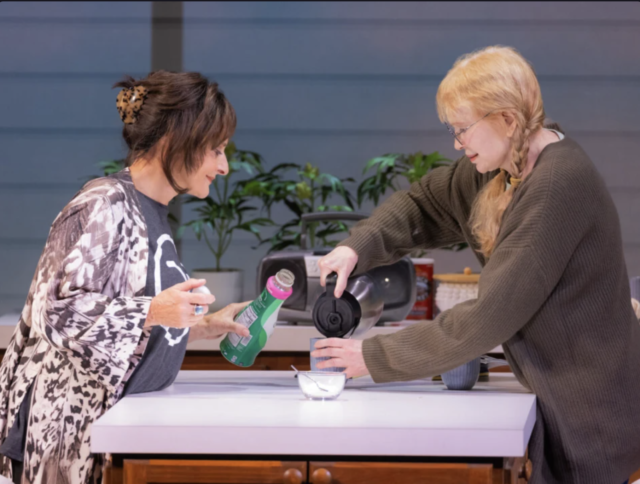
Robyn (Patti LuPone) and Sharon (Mia Farrow) form an odd couple in The Roommate (photo by Matthew Murphy)

As the play continues, we learn more about both women, their prejudices, their pasts, and their futures. Each is dealing with not being on the closest of terms with their children. While Robyn knows about what’s going on around the world, Sharon seems to be happily stuck in an old-fashioned bubble straight out of a Norman Rockwell painting, oblivious to what is happening right outside her door, although that changes as she grows more and more intrigued with what she at least initially considers Robyn’s vices.

The Roommate is in part a riff on The Odd Couple, with Sharon a fuddy-duddy like Felix Ungar, Robyn a more coarse figure like Oscar Madison. (At the 2017 Williamstown Theater Festival, S. Epatha Merkerson was Sharon, and Jane Kaczmarek was Robyn.)

But the effects they have on each other are difficult to believe, not fully formed. Silverman (Collective Rage: A Play in 5 Betties, Spain) might have a lot to say about human vulnerability and morality and female friendship, but she goes too far off the rails in the play’s slow-moving ninety minutes.

Farrow is lovely as Sharon, every line delivered with a touch of wonder, going especially high and squeaky when something Robyn reveals surprises her. She handles Sharon’s absurd shifts in right and wrong with aplomb, just going with the flow, but LuPone (Company, Shows for Days) looks like she’d rather be just about anywhere else, as if she knows she made a mistake choosing this play as her return to the stage. Hopefully Farrow and LuPone will join forces again, only next time in a better piece of theater.

“There’s a great liberty in being bad,” Robyn tells Sharon, who repeats the line later on.

It’s a catchy phrase that never comes to fruition in The Roommate.

Jacob McNeal (Robert Downey Jr.) gets good and bad news from his doctor (Ruthie Ann Miles) in McNeal (photo by Matthew Murphy and Evan Zimmerman)

McNEAL
Vivian Beaumont Theater at Lincoln Center Theater
150 West 65th St. between Broadway & Amsterdam Ave.
Tuesday – Saturday through November 24, $195.50-$371
212-362-7600
www.lct.org

The night before I saw Ayad Akhtar’s McNeal at the Vivian Beaumont Theater at Lincoln Center, I watched Dario Argento’s 1982 giallo cult classic, Tenebrae, starring Tony and Oscar nominee and New York City native Anthony Franciosa as Peter Neal, a popular American novelist on a book tour in Italy, accompanied by his agent, Bullmer (John Saxon), and his assistant, Anne (Daria Nicolodi). One critical scene involves Neal sitting down for a television interview with superfan Christiano Berti (John Steiner). Fact and fiction start weaving in and out of the plot as violent scenes from his books come to life in a series of murders.

In McNeal, Oscar and Emmy winner and New York City native Robert Downey Jr. is the title character, Jacob McNeal, a popular American novelist who, while being examined by his doctor, Sahra Grewal (Ruthie Ann Miles), gets notified that he has won the Nobel Prize in Literature, an award he feels he deserved many years ago. His agent, Stephie Banic (Andrea Martin), immediately contacts his publisher to negotiate a new contract, and the Times finally agrees to do a front-page magazine profile of him, sending over New York Times journalist Natasha Brathwaite (Brittany Bellizeare), who is not planning on doing a puff piece. “Were you a diversity hire?” he asks her, kicking off an awkward interview. McNeal flirts with using AI for his Nobel acceptance speech, but soon he is counting on AI for much more as fact and fiction intermingle.

I prefer Tenebrae.
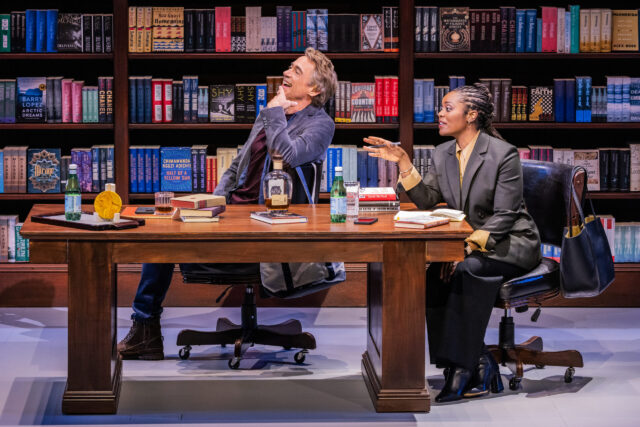
Jacob McNeal (Robert Downey Jr.) says way too much in interview with journalist Natasha Brathwaite (Brittany Bellizeare) (photo by Matthew Murphy and Evan Zimmerman)

In his Broadway debut, Downey, who first acted on the stage in Alms for the Middle Class in Rochester in 1983, delivers a solid performance as the self-destructive McNeal, who has a serious kidney issue but can’t stop going back to the bottle. (Downey himself has had problems with drugs and alcohol and has been drug-free for more than twenty years.) He looks completely comfortable in McNeal’s skin, playing a character who is adorable and unlikable at the same time, as it’s difficult to dismiss his misogyny as just exemplary of the way things used to be. The sets by Michael Yeargan and Jake Barton rise and lower from above and below as Barton’s projections beam out visual stimuli, from texts and close-ups to the spewing of words and letters.

In such previous works as Junk, The Invisible Hand, Corruption, and the Pulitzer Prize–winning Disgraced, Akhtar has proved to be a master of complex plots, tackling such issues as politics, race, religion, the financial industry, capitalism, and personal ambition. In McNeal, however, he takes on too much, straying from the central focus on the future of AI and its impact on literature and humanity itself to include scenes that feel like they’re from another play; even director Bartlett Sher (The King and I, Oslo), who has been nominated for eight Tonys and won one, is unable to weave together subplots involving McNeal’s son, Harlan (Rafi Gavron), with its bizarre revelation; McNeal’s flirtations with Banic’s assistant, Dipti (Saisha Talwar), and fondness for Harvey Weinstein, as his agent’s actions confound believability; his liberal use of the lives of his friends and relatives in his plots; and his relationship with journalist Francine Blake (Melora Hardin).

The 105-minute show does have a magical finale, but it’s not enough to save it. Near the end, a typing prompt acknowledges that the audience is “confused by what is real and what isn’t.”

There was no such problem in Tenebrae.

[Mark Rifkin is a Brooklyn-born, Manhattan-based writer and editor; you can follow him on Substack here.]

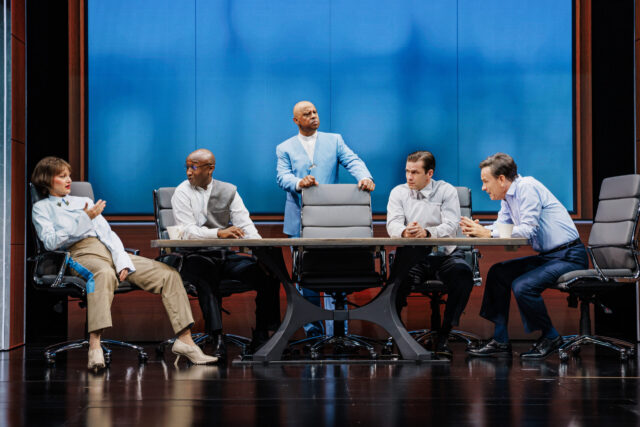
PAM TANOWITZ DANCE: DAY FOR NIGHT

Three-part Day for Night goes from daylight to dusk to evening (photo by Liz Devine)

DAY FOR NIGHT
The Amph at Little Island
Pier 55, Hudson River Park at West Thirteenth St.
July 17-21, $15 standing room, $25 seats sold out, 8:30
littleisland.org
www.pamtanowitzdance.org

Little Island’s inaugural season of site-specific commissions continues with Bronx-born choreographer Pam Tanowitz’s Day for Night, which blends beautifully with the surroundings of the outdoor Amph theater. As the audience makes its way past the grassy green hills that leads to the venue, the dancers are scattered along the path, offering a prologue, clad in diaphanous green costumes. As the audience is being seated in the Amph’s wooden rows, the sun is setting over the Hudson, a golden glow that evokes the title of the show, the term used when a film is shooting a nighttime scene during the day.

The sixty-minute piece was inspired by François Truffaut’s 1973 film, Day for Night, which goes behind the scenes of the making of a movie, featuring a British actress (Jacqueline Bisset) who has recently suffered a nervous breakdown, an aging French star (Jean-Pierre Aumont), an Italian diva (Valentina Cortese), and a young French actor (Jean-Pierre Léaud); Truffaut portrays the harried director.

The dance begins with Lindsey Jones, Marc Crousillat, and Maile Okamura forming an extended pony-stepping trio in which various emotions boil to the surface, including jealousy, power, and revenge. They are later joined by Morgan Amirah and Brian Lawson, who peer out over the river, in addition to Sarah Elizabeth Miele and Victor Lozano. In all black, Melissa Toogood delivers an impressive solo, looking serious and concerned.

The dancers move up the aisles, climb to a pair of scaffold balconies, and rest on the first row of benches, which is covered in fake green grass. They jump, run around in a circle, and lie down on the empty stage. The soundtrack features gentle tones as well as harsher drones, accompanied by recordings of the natural environment of Little Island, from birds and wind to lapping waves, human murmurings, and traffic. When the BBC’s Shipping Forecast plays over the sound system, I initially thought it was coming from a boat passing in the distance. (The immersive sound and music are by Justin Ellington.)

Reid Bartelme and Harriet Jung’s costumes come in multiple colors echoing the environs, with loose-fitting tops and tighter bottoms; old-fashioned striped swimming trunks provide contrast to the vertical picket fence bordering the water. Lighting designer Davison Scandrett blasts out red, orange, yellow, blue, green, and almost blinding white.

Tanowitz, who has previously choreographed such works as I Was Waiting for the Echo of a Better Day, Law of Mosaics, and Four Quartets, for such companies as New York City Ballet, the Royal Ballet, Martha Graham, Paul Taylor, Ballet Austin, and her own Pam Tanowitz Dance, teases the audience with a series of false endings and bows before everyone moves over to the Glade, where Toogood, in silver sequins, dances a forceful epilogue to Caroline Shaw and Sö Percussion’s slow, elegiac cover of ABBA’s “Lay All Your Love on Me,” in which Shaw nearly whispers, “Don’t go wasting your emotion / Lay all your love on me / Don’t go sharing your devotion / Lay all your love on me.”

“Cinema is king!” Truffaut’s character says in Day for Night. On Little Island right now, it’s dance that rules.

[Mark Rifkin is a Brooklyn-born, Manhattan-based writer and editor; you can follow him on Substack here.]

LITTLE ISLAND: DAY FOR NIGHT

DAY FOR NIGHT
The Amph at Little Island
Pier 55, Hudson River Park at West Thirteenth St.
July 17-21, $15 standing room, $25 seats sold out, 8:30
littleisland.org
www.pamtanowitzdance.org

Bronx-born choreographer Pam Tanowitz turns to a French Nouvelle Vague auteur for her latest evening-length piece, Day for Night, playing only five performances July 17-21 at the Amph on Little Island.

François Truffaut’s 1973 film, Day for Night — the French title is La Nuit américaine, or “The American Night” — goes behind the scenes of a movie being shot on location in Nice. Cast and crew members intertwine in all sorts of ways as a British actress (Jacqueline Bisset) who has recently suffered a nervous breakdown, aging French star Alexandre (Jean-Pierre Aumont), Italian diva Séverine (Valentina Cortese), and young French actor Alphonse (Jean-Pierre Léaud) spend a lot of time doing everything except making a film, upsetting the director, played by Truffaut himself. The title comes from the technique in which nighttime shots are made during the day.

The Little Island commission will be danced by Morgan Amirah, Marc Crousillat, Lindsey Jones, Brian Lawson, Sarah Elizabeth Miele, Maile Okamura, and Melissa Toogood, with costumes by Reid Bartelme and Harriet Jung, lighting by Davison Scandrett, and sound and music by Justin Ellington. Tanowitz has previously choreographed such works as I Was Waiting for the Echo of a Better Day, Law of Mosaics, and Four Quartets, for such companies as New York City Ballet, the Royal Ballet, Martha Graham, Paul Taylor, Ballet Austin, and her own Pam Tanowitz Dance.

“I make my dances in response to everything contained in the frame, like a film still, turning things over and over to discover what I haven’t yet found,” Guggenheim fellow and Bessie winner Tanowitz said in a statement. “Little Island is the exact right place for me to examine the way something can be seen and re-seen. When we look at something long enough it reveals what’s been forgotten, or taken for granted, or not yet noticed, and rewards us with new discoveries.”

As a bonus reward, Toogood will perform a short epilogue several times each night beginning at 9:30 in the cozy Glade; admission is free, first-come, first-served.

[Mark Rifkin is a Brooklyn-born, Manhattan-based writer and editor; you can follow him on Substack here.]
HOME

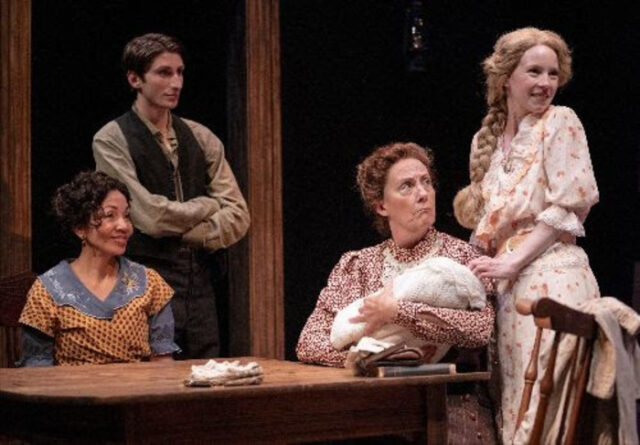
Tory Kittles is flanked by Brittany Inge and Stori Ayers, who play forty characters in Samm-Art Williams’s Home (photo by Joan Marcus)

HOME
Todd Haimes Theatre
227 West Forty-Second St. between Broadway & Eighth Ave.
Tuesday – Sunday through July 21, $49-$149
212-539-8500
www.roundabouttheatre.org

Tony-winning director Kenny Leon describes his Broadway revival of Samm-Art Williams’s rhythmic, poetic Home as a two-hundred-yard dash. It’s more like an Olympic relay, and his team wins the gold.

In December 1979, the Negro Ensemble Company debuted Home at St. Marks Playhouse, with Charlie Brown, Michele Shay, and L. Scott Caldwell, directed by Douglas Turner Ward; the show transferred to the Cort Theatre on Broadway in May, earning Tony nominations for Best Actor and Best Play. A 1982 DC version featured Samuel L. Jackson, S. Epatha Merkerson, and Elain Graham. Sadly, Williams, who was also an actor and television writer and producer, working on such series as The Fresh Prince of Bel-Air, Martin, and Frank’s Place, passed away in his hometown of Burgaw, North Carolina, on May 13 at the age of seventy-eight, just a few days before the first preview of Leon’s throughly engaging Roundabout production at the Todd Haimes Theatre.

Home takes place on Arnulfo Maldonado’s low-tech, cozy set, centered by a rocking chair on a wooden platform in front of a tall row of vegetables and a backdrop of vast green fields under a cloudy sky in the town of Cross Roads, North Carolina, a storm sometimes visible in the distance. Occasionally, a black cutout of a silhouetted house narrows the stage. The show begins with Cephus Miles (Tory Kittles) taking a deep breath — as if getting ready for the race — and two unnamed women who serve as a Greek chorus (Brittany Inge and Stori Ayers) singing, “In the great gitt’n up morning fare you well. Fare you well.” The second woman adds, “If there was ever a woman or man, who has everlasting grace in the eyes of God. It’s the farmer woman . . . and man.”

Cephus Miles (Tory Kittles) searches for home in fast-paced Roundabout revival (photo by Joan Marcus)

However, everlasting grace does not necessarily mean success and happiness. A moment later, after the first woman agrees that Cephus is blessed, the second woman says, “Shit. Big deal. He can think about grace while he’s chopping wood this winter to go in that ‘pop belly’ stove that he cooks on. Or when he has to pack mud in the cracks of his house to keep the wind out, or when he has to use newspaper to wipe his ‘behind’ because toilet paper is just not in his budget.”

Cephus is a simple man with simple desires. He cultivates the fields with his uncle Lewis and granddaddy and appears destined to marry the young and innocent Pattie Mae Wells (Inge). Though not a religious man, he agrees to be baptized by Rev. Doris (Ayers), who warns Pattie Mae, “Keep your eyes on this one, honey. He ain’t a whole Christian yet.”

The chorus lets us know early on that Cephus, like many local men before him, headed off to the big city but didn’t find what he was looking for. “Maybe they’ll all leave,” the first woman says. The second woman responds, “Most of them have. He left. But he came back. Fool.” Cephus also runs afoul of the draft board when his number comes up to go to Vietnam, as he was taught to love thy neighbor and thou shalt not kill. And to make matters more complicated, Pattie Mae decides to go to college, promising to write him every day.

Cephus undertakes a personal Great Migration in an attempt to find a new home, but amid all that befalls him, he sticks to his roots, explaining, “I have no regrets. No bitterness. I’m thankful. And I pray from time to time.”

Stori Ayers, Tory Kittles, and Brittany Inge make the Todd Haimes Theatre feel like home (photo by Joan Marcus)

Serving as the offstage anchor for this wise and very funny and intimate play that never stops once Cephus draws that first deep breath, Leon further establishes himself as contemporary theater’s most consistently successful Broadway revivalist; in the last ten years, he has directed memorable productions of A Raisin in the Sun, A Soldier’s Play, Topdog/Underdog, Ohio State Murders, and Purlie Victorious (among several off-Broadway shows and Shakespeare in the Park). Next up for Leon is Thornton Wilder’s Our Town in the fall, with Jim Parsons, Zoey Deutch, Katie Holmes, Billy Eugene Jones, Ephraim Sykes, Richard Thomas, Michelle Wilson, and Julie Halston.

Williams (The Montford Point Marine, The Dance on Widows’ Row) wrote Home while taking a bus back to where he was born and raised, Burgaw, North Carolina, influenced by the many characters he met on his journey. The play introduces us to such fanciful figures as Joe-Boy Smith, One Arm Ike, Old Chief, Hard Headed Herbert, Lottie Bell McKoy, Aunt Hannah, Pearlene Costin, Sydney Joe Murphy, Mr. Hezekiah Simmons, Miss Lizzie, and Dingles the invisible dog, each worthy of their own individual story as they tend to the fields, go to church, throw craps in the graveyard, or enjoy the fish fry.

Inge (Father Comes Home from the Wars, The Ballad of Klook and Vinette), and Ayers (Blood at the Root, Travisville) are phenomenal, taking on some forty roles between them, metaphorically passing the baton as they swiftly move from one part to the next with only small changes to their voice and demeanor and to Dede Ayite’s naturalistic southern costumes. Allen Lee Hughes’s tender lighting sharpens the focus on the character-driven narrative, while Justin Ellington’s sound maintains the sense of place even as the basic set stays the same as Cephus experiences life outside of Cross Roads, traveling miles away from his family farm (hence his last name).

Kittles (8 Hotels, Richard II) gives a career-defining performance as Cephus, a kind of southern Odysseus wondering what awaits him when he returns to a land he left years before. Kittles fully embodies the unpredictable Cephus, whether sitting in a rocking chair contemplating his fate, relaxing on the wooden platform sharing sweet memories, standing firm for his principles, or, perhaps, becoming a ghost, his right hand shaking.

The ninety-minute play concludes with a glorious finale that crosses the finish line with pure genius, reminding us all that there’s no place like home.

[Mark Rifkin is a Brooklyn-born, Manhattan-based writer and editor; you can follow him on Substack here.]
CORRUPTION

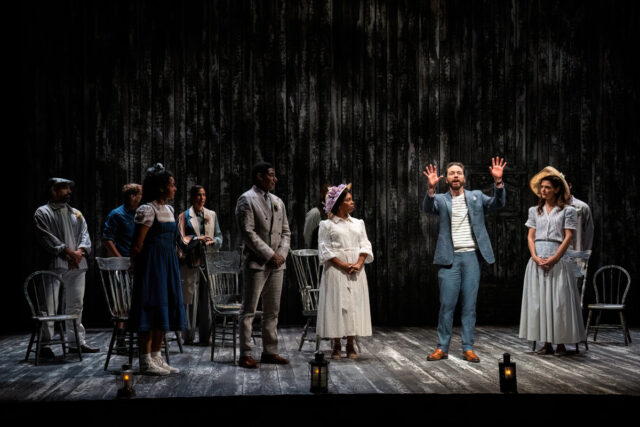
Toby Stephens stars as “Hatchet Man Watson” in J. T. Rogers’s Corruption (photo by T. Charles Erickson)

CORRUPTION
Lincoln Center Theater at the Mitzi E. Newhouse
150 West 65th St. between Broadway & Amsterdam Ave.
Tuesday – Sunday through April 14, $108
www.lct.org

In the last ten years, a handful of plays have successfully taken on the financial industry, the media, and politics in intriguing and involving productions often based on real-life events. In such works as Ayad Akhtar’s The Invisible Hand and Junk, Sarah Burgess’s Dry Powder, and James Graham’s Ink, capitalism trumps basic humanity in pursuit of money and power.

Brooklyn-based playwright J. T. Rogers follows the money and power in the provocative thriller Corruption, making its world premiere at Lincoln Center’s Mitzi E. Newhouse Theater.

Rogers delved into the Rwandan genocide in The Overwhelming, the Soviet war in Afghanistan in Blood and Gifts, and the Middle East peace process in the Tony-winning Oslo. Inspired by Tom Watson and Martin Hickman’s 2012 book, Dial M for Murdoch: News Corporation and the Corruption of Britain, he now turns his attention to the ripped-from-the-headlines true story behind the News International phone hacking scandal, in which the British tabloid News of the World was accused of breaking into thousands of people’s phones, from average citizens to politicians, celebrities, law enforcement, competitors, and the royal family, in order to get dirt and, essentially, blackmail them in order to sell more papers and gain further influence.

At the center of it all is Rebekah Brooks (usually portrayed by Saffron Burrows but I saw her understudy, Eleanor Handley), the ruthless editor of the paper and the company’s CEO. The show begins at her gala wedding, where she marries socialite and former horse trainer Charlie Brooks (John Behlmann); among the guests at the Sarsden Estate in Oxfordshire are Prime Minister Gordon Brown (Anthony Cochrane), Tory leader David Cameron, and freshly promoted News Corp head James Murdoch (Seth Numrich), the younger son of media mogul Rupert Murdoch, who remains unseen in the play but is a key figure throughout.

“Newspapers are a relic, Rebekah,” James says. Rebekah argues, “Now, James, the News of the World and the Sun are the backbone of this company. They are the engine that powers everything else.” James responds, “Save that speech for my father. You two can continue your newsprint romance when I’m not around. I’m here to grow this company. Going forward, change is the order of the day. From now on, our focus is television and new media. Everything else is expendable.”

Rebekah Brooks (Saffron Burrows) in under the microscope in ripped-from-the-headlines play (photo by T. Charles Erickson)

Meanwhile, after being excoriated in the Sun as a “hatchet man” for Prime Minister Brown, Watson (Toby Stephens), a member of Parliament, tells the PM that he needs a less visible role because the newspaper’s vitriol is affecting his wife, Siobhan (Robyn Kerr), and their young son. He instead accepts what is supposed to be a lackluster position on the Culture, Media, and Sport Select Committee. But when it is revealed that Gordon Taylor, president of the Professional Footballers’ Association, accepted a seven-figure payoff from News International to keep quiet about phone hacking, the committee starts investigating the case, which leads them to Brooks, former News of the World editor Andy Coulson (Numrich), and assistant police commissioner John Yates (T. Ryder Smith).

Despite pleas from his wife to let it go, Watson is driven to expose the corruption at nearly any cost, working with Guardian journalist Nick Davies (Smith), political foe Chris Bryant (K. Todd Freeman), New York Times reporter Jo Becker (usually Eleanor Handley but I saw a fine Doireann Mac Mahon), tainted multimillionaire Max Mosley (Michael Siberry), Independent journalist Martin Hickman (Sanjit De Silva), lawyer Charlotte Harris (Sepideh Moafi), and Paul (Behlmann) and Karie (Mac Mahon) from Watson’s staff. Leading the charge against them is News International chief counsel Tom Crone (Dylan Baker), who has Uncle Rupert’s ear, which enrages James, who thinks he is now running his father’s business.

Many of the key players risk their careers — and the lives of themselves and their families — as Watson can’t stop digging for the truth.

Paul (John Behlmann), Jo Becker (Eleanor Handley), and Tom Watson (Toby Stephens) uncover damning evidence in Corruption (photo by T. Charles Erickson)

Corruption is a taut cloak-and-dagger-style drama that makes a bold statement about where we are as a society as technology offers opportunities for abuse in the name of leverage, control, and domination. Cover-ups abound as strong-willed and determined men and women maneuver themselves, unable, or unwilling, to see the damage they are causing, personally and/or professionally. It’s the kind of story you wish couldn’t be true, but it’s all too real.

Michael Yeargan’s set consists of distressed walls evoking long-faded newsprint; movable, rearrangeable curved tables; and, above the stage, a circle of television monitors delivering a barrage of actual reports from multiple channels. Projections on the walls by 59 Productions reveal breaking news, social media posts, and important evidence. Jennifer Moeller’s costumes capture the essence of the characters, while Justin Ellington’s sound immerses the audience in the gripping narrative. Donald Holder’s lighting features three pairs of dazzling crisscrossing horizontal lines on the floor that change color, particularly as scenes shift, accentuating the fast pace as startling details emerge.

Tony-winning director Bartlett Sher (South Pacific, Joe Turner’s Come and Gone) builds the tension with skill and precision; even if you’re familiar with the story, there are many surprises in Rogers’s razor-sharp script, which feels economical even with a running time of more than two and a half hours (with intermission). The ensemble is excellent, led by Stephens (The Forest, Oslo), who refuses to quit regardless of the consequences; Handley (The Hard Problem, Jericho), who is superb as Brooks, a woman obsessed with expanding her influence; Kerr (The Great Society, Dark Vanilla Jungle) as Siobhan, who doesn’t understand why Tom cannot choose his family over his job; and Baker (La Běte, Not About Horses) as both the smarmy, egotistical lawyer Crone and the mysterious investigator Glen Mulcaire. Siberry seems right at home as Mosley, following his appearances in such other hard-hitting financial works as Ink and Junk.

The one-word title is not as simple as it may at first seem; the play is specifically about the News International phone hacking scandal, but it also alludes to rampant business and political crime that is growing throughout so many sectors of society, with no end in sight, particularly because the media itself is among the guilty.

[Mark Rifkin is a Brooklyn-born, Manhattan-based writer and editor; you can follow him on Substack here.]