Tag Archives: Justin Ellington

TOPDOG/UNDERDOG

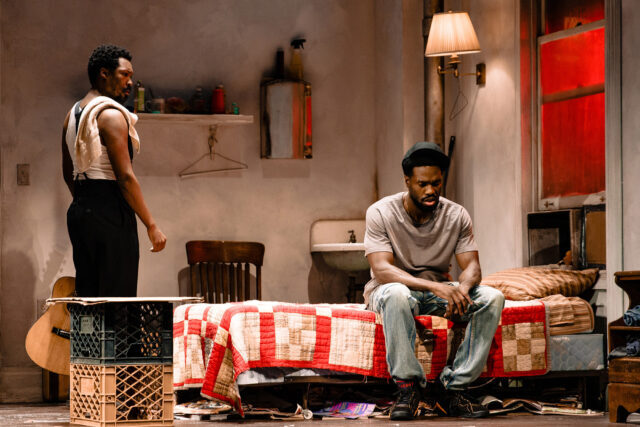
Siblings Lincoln (Corey Hawkins) and Booth (Abdul-Mateen II) face hard times in Topdog/Underdog (photo by Marc J. Franklin)

TOPDOG/UNDERDOG
Golden Theatre
336 West 20th St. between Eighth & Ninth Aves.
Tuesday – Sunday through January 15, $84-$248
topdogunderdog.com

“Theater will save the universe!” the writer, portrayed by Suzan-Lori Parks, declares in Parks’s theatrical concert Plays for the Plague Year, a sensational three-hour show that recently concluded a Covid-shortened run at Joe’s Pub. Later, she adds, “Yeah, maybe when I started I had this belief that theater would save us. But it won’t. Not in the way I thought it would. But it does preserve us, somehow.”

In honor of its twentieth anniversary, Parks’s Pulitzer Prize–winning Topdog/Underdog is being revived on Broadway at the Golden, just in time to preserve us.

Topdog/Underdog takes place in the here and now, as two brothers contemplate their fate in their cramped, tiny apartment in a rooming house. Older sibling Lincoln (Corey Hawkins), the topdog, was dumped by his wife, Cookie, and works at an arcade, where he dresses up as President Abraham Lincoln at Ford’s Theatre, slouching over and over again as patrons pay to shoot him with a fake pistol.

Booth (Abdul-Mateen II), the underdog, is a petty thief who is attempting to get back together with his ex-girlfriend, Grace, and learn how to master three-card monte, a con game in which people are duped into thinking they can pick a specific card as the dealer, aided by carefully placed accomplices, magically shuffles three cards. Lincoln was a three-card monte master, but he gave it up after one of his partners was shot and killed. Booth wants his brother to teach him, but Lincoln refuses, even though his job is in jeopardy. “They all get so into it. I do my best for them,” he says about the arcade patrons. “And now they talking bout replacing me with uh wax dummy. Itll cut costs.”

The brothers were abandoned first by their mother, who gave them each a small “inheritance,” then by their father, leaving them on their own when Lincoln was sixteen and Booth thirteen. Booth looks up to Lincoln’s three-card monte prowess and begs him to teach him to become a dealer; he doesn’t understand why Lincoln won’t help him out with the game.

They might live in squalor, but they both dream of a better life. There’s only one bed, so Lincoln sleeps in a recliner; the bathroom is down the hall, and their sink, which has no running water, is instead a storage space for Lincoln’s guitar; their phone has been turned off; and they have no table, so they use a large piece of cardboard atop milk crates to eat on. That arrangement doubles as Booth’s three-card monte table, except he angles the cardboard down for the game, as if everything is on the precipice of slipping away. (The claustrophobic set is by Arnulfo Maldonado, with costumes by Dede Ayite, lighting by Allen Lee Hughes, and sound by Justin Ellington.)
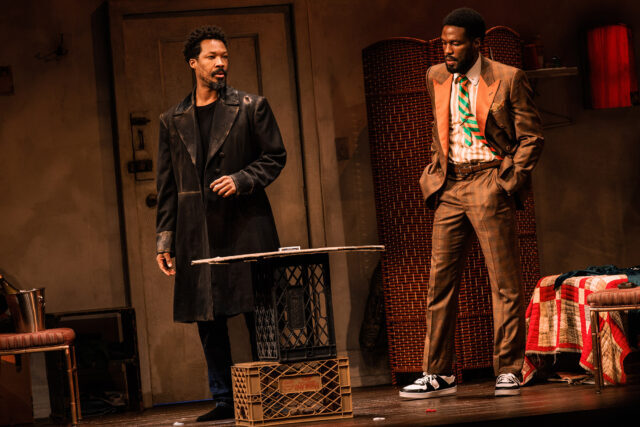
Lincoln (Corey Hawkins) and Booth (Abdul-Mateen II) consider teaming up for three-card monte in Pulitzer Prize–winning play by Suzan-Lori Parks (photo by Marc J. Franklin)

At one point Lincoln picks up his guitar and plays an improvised blues song. “My dear mother left me, my fathers gone away / My dear mother left me and my fathers gone away / I dont got no money, I dont got no place to stay. / My best girl, she threw me out into the street / My favorite horse, they ground him into meat / Im feeling cold from my head down to my feet,” he sings. “My luck was bad but now it turned to worse / My luck was bad but now it turned to worse / Dont call me up a doctor, just call me up a hearse.” The luck of the draw is an underlying theme of the show; Lincoln is adamant that three-card monte has nothing to do with luck but only skill, and when he celebrates a little victory, he goes to a bar named Lucky’s.

It all leads to a shocking ending that will echo in your head long after the show is over.

Topdog/Underdog pulsates with an electrifying energy as a cloud of doom hovers over the proceedings. Parks’s (Fucking A, The Death of the Last Black Man in the Whole Entire World AKA the Negro Book of the Dead) dialogue is pure poetry as she explores the Black experience in America from slavery to the present day, every sentence loaded with significance as it challenges stereotypes and selective history. The play reestablishes itself as part of the pantheon of outstanding works about two siblings at odds, along with such plays as Sam Shepard’s True West, Lyle Kessler’s Orphans, and August Wilson’s The Piano Lesson.

Tony winner Kenny Leon (A Raisin in the Sun, A Soldier’s Play) directs the play like a modern-dance choreographer, with nary a stray movement and gesture. Tony nominee Hawkins (In the Heights, Six Degrees of Separation) and Emmy winner Abdul-Mateen II (Watchmen, Candyman) are a formidable duo in roles originated by Jeffrey Wright and Don Cheadle at the Public in July 2001 (and on Broadway in April 2002). In his Broadway debut, Abdul-Mateen II portrays Booth with an edginess and a false bravado, his relationship with the world off kilter, while Hawkins offers up a Lincoln who is exhausted but unwilling to give up as he tries desperately to go straight.

In Plays for the Plague Year, the writer points out that she celebrates January 6 as Topdog Day, when she began writing Topdog/Underdog, but now it will go down in history as the date that MAGA rioters stormed the Capitol. Shows like Topdog/Underdog might not save us from such horrific events, but they do extend life preservers that help us survive them. “‘Does thuh show stop when no ones watching or does thuh show go on?’” Lincoln recalls one of his customers asking. The show must always go on.

CORSICANA

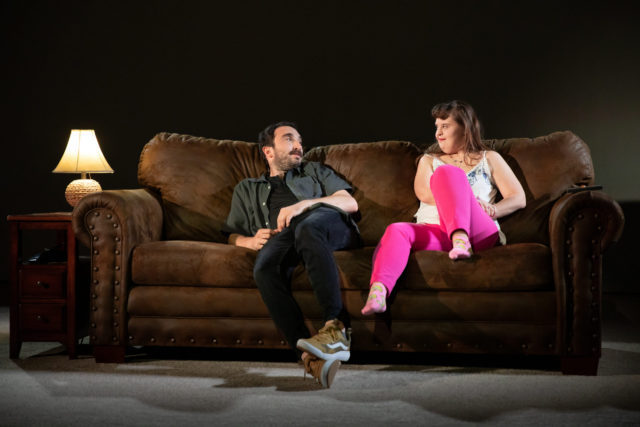
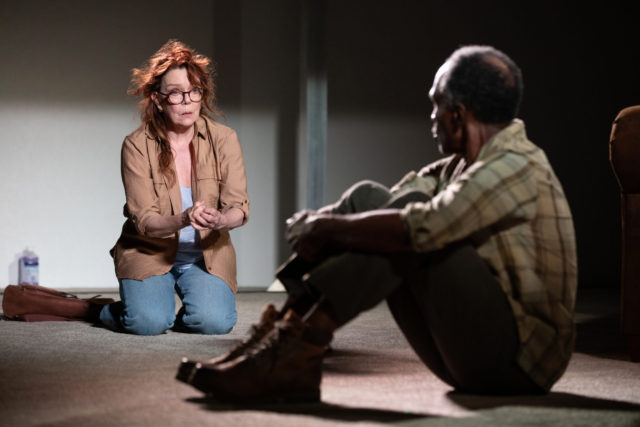
Justice (Deirdre O’Connell), Christopher (Will Dagger), and Ginny (Jamie Brewer) watch Mariah Carey in Glitter in Corsicana (photo by Julieta Cervantes)

CORSICANA
Playwrights Horizons, Mainstage Theater
416 West 42nd St. between Ninth & Tenth Aves.
Tuesday – Sunday through July 17, $35-$99
www.playwrightshorizons.org

In her acceptance speech for winning the Tony for Best Actress for her performance in Dana H., Deirdre O’Connell said, “I would love this little prize to be a token for every person who is wondering, ‘Should I be trying to make something that could work on Broadway or that could win me a Tony Award? Or should I be making the weird art that is haunting me, that frightens me, that I don’t know how to make, that I don’t know if anyone in the whole world will understand?’ Please let me standing here be a little sign to you from the universe to make the weird art.”

O’Connell has followed up Dana H., in which she never speaks but instead remarkably conveys a prerecorded true story told by playwright Lucas Hnath’s mother, with Will Arbery’s Corsicana, which has its fair share of weird, starting with the word itself, which is spoken two dozen times by the four characters, each of whom lives in their own reality.

Corsicana takes place in the Texas town named after the island of Corsica. Thirty-three-year-old Christopher (Will Dagger) is a teacher and an aspiring filmmaker who lives with his thirty-four-year-old half sister, Ginny (Jamie Brewer), in the family’s ranch house. They are often visited by the sixtysomething Justice (Deirdre O’Connell), who was best friends with their recently deceased mother.

After her mom’s death, Ginny, who has Down syndrome, is looking for something new to do. She doesn’t want to go back to her job at the nursing home or rejoin the choir because she feels she doesn’t belong. “I’m worried. I can’t find my heart,” she tells her brother.

Ginny had suggested that Ginny meet her friend Lot (Harold Surratt), a sixtysomething reclusive artist and musician who has just been “discovered” via a magazine article; Christopher thinks it might be good for Ginny to write a song with Lot, who previously played an original song for Christopher called “Weird.” (The original music is by singer-songwriter and visual artist Joanna Sternberg.)

A self-taught outsider artist, Lot is a loner who has trouble communicating directly with others, speaking in a sharp, straightforward manner, using few words and prone to non sequiturs; he has no phone or computer. He doesn’t want to interact with either the virtual or real world. And although he believes he may be neurodivergent, he is not about to be a babysitter for a woman with special needs.

Justice (Deirdre O’Connell) pleads with Lot (Harold Surratt) in new Will Arbery play (photo by Julieta Cervantes)

He tells Christopher: “Yeah, I know ‘special needs.’ Why’d you come here? I know the place in the high school. The hallway in the high school. You know I’m not one of them, right?” Christopher replies, “What?” Lot: “I’m not special needs.” Christopher: “Oh — I didn’t think you were. I assumed the opposite.” Lot: “What’s the opposite? I was only a couple years in that hallway. And they knew I didn’t belong. Got a graduate degree in my forties. So don’t worry about me.” Christopher: “Oh, cool. In what?” Lot: “Experimental mathematics. I proved the existence of God.” Christopher: “Are you serious? Can I see?” Lot: “I threw it away. Art’s a better delivery system.”

Art may be a better delivery system, but Lot prefers not to show anyone his work or exhibit in a gallery, or to even sell it. When Justice, who believes she is being trailed by a ghost, asks to see his latest sculpture, he declares, “No, it’s not ready! You’re not allowed to look back there.” The audience is not allowed to look either; none of Lot’s work is ever revealed. He later compares capitalism and consumption as a “prison . . . a man-made evil.” He also claims that they are all surrounded by dinosaur ghosts.

As the characters continue to interact with one another, Lot is fearful about becoming part of something. “You trying to get me to believe in community?” he asks Justice, who replies, “No. I have no agenda.” Lot: “Uh-huh.” Justice: “What do you have against community?” Lot: “I don’t have to have all the same opinions as you,” as if choosing to spend time with people is an opinion.

But he does find common ground with Ginny, explaining that the two of them are “so complicated, people don’t want to think about it. So they make us more simple. In their brains. They don’t think about it, and they call us simple. And everything is about our needs. All our little needs. Our special needs. Everyone around us becoming burdened by our constant need. And if there’s something that we want? Well, it’s for them to decide if we really need it.”

Over the course of the play, all the characters find some form of commonality with the others while also maintaining barriers, particularly when it comes to physical contact of any kind. “People have to understand touch, and ask for permission, and respect boundaries,” Ginny tells Lot. “Touch can cause problems.”

Obie- and Tony-winning director Sam Gold, who has helmed such marvelously inventive productions as Fun Home, John, and A Doll’s House, Part 2 in addition to critically lambasted versions of King Lear, Hamlet, and Macbeth, injects Corsicana with, well, a weird edge throughout. Laura Jellinek and Cate McCrea’s stage consists of a pair of rotating brown couches set against a white backdrop and ceiling, but Justice and Lot spend time sitting on the floor. Often, when two characters are interacting, one or both of the other actors watch from the far corners. Several times, two of the actors push poles to move part of the set toward the audience in order to change Isabella Byrd’s canopy lighting. Meanwhile, the long, horizontal, slanted back white wall serves as the entrance to Lot’s studio, which he often locks to keep people out of his space — and head.

Christopher (Will Dagger) and Ginny (Jamie Brewer) seek connections in Corsicana (photo by Julieta Cervantes)

There is a lot of repetition in the play, which could use a significant amount of trimming from its two-and-a-half-hour length (including intermission). The terrific cast is led by Surratt’s (Familiar, Serious Money) powerful performance as the antisocial Lot — evoking the biblical figure who lived in Sodom, “a righteous man who was tormented in his soul by the wickedness he saw and heard day after day” — primarily standing stiffly upright when talking as he, Justice, Christopher, and Ginny form a kind of found family. Arbery (Pulitzer finalist Heroes of the Fourth Turning, Plano), who is from Texas and Wyoming, based Christopher and Ginny on himself and one of his seven sisters, who has Down syndrome. He also knows about unique families, having served as executive consultant on the third season of Succession.

Brewer (American Horror Story, Amy and the Orphans) brings an unfettered honesty to Ginny, Dagger (Among the Dead, The Antelope Party) is appropriately offbeat as Christopher, and O’Connell (Circle Mirror Transformation, In the Wake) is just the right kind of quirky as the, um, weird Justice, who is writing a book that echoes the subject of Arbery’s play. She explains to Christopher:

“Well, it’s about anarchism and gifts. About the belief that humans are fundamentally generous, or at least cooperative. That in our hearts, most of us really do want the good. It’s about the evils of centralized power, specially in a country as massive as the USA, let alone a state as big as Texas. It’s about an unforgiving land. It’s about unrealized utopias. It’s about how failing is the point. It’s about surrender. It’s about small groups. It’s about community. It’s about the right to well-being. It’s about family. It’s about the dead. It’s about ghosts. It’s about gentle chaos. It’s about contracts of the heart. And the belief that when a part of the self is given away, is surrendered to the needs of a particular time, in a particular place, then community forms. From the ghosts of the parts of ourselves we’ve given away. A new particular body. Born of our own ghosts. I don’t know. It’s about Texas.”

And there’s nothing weird about that. (Is there?)

THE MERCHANT OF VENICE

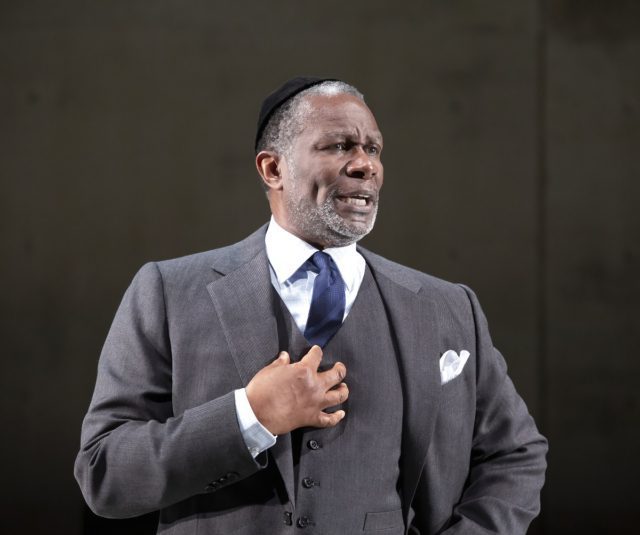
John Douglas Thompson is extraordinary as Shylock in TFANA production of The Merchant of Venice (photo by Henry Grossman)

THE MERCHANT OF VENICE
Theatre for a New Audience, Polonsky Shakespeare Center
262 Ashland Pl. between Lafayette Ave. & Fulton St.
Through March 6, $75-$85
866-811-4111
www.tfana.org

Arin Arbus reimagines a Merchant of Venice for this moment in time in her ingenious adaptation of the Bard’s challenging tragedy, continuing through March 6 at TFANA’s Polonsky Shakespeare Center. A coproduction with DC’s Shakespeare Theatre Company, the play is Arbus’s fourth collaboration with classical treasure John Douglas Thompson, following Macbeth, Othello, Ibsen’s A Doll’s House, and Strindberg’s The Father. Thompson is heart-wrenching as Shylock, the first professional Black actor to play the role in New York City since Ira Aldridge in the 1820s.

When the lights go out, the full ensemble comes out in regular dress, signaling they are performers, not the characters they are about to portray. A moment later the show begins, with the cast in contemporary costumes by Emily Rebholz — blazers, jeans, sneakers, gym clothes, suits. Riccardo Hernandez’s set is an imposing faux marble wall and steps, with a large black hole in the upper center, as if the sun and moon are both gone. The characters enter and leave through two doors, the wings, or the aisles, almost as if they’re part of the audience.

In order to woo the wealthy, beautiful heiress Portia (Isabel Arraiza), the noble Bassanio (Sanjit De Silva) asks his close friend, Venetian merchant Antonio (Alfredo Narciso), to borrow three thousand ducats from respectable Jewish moneylender Shylock. Shylock is tired of being mocked because of his religion, and he lets Antonio know it. He tells the brash Antonio, “Many a time and oft / In the Rialto you have rated me / About my moneys and my usances: / Still have I borne it with a patient shrug, / For sufferance is the badge of all our tribe. / You call me misbeliever, cut-throat dog, / And spit upon my Jewish gaberdine, / And all for use of that which is mine own. / Well then, it now appears you need my help: / Go to, then; you come to me, and you say / ‘Shylock, we would have moneys:’ you say so; / You, that did void your rheum upon my beard / And foot me as you spurn a stranger cur / Over your threshold: moneys is your suit / What should I say to you? Should I not say / ‘Hath a dog money? is it possible / A cur can lend three thousand ducats?’ Or / Shall I bend low and in a bondman’s key, / With bated breath and whispering humbleness, Say this; / ‘Fair sir, you spit on me on Wednesday last; / You spurn’d me such a day; another time / You call’d me dog; and for these courtesies / I’ll lend you thus much moneys’?”

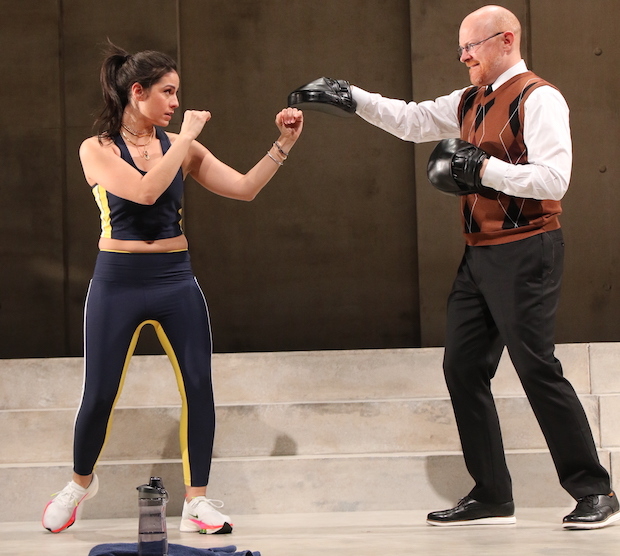
Portia (Isabel Arraiza) works out with her servant Balthazar (Jeff Biehl) in The Merchant of Venice (photo © Gerry Goodstein)

It’s a powerful speech that sets the stage for the relationship between Shylock and the others; he is clearly well educated and eloquent, but despite his passionate entreaty, the Christians treat him with scorn and disdain. Antonio needs to obtain the money for Bassanio, but he cannot help but still belittle Shylock.

“I am as like to call thee so again, / To spit on thee again, to spurn thee too,” he tells him. “If thou wilt lend this money, lend it not / As to thy friends; for when did friendship take / A breed for barren metal of his friend? / But lend it rather to thine enemy, / Who, if he break, thou mayst with better face / Exact the penalty.”

The penalty is a harsh one: Instead of charging Antonio interest, Shylock says he will take a pound of Antonio’s flesh if he doesn’t return the three thousand ducats in three months’ time. Certain that his merchant ships will come back successfully a month before the agreement ends, Antonio signs the contract.

Antonio and Bassiano are often accompanied by their sycophantic bros: snarky, sunglasses-wearing, cocktail-swilling yuppie Gratiano (Haynes Thigpen), who is funny until he isn’t; Solanio (Yonatan Gebeyehu) and Salerio (Graham Winton); and Lorenzo (David Lee Huynh), who wants to elope with Shylock’s daughter, Jessica (Danaya Esperanza), and convert her to Christianity to further her father’s shame. In addition, Shylock’s servant, the goofy Lancelot Gobbo (Nate Miller), who wears his jeans very low, quits his job with the moneylender and moves on to Bassiano. “For I am a Jew, if I serve the Jew any longer,” Lancelot says.

Meanwhile, two suitors beat Bassanio to try to win Portia’s hand. First Prince Morocco (Maurice Jones), then Prince of Aragon (Varín Ayala), must choose wisely among three caskets, one of which holds the key to Portia’s heart — and fortune. On the gold one is inscribed, “Who chooseth me shall gain what many men desire,” on the silver “Who chooseth me shall get as much as he deserves,” and on the lead “’Who chooseth me must give and hazard all he hath.”

Portia is attended by her servant Balthazar (Jeff Biehl) and her maid, Nerissa (Shirine Babb); the latter is supremely efficient, while the former offers comic relief, flirting hysterically with many of the men he meets and, when Portia asks for music, uses his iPhone. (The sound and original music is by Justin Ellington.)

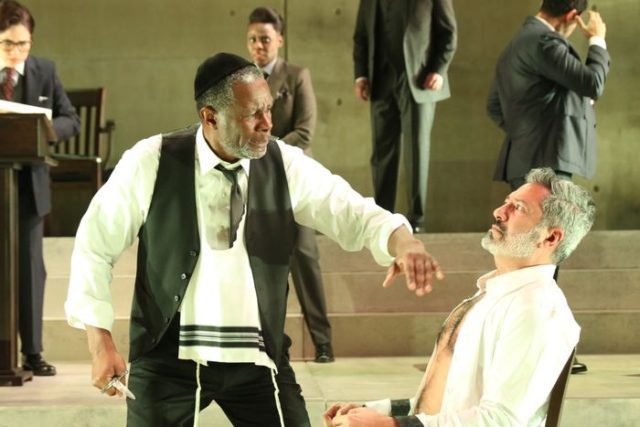
Shylock (John Douglas Thompson) demands a pound of flesh from Antonio (Alfredo Narciso) in Shakespeare tragedy (photo © Gerry Goodstein)

It all leads up to one of the great trial scenes in all of theater, a brutal battle of wits in which Shylock, who is suing Antonio for his pound of flesh, represents not only Jews and Blacks, both of whom have histories of being enslaved and discriminated against up to the present day, but, in essence, all of humanity who have suffered hatred and oppression at the hands of tyrants and bigots.

Throughout its four-century existence, The Merchant of Venice has likely been performed by troupes that glorified anti-Semitism and was cheered on by audiences that agreed with Antonio and his friends’ views of Jews, as well as by companies and audiences that had deep sympathy for Shylock’s plight. But Arbus achieves something different.

The casting is diverse but not random; by having Shylock and Jessica portrayed by Black actors, Arbus is making a powerful statement, particularly in the socioeconomic reckoning that has taken hold in the wake of the police murder of George Floyd. With his gentle cracked whisper of a hoarse voice that comes from deep in his soul, the British-born Thompson (Jitney, The Iceman Cometh) is unforgettable as Shylock, not merely following in the footsteps of Laurence Olivier, F. Murray Abraham, George C. Scott, Al Pacino, Jonathan Pryce, and Patrick Stewart but making the role his own.

When Shylock, who is repeatedly referred to as a dog, a villain, a cur, and the devil, asks, “If you prick us, do we not bleed? / If you tickle us, do we not laugh? / If you poison us, do we not die? / And if you wrong us, shall we not revenge?” Thompson is speaking for all the downtrodden; Shakespeare’s words echo down the ages: Sojourner Truth’s “Ain’t I a Woman?” speech leaps to mind as well. When Shylock tells the court, “Proceed to judgment: by my soul I swear / There is no power in the tongue of man / To alter me: I stay here on my bond,” Thompson speaks for all who resist injustice.

Arraiza shines as Portia, whether working out, dressed in an elegant gown with stiletto heels, or disguised as a learned doctor. Arbus ratchets up the homoeroticism by having Bassanio and Antonio be very good friends, while Biehl practically waves the Gay Pride flag as Balthazar. As serious as the subject matter is, Arbus includes plenty of fun and good humor; Biehl and Miller in particular often make vocal and gestural asides that are hilarious and certainly not in the original script.

“The quality of mercy is not strained, / It droppeth as the gentle rain from heaven / Upon the place beneath. It is twice blest: / It blesseth him that gives and him that takes,” Portia says in Act 4. We are blessed to have such a thrilling production of this dark tragedy; if only all were blessed equally with mercy in these dark times.

TAMBO & BONES

Tambo (W. Tré Davis) and Bones (Tyler Fauntleroy) channel Didi and Gogo from Waiting for Godot in new David Harris play (photo by Marc J. Franklin)

TAMBO & BONES
Playwrights Horizons, Mainstage Theater
416 West 42nd St. between Ninth & Tenth Aves.
Tuesday – Sunday through February 27, $30-$54
www.playwrightshorizons.org

In the past few years, several shows by Black playwrights have shattered the fourth wall in unique ways, challenging their majority white audiences by separating the line between fact and fiction, audience and performer. Two such examples are Jordan E. Cooper’s Ain’t No Mo’ and Jackie Sibblies Drury’s Pulitzer Prize–winning Fairview, both of which included participatory elements that placed systemic racism front and center while understanding precisely where their bread was buttered, balancing humor with recrimination.

David Harris’s new show, Tambo & Bones, which opened tonight at Playwrights Horizons, turns the tables on Black trauma porn in similar ways, incorporating Afrofuturism in its self-referential exploration of the past, present, and future of Black performers entertaining white audiences. Aggressively directed by Taylor Reynolds with a razor-sharp sense of wit and whimsy, the show, divided into three sections, expands on the concepts of minstrelsy — what Harris, who was a popular spoken word poet, refers to as “Black performative capitalism” — and freedom in different, not-always-obvious forms while scrutinizing what is real (life), what is fake (theater), and how they intertwine.

As Harris contends in his Playwright’s Perspective program note, “The most fun part about writing is that every writer I know is a fucking liar. Some think this is radical political work. Some think writing is to channel the ancestors and the woo-woos to put voice to page. But all of this is just tactic. This was the realization that made me stop doing poetry slams and start to focus on theater. I wasn’t growing as an artist; I was growing as someone who could perform identity. Spoken word capitalizes on an idea of the authentic identity. The real person. But here, in this theater, all of us know that every second of this experience is fake. And there is infinite possibility in that reality. And the pleasure is in the possibility.”

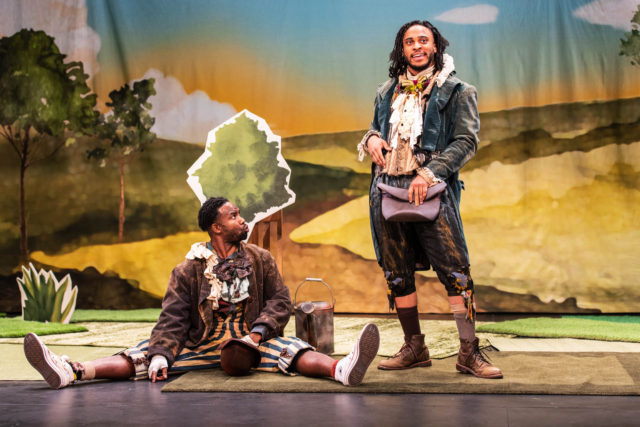
The play begins in a garden that looks like it was made for an elementary school musical. In his stage directions, Harris refers to it as “a fake ass pasture. Some fake ass trees and a fake ass bush. A fake ass sky with a fake ass sun. A lil bit of fake ass grass. Yo it’s fake ass pastoral out here.” Tambo (W. Tré Davis) is trying to grab a nap, moving a cardboard tree so he can relax in the shade. “It ain’t fake if I believe in it,” he says, getting to the heart of what theater is about, at least for a few hours.

But then Bones (Tyler Fauntleroy) arrives and ruins his friend’s rest by asking the audience for quarters so he can visit his son in the hospital for his birthday, all of which turn out to be lies. He also performs a lame trick with a knife to get more quarters. Tambo insists he is going about it all wrong.

“You gotta make em think. Stimulation, know what I mean?” Tambo explains. “And how do you do that?” Bones asks. Tambo replies, “You gotta deliver a treatise on race in America.” Bones: “Whaaaaaat?” Tambo: “Yup. Trendy intellectual shit.”

The scene is Harris’s reimagining of Samuel Beckett’s Waiting for Godot; both men wear old-fashioned hats and raise existential questions while waiting for something to happen. Bones is dressed in a raggedy costume that resembles Lin-Manuel Miranda’s military uniform in Hamilton, a show that used a Black and brown cast to entertain a predominantly white audience that patted themselves on the back for enjoying such a racially diverse musical about the Founding Fathers. But Tambo and Bones are not as passive as Vladimir and Estragon; instead of waiting for a mystery man to arrive, they go after the person responsible for their situation: the playwright.

“Why did this n—a write us into a minstrel show?” Tambo proclaims. “He could’ve written anything he wanted, and he chose to write this. You couldn’t give us no quarters in your show? You had to make us struggle n shit?” Bones replies, “Maybe he wanted all the quarters for himself.”

David Harris world premiere includes a hip-hop concert at Playwrights Horizons (photo by Marc J. Franklin)

In the second part, Tambo and Bones have become hip-hop superstars, covered in bling and rapping on a smoky stage with their names in lights. They blast such songs as “Started from the Cotton,” “Bootstrappin,” “Racism Is Bad,” and “Crack Rocks Crackin” as the audience, most of whom have probably never been to a live rap concert, dance in their seats, sing along, and wave their hands in the air like they just don’t care. But while Bones is reveling in their newfound wealth and success, Tambo still feels a responsibility to speak truth to power. “We here to have a mothafuckin party,” Bones shouts to the adoring crowd. Tambo adds more quietly, “And also provide commentary on some shit.”

The third section takes place four hundred years in the future — not a random number — as a seminar looks back at the legacy of Tambo and Bones and the history of race relations in America. It’s not an easy pill to swallow, reminding me of such other recent plays as Thomas Bradshaw’s 2019 revival of Southern Promises and Jeremy O. Harris’s Slave Play in how they relate to the audience.

Davis (Seared, Zooman and the Sign) and Fauntleroy (Tempest, Looking for Leroy) portray their carefully constructed stereotyped characters with a savvy appreciation of what they stand for in today’s world, paradigms of the Black experience in America, in theater and the rest of society, which tends to be not as forgiving as well-heeled off-Broadway audiences. “I’m just pondering my purpose n shit,” Bones says in the pasture. “You ain’t happy wit ya life as it is?” Tambo asks. “I read somewhere that happiness is just an illusion like sunlight,” Bones answers.

The first two sections feature stellar sets by Stephanie Osin Cohen, costumes by Dominique Fawn Hill, lighting by Amith Chandrashaker and Mextly Couzin, sound by Mikhail Fiksel, and music by Justin Ellington. The final scene is more ramshackle; it feels like Harris knew exactly what he wanted to say but is still working on how to accomplish it, resulting in a messy conclusion that still provides plenty of food for thought.

“It is not enough to demand insight and informative images of reality from the theater,” Bertolt Brecht wrote, describing what he called the alienation effect. “Our theater must stimulate a desire for understanding, a delight in changing reality. Our audience must experience not only the ways to free Prometheus, but be schooled in the very desire to free him. Theater must teach all the pleasures and joys of discovery, all the feelings of triumph associated with liberation.”

Tambo & Bones is a prime example of the alienation effect, but it comes with a fierce smackdown. By the end, you may simultaneously want to cheer wildly and cower in your seat. Harris (White History, Incendiary) and Reynolds (The Most Spectacularly Lamentable Trial of Miz Martha Washington, Plano) use form and genre to overturn expectations and confront an audience that is likely to revel in that challenge, then further contemplate what happened when they get home and think more about the show.

“Throughout my life, I’ve found myself continually in white spaces, and continually rebelling against white spaces, and continually finding that that rebellion has also led to me gaining in some way,” Harris admits in a Playwrights conversation with Reynolds. “I literally ask myself: what am I doing here besides trying to gain the currency of laughter, or the currency of someone thinking that I’m cool for writing this? Am I putting this up for an audience just because I want an audience?” Reynolds replies, “It’s awesome to hear you dig a little deeper into the play’s relationships with and to whiteness. And it’s not just that we are being held down by specific white people who have enslaved us — it’s also capitalism. The play puts capitalism on blast and I am so intrigued to see what the response will be from Playwrights Horizons audiences.”

Having now witnessed that response, I can say that it is, at the very least, intriguing. Harris’s next play, Exception to the Rule, will have its world premiere at Roundabout Underground in April. I already have my tickets.

STEPPENWOLF NOW: WHAT IS LEFT, BURNS

Keith (K. Todd Freeman) and Ronnie (Jon Michael Hill) reconnect online after fifteen years in What Is Left, Burns (photo by Lowell Thomas)

WHAT IS LEFT, BURNS
Steppenwolf Theatre Company
Through November 30, virtual membership for six shows $75
www.steppenwolf.org

The pandemic lockdown of theaters across the country has come with a side benefit that I hope you’re all taking advantage of: the opportunity to see live and prerecorded work by companies around the world from the comfort of your home. Of course, it’s not the same thing as sitting in a dark venue, being part of an audience, watching a story unfold in the same time, air, and space as the performers, but we have to make do with what we have. I’ve been particularly drawn to theater and dance created during the crisis as creators experiment with Zoom and other platforms to bring entertainment to a public starved for it. Which is why I’m excited that Chicago’s fabled Steppenwolf Theatre has just kicked off its Steppenwolf NOW program, a virtual series that consists of six online works through June 2021.

First up is James Ijames’s What Is Left, Burns, streaming this month. During the health crisis, people have been communicating more than ever via video, logging on with friends and family, sometimes digging deep into the past to reach out to those who might not be part of their lives anymore. In What Is Left, Burns, a literature professor and a former student reconnect after fifteen years, bringing up long-left-unsaid feelings as they take stock of their lives without each other. “It’s been a long time,” says the younger Ronnie (Jon Michael Hill) with a big smile. “Yeah, it has. Actually, honestly, I wasn’t sure you’d respond to my email,” replies the older, tentative Keith (K. Todd Freeman). “I wasn’t sure either,” the more open and emotional Ronnie says. Over the course of twenty-three minutes, the full extent of their relationship is revealed, involving love, lies, personal and professional jealousy, and, above all, loneliness, which we each have been facing in our own ways during Covid-19.

Though not about the pandemic, What Is Left, Burns is tailor-made for our current state of mind. By now we are used to watching others on our computers like never before, and Tony nominees Freeman (The Song of Jacob Zulu, Airline Highway) and Hill (Eastbound & Down, Superior Donuts), who last performed together onstage in 2009 in Tina Landau’s production of The Tempest at Steppenwolf — Freeman as Caliban, Hill as Ariel — do an outstanding job of making us feel just the right amount of uncomfortable as we peer into their private conversation; Freeman is appropriately jittery as Keith, who is hesitant to share too much at the outset, while Hill is bright and engaging as the bubbly Ronnie, who smiles widely even as he harbors discontent at what happened between them. Ijames uses his experience as a director (The Brothers Size), playwright (Kill Move Paradise), and actor (Angels in America) — he portrayed Franco in a Philly production of Superior Donuts, the role that earned Hill a Tony nomination — to craft an intimate tale that works on multiple levels.

Director Whitney White rhythmically cuts from Keith, sitting in his chair with books, CDs, and photos around him, as well as a computer open to the TED Legacy Project talk “The fight for civil rights and freedom” with John Lewis and Bryan Stevenson, while Ronnie is in front of a much more sparse background as he moves throughout his apartment. White (What to Send Up When It Goes Down, Our Dear Dead Drug Lord) adds interstitial abstract scenes that bathe the two boxes in mysterious pastel blues, greens, and reds, with droning sound and music by Justin Ellington that take us further into the characters’ complex psyche. Lowell Thomas serves as director of photography and video editor, using iPads, laptops, and phones from multiple angles to avoid the action becoming too static, which is the case with so many Zoom presentations. What Is Left, Burns is a strong start to Steppenwolf NOW, which continues with Isaac Gómez’s two-act radio play Wally World in December, Rajiv Joseph’s ten-minute Red Folder with Carrie Coon in January, Vivian J. O. Barnes’s Duchess! Duchess! Duchess! in February, Donnetta Lavinia Grays’s Where We Stand in April, and Sam Shepard’s Ages of the Moon with Randall Arney and William Petersen in June.

one in two

(photo by Monique Carboni)

Edward Mawere, Leland Fowler, and Jamyl Dobson star in Donja R. Love’s New Group world premiere, one in two (photo by Monique Carboni)

The New Group at the Pershing Square Signature Center
The Alice Griffin Jewel Box Theatre
480 West 42nd St. between between Ninth & Tenth Aves.
Through January 12, $33-$63
thenewgroup.org

Donja R. Love’s one in two presents the human side of numbers and elements of chance that are staggering: According to the CDC, fifty percent of queer and bisexual black men will contract HIV. Yes, one in two. The eighty-five-minute New Group world premiere takes place on Arnulfo Maldonado’s brilliant set, a blindingly white otherworldly waiting room that wittily morphs into a bar, a bedroom, a hospital room, and other locations. At the top of the back wall, three windowlike panels display numbers that move sequentially, reminiscent of the countdown clock in Lost, except here they go up, tallying the HIV toll second by second. But Love, who wrote the play in his notes app as he approached the tenth anniversary of his testing positive — and “experiencing suicidal ideations,” he explains in a program pamphlet — has not created a somber melodrama about disease. Instead, under the superbly inventive direction of Stevie Walker-Webb, one in two is as funny as it is serious, making its points in complex, intricate scenes filled with humor and intelligence.

As you enter the Alice Griffin Jewel Box Theatre at the Pershing Square Signature Center, there are three shirtless men onstage, lounging about as if in a sauna that is not quite right. They take numbers from a ticket dispenser and then play Rock Paper Scissors to determine who will be #1, #2, and #3. (The actors have to know the lines for each character, since their part could change from one night to the next, the chances one in three.) At the show I saw, Leland Fowler was #1, who becomes Donté Hart, a young man who has just learned that he has HIV and the only character to have an actual name. Edward Mawere was #2, and Jamyl Dobson #3; they both play multiple roles, including a nurse, a bartender, Donté’s mother, Kinda Ex-Boyfriend, Married Man at the Center, Trade Hung Like Horse Underscore 99, and Man of Your Dreams. Fowler, Mawere, and Dobson have an intoxicating camaraderie that is a joy to watch, perhaps because each one so well understands the other men’s roles, since they have played them numerous times as well.

(photo by Monique Carboni)

#1 (Leland Fowler) gesticulates wildly while facing a positive diagnosis in brilliantly realized play at the Signature (photo by Monique Carboni)

The trio goes back and forth in time, performing key moments from Donté’s life, fully aware that they are play-acting, occasionally breaking away to express their displeasure about what is happening onstage. “I don’t want to be the mom,” #3 says as a scene ends with him as the nurse. “If you don’t have to then neither, neither do I,” #2 replies. “Well, somebody’s gotta do it,” #1 argues. The one who becomes the mom puts on a colorful flowing wrap that is turned inside out for another role, the name of which can’t be printed here. (Andy Jean’s costumes also feature black T-shirts with the numbers 1, 2, and 3 on them to help identify who’s who.) The play has a powerful conclusion that resonates deeply; Love (Sugar in Our Wounds, Fireflies) and Walker-Webb (Ain’t No Mo’) avoid proselytizing and are not seeking sympathy; instead, they have an important narrative to share, and they do so with great skill and compassion while breaking through theatrical conventions. “I’m not just a number. I’m flesh. I’m blood. I feel,” #1 says early on. He’s not just a number, and as the play demonstrates, he might be number one, but his positivity affects so many others in his life. As Love writes in the pamphlet, one in two is “the story of a community — a community that’s in a hidden state of emergency.”

HEROES OF THE FOURTH TURNING

(photo by Joan Marcus)

It’s Catholic conservative against Catholic conservative in world premiere of Will Arbery’s Heroes of the Fourth Turning at Playwrights Horizons (photo by Joan Marcus)

Playwrights Horizons, Mainstage Theater
416 West 42nd St. between Ninth & Tenth Aves.
Tuesday – Sunday through November 10, $49-$89
www.playwrightshorizons.org

Almost every day we see news about the cannibalistic infighting among the Democrats as the moderate, liberal, and progressive wings argue over policy and identity politics while the original field of more than two dozen candidates to challenge President Donald Trump is whittled down. What appeared to be a slam dunk has been hampered by uncertainty and venomous attacks on their own. Tired of watching them yelling at one another? Then perhaps it’s time to hear some Republicans ripping each other apart, as playwright and filmmaker Will Arbery twists audience expectations in his unnerving and wickedly poignant Heroes of the Fourth Turning, making its world premiere at Playwrights Horizons through November 10. New York City theatergoers who are used to seeing liberal-minded works that attack, and often deride, religious conservatives and Trump supporters are in for a surprise as Arbery, who was raised in a Christian conservative home in Dallas, Texas, brings together five Republicans who are also hampered by uncertainty and let loose some venomous attacks. “We are living in barbaric times,” Justin says.

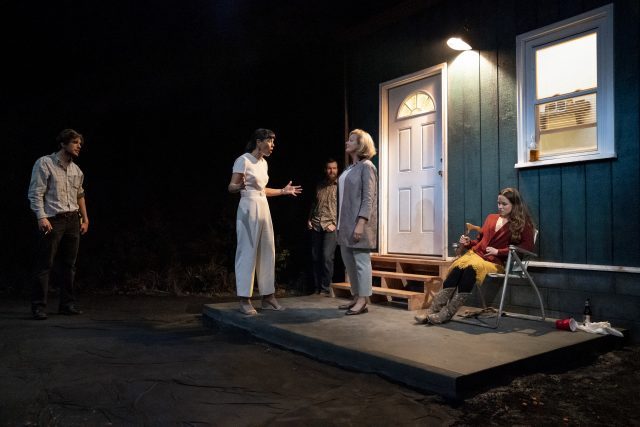
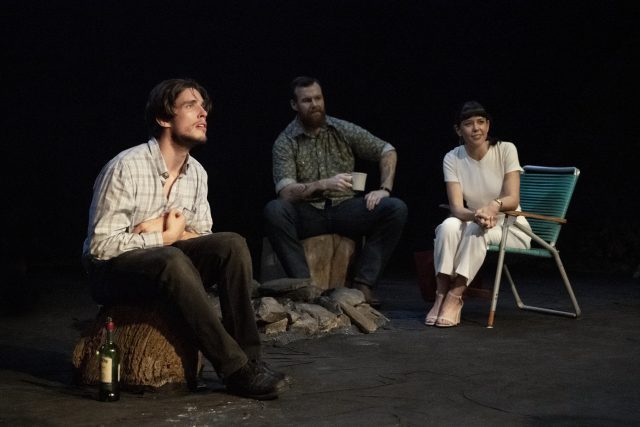
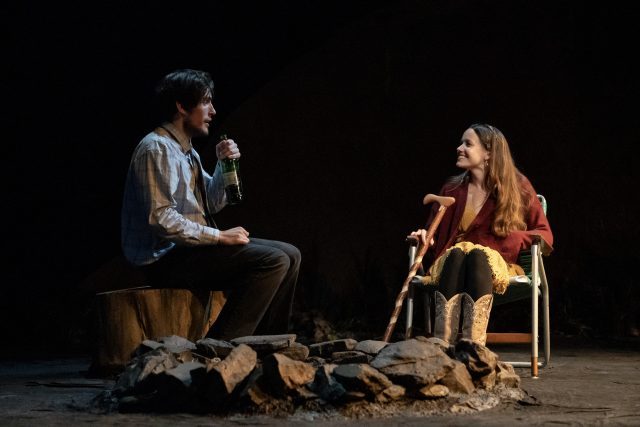
It’s August 19, 2017, one week after the Charlottesville riot and two days before the solar eclipse, and a group of friends are mingling in Justin’s backyard in the small town of Lander, Wyoming, pop. 7,000. (The cozy evening set is by Laura Jellinek.) He’s hosting a party for Dr. Gina Presson (Michele Pawk), who has just been inaugurated president of Transfiguration College of Wyoming, the alma mater of Justin (Jeb Kreager), Emily (Julia McDermott), Kevin (John Zdrojeski), and Teresa (Zoë Winters). They all graduated Transfiguration over the past fifteen years, and all are in the path of totality, a scientific term relating to the eclipse as well as a metaphor for their attempts to find their individual paths in the world. Although the Republicans control the White House and Congress, the friends are concerned about the Democrats. “There are more of them. We lost the popular vote, by a lot. And they’re mobilizing. In many ways, they are in power. And they’re trying to wipe us out,” Justin says. “There’s a war coming,” Teresa warns.

(photo by Joan Marcus)

Kevin (John Zdrojeski), Justin (Jeb Kreager), and Teresa (Zoë Winters) pray for better times in new political play (photo by Joan Marcus)

Kevin, who drinks, smokes, and snorts too much, is an off-balance clod who spurts out whatever’s on his mind, which pisses off the cold, calculating Teresa, who has moved to Brooklyn. “Don’t say gross things in a holy space,” Teresa declares after he makes a rude remark. “This isn’t a holy space; it’s just Justin’s house,” Kevin replies. “The panopticon, Kevin, Catholicism is the panopticon. This is a holy space,” Teresa explains. “It’s also a profane space,” Kevin responds.

They bicker over the Virgin Mary, morality, identity, the LGBT community, Trump, Hillary Clinton, Barry Goldwater, abortion, Patrick Buchanan, and more, making many of the same arguments that liberals do; in fact, if you were to switch a few names or words here and there, it could be a battle between lefties. There’s also a sexual energy that looms, from a past secret to possible future hook-ups.

The verbal sparring heats up when the distinguished Gina joins them and is not happy about Teresa’s unyielding support of far-right ideologues. Gina — a right-wing mirror of Hillary Clinton, down to her personal style — tells her, “These new people on the right, they’re not true conservatives. They’re charlatans, they’re hucksters. And honestly, darling, they’re a bit racist.” Meanwhile, Emily, who is very ill with what appears to be Lyme disease, is somewhere in the middle, searching for the human element. “Wow, she is . . . I’m sorry but she is such a hypocrite,” she says of Teresa. “At the ceremony, she had a little audience and she was trying to get me to admit that my liberal friend was a bad person. And I’m sorry, but I think it’s unfair to argue that I should cut ties with someone just because they’re on the other side. I can’t see things in black-and-white like that. I have a full faith, it’s my rock, it’s my pain, it’s my everything — and I also am friends with whoever I want to be friends with.”

(photo by Joan Marcus)

Kevin (John Zdrojeski) and Emily (Julia McDermott) discuss love and politics in Heroes of the Fourth Turning (photo by Joan Marcus)

Arbery (Plano, Evanston Salt Costs Climbing) was inspired by William Strauss and Neil Howe’s 1997 book The Fourth Turning: An American Prophecy — What the Cycles of History Tell Us About America’s Next Rendezvous with Destiny and his own family: He was raised in Texas by Catholic conservatives who were not a bunch of numbskull deplorables but fellow citizens with a different point of view. Teresa explains that there are four turnings, each one lasting about a generation: High, Awakening, Unraveling, and Crisis. In the play, as in America today, we are at Crisis mode. Not only won’t Republicans listen to Democrats, and liberals won’t listen to conservatives, but all the caterwauling within the same party is creating chaos; empathy and compassion have all but disappeared when it comes to politics. “Trump was made possible by the uneducated. . . . Liberty is being attacked, by both sides, and it’s tragic to see. Polarities make way for a tyrant,” Gina says, but Teresa proclaims, “Trump is a Golem molded from the clay of mass media and he’s come to save us all.”

Danya Taymor’s (Daddy, Pass Over) sharp, eagle-eyed direction smooths over some rough patches and carefully avoids turning the play into the kind of political posturing and manufactured conflicts we see on television news and social media, and monologues delivered by the three actresses are downright exhilarating, even if your personal opinions are completely contrary to theirs. In fact, the three female characters are stronger than the two males, and that shows in the acting; McDermott (Epiphany, Queens), Tony winner Pawk (A Small Fire, Hollywood Arms), and Winters (White Noise, An Octoroon) kick the men’s butts. But the real star of the show just might be sound designer Justin Ellington; the play begins with a blaring gunshot, and Ellington later lets loose a shrill, mysterious explosion of loud noise several times, a clarion call that perhaps is meant to wake us up to what is happening to every one of us, no matter who you plan to vote for in 2020.