Tag Archives: film forum

URSULA VON RYDINGSVARD: INTO HER OWN (with live Q&A)

Von Rydingsvard in her Williamsburg studio on South 5th Street, surrounded by the cedar cast of katul katul, 2002.

The life and career of Ursula Von Rydingsvard are detailed in intimate documentary

URSULA VON RYDINGSVARD: INTO HER OWN (Daniel Traub, 2019)
Opens virtually May 29, $15
Live YouTube Q&A May 31, free, 5:00
filmforum.org
intoherownfilm.com

I have spent many an hour experiencing the unique work of sculptor Ursula von Rydingsvard, walking around her dazzling large-scale wood sculptures at Galerie Lelong and art fairs, outside the Barclays Center, and in Madison Square Park. But it wasn’t until watching Daniel Traub’s hourlong documentary, Ursula von Rydingsvard: Into Her Own — which opens virtually May 29 on Film Forum’s website — that I have come to understand and appreciate her work that much more.

“She is using her own experiences to think about how abstract forms can be evocative and representative of what the human condition is,” arts writer Patricia C. Phillips says in the film. “It’s indisputable that there’s something about Ursula’s process that makes the work incredibly distinctive. And just continuing to pursue that with more and more depth and persistence over the years, it reveals some answers but always this feeling that there is also something being withheld.”

Von Rydingsvard was born in Germany in 1942 to a Polish mother and a severely abusive Ukrainian father; the large family lived in a displaced persons camp after the war, mired in poverty, struggling to survive in makeshift homes where everything was made from wood. “It was just the board between me and the outside world, and I recall my body being right next to the wall, and I could smell, I could feel,” von Rydingsvard remembers about the camp. “And there was a huge difference between what happened within this wooden structure and what happened outside of it, so that there was a kind of safety the wood gave me.”

The family immigrated to a blue-collar town in Connecticut in 1951, where she learned little about art and suffered severe emotional and physical abuse at the hands of her father. She married, moved to California, and had a daughter, Ursie, but left her abusive husband with help from her brother Staś Karoliszyn and moved to SoHo in 1975, determined to become an artist. “Going to New York City woke me up in a way that was jarring and marvelous,” she says. She eventually adopted a labor-intensive process of marking, cutting, and stacking cedar two-by-fours into masterful sculptures with a dedicated team of holders, runners, cutters, and fabricators, forming their own family; they even eat lunch together every day. Traub, who directed, produced, and photographed the film, speaks with such studio personnel as Ted Springer, Vivian Chiu, Morgan Daly, and Sean Weeks-Earp while showing the detailed, grueling yet clearly satisfying work they perform.
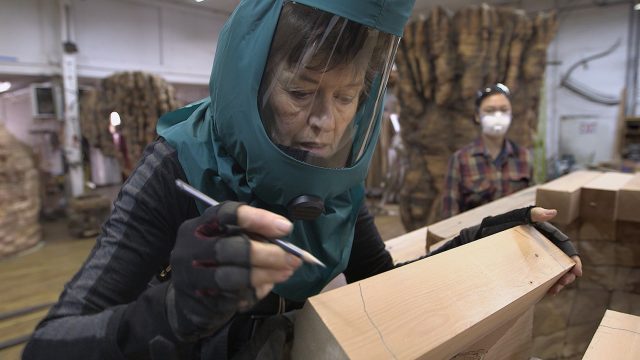
Von Rydingsvard drawing cut lines on a 4x4" cedar beam, 2016.

Ursula Von Rydingsvard has built her career primarily working with cedar via a laborious process

“Her process is almost medieval,” says Mary Sabbatino, owner of Galerie Lelong, von Rydingsvard’s longtime New York gallery. Traub traces von Rydingsvard’s career from St. Martin’s Dream in Battery Park and Song of a Saint (St. Eulalia) in Buffalo, both from 1980, through a recent Princeton University outdoor commission for which she would be using copper for the first time. She had seen Traub’s short film Xu Bing: Phoenix and so invited Traub to document her 2015 Venice Bienale installation, Giardino Della Marinaressa. That became a short film, and they then decided to collaborate again, documenting the making of the Princeton commission, which led to Into Her Own.

Such friends and colleagues as artists Elka Krajewska, Sarah Sze, and Judy Pfaff, patrons Agnes Gund and Lore Harp McGovern, and Whitney Museum director Adam Weinberg dig deep into von Rydingsvard’s almost proprietary use of materials, her distinction as a rare woman artist creating monumental sculpture, and the concept of time in her oeuvre. Touch is also key, from the many assistants who handle the wood, bronze, and copper in the construction of the work to the people who approach and feel the final product, something she encourages. There’s a wonderful scene in which von Rydingsvard speaks with her beloved second husband, Nobel Prize winner Paul Greengard, discussing nature, beauty, and her Polish heritage. Her daughter tells stories of growing up surrounded by her mother’s process and art, and Von Rydingsvard and Karoliszyn share intimate, frightening details of their father’s abuse as she explains how she was able to turn that pain around to figure out who she was and what she wanted out of life. “I knew I needed to do my work to live,” she says.

I can’t wait until I get outside and see von Rydingsvard’s work again, in person, with this newfound knowledge and understanding of an extraordinary artist. In the meantime, I’ve already watched the documentary twice, inspired by her continuing story.

Traub, a New York-based photographer who codirected the 2014 film The Barefoot Artist (about his mother, artist, activist, and teacher Lily Yeh), and von Rydingsvard will take part in a free, live Q&A with moderator Molly Donovan of the National Gallery of Art on May 31 at 5:00, hosted by Film Forum.
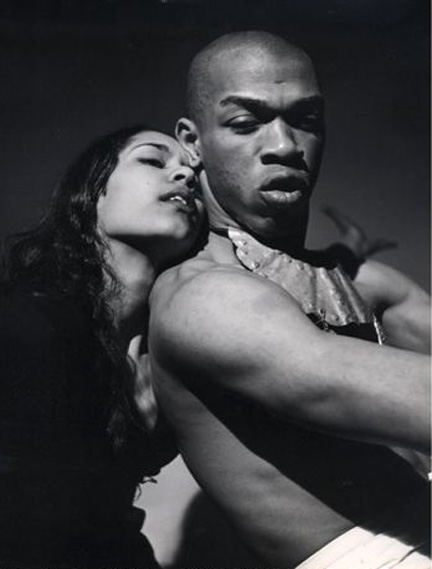
CARMEN & GEOFFREY: A BIRTHDAY TRIBUTE TO CARMEN DE LAVALLADE

The life of Carmen de Lavallade and Geoffrey Holder is examined in low-budget documentary screening at Film Forum

CARMEN & GEOFFREY (Linda Atkinson & Nick Doob, 2006)
Film Forum
209 West Houston St.
Friday, March 6, 6:30
212-727-8110
filmforum.org
firstrunfeatures.com

Film Forum is celebrating the eighty-ninth birthday of the one and only Carmen de Lavallade with a special screening of Linda Atkinson and Nick Doob’s 2006 documentary, Carmen & Geoffrey, along with rare footage of de Lavallade and Alvin Ailey dancing the ballet from Porgy and Bess in Howard Beach for a 1960 television show. Carmen & Geoffrey is an endearing look at de Lavallade and Geoffrey Holder’s lifelong love affair with dance — and each other. The New Orleans-born de Lavallade studied with Lester Horton and went to high school with Ailey, whom she brought to his first dance class. Trinidadian Holder was a larger-than-life gentle giant who was a dancer, choreographer, composer, costume designer, actor, director, writer, photographer, painter, and just about anything else he wanted to be.

The two met when they both were cast in Truman Capote and Harold Arlen’s Broadway show House of Flowers in 1954, with the six-foot-six Holder instantly falling in love with de Lavallade; they were together until 2014, when he passed away at the age of eighty-four. Atkinson and Doob combine amazing archival footage — of Eartha Kitt, Josephine Baker, Ulysses Dove, de Lavallade dancing with Ailey, and other splendid moments — with contemporary rehearsal scenes, dance performances, and interviews with such stalwarts as dance critic Jennifer Dunning (author of Geoffrey Holder: A Life in Theater, Dance and Art), former Alvin Ailey artistic director Judith Jamison, dancer Dudley Williams, and choreographer Joe Layton (watch out for his eyebrows), along with family members and Gus Solomons jr, who still works with de Lavallade. The film was made on an extremely low budget and it shows, but it is filled with such glorious footage that you’ll get over that quickly.

BEANPOLE

Beanpole

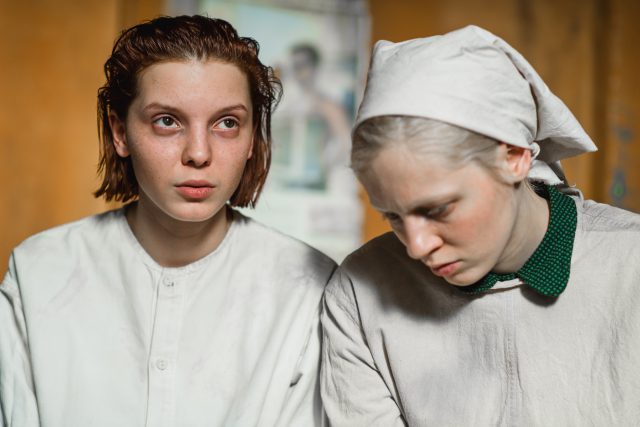
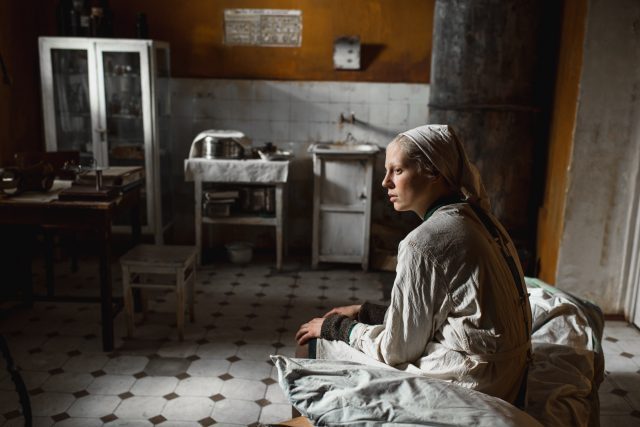
Iya (Viktoria Miroshnichenko) deals with horrific tragedy in Kantemir Balagov’s Beanpole

BEANPOLE (Дылда) (Kantemir Balagov, 2019)
Film Forum
209 West Houston St.
Through February 11
212-727-8110
filmforum.org

Russia’s official submission for the Oscar for Best International Film, for which it was shortlisted, Kantemir Balagov’s Beanpole is an unsparing look at PTSD in women, here specifically in WWII but also more generally as mothers and caretakers. In 1945 Leningrad, Iya (Viktoria Miroshnichenko) is a very tall, quiet, former anti-aircraft gunner working in a military hospital for men with severe injuries. She is particularly drawn to Stepan (Konstantin Balakirev), who is paralyzed. She has a condition in which her body freezes, as if trapped in a limbo between life and death, and it horrifically leads to tragedy. Iya’s best friend and lover, Masha (Vasilisa Perelygina), returns from the front, bearing a frightening scar. She deviously sets out to have a child, involving the oddball Sasha (Igor Shirokov) and the head of the hospital, Nikolay (Andrey Bykov), which confuses and deeply upsets Iya.

Beanpole

Masha (Vasilisa Perelygina) and Iya (Viktoria Miroshnichenko) try to put their lives back together after fighting in WWII in Beanpole

Inspired by Belarus author Svetlana Alexievich’s Nobel Prize-winning 1987 book The Unwomanly Face of War: An Oral History of World War II, Balagov’s second film, following his 2017 drama, Closeness, is a thoroughly unpredictable and purposefully uncomfortable journey into the minds of men and, more specifically, women shell-shocked by war. In their film debuts, Miroshnichenko and Perelygina are mesmerizing; cinematographer Ksenia Sereda zeroes in on Miroshnichenko’s head and Perelygina’s face as if they are characters unto themselves. The film’s palette is ochre-based, with explosions of bright yellows, reds, and especially greens — the color of rebirth, renewal, and envy — which pop up in wallpaper, paint, Iya’s sweater, and Masha’s dress. It’s a world in which women, after experiencing such pain and suffering, are expected to get married and pregnant amid all the death surrounding them. Balagov won Un Certain Regard’s Best Director prize at the Cannes Film Festival for this stark, brutal portrayal of average people looking for love amid the ruins. It might be set in 1945, dealing with the aftereffects of the Siege of Leningrad and what it did to the soul of the Russian city, but its exploration of the physical and psychological trauma of war is as relevant today as it was then.

WHAT SHE SAID: THE ART OF PAULINE KAEL

Pauline Kael

The life and career of film critic Pauline Kael is profiled in documentary What She Said

WHAT SHE SAID: THE ART OF PAULINE KAEL (Rob Garver, 2018)
Film Forum
209 West Houston St.
Opens Wednesday, December 25
212-727-8110
www.whatshesaidmovie.com
filmforum.org

I would love to read Pauline Kael’s review of Rob Garver’s What She Said: The Art of Pauline Kael, a documentary about the influential and pugnacious film critic who wrote about movies in her own unique, highly subjective way for nearly forty years. But the California-born Kael passed away in 2001 at the age of eighty-two, and we’ll never know. But in the film, which opens Christmas Day at Film Forum, we do learn about what many of her supporters and detractors, colleagues, fans (known as Paulettes), and targets thought of her. “We’re not talking about film criticism here; we’re talking about Pauline Kael,” explains writer and director Paul Schrader, who referred to Kael as his “second mother” in a 2001 Film Comment essay. “And, in the end of the game, what Pauline Kael promoted wasn’t film. It was her.”

Garver traces Kael’s career from her early days writing (ever-so-briefly) for McCall’s and the New Republic before moving to the New Yorker, where she covered “The Current Cinema” from 1968 to 1991, aside from a six-month hiatus when she attempted to produce a film with Warren Beatty for Paramount. Garver combines new and old interviews with Kael’s home movies and private photographs, television appearances, and narrated clips from her reviews and letters; among those discussing Kael and her work — the two are inseparable — are filmmakers John Boorman, Robert Towne, Quentin Tarantino, and David O. Russell, actor Alec Baldwin, writers Molly Haskell, Greil Marcus, Stephanie Zacharek, David Edelstein, Camille Paglia, Michael Sgragow, Joe Morgenstern, and Lili Anolik, and, seen in archival footage, Woody Allen, Norman Mailer (who referred to Kael as “lady vinegar”), Francis Ford Coppola, Robert Evans, Jerry Lewis, David Lean, and others. “Pauline could be very combative and very provocative and she could be cruel, for no reason,” Pulitzer Prize winner Morgenstern notes; Lean stopped making films for several years after Kael excoriated him at a luncheon.

We hear a lot from Kael, who split her time between New York City and her country home in Great Barrington, Massachusetts, through archival footage as well as narration by Sarah Jessica Parker, who reads excerpts from Kael’s personal and professional writings; in her last review, of Steve Martin’s 1991 film L.A. Story, Kael called Parker a “bouncy nymph.” While she was loathed by plenty of people inside and outside the industry, Kael was also beloved and needed by others. She says, “People don’t tend to like a good critic. They tend to hate your guts. If they like you, I think you should start getting worried.” Marlene Dietrich wrote to her, “I am quite lost without your opinions on films.” Directors such as Wes Anderson would send her their films even after she retired, just to hear what she thought. But her daughter, Gina James, notes, “There are times when people will tell me something that she said to them and I think, that’s impossible, and then I realize they couldn’t have made it up because it is just shocking.”

Garver (Comic Belief, The Man in the Yellow Cap) also includes snippets from hundreds of films; while the clips from such movies as Vittorio De Sica’s Shoeshine, Robert Wise’s The Sound of Music, Lean’s Lawrence of Arabia, Coppola’s Apocalypse Now, Arthur Penn’s Bonnie and Clyde, Jean-Luc Godard’s Bande à part, Alain Resnais’s Hiroshima Mon Amour, Charlie Chaplin’s Limelight, Stanley Kubrick’s 2001: A Space Odyssey, Bernardo Bertolucci’s Last Tango in Paris, and Brian De Palma’s Casualties of War are effective because they are shown in context with her reviews of those films, the snippets are also overused as punctuation, adding an unnecessary exclamation point at the end of a sentence to drive home a point that is already clear. For example, when Edelstein states, “Pauline would write about something, and you would not only love reading it, but then you would want to see what she wrote about so you could argue with her, or you could relive it with her, you could see it through her eyes,” Garver follows that with a scene from Martin Scorsese’s Taxi Driver in which Robert DeNiro as Travis Bickle puts his fingers over his eyes as he watches a movie. It might be cute, but it’s also extraneous.

Ultimately, Garver’s main point is that love her or hate her, Kael, who left behind a vast legacy of her writings, including thirteen books (I Lost It at the Movies, Kiss Kiss Bang Bang), and had several unsuccessful relationships with men, changed how we approach film criticism and experience films themselves. “She turned the movie review, which is this kind of flimsy vehicle — it’s a thumbs-up or thumbs-down endeavor — into this expressive art form. I mean, it was as expressive as the short story or the sonnet,” writer Lili Anolik says. Film Forum is hosting several Q&As and panel discussions during the scheduled two-week run, with Garver December 26 and 27 at 7:00, December 28 at 4:30, and December 29 with composer Rick Baitz as well at 2:30, with Zacharek and Monica Castillo on January 2 at 7:00, and with Owen Gleiberman on January 4 at 4:30.

ALEC GUINNESS: KIND HEARTS AND CORONETS / THE MAN IN THE WHITE SUIT

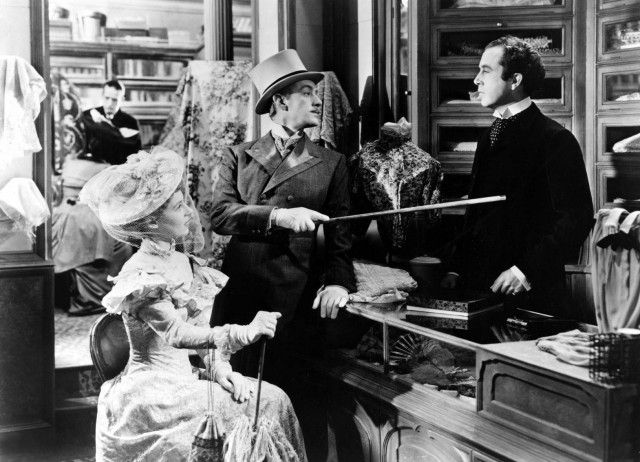
Louis Mazzini (Dennis Price) is sick and tired of being bossed around by the D’Ascoynes (Alec Guinness in multiple roles) and decides to take extreme action in KIND HEARTS AND CORONETS

Louis Mazzini (Dennis Price) is sick and tired of being bossed around by the D’Ascoynes (Alec Guinness in multiple roles) and decides to take extreme action in Kind Hearts and Coronets

KIND HEARTS AND CORONETS (Robert Hamer, 1949)
Film Forum
209 West Houston St.
Wednesday, November 27 – Thursday, December 5
212-727-8110
filmforum.org

After being spurned by their aristocrat family and watching the wealthy D’Ascoynes turn their back on his mother even in death, Louis Mazzini (Dennis Price) decides that he is not going to let them get away with such awful treatment. So Louis, the tenth Duke of Chalfont, comes up with a plot to get rid of the eight D’Ascoynes standing between him and the dukedom. In Robert Hamer’s wickedly funny black comedy Kind Hearts and Coronets — screening at Film Forum November 27 through December 5 in a seventieth anniversary 4K restoration — each one of those haughty D’Ascoynes is played by Alec Guinness, young and old, male and female, to deservedly great acclaim.
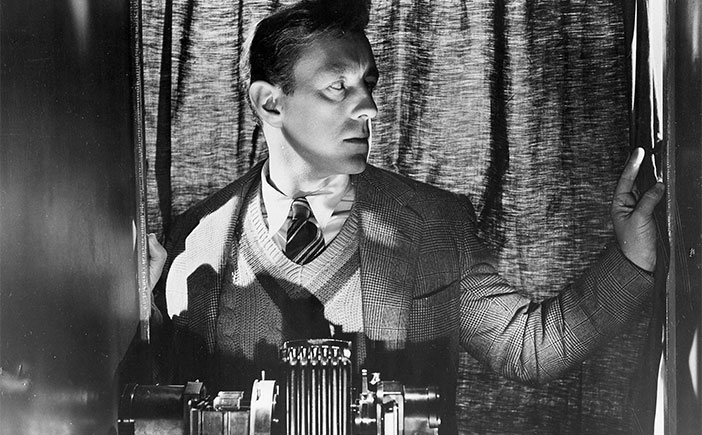
The film is told in flashback as an elegant, distinguished Louis is writing his memoirs in prison on the eve of his execution. He eloquently describes the details of his multiple murders, as well as his unending yearning for the questionably prim and proper Sibella (Joan Greenwood), who continues her flirtations with him even after she marries Louis’s former schoolmate Lionel (John Penrose), as well as his relationship with Edith (Valerie Hobson), the wife of one of the D’Ascoynes he kills on his march to power, glory, and revenge. But his hubris leads to his downfall — and one of the most delicious twist endings in film history.

Based on Roy Horniman’s 1907 novel, Israel Rank: The Autobiography of a Criminal, and adapted by Hamer (The Spider and the Fly, School for Scoundrels) and cowriter John Dighton (The Barretts of Wimpole Street), Kind Hearts and Coronets — which was turned into the Tony-winning musical A Gentleman’s Guide to Love and Murder — takes on British high society, class conflict, royalty, and hypocrisy with a brash dose of cynical humor and more than a hint of eroticism, pushing the sexual envelope amid all the laughter. Price is terrific as the dapper Louis, but it’s impossible to steal the show from Guinness, who is a riot as the succession of doomed D’Ascoynes. Guinness was originally asked to play four of the roles but suggested that he do them all, and thankfully Ealing Studios agreed; one of the key shots in the film is when six of the D’Ascoynes are seen together. In conjunction with Kind Hearts and Coronets, Film Forum is also showing three other classics starring the ever-graceful Alec Guinness de Cuffe, The Lavender Hill Mob, The Man in the White Suit, and The Ladykillers.

Goofy chemist Sid Stratton (Alec Guinness) is looking to revolutionize the textile industry in the Ealing classic The Man in the White Suit

THE MAN IN THE WHITE SUIT (Alexander Mackendrick, 1951)
Film Forum
209 West Houston St.
Wednesday, November 27, 2:40, 8:50
Sunday, December 1, 6:15
Wednesday, December 4, 2:40, 8:50
212-727-8110
filmforum.org

Alexander Mackendrick’s splendid 1951 Ealing comedy The Man in the White Suit is a hysterical Marxist fantasy about corporations, unions, and the working man that doesn’t feel dated in the least. Alec Guinness stars as Sidney Stratton, a brilliant scientist relegated to lower-class jobs at textile mills while he works feverishly on a secret product that he believes will revolutionize the industry — and the world. After being fired by Michael Corland (Michael Gough) at one factory, Sid goes over to Birnley’s, run by Alan Birnley (Cecil Parker, whose voiceover narration begins and ends the film). As Sid develops his groundbreaking product, he also develops a liking for Birnley’s daughter, Daphne (Joan Greenwood), who is preparing to marry Corland. Meanwhile, tough-talking union leader Bertha (Vida Hope) also takes a shine to the absentminded chemist, who soon finds himself on the run, chased by just about everyone he’s ever met, not understanding why they all are so against him.

Guinness is at his goofy best as Sid, a loner obsessed with the challenge he has set for himself; his makeshift, Rube Goldberg-like chemistry sets are a riot, bubbling over with silly noises like they’re in a cartoon. But at the heart of the film lies some fascinating insight on the nature of big business that is still relevant today. Nominated for an Oscar for Best Screenplay, The Man in the White Suit is an extremely witty film, expertly directed (and cowritten) by Mackendrick, who would go on to make such other great pictures as The Ladykillers and Sweet Smell of Success. It’s easy to imagine that if someone in a textile mill today came up with a similar invention as Stratton’s, the same arguments against it would arise, suppressing progress in favor of personal interest and preservation.

THE ROMANIANS: 30 YEARS OF CINEMA REVOLUTION

Anamaria Marinca

Anamaria Marinca stars in Cristian Mungiu’s harrowing 4 Months, 3 Weeks and 2 Days,, part of Film Forum celebration of the last three decades of Romanian cinema

Film Forum
209 West Houston St.
Through November 26
212-727-8110
filmforum.org

On December 25, 1989, Romanian dictator Nicolae Ceaușescu and his wife, Elena, were executed by a firing squad after being found guilty of corruption and genocide. In the wake of his death, the Romanian film industry reinvented itself, and Film Forum pays tribute to that change with “The Romanians: 30 Years of Cinema Revolution,” consisting of thirty films screening over twelve days through November 26. Several shows will be followed by Q&As with the director and/or actor. In addition to the below four recommendations, the series includes Nae Caranfil’s Do Not Lean Out the Window, Radu Mihaileanu’s Train of Life, Alexandru Solomon’s The Great Communist Bank Robbery, and Constantin Popescu’s Pororoca.

4 MONTHS, 3 WEEKS AND 2 DAYS (Cristian Mungiu, 2007)
Friday, November 22, 3:30, 7:45
filmforum.org

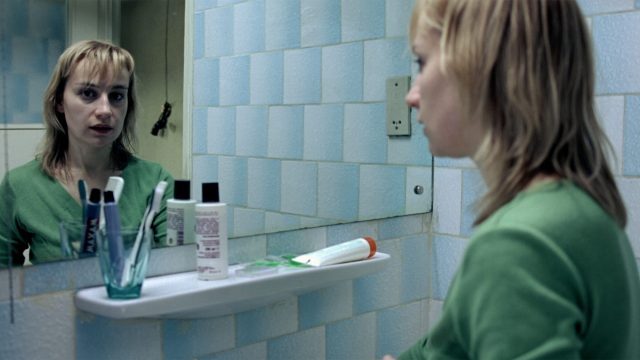
Winner of the Palme D’Or at the 2007 Cannes Film Festival, Cristian Mungiu’s 4 Months, 3 Weeks and 2 Days is a harrowing look at personal freedom at the end of the Ceaușescu regime in late-’80s Romania. Anamaria Marinca gives a powerful performance as Otilia, a young woman risking her own safety to help her best friend, Gabita (Laura Vasiliu), out of a difficult, dangerous situation. Their lives get even more complicated when they turn to Bebe (Vlad Ivanov) to take care of things. Cinematographer Oleg Mutu, who shot Cristi Puiu’s brilliant The Death of Mr. Lazarescu, keeps the camera relatively steady for long scenes, without cuts, pans, dollies, or zooms, as the actors walk in and out of view, giving the film a heightened level of believability without looking like a documentary. Set in a restrictive era with a burgeoning black market, 4 Months goes from mystery to psychological drama to thriller with remarkable ease — and the less you know about the plot, the better.

AFERIM!

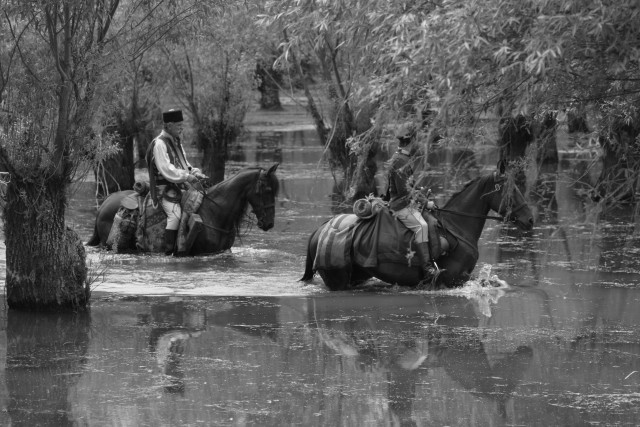
Father (Teodor Corban) and son (Mihai Comānoiu) hunt for a runaway slave in wickedly funny Aferim!

AFERIM! (Radu Jude, 2015)
Saturday, November 23, 3:30
bigworldpictures.org
filmforum.org

Romanian director Radu Jude won the Silver Bear as Best Director at the 2015 Berlin International Film Festival for Aferim!, his savagely funny blacker-than-black comic Western about bigotry, infidelity, and frontier justice in 1835 Wallachia. Lawkeeper Costandin (Teodor Corban) and his son, Ionitā (Mihai Comānoiu), are galloping through the local countryside, searching for runaway Gypsy slave Carfin (Cuzin Toma), who Boyar Iordache Cindescu (Alexandru Dabija) has accused of having an affair with his wife, Sultana (Mihaela Sîrbu). The surly Costandin leads the hunt, verbally cutting down everyone he meets, from random old women to abbots to fellow lawmen, with wicked barbs, calling them filthy whores, crows, and other foul names while spouting ridiculous theories about honor and religion; he even batters his son, saying he’s “a waste of bread” and that “if you slap him, he’ll die of grief.” It’s a cruel, cholera-filled time in which even the monks beat the poor, where Costandin regales a priest with the telling riddle, “Lifeless out of life, life out of lifeless,” which the priest thinks refers to the coming doomsday.

Cowritten by Jude (The Happiest Girl in the World, Everybody in Our Family) and novelist Florin Lăzărescu (Our Special Envoy, Numbness), who previously collaborated on the short film The Tube with a Hat, and shot in gloriously stark black-and-white by Marius Panduru (12:08 East of Bucharest; Police, Adjective), the Romanian / Bulgarian / Czech coproduction is an absurdist combination of Monty Python and the Holy Grail, Andrei Tarkovsky’s Andrei Rublev, Hal Ashby’s The Last Detail, and John Ford’s The Searchers, skewering everything in its path, either overtly or under its wide-reaching breath. Even Dana Pāpāruz’s costumes are a genuine riot, especially the boyar’s majestically ridiculous hat. But Aferim! is more than just a clever parody of period films and nineteenth-century Eastern European culture and social mores; it is also a brilliant exploration of the nature of racism, discrimination, misogyny, and the aristocracy that directly relates to what’s going on around the world today as well as how Romania has dealt with its own sorry past of enslaving the Romani people. Jude was inspired by real events and historical documents, setting the film immediately after the 1834 Russian occupation, which adds to its razor-sharp observations. “Aferim! is an attempt to gaze into the past, to take a journey inside the mentalities of the beginning of the nineteenth century — all epistemological imperfections inherent to such an enterprise included,” Jude says in his director’s statement. “It is obvious that such an effort would be pointless should we not believe that this hazy past holds the explanation for certain present issues.” Don’t miss this absolute gem of a film, which was Romania’s submission for the Academy Awards.

BEYOND THE HILLS

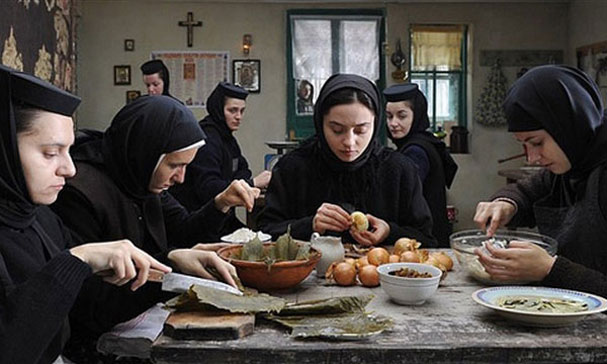
Voichita (Cosmina Stratan) must choose between her faith and her best friend in Cristian Mungiu’s Beyond the Hills

BEYOND THE HILLS (DUPA DEALURI) (Cristian Mungiu, 2012)
Sunday, November 24, 7:30
Monday, November 25, 12:40
filmforum.org

Inspired by a true story detailed in a pair of nonfiction novels by Romanian journalist Tatiana Niculescu Bran, Cristian Mungiu’s Beyond the Hills is a powerful, emotional study of love, friendship, dedication, devotion, and sexual repression. In a barren section of modern-day Romania, Alina (Cristina Flutur) arrives at a poverty-stricken Orthodox monastery, where her childhood friend Voichita (Cosmina Stratan) has become a nun. Both young women grew up in a poor orphanage, and both still have no real place in society. Alina has come to try to convince Voichita — possibly her former lover — to leave the flock and go with her to Germany, where they can live and work together freely. Early on, Voichita rubs a tired Alina’s bare back; when Alina turns over, Voichita just stops short of massaging her friend’s chest, the sexual tension nearly exploding in a scene of quiet beauty that speaks volumes about their relationship. Despite Alina’s pleading, Voichita, apparently filled with deep inner guilt, refuses to turn her back on the priest (Valeriu Andriuţă), whom all the nuns refer to as Pa, and her newfound vocation. Unable to accept her friend’s decision, Alina begins acting out in threatening ways to both herself and the true believers, leading to shocking, tragic consequences.
Mungiu’s feature-film follow-up to the 2007 Palme d’Or winner 4 Months, 3 Weeks and 2 Days is another harrowing examination of characters trapped in a devastating situation. The two-and-a-half-hour film seems to take place in a different era, far away from contemporary towns and cities, cell phones and even electricity. Mungiu, who won the Best Screenplay award at Cannes for the film, is careful not to condemn or belittle Pa, Ma (Dana Tapalagă), and their faith, but he doesn’t praise them either, leaving it up to viewers to decide for themselves. In their feature-film debuts, Flutur and Stratan, who are both from Mungiu’s hometown of Iasi and shared the Best Actress award at Cannes, are exceptional, their eyes filled with fear and longing as Alina and Voichita try to find a balance in their opposing worlds.

Luminița Gheorghiu

Luminița Gheorghiu plays a controlling, domineering mother in Călin Peter Netzer’s award-winning Child’s Pose

CHILD’S POSE (POZITIA COPILULUI) (Călin Peter Netzer, 2013)
Monday, November 25, 8:40
filmforum.org
www.zeitgeistfilms.com

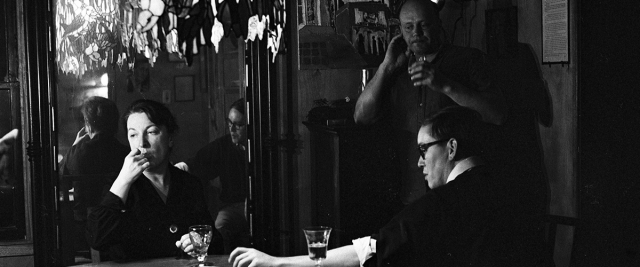
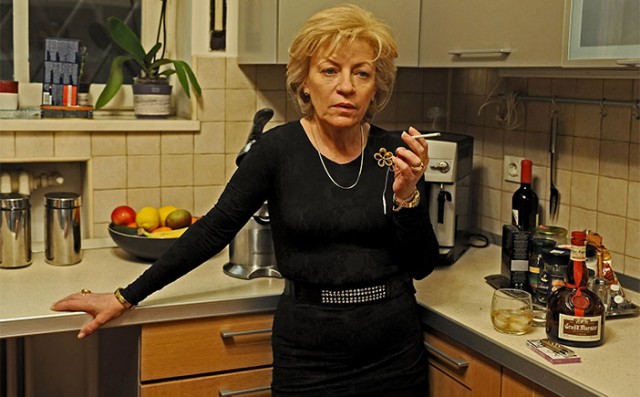
Luminita Gheorghiu, grand dame of the Romanian New Wave, was nominated for Best Actress at the European Film Awards for her devastating portrayal of a domineering mother in Călin Peter Netzer’s Child’s Pose. Gheorghiu (The Death of Mister Lazarescu; 4 Months, 3 Weeks and 2 Days) stars as Cornelia Kerenes, an elegant, cigarette-smoking architect who immediately jumps into action when her son, Barbu (Bogdan Dumitrache), is involved in a terrible car accident, killing a child. Despite their recent estrangement — Cornelia and Barbu have rarely spoken since he married Carmen (Ilinca Goia) — Cornelia starts constructing a scenario, like designing one of her buildings, to keep Barbu out of jail. She and her surgeon husband, Reli (Florin Zamfirescu), along with her sister, Olga (Nataşa Raab), start calling in favors and doling out bribes while showing a stunning lack of concern for the family of the boy who Barbu killed. As the child’s funeral approaches, relationships come together and fall apart as parents try to deal with what has happened to their children. Winner of the Golden Bear at the Berlinale, Child’s Pose is a searing examination of class, corruption, and power.

Reminiscent of Lucrecia Martel’s The Headless Woman, in which María Onetto gives a mesmerizing performance as an Argentine upper-class wife and mother who looks the other way when it appears that she might have run over a local boy, Child’s Pose is a penetrating character study that centers around the wide gap between the rich and the poor. Early on in the film, Cornelia, who her husband at one point calls “Controlia,” sits down with her dour cleaning woman and offers her a pair of used shoes, expecting her to rejoice in such wonderful charity. The scene sets the stage for what occurs later, as Cornelia believes money is the primary route to Barbu’s freedom, but it’s a path littered with more than just one young child’s body. The taut, razor-sharp script was written by Netzer (Maria, Medal of Honor) and Răzvan Rădulescu, who has worked on such other Romanian New Wave films as The Death of Mister Lazarescu, Stuff and Dough, and Tuesday, After Christmas. In Cornelia, they have created a woman worthy of joining the pantheon of classic domineering cinematic mothers.

SHIRLEY CLARKE 100: THE CONNECTION

The Connection is part of Shirley Clarke centennial celebration at Film Forum

THE CONNECTION (Shirley Clarke, 1962)
Film Forum
209 West Houston St.
Tuesday, October 29, 12:30; Monday, November 4, 8:30; Tuesday, November 5, 2:30
Series continues through November 5
212-727-8110
filmforum.org
www.milestonefilms.com

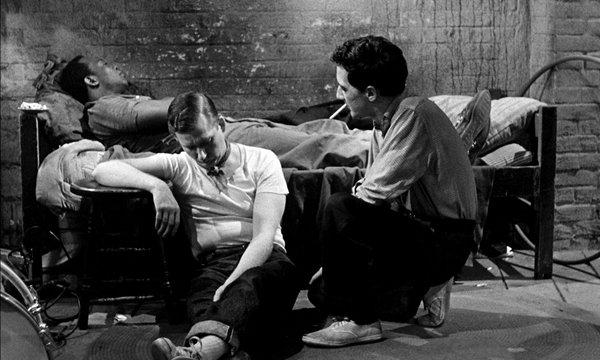
“Now look, you cats may know more about junk, see,” square film director Jim Dunn (William Redfield) says midway through The Connection, “but let me swing with this movie, huh?” Adapted by Jack Gelber from his play and directed and edited by Shirley Clarke, The Connection — screening October 29 and November 4-5 in the Film Forum series “Shirley Clarke 100,” celebrating the hundredth anniversary of the New York City native’s birth — is a gritty tale of drug addicts awaiting their fix that was banned for obscenity after only two matinee screenings back in October 1962. In 2012 it was rereleased in a sharp new fiftieth-anniversary print, beautifully restored by Ross Lipman of the UCLA Film & Television Archive. In a New York City loft, eight men are waiting for their man: Leach (Warren Finnerty), the ringleader who has an oozing scab on his neck; Solly (Jerome Raphael), an intelligent philosopher who speaks poetically about the state of the world; Ernie (Garry Goodrow), a sad-sack complainer who has pawned his horn but still clutches tight to the mouthpiece as if it were a pacifier; Sam (Jim Anderson), a happy dude who tells rambling stories while spinning a hula hoop; and a jazz quartet consisting of real-life musicians Freddie Redd on piano, Jackie McLean on sax, Larry Richie on drums, and Michael Mattos on bass. Dunn and his cameraman, J. J. Burden (Roscoe Lee Browne), are in the apartment filming the men as Dunn tries to up the drama to make it more cinematic as well as more genuine. “Don’t be afraid, man,” Leach tells him. “It’s just your movie. It’s not real.”

When Cowboy (Carl Lee) ultimately shows with the stuff, Bible-thumping Sister Salvation (Barbara Winchester) at his side, things take a decidedly more drastic turn. Mixing elements of the French New Wave with a John Cassavetes sensibility and cinema verité style, Clarke made an underground indie classic that moves to the beat of an addict’s craving and eventual fix. Shot in a luridly arresting black-and-white by Arthur Ornitz, The Connection is like one long bebop jazz song, giving plenty of time for each player to take his solo, with standout performances by McLean musically and Raphael verbally. The film-within-a-film narrative allows Clarke to experiment with the mechanics of cinema and challenge the audience; when Dunn talks directly into the camera, he is speaking to Burden, yet he is also breaking the fourth wall, addressing the viewer. Cutting between Burden’s steady camera and Dunn’s handheld one, Clarke adds dizzying swirls that rush past like a speeding subway train. A New York City native, Clarke made such other films as The Cool World and Portrait of Jason and won an Academy Award for her 1963 documentary Robert Frost: A Lover’s Quarrel with the World. This new print of The Connection is part of Milestone Films’ Shirley Clarke Project, which has preserved and restored a quartet of her best work. “Shirley Clarke 100” continues through November 5 with screenings of The Cool World and Robert Frost: A Lover’s Quarrel with the World, shown with the shorts In Paris Parks and Christopher and Me.