Tag Archives: Dane Laffrey

LAST CHANCE: SIX MISS AND DON’T-MISS SHOWS CLOSING THIS WEEKEND

Laurie Metcalf can’t believe another Broadway show she’s in is closing early (photo by Julieta Cervantes)

LITTLE BEAR RIDGE ROAD
Booth Theatre
222 West 45th St. between Broadway & Eighth Ave.
Tuesday – Sunday through December 21, $74–$206
littlebearridgeroad.com

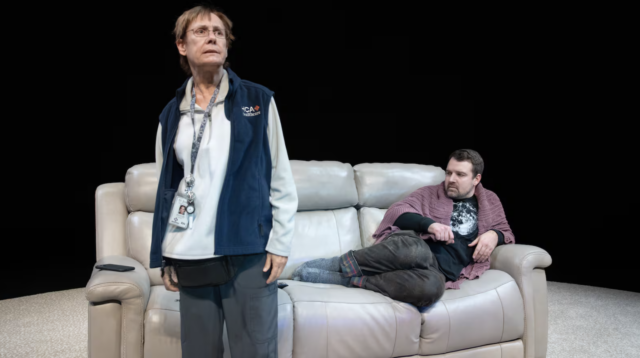
For me, the biggest disappointment of the year in theater is the early closing of Samuel D. Hunter’s sensational Little Bear Ridge Road. Originally scheduled to run until February 14, it is instead closing December 21, after opening on October 30 to a bevy of rave reviews. The play is a gripping ninety-five minutes of nonstop tension, brilliantly directed by two-time Tony winner Joe Mantello on Scott Pask’s beautifully minimalist set. On a couch on a round, carpeted platform, Sarah (Laurie Metcalf) and her nephew, Ethan (Micah Stock), spend a lot of time watching TV and complaining about their lives following the passing of Sarah’s brother, Ethan’s estranged father, a drug addict who died a miserable death. It’s a fabulous Broadway debut for Hunter, whose previous superb works include A Bright New Boise, The Whale, Lewiston/Clarkston, Greater Clements, A Case for the Existence of God, and Grangeville. I apologize for all the superlatives, but each one is well deserved.

Perhaps it’s what I’ve just dubbed the Metcalf curse.

Despite having earned four Emmys (out of twelve nominations), two Tonys (out of six nominations), and an Oscar nod, Metcalf has been in several shows that have shut their doors early, although not because of her performance. For every success like Three Tall Women and A Doll’s House, Part 2, there’s Hillary and Clinton, Grey House, The Other Place, and the aptly titled Misery.

In Little Bear Ridge Road, Metcalf plays Sarah, a nurse and loner who seems to be mad at the world, ripping off such one-liners as “Just because it’s so complicated that you have to watch an episode recap every week doesn’t mean it’s better,” “Why are you still here?!,” and “All this time you’ve thought I had an issue with you being gay? That’s the most interesting thing about you.” Ethan is a wannabe writer who is deeply uncomfortable in his own skin and exploring a potential relationship with an astrophysicist named James (John Drea) he met online. The narrative takes place between 2020 and 2022, and the pandemic plays a key role in how characters interact with each other, whether out at a bar or sitting home watching television, especially Extraterrestrial. Heather Gilbert’s intimate lighting is exceptional, making the audience feel like it’s on the couch, hanging out with Sarah, Ethan, and James.

Talking about the Orion constellation, James tells Ethan, “Okay, so — all three stars in the belt look like they’re in a line, but they’re actually spread out over about eight hundred light years. The closest is like twelve hundred light years away and the farthest is like two thousand.” It’s a clever metaphor that relates to how far away people can be even when they’re right next to each other — or conversing online. It’s both hilarious and meaningful when Sarah thinks she is texting Kenny, a handyman who is helping them with Ethan’s father’s house, but instead finds that she has accidentally FaceTimed him.

Hunter, who wrote the play specifically for Metcalf’s return to Chicago’s Steppenwolf company after a fourteen-year absence, brings it all together in a poignant finale that incorporates so many major and minor details and what seemed to be asides but then form a cohesive and thought-provoking whole, like a musical composition without a note out of place.

So why is it closing so early?

If I knew that, I’d be a producer.

James Corden, Neil Patrick Harris, and Bobby Cannavale star as three friends reaching a crisis point in Art (photo by Matthew Murphy)

ART
Music Box Theatre
239 West 45th St. between Broadway & Eighth Aves.
Tuesday – Sunday through December 21, $136.10 – $371.10
artonbroadway.com

One of my favorite theatrical moments of 2025 occurred at the end of the matinee of Art I attended. As the curtain closed, James Corden gave a little hop, skip, and jump, grabbing onto the shoulders of his two costars, Bobby Cannavale and Neil Patrick Harris, as a wide, childlike smile broke out across his face. It was one of the most happy-making things I’d seen all year.

It made the whole experience that much more enjoyable, helping me forget some of the holes in what is a pleasurable if not nearly as deep as it wants to be show. What are these men doing in Paris? Were they ever really close friends? Can Marc (Cannavale) and Serge (Harris) just leave poor Yvan (Corden) alone already?

When the audience enters the Music Box Theatre, they are greeted by a framed white rectangle on the red curtain, not only representing the white painting that Serge has paid three hundred thousand dollars for, but also the blank slate we all come into the world with, onto which we project our personal likes and dislikes, including how we appreciate, or don’t, art itself. When the play is over, some will have loved it, some will have despised it, and other, perhaps most, will find themselves in between. Friends will defend their views, just as Serge defends his purchase to Marc, who is insulted that Serge spent so much money on a white canvas, while Yvan is caught in the middle.

After Marc calls the painting “shit,” Serge tells the audience, “He doesn’t like the painting. Fine . . . But there was no warmth in the way he reacted. No attempt. No warmth when he dismissed it without a thought. Just that vile pretentious laugh. A real know it all laugh. I hated that laugh.”

Marc decides to get Yvan’s opinion, explaining, “Yvan’s a very tolerant guy, which of course, when it comes to relationships, is the worst thing you can be. Yvan’s tolerant because he couldn’t care less. If Yvan tolerates the fact that Serge has spent three hundred grand on some piece of white shit, it means he couldn’t care less about Serge. Obviously.”

Are we nothing more than our thoughts about art — or, for that matter, politics or other loaded subjects? Can each one of us see a white painting differently without casting aspersions?

Art was written in French by Yasmina Reza and premiered at Comédie des Champs-Élysées in Paris in 1994. Christopher Hampton’s English translation debuted in London two years later, with Albert Finney, Tom Courtenay, and Ken Stott, and made it to Broadway in 1999 with Alan Alda, Victor Garber, and Alfred Molina. It’s a star-driven vehicle, so director Scott Ellis gives each actor the chance to shine, and Cannavale, Harris, and Corden chew up the scenery with glee, especially Corden, whose Yvan is a kind of everyman not wanting to fight with his besties, more concerned about his impending wedding, which has reached the crisis-level planning stage. When Marc asks Yvan if he would be happy if Serge gave the painting to him and his bride as a present, he says to the audience, “Of course it doesn’t make me happy. It doesn’t make me happy, but, generally speaking, I’m not the sort of person who can say I’m happy, just like that. . . . You’re either happy or you’re not happy, what’s why wouldn’t I be got to do with it?”

Exactly.

A senior retirement community is clouded with an air of mystery in Everything Is Here (photo by Mari Eimas-Dietrich)

EVERYTHING IS HERE
59E59 Theaters
59 East 59th St. between Park & Madison Aves.
Tuesday – Saturday through December 20, $75.50
www.59e59.org

One of my favorite plays of 2023 was Annie Baker’s Infinite Life, which takes place at a Northern California clinic that treats chronic pain sufferers, mainly women.

One of my favorite plays of 2025 was Talking Band’s Triplicity, an experimental work about the interconnected, overlapping lives of four strangers in New York City.

Peggy Stafford’s Everything Is Here is a charming and gentle tale that is like Talking Band’s version of Infinite Life.

Bev (Jan Leslie Harding), Janice (Mia Katigbak), and Bonnie (Petronia Paley) live at a senior community retirement facility, where they participate in programs, sit around and discuss personal issues, and are taken care of by a young nurse named Nikki (Susannah Millonzi). The play begins with Grant (Pete Simpson), who runs several of the programs, asking the women to lie down on the floor and follow his instructions:

“There are these huge old trees that you don’t even know how old they really are / Maybe they’re ancient? / You’re not sure but this thought crosses your mind: ANCIENT TREES,” he says. “You stop dead in your tracks / Stop right now / Everybody stop / Don’t move / Okay, good / Something is gone that should be there / And it was there / In your pocket and now it’s not.” The audience falls under his spell as well.

For the next eighty minutes, the characters converse about dogs and cats, Salisbury steak, the large garden gnome just outside the window, Middle Earth, assisted suicide, and trust. They feed the fish, worry about a dangerous tree branch that could fall at any moment, and help Grant audition for a local production of A Streetcar Named Desire. (The curiously comforting set is by Richard Hoover.)

We soon learn that Bev is considering leaving, Janice is a kleptomaniac, Bonnie is a fine Blanche DuBois, and Nikki and Grant take a liking to each other.

But at the center of it all is a constant feeling of loss, of something that’s missing, physically, emotionally, and psychologically, with a hovering sense of impending doom.

Everything Is Here is worth seeing for the excellent cast alone, a joy to behold, whether they’re arguing, getting their vital signs checked, or dancing in their chairs to Lisa Fagan’s minimalist choreography. (Note: Simpson and Katigbak were in Infinite Life, and Simpson and Millonzi were in Berlindia!, which also used a goldfish tank as a metaphor, so the closeness of the actors is palpable.) Finn (The Invention of Tragedy, Doomocracy) adds just the right touches, and Stafford (Motel Cherry, 16 Words or Less with Katigbak) maintains a level of mystery around the proceedings, providing no easy answers in her abstract narrative.

On the way out, don’t be surprised if you reach into your pockets, wondering if something is missing, if everything is where it’s supposed to be.

Archduke takes some playful liberties with famous assassination (photo by Joan Marcus)

ARCHDUKE
Roundabout at Laura Pels Theatre
Harold and Miriam Steinberg Center for Theatre
111 West 46th St. between Sixth & Seventh Aves.
Tuesday – Sunday through December 21, $69-$102
www.roundabouttheatre.org

On June 28, 1914, nineteen-year-old Gavrilo Princip assassinated Archduke Franz Ferdinand of Austria, which led directly to the start of WWI. Pulitzer Prize finalist and Obie winner Rajiv Joseph, who has written such complex and intriguing shows as Gruesome Playground Injuries, Describe the Night, and Dakar 2000, imagines the events leading up to that fateful day in Archduke, a delicious, if slight, dark comedy.

The assassination plot is orchestrated by Dragutin “Apis” Dimitrijevic (a scenery-gobbling Patrick Page), a real-life Serbian military officer and cofounder of the Black Hand, a secret society dedicated to “Unification or Death.” With the help of a doctor, Apis convinces three young men, Gavrilo (Jake Berne), Trifko (Adrien Rolet), and Nedeljko (Jason Sanchez), that they have tuberculosis and should accomplish one last heroic deed before they die: murder the archduke.

“I never had no meaning. Not in my life. Never had it. Never will have it,” Nedeljko says to Gavrilo. “I wasted my life.” But given a new sense of purpose, the three men go to Apis’s resplendent home, highlighted by a huge wall map of Eastern Europe, are served by Apis’s dotty housekeeper, Sladjana (Kristine Nielsen), and plan the attack.

Joseph and Tony- and Obie-winning director Darko Tresnjak mix in a little of the Three Stooges’ You Nazty Spy! here, a touch of Charlie Chaplin’s The Great Dictator there, along with a dash of Stanley Kubrick’s Dr. Strangelove. At just over two hours with an intermission, Archduke is too long, and some of the slapstick grows repetitive and falls flat, such as Sladjana’s efforts to find Apis’s “special box.” It probably would have benefited from being streamlined to a tighter ninety minutes.

That said, it’s still an enjoyable take on an international tragedy with far-reaching ramifications while also commenting on disaffected, angry, aimless young men and political violence, no laughing matter in the United States today.

“Cats do not lay eggs,” Apis says at one point. “Never let anyone ever tell you that they do.”

Yes, the Habsburg hegemony can be funny.

Oklahoma Samovar shares the story of five generations of a Jewish family in America (photo by Marina Levitskaya-Khaldey)

OKLAHOMA SAMOVAR
The Downstairs at La MaMa Experimental Theatre Club
66 East Fourth St. between Second Ave. & Bowery
Thursday – Sunday through December 21, $25-300
www.lamama.org

Prior to seeing Oklahoma Samovar at La Mama, all I knew about Jews in the American West I learned from Blazing Saddles and The Frisco Kid, two comedies starring Gene Wilder that feature a bit of Yiddish. In 1987, award-winning author, teacher, and playwright Alice Eve Cohen met her eighty-seven-year-old great-aunt Sylvia, who shared with Cohen her family’s remarkable history fleeing from persecution in Latvia and starting a farm during the 1889 Oklahoma Land Run, the only Jews to do so. Cohen has been working on the play, which won the 2021 National Jewish Playwriting Contest, since 1987, and it is now making its world premiere at La MaMa through December 21.

Directed by Eric Nightengale, the play begins in 1987, when twenty-one-year-old Emily travels from Brooklyn to an Oklahoma farm where Sylvia lives, bringing with her an urn with her mother’s ashes. She also has a tape recorder to document Sylvia’s answers to her many questions, most importantly: Why did her mother want her ashes spread over the farm, which Emily knew nothing about? Sylvia shares her story as the play goes back and forth between eras and several actors switch among multiple roles: Nadia Diamond is Emily and Rose, her maternal great-grandmother; Seren Kaiser is Clara, Emily’s mother as a little girl; Sahar Lev-Shomer is Jake, Rose and Sylvia’s pioneer father; Alex J. Gould is Ben, Rose’s husband, and Max, Jake’s best friend; Sarah Chalfie is Hattie, Rose and Sylvia’s mother, and Maxine, Ben’s gallivanting, bisexual sister; and the scene-stealing Joyce Cohen is Sylvia at ages four, fourteen, forty-five, and eighty-seven as well as some minor characters.

The narrative follows Jake as he emigrates from Latvia to New York to avoid fighting in the Russian army; meets Max, who helps him find a job; is joined by his fiancée, Hattie, who is not keen on moving to Chandler, Oklahoma, where there is no synagogue and no other Jews; and begins raising a family. Emily is initially tight on time; like Hattie, Chandler is not at first her cup of tea — she believes that Sylvia is living on stolen land — but she soon becomes enthralled with learning about her ancestors. At the center of it all is a Russian samovar that Hattie brought from the old country.

“Look at this samovar. It’s the family heirloom,” Sylvia tells Emily, continuing, “Mom and I were starting to – we were just beginning to make a connection, and — suddenly she’s gone. She wanted me to come here with her ashes, and I have to know I’m doing the right thing. Sylvia, you’ve told me stories, but not what I need to know. Could you fast-forward a few decades?” Sylvia cautions, “You’re in a big rush. Try switching from coffee to tea, might help ya slow down.”

The first act sets everything up well, but the second act slows it all down. Characters and relationships get confusing, the set changes involving colored windows/walls feel extraneous, and standard melodrama takes over. It probably would have worked much better as a streamlined ninety-minute one-act.

There are lovely, touching moments throughout and creative staging, but it tries too hard to be an epic while raising all-too-relevant issues such as immigration, assimilation, and bigotry. “There’s no antisemitism in Chandler,” Rose asserts. Ben replies, “Where there are Jews, there is antisemitism.” It ends up being not quite enough to sustain its length, although it’s nearly worth it just to watch the wonderful Cohen, who is endearing as Sylvia.

Even Kristin Chenoweth can’t save The Queen of Versailles from getting high on its own supply (photo by Julieta Cervantes)

THE QUEEN OF VERSAILLES
St. James Theatre
246 West Forty-Fourth St. between Broadway & Eighth Aves.
Tuesday – Sunday through December 21, $88.48-$441.28
queenofversaillesmusical.com

It’s never fun writing a review for a show that is closing early; it’s sort of like that old saying, Don’t speak ill of the dead.

When I went to the St. James Theatre to see The Queen of Versailles, a musical based on the hit documentary, I was fully prepared to find something to like about it despite all the negative chatter that was circulating. And indeed, I thoroughly enjoyed the first scene, which takes place in Paris in 1661, as Louis XIV (Pablo David Laucerica) is getting ready to move to his new home in Versailles.

“I am the king, Louis Quatorze / My life is shinier than yours / In fact, I am the living proof / That life is quite unfair / I am the Sun King, like Apollo, / But with better hair,” Louis sings in an extravagantly decorated room. “And now that I am twenty-three / And fin’lly firmly in command / To celebrate the glory that is I, / I want to build a palace / Splendiferous and grand, / The grandest palace ever to be seen in any land, / In a little country village called Versailles!”

I also was all in on the second scene, with the action moving to Florida in 2006, where Jackie Siegel (Kristin Chenoweth) is overseeing the construction of her own Versailles with her fabulously wealthy, much older husband, David (F. Murray Abraham).

“We didn’t know we would need / The biggest home in America / That was never part of our plan,” Jackie sings. “But ev’ryone has needs to be filled, / Add ’em all up and we’ve got to build / The biggest home in America, / Because we can.”

After that, well, I just couldn’t.

Jackie and David live with Jackie’s daughter, the cynical Victoria (Nina White), and are soon joined by Victoria’s cousin, Jonquil Peed (Tatum Grace Hopkins). Also hovering around are Gary (Greg Hildreth), David’s business associate, and Sofia Flores (Melody Butiu), the Siegels’ nanny. The story devolves quickly into tawdry melodrama, along with clunky staging and less-than-compelling musical numbers. The book, which refuses to decide whether Jackie is a strong woman, a greedy socialite, or a misunderstood wife and mother, is by Olivier nominee Lindsey Ferrentino, the director is Tony winner Michael Arden, and the music and lyrics are by Oscar winner Stephen Schwartz, all of whom should have known better.

Tony and Emmy winner Chenoweth powers through the one hundred and fifty minutes with grit and determination — and, of course, fanciful costumes (by Christian Cowan) — and it’s always a treat to see the now-eighty-six-year-old Abraham, even if it turns out that he’s not exactly a song-and-dance man. But it’s impossible to care about anything that happens on Tony winner Dane Laffrey’s often elegant set (but the less said about his video projections, the better) or about any of the characters, particularly Jackie herself.

In a script note, Ferrentino explains, “The Queen of Versailles is the story of one family that reflects an entire country — a modern fable about the American Dream and what it has become in contemporary America. Our main character does what America teaches: work harder, want bigger, never stop. Her unfinished palace becomes a mirror to a culture that mistakes accumulation for meaning. Jackie is as complicated as the nation that created her.”

Not quite, especially as the country is mired in another economic crisis propelled by the growing wealth gap between the 1% and everyone else.

[Mark Rifkin is a Brooklyn-born, Manhattan-based writer and editor; you can follow him on Substack here.]

UNHAPPY ENDINGS: THE LONELINESS OF THE WELL-MEANING THEATER CRITIC

Peter Gallagher and Juliana Margulies star in Delia Ephron’s Left on Tenth (photo by Joan Marcus)

One of the most fun parts of being a theater critic is engaging with your fellow stage pundits. We greet one another before and after shows and during intermissions, discussing what we’ve seen lately that we’ve liked — and what we haven’t.

We have an unofficial community on social media, where we post our reviews and comment on those of others. While some appreciate different opinions, acknowledging that we all approach theater with personal biases, both conscious and unconscious, others are more insistent that their take is right and anyone who disagrees got it wrong.

One particular critic becomes dismayed on those rare occasions when she and I actually agree on a show.

Like I said, it’s fun.

But it can become disheartening when you find yourself on the opposite side of the fence from nearly all of your respected colleagues, which has happened to me often these last few extremely busy weeks.

I was charmed and delighted by author and screenwriter Delia Ephron’s Left on Tenth at the James Earl Jones Theatre, her adaptation of her 2022 memoir about finding love at the age of seventy-two shortly after losing her husband, Peter Kass, and right before finding out she has acute myeloid leukemia (AML). Julia Margulies stars as Delia, who often breaks the fourth wall and talks directly to the audience. Speaking of her childhood, she explains early on, “Every time I said something funny, my dad shouted, that’s a great line write it down. All four of us sisters grew up to be writers. But my parents were also angry alcoholics. My childhood was scary, often violent. With Jerry, I found my first true home. My first safe place. Now he wasn’t going to be here . . . Now . . . what?”

After writing an article in the Times about the trouble she had reconnecting online when Verizon canceled Jerry’s landline and, mistakenly, her internet access, she is contacted by Peter Rutter, a Jungian psychoanalyst who had briefly dated her in college, even though she does not remember him. Peter is elegantly portrayed by the ever-handsome Peter Gallagher. They rekindle their once-upon-a-time almost-relationship with passion and excitement — yes, older people can get hot and heavy — and he stands by her when she is hospitalized and things look bleak.

The play is directed by five-time Tony winner Susan Stroman and features Peter Frances James and Kate MacCluggage as multiple characters who make unbelievably fast costume changes. Although the show does get treacly, there was more than enough quality scenes for me to recommend it. My colleagues have not been kind to the play, writing, “Left on Tenth has the energy and the color scheme of a drugstore greeting card,” “Left on Tenth, billed as a romantic comedy, only fulfills half that description,” and “more suitable to the Hallmark Hall of Fame than Broadway.”

Although I don’t think so, perhaps my longtime admiration of Gallagher got in the way of my judgment? Thirty years ago, my wife and I moved into an apartment that was previously owned by him. (There was a lawyer in between who purchased it but never lived there, selling it to us.)

About twenty years ago, I met Gallagher at Powerhouse Theater’s annual New York Stage & Film benefit in Manhattan. Standing behind him, I said my address out loud so he could hear me. He whipped around and barked, “Who are you!” I calmed him down and explained that I now was in that apartment and told him that we occasionally still received junk mail for him. We talked about some of the unique advantages to the place. He then turned serious.

“You have to promise me something,” he said. “What?” I asked. Peter: “Is the yellow bookcase in the hall still there?” Me: “Yes.” Peter: “Promise me you’ll never take it down.” Me: “Why?” Peter: “Because I built in with my own two hands.”

I couldn’t help but think of that bookcase as I entered the James Earl Jones Theatre and saw that Beowulf Borritt’s main set is anchored by a gorgeous, filled-to-the-brim semicircular bookcase in Delia’s apartment. (It switches between that room, a restaurant, and the hospital where Delia is treated.) Books are discussed throughout the hundred-minute play; having worked my entire career in children’s and adult publishing, that was another plus for me, especially because it got the details of the industry right, which is rarely the case in theater, TV, and movies.

However, four other shows left me cold and dry, awash in disappointment.

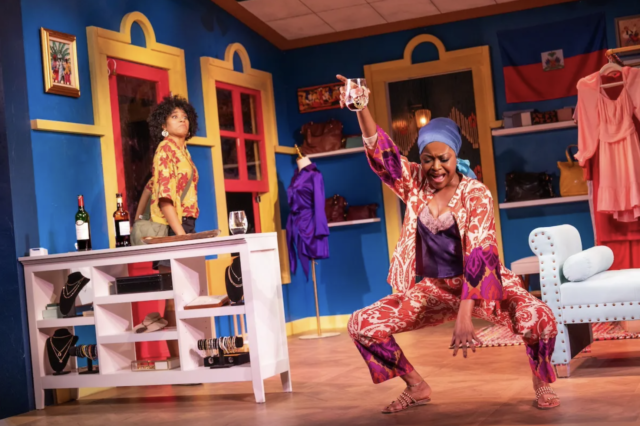
Cousins Simone (Kelly McCreary) and Gigi (Pascale Armand) try to reconnect in Dominique Morisseau’s Bad Kreyòl (photo by Matthew Murphy)

Over at the Signature, I was all set for Dominique Morisseau’s Bad Kreyòl, a coproduction with Manhattan Theatre Club that has been extended through December 1. The Detroit native has been on a thrilling roll with Pipeline in 2017, Paradise Blue in 2018, Skeleton Crew and Confederates in 2022, and Sunset Baby earlier this year. Maybe it was a bad night — critics generally have several performances to choose from, so they are not seeing the same exact show — but Bad Kreyòl felt like a work-in-progress, unfinished, its characters not yet fully developed.

Simone (Kelly McCreary), a Haitian American, is returning to the island for the first time in thirty years, staying with her cousin Gigi (Pascale Armand), who runs a boutique with the help of Pita (Jude Tibeau), a gay restavek whose rural family sent him to the city when he was a child in order to get an education and learn a trade. Simone is concerned that the restavek system means Pita is more like an indentured servant; she is also worried about Lovelie (Fedna Jacquet), who sews pillows, ties, scarves, and other items for an import-export company run by Thomas (Andy Lucien), who might be ignoring how women workers such as Lovelie are being abused by one of his male employees. Simone, Gigi, and Pita feel out of place in their dangerous country; they run into trouble as they try to firmly establish their identities and decide what they want out of life.

The night I went, the Irene Diamond Stage at the Signature was about half empty. The audience was almost too quiet during the show’s two hours and fifteen minutes (with intermission) as jokes fell flat and key moments flirted with clichés. Directed by Tiffany Nichole Greene, the play felt muted, lacking energy; I was more interested in the person sitting off to the side who kept taking photos and short videos of the drama.

Meanwhile, here’s what some of my colleagues had to say: “an illuminating reminder that Haiti and its people are much more than just bad headlines,” “a story told with care and intelligence, both warm-hearted and sharp-eyed,” and “confirms her as one of our most consistently interesting playwrights; where will she take us next?”

A young, energetic cast appears in the Lazours’ We Live in Cairo(photo by Joan Marcus)

In the early 2010s, I saw Stefano Savano’s intense documentary Tahrir: Liberation Square and Jehane Noujaim’s powerful fiction film The Square, extraordinary works about the 2010 Arab Spring in Egypt. So I was excited for New York Theatre Workshop’s We Live in Cairo, a musical by Daniel and Patrick Lazour, directed by Taibi Magar, that follows a group of twentysomethings risking their freedom and safety as they carefully take part in the resistance against President Hosni Mubarak and the Muslim Brotherhood during the revolution of 2011.

The score, performed by an onstage band, is sensational, and Tilly Grimes’s ramshackle set is evocative, as are David Bengali’s street-art projections. But the lyrics and staging are too plain, and the acting is merely standard — and I don’t know what I was going to do if one more character ran out in a tizzy through the door at stage left. At two and a half hours with intermission, the show is too long; perhaps it would have been more effective if it had been condensed into a streamlined ninety minutes.

While We Live in Cairo did not receive across-the-board raves, here are some of the favorable quotes from professional reviewers: “a welcome blast of excitement and intelligence,” “underscores the appeal, the importance — and the fragility — of democracy,” “pulses with the promise and enthusiasm of idealistic youth,” and “the most hypnotic, moving, and unique original score so far this year!”

Erika Sheffer’s Vladimir traces one journalist’s attempts to take on Putin (photo by Jeremy Daniel)

Although it closed November 10, MTC’s Vladimir also baffled me. The first act was so unsatisfying that I told my guest that I wouldn’t mind if she went home, but I had to stay for the second act, as is my responsibility. She stayed, and the second act was significantly better, but not enough so to recommend it.

Erika Sheffer’s play was inspired by the real-life story of Russian journalist Anna Politkovskaya, who continued to write negative reports about new Russian president Vladimir Vladimirovich Putin and his government even after she was poisoned. Mark Wendland’s overdesigned set with seemingly endless screens makes you wonder where you should be looking. Francesca Faridany is fine as Raya, but the rest of the cast — two-time Tony winner Norbert Leo Butz, Erin Darke, Erik Jensen, David Rosenberg, and Jonathan Walker — have trouble finding their way through numerous scenes, as Tony-winning director Daniel Sullivan attempts to figure out the convoluted stage. Everything becomes more assured after intermission, although a few of the key subplots border on the absurd.

What did my colleagues think? “Vladimir, beyond many other excellent qualities, feels distressingly current,” “as tough and uncompromising a piece of writing to be seen on a New York stage right now,” “accumulates enough awful truth to leave you sore and shaken,” and “Francesca Faridany and Norbert Leo Butz are towering in this Stoppardian Moscow-set drama.”

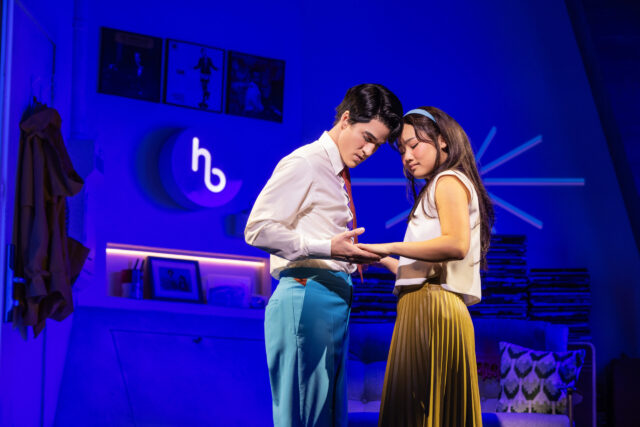
Darren Criss and Helen J Shen play Helperbots who fall in love in Maybe Happy Ending (photo by Matthew Murphy and Evan Zimmerman)

Which brings me to the reason I decided to write about this in the first place: Maybe Happy Ending. The instant-smash musical is about two retired Helperbots, Oliver (Darren Criss), a model 3, and Claire (Helen J Shen), the later model 5. They live across the hall from each other in a Seoul apartment complex where they are left to eventually power off forever. They meet-cute when Claire knocks on Oliver’s door because her charger is broken and can’t be fixed — replacement parts for both HBs are disappearing, so it’s clear, and very sad, that their time is limited, just like that of humans. “We have a shelf life, you know that,” Claire explains. “It’s the way that it has to be.”

When Oliver decides to return to his previous owner, James (Marcus Choi), he is joined by Claire for a road trip to Jeju Island; he is sure that James has been waiting years for him to come back because he needs him, while she wants to see the last colony of fireflies on the planet.

Director Michael Arden’s staging is nothing short of spectacular on Dane Laffrey’s magical set. Rectangular boxes open and close on a black screen, revealing the HBs’ differently decorated apartments similar to the way silent films irised in and out of scenes. Red LED lines stream across the screen. Crooner Gil Brentley (Dez Duron) rises from below to sing jazzy tunes. Round shapes are everywhere, representing the circle of life (for robots and humans), from windows, Claire’s soft and pillowy chair, and the moon to the HB logo, images on jazz posters, and Oliver’s beloved records, which he plays on an old-fashioned turntable. It might be 2064, but it’s jam-packed with nostalgic elements from the twentieth century, while George Reeves’s projections are filled with magic.

So why were my guest and I supremely bored through most of the show’s 105 minutes? The book, by Will Aronson and Hue Park, is littered with gaping plot holes that drain the narrative, while the music, by Aronson, and the lyrics, by Park, are more saccharine than sweet. Criss and Shen do an admirable job as the HBs, the former stiff and steady, the latter freewheeling, referencing how technology, especially AI, is becoming more human and personable. But I was not able to get past the numerous shortcomings and found the Brentley character wholly unnecessary and distracting.

Alas, nearly every other reviewer has been gushing with effusive praise: “In its gentle robot way, it helps us see ourselves through freshly brushed eyes,” “an undeniably moving, well-made, adorable musical,” “rapturous music and lyrics,” “an original show, charmingly acted and cleverly staged, with a touching take on love,” and “visually stunning, it epitomizes the journey of appreciation of the human world.”

Of course, when it comes right down to it, I’m right and they’re wrong, as any critic worth his salt should claim, even if, in some cases, I’m alone in, as HB3 calls it, “the world within my room.”

How’s that for a maybe happy ending?

[Mark Rifkin is a Brooklyn-born, Manhattan-based writer and editor; you can follow him on Substack here.]

PARADE

Lucille (Micaela Diamond) and Leo Frank (Ben Platt) fight for justice in Parade (photo by Joan Marcus)

PARADE
Bernard B. Jacobs Theatre
242 West 45th St. between Broadway & Eighth Ave.
Tuesday – Sunday through August 6, $84-$288
paradebroadway.com

At intermission of the first Broadway revival of Parade, based on a true story of anti-Semitism, racism, and a terrible miscarriage of justice, several colleagues and I asked the same question: “Why is this a musical?” We found out in the far superior second act.

The show, directed by Harold Prince, with music and lyrics by Jason Robert Brown and a book by Oscar and Pulitzer Prize winner Alfred Uhry (Driving Miss Daisy), debuted at the Vivian Beaumont in 1998, running for thirty-nine previews and eighty-four regular performances, earning nine Tony nominations and winning for Best Book and Best Original Score. It is now playing at the Bernard B. Jacobs Theatre, in a version directed by Tony winner Michael Arden that transferred from Encores! at City Center and uses the 2007 Donmar Warehouse production, which included a few different songs from the original.

Parade begins with a prologue set in Marietta, Georgia, in 1862, as a young Confederate soldier (Charlie Webb) sings goodbye to his love and prepares to fight “for these old hills behind me / these old red hills of home. . . . in the land where honor lives and breathes.” The action then shifts to Atlanta in 1913, where the soldier (Howard McGillin), who lost a leg in the Civil War, is determined to help the South rise again, “honor” be damned.

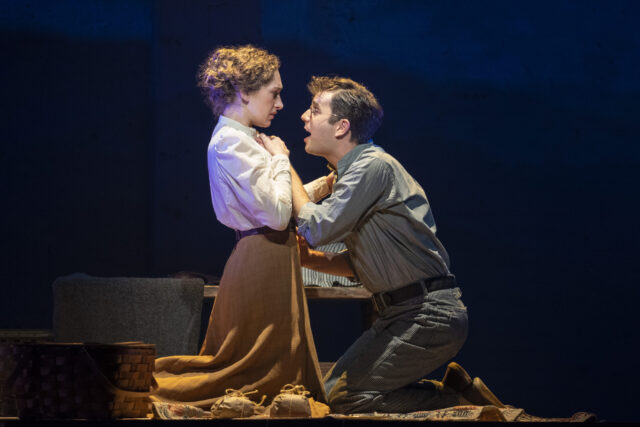
It’s Confederate Memorial Day, and Lucille Frank (Micaela Diamond) wants to go on a picnic with her husband, Leo (Ben Platt), but he instead decides to go to work at the National Pencil Company, her father’s factory where Leo is superintendent. Thirteen-year-old Mary Phagan (Erin Rose Doyle) arrives to collect her pay and is later found murdered in the basement. The police arrest Leo for the crime, but he doesn’t take them very seriously, since he is innocent — but when power-hungry district attorney Hugh Dorsey (Paul Alexander Nolan) starts building a strong case against him, constructed on a series of lies, Leo suddenly faces reality as Lucille seeks to uncover the truth and reveal the conspiracy to railroad her husband.

Mary Phagan (Erin Rose Doyle) enjoys one final moment of life with Frankie Epps (Jake Pedersen) in based-on-fact musical (photo by Joan Marcus)

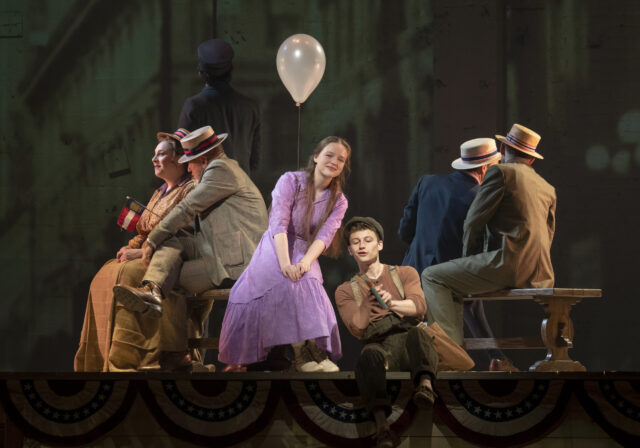
Among those participating in the frame-up led by Dorsey are National Pencil night watchman Newt Lee (Eddie Cooper), janitor Jim Conley (Alex Joseph Grayson), and Frank family maid Minnie McKnight (Danielle Lee Greaves), all of whom are Black and manipulated because of the color of their skin; Governor Jack Slaton (Sean Allan Krill), who is more concerned with his upcoming reelection campaign than the fate of one perhaps innocent man; Mary’s friend Frankie Epps (Jake Pedersen), who wants to see the murderer “burn in the ragin’ fires of hell forevermore”; right-wing newspaper editor and publisher Tom Watson (Manoel Felciano), who calls out, “Who’s gonna stop the Jew from killin’? Who’s gonna swing that hammer?”; Judge Roan (McGillin), who’d rather be fishing than in court; and Britt Craig (Jay Armstrong Johnson), an ambitious reporter who declares, “Take this superstitious city / Add one little Jew from Brooklyn / Plus a college education and a mousy little wife / And big news! Real big news! / That poor sucker saved my life!” Mary’s distraught mother (Kelli Barrett) is the only one considering forgiveness.

The focus of the show shifts dramatically after intermission, during which Leo remains onstage, in his jail cell, contemplating his fate; while the first act was all over the place, squeezing in too much information alongside oversized production numbers, the second act zeroes in on the touching relationship between Lucille and Leo as they desperately try to prove his innocence. It’s a beautiful, romantic love story, highlighted by a prison picnic Lucille brings to Leo in which she first chastises him for not accepting her assistance. “Do it alone, Leo — do it all by yourself. / You’re the only one who matters after all. / Do it alone, Leo — why should it bother me? / I’m just good for standing in the shadows / And staring at the walls, Leo,” she sings. Later they duet on “This Is Not Over Yet,” as Leo proclaims, “Hail the resurrection of / the south’s least fav’rite son! / It means I made a vow for better! / Two is better than one! / It means the journey ahead might get shorter. / I might reach the end of my rope! / But suddenly, loud as a mortar, there is hope!”

Parade features archival projections throughout (photo by Joan Marcus)

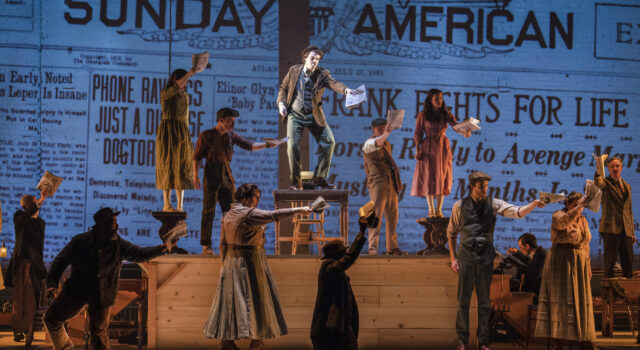
Dane Laffrey’s set is centered by a large wooden platform on which most of the action takes place, evoking a gallows as well as a coffin. There are scattered chairs and pews on either side, where many of the characters sit when they’re not in the scene, which can get confusing, especially for actors who play multiple roles. Susan Hilferty’s period costumes put us right in the 1910s, while Sven Ortel’s projections feature archival photographs of the real people and locations involved in the story, along with newspaper articles and a memorial plaque, a constant, and effective, reminder that this really happened — along with a final shot providing one last shock. Lauren Yalango-Grant and Christopher Cree Grant’s choreography thankfully calms down in the second half. Heather Gilbert’s lighting and Jon Weston’s sound maintains the dark mood surrounding the events. Music director and conductor Tom Murray handles three-time Tony winner Brown’s (The Last Five Years, Mr. Saturday Night) compelling score with a rousing touch, while director Michael Arden (Spring Awakening, Once on This Island) ably navigates through Uhry’s (Driving Miss Daisy, The Last Night of Ballyhoo) busy book. (Notably, Atlanta native Uhry’s great-uncle owned the National Pencil Company at the time of the killing.)

Tony winner Platt (Dear Evan Hansen, The Book of Mormon) and Diamond (The Cher Show, A Play Is a Poem) are wonderful together, portraying a Jewish couple in the Deep South facing bigotry; Platt captures Leo’s unrealistic belief that justice will triumph in the end, while Diamond embodies Lucille’s growth as she confronts what is happening in her beloved hometown. Grayson (Into the Woods, Girl from the North Country) brings down the house with “Feel the Rain Fall,” although, in 2023, it teeters on the edge of appropriation. Courtnee Carter (Once on This Island, Sing Street) as Angela and Douglas Lyons (Chicken & Biscuits, Beautiful) as Riley provide necessary perspective in their duet, “A Rumblin’ and a Rollin’,” in which they assert, “I can tell you this, as a matter of fact, / that the local hotels wouldn’t be so packed / if a little black girl had gotten attacked.” Also providing strong support are Cooper (Assassins, The Cradle Will Rock), Tony nominee Krill (Jagged Little Pill, Honeymoon in Vegas), and Greaves (Hairspray, Rent).

The final projection as the musical ends is a potent reminder that this country still has a long way to go when it comes to entrenched racism, misogyny, and anti-Semitism, in states such as Georgia and too many others that appear determined to continue a legacy of bigotry and hatred, although there is hope with such political stalwarts as Georgia senator Raphael Warnock, the reverend who tells us, before the show starts, to silence our cellphones but, implicitly, not our voices.

A CHRISTMAS CAROL

Jefferson Mays portrays more than fifty characters in A Christmas Carol (photo by Chris Whitaker)

A CHRISTMAS CAROL
Twenty-four-hour stream through January 3, $50 ($30 with code SCROOGE through 12/12)
Daily lottery: $15 (10 random winners)
www.achristmascarollive.com

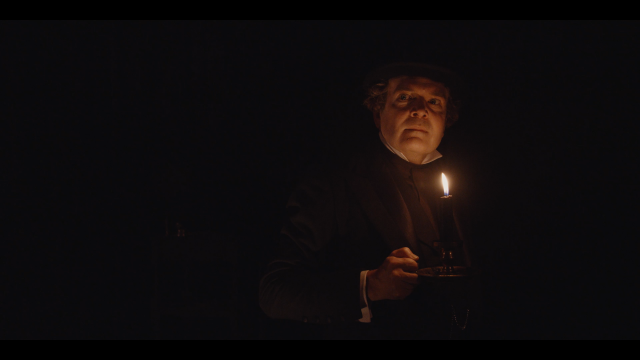
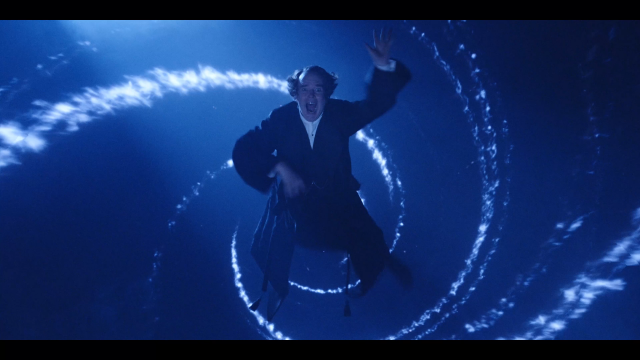
Jefferson Mays’s mostly one-man version of Charles Dickens’s A Christmas Carol is the best filmed theatrical production made during the pandemic that I have seen. It is also the best one I’ve heard. Tony winner Mays may be the star of the holiday tale, spectacularly portraying more than fifty characters in ninety minutes, but Joshua D. Reid nearly steals the show with his stunning sound design, which works hand in hand with Ben Stanton’s pinpoint-precision lighting; headphones and as large a screen as possible are a must to fully appreciate this outstanding presentation. A big monitor and great speakers will also increase the scare level, because first and foremost, this telling is a ghost story, with genuine frights, one of which made my heart drop into my stomach.

Originally produced at the Geffen Playhouse in LA in 2018, the play, adapted by Mays and his wife, Susan Lyon, with director Michael Arden, has been reimagined by Arden and set and costume designer Dane Laffrey for online viewing. It was recorded in October at the historic United Palace theater on Broadway at 175th St., built in 1930 as a lush vaudeville and movie house that served as a church for the Rev. Ike and his ministry from 1969 to 2017. United Palace calls itself the Home of Spiritual Artistry, and that’s exactly what you’ll find in A Christmas Carol.

“Oh! But he was a tight-fisted hand at the grindstone, was Scrooge!” Mays announces early as the narrator. “A squeezing, wrenching, grasping, scraping, clutching, covetous, old sinner! Secret, and self-contained, and solitary as an oyster.” The word “solitary” hits us differently during the pandemic lockdown, as we watch a single actor onstage, performing in an empty theater for an audience of one, or maybe a few more, sheltering at home.

He continues, “Nobody ever stopped him in the street to say, `My dear Scrooge, how are you?’ No beggars implored him to bestow a trifle, no children asked him what it was o’clock, no man or woman ever once in all his life inquired the way to such and such a place, of Scrooge. Even blind men’s dogs, when they saw him coming on, would tug their owners into doorways. . . . But what did Scrooge care! It was the very thing he liked. To edge his way along the crowded paths of life, warning all human sympathy to keep its distance.” At that instant, Arden cuts to a far shot of Mays, looking lonely and far away, socially distanced from the rest of humanity.

A Christmas Carol has been reimagined for online viewing during the pandemic (photo by Chris Whitaker)

Cinematographer Maceo Bishop’s camera follows Mays across the space, zooms in for extreme close-ups, and occasionally pulls back to remind us that Mays is on a stage; this Christmas Carol is a hybrid piece of film/theater, a new kind of work that is both and neither, something that is likely to last beyond Covid-19, when venues are open again for audiences to sit together in community while people around the world are craving access to the same show. At one point, when Mays is shifting between Ebenezer Scrooge and one of the ghosts, Mays not only changes his voice for each character, enhanced by Reid’s bold sound manipulation, but he merely needs to shift his shoulders from left to right to move between the roles, his face bathed in green as the ghost and in white light as the grinchy banker. It’s a terrifying scene that could not be captured in the theater for all to see, while on a movie screen it would lose its intimacy. There are also video projections, smoke and fog, and lighting effects so palpable they have an intense physicality to them.

Mays knows his way around multiple parts; his breakthrough came in 2003 in Doug Wright’s Pulitzer Prize-winning I Am My Own Wife, in which he portrayed the real-life Charlotte von Mahlsdorf and thirty-nine others, earning a Tony, and he played nine members of the D’Ysquith family in the Tony-winning musical A Gentleman’s Guide to Love and Murder. In A Christmas Carol, he plays more than fifty characters, from Jacob Marley, Bob Cratchit, Fezziwig, and Tiny Tim to Fred, Scrooge, and the Ghosts of Christmas Past, Present, and Future. He does so in the same Victorian outfit, a white shirt under a dark suit and long coat, with a top hat. His hair, styled by Cookie Jordan, fluffs up over each ear, evoking an unbalanced Princess Leia.

Mays inhabits the roles from the very start with an easygoing grace and familiarity; when he was a child, his parents would read the story to the family every year. Two-time Tony nominee Arden (Spring Awakening, Once on This Island) began his career playing Tiny Tim in a Texas community theater production of A Christmas Carol when he was ten. The care and understanding they have for the material shines through; the only weakness is Sufjan Stevens’s treacly caroling, which feels like it was meant for a different holiday show.

A Christmas Carol streams through January 3 and is a benefit for more than fifty local theater companies and venues around the country that have been impacted by the Covid-19 crisis. When two gentlemen knock at the door seeking a charity donation, Scrooge is none too happy, leading to the following exchange:

“Many thousands are in want of common necessaries; hundreds of thousands are in want of common comforts, sir.”

“Are there no prisons?” asked Scrooge.

“Plenty of prisons,” said the gentleman.

“And the Union workhouses?” demanded Scrooge. “Are they still in operation?”

“They are. Still,” returned the gentleman, “I wish I could say they were not.”

He politely gets to the point.

“What shall I put you down for?”

“Nothing!” Scrooge replied.

“You wish to be anonymous?”

“I wish to be left alone,” said Scrooge. “Since you ask me what I wish, gentlemen, that is my answer. I don’t make merry myself at Christmas and I can’t afford to make idle people merry.”

This Christmas Carol should make many people merry during what will be a very challenging holiday season, with the coronavirus raging inside and outside prisons, millions out of work, so many charities and businesses in need of funds, and the desperate need to not be alone overwhelming our daily existence. Mays, Arden, et al. don’t just transport us to another plane for ninety thrilling minutes — they have given us a present that will stay with us for a long time.

GREATER CLEMENTS

Greater Clements (photo by T. Charles Erickson)

Joe (Edmund Donovan) takes issue with his mother (Judith Ivey) in Samuel D. Hunter’s Greater Clements (photo by T. Charles Erickson)

Lincoln Center Theater at the Mitzi E. Newhouse
150 West 65th St. between Broadway & Amsterdam Ave.
Through January 19, $92
212-362-7600
www.lct.org

Samuel D. Hunter takes a sharp snapshot of a downtrodden America in the poignant drama Greater Clements, which ends its run at Lincoln Center’s Mitzi E. Newhouse Theater on Sunday. The play is set in Hunter’s home state of Idaho, the site of many of his works (A Bright New Boise, Lewiston/Clarkston). It’s 2017, and Greater Clements is at the end of the line; the Dodson Mine suffered a horrific tragedy in 1972 and shut down in 2005, and now there’s a referendum to abolish the town as a civic entity, at least in part as a reaction to the flood of wealthy Californians moving in. Maggie (Judith Ivey), who owns the local mine museum, is closing up shop; she has just brought her mentally ill twenty-seven-year-old son, Joe (Edmund Donovan), back from a stint in Anchorage, where he went to get away from some trouble he caused but did not necessarily fully understand. Maggie is visited by her high school flame, the gentle and stoic Japanese-American Billy (Ken Narasaki), and his adventurous fourteen-year-old granddaughter, Kel (Haley Sakamoto); Maggie, who is divorced, and Billy, who is widowed, flirt around with the idea of perhaps getting back together. Meanwhile, Maggie’s friend and employee, Livvy (Nina Hellman), is leading the charge for the town to remain incorporated, and Wayne (Andrew Garman), the police chief, is keeping a close watch on Joe, who appears to have potentially dangerous tendencies.

Greater Clements (photo by T. Charles Erickson)

Kel (Haley Sakamoto) tries to befriend Joe (Edmund Donovan) in Greater Clements (photo by T. Charles Erickson)

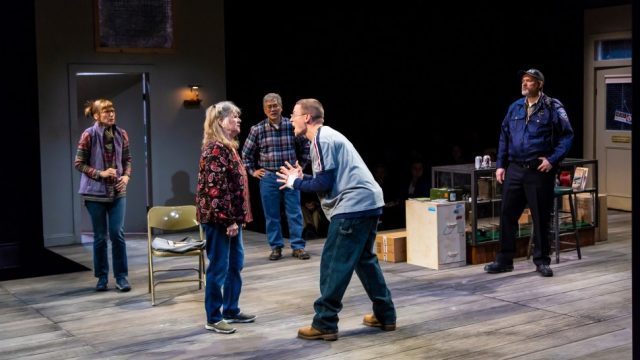
Shrewdly and discerningly directed by Hunter’s longtime collaborator, Davis McCallum (Stupid Fucking Bird, London Wall), the nearly three-hour Greater Clements explores a wide range of issues, from Japanese internment camps and cancer to mental illness and gentrification, from corporate insensitivity and greed to fear and, perhaps most pointedly, loneliness. Dane Laffrey’s potent, active set, which includes a small part of the audience seated in a corner section virtually amid the action, features a second level that descends from above; unfortunately, the construction requires numerous poles that will occasionally block some of your view as the setting changes from the mine and the museum to a bedroom and living room. Yi Zhao’s lighting is supremely effective in the scenes that take place in the mine itself, putting us inside the dark underbelly of America. Tony and Obie winner Ivey (Steaming, Hurlyburly) is exquisite as Maggie, bringing an intimate, realistic warmth to a stalwart woman who deserves better out of life, but Donovan (Lewiston/Clarkston; Xander Xyst, Dragon: 1) steals the show with his powerful, in-your-face portrayal of a man all-too-aware of his situation but not necessarily capable of controlling it.

SARAH JONES: SELL/BUY/DATE

(photo © Joan Marcus 2016)

Sarah Jones plays multiple characters in futuristic one-woman show about commercial sex trade (photo © Joan Marcus 2016)

New York Live Arts
219 West 19th St. between Seventh & Eighth Aves.
September 12-15 & 18-21, $15-$50, 7:30
212-924-0077
newyorklivearts.org
www.sarahjonesonline.com

Following its 2016 Manhattan Theater Club presentation, Sarah Jones’s Sell/Buy/Date is back in the city for an encore engagement at New York Live Arts. Below is an update of twi-ny’s original review, with relevant information added.

In 2006, British playwright and actress Sarah Jones won a Special Tony Award (and an earlier Obie) for her one-woman show Bridge and Tunnel, in which she played multiple characters, shining a light on New York City’s immigrant population. It took a decade, but she returned three years ago with her follow-up, another one-woman multiple-identity tour de force, Sell/Buy/Date, which revives some characters from her previous works while adding new ones; the production is now back by popular demand, running at New York Live Arts September 12-15 and 18-21. It’s late-twenty-first-century America, and Dr. Serene Campbell is teaching a class on the sex business, leading her students through a series of BERT modules, bio-empathetic resonant technology that dates back to 2017. Using this imaginary technology like oral histories, she tells her students, “We will be experiencing different bodies, different ages, what were then called ‘races’ or ‘ethnic groups,’ as you’ll remember from Unit One, and along the gender continuum, we’ll be encountering males as well as females — it was quite binary at that time. Remember, these are Personal History modules — the focus today is on feeling each person’s experience, so, before we begin, how many people have your emotional shunts engaged?”

She then proceeds to embody seventeen characters interviewed throughout the decades about the commercial sex trade, examining the reaction in the recent past to prostitution, pornography, and exotic dancing. “Chronologically advanced” Jewish bubbe Lorraine L. talks about trying to enhance her sexual relationship with her husband by searching for porn on the internet. Post–Valley Girl Bella, named after feminist activist Bella Abzug, is a “sex work studies major, minoring in social media with a concentration on notable YouTube memes” who cohosts “the biweekly pole-dancing party . . . called ‘Don’t Get All Pole-emical.” Jamaican No Fakin’ is a Caribbean prostitute at a sex workers rally who is carrying an unseen sign that says “No Justice, No Piece.” She defends what she does, noting, “You find me somebody who don’t hate some part of their job. There’s a lotta things I hate about doing this, but the money is not one of them.” And New York Domini-Rican Nereida angrily declares, “It just makes me so sick that we are all supposed to care about the same human rights, at least, that’s why we’re all here for this Feminist Plenary, but I mean, if one more of these so called ‘sex work advocates’ calls me anti-sex, I swear to god. I’m gonna be, like, first of all, I love sex. Sex is amazing. But what you are having is not sex.

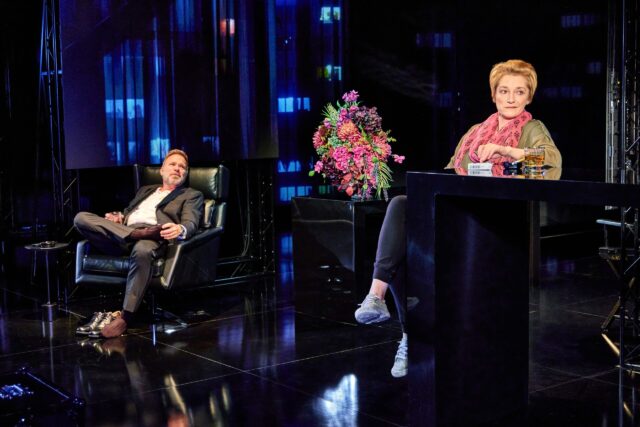
Dr. Campbell also calls up interviews of members of the male species as she walks around Dane Laffrey’s futuristic set, a spare, antiseptic classroom with a podium, a file cabinet, a floor sparsely outlined with lights, and a projection screen at the back. “Yes, of course men were having sex as well, but you’ll remember from the reading, what were male sluts called?” she asks the class. “Very good, they were called ‘men.’” Among the male characters in the show are frat boy and Grand Theft Auto fan Andrew “AV” Vanderbeek, Russian raunchpreneur Sergei Ledinov, Los Angeles pimp Cookie Chris (“Even with what I was doing, you know, exploiting women and whatnot, I had a rep for being real sweet about it”), and Native American comedian Gary (“I’m usually most popular on college campuses, whenever they wanna do their Diversity Day or Hey, We’re Not All White week”). But as much as the treatment of women and sex workers needs to change, not all change turns out to be progress.

Sarah Jones explores the history of the (photo © Joan Marcus 2016)

Sarah Jones explores a controversial aspect of human sexuality in Sell/Buy/Date (photo © Joan Marcus 2016)

Jones (The Foundation, Surface Transit), who was born in Baltimore and raised in Boston, DC, and Queens in a multiracial family, has created a fascinating future devoid of organized religion, bachelor parties, unpaid internships, personal security guards, violent video games, a livable New Jersey, and mobile phones, where people can travel freely between countries and there is no discrimination of any kind. “They did not believe one has an automatic right to live equally,” Dr. Campbell says about people from the past. It’s a potent point, especially given the vitriol present in this year’s lurid presidential election campaign. In researching Sell/Buy/Date, Jones met with sex workers around the world, visiting Sweden, Germany, Korea, India, Las Vegas, France, Ireland, Scotland, the Netherlands, and the Dominican Republican, helping her create believable men and women who share a wide range of thoughts about commercial sex. She smartly captures the humanity in the industry, even if it is a bit lighthearted at times for such a serious topic, while Drama Desk–nominated director Carolyn Cantor (Fly by Night, Indian Summer) ably uses sound (by Bray Poor) and light (by Eric Southern) to smoothly transition between time periods. However, a subplot involving Dr. Campbell’s mother’s identity as a “survivor” feels like a forced tribute to those who have paved the way for gender equality. Jones, who once declared, “The revolution will not happen between these thighs” (the late Gil Scott-Heron was a family friend), gives a superb performance, instantly taking control of the audience; she has a natural confidence as a teacher that is intoxicating. Sell/Buy/Date offers a lively and timely look at a controversial subject that has continued to raise eyebrows throughout the centuries.

APOLOGIA

(photo by Joan Marcus)

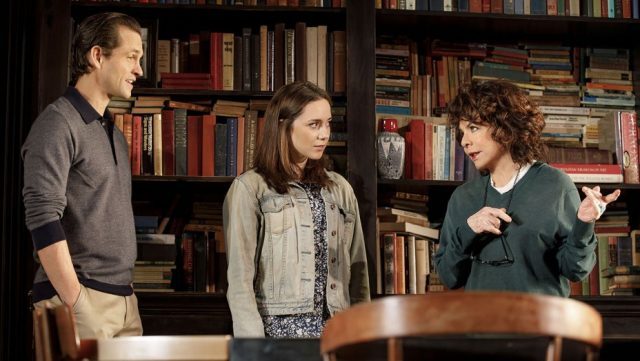
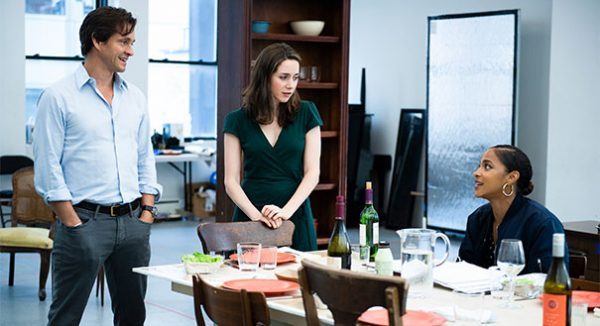
Kristin Miller (Stockard Channing) has a lot to say to her son Peter (Hugh Dancy) and his girlfriend, Trudi (Talene Monahon), in Apologia (photo by Joan Marcus)

Laura Pels Theatre
Harold and Miriam Steinberg Center for Theatre
111 West 46th St. between Sixth & Seventh Aves.
Tuesday – Sunday through November 30, $99
212-719-1300
www.roundabouttheatre.org

Successful art historian and proud humanist Kristin Miller (Stockard Channing) makes no apologies for the choices she’s made in Alexi Kaye Campbell’s Apologia, which continues at the Roundabout’s Laura Pels Theatre through November 30. An ex-pat living in the English countryside, Kristin is an uncompromising feminist and atheist who gave up custody of her children in order to pursue her career in Europe. On a spring day in 2009, she is expecting company for dinner, including her son Peter (Hugh Dancy), his new girlfriend, Trudi (Talene Monahon), her other son, Simon (also Dancy), his girlfriend, Claire (Megalyn Echikunwoke), and Kristin’s longtime friend, Hugh (John Tillinger). As they arrive, serious religious and socioeconomic conversations ensue, and it quickly becomes clear that Kristin respects no one as much as she does her own opinion. “Still raping the Third World?” she asks Peter, who responds, “If helping local initiatives and infrastructure projects off the ground is considered rape then, yes, brutally.” When she learns that Trudi is a vegetarian and a faithful Christian who met Peter at a prayer meeting, she digs in her talons. “I believe in mystery, imagination, and the power of myth and metaphor. But not in outmoded patriarchal propaganda,” she declares. When Claire, an actress, announces that her contract on a television series has been extended, all are happy for her except Kristin, who is quick to insult the program. “It was a little vacuous. I kept asking myself, ‘Why do people watch this? And why do they make it?’” But when the subject turns to Kristin’s latest book, a memoir called Apologia, the tension ratchets up, since she failed to mention anything about her sons or her family in it. But she’s not about to apologize for that either, as is evident when she explains what the title means: “a formal, written defence of one’s opinions or conduct.”

(photo by Jenny Anderson)

Hugh Dancy, Talene Monahon and Megalyn Echikunwoke in rehearsal for Apologia (photo by Jenny Anderson)

Tony winner Channing (Other Desert Cities, Six Degrees of Separation) is passionate and unrelenting as Kristin, who was English in the original version. She manages to keep the selfish, smug, and snarky writer from becoming too villainous or a mere relic from a different time; you keep wanting Kristin to say or do the right thing even though she never does, instead insisting on exploiting her supposed moral and intellectual superiority over everyone. She’s also not afraid to be exactly who she is; when she is given a Nigerian mask as a birthday present, she doesn’t hide her distaste. And it’s more than just a plot device that her oven isn’t working so she won’t be able to make dinner, a typically motherly responsibility. Dancy (Venus in Fur, The Pride) excels as both sons, whose names reference one of Jesus’s disciples, Simon Peter. Tillinger, a director who was lured back to the stage by Channing for this production — they starred together in Peter Nichols’s Joe Egg on Broadway in 1985 — does his best with Hugh, a relatively thankless part that merely serves as comic relief; when he departs Dane Laffrey’s book- and art-heavy set, his character is not really missed. Three-time Obie-winning director Daniel Aukin (Bad Jews, Admissions) guides the actors through some familiar, clichéd territory that is too straightforward and borders on just the kind of drama Kristin argues that Claire acts in. “She’s a bloody nightmare,” Peter tells Trudi. “Opinionated, didactic, dictatorial.” But that doesn’t mean she isn’t bold, brave, and heroic in her own way.