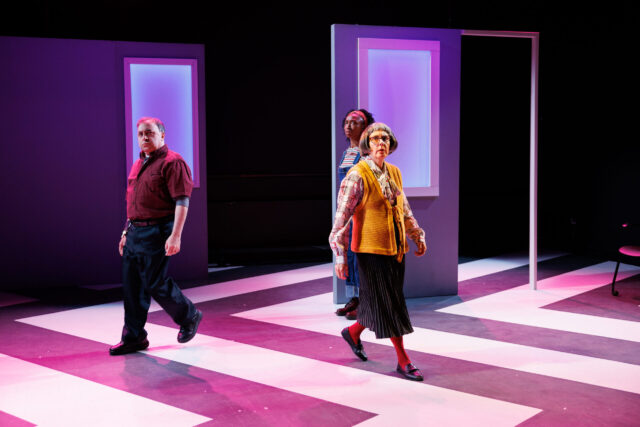
Steven Rattazzi, Amara Granderson, and Lizzie Olesker star as three accidentally interconnected New Yorkers in Triplicity (photo by Maria Baranova)
TRIPLICITY
Mabou Mines@122CC
150 1st Ave. at Ninth St.
Wednesday – Monday through October 26, $30-$40
talkingband.org
I got so mad watching Triplicity, Talking Band’s latest fantastic foray into the experimental and the avant-garde. The legendary downtown troupe was founded in 1974 by Paul Zimet, Ellen Maddow, and Tina Shepard and has presented approximately sixty shows over the years. Embarrassingly, I discovered them only a few years ago and have been blown away by their last five productions but, oh, what I have missed over the decades.
In a program note, director Zimet writes, “I feel Triplicity is a quintessential Talking Band work: It uses music, the music of speech, and choreography to heighten the ordinary and allow us to appreciate it in a new way.” If you’ve never experienced a Talking Band work, then Triplicity is a great place to start. And if you have been to previous TB shows, well, what are you waiting for? Triplicity runs at Mabou Mines@122CC only through October 26.
Triplicity is a truly New York City tale, following the interconnected, overlapping lives of four strangers as they go about their regular, mostly mundane existence in the big metropolis.
Frankie Shuffleton (Lizzie Olesker) is a seventy-something widowed bookkeeper who walks around her Christopher Street block every day at noon, sits on a park bench, and picks up a salad in a plastic container on her way home, where she listens to the news on the radio at seven, catches a police procedural at ten, then goes to bed. In true Beckett fashion, her first words are “There’s nothing to say,” which sharply contrasts with her accidental acquisition of a “talk to me” phone in which people call seeking advice.
Danny Dardoni (Steven Rattazzi) is a fifty-something exterminator who lives in a large Italian household in Bay Ridge, reads the poems of Virgil, and is shocked to learn that there is an enormous beehive in the attic. Danny, who has an innate sense for details, specializes in killing mice and rats and, not necessarily happily, tells us that he “is responsible for the safety and well-being of my family, to provide a home, this house, that is a safe place in a dangerous world.”
Norma Linda Box (Amara Granderson) is a twentysomething wannabe writer with five roommates, four jobs, and a hatred of people saying her name. When she sees a snake on the sidewalk, she takes him home because his blue stripes match a tattoo on her left ankle. “No one has witnessed the event,” she says. “I own it. I can define it. It’s mine to define.”
And Calliope (El Beh) is a street singer who is kind of a Greek chorus in funky, wild clothing, singing songs related to the words and actions of Frankie, Danny, and Norma, picking up on their sound and movement. “Whatever the weather / Calliope sings to whoever will listen / That’s it / That’s it,” she warbles.
As they share their stories, they break out into formalistic dances and roll around on their chairs; the playful choreography by Sean Donovan and Brandon Washington evokes the independence, and loneliness, of so many New Yorkers.
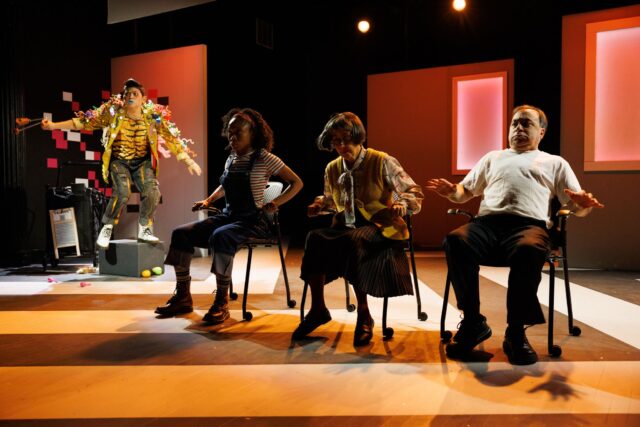
Talking Band’s Triplicity features unique choreography by Sean Donovan and Brandon Washington (photo by Maria Baranova)
In astrology, triplicity is an essential dignity involving a group of three Zodiac signs belonging to one element. That definition fits the show well, as the worlds of three people intersect and become one through the participation of a fourth.
The play begins with Frankie telling her story three different ways, moving her chair and adding more detail each time, a dazzling introduction to how we talk about our lives and share them with others. The concept of numbers is key throughout the seventy minutes, a poetic leitmotif. “Suddenly everything is in two’s!” Frankie declares. Three girls ride scooters. At four, Frankie goes out for coffee. Norma has five roommates and writes six essays. There are seven shards of glass on a blue tile floor. They get ten inches of rain over three days. The barrage of numbers suggests the passage of time, in minutes, hours, days, weeks, months, and years on the journey from birth to death.
Anna Kiraly’s set consists of rolling chairs, doorways with windows on which she projects different color schemes, a mazelike path on the floor, and a corner with special props for Calliope. Olivera Gajic’s costumes feature Frankie in a quaint sweater and skirt, Danny in a white T-shirt and sneakers, Norma in blue-jean overalls and wearing a red bandanna, and Calliope in a series of wildly adorned outfits.
Triplicity is written and composed by Ellen Maddow and directed by Paul Zimet, the incomparable married team who have been collaborating as writer, director, composer, and/or actors for half a century, including on Talking Band’s recent surge of endlessly compelling and engaging works, which have made me nearly weep with joy as the company continues to push the limits of what theater can be: Shimmer and Herringbone at Mabou Mines, Existentialism and Lemon Girls or Art for the Artless at La MaMa, and The Following Evening at PAC NYC.
In Triplicity, they capture the essence of New York City, the heart and soul of everyday people, the music and energy, divided into such chapters as “Adagio,” “Allegretto,” and “Scherzo,” resulting in a beautiful mini-symphony performed by a magical quartet.
[Mark Rifkin is a Brooklyn-born, Manhattan-based writer and editor; you can follow him on Substack here.]