Tag Archives: Dane Laffrey

COLLECTIVE RAGE: A PLAY IN 5 BETTIES

Betty 1 (Dana Delany) lets it all out in Collective Rage (photo by Joan Marcus)

Betty 1 (Dana Delany) lets it all out in Collective Rage (photo by Joan Marcus)

MCC Theater at the Lucille Lortel Theatre
121 Christopher St. between Bleecker & Hudson Sts.
Sunday – Friday through October 7, $49-$125
212-352-3101
www.mcctheater.org

For hundreds of years, the name “Betty” has been used to describe various types of women, from hot and stylish to relaxed and self-confident, from schoolteachers and the girl-next-door to wholesome and plain; it can also refer to a man who performs household duties, a gay man, and a light-skinned black man, according to Cassell’s Dictionary of Slang. The term has been linked to Betty Grable, Bettie Page, Betty Rubble from The Flintstones, Betty Cooper from the Archie comics, Betty Boop, and Betty Crocker and has been popularized in such films as Clueless and Encino Man. The word, with its wide range of meaning, can be a metaphor for the obscured individuality of women, one name covering the vast diversity and lack of sameness for a gender that has been treated as second-class citizens for millennia. But the second sex, as Simone de Beauvoir called women, has been fighting back in new ways in recent years, as depicted in Jen Silverman’s outrageously funny and perceptive play, Collective Rage: A Play in 5 Betties, an MCC production that continues at the Lucille Lortel through October 7. In the show, Silverman also reclaims the word “pussy,” which has multiple meanings too but has become a kind of feminist call to arms given its controversial usage by President Trump. The word appears about fifty times in the play, including in the subtitle: In Essence, a Queer and Occasionally Hazardous Exploration; Do You Remember When You Were in Middle School and You Read About Shackleton and How He Explored the Antarctic?; Imagine the Antarctic as a Pussy and It’s Sort of Like That.

Collective Rage features five characters from across the spectrum: Betty 1 (Dana Delany) is white and uptight, an erudite and elegant woman in a loveless marriage with the wealthy Richard; Betty 2 (Adina Verson) is white and unsophisticated, in a boring marriage with Charles; Betty 3 (Ana Villafañe) is a tough-talking bisexual Latinx who says what’s on her mind; Betty 4 (Lea DeLaria) is a heavily tattooed white butch lesbian who spends most of her time working on her truck and pining for Betty 3; and Betty 5 (Chaunté Wayans) is an African American boxing gym owner who self-identifies as a “gender-non-conforming masculine-presenting female-bodied individual.”
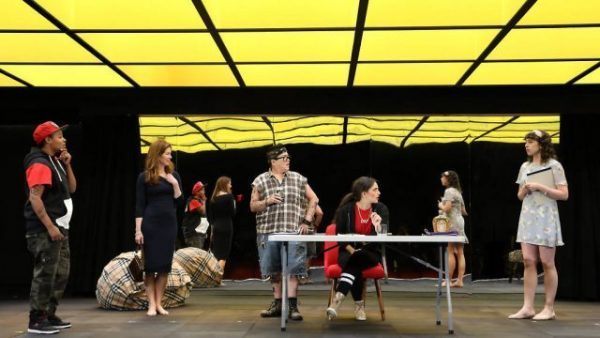
Five Betties gather together to stage their own play in biting work by Jen Silverman (photo by Joan Marcus)

Five Betties gather together to stage their own play in biting work by Jen Silverman (photo by Joan Marcus)

Betty 1 sets the tone in her opening monologue, in which she states after watching the news, “This world is terrible. This world is awful. / I am Very Very Concerned about the State of Things. / My husband Richard came home and I said to him RICHARD / I said RICHARD / I am Very Very Concerned About the State of Things. / My husband Richard is a calm person. / He is a logical and a rational person and He Wears a Suit. / And Richard said to me: BETTY / Richard said: BETTY / Richard said: Betty, Don’t Worry. / AND THAT DIDN’T MAKE ME FEEL BETTER.”

Each Betty busts female stereotypes; yet even as each is different, they all share a common loneliness, which is revealed at several women-only dinner parties. The intimate gatherings are not for men; in fact, the play itself was not written for the male gender, and in particular not straight white men. At one party, after Betty 3 raves about the first time she had sex with a woman, Betty 1 says, “That’s not good conversation for a dinner party.” Betty 3 says, “No?” Betties 1 and 2 answer in unison, “No.” Betty 3 asks, “How come?” Betty 1 says, “We don’t talk about sex at dinner parties.” Betty 3 responds, “What else you talk about?” Betty 2 replies, “We aren’t having sex, so we can’t talk about it.” Betty 3 offers, “Maybe you should start having it.” Betty 1 ends the discussion by saying, “We’re married.”

(photo by Joan Marcus)

Betty 5 (Chaunté Wayans) teaches Betty 1 (Dana Delany) how to fight back in Collective Rage (photo by Joan Marcus)

At another dinner party, Betty 3 gives Betty 2 and Betty 4 hand mirrors so they can look at their vaginas up close and personal. Betty 2 is terrified, claiming she has never done that before. “What if it’s ugly?” she says. “What if there’s teeth? What if it’s lopsided? What if it’s lumpy? Or flat? Or geometrically displeasing? Or what if I don’t have one at all and there’s just a small animal who lives there, like a lizard or a dwarf-hamster, and all I see are the gleam of its little eyes as it stares back up at me?” It’s a hysterically funny scene, but it also brilliantly depicts a woman’s fear of her sexuality and control of her own body. “Look at your pussy,” Betty 3 tells her. “Both eyes,” Betty 4 adds.

After Betty 3 goes to a play with a rich white woman — they see what she calls “Summer’s Midnight Dream” — Betty 3 decides to quit her job and stage her own piece of “Thea-tah”; entranced by the play-within-a-play narrative (of Shakespeare’s A Midsummer Night’s Dream,), she is going to do the same thing, a sly reference to Collective Rage, which now also has a similar structure. All five Betties become involved in the venture, for different reasons, furthering their relationships with one another and cleverly developing their individual characters as Silverman explores their innermost desires and their sense of self, as well as their thoughts on theater. “I think a lotta things that seem like art are maybe actually just about pussy. And then also, things that are mostly about pussy might actually be about art,” Betty 4 tells Betty 3, getting right to the point.

Collective Rage unfolds over ninety riotous yet poignant minutes, in chapters with such descriptive names as “Betty 2 Acts Out Her Feelings with a Puppet Because She Has No Real Friends,” “Betty 1 Has More Rage, and Does Something About It,” and “Betty 4 and 5 Work on Their Trucks and Talk About Relationships, Which Is Just Another Word for Pussy,” the titles projected above the stage. Dane Laffrey’s relatively spare set, just a few chairs and a desk, constantly surprises as items fall down through open grids in the ceiling, from truck engines and a punching bag to other key props, like gifts from heaven. (Kudos to prop master Joshua Yocom.) Director Mike Donahue (The Legend of Georgia McBride, Silverman’s The Moors) lets the women strut their stuff, and Delany (China Beach, Dinner with Friends), DeLaria (Orange Is the New Black, The Rocky Horror Show), Verson (Indecent, The Lucky Ones), Villafañe (On Your Feet, In the Heights), and Wayans (50 Shades of Black, Hollywood Misconceptions) don’t disappoint, shining a light on gender identity, sexuality, lust, love, societal expectations, and power in the twenty-first century. It’s about how to be a Betty, and how not to be a Betty, whatever that means. “I feel like things are changing,” Betty 4 says to Betty 5, who responds, “I hope so.” Betty 4 adds, “But everything was good the way it was. Wasn’t it?” Betty 5 replies, “Change is exciting.” And Betty 4 opines, “Change is sad. Change is things getting forgotten. Change is people getting left behind.” Exactly.
PEACE FOR MARY FRANCES

(photo by Monique Carboni)

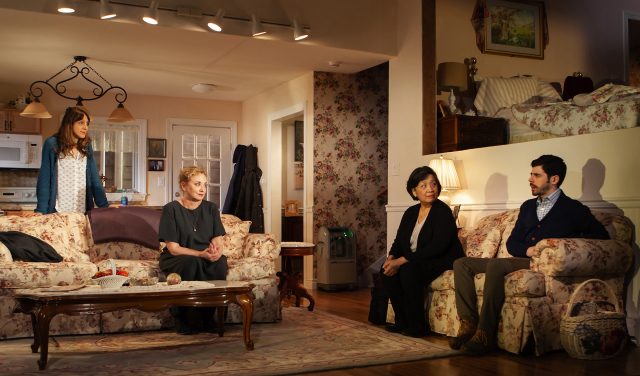
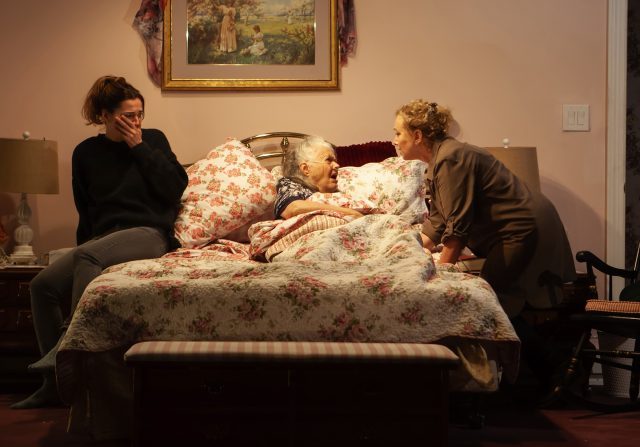
A dysfunctional family receives important information about hospice care in Peace for Mary Frances (photo by Monique Carboni)

The New Group at the Pershing Square Signature Center
The Alice Griffin Jewel Box Theatre
480 West 42nd St. between Tenth & Eleventh Aves.
Tuesday – Sunday through June 17, $30-$125
www.thenewgroup.org

Having recently lived through situations resembling those in Peace for Mary Frances, Lily Thorne’s debut play that opened tonight at the Alice Griffin Jewel Box Theatre at the Pershing Square Signature Center, it wasn’t easy for me to sit through the New Group production. Unfortunately, that wasn’t because the 155-minute play was right on target, offering me a cathartic experience. Thorne, who has worked on several documentaries and is currently getting her MFA in playwriting at Brooklyn College, has written a lifeless drama about end-of-life care. It feels more like an instructional primer on what to do when a loved one is dying than a dramatic work that sheds light on what can be a devastating time. Eighty-seven-year-old Lois Smith stars as Mary Frances, the matriarch of a dysfunctional West Hartford family. As her quality of life deteriorates, Mary Frances tells her Armenian-American family that she wants hospice care so she can be as comfortable as possible at home for whatever time she has left. It proves difficult for her two daughters, Fanny (Johanna Day), a divorced drug addict who works as a security guard at the Y and is estranged from her daughter, and Alice (J. Smith-Cameron), a divorced astrologist with no money and two grown children of her own, Helen (Heather Burns), a TV star, and Rosie (Natalie Gold), a married mom with two kids. While Fanny and Alice fight brutally, nonstop, Mary Frances’s son, Eddie (Paul Lazar), a divorced lawyer, comes by once a week, watches TV, and eats sushi, avoiding getting involved in anything of real importance. As Mary Frances hangs on longer than expected — “Typically, people don’t leave this life until their unfinished business is taken care of,” hospice nurse Bonnie (Mia Katigbak) says — the family relationships devolve into a crazy mess.

(photo by Monique Carboni)

Mary Frances (Lois Smith) argues with daughter Alice (J. Smith Cameron) as granddaughter Helen (Heather Burns) looks on in New Group world premiere (photo by Monique Carboni)

Peace for Mary Frances takes place on Dane Laffrey’s two-level set, a suburban living room / kitchen and Mary Frances’s upstairs bedroom, all decked out in flowery designs. Director Lila Neugebauer has done sensational work, particularly at Lincoln Center and the Signature, with such plays as At Home at the Zoo, The Antipodes, Everybody, The Wolves, and The Wayside Motor Inn, showing an innate sense of narrative structure, choreographed movement, and cutting-edge staging that both challenges and entertains. But she has little to work with here, unable to bring life to Thorne’s deadening dialogue and forced conflicts. Early on, Rosie and Helen are unable to lift Mary Frances off the couch. But when the scene ends a few moments later, Smith gets up herself and walks up the stairs. It instantly destroys the theatrical illusion that Mary Frances is dying, taking the audience out of the story and damaging the empathy we are trying to have with the characters. In addition, throughout the play, there is a hard-to-identify noise that seems to be coming from the front left of the stage. My companion and I wondered whether it was an audience member who was breathing very loudly (or was snoring), the air-conditioning, or part of the show, sounds meant to represent Mary Frances’s oxygen machine, mimicking the rhythm of her breathing. I even asked an usher what it was during intermission and she was not sure. (The script does say, “The machines are on and pumping throughout the play.”) If it was indeed intentional, it was ridiculously distracting. The play also sadly wastes the talent of two-time Tony nominee and Obie winner Smith, who recently starred in the stage and film versions of Marjorie Prime and previously did excellent work at the Signature in Annie Baker’s John and Sam Shepard’s Heartless. Despite an extremely talented director and an acting legend, Thorne’s debut is on life support from the beginning, and it goes on far too long before the plug is pulled.

ONCE ON THIS ISLAND

(photo © Joan Marcus 2017)

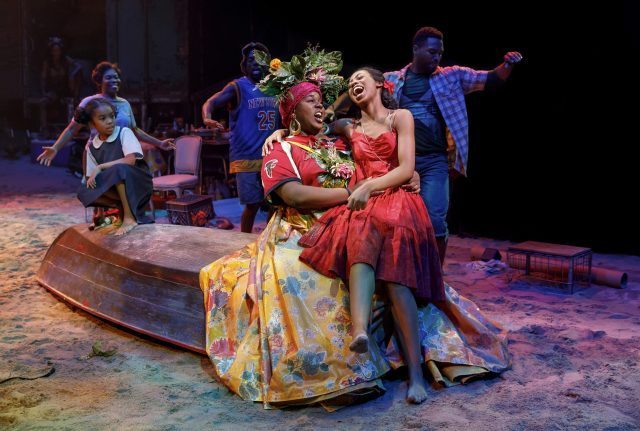
Once on This Island revival should have been dead in the water (photo © Joan Marcus 2017)

Circle in the Square Theatre
1633 Broadway at 50th St.
Friday – Wednesday through December 30, $89.50 – $189.50
onceonthisisla nd.com

Michael Arden’s revival of Lynn Ahrens and Stephen Flaherty’s 1990 hit musical, Once on This Island, is a critical and popular success, blowing away audiences with a stellar cast, superb staging, lively music, and a fantastic set that takes full advantage of the small Circle in the Square Theatre. There’s only one problem, and it’s more than a minor quibble: The story is culturally insensitive, racist, colonialist, and, as far as subject matter goes, tone deaf. Nominated for eight Tonys during its 1990-91 Broadway run and winner of the 1994 Olivier Award for Best New Musical, the show takes place in the “Jewel of the Antilles,” the former French colony known as Saint-Domingue before becoming Haiti. In the prologue, various characters describe their home as “an island where the poorest of peasants labor” and “the wealthiest of grands hommes play.” One woman says, “The grands hommes, with their pale brown skins and their French ways, owners of the land and masters of their own fates,” after which a man adds, “And the peasants, black as night, eternally at the mercy of the wind and the sea.” Thus, the central dilemma is set up, class warfare based on skin shade. The poor side of the island is overseen by a quartet of gods: Papa Ge, the sly Demon of Death (Merle Dandridge), Erzulie, the beautiful Goddess of Love (Lea Salonga), Agwe, God of Water (Quentin Earl Darrington), and Asaka, Mother of the Earth (Kenita R. Miller). Following a flood, little Ti Moune (Emerson Davis) is protected by a tree near a small, close-knit village, where she is taken in and raised by Mama Euralie (Kenita R. Miller) and Tonton Julian (Phillip Boykin). Grown into a lovely young woman, Ti Moune (Hailey Kilgore) sees an exciting stranger in a white car racing past and asks the gods for a glimpse of the man. When he later gets into a car accident and is saved by Ti Moune, she learns that he is Daniel Beauxhomme (Isaac Powell), the scion of the wealthy family that lives behind the gate on the other side of the island. As she nurses him back to health, she falls in love with him, but his family is against his having any kind of relationship with a peasant girl, ultimately leading to tragedy.

(photo © Joan Marcus 2017)

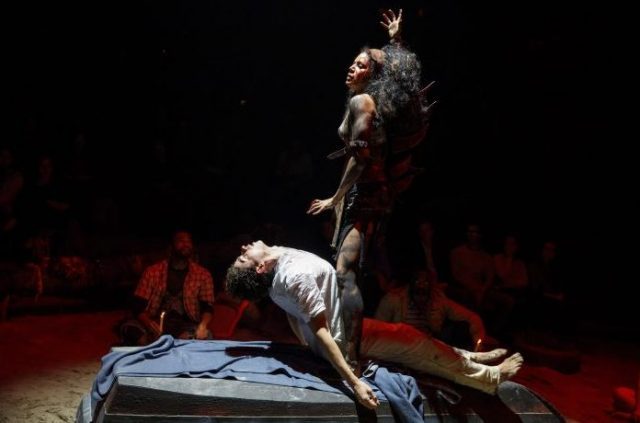
Papa Ge (Merle Dandridge) has a surprise for Daniel Beauxhomme (Isaac Powell) in Once on This Island (photo © Joan Marcus 2017)

In Once Upon This Island, William Shakespeare’s Romeo and Juliet meets Shel Silverstein’s The Giving Tree, with bits of Cinderella and Maid in Manhattan, only without any kind of legitimately believable romance and conflict. The narrative is told like a children’s bedtime story despite its adult themes of sex, power, class, and race. Kilgore is valiant as the older Ti Moune, Darrington is bold and strong as Agwe, and Dandridge is deliciously devilish as Papa Ge, while Dane Laffrey’s set boasts a mystical pond, a live goat, an overturned rowboat, plants, a large truck, drying clothes, and lots of sand, home to a close-knit community, the villagers dressed in Clint Ramos’s colorful costumes and moving to Camille A. Brown’s choreography. (Some of the characters also make their way into the audience.) The small band consists of Alvin Hough Jr. and Javier Diaz on percussion, Irio O’Farrill Jr. on bass, Hidayat Honari on guitar and mandolin, and Cassondra James on flute, performing Flaherty’s Caribbean-tinged music, but it’s the book and lyrics by Ahrens that are befuddling. Ti Moune is portrayed as some kind of legendary heroic figure willing to do anything for true love, but instead she’s just another victim of colonialism and racism, in this case celebrated for all the wrong reasons. Arden (Spring Awakening) and the creative team visited Haiti to get a better feel for its people and culture, even taking part in a Vodou ceremony, but what he’s delivered onstage is more like a knife in the back, particularly now that the president of the United States has offered his own take on the country. (Just wait till you see the shadow-puppet tale and the party dancing scene.) In his director’s note, Arden writes, “It is my hope that the story of Ti Moune might inspire any person, regardless of age, gender, race, ability, sexuality, or circumstance, to become a catalyst for change.” It’s my hope that more theatergoers see this sordid tale for what it really is, a perpetuation of stereotypes and genre clichés that prevent us all from moving forward and achieving real equality and sensitivity.

SELL / BUY / DATE

(photo © Joan Marcus 2016)

Sarah Jones plays multiple characters in futuristic one-woman show about commercial sex trade (photo © Joan Marcus 2016)

Manhattan Theatre Club
New York City Center: The Studio at Stage II
Tuesday – Sunday through December 3, $30 through October 30, $75 after
212-581-1212
manhattantheatreclub.com
www.nycitycenter.org

Ten years ago, British playwright and actress Sarah Jones won a Special Tony Award (and an earlier Obie) for her one-woman show Bridge and Tunnel, in which she played multiple characters, shining a light on New York City’s immigrant population. It took a decade, but she is now back with her follow-up, another one-woman multiple-identity tour de force, Sell/Buy/Date, which revives some characters from her previous works while adding new ones. It’s late-twenty-first-century America, and Dr. Serene Campbell is teaching a class on the sex business, leading her students through a series of BERT modules, bio-empathetic resonant technology that dates back to 2017. Using this imaginary technology like oral histories, she tells her students, “We will be experiencing different bodies, different ages, what were then called ‘races’ or ‘ethnic groups,’ as you’ll remember from Unit One, and along the gender continuum, we’ll be encountering males as well as females — it was quite binary at that time. Remember, these are Personal History modules — the focus today is on feeling each person’s experience, so, before we begin, how many people have your emotional shunts engaged?” She then proceeds to embody seventeen characters interviewed throughout the decades about the commercial sex trade, examining the reaction in the recent past to prostitution, pornography, and exotic dancing. “Chronologically advanced” Jewish bubbe Lorraine L. talks about trying to enhance her sexual relationship with her husband by searching for porn on the internet. Post–Valley Girl Bella, named after feminist activist Bella Abzug, is a “sex work studies major, minoring in social media with a concentration on notable YouTube memes” who cohosts “the biweekly pole-dancing party . . . called ‘Don’t Get All Pole-emical.” Jamaican No Fakin’ is a Caribbean prostitute at a sex workers rally who is carrying an unseen sign that says “No Justice, No Piece.” She defends what she does, noting, “You find me somebody who don’t hate some part of their job. There’s a lotta things I hate about doing this, but the money is not one of them.” And New York Domini-Rican Nereida angrily declares, “It just makes me so sick that we are all supposed to care about the same human rights, at least, that’s why we’re all here for this Feminist Plenary, but I mean, if one more of these so called ‘sex work advocates’ calls me anti-sex, I swear to god. I’m gonna be, like, first of all, I love sex. Sex is amazing. But what you are having is not sex.

Dr. Campbell also calls up interviews of members of the male species as she walks around Dane Laffrey’s futuristic set, a spare, antiseptic classroom with a podium, a file cabinet, a floor sparsely outlined with lights, and a projection screen at the back. “Yes, of course men were having sex as well, but you’ll remember from the reading, what were male sluts called?” she asks the class. “Very good, they were called ‘men.’” Among the male characters in the show are frat boy and Grand Theft Auto fan Andrew “AV” Vanderbeek, Russian raunchpreneur Sergei Ledinov, Los Angeles pimp Cookie Chris (“Even with what I was doing, you know, exploiting women and whatnot, I had a rep for being real sweet about it”), and Native American comedian Gary (“I’m usually most popular on college campuses, whenever they wanna do their Diversity Day or Hey, We’re Not All White week”). But as much as the treatment of women and sex workers needs to change, not all change turns out to be progress.

Sarah Jones explores the history of the (photo © Joan Marcus 2016)

Sarah Jones explores a controversial aspect of human sexuality in Manhattan Theatre Club production at City Center (photo © Joan Marcus 2016)

Jones, who was born in Baltimore and raised in Boston, DC, and Queens in a multiracial family, has created a fascinating future devoid of organized religion, bachelor parties, unpaid internships, personal security guards, violent video games, a livable New Jersey, and mobile phones, where people can travel freely between countries and there is no discrimination of any kind. “They did not believe one has an automatic right to live equally,” Dr. Campbell says about people from the past. It’s a potent point, especially given the vitriol present in this year’s lurid presidential election campaign. In researching Sell/Buy/Date, Jones met with sex workers around the world, visiting Sweden, Germany, Korea, India, Las Vegas, France, Ireland, Scotland, the Netherlands, and the Dominican Republican, helping her create believable men and women who share a wide range of thoughts about commercial sex. She smartly captures the humanity in the industry, even if it is a bit lighthearted at times for such a serious topic, while Drama Desk–nominated director Carolyn Cantor (Fly by Night) ably uses sound (by Bray Poor) and light (by Eric Southern) to smoothly transition between time periods. However, a subplot involving Dr. Campbell’s mother’s identity as a “survivor” feels like a forced tribute to those who have paved the way for gender equality. Jones, who once declared, “The revolution will not happen between these thighs” (the late Gil Scott-Heron was a family friend), gives a superb performance, instantly taking control of the audience at the intimate and comfortable Studio at Stage II at New York City Center; she has a natural confidence as a teacher that is intoxicating. Part of the Manhattan Theatre Club’s Harold and Mimi Steinberg New Play Series, Sell/Buy/Date offers a lively and timely look at a controversial subject that has continued to raise eyebrows throughout the centuries.

CLOUD NINE

(photo © Doug Hamilton)

The cast of CLOUD NINE rehearses amid the unusual theater-in-the-round setup at the Atlantic (photo © Doug Hamilton)

Atlantic Theater Company
Linda Gross Theater
336 West 20th St. between Eighth & Ninth Aves.
Tuesday – Sunday through November 1, $20-$65
866-811-4111
atlantictheater.org

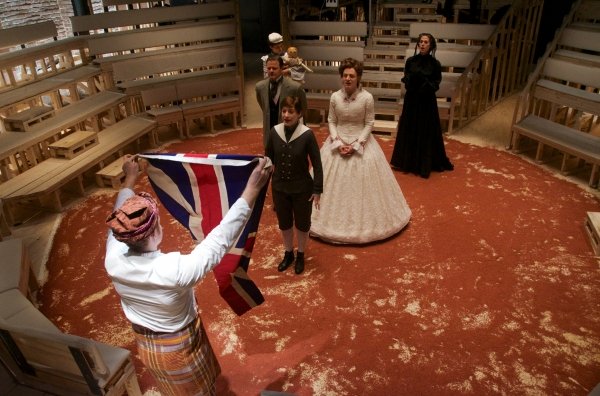
Caryl Churchill skewers British colonialism, patriarchy, and sexual oppression and obsession while examining intricate issues of gender identity and personal freedom in Cloud Nine, her 1979 play being wonderfully revived at the Atlantic. The first act, in which several characters are played by members of the opposite gender, takes place in the late nineteenth century, in an unnamed African nation where the natives are growing more than a little restless, the threat of revolt against their occupiers in the air. Set designer Dane Laffrey (the new Spring Awakening and Fool for Love revivals) has transformed the space into a theater-in-the-round, with several rows of uncomfortable steep wooden bleachers circling the center stage area. (A limited amount of cushions are available, or you can bring your own.) The play opens with Union Jack-waving British administrator Clive (Clarke Thorell) leading his family in a song praising jolly old England, during which he introduces his oddball clan in rhyme. He is married to Betty (Chris Perfetti, in a spectacular off-white gown, courtesy of costume designer Gabriel Berry), a shy, reserved woman who explains, “I live for Clive. The whole aim of my life / Is to be what he looks for in a wife. / I am a man’s creation as you see, / And what men want is what I want to be.” Their son, Edward (Brooke Bloom), prefers playing with dolls to playing catch, while the aptly named baby, Victoria, is an actual doll that the characters toss around. The children are cared for by Ellen (Izzie Steele), the young governess who is extremely dedicated to Betty. Betty’s mother, Maud (Lucy Owen), is a stern woman who thinks that her daughter has married beneath her. And their servant, Joshua (Sean Dugan, a white man playing a black man), goes about his duties with a blank, deadpan look that is fraught with impending danger; “My skin is black but oh my soul is white. / I hate my tribe. My master is my light. / I only live for him. As you can see, / What white men want is what I want to be,” he says without conviction. The family is visited by intrepid explorer and adventurer Harry Bagley (John Sanders), who apparently has never met a person, man or woman, adult or child, he doesn’t want to have sex with, and the widowed Mrs. Saunders (Steele), an independent, plucky sort. The first act plays out like a twisted comedy of manners with a Monty Python edge as most of the characters reveal their hidden sexual desires while arguing over what is proper in society. It’s both funny and poignant, wacky and incisive, but Churchill turns everything around marvelously in the second act.

(photo © Doug Hamilton)

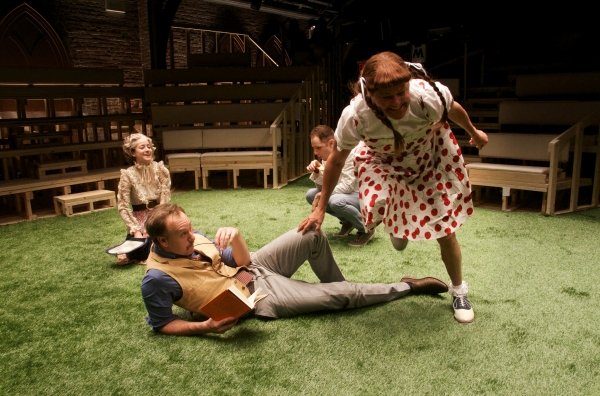
The actors switch roles for the second act of CLOUD NINE, which takes place in 1979 (photo © Doug Hamilton)

Following intermission, the play moves to a London park in 1979, the red gravel of Africa replaced by fake green grass. A century might have passed, but the characters have aged a mere twenty-five years. The full cast and most of the characters are back, but they’re played by different actors; Churchill leaves this doubling up to each new production, and her longtime director, James MacDonald (Love and Information, Cock), recasts the second act ingeniously, adding multiple layers to the already complex story. Bloom (You Got Older), who played the effeminate Edward in the first act, is now playing his mother, Betty, a stronger, more determined woman who is considering a life on her own. Owen (The Village Bike), who was the serious, suspicious Maud, now plays her granddaughter, Victoria, formerly a doll, now a modern woman who is thinking about leaving her husband for Lin, a lesbian played by Steele (What I Did Last Summer), who, as Ellen in the first act, declared her love for Betty. Thorell (Annie, Hairspray), previously Clive, the staunch defender of Mother England, is now Lin’s baby daughter, Cathy, prancing around in pigtails and smearing himself in paint, as if Great Britain has not yet grown up, making the same mess as always. Sanders (Peter and the Starcatcher), who was the brave Harry, has become Martin, Victoria’s very practical husband who simperingly supports anything she wants to do. And Edward, now played by Perfetti (Sons of the Prophet), who was Betty in the first act, has come out of the closet, a park worker in love with the gruff Gerry, portrayed by Dugan (Next Fall). Got all that? It makes for a whole lot of curious, surprising, and at times mind-blowing pairings (Freud would have a field day with the shenanigans) if you really delve into what’s happening between the actors and the characters. The latter have been thrust into an era that has witnessed the civil rights and women’s liberation movements and free love, and they’re ready to move on with their lives, determining their own places in the world rather than being limited by societal norms and what is expected, or demanded, of them. They still have their secrets and are haunted by ghosts, and there’s plenty of difficult work ahead for them, but there’s no need to play hide-and-seek again, as they did in the first act. Even when the story turns extremely serious and you, and many others, are shifting around in your cramped seat, you will have a blast trying to follow who is who, and who was who, and what it all says about the state of our world, then and now.

THE FEW / ANNAPURNA

THE FEW

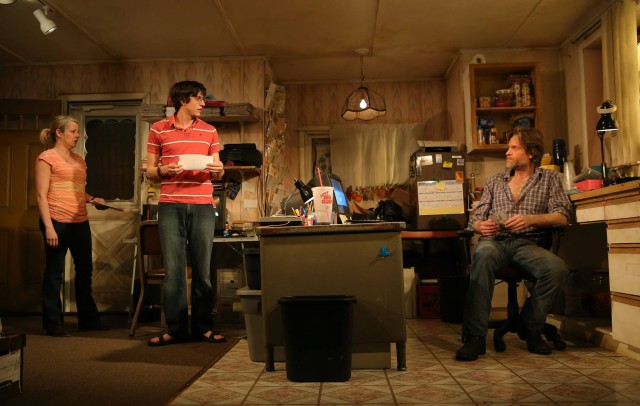
Tasha Lawrence, Gideon Glick, and Michael Laurence star in Rattlestick production of Samuel D. Hunter’s THE FEW

THE FEW
Rattlestick Playwrights Theater
224 Waverly Pl. between Eleventh & Perry Sts.
Wednesday – Monday through June 22 (extended), $55
866-811-4111
www.rattlestick.org

Quite by coincidence, we saw The Few and Annapurna on successive nights last week, and we couldn’t have been more struck by how oddly similar the two New York premieres were. Each work is a ninety-five-minute one-act contemporary drama written by an award-winning playwright and is set in a cluttered trailer, where a character unexpectedly returns to a former love after having been away for years. And in each case, letters play a key role in the plot. However, whereas one play is exciting and gripping, with surprise twists, the other drags on repetitively, with a late shock that comes out of nowhere and deflates the story. Writer Samuel D. Hunter (A Bright New Boise), director Davis McCallum (London Wall), and actress Tasha Lawrence (Wilder Wilder Wilder), who worked together on the widely hailed Playwrights Horizon hit The Whale, reunite for The Few, a sharply incisive tale running at the Rattlestick. The tale begins a few months before Y2K, as a down-and-out Bryan (Michael Laurence) suddenly shows up at his old trailer, where his abandoned love, QZ (Lawrence), has heroically kept the small paper they founded, The Few, going for four years. But she’s turned the idealistic journal about connecting lonely interstate truckers into a venue for personal ads and hired their unseen third partner’s nerdy nephew, Matthew (Gideon Glick), who pushes a reluctant Bryan to return The Few to its original lofty purpose. (We know, we know; just how interesting can a small paper for and about interstate truckers be? It turns out that it can be quite fascinating.) Glick (Spring Awakening) is a jittery marvel as Matthew, his tentative, stuttering delivery an excellent foil to the raw tension brought out by Lawrence and Laurence. McCallum’s aggressive, unpredictable direction prepares the audience for an explosion, and when it comes, just watch out.

(photo by Monique Carboni)

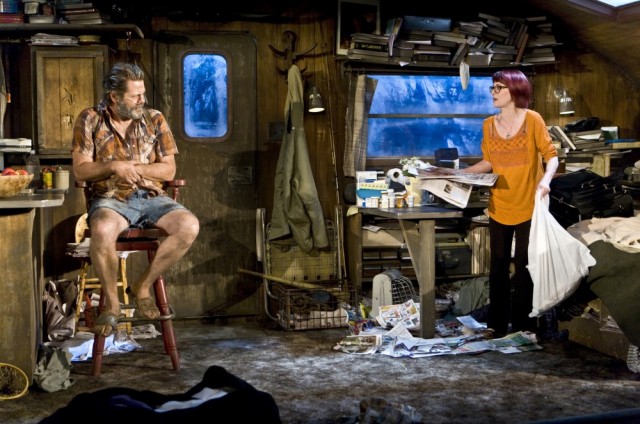
Real-life husband and wife Nick Offerman and Megan Mullally play former spouses reunited after twenty years in the New Group production of Sharr White’s ANNAPURNA (photo by Monique Carboni)

ANNAPURNA
The Acorn Theatre at Theatre Row
410 West 42nd St. between Ninth & Tenth Aves.
Tuesday – Sunday through June 1, $75
212-560-2183
www.thenewgroup.org
www.theatrerow.org

In the New Group production of Annapurna, written by Sharr White (The Other Place, The Snow Geese) and directed by Bart DeLorenzo (Passion Play, Fast Company), Emma (Megan Mullally) suddenly shows up at Ulysses’s (Nick Offerman) run-down trailer in the mountains of Colorado. The former spouses haven’t seen each other in twenty years, since she walked out on him, taking their son with her. Emma arrives lugging several suitcases, apparently planning on staying a while, but Ulysses, wearing a butt-revealing apron and a life-sustaining backpack with an oxygen tube, wants no part of her, preferring to remain a hermit. They battle over the past, leading to a reveal that is like a reverse deus ex machina, draining the drama of any subtlety and making it about something else in a manipulative way. Real-life husband and wife Offerman (Parks and Recreation) and Mullally (Will & Grace) certainly have a familiarity with each other, but their characters’ affectations, especially Emma’s whininess, grow tiresome quickly. The conflict dries up long before the lights go out for the final time — DeLorenzo and lighting designer Michael Gend like to flip the switch like a kid with a new toy — so the last darkness comes as a relief. Annapurna lacks the energy and passion that drives The Few, the latter a far more successful exploration of responsibility, lost love, past misdeeds, and being a part of something that is bigger than oneself.