this week in theater

PARADISE SQUARE

Races and dance styles mix it up in Paradise Square (photo by Kevin Berne)

PARADISE SQUARE
Ethel Barrymore Theatre
243 West 47th St. between Broadway & Eighth Ave.
Tuesday – Sunday through July 17, $39 – $250
www.paradisesquaremusical.com

Paradise Square gets off to a rousing start, with exciting choreography by Bill T. Jones, a fabulous set by Allen Moyer, a terrific cast led by Joaquina Kalukango, splendid period costumes by Toni-Leslie James, historical projections by Wendall K. Harrington and Shawn Boyle that establish the time and place, and thrilling music by Jason Howland and Larry Kirwan. But once Nathan Tysen and Masi Asare’s lyrics and the book, by Christina Anderson, Craig Lucas, and Kirwan, kick into full gear, the whole thing falls apart, leaving us to wonder what could have been. Not even two-time Tony-nominated director and National Medal of Arts recipient Moisés Kaufman can put it back together.

It’s 1863, the middle of the Civil War, and Nelly Freeman (Kalukango) is running the (fictional) Paradise Square pub in Five Points, at the corner of Baxter and Worth Sts., what she proudly calls “the first slum in America!” It’s a place where everyone, regardless of race, gender, or religion, can come for a “little bit of Eden.” As she sings, “All we have is what we are / Inside here we all feel free / We love who we want to love / With no apology / If you landed in this square / Then you dared to risk it all / At the bottom of the ladder / There’s nowhere left to fall.”

Nelly is married to Willie O’Brien (Matt Bogart), an Irishman who is captain of the Fighting 69th Infantry. Willie’s right-hand man is Lucky Mike Quinlan (Kevin Dennis); Nelly runs the saloon with Willie’s sister, Annie (Chilina Kennedy), who is married to the Reverend Samuel Jacob Lewis (Nathaniel Stampley). Willie and Mike are about to head back to the war. “We’ll be back before ya blink,” Mike promises. “On me word, Nelly. I’ll bring him to ya with all his workin’ parts still workin’.”

Annie’s nephew, Owen Duignan (A. J. Shively), arrives, looking to make a fresh start in a new land where the streets are supposedly paved with gold. Also showing up is Washington Henry (Sidney DuPont), an escaped slave seeking shelter until he is reunited with his wife, Angelina Baker (Gabrielle McClinton), who was separated from him in the woods. Meanwhile, a drunk piano player named Milton Moore (Jacob Fishel) comes in looking for a job; Nelly does not realize that he is actually Stephen Foster, who has already written some racist anthems (and who really did live — and die — in Five Points).

Broadway musical looks at slavery, immigration, war, and personal sacrifice (photo by Kevin Berne)

Keeping a close watch on everything that happens at the Paradise is uptown party boss Frederic Tiggens (John Dossett), who wants to close the establishment because it is the center of Black and Irish anti-South and anti-business voters, “a haven of social depravity and political ascension.” He confronts Nelly, calling her “a facilitator of prostitution, gambling, and drunken mayhem.” She humbly replies, “I am just one woman who runs a saloon.” He bites back, “Don’t play coy. A degenerate who somehow wields power in New York politics doesn’t get to be coy.” To which she responds, “But enough about you —.”

It all devolves quickly once Nelly decides to hold a dance-off in which the winner will get three hundred dollars, the exact amount needed to buy one’s way out of President Lincoln’s newly implemented draft for the Union army. “Three hundred dollars?! That’s more than a year’s wage!” an Italian longshoreman declares. “I won’t go,” a German longshoreman adds. “If you do not go, you will be considered a deserter and a criminal,” a provost marshal explains. “This is a rich man’s war that the poor and immigrant will have to fight,” an Irish longshoreman says. When two Black longshoremen are ready to sign up, the marshal tells them, “No coloreds. Only citizens and immigrants.”

The contest and its aftermath turns what was a compelling drama about immigrants, slavery, poverty, and war into a cliché-ridden narrative that will leave you exasperated, as Tiggens becomes more and more like cartoon villain Snidely Whiplash and the lines between good and evil might as well be drawn with a giant crayon, eliminating any nuance or subtlety. It really is a shame, since so many of the individual elements are outstanding; Anderson, Lucas, and Black 47 leader Kirwan don’t have enough faith that the audience will be able to weave its way through a more complex and realistic story, instead opting for the lowest common denominator. I nearly screamed at a plot development late in the show that still has me seeing red.

Two-time Tony nominee Kalukango (Slave Play, The Color Purple) is almost reason enough to see Paradise Square, but I had to wonder whether the showstopping standing ovation she received for her blazing solo “Let It Burn” was genuine or was at least partly egged on by an excerpt of a review on the theater’s facade that highlights the standing O from the Chicago production. The song includes such mundane lyrics as “I know why you have come here / What you want to erase / But I know that our spirit / Is bigger than this place.”

Paradise Square wants to make serious statements about issues that are still relevant a century and a half after the Civil War, but it can’t stop stepping on its own toes, unable to leap beyond the obvious.

LOWER EAST SIDE FESTIVAL OF THE ARTS: ARTISTS EMBRACE LIBERTY AND JUSTICE FOR ALL

Who: Nearly two hundred performers
What: Lower East Side Festival of the Arts
Where: Theater for the New City, 155 First Ave. at Tenth St.
When: May 27-29, free (donations accepted)
Why: The twenty-seventh annual Lower East Side Festival of the Arts, a wide-ranging, indoor and outdoor celebration of the vast creativity of the neighborhood over the decades, will feature nearly two hundred performers, at Theater for the New City and on Tenth St. Taking place May 27-29, the festival, with the theme “Artists Embrace Liberty and Justice for All,” includes dance, spoken word, theater, music, visual art, and more from such familiar faves as David Amram, the Thunderbird American Indian Dancers, Shakespeare in the Parking Lot, James Rado, La MaMa, Akiko, Folksbiene National Yiddish Theater, Malachy McCourt, KT Sullivan, Eduardo Machado, Austin Pendleton, the Rod Rodgers Dance Company, Melanie Maria Goodreaux, Chinese Theater Works, New Yiddish Rep, Eve Packer, 13th Street Rep, and Metropolitan Playhouse.

The event will be emceed at the various locations by Crystal Field, Robert Gonzales Jr., Danielle Aziza, Sabura Rashid, David F. Slone Esq., and Joe John Battista. There will also be vendors and food booths and special programs for children curated by Donna Mejia and hosted by John Grimaldi, film screenings curated by Eva Dorrepaal, a “poetry jam with prose on the side” curated by Lissa Moira, and an art show curated by Carolyn Ratcliffe. Select performances will be livestreamed here.

THE SKIN OF OUR TEETH

Thornton Wilder looks at the history of the world through the Antrobus family in The Skin of Our Teeth (photo by Julieta Cervantes)

THE SKIN OF OUR TEETH
Vivian Beaumont Theater at Lincoln Center Theater
150 West 65th St. between Broadway & Amsterdam Ave.
Tuesday – Saturday through May 29, $49-$225
212-362-7600
www.lct.org

“The theatric invention must tirelessly transform every fragment of dialogue into a stylization surprising, comic, violent, or picturesque,” Thornton Wilder wrote about his Pulitzer Prize–winning play The Skin of Our Teeth in a 1940 notebook. Over the years, many productions have attempted to capture that spirit, with varying degrees of success. In 2017, TFANA staged an exemplary version under Arin Arbus’s direction, almost making sense of Wilder’s complex story involving the Antrobus family — their name means “human” — who have experienced it all but keep on keeping on, as if it’s all in a day’s work.

Mr. Antrobus (James Vincent Meredith) is the inventor of the multiplication table, the alphabet, and the wheel. He’s been married to Mrs. Antrobus (Roslyn Ruff) for five thousand years, and they have two children, Gladys (Paige Gilbert) and Henry (Julian Robertson). Their maid, Sabina (Gabby Beans), runs the household and lets the audience know just what she’s thinking, breaking the fourth wall not only as Sabina but as the actress portraying her. “I hate this play and every word in it,” she tells us. “Besides, the author hasn’t made up his silly mind as to whether we’re all living back in caves or in 1950s Jersey, and that’s the way it is all the way through.”

Massive sets dominate Lincoln Center revival of The Skin of Our Teeth (photo by Julieta Cervantes)

Over the course of three acts and nearly three hours, they are surrounded by melting polar ice caps, a raging war, a refugee crisis, a coming flood, and other key moments of world history. The setting shifts from their suburban home in Excelsior, New Jersey, to the bustling Atlantic City boardwalk. Large-scale pet dinosaurs enter their living room and walk around. A fortune-teller (Priscilla Lopez) offers a stern warning. Sabina flirts with Mr. Antrobus. Everyone worries when he’s not home from work one night. Sitcom meets disaster movie with biblical implications in a choppy narrative that has been significantly tweaked by Branden Jacobs-Jenkins (Everybody, An Octoroon), adding modern-day Black references that often feel out of place alongside old-fashioned newsreels. It’s all too much of a good thing.

Adam Rigg’s set is endlessly imaginative and often awe-inspiring, but at times you’ll find yourself distracted by it. The dinosaur puppets stay onstage too long. Sabina’s complaints grow tiresome and repetitive. Immensely talented Obie-winning director Lileana Blain-Cruz (Fefu and Her Friends, Marys Seacole) has overstuffed the show; it ends up working best in the third act, when the pace slows down and we get into the heart of the play. Wilder invited surprise, but too many surprises can get overwhelming; sometimes it really is best to stop and smell the roses, thorns and all.

THE LEGEND OF THE WAITRESS AND THE ROBBER

The Legend of the Waitress and the Robber comes to Dixon Place May 25-29 (photo by Stefan Hagen)

Who: Playfactory Mabangzen, Concrete Temple Theater
What: Cross-cultural theatrical collaboration
Where: Dixon Place, 161A Chrystie Pl. between Rivington & Delancey Sts.
When: May 25-29, $20-$25
Why: The Seoul-based Playfactory Mabangzen and the NYC-based Concrete Temple Theater have teamed up to present a unique mashup of two Robin Hood–style tales, Friedrich Schiller’s 1781 play, The Robbers, and the Joseon dynasty Korean novel The Story of Hong Gildong. Written before the pandemic by Renee Philippi and directed by Philippi and Eric Nightengale, The Legend of the Waitress and the Robber takes place in a dystopian society fighting for justice for seniors and freedom from cellular devices. The opening song explains, “Imagine, if you will, there’s a world much like ours. Maybe in the future. Maybe even now. A world where every human lives separate and alone. The only interaction allowed — is on a phone.”

The seventy-five-minute show will be performed by Carlo Adinolfi, Hye Young Chyun, Lisa Kitchens, Anthony Simone, Ju Yeon Choi, Nam Pyo Kim, Won Kyongsik, Joo Youn Park, and Noh Yura, with sets by Adinolfi, costumes by Laura Anderson Barbata, an original score by Lewis Flinn, and musical direction by Jacob Kerzner and Hee Eun Kim. The New York City premiere runs May 25-29 at Dixon Place; tickets are $20-$25.

BELFAST GIRLS

Five women believe they are on their way to a better life in Belfast Girls (photo by Carol Rosegg)

BELFAST GIRLS
Irish Repertory Theatre, Francis J. Greenburger Mainstage
132 West 22nd St. between Sixth & Seventh Aves.
Wednesday – Sunday through June 26, $50-$70
212-727-2737
irishrep.org

“From now on on this ship we’re to be mistresses of our own destiny,” Judith Noone declares early in Belfast Girls, which opened tonight at the Irish Rep. Moments later, she adds, “Youse think the English poor are any better off than us? They’re not. An’ besides, we’re women. An’ we’ll never be anythin’ here. For we are as the peat; to be used up an’ walked on.”

During the Great Famine, also known as the Great Starvation, the Orphan Emigration Scheme was put into effect in Ireland by British secretary of state for the colonies Earl Grey, purportedly to send young, parentless Irish girls (nineteen and under) who had been toiling in overcrowded workhouses to a better life in Australia. Between 1848 and 1850, more than four thousand women made the treacherous months-long journey by ship; however, many of them were not orphans but older prostitutes who had been soliciting on the streets. Their occupation would be quite a surprise to the Australian men who were supposed to be waiting for them with open arms on the shores of the faraway continent.

London-born Irish playwright Jaki McCarrick tells the fictionalized story of one such harrowing trip in Belfast Girls, making its New York City debut at the Irish Rep through June 26. It’s 1850, and the Inchinnan, the name of a real ship, is about to set sail. Four Catholic girls from Belfast have been assigned a small room with two bunks, Judith (Caroline Strange), Hannah Gibney (Mary Mallen), Ellen Clarke (Labhaoise Magee), and Sarah Jane Wylie (Sarah Street). At first, it’s like a dorm room at a girls school, one none of them would have been able to afford. They poke fun at one another while also hoping for a different future than the one they had been destined for.

When Hannah and Ellen take an immediate liking to the (unseen) attractive male cook, Judith, the most no-nonsense of the group, tells them to stay away from the men onboard. “All a youse, get your heads round the plain fact we’re leavin’ an’ we won’t ever be comin’ back,” she says. “Look, I know some of youse an’ youse know me. We have this one an’ only chance. An’ in all the kingdom of Ireland aren’t we — us women — aren’t we damned lucky to be gettin’ out of it?”

Molly (Aida Leventaki), Judith (Caroline Strange), and Hannah (Mary Mallen) take a break on board the Inchinnan (photo by Carol Rosegg)

A few moments later, Hannah says, “I hear there’s fine English farmers in the colony with thousands of acres, Judith, an’ more cattle than ya could dream of seein’ in the whole of Ireland, just drippin’ wit need for female companionship.” Ellen responds, “I want no damn Englishman. Haven’t they been trouble enough in this country? Why in the name a god would I travel halfways across the earth ta find one of them when every self-respectin’ Irishman is tryin’ to get them outta the place?”

Hannah, Sarah, and Judith are none-too-pleased when Ellen, who had gone for a walk, comes back with Molly Durcan (Aida Leventaki), a whisper-thin maidservant from the much wealthier county of Sligo who will be staying with them as well. Hannah is suspicious of Molly, but the five women attempt to bond through a terrible storm and some surprising revelations. And for good measure, McCarrick adds an Irish ghost story and several traditional folksongs.

In Belfast Girls, McCarrick (Leopoldville, The Naturalists) takes on such issues as class, gender, and religion, adding a dose of Marxism, all seen through a feminist lens as the women contemplate what’s next for them. They talk a lot about what was considered women’s responsibilities a hundred and seventy years ago: being a maidservant, sewing adornments on bonnets, not learning how to read, existing primarily as birthing vessels.

“When I arrive in the Colony what choice do I have only to work as I always worked?” Sarah asks. Molly answers, “But you do have choices. There are groups starting all over the world. Where women stand up and talk and demand the privileges only men have now; to be paid as men are paid, to be allowed to do the same things — to tour in a theatrical, for instance, without people thinking you’re loose or worse.” Molly has dreams of being an actress, perhaps playing Puck in Shakespeare’s A Midsummer Night’s Dream, a character who, as Robin Goodfellow in the play within the play, says, “Lord, what fools these mortals be! . . . Follow my voice: we’ll try no manhood here.” But all five of the women are acting, adapting their personas, and toying with the truth, in order to get away from their miserable lives.

Judith (Caroline Strange), Ellen (Labhaoise Magee), and Hannah (Mary Mallen) contemplate their future in Belfast Girls (photo by Carol Rosegg)

Director Nicola Murphy (A Girl Is a Half-formed Thing, Pumpgirl) keeps a fast pace and steady ship as controversies ensue and truths come out. Chika Shimizu’s two-story set is like a kind of liminal prison for the women, cramped in a room with no windows. China Lee’s costumes emphasize the type of restrictive clothing women had to wear at that time. Caroline Eng’s sound puts the audience on the water, birds chirping outside, tempting freedom. The only male member of the primary cast and crew is lighting designer Michael O’Connor.

The cast is exemplary, led by Strange (London Assurance, Meditations on a Magnetic North) as the Jamaican-born mixed-race Judith; her last name, Noone, might imply that she is “no one,” but she is a force to be reckoned with, unafraid to defend her decisions in a patriarchal society. “We didn’t leave Ireland at all, ladies,” Judith declares. “Ireland has spat us out.” The Orphan Emigration Scheme ended in 1850, but the battle for women’s rights in Ireland continues.

ALISON LEIBY: OH GOD, A SHOW ABOUT ABORTION

Alison Leiby shares her the details of her own abortion in comic routine at the Cherry Lane (photo by Mindy Tucker)

OH GOD, A SHOW ABOUT ABORTION
Cherry Lane Theatre
38 Commerce St.
Through June August 26, $37-$61
www.cherrylanetheatre.org

Nearly every night, the opening lines of Alison Leiby’s Oh God, a Show About Abortion change as the debate over abortion rages even hotter since May 2, when the draft opinion in which the Supreme Court appears to be ready to overturn Roe v. Wade was leaked. The day I attended, West Virginia senator Joe Manchin had announced that he would not vote for a bill to codify abortion rights, so he made it into the beginning of Leiby’s show, and not favorably.

Extended through August 26 at the Cherry Lane, Oh God is really more of a themed comedy monologue than a one-person show. For seventy-five minutes, Leiby, who has written for such series as The Marvelous Mrs. Maisel and The Opposition with Jordan Klepper, uses her recent abortion to talk about her career, her relationships with men and her family, and the need for reproductive freedom in America.

“Welcome to what my dad calls my ‘special show,’” she says. “My parents are very supportive. My mom texted me, ‘kill it tonight!’ and I’m like, I already did, that’s why the show exists.”

On an empty stage save for a mic stand, a stool, and a glass of water, the classic stand-up set, Leiby talks about “all of the unprotected sex I have had,” getting pregnant while on the road in Missouri, deciding not to keep the baby, and going to Planned Parenthood in New York City to have the procedure done. “So I had an abortion three years ago. I’m still trying to lose the no baby weight,” she explains.

She also notes, “I was thirty-five years old. I thought my eggs were just Fabergé at this point: feminine, but decorative. But this positive test brought into light all of the intense anxieties I have been feeling as a woman for years.” Many of those anxieties stem from her mother. “When I was thirty, she told me, ‘The best time in your life is when you’re married and you don’t have kids.’ I am her only child.”

Leiby uses the central narrative as the impetus to make tangential one-liners that perhaps are meant as comic relief from the main topic, but too many miss the mark or feel unnecessary, including digressions about Oreo flavors, Michael Jordan, Al Gore, Ashanti, and falafel. For comparison, in March, I saw Alex Edelman’s hysterical Just for Us, about his infiltration of a white supremacist meeting in Queens, and that was more theater than stand-up, with relevant detours about dating and family that were insightful and pushed the story forward, not one-off jokes; when he described certain events, you could see it in your mind, even though it was also an empty stage. And although Oh God credits the immensely talented Lila Neugebauer (Morning Sun, The Wolves) as director, her contributions are not clearly visible.

But the Brooklyn-based Leiby does have a lot to say about birth control, Barbie dolls, sex education in schools, period trackers, reproductive ads, doctors, Richard Gere, Jennifer Aniston, drunk sex, and womanhood in the twenty-first century. A story about receiving a nerve shot for her back is both very funny and representative of our patriarchal society. “The medical community has abandoned women,” she declares. She also delves into how “the culture seems to pit women who are mothers against women who aren’t all the time. TV shows, magazines, influencers all perpetuate this fake divide between mothers and non-mothers so we are left fighting about that while men go to space in their cock rockets? Fuck. That.”

But amid all the sociopolitical controversies and the gender gap, perhaps the most important question she asks is “If I’m not a mother, then who am I?” It’s a matter of personal choice, one that is as fraught today as it ever was, in myriad ways.

Oh God, a Show About Abortion is presented by Ilana Glazer (Broad City, The Afterparty), who, on May 22 at 7:00, will join Leiby for a conversation about the production in Buttenwieser Hall at the 92nd St. Y; in-person tickets are $30-$35, or you can watch the livestream for $20.

EXCEPTION TO THE RULE

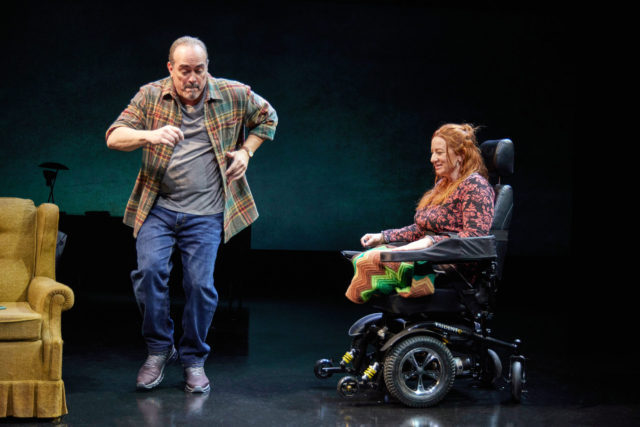
Detention turns existential in new play by Dave Harris (photo by Joan Marcus)

EXCEPTION TO THE RULE
Black Box Theatre
Harold and Miriam Steinberg Center for Theatre
111 West 46th St. between Sixth & Seventh Aves.
Tuesday/Wednesday – Sunday through June 26, $30
www.roundabouttheatre.org

The Breakfast Club meets Waiting for Godot and Five Characters in Search of an Exit in Dave Harris’s electric Exception to the Rule, which opened tonight at Roundabout Underground. Originally meant to mark Harris’s New York debut but delayed because of the pandemic, Exception now follows on the heels of the breakout success of Tambo & Bones, which was written after Exception.

The eighty-five-minute play takes place in a classroom open on three sides, with six chairs in addition to the teacher’s desk next to the door. The room has fluorescent borders, making it resemble a cage with no bars, a kind of existential prison. The audience sits on the three open sides in three rows, the first nearly on the set, as if on the brink of being jailed as well but just safe enough. One by one, five high school teenagers unabashedly enter and kid around with one another. They are there for detention, something they appear to be used to. Tommy (Malik Childs) puts the moves on Mikayla (Amandla Jahava), who wants nothing to do with him. The tough-looking Dayrin (Toney Goins) calls Dasani (Claudia Logan) “Aquafina” and “Poland Springs” to piss her off. Dayrin is none-too-happy when the moody Abdul (Mister Fitzgerald) shows up. But the freewheeling dynamic shifts immediately when Erika (Mayaa Boateng) arrives, looking for Mr. Bernie, the detention teacher. The others are shocked that she has been sent to Room 111.

“I never thought I’d see the day,” Dasani says. “How did she end up in detention?” Mikayla asks. “You sure she supposed to be here?” Tommy says to Mikayla. “Every good girl gotta go bad at some point,” Dayrin offers.

Erika is dismayed by all the attention she is receiving as they derisively refer to her as “Smart Girl Erika,” “College Bound Erika,” and “Take the Test and Fuck Up the Curve for Everybody Else Erika.” She explains, “I thought detention was quiet. A place where everyone remembers the mistakes that got them here and then learns how to not make the same mistakes again. And you leave different than when you came in. Why else would they put you here?” After a brief silence, the others break out in hysterics.

“You might be the only person left in this school who’s never done some time,” Abdul says. “Still haven’t lost your innocence yet,” Dayrin adds.

College-bound Erika (Mayaa Boateng) makes a connection with Abdul (Mister Fitzgerald) in Exception to the Rule (photo by Joan Marcus)

As they wait for Mr. Bernie — if they don’t get their detention slips signed, they’ll receive more detention — the six teenagers bond, argue, fight, flirt, and reveal secrets about themselves, each trapped in a system set up for them to fail. They’re terrified just to go into the hall to find Mr. Bernie. “I heard this kid Roger left detention one time. You know what they did? They shot him on sight. He dead,” Tommy says. As apocryphal as that story might be, it holds the awful truth of what happens to so many innocent, unarmed people of color.

Meanwhile, there’s no cell service in Room 111 or anywhere in the school. Tommy points out, “Phones can’t even tell what time it is. Cuz the whole building is surrounded by an invisible force to keep us from calling for any —” Time, for Black and brown people, is a weighted concept; the more things change, the more they stay the same.

Intermittent announcements over the creaky PA remind them that it’s the Friday afternoon of the MLK holiday weekend and the school will be closed for the next three days, leading Dasani to reinterpret Dr. Martin Luther King Jr.’s “I Have a Dream” speech for what is happening today; it’s one of the most powerful moments of a play constructed of myriad small touches that can nearly go unnoticed. Director Miranda Haymon always has something going on; the audience has to keep their eyes moving to catch everything, and you won’t want to miss a second of these well-crafted characters and potent situations as the clock winds down and the six teens have to make critical choices.

In Tambo & Bones, Harris investigated the history of Black performers entertaining paying white audiences, but it’s much more than a treatise on minstrelsy. While Bones wants to cash in, draping himself in stardom, Tambo wants to help change the world. In Exception to the Rule, takes on social injustice, inequities in education and employment, and a corrupt system that is rotten to the core, but he is also making it clear that there are ways out. Erika is a stand-in for the playwright, who pulls no punches. She’s a top student preparing for college, getting ridiculed for her desire to succeed; some of the others occasionally look like they also want to be better students with more opportunities, but that is frowned upon by their peers. Even their outfits — the costumes are by Sarita Fellows — play with stereotypes and expectations.

Six characters are in search of an exit in Roundabout Underground world premiere (photo by Joan Marcus)

Reid Thompson and Kamil James’s dynamic set seems to offer them an escape, as if they can just walk through the invisible bars and into another world, but that’s not something they’re considering; they’re scared enough of going through an unlocked door into a situation they’re already familiar with. “There’s no one keeping us in this room,” Erika says. Dasani responds, “We in detention. We gotta wait for Mr. Bernie. Then we can go, Sweet Pea. Then we can go.” It’s as if society has relegated them to an unending prison, where it doesn’t matter what they’ve done; they can’t even imagine being free.

The outstanding cast bursts with an energy that can barely be contained on the set; in fact, one fight nearly spilled into the audience (but didn’t), making the action all the more palpable and realistic.

Cha See’s lighting keeps the audience at least partly illuminated throughout the play; it is not lost on us, or the actors and playwright, that the crowd is predominantly white, watching six caged people of color. No wonder they are hesitant to walk through the invisible bars. But Harris is adamant that they must, that in order to better their lives, they need to go forward, to face what’s out there and not let the system, as well as cultural norms, hold them back. Tommy might be afraid of the dark, but there’s light ahead.

“Just imagine. If life was all tingly and nice. . . . If closing my eyes was just closing my eyes,” Tommy says. Erika replies, “You’d still be in detention when you opened them.”