this week in theater

EPIPHANY

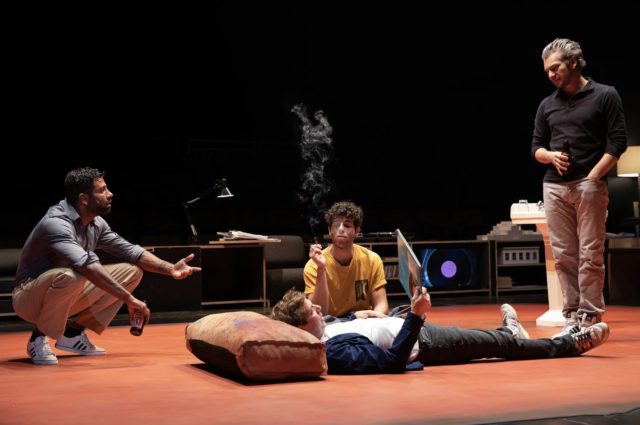
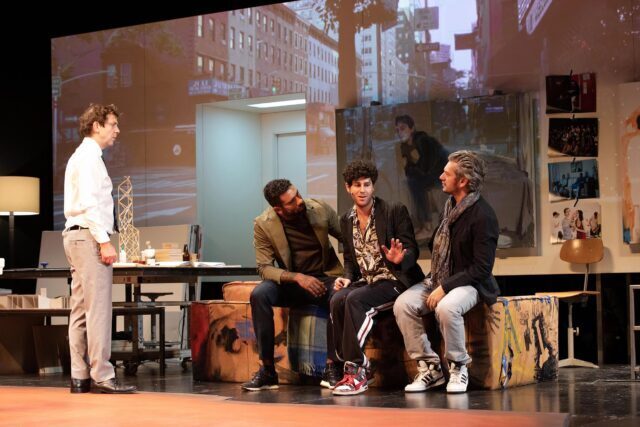
Brian Watkins’s Epiphany takes place at an awkward dinner party (photo by Jeremy Daniel)

EPIPHANY
Lincoln Center Theater at the Mitzi E. Newhouse
150 West 65th St. between Broadway & Amsterdam Ave.
Tuesday – Sunday through July 24, $92
212-362-7600
www.lct.org

In Brian Watkins’s Epiphany, continuing at Lincoln Center’s Mitzi E. Newhouse Theater through July 24, Aran (Carmen Zilles) reads from a letter to guests at a dinner party, “‘A new generation is growing up in our midst, a generation actuated by new ideas and new principles. But we are living in a special . . . ’ — sorry — “‘we are living in a skeptical and, if I may use the phrase, a thought-tormented age: and sometimes I fear that this new generation, educated as it is, will lack those qualities of humanity, of hospitality, of kindly humour which belonged to an older day. It seems to me, I must confess, that we were living in a less spacious age.’ No, that’s not right: ‘that we are living in a less spacious age.’ Well, I can’t tell if it says are or were.

The quote is taken nearly verbatim from James Joyce’s 1914 short story “The Dead,” which served as inspiration for Watkins’s play. But Watkins and director Tyne Rafaeli transport the tale, which also takes place at a dinner party, to modern times; in fact, though it premiered in 2019 in Ireland, the plot has been tweaked to comment on how the Covid-19 pandemic impacted the way humans relate to one another in what may or may not be a less spacious age.

Morkan (a sensational Marylouise Burke) is a woman of a certain age who has invited a diverse group of people to a dinner party celebrating the epiphany: Freddy (C. J. Wilson), a disheveled math teacher whom Morkan is afraid might drink too much; Sam (Omar Metwally), a well-respected psychiatrist, and his partner, the younger Taylor (David Ryan Smith), who is in marketing; a second couple, lawyer Charlie (Francois Battiste) and pianist Kelly (Heather Burns); Ames (Jonathan Hadary), one of Morkan’s oldest and dearest friends; and Gabriel, Morkan’s nephew and a famous writer who has promised to present a new work and is the main reason everyone has trudged through a snowstorm to come to the party at Morkan’s large country house outside an unidentified major city. Morkan has asked the twentysomething Loren (Colby Minifie) to help her with the food and drinks.

While they’re waiting for Gabriel, Morkan tells them that they have to surrender their phones — she refers to them as “thingamajigs” — and puts them in a box that is tantalizingly close. The guests, none of whom is well acquainted with anyone other than Morkan and the person they came with, are instantly rattled, acting as if a part of their body has been temporarily removed. They feel even more uncomfortable after it becomes evident that no one read any of the attachments Morkan included with the invitation, so they’re not prepared for all the activities she has planned, and they don’t know how to tell her. In addition, no one, including Morkan, knows what the word epiphany means or refers to.

Marylouise Burke is sensational as a dinner party host forced to improvise (photo by Jeremy Daniel)

Charlie: Where did the whole celebration idea come from anyway?
Morkan: Well, that’s the question! I actually have very little idea of what epiphany actually is.
Loren: Oh. I thought this was part of your religion or something.
Morkan: Oh no no no, not at all, it’s just sort of a new curiosity, because . . . well, it’s been an odd twelve months. . . . I’m really so forgetful these days, which is why Gabriel is going to do a whole . . . overview thingy and give a speech with the history and all the answers to the whole yadda yadda.
Taylor: Of course he is.
Kelly: Fucking . . . brilliant man.
Morkan: But so, ok, show of hands, who has celebrated Epiphany?
Kelly: Like the idea? The idea I guess, privately, yes — the what? Oh no.
Morkan: The holiday. The holiday. Show of hands for the holiday.

No one raises their hand.

Morkan: Alright so, before I sent you all the stuff with the invitation . . . who knew what epiphany was?
Kelly: The idea or the holiday?
Morkan: The holiday of Epiphany.
Taylor: The general concept or —
Morkan: The holiday.
Taylor: Oh. No.
Freddy: Not me!
Morkan: Ok. Well. I have no idea what Epiphany is. We have no idea what Epiphany is. But the thing that struck my head was, ya know like . . . creating a tradition . . . How does that work?! Or even just creating a reason, to ya know, get together in a terrible month like January to celebrate life!

As if that weren’t enough, Aran, Gabriel’s partner, soon shows up to explain that Gabriel will not be coming after all, which adds further disappointment and awkwardness. But Morkan is determined to soldier on with music, poetry, intellectual conversation, and the goose she has cooked, leading to some prickly physical and verbal exchanges as the snow keeps falling.

At nearly two hours without intermission, Epiphany is too long, and some of the awkwardness onstage leaks into the audience; at times you might feel like you’re at a dinner party that is going nowhere but you can’t leave. In addition to Joyce, it’s got a bit of Luis Buñuel’s The Discreet Charm of the Bourgeoisie mixed in with Samuel Beckett’s Waiting for Godot, Agatha Christie’s And Then There Were None (without the murders), and the disastrous parties Mary Richards used to throw on The Mary Tyler Moore Show, all of which play with the idea of expectations.

A lot of those expectations have changed significantly since the pandemic lockdown, as people wrestle with who to gather with and where. Gabriel chooses not to go because of a deep depression; it’s not a stretch to think that it may have been caused, at least in part, by the coronavirus crisis and a fear of meeting up with people. I have great friends who still refuse to go to gatherings, whether indoors or outdoors. It can be hard to know when to hug, when to shake hands, when to kiss, and when to bump elbows, which is addressed in Epiphany.

The show also plays with the idea of time, something that was difficult to keep track of during the lockdown and still today, when many of us are working from home. Although the story appears to unfold in something close to real time, Morkan makes several confusing references near the end about how much time has passed that will leave you scratching your head and wondering whether her statements are plain mistakes or have another, not immediately clear meaning.

You’re unlikely to reach any epiphanies while at the Newhouse, but it’s not so bad when you’re spending time with such a terrific cast, comprising some of the city’s finest character actors. Drama Desk winner Burke (Ripcord, Fuddy Meers), in the starring role, is phenomenal, short of stature but long on doddering charm and effervescence, her creaky voice reaching poetic heights. Tony nominee and Obie winner Hadary (Gypsy, As Is) excels as Ames, especially after suffering what could be a serious injury that is handled with slapstick humor. Tony nominee and Obie winner Metwally (Sixteen Wounded, Guards at the Taj) is smooth as silk as the curious neuroscientist. And Minifie (The Boys, Punk Rock), dressed in a yellow outfit that just might have been the old color of the dining room, is wonderful as Loren, who has no idea what she has gotten herself into. (The costumes are by Montana Levi Blanco.)

John Lee Beatty’s set has a gothic charm to it, bar carts and tables hovering close to the audience seated in the first row, who could reach out and grab a drink or snack (but shouldn’t). The snow can be seen through two large windows; mysterious stairs go down to the front door and up to the bedrooms and bathroom, lending the house a ghostly atmosphere. Isabella Byrd’s moody lighting reminds everyone that the storm might knock out the electricity at any second, while Daniel Kluger’s sound often adds a chill to the air.

“Life has just felt so wobbly, so even though I’ve lived here over forty years I feel . . . dislocated . . . exiled, I suppose . . . And I’m not sure why,” Morkan says, essentially speaking for many in the theater. “But maybe that’s the world, I dunno . . . I feel like I’m not making any sense.” Perhaps the same can be said of our “thought-tormented age” itself.

FIAF’s BASTILLE DAY 2022

BASTILLE DAY
French Institute Alliance Française (FIAF)
Madison Ave. between Fifty-Ninth & Sixty-Third Sts.
Sunday, July 10, free – $75, noon – 5:00 pm
fiaf.org

On July 14, 1789, a Parisian mob stormed the Bastille prison, a symbolic victory that kicked off the French Revolution and the establishment of the Declaration of the Rights of Man and of the Citizen. Ever since, July 14 has been a national holiday celebrating liberté, égalité, and fraternité. In New York City, the Bastille Day festivities are set for Sunday, July 10, on Madison Ave. between Fifty-Ninth & Sixty-Third Sts., where the French Institute Alliance Française hosts its annual daylong party of food and drink, music and dance, and other special activities. The celebration features free live music by Paul Beaubrun, street dance by Cal Hunt, a dance party with DJ Orson, and an excerpt from the French musical Notre Dame de Paris on the main stage at Fifty-Ninth St. from noon to 5:00; a Summer in the South of France Tasting in Tinker Auditorium from 12:30 to 5:00 ($35), with wines from Maison Antech, Château Maris, and Château Haut-Blanville, nonalcoholic wines from Le Petit Béret, gazpacho from Karine & Jeff, and cheese selections from cheese2u.com; a sneak preview screening of Matthieu Rozé’s Azuro starring Valérie Donzelli in Florence Gould Hall at 5:30 ($17); and the elegant Champagne & Musette Party at 1:30 ($65-$75) in Le Skyroom, with live music by Chloé Perrier & the French Heart Jazz Band, Champagnes from Billecart Salmon, Delamotte, and Henriot, macarons from Thierry Atlan, and hors d’oeuvres from Miss Madeleine.

A sneak preview of Matthieu Rozé’s Azuro is part of FIAF Bastille Day festivities

The French Garden between Sixtieth & Sixty-First consists of booths from Thermomix, Thierry Atlan, Stephane Koerwyn, Angelina Paris, Bichon, OCabanon, Oliviers & Co, Opinel, Payot, Silpat, and Tissage Moutet, while Market Booths between Sixtieth & Sixty-Third include Brasserie Cognac, Maman Bakery, Mille-feuille Bakery Cafe, Hanami Designs, Barachou, Miss Madeleine, and dozens more. The FIAF Language Center Booth between Fifty-Ninth & Sixtieth will present special activities for children and a trivia contest for adults from 1:00 to 4:00. And this year’s prize drawing can win you skincare baskets, a wellness collection, a FIAF Premier Membership, a two-night stay at Sofitel New York, or a Dream Getaway for Two to France’s Occitanie region.

BroadwayCon 2022

Who: Anthony Rapp, LaChanze, Andrew Barth Feldman, Carolee Carmello, Ben Cameron, Erin Quill, Fredi Walker-Browne, Julie White, Telly Leung, Ilana Levine, Jacqueline B. Arnold, Jennifer Ashley Tepper, Vanessa Williams, Judy Kuhn, Lesli Margherita, Nik Walker, Ryann Redmond, Thayne Jasperson, Hillary Clinton, more
What: BroadwayCon 2022
Where: Manhattan Center, 311 West Thirty-Fourth St., and the New Yorker Hotel, 481 Eighth Ave.
When: July 8-10, day passes $80, general pass $200, gold pass $425, platinum pass $1,250
Why: BroadwayCon is back with an in-person edition taking place July 8-10 at the Manhattan Center and the New Yorker Hotel, right by Madison Square Garden and Penn Station and just a few blocks south of the Theater District. This year’s edition includes panel discussions, interviews, live performances, podcasts, a cosplay contest, workshops, photo and autograph sessions, singalongs, meetups, and celebrations of and inside looks at such shows as A Strange Loop, Six the Musical, Chicago, POTUS, Dear Evan Hansen, Beetlejuice, Thoughts of a Colored Man, Kimberly Akimbo, SpongeBob SquarePants, Harry Potter and the Cursed Child, The Kite Runner, Assassins, and Hamilton.

Among those participating at the three-day festival are Anthony Rapp, LaChanze, Carolee Carmello, Ben Cameron, Erin Quill, Julie White, Telly Leung, Vanessa Williams, Judy Kuhn, Lesli Margherita, and Hillary Clinton, talking about such topics as racial and gender diversity, disability, understudies, anxiety, body positivity, and Stephen Sondheim.

Below are select highlights for each day:

Friday, July 8
Ensemble screening, with Telly Leung, 10:00 am, followed by a talkback at 11:20, Crystal Ballroom, the New Yorker Hotel

BroadwayCon 2022 Opening Ceremony, with Ben Cameron, Manhattan Center Grand Ballroom, 12:40

Here’s to the Ladies: Hillary Rodham Clinton Live at BroadwayCon, with LaChanze, Julie White, and Vanessa Williams, moderated by Hillary Clinton, Manhattan Center Grand Ballroom, 1:00

Making a Living and Having a Life in Theatre Production, with Jameson Croasdale, Mary Kathryn “MK” Blazek, Rebecca Zuber, Lauren Parrish, and Gary Levinson, moderated by Naomi Siegel, Sutton Place Suite, the New Yorker Hotel, 2:20

Lights, Overture, Stage Fright! Breaking Down Performance Anxiety, with Kira Sparks, Sutton Place Suite, the New Yorker Hotel, 3:40

POTUS is one of several Broadway shows that will be featured at BroadwayCon (photo by Paul Kolnick)

Saturday, July 9
Black Lives Matter on Broadway, with T. Oliver Reid, Britton Smith, Emilio Sosa, Michael Dinwiddie, and Lillias White, moderated by Linda Armstrong, New Yorker Hotel Grand Ballroom, 10:00

Broadway Livestreaming: Expanding the Reach of Live Theatre, with Timothy Allen McDonald, Sean Cercone, Luke Naphat, Tralen Doler, Nathan Gehan, and Jen Sandler, moderated by Joshua Turchin, Gramercy Park Suite, the New Yorker Hotel, 11:20

Getting the Show Back on the Road: The Pandemic and Its Impact on Touring Broadway, with Jacob Persily, Sutton Place Suite, the New Yorker Hotel, 2:20

Paul Gemignani and Sondheim’s Musical Legacy, with Margaret Hall and Meg Masseron, Crystal Ballroom, the New Yorker Hotel, 3:40

BroadwayCon Cabaret, with special secret guest, hosted by Ben Cameron, Manhattan Center Grand Ballroom, 5:00

Sunday, July 10
Cheers to Understudies: The Broadway Cast Live!, with Amber Ardolino, Mallory Maedke, Tally Sessions, and Lauren Boyd, hosted by Ben Cameron, New Yorker Hotel Grand Ballroom, 10:00

Body Liberation on Broadway, with Amara Janae Brady, Shantez M. Tolbut, and Evan Ruggiero, moderated by Stephanie Lexis, Gramercy Park Suite, the New Yorker Hotel, 10:00

Directors on Debuts, with Zhailon Levingston and Tina Satter, moderated by Zeynep Akça, Crystal Ballroom, the New Yorker Hotel, 1:00

Tell Me More! Tell Me More!, special guests TBA, Manhattan Center Grand Ballroom, 2:20

Broadway Anecdotes II: Golden Age Gossip, with Kenneth Kantor, Joshua Ellis, and Mimi Quillin, moderated by Ken Bloom, Gramercy Park Suite, the New Yorker Hotel, 5:00

MEET MISS BAKER: CHAINS

Charley (Jeremy Beck) and Lily Wilson (Laakan McHardy) face a turning point in Chains

CHAINS
The Mint Theater at Theatre Row
410 West 42nd St. between Ninth & Tenth Aves.
Tuesday – Sunday through July 17, $35-$80
minttheater.org
www.bfany.org

As live theater slowly emerged from the long pandemic lockdown, I waited with bated breath for the return of the Mint, one of New York City’s genuine treasures. For the last two years, the Mint, founded in 1992 to resurrect lost or forgotten plays, has been streaming recordings of such relatively recent successes as Conflict, Katie Roche, and Women without Men. Artistic director Jonathan Bank and the troupe are now back with its first live presentation since 2019, an exquisitely rendered adaptation of Elizabeth Baker’s 1909 working-class drama, Chains.

The second part of the Mint’s “Meet Miss Baker” series, which began with The Price of Thomas Scott, Chains was originally scheduled for the spring of 2020; the production finally opened on June 23, and the events of the past two years make it feel excitingly fresh and timely, as if it were written yesterday.

During the lockdown, many New Yorkers were overcome with wanderlust, heading to less-dense areas of America, sometimes for good. As the coronavirus crisis declined — it is still with us, of course, one example of which are the vaccine checks and masks required to enter Theatre Row, where Chains continues through July 17 — people across the country began reexamining their lives and careers, suddenly leaving their jobs, even without other prospects, what has become known as the Great Resignation. According to a Pew Research survey released this past March, “Low pay, a lack of opportunities for advancement, and feeling disrespected at work are the top reasons why Americans quit their jobs last year.” Also cited was a better balance between work and family responsibilities.

All of those aspects are at play in Chains, which is elegantly directed by Jenn Thompson with a cunning wit — she also helmed Conflict and Men without Women — and impeccably performed by a nine-person cast, most of whom portray characters who are chained down in one way or another, whether they realize it or not, primarily by capitalism and social convention.

When Fred Tennant (Peterson Townsend), a kind lodger renting a room from Charley Wilson (Jeremy Beck) and his devoted wife, Lily (Laakan McHardy), announces that he is emigrating from England and starting a new life in Australia, friends and neighbors are mostly shocked and stunned. Tennant is single and on a career path to become head clerk at his firm.

“I’m sick of the whole show. I can’t stand it any longer,” Tennant tells Charley, who, a moment later, asks, “Do you mean you are just going out because you want a change?” Tennant replies, “That’s about it. I’ve had enough of grind.” Charley points out, “Well, perhaps you’ll get grind somewhere else.” Tennant responds calmly, “It’ll be a change of grind then. That’s something.”

Elizabeth Baker’s Chains is gorgeously revived by the Mint (photo by Todd Cerveris)

The Wilsons’ big, boisterous neighbor, Morton Leslie (Brian Owen), comes bounding over the fence of Charley’s small backyard vegetable garden and chimes in, believing Tennant’s a fool for giving up his cushy gig. “He’s going to throw it away!” he proclaims. “And then I suppose he’ll be out of work over there, and we shall be hearing of the unemployment in the Colonies! It’s just this sort of thing that makes a man a Conservative. It’s what I call getting off the ladder and deliberately kicking it down.” Ironically, Leslie has a problem with the garden ladder as he tries to get home.

Lily’s twenty-two-year-old brother, Percy Massey (Avery Whitted), is in love with Sybil Frost (Claire Saunders) and wants to marry her, while Lily’s sister, Maggie (Olivia Gilliatt), is being courted by wealthy but dull-as-a-doornail widower Walter Foster (Ned Noyes). When Charley’s coworker, Thomas Fenwick (Christopher Gerson), shares some unfortunate news with him, Charley starts thinking that maybe it’s time for him to give up the daily monotony, the awful commute, the nonstop grind and head to Australia for better opportunities, then send for Lily after he’s settled. The men’s discussion is eerily contemporary, centering on “low pay, a lack of opportunities for advancement, and feeling disrespected at work,” exactly what the Pew study exposed workers complaining about more than a century later.

Charley asks his wife, “Don’t you ever get sick of it? It’s jolly hard work sometimes.” But Lily seems content with being a homemaker, following the predictable lower-middle-class suburban lifestyle, as if there was nothing else to consider.

Learning of Charley’s wanderlust, Lily’s parents (Anthony Cochrane and Amelia White), who are just fine with the status quo, are surprised and disappointed. Mrs. Massey offers, “Suppose we all stopped work when we didn’t like it? A pretty muddle the world would be in. Charley is forgetting there is such a thing as duty. . . . We’ve got to do our duty, and the more cheerfully we can do it, the better for ourselves and everybody else.” Mr. Massey argues, “Father was a plumber, and if it was good enough for him, it was good enough for me.”

The only one who recognizes what Charley is going through is Maggie, a free spirit who appreciates that there is more than the never-ending cycle of school, work, marriage, kids, retirement. She tells Charley, “I can never understand why a man gets married. He’s got so many chances to see the world and do things — and then he goes and marries and settles down and is a family man before he’s twenty-four.” Charley replies, “It’s a habit.” Maggie adds, “If I were a man I wouldn’t stay in England another week. I wouldn’t be a quill-driver all my life.”

Puffing away on his pipe, Charley has a major decision to make that affects more than just him, a choice that many in the audience can relate to.

Wealthy but dull Walter (Ned Noyes) woos Maggie (Olivia Gilliatt) in Chains (photo by Todd Cerveris)

Chains switches between two locations: the Wilsons’ sitting room in Hammersmith, with a fireplace on the right, the kitchen table at the center, and a parlor in the back, and the Massey living room, with a comfy couch, a cozy nook, and a piano. Both sets are gorgeously designed by John McDermott; one of the Mint’s trademarks is its consistently beautiful stage design and its magical change of sets, which is usually done during intermission but here is saved for the beginning of the second act so everyone can experience its wonder. The Edwardian costumes are by David Toser, with lighting by Paul Miller and sound by M. Florian Staab. To further Charley’s sense of captivity, there are repeated images of small chains on the Wilsons’ wallpaper.

Beck, who starred in two of the Mint’s best recent productions, Conflict and Hindle Wakes, is sublime as Charley, bringing a Daniel Craig–like quality to the role of a man who abruptly decides that he needs more out of life, unsatisfied with his current circumstances and unhappy that it’s precisely what’s expected of him. When he looks at Tennant’s map of Australia, we are examining it with him, as if searching for our own possibilities of seeking something new.

The rest of the cast is superb, led by McHardy (The Wolves, Mac Beth) in her off-Broadway debut as the gentle, doe-eyed Lily and Gilliatt (Pushkin, Mother of the Maid) as her far more adventurous sister. Owen (Dog Man: The Musical, Baskerville: A Sherlock Holmes Mystery) nearly shakes the house as Leslie, towering over everyone else.

Thompson’s (The Gravedigger’s Lullaby, Abundance) direction is richly harmonic, allowing former stenographer Baker’s words to sing. It’s a song many of us have listened to, and many more are terrified of or reject outright. At one point, Fenwick says to Charley, “What can I do? Stay, of course — what else is there?”

What else is there? As Baker (Edith, Partnership), in her first play, reveals, there’s a whole world out there to be explored, onstage and off. And as we now know, sometimes it takes a pandemic for people to break out of the chains of their self-imposed bondage.

SNOW IN MIDSUMMER

Classic Stage Company’s Snow in Midsummer bites off more than it can chew (photo by Julieta Cervantes)

SNOW IN MIDSUMMER
Classic Stage Company, Lynn F. Angelson Theater
136 East 13th St. between Third & Fourth Aves.
Tuesday – Sunday through July 9, $70
www.classicstage.org

As an aficionado of Asian ghost stories — I’ve seen more than my fair share of horror flicks from Japan, China, South Korea, Taiwan, Vietnam, and the Philippines — I was looking forward to Classic Stage Company’s Snow in Midsummer, Frances Ya-Chu Cowhig’s adaptation of Guan Hanqing’s thirteenth-century Yuan dynasty drama The Injustice to Dou Yi That Moved Heaven and Earth. The play was originally presented by the Royal Shakespeare Company in 2017 as part of its Chinese Translations Project; CSC’s version, directed by Zi Alikhan, can’t find its way out of Cowhig’s overstuffed, undercooked narrative. While the central ghost story, involving grave injustice, works well, every aspect of the rest of the tale is overwhelmed by myriad social justice elements that just keep coming from every direction.

Three years earlier, in the remote factory town of New Harmony in Jiangsu Province, Dou Yi (Dorcas Leung) was executed for a crime she claims she did not commit. “If we still live on a planet that hates injustice, / Snow will fall from the clouds and shield my remains. / May that snow be the last water that falls on New Harmony until / Justice is brought to Dou Yi,” she proclaims, awaiting her death. “Officers — / Do you see the white flag flapping overhead? / If I am innocent, / Not a drop of hot blood will spill onto the green earth or / Stain my clothes, no matter how many bullets pierce this flesh / My blood will fly towards the Blue Sky and / Stain the white flag flying above. . . . I promise you — / It is the hottest time of the year, / But soon snow will tumble down like cotton / And New Harmony will experience the wrath of a drought for three years. / They say Heaven has no sympathy for the human heart — / The Blue Sky will answer my prayers. / Mother! / Wait until snow falls in June and drought lasts three years. / Only then will my innocent soul be — ”

In the present, a drought is threatening the very existence of the town. Tianyun (Teresa Avia Lim), a single mother who grew up in a nearby village, has returned to the area and purchased the factory previously owned by Master Zhang (Kenneth Lee), who Dou Yi was accused of murdering. Tianyun rose from teenage migrant to assembly line employee to operating the largest synthetic flower company in the country. As Master Zhang’s son, Handsome Zhang (John Yi), prepares to propose in public to Rocket Wu (Tommy Bo), his true love, Tianyun’s six-year-old daughter, Fei-Fei (Fin Moulding), warns, “Don’t propose during Ghost Month! It’s an invitation for spirits to visit!” Nurse Wong (Wai Ching Ho), who runs the local bar, replies, “Wasn’t the Cultural Revolution supposed to wipe out rural superstition?”

Things are set in motion when the ghost of Dou Yi appears to Fei-Fei and they declare in unison, “Heart of Sorrow, Tears of Suffering. How will you redeem my three-year rotting bones? / No rain and not an inch of grass has grown. Injustice killed this girl of youth and spring. No one on earth has avenged me. / Earth — why have you only mourned but not fought for me?” As Tianyun and Fei-Fei attempt to find out what really happened to Master Zhang, they are continually thwarted by citizens of a town who have a lot to hide, from Mother Cai (Wai Ching Ho), Nurse Wong, Doctor Lu (Kenneth Lee), and Judge Wu (Lee) to a trio of factory workers (Paul Juhn, Julian Leong, and Alex Vinh), the local police, and Handsome himself.

There are several creepy, eerie moments involving Dou Yi as she seeks her revenge, but they get lost amid a sea of social justice tropes immersed in overdramatized and overacted melodrama. Instead of focusing on the misogyny and abuse that led to the execution of Dou Yi and its extensive cover-up, Cowhig and Alikhan throw in police and government corruption, homophobia, illegal organ harvesting, income inequality, class and gender differences, deforestation, the death penalty, generational trauma, climate change, and other issues. This kitchen-sink approach drowns a play that otherwise has a solid core. The spare sets by dots are effective in their simplicity, and Jeanette Yew’s lighting maintains an otherworldly quality. Leung (Miss Saigon, Hamilton) and Lim (Junk, The Alchemist) stand out among the uneven cast, who are dressed in Johanna Pan’s unflattering costumes.

Perhaps Snow in Midsummer would have been more successful if it had been significantly cut down from its outstretched two-and-a-half-hour length (with intermission) and did not try to tackle most of the world’s current problems all at once; I could see it working well in a kind of modern-day Kwaidan omnibus, concentrating on Dou Yi’s tragic but, unfortunately, universal story.

THE RISE AND FALL, THEN BRIEF AND MODEST RISE FOLLOWED BY A RELATIVE FALL OF . . . JEAN CLAUDE VAN DAMME AS GLEANED BY A SINGLE READING OF HIS WIKIPEDIA PAGE MONTHS EARLIER

Joe Cordaro and John Harlacher star in Timothy Haskell’s semibiographical play about Jean Claude Van Damme (photo by Nathaniel Nowak)

THE RISE AND FALL, THEN BRIEF AND MODEST RISE FOLLOWED BY A RELATIVE FALL OF . . . JEAN CLAUDE VAN DAMME AS GLEANED BY A SINGLE READING OF HIS WIKIPEDIA PAGE MONTHS EARLIER
The Pit Loft
154 West Twenty-Ninth St. between Seventh & Eighth Aves.
Friday – Sunday through July 17, $24.99 with discount code JCVD22, 7:30
thepit-nyc.com

I’ve seen so many meticulously researched plays about real-life figures and situations, wondering what is actually true and what has been tweaked — or just plain made up — for dramatic effect, that Timothy Haskell’s new work is a breath of fresh air. The title explains exactly what you’re in for: The Rise and Fall, Then Brief and Modest Rise Followed by a Relative Fall of . . . Jean Claude Van Damme as Gleaned by a Single Reading of His Wikipedia Page Months Earlier. Haskell checked out Jean Claude Van Damme’s relatively lengthy Wikipedia entry, then, a few months later, wrote a play based only on what he could remember, without doing any further reading or fact checking. “Absolutely no research was put into learning anything about the subject at hand,” we are told early on. “It was all gleaned from one cursory glance at his Wikipedia page, and just general knowledge of the man based on tabloid headlines.”

The result is a breezy, extremely funny look at fame, ambition, gossip, and celebrity, gleefully codirected by Haskell, set designer Paul Smithyman, and puppet master Aaron Haskell (Timothy’s brother). For about an hour at the Pit Loft, John Harlacher and Joe Cordaro, standing behind makeshift podiums, share the not-necessarily-true story of the Muscles from Brussels. Between them is an angled table with slots where they place cardboard cutouts on Popsicle sticks of Van Damme and people who have been part of his personal life and professional career — or have nothing to do with him. Behind them is a small “screen” on which they project photos and a few choice film clips, including a fantastic moment from 1984’s Breakin’ with Van Damme as an uncredited background extra.

Both actors play multiple roles, but the hirsute Harlacher (Bum Phillips, Dog Day Afternoon) is mainly the narrator, meandering through his overstuffed, disorganized notebook, while Cordaro (The Foreigner, The Tiny Mustache) is mostly the former Jean-Claude Camille François Van Varenberg, reacting to what the narrator says and occasionally taking center stage to act out various scenes, including JCVD’s infamous barfight with Chuck Zito.

Timothy Haskell and the narrator make no bones about what went into the scattershot though chronological show, which has a proudly middle school DIY aesthetic. Introducing the Breakin’ clip, the narrator explains, “There’s a pretty fun YouTube remix our author was lucky enough to stumble upon while limply researching another play about the movie Breakin’ that some guy did that looks like this.” The two actors dance along with JCVD, after which the narrator rhetorically asks, “Isn’t that fun?” Yes it is!

Repurposed action figures play a pivotal role in JCVD show at the Pit Loft (photo courtesy Aaron Haskell)

Commenting on JCVD’s battle with drugs, the narrator admits, “As for Jean Claude, he did that stupid thing in Breakin’ and then toiled away some more and did a ton of bullshit and got all kinds of high. Not on life either, brother. The man was a straight up smack head if smack head means you did lots of cocaine which the author is now not sure it does. Fed up and high as a Romanian glue-huffer he decided to make some bold moves. He decided to case Joel Silver’s office. Joel Silver was the producer of Road House starring Patrick Swayze that was later turned into a hit play by Timothy Haskell who thought after that he could do serious work but was wrong.”

As JCVD’s career rises and falls and rises and falls and so on, we (sort of) learn about his siblings, his wives, his martial arts mentors and heroes, his perhaps partially fabricated tournament record, and his hotly anticipated confrontation with Steven Seagal. We go behind the scenes of such films as Bloodsport, Kickboxer, Universal Soldier, and Timecop. Oh, and there is plenty of fighting, carried out by Cordaro and Harlacher with repurposed action figures, designed by Aaron Haskell, battling it out on a long, narrow fencing piste at the front of the stage. It’s like watching two young friends playing in the basement with their GI Joe dolls — the ones with kung fu grip, of course.

As a founding member of Psycho Clan, Haskell has presented such immersive horror experiences as This Is Real, Santastical, and I Can’t See. He has also directed James and the Giant Peach, Fatal Attraction: A Greek Tragedy, Road House: The Stage Play, and the upcoming graffiti drama Hit the Wall.

In an April 2014 twi-ny talk about his interactive Easter-themed eggstravaganza, Full Bunny Contact, I asked him, “What happened to you as a child? Based on the kinds of shows and events you write, produce, direct, and create, there had to be some kind of major trauma involved.” He replied, “Nothing unusual. My mother says she dropped a toy Ferris wheel on my head, and anytime I do something unusual she blames herself for dropping a heavy toy on my noggin.” That could explain this new work as well.

The show concludes with an extended monologue by JCVD, who begins by warning, “I know what happened. I am me. I don’t need to read a Wikipedia page to know who I am. I did, however. Thoroughly. Ya know, for safety.”

There’s nothing safe about The Rise and Fall, Then Brief and Modest Rise Followed by a Relative Fall of . . . Jean Claude Van Damme as Gleaned by a Single Reading of His Wikipedia Page Months Earlier. But there is a whole lot that is hilariously entertaining. And that person sitting behind you, laughing even harder than you, just might be Timothy Haskell himself.

CASCANDO

Pan Pan’s Cascando takes cloaked and hooded audiences through the Village (photo by Ian Douglas)

CASCANDO
NYU Skirball
566 LaGuardia Pl.
Through July 3, $35
nyuskirball.org
www.panpantheatre.com

“What are they!?” a young woman shouted on a recent early evening in Washington Square Park as we marched in a slow procession, more than a dozen people wearing long black cloaks and hoods. She wasn’t the only one confused by what was happening. As we took off from NYU Skirball, we had to wind past graduating seniors in purple robes celebrating with friends and family; hopefully they didn’t take our silent appearance as a sign of impending doom.

A few months ago, I experienced Chasing Andy Warhol, Manhattan-based Bated Breath’s immersive production in which a guide led an audience of no more than sixteen on a walk through Greenwich Village, encountering different manifestations of the Pop artist that played out in vignettes on the streets, where passersby could stop and watch and take photos and video even if they didn’t quite know exactly what was going on, though the multiple Warhols were obvious.

I went on a very different kind of theatrical walk last week, Dublin-based Pan Pan theater’s immersive, mysterious adaptation of Samuel Beckett’s early 1960s “radio piece for music and voice,” Cascando. We gathered, put on robes and headphones (under our hoods), and sauntered in formation as we listened to two thick, Irish-accented voices read Beckett’s words. In 1936, Beckett had written a love poem with the same title, which American poet Robert Pinsky, in comparing it to William Butler Yeats’s “Adam’s Curse,” explained in Slate, “More passionate than dismissive, too dire and skeptical to be read at weddings, yet ardent, these poems are explicitly in conflict with writing itself, yet embrace it.” Just like Warhol’s films, such as Kitchen and Empire, where narrative storytelling conventions are hard to find, much of Beckett’s work, including Cascando, does not incorporate standard plotting devices either. In essence, Cascando is about the art of storytelling itself, but only as Beckett can tell it.

The half-hour tale is told by Dan Reardon as Opener, Andrew Bennett as Voice, and Jimmy Eadie as Music, as Beckett equates voice and music, the former about meaning, the latter feelings. The first words we hear are Opener saying, “It is the month of May . . . for me,” as if it might not be for the rest of us. That is about as specific as the piece gets as it deals with starting and finishing, getting lost, vague memories, an abstract sense of place, and what goes on inside one’s head. The words spoken by Bennett lead right into Eadie’s tense, dramatic instrumentals, sometimes with extended breaks that can make you wonder whether the narration is over. (Marcel Mihalovici composed the original score.)

In their book The Collected Poems of Samuel Beckett, editors Seán Lawlor and John Pilling elucidate that the term “‘cascando’ is (rarely) used in music to distinguish a diminuendo in volume and/or tempo,” particularly as the end approaches. The repetitive text, however, doesn’t really have a beginning, middle, or finale, or at least not in the way theatergoers generally expect.

In a low panting, Voice begins, “—story . . . if you could finish it . . . you could rest . . . sleep . . . not before . . . oh I know . . . the ones I’ve finished . . . thousands and one . . . all I ever did . . . in my life . . . with my life . . . saying to myself . . . finish this one . . . it’s the right one . . . then rest . . . sleep . . . no more stories . . . no more words . . . and finished it . . . and not the right one . . . couldn’t rest . . . straight away another . . . to begin . . . to finish . . . saying to myself . . . finish this one . . . then rest . . . this time . . . it’s the right one . . . this time . . . you have it . . . and finished it . . . and not the right one . . . couldn’t rest . . . straight away another . . . but this one . . . it’s different . . . I’ll finish it . . . then rest . . . it’s the right one . . . this time . . . I have it . . . I’ve got it . . . Woburn . . . I resume . . . a long life . . . already . . . say what you like . . . a few misfortunes . . . that’s enough . . . five years later . . . ten . . . I don’t know . . . Woburn . . . he’s changed . . . not enough . . . recognizable . . . in the shed . . . yet another . . . waiting for night . . . night to fall . . . to go out . . . go on . . . elsewhere . . . sleep elsewhere . . . it’s slow . . . he lifts his head . . . now and then . . . his eyes . . . to the window . . . it’s darkening . . . earth darkening . . . it’s night . . . he gets up . . . knees first . . . then up . . . on his feet . . . slips out . . . Woburn . . . same old coat . . . right the sea . . . left the hills . . . he has the choice . . . He has only—” Opener responds, “And I close. . . . I open the other.” Then music.

Much of the rest of the text continues that pace and language, a story about a story about Woburn that opens and closes and veers off into puzzling tangents that occasionally relate to the procession. “Don’t lose him . . . follow him . . . waiting for night . . . night to fall,” Voice says, as if reminding us to stay right behind the person in front of us (our own personal Woburn, who is described as wearing the “same old coat”?) as, indeed, dusk approaches. “It’s in his head,” Opener points out, and of course, this is all happening inside our heads. The back-and-forth language is reminiscent of what the anonymous protagonist declares in Beckett’s 1953 novel The Unnamable: “You must go on. I can’t go on. I’ll go on.”

Poetic procession passes people who are perplexed, take pictures, or are simply nonplussed (photo by Ian Douglas)

As we go on, getting closer to the conclusion and are ambling determinedly through Greenwich Village back to Skirball, Opener says, “Then the return. Where? To the village.” During the journey, a few people stopped and took pictures or video, some cast sideways glances, curious about who we were and what we were doing, but mostly passersby just ignored us, as if there was nothing strange or different about our ceremony. One graduate laughed, put his purple robe over his head, and joined in for a few steps. Fortunately, no one threw rocks, which creator and director Gavin Quinn said had occurred when Cascando was presented in Düsseldorf. (It has also been performed at the Barbican London, the Beckett Festival in Enniskillen, the Galway International Arts Festival, and the Samuel Beckett Theatre in Dublin.)

I highly recommend fully immersing yourself into the walk and embracing designer Aedín Cosgrove’s costume; if you bring a purse, pocketbook, or shoulder bag, make it a black one, and try to keep it inside the cloak to avoid any bits of color forming a distraction. Also, even though you’ll be outside, wear a black mask to cover much of whatever part of your face is visible to others; it will add to the anonymity and enigma of it all as passersby ponder whether you’re in a demonic cult or en route to an Eyes Wide Shut sex party.

Beckett himself called Cascando “an unimportant work but the best I have to offer. It does I suppose in a way show what passes for my mind and what passes for its work.” Pan Pan, which has staged such other Beckett concoctions as Endgame, Quad, Embers, and All That Fall in addition to adaptations of William Shakespeare, Bertolt Brecht, Anton Chekhov, Henrik Ibsen, Aldous Huxley, and Oscar Wilde, has put together a unique pilgrimage with Cascando, a personal journey as well as an homage to Beckett, a melding of the interior and the exterior, held in an area of New York City bubbling over with life, promise, and hope.