this week in theater

TICKET GIVEAWAY: THE MEMORY SHOW

THE MEMORY SHOW

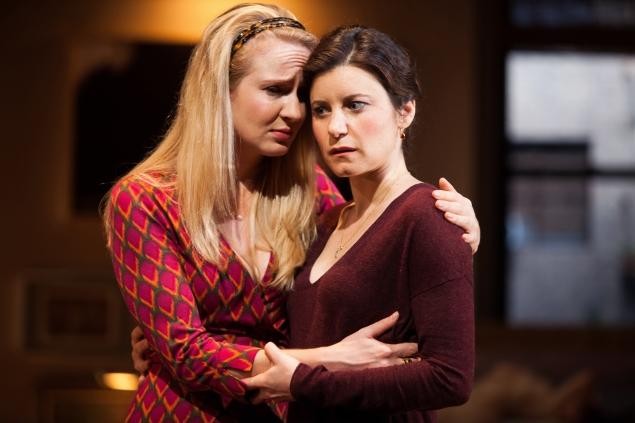
A mother (Catherine Cox) and daughter (Leslie Kritzer) redefine their relationship in THE MEMORY SHOW

THE MEMORY SHOW
The Duke on 42nd St
229 West 42nd St. between Seventh & Eighth Aves.
Tuesday – Sunday through May 18, $65
646-223-3010
www.transportgroup.org
www.dukeon42.org

In the two character musical The Memory Show, a daughter (Leslie Kritzer) moves back home to take care of her mother (Catherine Cox), who has just been diagnosed with early-onset Alzheimer’s. Blending humor and tragedy in charming, touching ways, the musical deals with the changing relationship between mother and daughter in such songs as “Me and My Mother,” “You Remember Him Wrong,” and “Who’s the President of the United States?” The Memory Show, which originated in the graduate musical theatre writing program at NYU’s Tisch School of the Arts and is now having its New York premiere at the Duke on 42nd St., features book and lyrics by Sara Cooper and music by Zach Redler; it is directed by Joe Calarco for the Transport Group Theatre Company, which is also holding a series of special events in conjunction with the show, including “Dark Nights: Mary Testa and Michael Starobin” on May 5 and a Mother’s Day brunch at Chez Josephine on May 12.

TICKET GIVEAWAY: The Memory Show runs through May 18 at the Duke on 42nd St., and twi-ny has three pairs of tickets to give away for free. Just send your name, daytime phone number, and all-time-favorite movie or play about a mother-daughter relationship to contest@twi-ny.com by Friday, May 3, at 12 noon to be eligible. All entrants must be twenty-one years of age or older; three winners will be selected at random. All responses will be kept confidential.

IDEAS CITY: UNTAPPED CAPITAL

Markus Kayser’s “SolarSinter” is part of “Adhocracy” exhibit opening at New Museum during Ideas City festival

Markus Kayser’s “SolarSinter” is part of “Adhocracy” exhibit opening at New Museum during Ideas City festival

The second biannual Ideas City festival takes place May 1-4, with more than one hundred programs featuring conferences, workshops, seminars, panel discussions, walking tours, live music and dance, interactive art installations, a street festival, and other events tackling urgent urban issues at home and around the globe. Following up on 2011’s Festival of Ideas for the New City, this year’s theme is “Untapped Capital,” exploring ways to better use available resources to provide better infrastructure and general societal needs. On May 1, the keynote address will be delivered by MIT Media Lab director Joi Ito at the Great Hall of the Cooper Union, who will examine the internet’s role in untapped capital. On May 2 at the Great Hall, four prestigious panels will examine “Ad Hoc Strategies,” “Waste,” “Play,” and “Youth,” with such impressive guests as Jeffrey Inaba, Emeka Okafor, Thaddeus Pawlowski, Nancy Lublin, Barry McGee, Charles Renfro, and Carlos Motta. On May 3, the Old School at 233 Mott St. will host a series of workshops, including “A Discussion about the Armed Forces and the Arts,” “Social Mirroring,” “Hack City,” “Wherefore Store and Designing for Future Economies,” and “Revitalizing Space — Unlocking Creativity,” while “Pitching the City: New Ideas for New York” will be held at St. Patrick’s Old Cathedral. Among the projects on view throughout the four-day presentation are the Uni Portable Library, “TrafficCom” by Tomorrow Lab and Change Admin, “In Art and Cooperation We Trust!” by Trust Art, and “The Plastic Bag Mandala” by what makes you move. On May 4, the Basilica of St. Patrick’s Old Cathedral will host “Music of the Invisible”; the talk and performance “Big Art in All Spaces” occurs at Dixon Place; Downtown Art will stage the roaming outdoor opera The Great Struggle for Cheap Meat; and First City Green will screen the multichannel video Urban Exquis III. Also on Saturday, Streetfest offers dozens of fascinating presentations downtown, including Art in Odd Places 2013: “NUMBER,” “Ask a Prisoner,” “Dance for DNA,” “Raw Candy Innovation,” “Sewer in a Suitcase,” “SUSTAIN: Steering Urban Sustainability through Action, Innovation & Networks,” “Truck Farm,” “Unboxed,” and “The Urban Habitat Project.” Home base for the festival is the New Museum, where you can catch “The Money Shot: Roundtable with Karen Finley” on May 3 at 1:00, “Performance Beyond the Limits: Short Works” with Erin Markey, Sally May, Brigham Mosley, and Tobaron Waxman on May 3 at 7:00, a screening of Robert Garcia and Kevin Couliau’s Doin’ It in the Park, followed by a Q&A with the director on May 4 at 8:00, “Change of State” video projections on the facade of the museum on Saturday night, and other special events.

THE NANCE

(photo by Joan Marcus)

Nathan Lane is devilishly delightful as a burlesque performer in THE NANCE (photo by Joan Marcus)

Lyceum Theatre
149 West 45th St. between Sixth & Seventh Aves.
Through June 17, $37- $132
www.lct.org

As Douglas Carter Beane’s enjoyable new play, The Nance, opens, Chauncey (Nathan Lane) is sitting in a Greenwich Village Automat, looking for someone to go home with. He sets his sights on an attractive young man, Ned (Jonny Orsini), but they have to hide their potential rendezvous for fear of being arrested — because, yes, being or acting gay in public could land you in jail in 1930s New York City. But after their very funny one-night stand, Chauncey, a local burlesque performer who stars as the Nance (short for Nancy Boy) in a show at the Irving Place Theatre, cannot seem to shake the mysterious Ned, who keeps hanging around, which both delights and annoys Chauncey, a conservative Republican who cherishes his privacy. But as the cops close in on them, they both have to examine who they really are deep down and what they want out of life. Playwright Beane (The Little Dog Laughed, Xanadu) and award-winning director Jack O’Brien (The Coast of Utopia, Hairspray) keep the action moving across John Lee Beatty’s rotating set, which turns from Chauncey’s apartment to backstage and then onstage at the Irving Place Theatre, where Chauncey performs naughty sketches with his partner, Efram (Lewis J. Stadlen), that are filled with deliciously devious and supremely silly double entendres. The troupe also includes bawdy strippers Carmen (Andréa Burns), Joan (Jenni Barber), and Sylvie (Cady Huffman), who tantalize the audience with yet more haughtiness. The play is at its best when Chauncey delves into the political implications of his personal life and career, particularly in an inventively staged courtroom scene. But while the play celebrates the boundary-defying, envelope-pushing burlesque defended so eloquently by Chauncey, it actually features far too many examples; while several of the skits are memorable, at certain points it would have been more interesting to continue with what was going on behind the scenes rather than depicting yet another burlesque bit. The Nance was written with Lane in mind, and Lane is terrific in the role that, well, was tailor made for him. Huffman, who won a Tony playing opposite Lane in The Producers, is also outstanding as a stripper who is smarter than she initially lets on. If you love old-fashioned burlesque, you’re likely to love The Nance, while if you don’t care much for that type of entertainment, you’re still in for a solid night of quality theater.

MATILDA THE MUSICAL

MATILDA (photo © 2013 by Joan Marcus)

Miss Trunchbull (Bertie Carvel) declares that “children are maggots” in MATILDA (photo by Joan Marcus)

Shubert Theatre
225 West 44th St. between Broadway & Eighth Aves.
Tuesday – Sunday through April 6, 2014, $32-$157
www.matildathemusical.com

The best musical to hit the Great White Way since The Book of Mormon, the Royal Shakespeare Company production of Matilda is a dazzling spectacle, a sensational gift from across the pond. Based on Roald Dahl’s 1988 children’s novel, Matilda follows the trials and tribulations of young Matilda Wormwood (played alternately by Sophia Gennusa, Oona Laurence, Bailey Ryon, and Milly Shapiro), an extraordinarily gifted nine-year-old who loves to read books and tell stories. But her sleazy car-salesman father (Gabriel Ebert), who is involved in a shady deal with some Russians, and her self-obsessed mother (Lesli Margherita), who is training for a dance competition with hot-to-trot partner Rudolpho (Phillip Spaeth), want her to give up books and instead be more like her older brother, the dim-witted Michael (Taylor Trensch), who spends his days watching TV and grunting. At school, her teacher, Miss Honey (Lauren Ward), recognizes Matilda’s promise and wants to escalate her education, but the headmistress, Miss Trunchbull (Bertie Carvel in magnificent drag), prefers to punish kids — by sending them off to the terrifying Chokey — rather than promote learning. Meanwhile, Matilda tells an intriguing story to Mrs. Phelps (Karen Aldridge), the school librarian, about a doomed relationship between an acrobat (Samantha Sturm) and an escapologist (Ben Thompson) that is a metaphor for Matilda’s awful family life. But with the help of her remarkable self-possession and unending determination, Matilda is not about to give up her unquenchable thirst for knowledge.

Matilda (Molly Shapiro) tells illuminating, and very adult, stories to Mrs. Phelps the librarian (Karen Aldridge) in MATILDA (photo by Joan Marcus)

Matilda (Molly Shapiro) tells illuminating, and very adult, stories to Mrs. Phelps the librarian (Karen Aldridge) in MATILDA (photo by Joan Marcus)

Winner of seven Olivier Awards, Matilda is a complete triumph from start to finish, from the opening “Miracle” scene, in which the kids are all introduced at a birthday party, to the closing ensemble piece, “Revolting Children.” Every detail is filled with magic, from Rob Howell’s letter-laden sets, which spell out various words that appear during the course of the show, and his inventive, very funny costumes, particularly for Miss Trunchbull and Matilda’s father, to Peter Darling’s choreography, which reaches jaw-dropping proportions when the stage turns into a three-dimensional Scrabble board. Shapiro is extraordinary as the title character, employing just the right mix of wry cynicism and childhood wonder, as Dennis Kelly’s book and Tim Minchin’s music and lyrics capture Dahl’s unique tone and spirit. “So you think you’re able to survive this mess / by being a prince or a princess / you will soon see / there’s no escaping tragedy,” the kids sing in the bouncy but ominous “School Song,” continuing, “And even if you put in heaps of effort / you’re just wasting energy / ’cause your life as you know it / is ancient history.” The large cast also includes Frenie Acoba as Lavender, who develops a delightfully devilish little plan, and Jack Broderick as Bruce, who has a thing for chocolate cake, but even with all the cute and talented kids around, it’s Carvel as the hunchbacked Miss Trunchbull who steals the show, declaring that “children are maggots” as she takes delight in destroying even the tiniest bits of happiness they might find. Impressively directed by Matthew Warchus (God of Carnage, Boeing-Boeing), Matilda creates a world of pure imagination, yet one with darkness hovering around every corner, the must-see musical of the season.

FRAGMENTS

FRAGMENTS

Marcello Magni deals with a disappointing existence in ACT WITHOUT WORDS II, one of five short Beckett plays that make up FRAGMENTS at BAC

Baryshnikov Arts Center, Jerome Robbins Theater
450 West 37th St. between Ninth & Tenth Aves.
Tuesday – Sunday through May 5, $75
866-811-4111
www.bacnyc.org
www.bouffesdunord.com

If you missed C.I.C.T. / Théâtre des Bouffes du Nord’s widely praised production of Fragments at the Baryshnikov Arts Center back in fall 2011, you have another chance, as the show has returned for a splendid encore run through May 5. The Theatre for a New Audience presentation is directed by theater masters Peter Brook and Marie Hélène Estienne, whose entertaining version of The Suit ran at BAM this past winter. Fragments consists of five extremely short minimalist plays by Samuel Beckett, each one an existential gem in its own right. Totaling a mere fifty minutes, they flow into one another effortlessly as they examine loneliness and despair with a wicked sense of humor. In Rough for Theatre I (1979), original Complicité members Marcello Magni and Jos Houben play a pair of destitute souls, the former a blind and rather bad violinist, the latter a one-legged man who pushes himself about on a box and believes that maybe, if they team up, they can make more money, but their prospects don’t look good. In Rockaby (1981), Kathryn Hunter, who was so outstanding in Hideki Noda’s experimental The Bee at Japan Society last year, is dazzling as a woman citing initially repetitive nonsensical text that soon begins to take shape as she contemplates the death of her mother and her own impending demise, the words coming together in a virtuosic display of poetic grandeur.

In Act without Words II (1956), Houben and Magni play two men who live in large white sacks and are individually awakened by a goad that comes down from above; in turn, each man puts on the same suit, socks, hat, and shoes, but while Houben does it with a kick in his step, Magni is disappointed in the world, releasing a series of hysterical sighs as nothing goes his way. Hunter, in fine, deep, gravelly voice, returns for the solo Neither, originally an operatic collaboration between Beckett and Morton Feldman that begins, “to and fro in shadow from inner to outer shadow / from impenetrable self to impenetrable unself by way of neither.” Come and Go (1965) concludes the evening, with Houben, Hunter, and Magni wearing fabulous dresses as they gather on a park bench; one by one, they walk away for a moment, giving the other two the opportunity to gossip about her until all three have been the target of playful maliciousness. Fragments is a delightful collection of absurdist pieces that combine to form a wonderful whole. “When [Beckett] discovered theater,” Brook writes in a program note, “it became a possibility to strive for unity, a unity in which sound, movement, rhythm, breath, and silence all come together in a single rightness.” Such a unity of rightness can be found in this stellar production.

TRIBECA FAMILY FESTIVAL STREET FAIR & TRIBECA/ESPN SPORTS DAY

Crowds will flock to TriBeCa for film festival street fair and sports day on Saturday

Crowds will flock to TriBeCa for film festival street fair and sports day on Saturday

Tribeca Family Festival Street Fair: Greenwich St. between Chambers & Hubert Sts., free, 10:00 am – 6:00 pm
Tribeca/ESPN Sports Day: North Moore St. between Greenwich & Wall Sts., free, 10:00 am – 6:00 pm
www.tribecafilm.com/festival

The Tribeca Film Festival celebrates the TriBeCa neighborhood with its annual downtown street fair on April 27, a full day of special activities for children and adults. There will be signature dishes from such local chefs as Morimoto of Tribeca Canvas, Jehangir Mehta of Mehtaphor, Keith Klein of Milk Truck, and Rachel Thebault of Tribeca Treats, along with specialties from Bubby’s, Kutsher’s Cavaniola’s, Grandaisy Bakery, and others; live performances by the Amazing Max, Judy Pancoast, Jody Prusan, LAVA Brooklyn, TADA!, Noel MacNeal, Rolie Polie Guacamole, and the casts of Rock of Ages, Spider-Man Turn Off the Dark, Motown: The Musical, Cinderella, and Kinky Boots; plenty of arts & crafts booths; a green-screen studio backlot and other film-related activities; and a free screening of The Smurfs, with an appearance by Christina Ricci and a sneak peek at The Smurfs 2. Meanwhile, Tribeca/ESPN Sports Day will be taking place nearby, featuring a full slate of sports-related events, including live performances, demonstrations, competitions, and lessons involving basketball, hockey, badminton, fencing, flag football, cricket, jump roping, lacrosse, Ultimate Frisbee, women’s baseball, golf, soccer, sailing, and more, with street teams from the Rangers, the Mets, the Red Bulls, and others.

TWI-NY TALK: NICK VAUGHAN & JAKE MARGOLIN: A MARRIAGE: 1 (SUBURBIA)

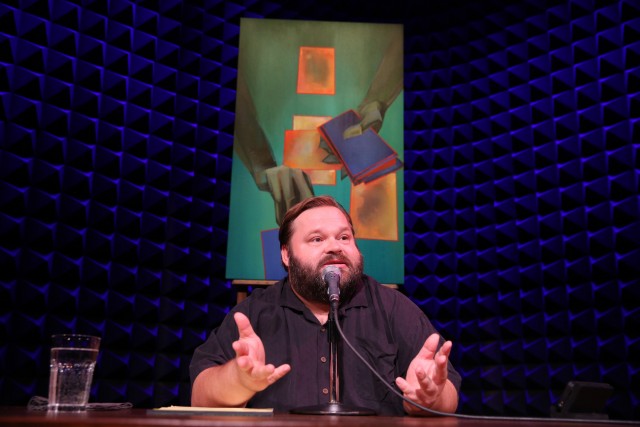
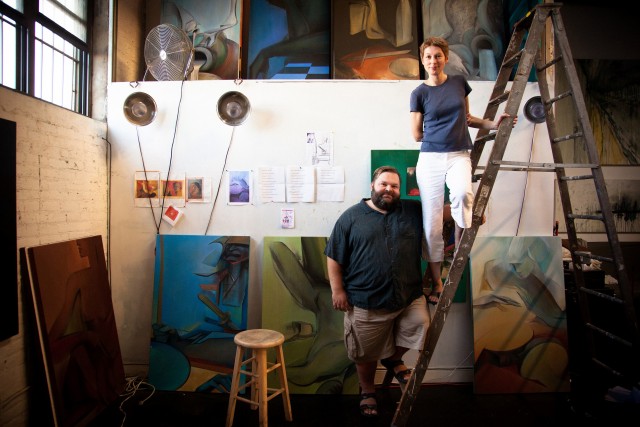
Nick and Jake

Nick and Jake collaborate both personally and professionally, using their life together as a starting point in their art

HERE
145 Sixth Ave. at Dominick St.
April 23 – May 4 (Tuesday – Sunday, 8:30), $10 in advance, $20 within twenty-four hours
Installation free Tuesday – Sunday 2:00 – 10:00
212-647-0202
www.here.org
www.nickandjakestudio.com

Married couple and professional partners Nick Vaughan and Jake Margolin have taken over HERE, filling the downtown arts center with the multimedia immersive presentation A Marriage: 1 (Suburbia). Employing the visual sensibility of Gilbert & George, Nick and Jake examine what has become of the American Dream and the concept of the nuclear family through photography, video, performance, and installation that will continue to evolve from April 23 through May 4. In the art exhibit, which is free, they employ maps that have been reconfigured to portray superimposed families on them and/or video of the two men in the background; pages from John Updike’s Rabbit Run torn out and put on a wall, with highlighted phrases and blue lines connecting them to tell a different kind of suburban story; a hallway of colorful light boxes depicting the conventional 1950s ideal of the American family; and wall sketches that will be added to over the course of the two weeks. Every night will feature a sixty-minute live show ($10 in advance, $20 within twenty-four hours) featuring text written by Jessica Almasy and performed by Jess Barbagallo, with long-duration actions by Brandon Hutchinson and Libby King (April 23-25), Sean Donovan (April 26-30), and Chantal Pavageaux (May 1-4); brand-new Guggenheim Fellow and award-winning choreographer Faye Driscoll serves as consulting director.

“It was super fun for me to work with Nick and Jake; they are both so earnest, humble, and smart and amazingly open inside their process,” says Driscoll. “I loved working on ideas around performance in a visual art context; it opened up my thinking around my own work and gave me some new structures of making, and permission for a different type of exploration. But I think it really helped that all three of us have backgrounds in working in theater. We very easily found a common language around dramaturgical questions and rigor. And we all have an easy willingness to engage in the labor involved in making things. We did a lot of figuring out on our feet, which is how I think best. I think in A Marriage there is clear play with that merged and excessive space of togetherness of coupledom, but as opposed to the work just becoming insular and exclusive, there is actually something deeply generous and activist happening in what Nick and Jake are creating.” At the center of that togetherness and activism is an exploration of America’s changing relationship with same-sex marriage. Nick and Jake, who are still part of the TEAM arts collective where they met, discussed that and more as they prepared for the start of this fascinating undertaking.

twi-ny: Did either of you grow up in the suburbs?

Jake: Neither of us grew up in the suburbs. We both grew up in small university cities, Nick in Fort Collins, Colorado, and I in Berkeley, California. I think it’s safe to say that we both grew up with a healthy distrust of the suburbs — growing up, my family hosted a singing group at our house in which Malvina Reynolds’s “Little Boxes” was a pretty frequent request. Growing up with parents who had no interest in the suburban version of the American Dream is part of why I grew up thinking that the suburbs were for other people. But I also felt that because I was gay it wasn’t an option, even if I wanted it. I grew up knowing a fair number of kids who lived in the suburbs of the Bay Area, and many of them were nonwhite, and not wealthy, which I mention only to say that I didn’t have a view of the suburbs as a place that was exclusively white or monied. But my sense of it was that the suburbs were exclusively heterosexual. And as I realized that I didn’t fit into that, I had a real sense that even had I wanted anything to do with the suburbs, I wouldn’t be welcome — that the ’burbs weren’t for people like me.

twi-ny: What do you think has happened to that American Dream since your were kids?

Jake: When we talk about the “American Dream” we are talking about the heteronormative version that aspires to a suburban nuclear family. There are as many different versions of the American Dream as there are people in this country, so I just want to clarify that we are using it as a cliché. And I think a major shift has happened since we were kids, which is that this version of the American Dream is now opened up to include LGBTQ people. Even growing up in a hyperliberal place, I had a sense of gay people as being abnormal – a deviance from the norm that are tolerated because Berkeleyites are tolerant and open-minded people, but still a group of people who are in some way going to have to live on the outside of mainstream society. As many things about gay culture have been accepted into the mainstream since we were kids, now that set of aspirations that were traditionally exclusively for heterosexuals, aspirations towards suburbia, the nuclear family, and all of that – are on the table.

Nick and Jake explore the suburban ideal of the American Dream in immersive multimedia installation (photo by twi-ny/mdr)

Nick and Jake explore the suburban ideal of the American Dream in immersive multimedia installation (photo by twi-ny/mdr)

twi-ny: An earlier part of A Marriage at HERE included your watching twenty hours of Fox News. What are your feelings toward America’s evolving relationship with same-sex marriage, primarily as portrayed in the media?

Jake: That piece was trying to get at how we are surrounded by these media portrayals of same-sex marriage, almost swimming in these sound bites. And we’d been floored by the general tone on Fox News about same-sex marriage – it felt so belittling whenever we saw it. That said, I should fess up that Nick and I don’t own a TV, and other than when we are on tour with the TEAM or other projects (or holing up in motels to make art pieces), we watch very little TV. Probably my greatest exposure to how the media portrays same-sex marriage is the package of clippings from the New York Times and various Bay Area publications on the topic that my mother sends us every few months.

In general I am so thrilled by the growing acceptance of same-sex marriage, both by the country in general and by the media that I am exposed to. Thrilled and grateful for the hard work and sacrifices that have been made by so many people to make this happen. However, I feel a certain ambivalence about this acceptance because I wonder who’s terms this acceptance is on. I wonder about the sense that we are accepted as long as we conform to a version of heteronormative social structures that people have spent the last however long – forty years? – trying to dismantle. I grew up with plenty of models of people living outside the construct of marriage – whether it be raising a family with their partner and never getting married or remaining single. So while Nick and I have a pretty traditional marriage in all respects other than our gender, I don’t have a sense that it is an inherently superior situation than any other. It just works for us.

As we were creating this piece, this ambivalence felt very strong – a real sense of “Now we have the option of fitting into all this iconography, but do we want to have anything to do with it? This inevitable-feeling march towards the mainstream, do we want it or are we losing something really important tied to our heritage as a people relegated to being the Other.” And then the Prop 8 case gets argued in front of the Supreme Court, and when I hear the justices waffling about “Is this really the right time?” and “Can’t we just wait for the states to decide on their own?” I find that I swing completely in the opposite direction and feel strongly, “How dare anyone say that I am different or that our relationship is in any way inferior” and find that I want that mainstream acceptance – that I feel completely entitled to it.

twi-ny: Among your collaborators is one of our favorite people, Faye Driscoll. How did that collaboration come about?

Nick: She’s one of our favorite people too! I first met Faye when I designed the set for Taylor Mac’s The Lily’s Revenge a few years ago. For the third section of the epic piece (which Faye choreographed) we stripped the space bare and taped out “‘scenery’ on the wall.” I’ve been following her work ever since and have collaborated on a couple of operas which she choreographed and I designed.

It was after the premiere of You’re Me at the Kitchen, though, that Jake and I decided to ask her to help us out with this project. She has such a clear and deceptively simple way of cutting to the core of visual ideas. You always have the sense watching her work that things are actually happening, that there’s a real exchange taking place. She’s also one of the smartest people I know. It seemed, therefore, only natural to ask her to help us curate and develop the eleven nightly actions for our piece, none of which is dance, per-se. . . .

twi-ny: The images of you and Jake in the installation evoke the work of Gilbert and George. Did they serve as any kind of influence or inspiration?

Nick: Absolutely. I don’t know if it would have been possible for the two of us as a couple and artistic team not to address Gilbert and George in some way. At some level I think their work was probably influencing us from the very beginning of our collaborations, but I don’t know that we realized it until their retrospective at the Brooklyn Museum a few years ago.

I think there is a very different approach to performance and it’s something that has certainly come up multiple times as we’ve developed the nightly actions. G&G were revolutionary in that they presented themselves as objects, stripped (or at least muted) of identity. Our presence in our work (hopefully) serves to frame the world through our eyes so you’re looking with us, not at us.

But there are small references peppered throughout the piece: There’s a large wax panel work that bears a slight reference to G&G in its framing. There are three sprayed-paint performances that I think in some way give a little nod to the silver and red body paint of the duo. But there are also other little nods to other artists who have inspired us.

There’s a piece in the downstairs hallway (and bathrooms) that lightly reference this wonderful Sol Lewitt piece Jake and I saw at MassMOCA last year in which he took an art criticism journal and diligently connected every use of the word “art” so you got this strange kind of matrix and it turned the text into this impenetrable geometric construction. We’ve taken a much looser approach, deconstructing John Updike’s Rabbit Run and attempting to give some kind of graphic anchor to the images that feel related, from a very subjective set of criteria.

Installation includes geographic portraits made of cut maps emphasizing negative space (photo by twi-ny/mdr)

Installation includes geographic portraits made of cut maps emphasizing negative space (photo by twi-ny/mdr)

twi-ny: You met while working together at the Team, and now you’re married. How has the dynamic of living, working, and performing together impacted your relationship?

Jake: One thing we joke about is that normally your spouse is the person you can come home to and gripe about work and your coworkers. . . . We can’t really do that. Our collaboration came out of conversations that we had while on tour with the TEAM as well as while on tour with Yoshiko Chuma. It feels that through the TEAM we have the most wonderful outlet for making theater with a group of the smartest and most talented people we know. And we realized that we shared an interest in installation art and how performance functions in that setting, and what started as daydreaming while on tour turned into works-in-progress at various places and ultimately this residency at HERE.

The show will change over time, with people encouraged to return to see where things have gone. Dare we read anything into the work as coming from your real-life marriage?

Jake: Each night of the show we will do a different performance action, so they will accumulate over the course of the run, while a fourteen-day-long action in which we, Brandon Hutchinson, Libby King, Sean Donovan, and Chantal Pavageaux read the entire oral arguments of Perry v. Schwarzenegger into clear bags, creating an expanding sculpture of the captured breath. We hope that people will come by later in the run to see how this has evolved, and the tickets are structured to encourage that – the ticket that you purchase is good for return visits so that people might stop by for ten minutes on a later night to check in on it all.

This question makes me laugh – I suppose it does feel like our marriage evolves over time and that if you check back in with us at a later point it will have gotten larger and more complicated and more fleshed out . . . but I suspect that is true of all relationships.

Earlier this year we were debating whether we should condense the performance actions into brief excerpts that could all be performed each night — and ultimately decided that they really only function if they are given the room to take a whole evening each — that their duration is at the core of the thing. Perhaps there’s an analogy there with our marriage, and probably with marriage in general – that it’s slow work, and things take time to breathe and grow, and that in fact this expansive time is a really good thing. A great perk of being married is that there isn’t the pressure to get things right immediately, because we’re in it for the long haul.

(A Marriage: 1 (Suburbia) runs April 23 – May 4 at HERE and will include several special programs. The April 24 performance will be preceded by “Cocktails & Context” at 7:30 and will be followed by the panel discussion “The Ambiguity of Acceptance,” and the May 1 show will be followed by a discussion moderated by Risa Shoup and featuring Steven Cheslik-DeMeyer, Erin Markey, Glenn Marla, and Tony Osso.)