this week in theater

JULIUS CAESAR

Royal Shakespeare Company sets JULIUS CAESAR in contemporary Africa (photo by Richard Termine)

Royal Shakespeare Company sets JULIUS CAESAR in contemporary Africa (photo by Richard Termine)

Brooklyn Academy of Music
BAM Harvey Theater
651 Fulton St. between Ashland & Rockwell Pl.
Through April 28, $25-$125
718-636-4100
www.bam.org

New Royal Shakespeare Company artistic director Gregory Doran makes a smashing debut with his unique take on the Bard’s Roman tragedy Julius Caesar. Inspired by the Robben Island Bible – a copy of The Complete Works of William Shakespeare that was annotated by South African political prisoners, including Nelson Mandela, while being held on Robben Island – Doran sets the play in contemporary Africa, performed by an all-black British cast. The action begins about fifteen minutes prior to curtain, as a group of men and women have gathered for a political rally, holding up signs that read “Caesar” and dancing to live music (by Akintayo Akinbode) played by a small band using traditional instruments. They also share their faith in Caesar with early-arriving audience members sitting down front, talking to them and handing them flyers. The loose, fun atmosphere is soon interrupted by the appearance of Julius Caesar himself (Jeffery Kissoon), who is greeted by such supposed followers as Markus Brutus (Paterson Joseph), Caius Cassius (Cyril Nri), and Casca (Joseph Mydell). A wild soothsayer (Theo Ogundipe) predicts doom, but Caesar is too wrapped up in his own glory to worry too much about it. But as Caesar’s thirst for power grows, Brutus, Cassius, Casca, and others conspire to murder him, with Mark Antony (Ray Fearon) caught somewhere in the middle, trying to be a man of the people while also lamenting Caesar’s demise.

(photo by Richard Termine)

The deed is done, setting things in motion in stirring production of JULIUS CAESAR at BAM (photo by Richard Termine)

On December 16, 1977, Mandela highlighted the following passage from Julius Caesar in the Robben Island Bible: “Cowards die many times before their deaths; / The valiant never taste of death but once. / Of all the wonders that I yet have heard. / It seems to me most strange that men should fear; / Seeing that death, a necessary end, / Will come when it will come.” Working off that quote, Doran builds this stirring production around the concept of fear. Once the audience is seated, two guards come out, whipping their truncheons down hard, sending chilling sounds echoing through BAM’s Harvey Theater, getting everyone’s attention, both on- and offstage. Casca is afraid that Cassius might not be loyal to Caesar, Brutus is afraid that Caesar has gone mad with power, the people are afraid to be left without a strong leader, and Mark Antony is afraid for Rome’s future amid so much treachery. Looming over it all is a huge statue of Caesar, its back facing the crowd. Doran’s production is fresh and vibrant, breathing new life into what is one of Shakespeare’s most straightforward, less complex tales. It all takes place on Michael Vale’s cold, gray, multilevel concrete set, with the crowd wearing modern clothing and the main characters changing into black togas. The cast is strong, with Mydell and Joseph particularly effective in their key roles in a play that still resonates today, relating to recent revolution, assassination, and the general confusion of a conflicted citizenry. Julius Caesar continues at BAM through April 28, with members of the company participating in an Artist Talk following the April 26 performance.

SOUTHERN DISCOMFORT

(photo by Ewa Skowska)

Proud southerner Elisabeth Gray takes on six roles in new one-woman show (photo by Ewa Skowska)

TRIPLE DISTILLED SOUTHERN GOTHIC
SoHo Playhouse, the Huron Club
15 Vandam St.
Monday nights at 8:00 through May 13, $20
866-811-4111
www.sohoplayhouse.com
www.newumbrella.org

Southern native Elisabeth Gray evokes the ghosts of Tennessee Williams, Walker Percy, and Flannery O’Connor in her new one-woman show, Southern Discomfort. Over the course of seventy minutes, Gray explores personal loneliness as she portrays six characters in seven vignettes, ranging from nineteen-year-old Josh Robinson Riddle, a one-handed North Carolina lad working at a gun show, to ninety-one-year-old South Carolinian Penelope Weaver, who bookends the New Umbrella production with her aging mind’s meanderings. Gray, who was born and raised in the South and recently made her Broadway debut in various small roles in the short-lived Breakfast at Tiffany’s, also plays twenty-seven-year-old Alabamian Julia Hanover, who is obsessed with crooked faces; forty-one-year-old Tennessee truck driver Jonny Stutts, who discusses porn with an unseen traveling companion; fifty-two-year-old Cheri Kane, who is giving a speech at the Olive Branch Mississippi Women’s Historical Society announcing that the club has accepted its first black member; and sixty-three-year-old William Ernest Fells, a Georgia man eulogizing his deceased wife. In the show — which is subtitled Triple Distilled Southern Gothic and runs Monday nights through May 13 in the Huron Club bar downstairs at the SoHo Playhouse, with free bourbon-and-lemonade cocktails — Gray and director Daniel Zimbler take on such topics as racism, sexism, guns, ideals of beauty, violence against women, love, family, and the Civil War without getting preachy or pedantic. Sometimes Gray’s point is too abstract, as in the pieces involving Weaver, but otherwise she employs a careful subtlety while avoiding clichés and stereotypes. She also involves the audience by occasionally using various paying customers as characters in her stories, pointing them out in the crowd and addressing them directly. (Try to get their early if you want a table instead of sitting on a stool at the bar or on a long couch.) At its heart, Southern Discomfort works because there’s a basic truth inherent in Gray’s telling; in the program notes, she explains that all of the characters are based on actual people she has known, resulting in believable situations that touch on both the comic and the tragic.

MOTOWN THE MUSICAL

Hitsville, U.S.A. comes to Broadway in new jukebox musical (photo by Joan Marcus)

Hitsville, U.S.A. comes to Broadway in new jukebox musical (photo by Joan Marcus)

Lunt-Fontanne Theatre
205 West 46th St. between Seventh & Eighth Aves.
Through December 30, $49-$159
www.motownthemusical.com

Motown: The Musical opens with a battle of the bands between the Temptations and the Four Tops from the 1983 Motown 25 television special, setting the too-fast pace for this watered-down ride through the history of the legendary record label and its founder, Berry Gordy. With a book by Gordy based on his 1994 autobiography, To Be Loved: The Music, the Magic, the Memories of Motown, the jukebox musical features snippets from nearly sixty songs from the Detroit label’s stellar catalog, whipping past in sped-up fury, re-created by a talented cast of performers who, of course, “ain’t nothing like the real thing” (a tune that, by the way, is not in the show). Brandon Victor Dixon is solid as Gordy, a dreamer who goes from odd job to odd job until deciding to start his own music company. He puts together an amazing group of singers, from Marvin Gaye (Bryan Terrell Clark), Smokey Robinson (Charl Brown), Stevie Wonder (Raymond Luke Jr. and Ryan Shaw), and Mary Wells (N’Kenge) to the Marvelettes, Gladys Knight (Marva Hicks) and the Pips, and Martha Reeves (Saycon Sengbloh) and the Vandellas. But this by-the-numbers story of Hitsville, U.S.A., directed by Charles Randolph-Wright, focuses too much on the relationship between Gordy and Diana Ross (Valisia LeKae), feeling more like a public apology than a realistic depiction of their years together, both personally and professionally, particularly her solo debut in Las Vegas that involves forced audience interaction. Gordy also forces in set pieces related to the civil rights movement and such tragedies as the assassinations of John F. Kennedy and Martin Luther King that are driven by clichés.

Raymond Luke Jr. nearly steals the show as young Michael Jackson (played alternately by Jibreel Mawry), channeling the superstar on such Jackson 5 classics as “ABC,” “I Want You Back,” and “I’ll Be There,” but that also is a major problem with the production, which works so hard to impress the audience with its re-creations, resulting in truncated versions that come off more like a talent show, albeit a pretty darn good one. There are also a few new songs written by Gordy and Michael Lovesmith that are standard Broadway musical fare. Motown: The Musical is like an old record spinning on an even older turntable, going a little too fast, filled with skips and scratches as the needle follows the grooves, but in the end, the songs are so good that you just might not even care about all those hiccups.

BLUES FOR SMOKE

Rodney McMillian, “Asterisks in Dockery,” mixed-media installation, 2012 (photo by Sheldan C. Collins)

Rodney McMillian, “Asterisks in Dockery,” mixed-media installation, 2012 (photo by Sheldan C. Collins)

Whitney Museum of American Art
945 Madison Ave. at 75th St.
Wednesday – Sunday through April 28, $14-$18 (pay-what-you-wish Fridays, 6:00 – 9:00)
212-570-3600
www.whitney.org

In 1960, jazz pianist and composer Jaki Byard released his solo debut, Blues for Smoke, an improvisatory record that features on its cover a train puffing out dark clouds as it makes its way down the tracks. The album lends its name to an exciting multimedia exhibit at the Whitney that examines the impact of the blues on the arts. The show is highlighted by David Hammons’s extraordinary 1989 installation, “Chasing the Blue Train,” which greets visitors on the third floor. A blue train makes its way across tracks that take it through a tunnel covered in coal and a landscape with upturned piano tops as John Coltrane’s 1957 Blue Train album plays from a boom box, the work riffing on Coltrane’s name (coal, train) while celebrating the blues. Zoe Leonard’s “1961, 2002-Ongoing” consists of a row of suitcases of different shades of blue, evoking impermanence and creating a mystery about what might be inside; nearby, Martin Kipperberger’s “Martin, into the Corner, You Should Be Ashamed of Yourself” is a life-size replica of the artist standing in the corner, suffering from a case of the blues. Specially commissioned for the show, Kori Newkirk’s “Yall” consists of a shopping cart nearly completing a circle of blue on the floor, calling to mind exclusion, homelessness, and failed capitalism. Kira Lynn Harris lines a stairwell and entrance with silver Mylar in “Blues for Breuer,” paying tribute to the architect of the Whitney building, which will be taken over by the Met in 2015 when the Whitney moves downtown.

Installation view, Blues for Smoke (photo by Sheldan C. Collins)

Works by Martin Wong, Martin Kipperberger, Zoe Leonard, and others form a blues aesthetic at the Whitney (photo by Sheldan C. Collins)

Curated by Bennett Simpson in consultation with Chrissie Iles, “Blues for Smoke” also features works by Romare Bearden, Carrie Mae Weems, Glenn Ligon, Liz Larner, Jean-Michel Basquiat, Rachel Harrison, Mark Morrisroe, Alma Thomas, Beauford Delaney, Kara Walker, William Eggleston, and Lorraine O’Grady, all contributing to the overall examination of the blues aesthetic. A media room includes viewing stations where people can watch classic performances, while Stan Douglas’s “Hors-champs” plays continuously in its own space on the first floor, offering a unique view of a live recording on the front and back of a screen hanging from the ceiling. In addition, the Whitney is hosting a series of live events that continue through the end of the exhibition, which closes April 28, including “Blues for Smoke: Matana Roberts, Keiji Haino, and Loren Connors” on April 20 at 8:00 (featuring a solo performance by Roberts and a duo guitar improvisation by Haino and Connors), “Through the Lens of the Blues Aesthetic: An Evening of Short Films Selected by Kevin Jerome Everson” on April 25 at 7:00, the live concert “Blues for Smoke: Annette Peacock” on April 26 at 7:00, and the three-day “Blues for Smoke: Thomas Bradshaw,” in which the playwright will be creating a new piece that will be shown April 26-28.

LA RUTA

(photo by Lia Chang)

LA RUTA tells the story of illegal immigrants risking everything for a new life in America (photo by Lia Chang)

Multiple locations
Wednesday – Sunday through May 12, $25
212-244-3300
www.theworkingtheater.org

The controversial topic of illegal immigration takes center stage in the Working Theater’s timely and powerful La Ruta. Actually, “stage” is probably the wrong word, as the uniquely immersive production takes place primarily in a forty-eight-foot truck. Sharply written by Ed Cardona Jr. and skillfully directed by Tamilla Woodard, La Ruta begins as the audience, limited to thirty people per performance, gathers in a small tent, waiting to be hustled into a truck that will take them — along with a mysterious cargo — across the border into Texas. In charge of the journey is Raula (Sheila Tapia), a tough Hispanic woman who does not like being talked back to, leading to an immediate confrontation with Irma (Zoë Sophia Garcia), who has trouble keeping her mouth shut. The audience is soon pushed inside the truck, where they sit in darkness on big boxes. Raula relaxes in the front cab with the driver, Albert (Brian D. Coats), while Irma, Mabel (Annie Henk), and Francisco (Gerardo Rodriguez) are put in the back, where the unpredictable Juancho (Bobby Plasencia) is protecting the merchandise. Expert use of sound (Sam Kusnetz), light (Lucrecia Briceno), and projection (Dave Tennant and Kate Freer) makes it feel like the truck is actually moving as the story of each character unfolds, building to a shocking and unsettling climax.

Albert (Brian D. Coats) and Raula (Sheila Tapia) take a group of illegal immigrants into Texas in moving play (photo by Lia Chang)

Albert (Brian D. Coats) and Raula (Sheila Tapia) take a group of illegal immigrants into Texas in moving play (photo by Lia Chang)

La Ruta is adventure theater at its best, led by a strong, convincing performance by Tapia (CQ/CX), who has the primary responsibility of putting the audience on edge and keeping them there. Garcia, in her New York debut, is also excellent, her fear representative of the audience’s, constantly worrying about what is going to happen next. Since most of the play’s seventy-five minutes take place in close, dark quarters, claustrophobics should take note, but everyone else should rush to get the limited amount of tickets available for this smashing production. Of course, the audience gets only the tiniest taste of what it’s like for illegal immigrants who risk it all trying to make a new life in the supposed land of opportunity, able to return after the show to apartments that suddenly feel a whole lot more safe and comfortable. But if you really allow yourself to become lost in the tense drama, as if you’re also risking everything and not merely there as a theatrical spectator, you’re in for an unforgettable experience. La Ruta, which already played in the Bronx, continues alongside the Cathedral Church of St. John the Divine in Manhattan through April 28, then traveling to IBEW Local 3 Headquarters in Flushing May 1-5 and Snug Harbor on Staten Island May 8-12. The play is accompanied by a small but informative multimedia exhibit about immigration put together by the Magnum Foundation.

TWI-NY TALK: DONNA UCHIZONO — LIVE IDEAS: THE WORLDS OF OLIVER SACKS

(photo by Mia}

Donna Uchizono will present two works during NYLA festival celebrating Oliver Sacks (photo by Mia}

LIVE IDEAS: THE WORLDS OF OLIVER SACKS — RE: AWAKENINGS (DANCE)
New York Live Arts
219 West 19th St.
Thursday, April 18, 8:00, and Saturday, April 20, 4:00, $40
Festival runs April 17-21
212-691-6500
www.newyorklivearts.org
www.ladonnadance.org

In the preface to the 1990 edition of his bestseller Awakenings, Dr. Oliver Sacks wrote, “It is now 21 years since my patients’ awakenings, and 17 years since this book was first published; yet, it seems to me, the subject is inexhaustible — medically, humanly, theoretically, dramatically. It is this which demands new additions and editions, and which keeps the subject for me — and, I trust, my readers — evergreen and alive.” In celebration of Sacks’s upcoming eightieth birthday (on July 9) and the thirtieth anniversary of the publication of Awakenings, New York Live Arts is hosting its first Live Ideas festival, “The Worlds of Oliver Sacks,” five days of special programs that medically, humanly, theoretically, and dramatically examine and explore the good doctor’s inexhaustible contributions to the field of science and the arts. The festival includes the world premiere of Bill Morrison’s short film Re: Awakenings; a series of talks delving into Sacks’s work with people who have Tourette’s, Parkinson’s, and hearing loss; an evening of music and dance with the Orchestra of St. Luke’s, choreographer Aletta Collins, dancer Daniel Hay-Gordon, and conductor Tobias Picker; back-to-back presentations of Harold Pinter’s A Kind of Alaska, the first with spoken words, the second in American Sign Language; and such panel discussions as “Disembodiedness: Body Image & Proprioception,” “Musicophilia & Music Therapy,” “Neurologists & Philosophers Consider Sacks at 80,” and “Minding the Dancing Body,” the latter bringing together NYLA executive artistic director Bill T. Jones, Miguel Gutierrez, Colin McGinn, Alva Noë, and Gwen Welliver.

Sacks himself will participate in an Opening Keynote Conversation with Jones and will introduce a screening of the 1974 British television documentary Awakenings, followed by a Q&A. “Live Ideas” also features a pair of works by New York-based choreographer Donna Uchizono, performed by Levi Gonzalez, Hristoula Harakas, and Rebecca Serrell Cyr: a “Sacksian version” of Uchizono’s 1999 State of Heads and the newly commissioned Out of Frame. Earlier this week Uchizono discussed her involvement in this inaugural festival while preparing for the April 18 and 20 shows.

twi-ny: How did you get involved in “Live Ideas: The Worlds of Oliver Sacks” in the first place, and how familiar were you with his work prior to becoming part of the festival?

Donna Uchizono: I received a phone call from [NYLA artistic director] Carla Peterson asking me if I would be interested in creating a work about Awakenings based on Oliver Sacks’s work. I was, of course, completely honored and intrigued while simultaneously humbled by the offer. My father had his PhD in psychology and was interested in the workings of the brain. My father had a great love for books and had a huge library. Oliver Sacks’s books were among the many books my father owned. He gave me a copy of The Man Who Mistook His Wife for a Hat to read quite a long time ago. I had also seen the film Awakenings so was somewhat familiar with the horrible loneliness and “silent scream” of sleeping sickness. Heartbreaking. It’s quite a different challenge being commissioned to create a work about a specific topic other than a concept that is driven by oneself. The new work is turning out to be much more representational than work that I normally create, which I think is quite natural given the subject and the context in which it will be performed.

twi-ny: You’ll be presenting State of Heads, which premiered at Dance Theater Workshop in 1999. Why did you choose this to be part of your Sacks presentation?

Donna Uchizono: Coming out of a much larger discussion, the reasons for State of Heads being in the program are many and beyond the scope of this writing. But when the suggestion to move away from a program that included a play, music, and dance on one evening, to that of separate evenings of dance, music, and theater, State of Heads was discussed as a piece that may be included in the evening of dance because of its movement vocabulary. As I wrote in the choreographer’s notes, State of Heads explores the feeling of waiting and the passage of time in the state of hiatus where familiar time and scale are pushed. Using the separation of the head from the body as a point of departure, in an exploration of disjointedness and the sense of a will apart from the mind driving the movement, surprisingly created a world of endearingly odd characters. State of Heads reveals endearment in the awkward where the ordinary become extraordinary. The accounts of the patients that Oliver Sacks writes about in his book Awakenings are remarkable, where most definitely the ordinary become extraordinary and where profound “humanness” is found in the most unlikely places and time.

Live Ideas festival runs April 17-21 at New York Live Arts

Live Ideas festival runs April 17-21 at New York Live Arts

twi-ny: You’re also debuting Out of Frame, incorporating text from Dr. Sacks’s work. What was it like transforming his scientific studies into dance?

Donna Uchizono: I rarely use text in my work, but Oliver Sacks is not only a neurologist of note, he is also a well-known writer, thus it seemed natural to use his words. It was Oliver Sacks’s words that conjured up the images and movement for Out of Frame. I made a conscious decision not to view Bill Morrison’s film that incorporates actual archival footage or revisit the film Awakenings while creating the new work. I did not want to imitate but rather to create the movement vocabulary and images from Sacks’s writings. I was deeply moved by Dr. Sacks’s humane understanding of the plight of his patients. It was the idea of compassion and the need for tenderness towards the individuals that drives the work, rather than his scientific studies. The short solo seems to float between three states — the physical torque of the disease, the human beneath the dress, and the dreamlike temporary state of L-DOPA.

twi-ny: This year marks the twenty-fifth anniversary of your choreographic debut. What are some of the key differences in being a New York City dancer-choreographer in 1988 as opposed to today?

Donna Uchizono: I feel quite lucky to be part of a generation that started to show their work during the late 1980s and early ’90s. At that time it seemed as if anything was possible. We could design spaces, design programs, and find places to create. We were not yet aware of the looming financial shutdown that was about to happen. We looked around at other choreographers and there seemed to be a possible linear path moving from individual and emerging choreographer to having a small dance company. By the mid-’90s the financial wall had crumbled. I think it is much harder to make work now. Well, it is for me anyway. Young choreographers today seem to be much more aware that there is no obvious financial path. What remains the same is the need to make work.

twi-ny: You’ve had a long relationship with Dance Theater Workshop, which recently morphed into New York Live Arts. What do you think of the new venue?

Donna Uchizono: I have had a long relationship with with the wonderful and dedicated Carla Peterson, who continues to champion experimental artists. I am quite thrilled and honored to be in this Live Ideas festival, and the staff at NYLA have treated me with openness and generosity.

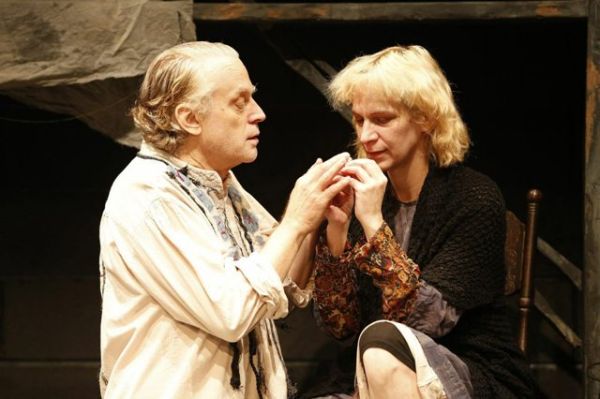
TICKET GIVEAWAY: DIFFERENT ANIMALS

different animals

DIFFERENT ANIMALS
Cherry Lane Theatre
38 Commerce St.
Wednesday – Sunday, April 20 – May 26, $41
866-811-4111
www.cherrylanetheatre.org
www.differentanimalsplay.com

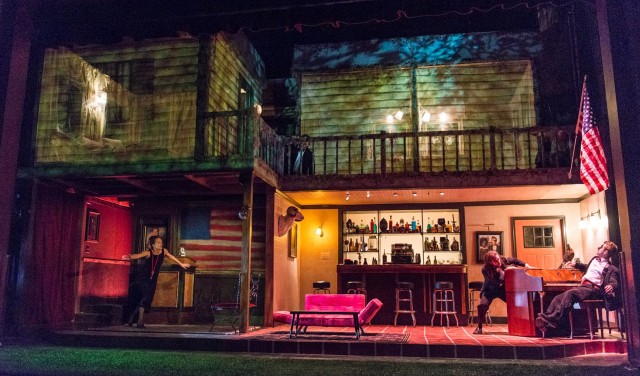
Monogamy takes quite a hit in Different Animals, a new romantic comedy written by and starring Abby Rosebrock. Jessica Tarver (Cesa Pledger) is an unhappy Spartanburg, South Carolina, woman whose life has turned out to be not quite what she hoped for. While searching for spiritual contentment in a suburban landscape dominated by churches and chain restaurants, she cheats on her much older husband (Dirk Keysser), who is looking for his own kind of satisfaction and fulfillment, so he invites a coworker to join him and his wife in bed. But that coworker, Molly Gardner (South Carolina native Rosebrock), is not exactly a stable person herself, leading to all kinds of complex entanglements. The Wednesday Repertory Company production is produced and directed by Bruce Ornstein (Vamperifica, Jack and His Friends) and also features Brady Kirchberg, Sienna Sternick, and Maria Panoski.

TICKET GIVEAWAY: Different Animals runs April 20 to May 26 at the Cherry Lane Theatre, and twi-ny has three pairs of tickets to give away for free. Just send your name, daytime phone number, and all-time-favorite ménage à trois movie or theater scene to contest@twi-ny.com by Thursday, April 18, at 12 noon to be eligible. All entrants must be twenty-one years of age or older; three winners will be selected at random. All responses will be kept confidential.