this week in theater

I’LL EAT YOU LAST: A CHAT WITH SUE MENGERS

(photo by Richard Termine)

Bette Midler makes her long-awaited return to Broadway in one-woman show about Hollywood superagent (photo by Richard Termine)

Booth Theatre
222 West 45th St. between Broadway & Eighth Ave.
Friday – Wednesday, $87 – $152
www.illeatyoulast.com

In her long-awaited return to the Great White Way, the Divine Miss M inhabits the role of Hollywood superagent Sue Mengers in the one-woman show I’ll Eat You Last. Midler, making her first nonconcert Broadway appearance since 1967, when she played Tzeitel in Fiddler on the Roof, is, well, simply divine as the aggressive, ultra-determined Mengers, who was both loved and hated while tirelessly working for such big-time clients as Julie Harris, Steve McQueen, Ali McGraw, Gene Hackman, Faye Dunaway, and Ryan O’Neal. Midler spends ninety minutes as Mengers, wearing a lovely sparkly blue caftan designed by Ann Roth, lounging on a couch in Scott Pask’s elegant living-room set, drinking, smoking, and cursing as she shares intimate moments from her life and career while waiting for a critical phone call from her number one client, Barbra Streisand. She even invites an audience member onstage to get her some booze and a cigarette, revealing her power to get men to do her bidding. Unfortunately, John Logan has not given Midler much of a play to work with. The show is subtitled A Chat with Sue Mengers, and that’s pretty much exactly what it is: a mere chat, not a Broadway production. Logan, who has penned such films as The Last Samurai, Hugo, Rango, Star Trek: Nemesis, and The Aviator in addition to Red, for which he won a Tony, was inspired to write I’ll Eat You Last after meeting Mengers at a 2008 dinner party. His script contains plenty of funny one-liners but is primarily superficial and reverential, paying tribute to Mengers, who died in 2011 at the age of seventy-nine, in a series of worshipful anecdotes that don’t quite come full circle. Midler is delightful gossiping about such Hollywood celebs as McGraw, McQueen, producer Bob Evans, and director William Friedkin, but this chat is more of a pleasing appetizer than a full, satisfying meal.

PIPPIN

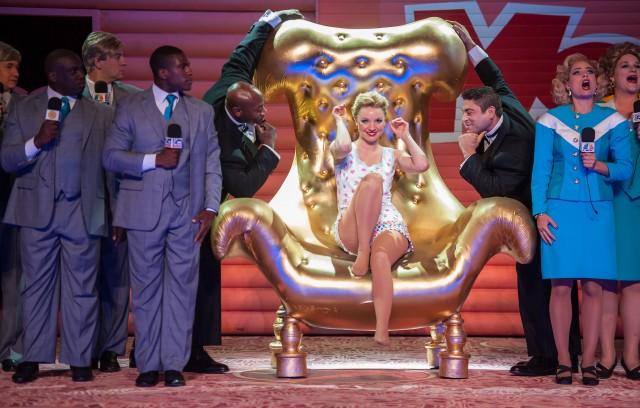
Talented troupe dazzles in new Broadway production of PIPPIN (photo © 2013 Joan Marcus)

Talented troupe dazzles in new Broadway production of PIPPIN (photo © 2013 Joan Marcus)

Music Box Theatre
239 West 45th St. between Broadway & Eighth Aves.
Tuesday – Sunday through December 22, $59 – $148
www.pippinthemusical.com

Inventive director Diane Paulus, who has staged wildly successful revivals of Hair and Porgy and Bess in recent years, now lovingly resurrects Roger O. Hirson’s and Stephen Schwartz’s Pippin on the occasion of its fortieth anniversary. “We’ve got magic to do, just for you,” the cast announces in the dazzling opening number, and the first act of this self-described “anecdotic revue” is indeed magical. The show, which was directed by Bob Fosse back in 1973, is hosted by the Leading Player (usually played by Patina Miller but performed by Stephanie Pope when we saw it) à la the Emcee in Fosse’s Cabaret, both addressing the audience directly and running things onstage. It’s the early Middle Ages, and King Charlemagne (a beautifully bearded Terence Mann) is sitting on the throne, denying peasants’ wishes and leading his empire through a series of wars. Meanwhile, his prodigal son, Pippin (Matthew James Thomas), has returned from his studies, trying to figure out what to do with his life. “Why do I feel I don’t fit in anywhere I go?” he asks in the ballad “Corner of the Sky,” continuing, “Rivers belong where they can ramble / Eagles belong where they can fly / I’ve got to be where my spirit can run free / Got to find my corner of the sky.” He considers becoming a warrior like his half brother, Lewis (Erik Altemus), which delights his stepmother, Fastrada (Charlotte d’Amboise), who envisions Pippin getting killed, making Lewis next in line to be king. But that doesn’t quite work out, and soon Pippin finds himself in the midst of a difficult moral quandary as he considers the sins of the father and the needs of the common people.

Berthe (Andrea Martin) gives life lessons to her grandson (Matthew James Thomas) in Broadway revival of PIPPIN (photo © 2013 Joan Marcus)

Berthe (Andrea Martin) gives life lessons to her grandson (Matthew James Thomas) in Broadway revival of PIPPIN (photo © 2013 Joan Marcus)

The first act is spectacular as the fictionalized story plays out within a circus setting featuring thrilling acrobatics by members of the Montreal-based troupe Les 7 Doigts de la Main, who juggle fire, slide across rolling balls, impossibly balance on objects and one another, and literally jump through hoops as they display life’s unlimited potential. Andrea Martin (SCTV, Young Frankenstein) amazes in a showstopping acrobatic number of her own as Pippin’s grandma Berthe, agelessly performing “No Time at All.” The second act bogs down significantly as Pippin spends time on a farm with the motherly Catherine (Rachel Bay Jones) and her young son, Theo (alternately played by Andrew Cekala and Ashton Woerz), considering a more ordinary life, but he still knows there’s something special out there for him. “Every so often a man has a day he truly can call his,” he sings. “Well, here I am to seize my day / if someone would just tell me when the hell it is.” Understudy Pope is luscious, leggy, and lascivious as the Leading Player, a star-making role originated on Broadway by Ben Vereen, who won a Tony for it, and currently played by Tony nominee Miller. Chet Walker’s choreography has Bob Fosse written all over it, and indeed it’s credited to Walker (Fosse) “in the style of Bob Fosse.” Paulus has managed to transform Pippin, an obvious product of its era, coming in the early 1970s following a tumultuous decade that included the civil rights movement, the Vietnam War, and free love, into a more timeless tale of generational change as the son both embraces and rebels against the father, trying to find his place in the world.

ORPHANS

ORPHANS (photo by Joan Marcus)

Phillip (Tom Sturridge), Treat (Ben Foster), and Harold (Alec Baldwin) form a rather unique pseudo-family in ORPHANS (photo by Joan Marcus)

Gerald Schoenfeld Theatre
236 West 45th St. between Broadway & Eighth Aves.
Tuesday – Sunday through May 19, $67-$132
www.orphansonbroadway.com

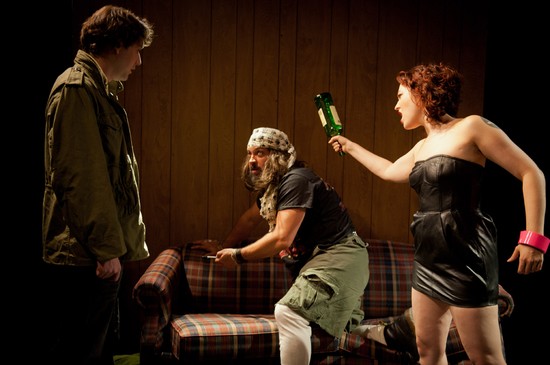
When petty thief Treat (Ben Foster) lures home businessman Harold (Alec Baldwin), he gets more than he bargained for in the energetic Broadway debut of Lyle Kessler’s 1983 play, Orphans. Treat has turned to a life of crime in order to take care of himself and his developmentally disabled younger brother, Phillip (Tom Sturridge), in their run-down house in North Philadelphia. Treat, who takes pleasure in wielding a knife, ties the passed-out Harold to a chair and tells Phillip to watch him while the older brother goes out to try to collect a ransom for his kidnap victim. Phillip, who has a thing for mayonnaise, canned tuna, and a woman’s red shoe, can’t leave the house because of allergies that could potentially kill him. But inside he’s like a playful caged animal, leaping across John Lee Beatty’s set like a feral cat, from stairs to couch to windowsill and back again. Meanwhile, when he comes to, Phillip is nonplussed at having been captured, speaking eloquently about admiring the Dead End Kids and remembering his difficult childhood as an orphan, just like Treat and Phillip. Soon he’s serving as a surrogate father figure, at first enraging Treat while intriguing Phillip, leading to a surprise shift in the power dynamic.

Orphans is a showcase for the trio of actors; the original L.A. production thirty years ago starred Joe Pantoliano, Lane Smith, and Paul Leiber, while the 1985 Steppenwolf version boasted Gary Sinise directing John Mahoney, Terry Kinney, and Kevin Anderson, and Alan J. Pakula’s 1987 film featured Albert Finney, Matthew Modine, and Anderson. For this Great White Way edition, Foster (3:10 to Yuma, The Messenger), in his Broadway debut, is solid as the ultraserious Treat, who will do whatever it takes to protect Phillip, while Baldwin has a field day as Harold, part Leo Gorcey, part Huntz Hall, part Humphrey Bogart as he coolly and calmly handles what should be a life-threatening situation, instead seeing it as an opportunity. But it’s Sturridge (Being Julia, On the Road) who steals the show with his mesmerizing, acrobatic performance as a trapped man-child ready to burst free. Director Daniel Sullivan (Prelude to a Kiss, The Substance of Fire) injects a kind of punk-rock ferocity into the Pinteresque proceedings as he weaves together Treat’s intense rage, Phillip’s sense of wonder, and Harold’s absurdist ramblings on human existence. Orphans is a captivating, if unusual and offbeat, dark comedy that thrills from start to finish.

THE BIG KNIFE

THE BIG KNIFE

Marion (Marin Ireland) and Charlie Castle (Bobby Cannavale) face some tough decisions about their future together in revival of THE BIG KNIFE (photo by Joan Marcus)

American Airlines Theatre
227 West 42nd St. between Broadway & Eighth Ave.
Through June 2, $42-$127
212-719-1300
www.roundabouttheatre.org

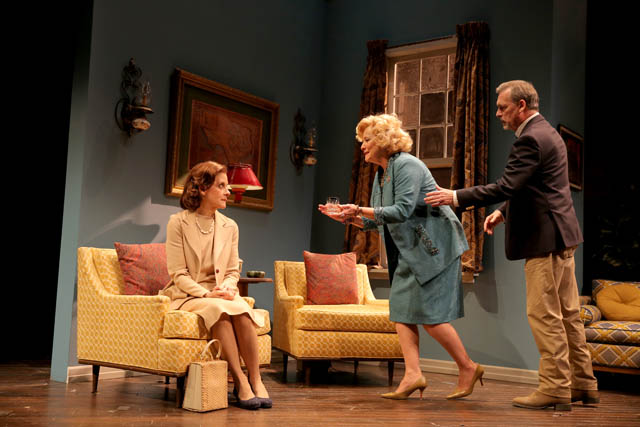
Clifford Odets skewers Hollywood and the studio system in The Big Knife, a sharply drawn tale of greed, temptation, and ambition that ultimately dulls as it reaches its melodramatic conclusion. Bobby Cannavale stars as Charlie Castle, a studio-era B-movie star whose twelve-year contract with Hoff-Federated is up and who needs to decide whether he is going to sign on for another fourteen years. The strong first act focuses on Charlie’s relationship with his wife, Marion (Marin Ireland), who threatens to leave him if he signs, wanting the company out of their life. But studio head Marcus Hoff (Richard Kind) and his right-hand man, Smiley Coy (Reg Rogers), are essentially blackmailing Charlie, ready to tell the truth about a scandal they helped cover up that could ruin him. Meanwhile, gossip columnist Patty Benedict (Brenda Wehle) wants the inside scoop on the Castles’ potential divorce, Charlie’s fast-talking agent, Nat Danziger (Chip Zien), is caught in the middle, and family friend and writer Hank Teagle (C. J. Wilson) wants Marion if she leaves Charlie. “Well, get seven of Hollywood’s intellectual hillbillies at one nightclub table and you’re in titanic trouble,” Hank tells Marion. “Men of a thousand causes and quips, not one unpopular or human. And then to be so dull — success has made them all so dull.” In the second act, the play becomes repetitive and predictable, the characters less likable, and many of the situations less believable, taking twists and turns that grow frustrating. The Roundabout Theatre production — the first Broadway revival since the play’s 1949 debut on the Great White Way, directed by Lee Strasberg and starring John Garfield as Charlie (Robert Aldrich’s 1955 Silver Lion-winning film featured Jack Palance as Charlie, Ida Lupino as Marion, Rod Steiger as Hoff, Shelley Winters as Dixie, and Everett Sloane as Nat) — is less successful than Lincoln Center’s recent revival of Odets’s Golden Boy, which also deals with such themes as career ambition and artistic integrity. Fluidly directed by Doug Hughes (An Enemy of the People, Born Yesterday,), the show features a solid cast highlighted by Kind’s marvelous portrayal of the sleazy, powerful Hoff, from how he walks around with hunched shoulders to how he confidently relaxes in an armchair on John Lee Beatty’s lovely Beverly Hills living-room set. The Big Knife might lose its edge as it approaches its grand finale, but is has plenty of cutting moments as it asks the age-old question, What price Hollywood?

THE ASSEMBLED PARTIES

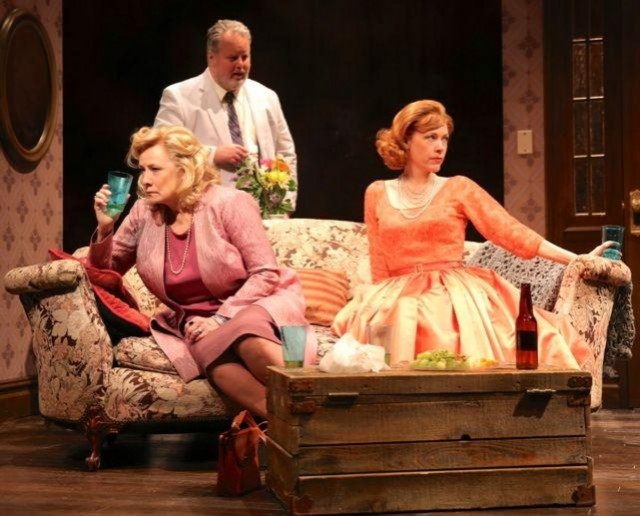
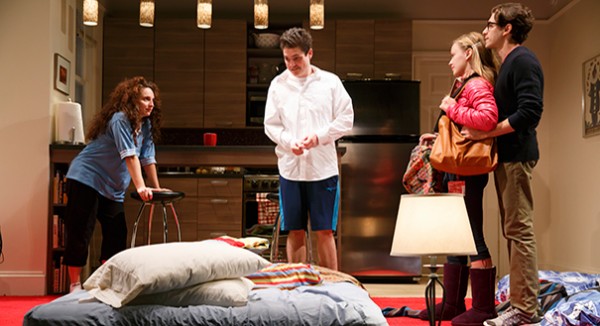
Julie (Jessica Hecht), Jeff (Jeremy Shamos), and Faye (Judith Light) share a Christmas toast in THE ASSEMBLED PARTIES (photo by Joan Marcus)

Julie (Jessica Hecht), Jeff (Jeremy Shamos), and Faye (Judith Light) share a Christmas toast in THE ASSEMBLED PARTIES (photo by Joan Marcus)

Manhattan Theatre Club at the Samuel J. Friedman Theatre
261 West 47th St. between Broadway & Eighth Aves.
Tuesday – Sunday through June 16, $67-$120
www.theassembledpartiesbroadway.com

Throughout Richard Greenberg’s splendid new play, The Assembled Parties, characters comment on how easy it is to get lost in the Bascovs’ fourteen-room Upper West Side apartment. It is also easy for the audience to get lost in Greenberg’s compelling story and well-drawn characters as the Jewish clan celebrates Christmas first in 1980, then twenty years later, with things having substantially changed. Jessica Hecht (A View from the Bridge, After the Fall) is captivating as the family matriarch, Julie, speaking in an elegant, drawn-out voice that instantly reveals her character’s unique take on the world. As the play opens, she is joined by Jeff (Jeremy Shamos), her son Scotty’s (Jake Silberman) college friend, who appears smitten with her as he helps chop vegetables in the kitchen. Soon Julie’s older sister, Faye (Judith Light), arrives, with her gruff husband, Mort (Mark Blum), and their somewhat simple daughter, Shelley (Lauren Blumenfeld). “What is all this goyisha hazarai?” Faye declares upon seeing the spread in the living room, firmly establishing her character in a mere six words. As Santo Loquasto’s superb revolving set roams from room to room (to room to room), Faye tries to set Jeff up with Shelley; Jeff throws around a basketball with Scotty while discussing Scotty’s gorgeous, unseen girlfriend; Faye demands a pill from Julie to help her get through the evening; Jeff can’t break free of the telephone-umbilical cord, obsessed with calling his mother; and Mort has quite a surprise for Julie’s husband, Ben (Jonathan Walker). “God is bogus,” Julie says over dinner, “and religion a scourge. Still, I believe in something, though I’m not sure what.”

Twenty years later, things are vastly different, the only constant being Jeff’s unending dedication to Julie. Although so much of the story is built around Julie and her Jewish family, the centerpiece of the story is really Jeff, who serves as the onstage proxy for the audience. He interacts with all the characters but often does so from an observational distance, so glad to be among such unique and intriguing people. The audience is likely to feel the same way, glad to be among such unique and intriguing characters in Greenberg’s highly entertaining and extremely clever play.

JACK FERVER: ALL OF A SUDDEN

(photo by Al Hall)

Jack Ferver delves into Tennessee Williamsʼs SUDDENLY LAST SUMMER in new multidisciplinary piece (photo by Al Hall)

Abrons Arts Center Playhouse
466 Grand St. at Pitt St.
May 2-4, $20, 8:00
212-598-0400
www.abronsartscenter.org
www.jackferver.org

In our May 2012 interview with the great Jack Ferver, he tantalizingly described what he was working on next, a piece entitled All of a Sudden. “It is loosely inspired by Tennessee Williamsʼs Suddenly, Last Summer and explores the similarities between the artist/dramaturg and the patient/therapist relationship,” he said. “ Of course, it was a play before the film, but having played Cleopatra this past year [in Me, Michelle], I feel I am being haunted by Liz in some way.” Ferver has previously brought his unique interpretation, melding dance, theater, confessional, psychoanalysis, and multimedia elements, to such disparate films as Notes on a Scandal, Poltergeist, Black Swan, and Return to Oz. This time he has set his sights on the steamy story about an institutionalized woman and her sordid southern family, which debuted on Broadway in 1958 and was made into a film the next year by Joseph L. Mankiewicz with an all-star cast that included Elizabeth Taylor, Montgomery Clift, Katharine Hepburn, Albert Dekker, and Mercedes McCambridge. Ferver collaborated with Joshua Lubin-Levy on the new show, which will be performed by the two men along with Jacob Slominski; music and sound design is by regular Ferver composer Roarke Menzies, with set design by Marc Swanson (Ferver’s Two Alike) and costumes by Reid Bartelme (Mon Ma Mes). Ferver has an endlessly inventive imagination that is thrilling to watch onstage; he’s never afraid to take chances as he opens up his heart and soul — and injects ample amounts of his wicked sense of humor — in fabulously entertaining and deeply personal ways. All of a Sudden runs May 2-4 at Abrons Arts Center, and you’d be doing yourself a great disservice if you missed it.

Update: Jack Ferver blurs the lines between audience and performer, creation and execution, and straight and gay in All of a Sudden, his latest multimedia work to use film as a way to tell a more personal story. This time Ferver focuses in on Tennessee Williams’s 1959 melodrama Suddenly, Last Summer, in which Catherine, a southern woman played by Elizabeth Taylor, is in a mental institution, being treated by a doctor (Montgomery Clift) who is trying to get her to remember a tragic event before her aunt (Katharine Hepburn) forces her to get a lobotomy. The show opens with Ferver, as Catherine, overemoting and Jacob Slominski, as the doctor, underemoting, as Joshua Lubin-Levy sits in a chair across the stage, carefully watching and taking notes. It soon becomes apparent that the three men are in the midst of creating the piece, which is far from done, discussing various elements and possible changes. At one point Slominski goes off to call his wife while Ferver and Lubin-Levy look at clips from Joseph L. Mankiewicz’s film on an old television set that mimics a theatrical dressing-room mirror, and later Ferver and Slominski break off into duets that include lots of kissing. They also at times directly address the audience, acknowledging that they are being viewed while still, in essence, rehearsing. It’s all great fun, but with more than a touch of seriousness to go with the humor. The set, designed by Marc Swanson, features a group of ropes dangling from above in one corner, evoking death and suicide, while Reid Bartelme’s costumes for Ferver are spectacularly beautiful, from ridiculously tight and tiny green body-hugging shorts to an elegant, sparkling red sequined dress. As always, Ferver adds an occasional level of discomfort to the fanciful proceedings, keeping the audience on edge, never knowing quite what is going to happen next as fantasy morphs into reality and back again, art and life becoming one and the same.

A MARRIAGE: 1 (SUBURBIA)

Nick Vaughan and Jake Margolin use sugar to add to a white picket fence as part of performance installation examining same-sex marriage and the America dream (photo by twi-ny/mdr)

Nick Vaughan and Jake Margolin use sugar to add to a white picket fence as part of performance installation examining same-sex marriage and the America dream (photo by twi-ny/mdr)

HERE
145 Sixth Ave. at Dominick St.
Through May 4 (Tuesday – Sunday, 8:30), $10 in advance, $20 within twenty-four hours
Installation free Tuesday – Sunday 2:00 – 10:00
212-647-0202
www.here.org
a marriage: 1 (suburbia) / sugar cube picket slideshow

American dream or suburban nightmare? Nick Vaughan and Jake Margolin, who got married in 2008, take a sharp but playful look at the institution, examining domestic bliss from the 1950s to the present in their immersive multimedia performance piece A Marriage: 1 (Suburbia). Vaughan and Margolin have transformed nearly every room at HERE into a marital landscape that includes twists on such suburban mainstays as the garden hose, the ironing board, a pair of comfy armchairs surrounding an old radio, shirts hanging on a clothesline, the Game of Life, and a white picket fence. Now that same-sex marriage is legal in so many states, is this really what gays want? “The suburban ideal, the traditional nuclear family, emerald lawns and Betty Crocker . . . is now part of our heritage as well, and for better or worse we have to deal with it,” they write at the entrance to the exhibit. “This is our attempt to unpack those structures as we continue to construct our own.” In “First Seasons,” they’ve compiled thematically linked clips of scenes from four classic family sitcoms — The Cosby Show, Roseanne, The Dick Van Dyke Show, and Leave It to Beaver — laying the groundwork for what is considered the ideal in American society. Meanwhile, in a two-channel video, Deb Margolin, Joe Stackell, Lisa Kron, Yoshiko Chuma, and Penny Arcade share their opinions on same-sex marriage, and Vaughan and Margolin read the full transcript of the Perry v. Schwarzenegger Prop 8 case into plastic bags that form a floating balloon sculpture. Each night at 8:30, Vaughan and Margolin put on a sixty-minute performance, from typing pithy sayings on wallpaper (“There is something so deep and so comfortable in this version of living”) to making a Welcome mat out of bubblegum. On April 30, they added a picket to a white fence using sugar cubes and vanilla icing, then painting one side with red food coloring, questioning the supposed sweetness of suburbia. Purchasing a ticket allows you into the performance and to return for any of the others, which continue through May 4; admission to the exhibition itself is free. Be sure to get there well before 8:30 in order to take it all in; there’s a lot to see — even in the unisex bathrooms — running the gamut from the sublime to the ridiculous, in thought-provoking and very funny ways. (To read our interview with Nick and Jake, go here.)