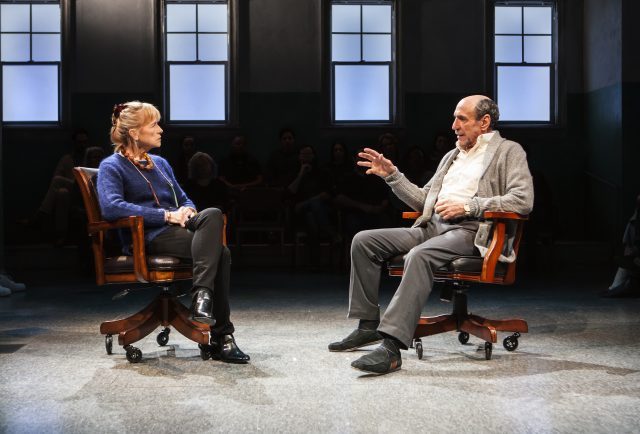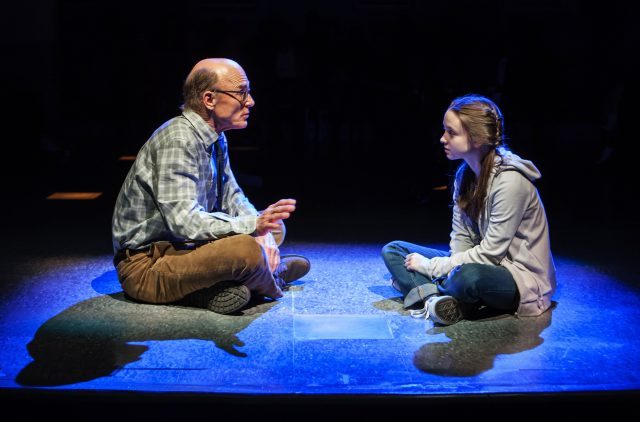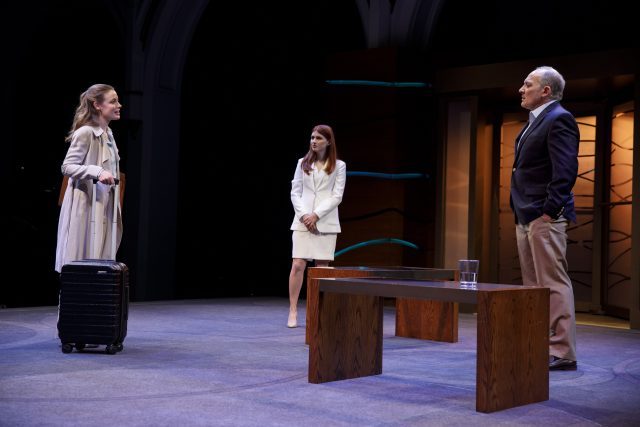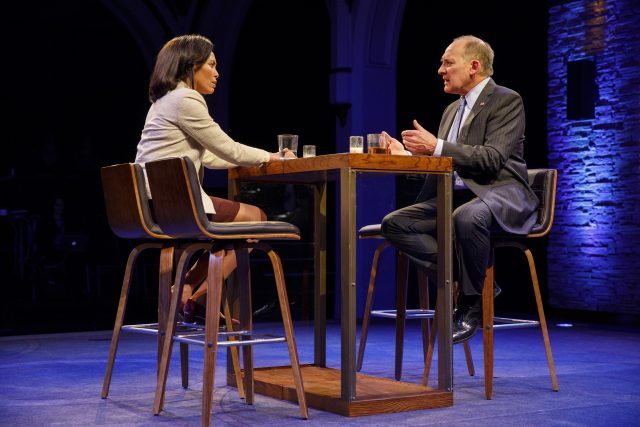
this week in theater

TIME AND THE CONWAYS

(photo by Jeremy Daniel)

Carol (Anna Baryshnikov) entertains her family in revival of J. B. Priestley’s Time and the Conways (photo by Jeremy Daniel)

American Airlines Theatre
227 West 42nd St. between Broadway & Eighth Ave.
Run ended November 26
212-719-1300
www.roundabouttheatre.org

“A novel or a play cannot really be about Time. (And I ask the reader to remember that I am a man who is widely credited with having written ‘Time plays,” although I never made any such claim myself),” British playwright J. B. Priestley wrote. “Time is a concept, a certain condition of experience, a mode of perception, and so forth; and a novel or a play, to be worth calling one, cannot really be about Time but only about people and things that appear to be in Time.” Among Priestley’s Time plays are An Inspector Calls, I Have Been Here Before, and Time and the Conways, which was just revived by the Roundabout at the American Airlines Theatre on Broadway. As the title implies, Time is like a character unto itself in the show, which begins in 1919, shortly after the end of WWI. The Conways, led by their widowed matriarch (Elizabeth McGovern), are celebrating the twenty-first birthday of Kay Conway (Charlotte Parry), an aspiring novelist. The family is immersed in a game of Charades, which is going on in another, unseen room. Among those participating are Kay’s sisters, Hazel (Anna Camp), Madge (Brooke Bloom), and Carol (Anna Baryshnikov); their brothers, dullard Alan (Gabriel Ebert) and the swashbuckling Robin (Matthew James Thomas); and family friend Joan Helford (Cara Ricketts). They are soon joined by their solicitor, Gerald Thornton (Alfredo Narciso), and his odd pal, a businessman named Ernest Beevers (Steven Boyer), who has a creepy liking for Hazel. (“Ugh. I’d just as soon marry a — a ferret,” Hazel tells Joan.) The word they are trying to convey to their guests is “pussyfoot,” which, appropriately enough, means to evade commitment, emblematic of how the Conways avoid facing reality. “Just when everything is very jolly and exciting, I suddenly think of something awfully serious, sometimes horrible — like Dad drowning — or that little mad boy I once saw with the huge head — or that old man who walks in the Park with that great lump growing out of his face,” Carol says, to which Hazel responds, covering her ears, “I’m not listening. I’m not listening.” Mrs. Conway essentially covers her ears when Beevers advises that she accept a generous offer for her house, but the family will have none of it.

(photo by Jeremy Daniel)

A family refuses to face harsh realities in Roundabout Broadway revival (photo by Jeremy Daniel)

When Mrs. Conway says, “I’m not used to happiness,” she’s not kidding, but she’s also not about to do much to change things and face reality. The play then shifts to 1937, as the Conways all have to deal with the decisions they’ve made, most of which have not been for the better. The stern Madge, explaining that she has come to the house just because she was in the neighborhood, tells Kay, “I’ve no further interest in these family muddles, financial or otherwise.” When Gerald is about to deliver some bad news, Kay complains, “When you turn on that legal manner, I can’t take you seriously — I feel you’re still acting in one of our old charades.” But it’s the Conways who can’t come to terms with what his happening. The third act returns to 1919, picking up just where act one left off, cleverly filling in some holes to explain how things got to where they were eighteen years later. Time and the Conways, which is rarely revived and has been made into a film twice, a 1984 Russian drama and a BBC version starring Claire Bloom, is reminiscent of the Roundabout’s 2013 expert production of Terence Rattigan’s The Winslow Boy, which also ran at the American Airlines Theatre and dealt with a family facing a dilemma. Priestley’s play also evokes elements of Anton Chekhov’s The Cherry Orchard and Jane Austen’s Pride and Prejudice as the Conways face an uncertain future they’d rather not think about. The ten-person cast is superb, with precise, confident direction by rising star Rebecca Taichman (Indecent, Familiar) on Neil Patel’s engaging drawing-room set. Frank Ventura is credited with etiquette and period movement, which is appropriately proper. “Some novelists and dramatists may be unusually aware of Time, but they have to write about something else,” Priestley explained. In Time and the Conways, he has done just that in telling the fateful story of a dysfunctional family that refuses to look in the mirror.

ANNA ZIEGLER: LOVE, ACTUALLY

(photo © Matthew Murphy)

Tom (Joshua Boone) and Amber (Alexandra Socha) cannot quite agree what happened one night in Actually (photo © Matthew Murphy)

ACTUALLY
Manhattan Theatre Club
New York City Center: The Studio at Stage II
Tuesday – Sunday through December 10, $30
212-581-1212
manhattantheatreclub.com
actuallyplay.com

Watching a talky play with relatively few characters, say, only two or four, can be like watching a tennis match. When the writing and directing is exceptional, it’s like seeing a championship bout between Nadal and Federer, Borg and McEnroe, Evert and Navratilova, your head going back and forth as the shifting dialogue consists of aces, expert passing shots, exciting net play, and thrilling overhead smashes. Of course, just as every play is not going to qualify for award status, not every tennis match is going to be memorable, something I can vouch for, having attended the U.S. Open for more than twenty years. Brooklyn-born playwright Anna Ziegler serves up both ends of the spectrum with two current off-Broadway shows, Actually and The Last Match, both of which involve the characters breaking the fourth wall and speaking directly to the audience, with very different results. The Manhattan Theatre Club production of Actually, continuing at City Center’s Stage II through December 10, is a timely, intense look at what actually happened the night two Princeton freshmen, Tom (Joshua Boone) and Amber (Alexandra Socha), hooked up at a party. While Tom believed their coupling was completely consensual, Amber thinks it turned into rape and reported it to the university.

Alexandra Socha and Joshua Boone star in gripping play by Anna Zielger

Alexandra Socha and Joshua Boone star in gripping play by Anna Ziegler (photo © Matthew Murphy)

Tom is a black classical pianist who says, “In some ways, I’ve been on trial my entire life.” Amber is white and Jewish, a mediocre squash player who explains, “We all fill some stupid niche, which reduces us to something much less than what we are, but that’s the way it goes.” The play begins with them playing the game Two Truths and a Lie; Tom is reluctant, but Amber demands he participate if he wants to sleep with her. For ninety taut minutes, they reenact events from that night and share their thoughts with the audience, discussing consent, race, religion, Title IX, gender, and other key topics, turning viewers into a kind of jury of public opinion. When Amber says that her default state is “this zone of wanting something and not wanting it at the same time,” it really hits home, getting to the core of how so many people feel. Boone (Holler If You Hear Me, Mother Courage and Her Children) and Socha (Spring Awakening, Fun Home) are outstanding caught up in a long deuce, each one taking, then losing, the advantage as they volley back and forth. Ziegler’s (Photograph 51, Boy) dialogue is sharp and focused, while Obie winner Lileana Blain-Cruz (Pipeline, The Death of the Last Black Man in the Whole Entire World) directs with pinpoint accuracy on Adam Rigg’s spare set. Actually is no mere Bobby Riggs vs. Billie Jean King, he said / she said contest; it is a powerful exploration of possible sexual misconduct in an age when Americans learn more and more about the issue every day, as more and more predators are revealed.

(photo by Joan Marcus)

The Last Match takes place during the semifinals of the U.S. Open (photo by Joan Marcus)

THE LAST MATCH
Laura Pels Theatre
Harold and Miriam Steinberg Center for Theatre
111 West 46th St. between Sixth & Seventh Aves.
Tuesday – Sunday through December 23, $79
212-719-1300
www.roundabouttheatre.org

Unfortunately, the Roundabout production of The Last Match, running at the Laura Pels Theatre through December 23, is not nearly as incisive and gripping as Actually. It’s the semifinals at the U.S. Open, and six-time champion Tim Porter (Wilson Bethel), who might be on the downside of his career at the tender age of thirty-four, is playing younger up-and-comer Sergei Sergeyev (Alex Mickiewicz), a hotheaded Russian who wants to dethrone the even-tempered American star and crowd favorite. They serve and volley on Tim Mackabee’s tennis court set, with the familiar blue, white, and green colors of the Open and scoreboards on either side, while Bray Poor’s audio design includes the sound of imaginary swinging rackets striking imaginary yellow balls. In between and during points, Tim and Sergei argue with each other in ways that don’t feel real during a live match; share their thoughts directly with the audience; and reenact scenes from their past, primarily Tim’s relationship with fellow tennis player Mallory (Zoë Winters) as they marry and try to have a baby, and Sergei’s courtship of the fiery Galina (Natalia Payne). The women cheer their partners on from the sides of the stage as the men fight it out. But whereas Amber and Tom in Actually were complex characters who had their charms along with their shortcomings, both gaining the audience’s sympathy at different times, only Mallory is able to elicit much catharsis in The Last Match.

(photo by Joan Marcus)

Tim Porter (Wilson Bethel) and Sergei Sergeyev (Alex Mickiewicz) battle it out on court and off in Anna Ziegler play (photo by Joan Marcus)

“You don’t want people to know you’re an asshole. But anyone who does this sport at this level is gigantic asshole of worst gigantic asshole variety,” Sergei says early on, adding, “You have to care only for yourself.” It’s hard to care about Sergei, Galina, and Tim, who are self-obsessed; Ziegler (A Delicate Ship, The Wanderers) and director Gaye Taylor Upchurch (Animal, The Year of Magical Thinking) give them back stories that don’t help humanize them but turn each one into more of a caricature. While Actually made smart, subtle references to societal issues and did not proclaim any grand statements about who was right, The Last Match is melodramatic and obvious, like a love match in tennis. “So many game points, on my racquet,” Sergei says. “This should be my game so many times over. I have earned it! But life does not actually work that way. You actually have to win.” But you’re likely to decide who you want to win from the very start, rendering the competition relatively mute. “Some people don’t even love their babies right away so it’s just relentless and boring. And we already have tennis for that, right?” Mallory asks Tim, who replies. “Well, I don’t find tennis boring.” But any tennis match, like any sporting event, can be relentless and boring. Just like any play.

NOH-NOW: HANJO

SITI Company presents a new adaptation of Yukio Mishimas Hanjo at Japan Society

SITI Company presents a new adaptation of Yukio Mishima’s Hanjo at Japan Society

Japan Society
333 East 47th St. at First Ave.
December 7-9, $35, 7:30
212-715-1258
www.japansociety.org
siti.org

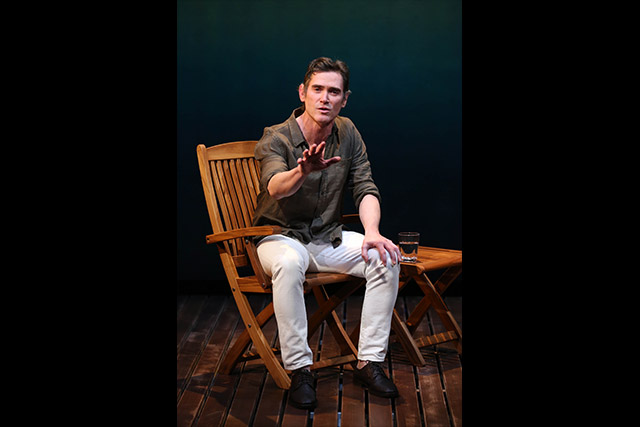
Japan Society’s four-part “NOH-NOW” series, which began with Luca Veggetti’s Left-Right-Left and Hiroshi Sugimoto’s Rikyu-Enoura, continues with SITI Company’s adaptation of Yukio Mishima’s Hanjo, running December 7-9. (SITI presented a staged reading of Hanjo at Japan Society in May 2007.) Freely adapted by Japanese author, poet, and filmmaker Mishima (The Sailor Who Fell from Grace with the Sea, Madame de Sade) from Seami Motokiyo’s fourteenth-century noh play about love and betrayal, the work features three characters, the mad girl Hanako, the spinster Jitsuko, and a young man, Yoshio, performed in rotation through three iterations by Akiko Aizawa (who just appeared in Ripe Time’s adaptation of Haruki Murakami’s Sleep at BAM), Gian-Murray Gianino, and Stephen Duff Webber. Leon Ingulsrud directs the bilingual production from his translation, with live music composed and played by violist Christian Frederickson, sets and lighting by Brian H Scott, costumes by Mariko Ohigashi, and choreography by Wendell Beavers. Founded by Anne Bogart and Tadashi Suzuki in 1992, the company has previously staged such inventive works as Chess Match No. 5, bobrauschenbergamerica, Steel Hammer, and Bob and, in its early years, were regulars at the Toga Festival in Japan. The December 7 show at Japan Society will be followed by a reception with members of the company, while the December 8 performance will be followed by a Q&A with the artists. “NOH-NOW” concludes January 11-14 with Satoshi Miyagi’s Mugen Noh Othello as part of the Public Theater’s Under the Radar Festival.

A ROOM IN INDIA

A Room in India

Ariane Mnouchkine and Théâtre du Soleil return to Park Ave. Armory with the epic A Room in India

UNE CHAMBRE EN INDE
Park Ave. Armory, Wade Thompson Drill Hall
643 Park Ave. at 67th St.
December 5-20, $45-$150
212-933-5812
www.armoryonpark.org
www.theatre-du-soleil.fr

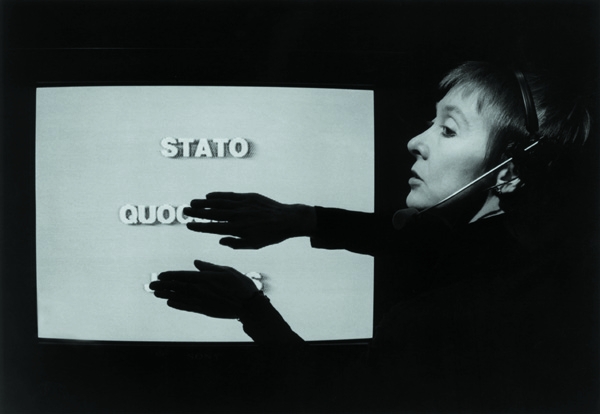
In 2009, Ariane Mnouchkine and Théâtre du Soleil staged the epic Les Éphémères at Park Ave. Armory as part of the Lincoln Center Festival, asking the question “What would you do if the end of the world were imminent?” Mnouchkine and her avant-garde collective now return to the armory with the North American premiere of their latest epic, A Room in India, exploring the question “What is the role of theater and art in a world dominated by terrorism and hostility?” Directed by Mnouchkine with music by Jean-Jacques Lemêtre and Hélène Cixous and featuring a cast of thirty-five actors from around the world, the spectacle, performed in French, English, Tamil, Arabic, Japanese, and Russian (with English supertitles), explores Eastern and Western traditions as a French theater company is stranded in India and chaos descends in the form of contemporary sociopolitical issues. The production is three hours and fifty-five minutes with one intermission; to get in the mood, the armory is offering a preshow Indian meal ($30; must be ordered at least two days in advance), by chef Gaurav Anand of Moti Mahal Delux, that includes Paneer Tikka Masala, Dal Tadka, and Aloo Dum, rice, bread, naan, Indian pastries, and beer, wine, and water. On December 8 at 6:00, Mnouchkine will participate in an artist talk with Tony Kushner and New Yorker editor David Remnick. In a letter about the show, Théâtre du Soleil stirs up curiosity with a playful conversation:

“So, you’re going to put on another play about India?”

“It won’t be about India but rather will take place in India. In a room in India. That’s even the title of the play.”

“Come again? What do you mean? What happens in an India that’s not India?”

“Visions, dreams, nightmares, apparitions, moments of panic, doubts, revelations. Anything and everything that might haunt the actors and technicians of a poor theater troupe desperately in search of resolutely contemporary, political theater, a troupe stranded there by deeply moving events beyond its control, just as they are beyond our control and move us, leaving us looking for a way to face them, a way to suffer through them without resigning ourselves to adding evil to Evil through our words and our deeds.”

“And so what?”

“For now, that’s it, which is already quite a lot.”

TWI-NY TALK: POLLY DRAPER / 20th CENTURY BLUES

(photo © Joan Marcus)

Sil (Ellen Parker), Mac (Franchelle Stewart Dorn), Danny (Polly Draper), and Gabby (Kathryn Grody) celebrate forty years of friendship in 20th Century Blues (photo © Joan Marcus)

The Pershing Square Signature Center
The Alice Griffin Jewel Box Theatre
480 West 42nd St. between Tenth & Eleventh Aves.
Tuesday – Sunday through January 28, $79-$99
212-244-7529
20thcenturyblues.com
www.signaturetheatre.org

I spent much of the summer of 2014 serving on a jury for a murder trial, a case involving a drug-related shooting in Harlem. One of my fellow jurors was writer, director, and Emmy-nominated actress Polly Draper. Best known for her portrayal of Ellyn Warren on the groundbreaking drama thirtysomething, the Yale grad (both BAA and MFA) has also starred on and off Broadway (Closer, Brooklyn Boy); wrote and starred in The Tic Code, inspired by her husband, jazz musician Michael Wolff, who has Tourette’s syndrome; and wrote and directed The Naked Brothers Band television series and movie, starring their sons, Nat Wolff (The Fault in Our Stars, Buried Child) and Alex Wolff (In Treatment, All the Fine Boys). Draper, who has also won a Writers Guild Award, has been experiencing a career renaissance of late, portraying recurring characters on The Big C with Laura Linney, The Good Wife with Julianna Margulies, and Rhinebrook, as well as playing a key supporting role in the Kickstarter-funded indie hit Obvious Child.

She is now appearing off Broadway through January 28 at the Signature in 20th Century Blues, a bittersweet drama written by Susan Miller (My Left Breast, A Map of Doubt and Rescue) and directed by Emily Mann (Baby Doll, The How and the Why) about four sixtysomething women who have been getting together once a year ever since they met when they were all arrested at a political protest forty years earlier. Draper plays Danny, a divorced photographer and mother who has taken their picture every year. When Danny tells journalist Mac (Franchelle Stewart Dorn), veterinarian Gabby (Kathryn Grody), and real estate agent Sil (Ellen Parker) that she is having a solo show at MoMA and wants to include the forty years of photos, displaying them publicly for the first time, questions arise as the women look back at their past and consider their future. Danny is also contemplating taking care of her aging mother, Bess (Beth Dixon), in her apartment, which her friends do not think is the best idea. “She’s my mother,” Danny explains. “And, I don’t know how long I’ll get to be a daughter.” (That line rang extra true for me, as a half hour after I saw the play last week, my mother passed away in my sister’s Upper East Side apartment.)

A relaxed, easygoing woman with a broad sense of humor and a natural talent for leadership, Draper, like Danny, is passionate about everything she does. “When it comes to my art, I have very strong feelings,” she said when we met to talk shortly after the bizarre trial ended with a hung jury. And also like Danny, she is passionate about justice and freedom, as evidenced by her reactions to the trial in addition to her activism for numerous liberal causes. What follows are edited excerpts from our 2014 interview and a brand-new email exchange about 20th Century Blues, the legal system, working with family, and more.

(photo © Joan Marcus)

Danny (Polly Draper) cares for her aging mother (Beth Dixon) in new play by Susan Miller (photo © Joan Marcus)

twi-ny: I can’t believe it’s been three and a half years since we sat on that long, bizarre murder trial. What are your thoughts looking back at that summer in court? At the time you called it a musical comedy.

Polly Draper: I think about that experience so much!!! And did you hear that those guys got convicted finally? I guess the second jury didn’t have our crazy guy on it. But I doubt they had as much fun as we did! What a mind-blowing experience!!!

twi-ny: I know! What was your single favorite moment of the trial?

Polly Draper: Meeting you guys. Meeting all the fun people and going out to the Chinese restaurants. I had a lot of fun. The only thing that wasn’t fun was the deliberations because of the crazy person. But even the deliberations had their fun things, like every time he’d fall asleep or when he wasn’t there. All the characters . . . It was fascinating for me in every way.

twi-ny: If you knew then what you know now, would you put yourself through it again?

Polly Draper: Definitely! Absolutely! I know some of the people wouldn’t say that at all, but I would so do it. It’s one of the most fascinating things that happened in a long time to me.

twi-ny: You’re currently starring in Susan Miller’s 20th Century Blues at the Signature. What initially drew you to the play itself and your part specifically?

PD: First of all, I was drawn to the play because it dealt with friendships between women and also with issues common to women my age. Plays written on this subject matter are few and far between.

Secondly, I really related to the character I was playing and her struggle to realize her artistic vision, which in her case involved putting together a photography exhibit at MoMA. Having struggled with many of my own artistic endeavors, I could identify with the obstacles she faced.

I also intimately understand this character’s relationship with her mother, who is in the throes of dementia, because my own mother is suffering from Parkinson’s disease–related dementia.

twi-ny: I’m sorry to hear that. The play follows four women who have documented their friendship through forty years of photos. What’s your longest current friendship?

PD: I’ve known my oldest friend, Wende Lufkin, since we were eight years old and share all my childhood and teenage memories with her. We live on opposite sides of the country and rarely see each other but are inextricably bonded by our shared past.

The two old friends I see constantly and have been entwined in my life for the past forty years are writer Jenny Allen, who I met in college, and actress Brooke Adams, who I met doing a play when I first came to NYC. (The two of them were at opening night for this play, in fact, rendering it even more meaningful to me.)

twi-ny: Speaking of long friendships, it’s now been forty years since thirtysomething debuted. In June 2007, you reunited with the cast for a “Look Who’s Fifty” story, and this past September EW did a “Where Are They Now?” feature. It really was quite a group of creative people; all these years later, everyone is still very busy, with many of the actors becoming directors, including yourself. Why do you think that might be?

PD: When we were on thirtysomething, all the actors were encouraged to direct. Regrettably, I wasn’t interested in doing so at the time, but I think the fact that so many of my cast members did it demystified the process for me. We were also encouraged to volunteer ideas for scripts, which got me interested in the whole process of script writing. Some of my castmates, like Melanie Mayron and Peter Horton, had already been directors and writers before they got on the show.

Everyone in the cast was smart and ambitious. So . . . I’m guessing that accounts for all the many directing / writing / acting projects among us.

(photo by Carol Rosegg)

Emmy nominee and Writers Guild Award winner Polly Draper has a passion for art, social justice, and family (photo by Carol Rosegg)

twi-ny: You’ve directed your family in The Naked Brothers Band series and movie, wrote and starred in The Tic Code, which was inspired by your husband’s Tourette’s syndrome, directed one of your sons in a play written by your other son, and next up is Stella’s Last Weekend, which you wrote, directed, and star in with your sons. Why do you think working with your family has gone so well? Do things ever get especially difficult either on the set or back at home?

PD: My family is the most important thing to me, so it is not surprising that all of the work I have created involves them. And it doesn’t hurt that they happen to be extraordinarily gifted actors and musicians.

I was actually surprised by the lack of stress we had on the set of Stella’s Last Weekend. The last time I worked professionally with Nat and Alex was on The Naked Brothers Band when they were wild and crazy little boys, so it was a treat for me to work with them as wild and crazy adults.

Because we worked together before and because we all know each other so well, we not only trusted each other, we have a shorthand communicating with each other. This resulted in all of it feeling surprisingly effortless from beginning to end. Nat and Alex both had great ideas for their characters and great improvisations they did in the scenes. They also kept everyone on the set in constant hysterical laughter with their brother antics.

I think the movie reflects the joy we all had making it. I am really proud of it and I can’t wait until it comes out so people can see it. The screenings we have had of it so far have been phenomenally successful.

And Michael, who also did the score for The Tic Code and The Naked Brothers Band, did a killer score for this one too.

twi-ny: Would you say that the camaraderie that you helped foster in the jurors room during the trial compares to that on a film set?

PD: That’s what my husband said. He said, “This is just typical of you. You always wind up hanging out with the people you’re doing a project with, and this is your new project.”

twi-ny: You move smoothly between film, television, and theater, from Obvious Child, The Good Wife, and Golden Boy to Closer, Rhinebrook, and now 20th Century Blues. Do you have a particular preference as an actor for one medium over another?

PD: I think I just like doing work I’m proud of. I like working on interesting projects no matter what medium they’re in.

There are advantages to the control you have and the instant audience feedback of acting onstage, but there is something magical about the intimacy of acting on film as well.

I love to write scripts because I can play every role in my head.

I love to direct because it is thrilling to create the real-life version of what used to be just my fantasy.

It is also beyond exciting to watch what each actor brings to my words.

I also love the process of editing because it is so much fun to give shape to the movie and fix mistakes and choose music and find meanings in all of it that I never saw before.

So basically, I love every part of the process of acting, writing, and directing except the actual business part. That part I hate and fear. Unfortunately, it is one of the most important parts!

twi-ny: Getting back to the play, what gave you the blues in the twentieth century? And what about now, in the twenty-first century?

PD: Oy vey. I guess the simple answer would be to say that the blues I had in the twentieth century were more personal and involved growing up, and the blues I have in the twenty-first century are more global and involve fear for all of mankind.

When you and I served on that jury almost four years ago and Obama was still president, I don’t think either of us could have guessed the seismic shifts that have happened this year. The list of things that give me the blues now have to do mostly with our president and the flame he fans of lies and hatred and backward thinking, but he seems to be just a by-product of a frightening trend worldwide.

My blues in this century are every thinking person’s blues: They concern the environment, the spread of misinformation, North Korea, Putin, guns, nuclear holocausts, sexual predators, prescription drugs, women’s rights, civil rights, immigrants’ rights, terrorists, the Koch brothers and where they put their dark money, Steve Bannon and his scary white supremacy fans, cyberwarfare, Republican congressmen, our judicial system, and any old men with weird orange hair.

BAM NEXT WAVE FESTIVAL: HARUKI MURAKAMI’S SLEEP

Ripe Time reimagines Haruki Murakamis Sleep in inventive theatrical adaptation (photo ©Julieta Cervantes)

Ripe Time reimagines Haruki Murakami’s Sleep in inventive theatrical adaptation at BAM (photo ©Julieta Cervantes)

BAM Fisher, Fishman Space
321 Ashland Pl.
November 29 – December 2, $25
718-636-4100
www.bam.org
ripetime.org

In February 2016, Japan Society presented Ripe Time’s work-in-progress adaptation of Japanese author Haruki Murakami’s 1993 short story Sleep as part of the “Women on the Rise” series. The final version is now making its New York City premiere November 29 through December 2 at the BAM Fisher as part of BAM’s Next Wave Festival. The seventy-five-minute experimental, fantastical production is based on Murakami’s (The Wind-Up Bird Chronicle, Kafka on the Shore) tale of a Japanese housewife who is “both a body on the verge of sleep and a mind determined to stay awake”; the story begins, “This is my seventeenth straight day without sleep. I’m not talking about insomnia.” The multimedia, multidisciplinary show is adapted by Naomi Iizuka (36 Views, Tattoo Girl) and directed and devised by Rachel Dickstein (The World Is Round, Septimus and Clarissa) and Ripe Time, with set design by Susan Zeeman Rogers, projections by Hannah Wasileski, lighting by Jiyoun Chang, sound by Matt Stine, costumes by Ilona Somogyi, and music by NewBorn Trio. The cast features Akiko Aizawa, Brad Culver, Takemi Kitamura, Paula McGonagle, Jiehae Park, and Saori Tsukada. In a program note, Dickstein explains, “In an era where difference is under siege, we hope Sleep’s vision of an ordinary woman tearing down the prison walls of her life as a wife and mother offers a necessary rally cry for us all.”

BAM NEXT WAVE FESTIVAL: THE FOUNTAINHEAD

Ivo van Hoves adaptation of Ayn Rands The Fountainhead runs at BAM November 28 to December 2

Ivo van Hove’s adaptation of Ayn Rand’s The Fountainhead runs at BAM for only five performances

BAM Howard Gilman Opera House, Peter Jay Sharp Building
230 Lafayette Ave.
November 28 – December 2, $35-$140
718-636-4100
www.bam.org
tga.nl/en

Since he joined Toneelgroep Amsterdam in 2001, Belgian director Ivo Van Hove has presented wildly unusual and unique versions of such films and plays as Ingmar Bergman’s Scenes from a Marriage and After the Rehearsal / Persona, Arthur Miller’s A View from the Bridge and The Crucible, Shakespeare’s Othello and The Taming of the Shrew, John Cassavetes’s Husbands, Henrik Ibsen’s Hedda Gabler, Eugene O’Neill’s Mourning Becomes Electra, Jean Cocteau’s La Vox Humaine, and Luchino Visconti’s Rocco and His Brothers and Obsession. Among his productions to appear at BAM are the Shakespeare compilations Roman Tragedies and Kings of War, Bergman’s Cries and Whispers, Cassavetes’s Opening Night, Tony Kushner’s Angels in America, and Sophocles’s Antigone. It’s a vast, diverse, and staggering output, one that continues this week with the BAM Next Wave Festival New York premiere of his 2014 adaptation of Ayn Rand’s 1943 novel, The Fountainhead, the beloved tome of such Republicans as Paul Ryan. Taking place in an open-office plan, the show features set and lighting by Jan Versweyveld, music by Eric Sleichim, video design by Tal Yarden, and costumes by An D’Huys. Ramsey Nasr plays Howard Roark, with Halina Reijn as Dominique Francon, Hans Kesting as Gail Wynand, Aus Greidanus jr. as Peter Keating, and Bart Slegers as Ellsworth Toohey. The book was turned into a 1949 film directed by King Vidor starring Gary Cooper and Patricia Neal that lasted less than two hours; Toneelgroep Amsterdam’s version, adapted by Koen Tachelet, translated by Erica van Rijsewijk and Jan van Rheenen, and directed by van Hove, lasts four hours. It begins, “Howard Roark laughed.” There’s no telling what will come after that in the hands of van Hove, but strap yourself in for what should be at the very least a rather unconventional evening.