this week in theater

NEW YIDDISH REP: AWAKE AND SING!

(photo by Pedro HernandezP

The Bergers sit down for some food and tsouris in New Yiddish Rep adaptation of Clifford Odets’s Awake and Sing! at the 14th Street Y (photo by Pedro Hernandez)

VAKH OYF UN ZING
Theater at the 14th Street Y
344 East 14th St. at First Ave.
Tuesday – Saturday through December 24, $45
646-395-4310
www.newyiddishrep.org
www.14streety.org

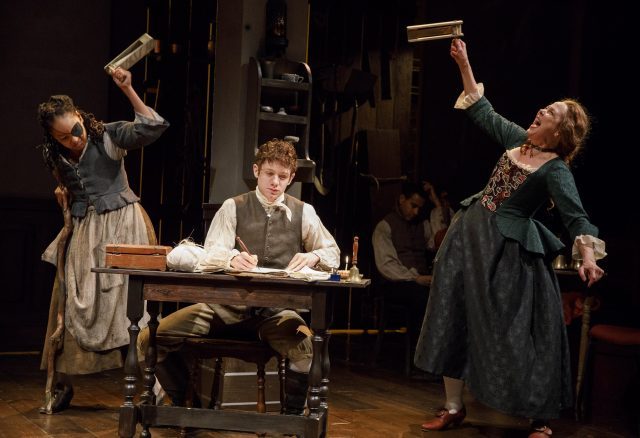
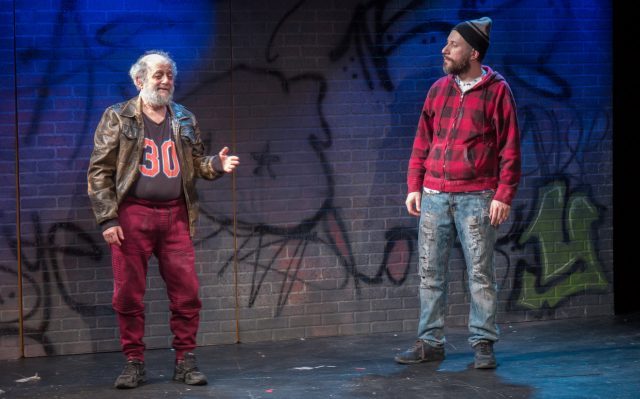
In her 1983 book From Stereotype to Metaphor: The Jew in Contemporary Drama, Ellen Schiff calls Clifford Odets’s Awake and Sing! “the earliest quintessentially Jewish play outside the Yiddish theatre. It bears the unmistakable stamp of authenticity, exactly what one would wish from a Jewish dramatist writing a slice of Jewish life problem play.” That stamp of authenticity is at the center of a new version by New Yiddish Rep, continuing at the Theater at the 14th Street Y through Christmas Eve. The show is adapted and directed by New Yiddish Rep artistic director David Mandelbaum, using Chaver Paver’s Yiddish translation for Jacob Mestel’s 1938 Federal Theatre production. During the Depression, the Berger family is trying to get by in their crowded Bronx apartment, where they are not exactly living the immigrant American dream. Matriarch Bessie Berger (Ronit Asheri-Sandler) is desperate for her children to marry well, but son Ralph (Moshe Lobel), a wannabe entertainer, is secretly dating a young woman from a poor family and daughter Hennie (Mira Kessler) doesn’t seem to like any of her suitors, who include Moe Axelrod (Gera Sandler), a shady operator who lost his leg in the war, and Sam Feinschreiber (Luzer Twersky), for whom Hennie has no desire. Bessie’s husband, Myron (Eli Rosen), is a gentle man who can’t keep a good job and instead puts money on the horses, while Bessie’s elderly father, Jacob (Mandelbaum), wanders around the apartment listening to opera and spouting Marxist doctrine. Bessie’s sister, Mimi (Amy Coleman), occasionally stops by to gossip and gloat. When Hennie gets pregnant and the man who did it is instantly out of the picture, the close-knit but argumentative family has some important decisions to make, facing difficult choices in very hard times.

(photo by Pedro Hernandez)

Hennie Berger (Mira Kessler) and Moe Axelrod (Gera Sandler) have one of many disagreements in New Yiddish Rep production of Awake and Sing! (photo by Pedro Hernandez)

Awake and Sing! premiered on Broadway in 1935 with the sensational cast of Luther Adler, Stella Adler, Morris Carnovsky, John Garfield, and Sanford Meisner. In 2013, the National Asian American Theatre Co. staged a strong version with an all-Asian cast. But the show really feels at home in this Yiddish production, featuring a charming apartment set by Nathan Rosen, with an old radio and Victrola, a kitchen table, a couch, an armchair, and a daybed in the corner of the living room, where Ralph sleeps. The Bergers complain about life and love in Yiddish, with English supertitles. The whole thing is warm and comfy, with an emphasis on the status and power of women in Jewish families; the men in the show are at the mercy of the women. In addition, the part of Mimi was originally written for a man, Morty, but it has been skillfully changed to a successful businesswoman, something that was relatively unusual in 1930s America. Asheri-Sandler, who is married to Sandler in real life, is wonderfully domineering as Bessie, while Lobel ably personifies a man refusing to give up on his dreams. The play sounds absolutely lovely in Yiddish, flowing with the beauty and angst ingrained in the language like no other. It’s almost disappointing when English words or lines suddenly show up, probably because there’s no legitimate translation for them. The theater is also filled with Yiddish songs as the audience enters and during intermission, adding to the nostalgic atmosphere. Established in 2013 to keep Yiddish theater alive, New Yiddish Rep has previously staged Waiting for Godot, Death of a Salesman, Rhinoceros, and a double bill of one-acts by Wolf Mankowitz. Awake and Sing! is a natural for them, and they do Odets, and Yiddish theater, proud.

DESCRIBE THE NIGHT

Nikolai Yezhov (Zach Grenier) and Isaac Babel (Danny Burstein) begin a dangerous friendship in Describe the Night (photo by Ahron R. Foster)

Nikolai Yezhov (Zach Grenier) and Isaac Babel (Danny Burstein) begin a dangerous friendship in Describe the Night (photo by Ahron R. Foster)

Atlantic Theater Company
Linda Gross Theater
336 West 20th St. between Eighth & Ninth Aves.
Tuesday – Sunday through December 24, $51-$86.50
866-811-4111
atlantictheater.org

At the beginning of Rajiv Joseph’s extraordinary Describe the Night, Isaac Babel (an almost unrecognizable Danny Burstein), a military journalist covering the Polish-Soviet War in 1920, has stopped in the Polish countryside and says to himself, “Describe the night . . . Describe the air . . . Describe the field . . .” as he unsuccessfully tries to capture their essence in his diary. He is soon joined by Russian captain Nikolai Yezhov (Zach Grenier). “The night. Describe it,” Isaac says. “Why?” Nikolai asks, dumbfounded. Isaac explains, “I just described it in my journal. I’m wondering how you would describe it. And if we both describe the same thing at the same time, will one of our descriptions be more true than the other?” Joseph’s follow-up to Guards at the Taj and Bengal Tiger at the Baghdad Zoo is a glorious, difficult-to-describe work that searches for the truth amid many lies, melding fact and fiction in creating a wildly unpredictable, endlessly adventurous tale that is as historical as it is contemporary. (At one point, a character says, “Go ahead, write your fake news story.”) The swiftly moving 165-minute play is told in three acts of four scenes each, featuring such titles as “Lies,” “Fate,” “Blood,” “Asylum,” and “Freedom,” shifting back and forth between 1920, 1937, 1940, 1989, and 2010, from Smolensk to Moscow to Dresden. As Isaac becomes a successful and well-respected writer, he maintains an odd friendship with Nikolai, who rises in the ranks of Stalin’s secret police; Isaac also has an extra-close relationship with Nikolai’s wife, Yevgenia (Tina Benko). Meanwhile, in 1989 Dresden, Russian KGB agent Vova (Max Gordon Moore) is determined to not let young Polish immigrant Urzula (Rebecca Naomi Jones) defect to the West, for both personal and political reasons. And in 2010, a plane flying from Poland to Russia to honor the seventieth anniversary of the Katyn Massacre in WWII crashes in Smolensk, setting journalist Mariya (Nadia Bowers) on the run, where she encounters young Feliks (Stephen Stocking), who just wants to avoid trouble. Through the years, various characters and their stories intersect in unexpected ways as Isaac’s diary makes its way around the world.

(photo by Ahron R. Foster)

Rajiv Joseph’s Describe the Night climbs high at the Atlantic (photo by Ahron R. Foster)

Continuing at the Atlantic through December 24, Describe the Night is a gorgeously ambitious play, continually challenging the audience with its unconventional twists and turns. Director Giovanna Sardelli, who has previously collaborated with Joseph on Archduke and Guards at the Taj, brilliantly navigates through the multiple time periods and Tim Mackabee’s mostly simple but effective changing sets. Six-time Tony nominee Burstein (Fiddler on the Roof, The Drowsy Chaperone) is gentle and touching as Isaac, a man who believes that his principles will triumph over tyranny; Tony nominee Grenier (33 Variations, The Good Wife) is an excellent counterpoint, loud and blustery as Nikolai, a proud but uncomplicated man who is able to overlook friendship when necessary for the sake of the party. Benko (Scenes from a Marriage, Desdemona) excels as the strangely mysterious Yevgenia, while Stocking (Archduke, Dance Dance Revolution) embodies all of our everyday fears with an intense quirkiness. The Playbill comes with an extra sheet that details the true stories of Isaac, Nikolai, Yevgenia, and the Smolensk crash; be sure not to read it until after the show to fully appreciate the artistic license Joseph takes in transforming this tale into so much more. “You’re a media person, and so you you you love to make up stories that are more interesting than what the truth is and what the truth is that sometimes planes try to land in a heavy fog over a forest and then hit trees and crash,” Feliks tells Mariya. So how to succinctly describe Describe the Night? Truthfully, it’s indescribable.

DOWNTOWN RACE RIOT

(photo by Monique Carboni)

A drug-addict mother (Chloë Sevigny) and her troubled son (David Levi) prepare for battle in Downtown Race Riot (photo by Monique Carboni)

The New Group at the Pershing Square Signature Center
The Romulus Linney Courtyard Theatre
480 West 42nd St. between between Ninth & Tenth Aves.
Tuesday – Sunday through December 23, $20-$100
www.thenewgroup.org
www.signaturetheatre.org

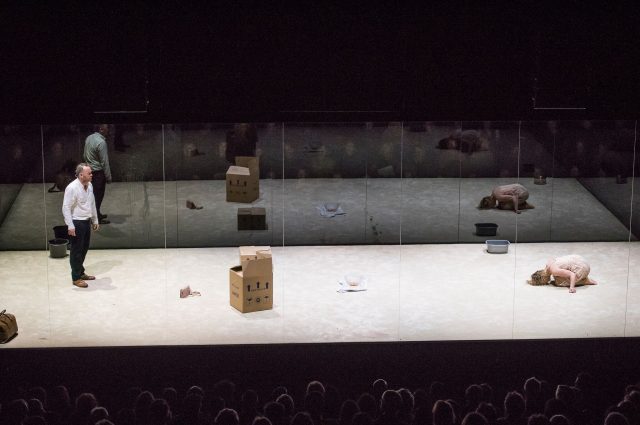
Not a whole lot of the New Group world premiere of Seth Zvi Rosenfeld’s Downtown Race Riot makes sense. Continuing through December 23 at the Signature Center’s Romulus Linney Courtyard Theatre, the one-act play, set in an apartment in Greenwich Village in 1976, is dominated by its long, deep set by master designer Derek McLane, which stretches across the space, consisting of, from left to right, a bedroom, a living room / kitchen with a small cast-iron clawfoot tub, and another bedroom. The center section juts one row into the audience, assuming added intimacy, while many of the seats in the left and right sections offer limited, sharply angled views that require patrons to stretch their bodies to try to see what’s going on, which is not really that much, as most of the action takes place center stage. Oddly, many people in the first row placed their drinks and even a bag or hat on the stage itself while waiting for the rest of the crowd to enter; one of the theater employees had to tell them that doing that was a no-no. The individual rooms are splendidly decorated, with one bedroom filled with pictures and posters of 1970s celebrities and music groups, the kitchen capturing the feel of the schlocky era, and the far bedroom a tribute to a former flower child. I realize that I’ve gone on at length about the set, primarily because it’s the most interesting part of the play; the story, inspired by an actual 1976 riot in Washington Square Park, is slack and uninvolving, with unlikable characters and questionable plot developments.

(photo by Monique Carboni)

New Group world premiere looks at real 1976 riot in Washington Square Park (photo by Monique Carboni)

Chloë Sevigny plays Mary Shannon, a thirty-nine-year-old drug addict and single mother living on disability and constantly coming up with new scams to bring in money. Her twenty-one-year-old daughter, Joyce (Sadie Scott), is a lesbian who is looking to move out, while her eighteen-year-old son, Jimmy, known as Pnut (David Levi), has no big plans except for hanging out. His best friend is Marcel “Massive” Baptiste (Moise Morancy), a Haitian American considered an acceptable black; Pnut is also acquainted with Italian troublemakers Jay 114 (Daniel Sovich) and Tommy-Sick (Cristian DeMeo). Later the family is visited by lawyer and former hippie Bob Gilman (Josh Pais), who just confuses the story, which takes place during one endless day as Joyce comes on to Massive, Pnut makes hamburgers, Mary shoots up, and the teenage boys get ready to hurt some people in the park. “The whole neighborhood is goin’ out there with pipes and bats and it’s open season on yans and piss-a-ricans,” Pnut tells his mother, who replies, “Are you demented? Did I bring you up to be a KKK member? We’re in Greenwich Village, for chrissakes. This is where people come to be free.” (There is also plenty of hatred for gays and Jews.) Director Scott Elliott, the New Group’s artistic director who recently helmed terrific productions of Mercury Fur, Evening at the Talk House, and The Whirligig, can’t do much with Rosenfeld’s (The Flatted Fifth, The Get Down) muddled, stilted dialogue or the inefficient acting, although it is a treat to see Oscar nominee Sevigny so up close and personal — she previously appeared onstage with the New Group in 1998 in Hazelwood Junior High and two years later in What the Butler Saw. And as fab as McClane’s set is, it ends up only adding to the problems of the hundred-minute play, as you won’t know where to look when all three rooms are occupied at the same time. Of course, if you are in one of the numerous partial-view seats, you might not have much of a choice, nor might you care.

HARRY CLARKE

(photo by Carol Rosegg)

Tony winner Billy Crudup stars as a man in search of his genuine identity in Harry Clarke (photo by Carol Rosegg)

Vineyard Theatre
Gertrude and Irving Dimson Theatre
108 East 15th St. between Union Square East & Irving Pl.
Extended through December 23, $120
www.vineyardtheatre.org

Tony winner Billy Crudup charms the audience much as the character he plays charms the Schmidt family in David Cale’s riveting one-man show, Harry Clarke. In his first solo performance, Crudup is captivating as Philip Brugglestein, a wayward midwesterner who invented an alter ego, the British-speaking Harry Clarke, as a psychological defense against bullying schoolmates and his mentally and physically abusive father. As an adult, Philip has moved to New York City, where he is floundering. One day, in the mood for an adventure, he follows a random guy in the street; later, he befriends the man, a wealthy financier named Mark Schmidt, but Philip introduces himself as his childhood creation, pretending to be the fun-loving Harry Clarke, a smooth operator from Elstree. (He even claims that he worked for Sade for twenty years.) Harry insinuates himself into Mark’s life, as well as that of Mark’s sister, Stephanie, and mother, Ruth, in a way reminiscent of Tom Ripley in Patricia Highsmith’s books except Harry is no mere con man out for money; he’s seeking connections, searching for his identity, as are most of the characters in the play. “I could be myself if I had an English accent,” he recalls saying as child, later telling his parents, “But it’s my real voice.” Soon Harry finds himself caught up in a situation that he didn’t quite expect.

(photo by Carol Rosegg)

Billy Crudup voices multiple characters in world premiere of David Cale one-man show at the Vineyard (photo by Carol Rosegg)

An actor, composer, and playwright who was born in London and moved to New York when he was twenty, Cale originally wrote Harry Clarke for himself — he has previously written and starred in such solo works as Lillian, Deep in a Dream of You, and The Redthroats and has appeared on The Good Wife and in The Total Bent at the Public — but he eventually opted for Crudup, who has been nominated for four Tonys, winning one (for The Coast of Utopa), and has had major roles in such films as Almost Famous and Jesus’ Son. In his third play at the Vineyard, following Chiori Miyagawa’s America Dreaming and Adam Rapp’s The Metal Children, Crudup commands the virtually bare stage with a tender fury; Alexander Dodge’s set features a lone chair on a deck, a small table where Crudup keeps a glass of water, and a scrim in back for abstract projections that hint at a blue sea and sky, with occasional changes. Two-time Obie winner and Tony nominee Leigh Silverman (Violet, In the Wake), who directed Marin Ireland in the searing one-woman show On the Exhale earlier this year, knows just when to get Crudup on the move. Crudup (Waiting for Godot, No Man’s Land) sits casually before at last getting up and really hitting his stride, doing different voices for every character; the writing is so sharp, and the performance so astute, with a cinematic fervor, that you can easily visualize the places Harry goes, from Sixth Ave. to a gay bar to relaxing on board the Schmidts’ boat, Jewish American Princess. Harry is a big movie fan, preferring noirs and thrillers and listening to records by French film composer Georges Delerue, and Cale’s play becomes like a noir thriller itself; it’s no coincidence that Mark wants to become a movie producer. When Harry and Mark meet for the second time, in a theater, Harry says, “This play’s like a mystery, in that sense, seems more like a movie.” Meanwhile, Philip, of course, is a completely unreliable narrator; all of the events are related through his warped, damaged, unpredictable view, as if he’s created his own movie, but that’s part of what makes the show so tantalizing.

COUNTING SHEEP: AN IMMERSIVE GUERRILLA FOLK OPERA

(photo by Mati Bardosh Gelman)

Counting Sheep re-creates the February 2014 Maidan revolution in Kiev with music and mayhem (photo by Mati Bardosh Gelman)

3LD Art and Technology Center
80 Greenwich St. at Rector St.
Through December 17, $20-$59.50
866-811-4111
countingsheeprevolution.com
www.3ldnyc.org

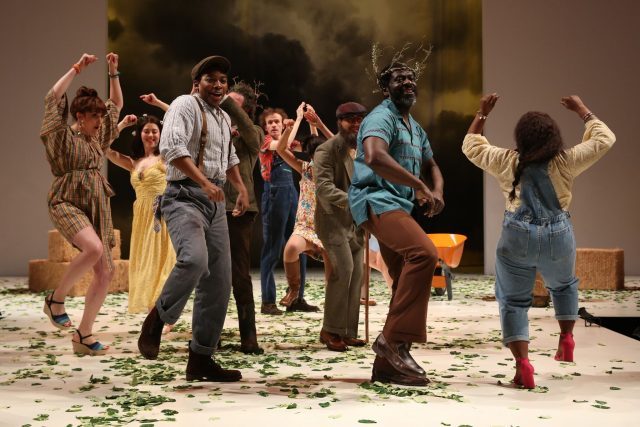
Theater doesn’t get much more immersive — or personally involving — than Mark and Marichka Marczyk’s Counting Sheep, a nonstop, exhilarating, highly emotional experience that puts you right in the middle of a re-creation of the stalwart Revolution of Dignity that took place in February 2014 in Kiev, as Ukrainians rose up against President Viktor Yanukovych’s corrupt, Russia-friendly, anti-EU policies. The international Occupy movement meets Les Miz in the multimedia production, continuing at 3LD through December 17. Ingeniously conceived by the Marcyzks, who met during the protests and fell in love, the seventy-five-minute interactive show invites the audience to participate as much as they’d like, from dining at a long, communal table with various characters to carrying banners, throwing (foam) bricks, singing songs, dancing, and building a barricade. It’s virtually all in Ukrainian, except for occasional facts, figures, and slogans projected onto the walls in English, but that won’t prevent you from understanding what the common people and revolutionaries are singing and saying as they battle the special police force known as the Berkut. The dedicated cast, wearing sheep masks, consists primarily of Toronto’s Lemon Bucket Orkestra (which refers to itself as “a guerilla-punk-balkan-folk-brass band”), featuring violinist Mark Marczyk, trombonists Eli Camilo and Nathan Dell-Vandenberg, darbouka player Jaash Singh, trumpeter Michael Louis Johnson, guitarist Alex Nahirny, percussionist Oskar Lambarri, singer Tamar Ilana, dancer and percussionist Stephania Woloshyn, cellist Volodymyr Bedzvin, and Natalia Telentso and George Rush. (Music director Marichka Marczyk was only recently replaced in the cast because she is in her third trimester.) The revolutionaries are played by Joshua Hopkins, Taylor Kozak, Matt McGill, Adam Munoz, and Danielle Ruth, with Dima Nechepurenko as the roving cameraman, his live shots often projected onto the walls, along with archival footage and actual television reports.

(photo by Mati Bardosh Gelman)

Cocreator Mark Marczyk surveys the damage done in immersive multimedia production at 3LD (photo by Mati Bardosh Gelman)

Don’t worry if you didn’t spring for the extra thirty bucks to sit at the table and eat the opening meal; the menu, from Veselka, includes fried pierogi, borscht, kasha, mushroom stroganoff, cucumber salad, rye bread, sliced pickles, sour cream, applesauce, and fried onions, but some of it is served later for free as sustenance is needed to keep the struggle going. The actors will not force you to do anything you don’t want to, but the more you get involved, the more you will get out of this breathtaking, breathlessly paced show, which is directed by Kevin Newbury and the Marczyks, with the ever-frantic set design and costumes by Vita Tzykun, lighting by Eric Southern, movement by Chloe Treat, fight direction by Joseph Travers, and video design by Greg Emetaz, immersing the audience in the carefully controlled chaos. Photography is allowed, but don’t get too caught up in capturing things on film and instead go full throttle with your participation, constructing lasting memories in your head and heart. Billed as an “Immersive Guerrilla Folk Opera,” Counting Sheep might ostensibly be about the Maidan revolution, but it could really be about any of the recent events in which the people stood up to the government, usually paying a high price. By the end, you’ll be exhausted and uplifted and might even break into tears. Finally, there is no program to give further information about the cast, crew, and show; instead, you’re left to venture into the good night, processing your own private experience of this unique and powerful creation. (The Lemon Bucket Orkestra will be celebrating the end of the New York run of Counting Sheep with a concert at 3LD on December 16 at 11:00 pm; tickets are $20.)

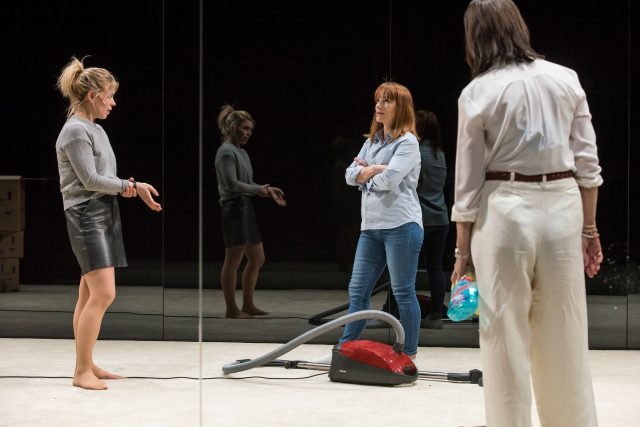
THÉÂTRE DU SOLEIL: A ROOM IN INDIA

Le Theatre du Soleil performs A Room in India directed by Ariane Mnouchkine at the Park Avenue Armory on December 4, 2017.  A collective creation by the Théâtre du Soleil Directed by Ariane Mnouchkine Music by Jean-Jacques Lemêtre Together with Hélène Cixous With the exceptional participation of Kalaimamani Purisai Kannappa Sambandan Thambiran (photo by Stephanie Berger)

Hélène Cixous gives a tour-de-force performance in Théâtre du Soleil’s epic A Room in India at Park Ave. Armory (photo by Stephanie Berger)

UNE CHAMBRE EN INDE
Park Ave. Armory, Wade Thompson Drill Hall
643 Park Ave. at 67th St.
December 5-20, $45-$150
212-933-5812
www.armoryonpark.org
www.theatre-du-soleil.fr

One of the true joys of experiencing anything at the Park Ave. Armory, from film and dance to music, theater, and art installations, is to see how the spectacle-driven institution has reinvented itself for its latest production. Kenneth Branagh and Rob Ashford’s Macbeth took place in a narrow stone-bounded pathway that turned to mud. Audience members were encouraged to walk around the space to fully immerse themselves in Shen Wei’s Undivided Divided. And visitors could have fun on large swings in Ann Hamilton’s The Event of a Thread. Ariane Mnouchkine and Théâtre du Soleil’s epic four-hour A Room in India, running through December 20, does not disappoint. Upon entering the armory, guests are wanded by the Great Police Security Brigade, guards wearing fanciful uniforms. In one of the period rooms, attendees who preordered dinner sit down for a buffet-style meal by chef Gaurav Anand of Moti Mahal Delux. (During intermission, free chaat, masala peanuts, wine, and water are served as well.) Inside the massive Wade Thompson Drill Hall, you’ll first come upon an open dressing room tucked under the seat risers, where you can talk to the performers as they are getting ready, applying makeup and getting into costume. To the left is a bookstore, while to the right is a carpeted and pillowed area where some of the actors prepare with vocal exercises about fifty minutes before showtime and which ticket holders are invited to watch. The long, deep set is on the east side of the hall; the audience seating rises on the west. Even the program is unique, a booklet packed with information, including inspirational quotes and excerpts from the main character’s journal. “It was as if we were refugees from history,” Cornélia writes. “All about our bedroom, the times had been unleased. We wondered what would become of us, we wondered what to call this, this chaos.”

A Room in India the Théâtre du Soleil (photo by Stephanie Berger)

Ariane Mnouchkine returns to the Park Ave. Armory with latest spectacle, A Room in India (photo by Stephanie Berger)

A Room in India is chaotic indeed, but wonderfully so, with a decidedly feminist take on the state of the planet, especially one lacking in legitimate, compassionate leadership. A theater company is in India for a performance when its leader suddenly has a manic episode and quits the troupe, leaving his assistant, Cornélia (Hélène Cixous), in charge, to her surprise and dismay. The entire play takes place in the same enormous room, in which the furniture is constantly being moved around and changed save for an ever-present bed, where Cornélia sleeps; it is often difficult to know which scenes are really happening and which are Cornélia’s (Freudian?) dreams and nightmares come alive, often spurred by telephone calls from the company’s administrator, Astrid (Thérèse Spirli). Mnouchkine, who was previously at the armory with Les Éphémères in 2009 as part of the Lincoln Center Festival, throws just about everything she can into the mix as she explores the responsibility that theater has both to inform and entertain, shining a light on society’s ills and thrills; among those making an appearance are Shakespeare (Maurice Durozier), King Lear (Seietsu Onochi) and Cordelia (Man-Waï Fok), Mahatma Gandhi (Samir Abdul Jabbar Saed), Anton Chekhov (Arman Saribekyan), the God Krishna (Palani Murugan), and Charlie Chaplin, along with bumbling police led by Lt. Ganesh-Ganesh (Omid Rawendah), local mobster S. S. Loganathan (Duccio Bellugi-Vannuccini), monkeys (Seear Kohi, Saribekyan) who can’t believe what evolution has wrought, a holy white cow (Ghulam Reza Rajabi or Saribekyan), a pimp (Rawendah), the Taliban, and rickshawallahs. Torture alternates with farce, including a riotous Terukkuttu scene of a film being made in the desert. Two sections from The Mahābhārata are presented. Meanwhile, Jean-Jacques Lemêtre’s entrancing music is played in a separate room stage left by Ya-Hui Liang and Marie-Jasmine Cocito. Mnouchkine — whose father, Alexandre, produced such films as Jean Cocteau’s L’Aigle à deux têtes, Jean-Jacques Annaud’s The Name of the Rose, Philippe de Broca’s L’Homme de Rio, and Claude Lelouch’s Un homme qui me plait — doesn’t seem to have an “off” switch; the show does not need to be four hours long, as there is repetition and various needless moments, but Cixous is so delightful as Cornélia, and the cast of thirty-five is having so much fun, that you might not really care that much about the shortcomings and instead just revel in the daring, exhilarating spirit of the superb production as a whole.

ILLYRIA

Joe Papp discusses his theatrical vision in Illyria) (photo by Joan Marcus)

Joe Papp (John Magaro, left) discusses his theatrical vision in Richard Nelson’s Illyria at the Public Theater (photo by Joan Marcus)

Anspacher Theater, the Public Theater
425 Lafayette St. at Astor P.
Tuesday through Sunday through December 10, $75
212-539-8500
publictheater.org

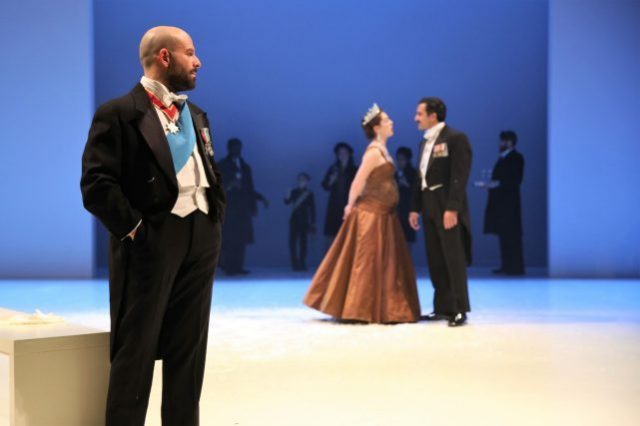
Since 2010, Chicago-born playwright Richard Nelson has been a fixture at the Public Theater, presenting the four-part Apple Family saga and the three-part series about the Gabriel clan, including The Hopey Changey Thing from the former and Women of a Certain Age in the latter. The Obie and Tony winner now turns his attention to the history of the Public itself with Illyria, a surprisingly bland look at the development of Public founder Joe Papp’s master plan, bringing free Shakespeare to the people of New York City. The play takes place between April and August 1958, moving from the Green Room in Heckscher Auditorium to Colleen Dewhurst’s (Rosie Benton) apartment and then to a temporary stage on the Belvedere lawn in Central Park. It starts with a very funny anecdote about George C. Scott having just told a kid during a children’s showing of As You Like It to shut up. That is followed shortly by a wonderful scene in which young actress Mary Bennett (Naian González Norvind) auditions for the part of Olivia in Twelfth Night and is undeservedly given short shrift by Papp (John Magaro), who wants to his wife, Peggy (Kristen Connolly), for the role. Unfortunately, the rest of the play deals with relatively uninteresting backstage drama as the Papps, Dewhurst, press agent Merle Debuskey (Fran Kranz), director Stuart Vaughan (John Sanders), his wife and assistant, Gladys Vaughan (Emma Duncan), musician and composer David Amram (Blake DeLong), and stage managers John Robertson (Max Woertendyke) and Bernie Gersten (Will Brill) discuss various elements of creating quality theater within budgetary limitations. They needle one another, disagree on specific plans, talk about Lincoln Center and Stratford, fight over two hundred bucks, share gossip, and eat sandwiches. At one point Papp tells John, “Don’t be sentimental.” But Illyria, named for a location in Twelfth Night, is idealistic to a fault; Nelson, who also directs the play, leaves too much out, primarily concentrating on small tidbits that don’t shed enough light on the birth of the New York Shakespeare Festival. It all comes off as a show by insiders, for insiders. “Some are born great, others achieve greatness, and some have greatness thrust upon ’em,” Malvolio says in Twelfth Night, reading a letter from Maria. In Illyria, it is hard to distinguish where the greatness of Joe Papp came from.