this week in theater

AYAD AKHTAR: JUNK

junk

Who: Ayad Akhtar, Tom Santopietro, Steven Pasquale, and others
What: Discussion and performance
Where: Barnes & Noble, 150 East 86th St. at Lexington Ave., 212-369-2180
When: Tuesday, November 28, free, 4:00
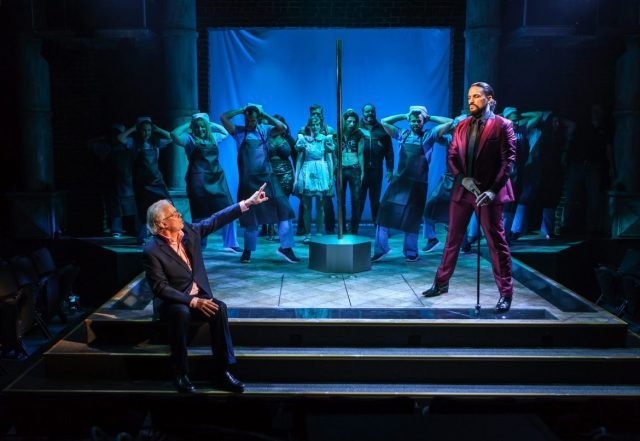
Why: Pulitzer Prize winner and Tony nominee Ayad Akhtar’s latest play, Junk, is currently on Broadway, running at Lincoln Center’s Vivian Beaumont Theater through January 7. On November 28, Akhtar, who has previously written the plays Disgraced, The Invisible Hand, and The Who & the What and the novel American Dervish as well as cowriting and starring in the film The War Within, will be at the B&N on Lexington and Eighty-Sixth St. in conversation with author, media commentator, and Broadway theater manager Tom Santopietro, discussing Junk, set during the 1980s junk-bond phenomenon. In addition, Junk star Steven Pasquale (The Good Wife, reasons to be pretty) and other cast members will perform scenes from the play, which has just been published in paperback by Little, Brown.

TINY BEAUTIFUL THINGS

(photo by Joan Marcus)

Tiny Beautiful Things brings to life Cheryl Strayed’s “Dear Sugar” advice column (photo by Joan Marcus)

The Public Theater, Newman Theater
425 Lafayette St. by Astor Pl.
Tuesday – Sunday through December 10, $75
212-967-7555
www.publictheater.org

Writer and star Nia Vardalos and director Thomas Kail’s adaptation of Cheryl Strayed’s beloved Tiny Beautiful Things: Advice on Love and Life from Dear Sugar has moved from the Public Theater’s tiny Shiva Theater to the Newman, where more tears will flow through December 10. Conceived by Vardalos (My Big Fat Greek Wedding, Company), Kail (Hamilton, Dry Powder), and journalist Marshall Heyman, Tiny Beautiful Things brings to life many of the “Dear Sugar” advice columns Strayed wrote anonymously, answering readers’ questions about life and love by sharing many of her own deeply personal tales, getting to the bottom of “when you are simultaneously happy and sad and angry and grateful and accepting and appalled and every other possible emotion, all smashed together and amplified.” The show takes place in Sugar’s (Vardalos) cramped home, where set designer Rachel Hauck has removed the walls between rooms, as if knocking down psychological barriers. Sugar primarily sits at her kitchen table typing away on her laptop, reading and answering questions posed by a trio of actors, Teddy Cañez, Hubert Point-Du Jour, and Natalie Woolams-Torres, who wander through the rooms almost like ghosts, their funny, strange, and sometimes heart-wrenching stories awakening parts of Sugar’s past, helping her face her own problems.

(photo by Joan Marcus)

Nia Vardalos wrote and stars in Tiny Beautiful Things at the Public (photo by Joan Marcus)

Fans of Strayed’s (Wild) column and books come to the show with a strong connection to the material and react accordingly, with knowing nods, laughter, and sobs. Those not familiar with Strayed and not particularly keen on advice columns are likely to find the show rather syrupy. Despite fine performances all around and stellar direction by Kail, Tiny Beautiful Things is overly long and repetitive even at a mere eighty-five minutes. Sugar might be wearing a CBGB T-shirt and her laptop bears the sticker “Question Authority,” but there is hardly anything radical or cutting edge about the play. It accomplishes what it set out to do, using inventive staging to delve into the kinds of life issues that many of us face, but how involved you get in it all depends on how cathartic advice columns make you feel.

RED ROSES, GREEN GOLD

(photo by Chad Batka)

Red Roses, Green Gold features fun interpretations of Grateful Dead songs (photo by Chad Batka)

Minetta Lane Theatre
18 Minetta Lane between MacDougal St. & Sixth Ave.
Tuesday – Sunday through January 7, $57-$124
redrosesgreengold.com
minettalanenyc.com

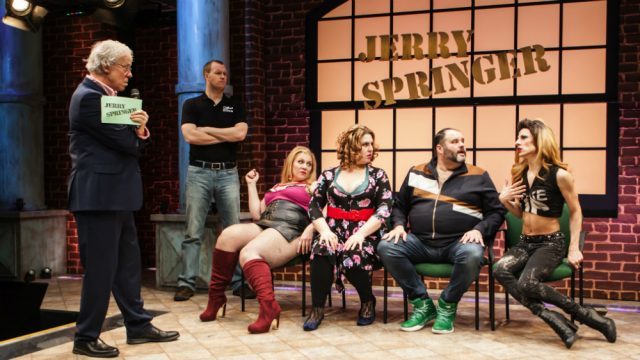
Deadheads are in for a musical treat with Red Roses, Green Gold, a reworking of Michael Norman Mann’s 1998 show, Cumberland Blues. The songs, primarily by Robert Hunter and Jerry Garcia from the classic Grateful Dead period of the early 1970s, are performed with care and flair by a fun troupe and arranged by Furthur and Dead & Co. veteran guitarist Jeff Chimenti. However, there’s no one at the wheel driving the train wreck of a story, no matter how tongue in cheek it might think it is. Running at the Minetta Lane Theatre through January 7, the musical is set in the 1920s at the Palace Saloon and Mining Company, a tumbledown spot won long ago in a card game by Jackson Jones (Scott Wakefield), who has failed to keep up with the bills and is now facing eviction. Evil drummer Jessup McElroy (Michael McCoy Reilly) and his dimwitted brother, Dudley (bassist and pianist Brian Russell Carey), want the Palace back, but Jackson is not about to let them take it away from him, although he has no legitimate master plan. Offering their support are Jackson’s girlfriend, Glendine (pianist and bassist Maggie Hollinbeck), who is afraid to say, “I love you”; his doomsayer of a daughter, Melinda (Natalie Storrs); Melinda’s childhood friend, Liam Alexander (David Park), now a lawyer; his gadabout son, the hirsute Mick (guitarist Michael Viruet), who seems to have escaped from a road version of Hair; and Bertha Marie (Debbie Christine Tjong), who Mick leaves at the altar. (Yes, there are plenty of inside references to Grateful Dead characters and situations.)

All of the actors sing and dance and/or play instruments well enough to satisfy the GD faithful, encouraging participation; there’s also an area where audience members can get up and boogie down. The silly script is just an excuse to present such songs as “Friend of the Devil,” “Truckin’,” “Ripple,” “Wheel,” and “Deal,” with director and choreographer Rachel Klein (More Than All the World) at her best when she cuts loose with “Bertha” or slows things down with beautiful renditions of “Box of Rain” by Park and Storrs and “Brokedown Palace” by Hollinbeck and Storrs. The wood-laden set by Robert Andrew Kovach is appropriate, featuring occasional projections by Brad Peterson that are often hard to make out. Most of the cast play it too far over the top, beginning with Wakefield’s slick and confident Jackson, who knows more than he’s telling. The script could use significant tightening, including getting the show down to about ninety minutes without a break instead of two hours and ten minutes with intermission and encore. Grateful Dead fans, a group that includes me, are a forgiving lot when it comes to the band meandering during a long, strange solo or riding off the tracks on certain tunes, but the theater crowd is not so merciful. But as Jerry famously sang, “Let there be songs / to fill the air.”

SETH’S BROADWAY DIARY

seths broadway diary

Who: Seth Rudetsky, Charles Busch, Mario Cantone, Ann Harada, Judy Kuhn
What: Book release party with readings and songs
Where: Barnes & Noble, 150 East 86th St. between Lexington & Third Aves., 212-369-2180
When: Monday, November 20, free, 7:00
Why: In his latest campy tome, Seth’s Broadway Diary, Volume 3: Inside Scoop on (Almost) Every Broadway Show & Star (Dress Circle, November 14, $19.99), novelist, pianist, deejay, vocal coach, actor, singer, and all-around good guy Seth Rudetsky shares more of his behind-the-scenes “Onstage and Backstage” pieces from his Playbill column, which focuses on theater and cabaret. Rudetsky (The Rise and Fall of a Theater Geek, Disaster!) will be celebrating the release of the book with a fab gathering at the Eighty-Sixth St. B&N, where he will be joined by Charles Busch (The Tale of the Allergist’s Wife, Vampire Lesbians of Sodom), Mario Cantone (Sex and the City, Laugh Whore), Ann Harada (Avenue Q, Smash), and Judy Kuhn (Les Misérables, Fun Home) for an evening of readings and music. Wristbands must be picked up in advance and priority seating is given to anyone who buys the book that day.

THE PERFORATIONS FESTIVAL

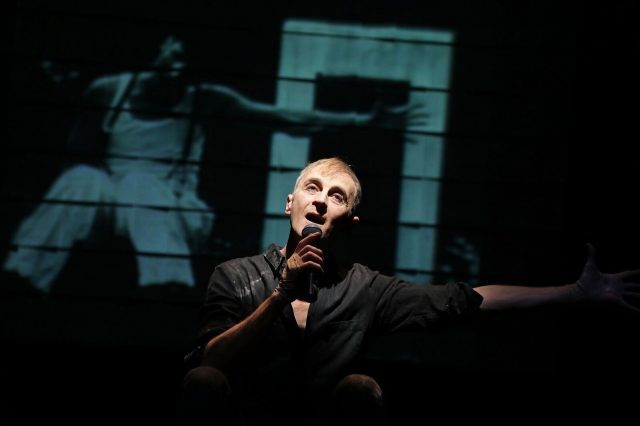
Croatias Perforations Festival returns to New York City with unusual productions at Abrons Arts Center and La MaMa

Croatia’s Perforations Festival returns to New York City with unusual and innovative productions at Abrons Arts Center and La MaMa

Abrons Arts Center, 466 Grand St. at Pitt St.
La MaMa Experimental Theatre Club, Ellen Stewart Theatre, 66 East Fourth St., second floor
November 17-26, $25
lamama.org/perforations

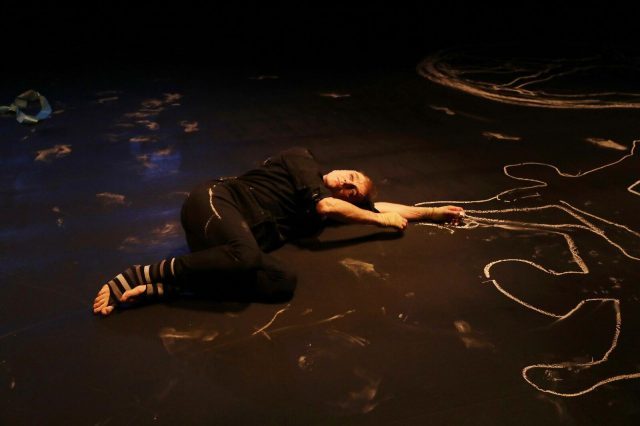
Croatia’s Perforations Festival, featuring ten days of cutting-edge performances from Central and Eastern Europe, returns to the city with seven productions running November 17 to 26. Founder and curator Zvonimir Dobrović notes, “It is always a privilege to present such an exciting roster of energetic and creative artists to new audiences. These artists have been the driving forces behind the current wave of resistance to neo-conservatism in Eastern Europe and their work has been an oasis of hope for a whole generation.” The festival kicks off November 17-18 at Abrons Arts Center with Jasna L. Vinovrški’s interactive Staying Alive, then moves to La MaMa with the Great Jones Repertory Company’s adaptation of Pier Paolo Pasolini’s Pylade, directed by Ivica Buljan; Marta Ziółek’s Make Yourself, with the Polish Ziółek serving as moderator and guide; Via Negative’s One Hundred Toasts, with music by Glenn Miller, Michael Nyman, Alfred Schnittke, and the Stooges; Bruno Isaković and Mia Zalukar’s multimedia, multidisciplinary Suddenly Everywhere; TukaWach/Magda Stawman-Tuka and Anita Wach’s double bill, How the Hares Are Dying and Private Inventor, exploring ontological insecurity and transformation; and Ina Sladić’s two-part Penny/Audience, in which Sladić receives live instructions from Penny Arcade in the former and the audience in the latter. Tickets to all performances are a mere twenty-five bucks to check out some innovative and unusual theater.

PEOPLE, PLACES & THINGS

(photo by Teddy Wolff)

Emma (Denise Gough) doesn’t want to get with the program in People, Places & Things (photo by Teddy Wolff)

St. Ann’s Warehouse
45 Water St.
Tuesday – Sunday through December 3, $81-$91
718-254-8779
stannswarehouse.org

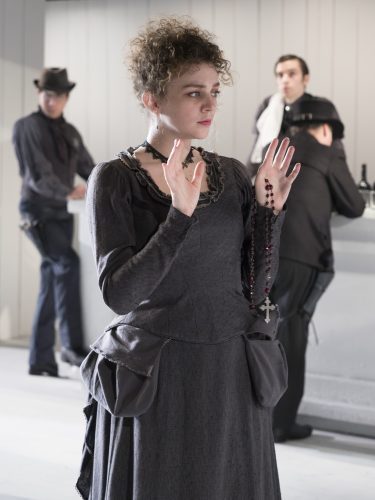
Denise Gough gives a career-redefining performance as an actress struggling through rehab in Duncan Macmillan’s People, Places & Things, which has been extended at St. Ann’s Warehouse through December 3. The broke Gough nearly quit the business before getting the role of Emma, a drug addict and alcoholic who checks herself into a rehab center; her riveting portrayal earned her an Olivier Award. The narrative arc is all too familiar: Emma’s addictions make it hard for her to keep a job, so she’s looking to “graduate” from a rehab to show she’s okay now. She proclaims, “I shouldn’t be here,” to the staff doctor (an excellent Barbara Marten), who replies, “It’s pretty obvious that you should. You came here for a reason. That was a good impulse.” As Emma’s hands shake, the doctor continues, “Your addiction will fight any progress. It’s a parasite and it will fight for its own survival until you’re dead. But progress is possible. I just need to hear you say that you are willing and motivated to make changes.” But Emma resists the twelve-step program, which requires mandatory group therapy. Emma, who at first goes by the name Nina — the play opens with a scene from Chekhov’s The Seagull in which Emma, as Nina, spins out of control — insists she is different from the other members of the group, which is led by a therapist (Marten) and includes Shaun (Himesh Patel), Laura (Laura Woodward), Charlotte (Charlotte Gascoyne), T (Jacob James Beswick), Jodi (Jacqui Dubois), Paul (Kevin McMonagle), Mark (Nathaniel Martello-White), and Foster (Alistair Cope), a former addict who completed the program and now works at the facility, helping others. Although she is an actress, Emma refuses at first to participate in role-playing exercises or share the details of her story; she is used to playing fictional characters onstage, so she steers away from the truth despite repeated admonitions that she must be truthful and hold nothing back. “Drugs and alcohol have never let me down. They have always loved me,” Emma says. “There are substances I can put into my bloodstream that make the world perfect. That is the only absolute truth in the universe.” But soon it is clear that if Emma doesn’t clean up her act, she is going to die.

(photo by Teddy Wolff)

Emma (Denise Gough) is spinning out of control in Duncan Macmillan play (photo by Teddy Wolff)

A coproduction of the National Theatre and the British Headlong company, the play is superbly directed by Jeremy Herrin (This House, Wolf Hall) with a bold energy that never lets up, with scene changes indicated by loud noises and lightning-like flashes, evoking the ups and downs of addiction, as if synapses are firing wildly. Bunny Christie’s set is a rectangular white-tiled room with hidden doorways in the walls; the audience sits on opposite sides, able to see one another through the whole show. After intermission, the simple move of a desk makes it feel like the entire set has been turned around, like Emma’s life. As Emma seeks her real identity, she suffers hallucinations in which she is surrounded by multiple Emmas, threatening her sanity. Martello-White excels as Mark, a fellow patient who bonds with Emma — and shares the same name as the brother she claims is dead. McMonagle stands out as Paul, a paranoid addict who is first seen shirtless, the words “The End” on his stomach in what appears to be blood. And Marten gives a thoughtful, caring performance as the doctor and the therapist. “You look like my mother,” Emma tells the doctor, who claims that it is just projection. “No, you really fucking look like her,” Emma says. Indeed, later Marten plays Emma’s mother as well. Macmillan (1984, Lungs, Every Brilliant Thing) gets too caught up in religion and recovery; the play suffers when the characters espouse the program, becoming far too preachy and treacly. It works much better when it is more abstract, Emma’s problems relating to twenty-first-century ills that we all can understand. “Self-medicating is the only way to survive in a world that is broken,” she explains. Gough, who was born in Ireland and has been a longtime London denizen, had never been to New York before this show; she was determined to step foot in the city for the first time only as an actress in a play. She is now taking New York by storm, currently off Broadway at St. Ann’s, and next as Harper in the upcoming Broadway revival of Tony Kushner’s Angels in America. We are all fortunate that she stuck with the program, ultimately refusing to give up on her hopes and dreams.

HIROSHI SUGIMOTO: RIKYU-ENOURA

(photo © Odawara Art Foundation)

Hiroshi Sugimoto’s Rikyu-Enoura makes its world premiere this weekend at Japan Society (photo © Odawara Art Foundation)

Japan Society
333 East 47th St. at First Ave.
November 3-5, $95
212-715-1258
www.japansociety.org
www.odawara-af.com/en

In 2011 and 2014, Japan Society awarded grants to Japanese multidisciplinary artist Hiroshi Sugimoto for his ambitious Odawara Art Foundation, which is now open to the public and features indoor and outdoor stages for noh and bunraku productions, a large gallery, a tearoom, astronomical observation spaces, and more. Sugimoto, who is based in Tokyo and New York City, will now be presenting the first fruits of that collaboration with several special programs at Japan Society, beginning with the exhibition “Gates of Paradise” (through January 7), the noh play Rikyu-Enoura (November 3-5), and the lecture and book signing “Architecture of Time: Enoura Observatory, Where Consciousness & Memory Originate” (December 15). For more than forty years, photographer, sculptor, architect, and historian Sugimoto has explored history and science, the past and the future, time and memory while blurring the lines between fiction and reality. He has photographed dioramas at natural history museums (“Still Life”), captured electrical discharges on photographic dry plates (“Lightning Fields”), focused on the horizon line across the ocean (“Seascapes”), shot wax figures to look like paintings (“Portraits”), used long exposures to reveal the blinding soul of movie palaces (“Theaters”), and turned one thousand gilded wooden Buddha statues at Sanjῡsangen-dō (Hall of Thirty-Three Bays) in Kyoto into a dizzying film (Sea of Buddha). He also curated the expansive and wide-ranging “History of History” in 2005-6 at Japan Society and designed the set and costumes for Sanbaso, divine dance, an ancient celebratory ritual dance with noh performers in the Guggenheim Rotunda in 2013. So Sugimoto was a logical go-to choice when Japan Society was putting together its “NOH NOW” series as part of its 110th anniversary. Sugimoto will be staging the world premiere of Rikyu-Enoura, about sixteenth-century tea master Sen-no-Rikyu, featuring a libretto by traditional-style poet Akiko Baba; a tea ceremony by Sen So’oku (a direct descendant of Sen-no-Rikyu); noh actors Kanze Tetsunojo and Katayama Kurouemon; noh musician Kamei Hirotada; and more. Each show will be preceded by a lecture by Wesleyan University assistant professor Dr. Takeshi Watanabe one hour before curtain.