this week in theater

NASSIM

Nassim (photo by Joan Marcus)

Iranian playwright Nassim Soleimanpour says hello to guest actor Kate Arrington in autobiographical play at City Center (photo by Joan Marcus)

New York City Center, Stage II
130 West 56th St. between Sixth & Seventh Aves.
Tuesday – Sunday through April 20, $69-$90
212-581-1212
www.barrowstreettheatre.com
www.nycitycenter.org

Iranian playwright Nassim Soleimanpour has followed up his international hit, White Rabbit Red Rabbit, in which each show was performed by a different actor reading a script that they hadn’t rehearsed or seen before, with another twist on the standard theatrical experience. Nassim, which opened tonight at City Center’s intimate Stage II, is a delightful and moving autobiographical work about language, heritage, and the deep need for artists to tell stories. And, as with White Rabbit Red Rabbit, the less you know about it going in, the more wonderful the surprises are. Soleimanpour, who was born and raised in Iran and now lives in Berlin, arrived in the United States on a working artist visa on December 4; the play, presented by Barrow Street Theatricals, began the next night and is scheduled to run through April 20. Rhys Jarman’s set is quite simple, consisting of a microphone stand on one side, a chair and a desk on the other, and a white screen at the back. A box on the desk contains information for the guest actor, whose name is not revealed until you enter the theater; among those who either have already performed or are scheduled to are Kate Arrington, Reed Birney, Michael Chernus, Cush Jumbo, Tracy Letts, Jennifer Lim, Tedra Millan, Brad Oscar, Annie Parisse, Michael Shannon, and Michael Urie. I saw three-time Tony nominee and Obie winner Linda Emond (Homebody/Kabul, Cabaret), who was fabulously warm and engaging, throwing herself fully into the show, which is cheerfully directed by Omar Elerian (The Mill — City of Dreams, Misty).

Nassim (photo by Joan Marcus)

A guest actor and the playwright take a look at themselves and each other in Nassim (photo by Joan Marcus)

For seventy-five minutes, Emond does what she is told with wit and verve, getting so deeply involved in the proceedings that she was wiping away tears near the end. She doesn’t actually have the script in hand; instead, it is projected onto the screen, a pair of hairy hands turning the pages live. Although she is not supposed to go off-script, she did so a few times, which even Soleimanpour got a kick out of. The central focus is that Soleimanpour has never been able to stage one of his plays in Iran in his native Farsi, a language he has lost contact with; thus, his mother has never seen one of his works. “I’ve become a foreigner in my own mother tongue,” he writes. But by putting this play on in the States, he learns some English while reconnecting with Farsi.

(photo by David Monteith-Hodge)

Nassim holds myriad surprises for both the audience and a guest actor (photo by David Monteith-Hodge)

Soleimanpour has mastered this format, incorporating Q&As, photos, and audience interaction, quickly improvising while also cleverly anticipating many reactions. Originally presented at London’s Bush Theatre in July 2017, Nassim feels right at home at City Center; even the producer, the stage manager, and an usher get involved. While a significant part of the fun is watching how the guest actor deals with being put on the spot time and time again — Emond was such a joy, clearly relishing this unusual opportunity — Soleimanpour, whose father was a novelist and his mother a painter, is also sharing an intimate story that we can all relate to, tackling such ideas as human communication, family connection, and the international power of theater. It very much reminded me of Iranian auteur Jafar Panahi’s This Is Not a Film, in which the writer, director, editor, and actor defied a government edict putting him under house arrest and banning him from producing any further movies for twenty years by making a documentary with Mojtaba Mirtahmasb and having colleagues smuggle it out of the country on a USB thumb drive. (Panahi has made several other remarkable films since.) Although Soleimanpour is not under that kind of political scrutiny, his zeal for writing a play in Farsi is inspiring. Ultimately, you’ll leave City Center knowing a little more about the guest actor, a lot more about Soleimanpour, and even a few things about yourself, along with a hunger for tomatoes. Oh, and you’ll also immediately want to call your mother.

THE PRISONER

(photo © Joan Marcus)

A woman (Hayley Carmichael) visits a convicted man (Hiran Abeysekera) facing an unusual sentence in The Prisoner (photo © Joan Marcus)

Theatre for a New Audience, Polonsky Shakespeare Center
262 Ashland Pl. between Lafayette Ave. & Fulton St.
Tuesday – Sunday through December 16, $90-$115
866-811-4111
www.tfana.org

Peter Brook and Marie-Hélène Estienne and their C.I.C.T. — Théâtre des Bouffes du Nord return to Theatre for a New Audience’s Polonsky Shakespeare Center with the existential parable The Prisoner, a meditative, minimalist adult fable about crime and punishment, forgiveness and forgetting. Inspired by an experience Brook had in Afghanistan more than sixty years ago, the seventy-minute piece is set in an unnamed land, on a mostly bare set (by David Violi) save for a tree stump and some scattered twigs and branches. Mavuso (Hiran Abeysekera) has committed an “unspeakable act,” and his sister, Nadia (Kalieaswari Srinivasan), and uncle, Ezekiel (Hervé Goffings), prepare his punishment, according to both ancient laws and the court system. He is ultimately sentenced to twenty years on a hill by himself, facing a prison, with no guards watching him, no barriers to walking away except those in his own mind. “There are no cells, no bars, and you will always have the temptation to leave,” Ezekiel instructs him. He also tells Mavuso that whenever someone asks him why he is there, he must answer, “I am here to repair.” Over the years, he is visited by a woman traveler (Hayley Carmichael), a man from a nearby village (Omar Silva), his uncle, and a few drunk guards. “You are disturbing the system!” one of them declares, but nothing can change Mavuso’s intention to carry out his sentence.

(photo © Joan Marcus)

The prisoners sister, Nadia (Kalieaswari Srinivasan), speaks with their uncle, Ezekiel (Hervé Goffings), in new work by Peter Brook and Marie-Hélène Estienne (photo © Joan Marcus)

The story includes bits of magic and such philosophical statements as “Everything is in the past” and “We want to possess everything without seeing that we have nothing,” but there is no moralizing. There is also no score but instead long silences. The passage of time is indicated by Philippe Vialatte’s lighting softly going down, then coming back up. Brook never found out what crime the man in Afghanistan had committed to receive such a fate, but Mavuso’s misdeed is named, and it serves to further complicate his sentence. The time period and place are also left ambiguous, made more so by a cast of diverse actors with different accents and heritages, leaving plenty of space for each audience member’s individual imagination. Only the traveling woman wears shoes; everyone else is barefoot, walking over the wood (and hopefully avoiding splinters). Written and directed by Tony, Emmy, and Obie winner Brook and Estienne (Samuel Beckett’s Fragments, The Valley of the Astonishment, Can Themba’s The Suit), The Prisoner raises issues of tolerance and hate, love and judgment, birth and rebirth, fathers and sons, and the prisons that we all build for ourselves. When Mavuso — who wanted to be judged for his actions, since he judged the actions of others — sits quietly and stares out at the jail, he is looking over the audience, almost as if we are all in a prison as well and need to repair something in our lives as we sit still, looking back at him. Seeing such beautifully engaging and thoughtful works as The Prisoner is not a bad place to start that reparation process.

WILLIAM KENTRIDGE’S THE HEAD & THE LOAD

(photo by Stephanie Berger)

William Kentridge’s massive spectacle The Head & the Load continues at Park Avenue Armory through December 15 (photo by Stephanie Berger)

Park Avenue Armory, Wade Thompson Drill Hall
643 Park Ave. at 67th St.
December 4-15, $40-$90, 2:00/7:00/8:00
212-933-5812
armoryonpark.org
www.theheadandtheload.com

In 2012, MoMA hosted “Five Themes,” a major, wide-ranging retrospective of the work of South African artist William Kentridge. Virtually everything Kentridge has done since then — the public procession Triumph and Laments: A Project for Rome, the multimedia chamber opera Refuse the Hour, adaptations of Berg’s Lulu and Shostakovich’s The Nose at the Met, “The Refusal of Time” installation at the Metropolitan Museum of Art, the gallery exhibition “Second-Hand Reading” at Marian Goodman, and a performance of Kurt Schwitters’s Ursonate at Harlem Parish — has merely been a prelude to The Head & the Load, a massive multidisciplinary spectacle that could only be put on in New York City in the Park Avenue Armory’s Wade Thompson Drill Hall. Taking place on a stage nearly two hundred feet long, the presentation employs a jagged, abstract narrative to explore the fate of hundreds of thousands of black Africans forced into service by colonialist European countries, primarily Germany, France, Belgium, and Britain, as porters and carriers during World War I. Kentridge uses live music, choreographed movement, video projections, and dialogue in multiple languages to relate the tragic tale. A trio of military men (Hamilton Dlamini, Nhlanhla Mahlangu, and associate director Luc De Wit) speak in nonsense words from Ursonate. Ann Masina delivers gorgeous arias with objects on her head. Joanna Dudley, wearing an eagle on a Nazi helmet, is pushed across the stage on a ramshackle cart, pronouncing edicts. Sipho Seroto stands atop a tower, wearing an evil-looking gas mask. The Knights play in a surprise confined space. Mncedisi Shabangu, in a bright yellow jacket, serves as narrator, guiding us through the complex story. A procession of men and women parades across the length of the stage, many wearing or carrying stencil cutouts of human faces and animals that show up as silhouetted shadows on the back wall, mixing with previously photographed video.

(photo by Stephanie Berger)

Ann Masina sings as four men look on in The Head & the Load (photo by Stephanie Berger)

In a program note, Kentridge asks, “Can one find the truth in the fragmented and incomplete? Can one think about history as collage, rather than as narrative?” Commissioned by 14-18 NOW and the armory along with Ruhrtriennale and MASS MoCA as part of the centenary of the end of WWI, The Head & the Load is a thrilling eighty-five-minute cacophony of sound, images, and movement, a performance collage that reveals little-known facts about African involvement in the war. The title comes from the Ghanaian proverb “The head and the load are the troubles of the neck,” representing the physical and psychological burdens thrust onto Africans. The production is divided into three acts, “Manifestos,” “Paradox,” and “War,” with such scenes as “Morsecode / Swahili Phrasebook,” “Orders & Commands,” “Troubles of the Body,” “Playing Against History,” “Kaiser Waltz,” and “Coda & Deathlist.” Composers Philip Miller and Thuthuka Sibisi’s score was inspired by Maurice Ravel, Erik Satie, Paul Hindemuthy, Arnold Schoenberg, and Fritz Kreisler, while Kentridge incorporates text, either spoken or projected onscreen, from Frantz Fanon, Tristan Tzara, Wilfred Owen, Aimé Césaire, the conference of Berlin, phrases from a handbook of military drills, Setswana proverbs from Sol Plaatje’s 1920 collection, and a letter from John Chilembwe.

(photo by Stephanie Berger)

The Head & the Load is highlighted by a multimedia procession across a two-hundred-foot-long stage (photo by Stephanie Berger)

The choreographer is Gregory Maqoma, with cinematography by Duško Marović, costumes by Greta Goiris, sets by Sabine Theunissen, lighting by Urs Schönebaum, and sound by Mark Grey, all coming together in exciting ways. Although Kentridge himself does not appear, his hands are evident throughout, particularly when cutting up maps and other documents on filmed segments, evoking the feel of the entire piece, which is really more of an experience than a show. When the audience enters the drill hall, they pass by several lights that project their shadows onto the back wall of the stage, a sly way of making everyone complicit in this colonialist world of war, ethnocentricity, and cultural suppression. It’s a critical message for the modern era, sent by an extraordinary artist and his marvelous team.

NETWORK

(photo by Jan Versweyveld, 2018)

Bryan Cranston takes on iconic role of madman Howard Beale in stage version of Network (photo by Jan Versweyveld, 2018)

Belasco Theatre
111 West 44th St. between Sixth & Seventh Aves.
Tuesday – Saturday through March 17, $49 – $399
networkbroadway.com

When it was released in 1976, Sidney Lumet’s Network instantly shocked audiences as it unmasked the approaching intersection of the corporatization of entertainment and news in the media, featuring a brilliant, prescient script by Bronx native Paddy Chayefsky that skewered the television industry and Americans’ obsession with “the tube.” It revealed a world dominated by ratings-hungry white men in suits, with two exceptional white female characters boldly asserting their own personal and professional power and independence at the height of the women’s liberation movement. Four decades later, the story is as relevant and shocking as ever in Ivo van Hove’s riveting yet dizzying stage production, which opened last night at the Belasco.

The film was nominated for ten Oscars, winning acting awards for the late Peter Finch, Faye Dunaway, and Beatrice Straight and Best Original Screenplay for Chayefsky, who wrote such other gems as Marty, The Hospital, The Americanization of Emily, and Altered States before passing away in 1981 at the age of fifty-eight. Despite Bryan Cranston’s mesmerizing lead performance and all of van Hove’s live-streaming technical wizardry — which can be breathtaking and exhilarating as well as overwhelming, distracting, anachronistic, and confusing — it’s Chayefsky’s words that steal the show, adapted here by Lee Hall like they are gospel, which in many ways they are. In the published version of the play, which debuted at London’s National Theatre in November 2017, Hall describes his adaptation as “keyhole surgery,” writing, “Hopefully my interventions are invisible to the untrained eye.” The only significant changes involve the treatment of terrorists by the media, which Hall and van Hove tone down here, and the addition of a coda following the climactic finale. (Hall was given access to Chayefsky’s archives, so he has noted that any and all changes were based on or inspired by the author’s notes, letters, drafts, etc.)

(photo by Jan Versweyveld, 2018)

Howard Beale (Bryan Cranston) is downtrodden as Max Schumacher (Tony Goldwyn) looks distraught in Ivo van Hove’s high-tech Broadway version of Network (photo by Jan Versweyveld, 2018)

Olivier, Emmy, and Tony winner Cranston (Breaking Bad, All the Way) takes on the iconic role of Howard Beale, portrayed so memorably by Finch in the film. Cranston immerses himself in the role with a careful abandon; he pays tribute to Finch while making the part his own, much as Hall and van Hove treat the movie. After twenty-five years with Union Broadcasting Systems, Beale is being put out to pasture because of low ratings. But he surprises everyone when he announces during a broadcast that he is going to commit suicide live on television the next week. His best friend and longtime colleague, news division president Max Schumacher (Tony Goldwyn), puts him back on the air quickly so he can apologize and restore his dignity, but Beale instead calls “bullshit” on the state of the world, sending everyone into a tizzy — except ruthlessly ambitious programming head Diana Christensen (Tatiana Maslany), who jumps on the unique opportunity and soon convinces executive producer Harry Hunter (Julian Elijah Martinez), network executive Nelson Chaney (Frank Wood), and network head Frank Hackett (Joshua Boone) to give Beale his own show, making him a kind of angry prophet of the airwaves, speaking for and to the common person. The contemporary of industry legends Walter Cronkite, Eric Sevareid, and Edward R. Murrow becomes a ranting and raving populist hero, although Schumacher believes Beale is being turned into a fool, but there’s little he can to do stop the momentum, which eventually falls apart all by itself.

The use of live video, something van Hove has done in such previous productions as The Damned at Park Avenue Armory and A View from the Bridge and The Crucible.) Depending on where you are sitting, the cameras, operated by technicians Gina Daniels, Nicholas Guest, Jeena Yi, and Joe Paulik, may also occasionally block your view. The footage is projected onto a large screen at the back, often turning Beale into a giant, his image repeating into the distance. Period news reports about Patty Hearst and old commercials — with Roy Scheider in a Folgers ad and Cranston himself pitching Preparation H — fly by on a wall of screens on one side, but don’t get too caught up in them or you’ll miss the magnificent dialogue. The set, by van Hove’s partner, Jan Versweyveld, includes a bar and nightclub-like tables and couches at stage left (where audience members who pay $299 to $399 enjoy dinner and drinks curated by former White House pastry chef Bill Yosses while watching the show and even interacting with the characters) and the glassed-in control room at stage right, where various executives, some of the tech crew, and the announcer (Henry Stram) can always be seen, as if everyone is both under surveillance and doing the surveilling.

(photo by Jan Versweyveld, 2018)

Diana Christensen (Tatiana Maslany) and Harry Hunter (Julian Elijah Martinez) can’t believe what they’re seeing in Network (photo by Jan Versweyveld, 2018)

When Beale implores his television audience to open their windows and scream, “I’m mad as hell, and I’m not going to take this anymore,” van Hove shows numerous people doing only the latter; instead of photographing men and women yelling out their windows, a procession of YouTube-like selfie videos follow, seeming out of time and place. The live video even extends outdoors when Max and Diana go for a stroll, but the scene takes you out of the play as passersby gawk at Goldwyn (Scandal, Ghost) and Emmy winner Maslany (Orphan Black, Mary Page Marlowe), who never quite catch the fire and passion of William Holden and Dunaway in the film, a critical relationship that literally puts the news and entertainment divisions in bed together. Goldwyn is otherwise solidly effective as Beale’s determined protector, and the pivotal showdown between Max and his wife, Louise (Alyssa Bresnahan), hits the right notes; however, Bresnahan looks so much like Dunaway that you can’t help but wonder if she should have played Diana. (Coincidentally, Dunaway just announced she will be returning to Broadway next year, portraying Katharine Hepburn in Tea at Five.) In a fine casting touch, Barzin Akhavan plays both Jack Snowden, the young anchor in line to replace Beale, and the warm-up guy for Beale’s circuslike show, a newsman transformed into carnival barker.

(photo by Jan Versweyveld, 2018)

News division president Max Schumacher (Tony Goldwyn) and programming head Diana Christensen (Tatiana Maslany) bring their work home with them in Network) (photo by Jan Versweyveld, 2018)

But it’s Chayefsky’s sparkling language that reigns supreme all these years later; Beale’s pronouncements ring as true now as they did in 1976. Take this speech, for example: “I don’t have to tell you things are bad. Everybody knows things are bad. Everybody’s out of work or scared of losing their job, the dollar buys a nickel’s worth, banks are going bust, shopkeepers keep a gun under the counter, punks are running wild in the streets, and there’s nobody anywhere who seems to know what to do and there’s no end to it. We know the air’s unfit to breathe and our food is unfit to eat and we sit and watch our teevees while some local newscaster tells us today we had fifteen homicides and sixty-three violent crimes, as if that’s the way it’s supposed to be. We all know things are bad. Worse than bad. They’re crazy. It’s like everything’s going crazy. So we don’t go out anymore. We sit in the house and slowly the world we live in gets smaller and all we ask is, please, at least leave us alone in our own living rooms. Let me have my toaster and my teevee and my hair dryer and my steel belted radials, and I won’t say anything, just leave us alone. Well, I’m not going to leave you alone. I want you to get mad.” When he mentions Russia, the audience laughs, but Hall isn’t making a cheap joke about current events; the reference is in the film.

In another Beale rant, it’s as if Chayefsky saw the coming of smartphones, the internet, and social media: “Because less than three percent of you people read books. Because less than fifteen percent read newspapers. Because the only truth you know is what you get on your television. There is a whole and entire generation right now who never knew anything that didn’t come out of this tube. This tube is gospel. This tube is the ultimate revelation. This tube can make or break presidents, popes, and prime ministers. This tube is the most awesome goddam force in the whole godless world! And woe is us if it ever falls into the hands of the wrong people.”

When Jensen makes his remarkably foresighted proclamation to Beale about power, international commerce, and “the primal forces of nature,” devilishly delivered by Wyman (Catch Me If You Can, A Tale of Two Cities), van Hove puts Jensen above everyone else on a heavenly platform, as if he’s a godlike figure who is the only one who understands what is really happening in the world — in 1976 as well as in 2018. Be sure to get to the Belasco early, as the actors are already traversing the stage, preparing for the evening news, as the audience enters the theater, and stay in your seats after the curtain call, as there’s a bonus that brings the visionary satire right up to the present moment, although that point has already frighteningly shone through over and over again.

WILLIAM KENTRIDGE: THE HEAD & THE LOAD

head and the load

Park Avenue Armory, Wade Thompson Drill Hall
643 Park Ave. at 67th St.
December 4-15, $40-$90, 2:00/7:00/8:00
212-933-5812
armoryonpark.org
www.theheadandtheload.com

South African multidisciplinary artist and certified genius William Kentridge creates charcoal drawings, live-action and animated films, operas, multimedia installations, museum and gallery exhibitions, sculptures, collages, chamber pieces, university lectures, circus-like processions, and one-man shows, including a recent performance of Kurt Schwitters’s Ursonate Dada speech at Harlem Parish. For his latest unique, complex presentation, he is bringing the eighty-five-minute The Head & the Load to the Park Avenue Armory, where it will run December 4-15. The work was commissioned by 14-18 NOW and Park Avenue Armory along with Ruhrtriennale and MASS MoCA as part of the centenary of the end of WWI. “The Head & the Load is about Africa and Africans in the First World War. That is to say about all the contradictions and paradoxes of colonialism that were heated and compressed by the circumstances of the war,” Kentridge explains on the event website. “It is about historical incomprehension (and inaudibility and invisibility). The colonial logic towards the black participants could be summed up: ‘Lest their actions merit recognition, their deeds must not be recorded.’ The Head & the Load aims to recognise and record.” The title comes from the Ghanaian proverb “The head and the load are the troubles of the neck,” and the work pays tribute to African porters and carriers who served the French, German, and British armies during the war.

The technical aspects of productions are always pristine. Kentridge is credited with concept and design and is the director; his longtime collaborator, Philip Miller, composed the score and handled the music concept and orchestration, while Thuthuka Sibisi is cocomposer and music director. The projection design is by Catherine Meyburgh, with Janus Fouché, Žana Marović, and Meyburgh doing video editing and compositing. The choreographer is Gregory Maqoma, with cinematography by Duško Marović, costumes by Greta Goiris, sets by Sabine Theunissen, lighting by Urs Schönebaum, and sound by Mark Grey. The North American premiere at the armory will be performed by actors Mncedisi Shabangu, Hamilton Dlamini, Nhlanhla Mahlangu, and associate director Luc De Wit; featured vocalists and musicians Joanna Dudley, Nhlanhla Mahlangu, Ann Masina, Bham Ntabeni, Sipho Seroto, N`Faly Kouyate on kora, Mario Gotoh on viola, Tlale Makhene on percussion, and Vincenzo Pasquariello on piano (among other members of the Knights chamber orchestra); dancers Maqoma, Julia Zenzie Burnham, Thulani Chauke, Xolani Dlamini, Nhlanhla Mahlangu; and ensemble vocalists Mhlaba Buthelezi, Ayanda Eleki, Grace Magubane, Ncokwane Lydia Manyama, Tshegofatso Moeng, Mapule Moloi, Lindokuhle Thabede, and Motho Oa Batho. Kentridge, Miller, and Sibisi will participate in an artist talk on December 6 at 6:30 with Dr. Gus Casely-Hayford, placing The Head & the Load in political context.

William Kentridge’s The Head & the Load runs at Park Ave. Armory December 4-15 (photo by Stella Olivier)

William Kentridge’s The Head & the Load runs at Park Ave. Armory December 4-15 (photo by Stella Olivier)

“The test is really to find an approach that is not an analytic dissection of a historical moment, but which doesn’t avoid the questions of history. Can one find the truth in the fragmented and incomplete? Can one think about history as collage, rather than as narrative?” Kentridge asks. “Carrying through the idea of history as collage, the libretto of The Head & the Load is largely constructed from texts and phrases from a range of writers and sources, cut-up, interleaved, and expanded. Frantz Fanon translated into siSwati; Tristan Tzara in isiZulu; Wilfred Owen in French and dog-barking; the conference of Berlin, which divided up Africa, rendered as sections from Kurt Schwitters’s Ursonate; phrases from a handbook of military drills; Setswana proverbs from Sol Plaatje’s 1920 collection; some lines from Aimé Césaire.” Meanwhile, Miller and Sibisi explain, “During the First World War, the English Committee for the Welfare of Africans sent hymn books, harmonicas, gramophones, and banjos to the African battalions so that they could entertain themselves. What songs of war, love, and longing might have been made by these African men in the trenches on the Western Front or in the camps of East Africa? . . . What did the Great War sound like to the African soldiers and carriers who fought in it? Their experiences were not considered significant enough to be recorded or archived. We can only imagine the noises they heard or the music they made, through the multitude of voices and sounds we have created in The Head & the Load.” As always with Kentridge, expect the unexpected, and the extraordinary.

THE WAVERLY GALLERY

(photo by Brigitte Lacombe)

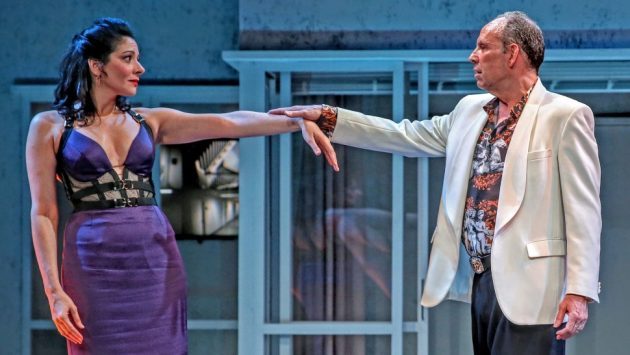
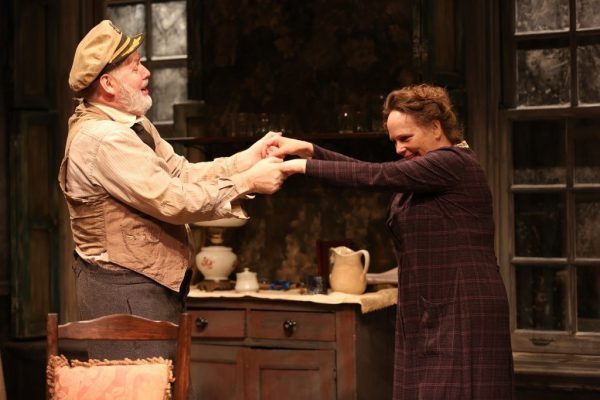
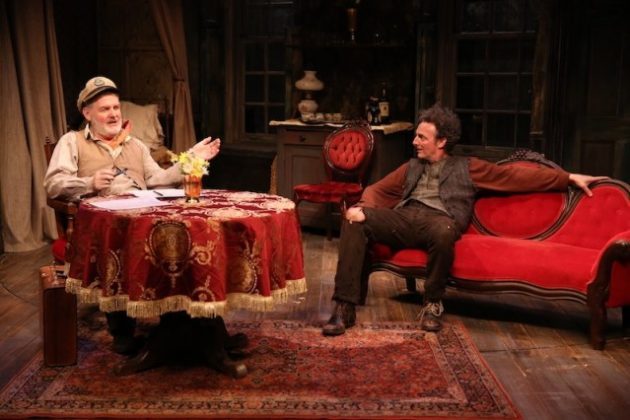
A family faces a matriarch experiencing dementia in Kenneth Lonergan’s The Waverly Gallery (photo by Brigitte Lacombe)

Golden Theatre
252 West 45th St. between Broadway & Eighth Ave.
Tuesday – Sunday through January 27, $49 – $149
thewaverlygalleryonbroadway.com

Elaine May gives a career-topping performance as an octogenarian suffering from dementia in the Broadway debut of Kenneth Lonergan’s Pulitzer Prize finalist, the sensitive, bittersweet memory play The Waverly Gallery. Running through January 27 at the Golden Theatre — the same venue where May and her longtime comedy partner, Mike Nichols, staged An Evening with Mike Nichols and Elaine May in October 1960 — The Waverly Gallery takes place between 1989 and 1991 in a small, inconsequential Greenwich Village art gallery operated by eighty-five-year-old Gladys Green (May) and the Upper West Side apartment where Green’s daughter, Ellen Fine (Joan Allen), lives with her second husband, Howard Fine (David Cromer), and their dog. Ellen’s son, Daniel Reed (Lucas Hedges), often comes over for dinner, along with Gladys. “I want to tell you what happened to my grandmother, Gladys Green, near the end of her life,” Daniel tells the audience early on in the first of a series of direct addresses looking back at the past. “I lived in her building — where I still live — in Greenwich Village, during the last couple of years when she was there. . . . For twenty-eight years she ran a tiny gallery on Waverly Place, around the corner from where we lived. And without being too depressing about it, she didn’t always have the best stuff in there. But some of it was pretty good. . . . It’s not that I didn’t like her. I did. It’s just that once you went in there, it was kind of tough getting out again. So I was pretty stingy with the visits.”

(photo by Brigitte Lacombe)

Art gallery owner Gladys (Elaine May) speaks with her daughter, Ellen (Joan Allen), as painter Don (Michael Cera) looks on in Broadway debut of Kenneth Lonergan play (photo by Brigitte Lacombe)

One day a somewhat egotistical artist from Massachusetts, Don Bowman (Michael Cera), walks into the gallery, which is connected to a hotel undergoing renovations, with his portfolio, and Gladys decides not only to give him a show but also to let him sleep in the back room, as he claims to have no money. Ellen, who becomes easily exasperated with her mother, and Howard, who practically yells at Gladys when he talks to her, thinking she is deafer than she is, are suspicious of Don’s motives as he insinuates himself into Gladys’s life. But when the hotel owner tells the family that he is taking back the gallery to turn it into a breakfast café, Ellen, Howard, and Daniel have to figure out a way to tell Gladys, whose Alzheimer’s is getting worse.

The play opens with Gladys saying, “I never knew anything was the matter.” Although she was specifically referring to Ellen’s first marriage falling apart, she could just as well be talking about her own life. Her memory lapses, hearing problems, and inability to truly understand what is going on around her are harrowing to watch, yet Lonergan, the writer-director of such award-winning films as You Can Count on Me and Manchester by the Sea and such hit plays as This Is Our Youth and Lobby Hero, injects plenty of humor into the strife. “We’re liberal Upper West Side atheistic Jewish intellectuals — and we really like German choral music,” Daniel tells Don. A dinner scene in which Ellen and Howard futz with Gladys’s hearing aid has a slapstick touch. And Gladys’s forgetfulness can be charming and funny — until it’s not. The eighty-six-year-old May, a National Medal of Arts winner who wrote, directed, and starred in A New Leaf and worked with the likes of Nichols, Warren Beatty, and Neil Simon in such films as The Birdcage, The Heartbreak Kid, and, yes, Ishtar, imbues Gladys with such honesty and sincerity that it’s heart-wrenching watching her decline.

(photo by Brigitte Lacombe)

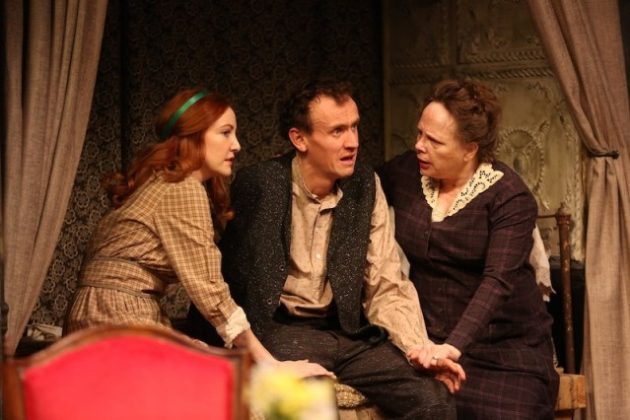
Lucas Hedges, Elaine May, Joan Allen, David Cromer, and Michael Cera star in The Waverly Gallery (photo by Brigitte Lacombe)

In her first Broadway show, Drama Desk- and Obie-winning director Lila Neugebauer, who is building an impressive résumé with such works as Edward Albee’s At Home at the Zoo, Annie Baker’s The Antipodes, Branden Jacobs-Jenkins’s Everybody, and Sarah DeLappe’s The Wolves, superbly balances the humor and heartbreak, never letting melodrama take over and instead including numerous moments in which the audience feels appropriately uncomfortable going from laughing to tearing up as David Zinn’s sets alternate between New York City apartments to the quaint belowground art gallery. Grammy winner and Oscar nominee May, Tony winner and Emmy and Oscar nominee Allen (Burn This, The Contender), Tony-winning actor and director Cromer (The Band’s Visit, Tribes), Oscar nominee Hedges (Manchester by the Sea, Yen), and Tony nominee Cera (Arrested Development, Juno), in his third consecutive Lonergan play on Broadway, form a stellar ensemble, capturing the essence of an extended family facing a tragic situation. (The 1999 original cast featured a widely hailed Eileen Heckart as Gladys, Maureen Anderman as Ellen, Mark Blum as Howard, Josh Hamilton as Daniel, and Anthony Arkin as Don; Anderman is now May’s understudy on Broadway.) “Honey? Do you think the Village has changed much in the last five years?” Gladys asks Daniel, who responds, “Yes! It’s been changing for a lot longer than that!” But what hasn’t changed nearly enough is the brutal impact of Alzheimer’s disease on sufferers and their families, so aptly on display in this perceptive and humane production.

SHAKE & BAKE: LOVE’S LABOR’S LOST

(photo © Chad Batka)

Berowne (Matthew Goodrich) battles King Ferdinand of Navarre (Darren Ritchie) in culinary condensation of Love’s Labor’s Lost (photo © Chad Batka)

94 Gansevoort St.
Tuesday-Saturday through January 4, $75-$200
866-811-4111
www.shakeandbaketheatre.com

In William Shakespeare’s Love’s Labor’s Lost, Moth tells Costard, “They have been at a great feast of languages, and stolen the scraps.” That line might have been cut from Shake & Bake Theatre’s tasty, streamlined adaptation of the Bard’s mid-1590s comedy, but it is an apt description of the festive experience to be had at 94 Gansevoort St. across the street from the Whitney. The two-hour presentation features music, dance, an eight-course menu with drinks, and a fine dose of Shakespeare, all stirred together for an appetizing evening. Shake & Bake boils things down to three men, King Ferdinand of Navarre (Darren Ritchie), Longaville (Oge Agulué), and Berowne (Matthew Goodrich), who have just taken a three-year vow of no women, spare eating and sleeping, and intense study when a trio of ladies suddenly arrives, the Princess of France (Victoria Rae Sook), Rosaline (Mary Glen Fredrick), and Maria (Rami Margron). The Princess has come to collect a hefty debt that King Ferdinand owes her father. The men’s will is tested as they pair off in potential love matches: the King with the Princess, Berowne with Rosaline, and Longaville with Maria. Meanwhile, the Chef (Joe Ventricelli) prepares food and drink, the Cheetos-loving Costard (Margron) misdelivers some crucial letters, Boyet (Charles Osborne) attends to the ladies, and Spanish nobleman Don Armado de Adriano confesses his love for the (unseen) country maid Jaquenetta. Mystery and mayhem ensue as the cast also serves a rather impressive dinner.

(photo © Chad Batka)

The Princess of France (Victoria Rae Sook) and King Ferdinand of Navarre (Darren Ritchie) try to make a deal in tasty Shakespeare adaptation (photo © Chad Batka)

Created and adapted by director Dan Swern, choreographer Sook, and executive chef David Goldman, Shake & Bake: Love’s Labor’s Lost is a sweet and savory treat, even for Shakespeare purists. The show takes place in a large space where the audience of no more than fifty sits in cool, comfy couches for two or four people, surrounding the action; Shawn Lewis’s production design also includes a small kitchen on one side and a culinary cart wheeled on- and offstage. The male and female protagonists are dressed like royal waitstaff, in different-hued button-down tops, while Armado is in a nutty and colorful chef’s outfit. The dishes they serve, which relate directly to what is happening in the play, include field greens with balsamic quinoa, Cheeto-dusted mac n’ cheese, smokey brisket tacos, and roasted beet gazpacho, along with red and white wine and a shot of Jagermeister. (Vegetarian, vegan, gluten-free, and nonalcoholic options are available.) The soundtrack ranges from acoustic guitar played by Ritchie and accordion by Margron to Scott Bradlee and the Postmodern Jukebox’s covers of Meghan Trainor’s “All About the Bass” and Lorde’s “Royals,” along with snippets of songs by the Beatles, Hall & Oates, Whitney Houston, Outkast, New Kids on the Block, and Queen. Osborne provides wild and wacky over-the-top comic relief, playing up his character for all its worth, while Margron adds in her fair share as Costard.

Goodrich and Fredrick are a particularly attractive Berowne and Rosaline among an appealing cast — a member of which might rest a head on your shoulder, lick the bottom of your shoe, or, as one did with me, hand you a package to deliver, telling you not to worry because the entire plot rests on your correctly performing the task. Early on, Berowne proclaims, “Come on, then, I will swear to study so, / To know the thing I am forbid to know: / As thus — to study where I well may dine, / When I to feast expressly am forbid; / Or study where to meet some mistress fine / When mistresses from common sense are hid.” Fortunately, they break all oaths, and everyone benefits in this delightfully filling reimagination of dinner theater. (As a bonus, Shake & Bake is presenting “Beers and Bard” on November 26 [$10, 7:00], in which audience members can preselect a part to play in Twelfth Night [scripts are provided] or grab a drink from the bar and simply watch the proceedings.)