this week in theater

THE LIFESPAN OF A FACT

(photo by Peter Cunningham)

Author John D’Agata (Bobby Cannavale) gets more than a little frustrated with intern Jim Fingal (Daniel Radcliffe) in The Lifespan of a Fact (photo by Peter Cunningham)

Studio 54
254 West 54th St.
Through January 13, $49-$179
212-719-1300
www.lifespanofafact.com

In another part of my life, I have worked in book, newspaper, and magazine publishing, where I am regularly involved in fact checking, corresponding with freelancers, editors, and authors, trying to carefully balance artistic license and the absolute truth, if such a thing exists. So I have a particular interest in The Lifespan of a Fact, the new play by Jeremy Kareken, David Murrell, and Gordon Farrell continuing at Studio 54 through January 13. Inspired by a true story, the eighty-five-minute show centers around an essay written by John D’Agata (Bobby Cannavale) for a magazine run by Emily Penrose (Cherry Jones), who has hired intern Jim Fingal (Daniel Radcliffe) to fact check the piece, which is about the suicide of sixteen-year-old Levi Presley in Las Vegas. A recent Harvard grad, Fingal is excited about showing Penrose what he can do, assuring her that he is the right person for the job, which is on a very tight deadline. “Check all the details, make sure they’re correct,” she tells him. “John’s been known to take his little liberties, so if there’s a place mentioned, make sure it’s spelled correctly. If there’s a person mentioned, confirm they exist. We need to make a good faith effort — confirm every detail.” She also tells him not to “be roughshod,” as D’Agata is a great writer and the piece is an extremely beautiful and important essay about humanity. But what begins as a small dispute between the nerdy Fingal and the tough D’Agata over how many strip clubs there are in Vegas turns into a major battle over language, journalism, and veracity.

Daniel Radcliffe is a nerdy intern trying to do his job in The Lifespan of a Fact (photo by Peter Cunningham)

Daniel Radcliffe is a nerdy intern trying to do his job in The Lifespan of a Fact (photo by Peter Cunningham)

Objecting to Fingal’s queries, D’Agata advises him, “I take liberties with things that deepen the central truth of the piece. Don’t get bogged down in the details, keep your eye on the big picture. Except don’t, because that’s my job.” But when Fingal does get bogged down on the details, questioning just about every single thing mentioned in the essay, he flies out to Vegas to perform what he believes to be due diligence. “If you say an event occurred, readers need to trust that it occurred,” Fingal insists to D’Agata. “This piece rests on the weight of a lot of details; it’s problematic for you to wash your hands of their accuracy.” D’Agata defends himself, explaining, “Things don’t rest on weights. Weights rest on things. I’m not washing my hands of anything. I’m saying there’s a world of facts to choose from. The wrong facts get in the way of the story.” To which Fingal snidely responds, “The ‘wrong’ facts?! And that means what exactly?” Soon Penrose becomes the referee in a furious fight between the two men, each of whom is making legitimate points as the deadline approaches.

Breezily directed by Tony nominee and Obie winner Leigh Silverman (Violet, Go Back to Where You Are), the play features dynamic performances by three-time Drama Desk nominee Radcliffe (Privacy, The Cripple of Inishmaan), two-time Tony winner Jones (The Glass Menagerie, Doubt), and two-time Tony nominee Cannavale (The Hairy Ape, The Motherf**ker with the Hat), an outstanding trio of actors who play off one another with endless charm even as the plot heats up and moves from Penrose’s office to D’Agata’s Vegas home. (The sets are by Tony winner Mimi Lien, with distracting projections by Lucy Mackinnon and original music by Palmer Hefferan.) Watching the annotation of the essay is fascinating; you can actually read the final, published article here, in the aptly titled Believer magazine.

(photo by Peter Cunningham)

Daniel Radcliffe, Cherry Jones, and Bobby Cannavale star in new Broadway play about the importance of facts (photo by Peter Cunningham)

Over the years, I have often found myself between a copy editor and a line editor, the former catching a factual error, the latter stetting it (letting it stand as is) for one reason or another. The Lifespan of a Fact gets right to the heart of the matter with intelligence and wit, although it takes it to an extreme, complete with some very funny slapstick comedy. The play itself has taken many liberties with the story; Fingal and D’Agata are real, while Penrose is not, and many of the situations and the timeline have been altered for dramatic impact, which is okay with Fingal and D’Agata, who wrote about their experience in their 2012 book, The Lifespan of a Fact. The show arrives on Broadway at an opportune moment in American history, when facts are challenged on social media and the president screams about fake news when he doesn’t like what is written about him in the press. But The Lifespan of a Fact wisely avoids getting political, instead concentrating on how three very different people with distinct objectives approach the truth, understanding that what’s most critical in this case is trying to find out why a teenager jumped from the top of a hotel in a place called Sin City. “Readers care how events play out on a deeper level. They care about the meaning behind the confluence of the events,” John says. “But events didn’t conflue the way you said,” Jim replies. “Conflue is not a word,” John responds. In today’s day and age, does it even matter who among the three characters might be the most right and what qualifies as a necessary fact?

GLORIA: A LIFE

(photo by Joan Marcus)

Christine Lahti portrays feminist icon Gloria Steinem in world premiere production at the Daryl Roth Theatre (photo by Joan Marcus)

Daryl Roth Theatre
103 East 15th St. between Irving Pl. & Park Ave.
Saturday – Tuesday through March 31, $55-$150
gloriatheplay.com

Gloria: A Life is being billed as a play about feminist icon Gloria Steinem, but that’s not completely accurate; it’s really more of an illustrated lecture/performance than a truly dramatic narrative, a relatively chronological recap of her life and career. Told by Oscar, Emmy, and Obie winner Christine Lahti as Steinem, complete with aviator sunglasses, bell-bottoms, and long brown hair, the story evolves as a diverse group of six women take on multiple roles. Tony-nominated writer Emily Mann (Having Our Say, Execution of Justice) and Tony-winning director Diane Paulus (The Gershwins’ Porgy and Bess, All the Way) capture Steinem’s greatest hits, from her early days in journalism, including her breakthrough Playboy bunny exposé, her New York magazine story on abortion, and the harsh misogyny she encountered, to her founding of Ms., her participation in the 2017 Women’s March, and her unfortunately brief marriage to David Bale. Lahti stays primarily in the center of Amy Rubin’s comfy theater-in-the-round set, which features rows of benches, each seat with its own brightly colored pillow back. Actresses Joanna Glushak, Fedna Jacquet, Francesca Fernandez McKenzie, Patrena Murray, DeLanna Studi, and Liz Wisan portray various Steinem friends and enemies, colleagues, and family members, including Coretta Scott King, Bella Abzug, Wilma Mankiller, Florynce Kennedy, Dorothy Pitman Hughes, and Steinem’s mother.

(photo by Joan Marcus)

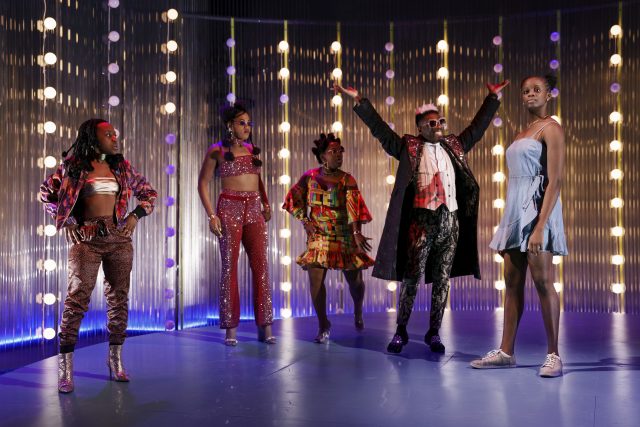
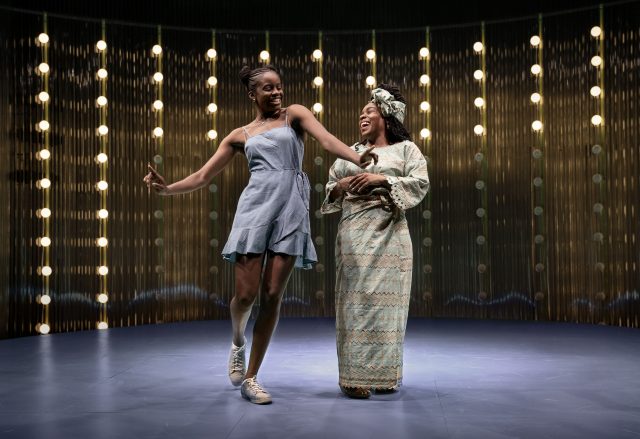
Christine Lahti is joined by a cast of diverse actresses in Gloria: A Life (photo by Joan Marcus)

Archival footage of Steinem is projected onto two walls of the theater, along with occasional live video of what’s happening onstage, primarily re-creations of actual interviews. It’s all fairly straightforward and lacking any real conflict; Lahti does not attempt to completely transform herself into Steinem — for example, she uses her real speaking voice and doesn’t change costumes or hairstyle to match the passing years — while the other actresses’ portrayals tend to be underwhelming or over the top. But the show is hard not to like as Steinem, now eighty-four and the author of such books as Outrageous Acts and Everyday Rebellions and My Life on the Road, is a captivating figure and Lahti, sixteen years younger and the author of the new essay collection True Stories from an Unreliable Eyewitness: A Feminist Coming of Age, which features advance praise on the back cover from Steinem, is utterly charming as our host.

After ninety minutes, Gloria changes direction and turns into a Talking Circle where the audience in invited to participate in a discussion about the play, Steinem, or other issues related to feminism and the world today. A sign announces, “Lead with love. Low ego. High impact. Move at the speed of trust.” The night I went, Lahti moderated the conversation, but there are often special guests, such as Lena Dunham, Christiane Amanpour, Julie Menin, show consultant Kathy Najimy, Letty Cottin Pogrebin, and Steinem herself. It was a fascinating exchange of ideas about the absence of African American women in second-wave feminism, the decision to not mention Betty Friedan in the play, how the vast majority of the crew and producers are women, and the impact of current activist movements. Among those in the audience were Melissa Silverstein, cofounder and producing director of the Athena Film Festival at Barnard, New York City political stalwart Ruth Messinger, and a woman who once worked for Steinem, a self-described hope-aholic who, after all these years, still believes every one of us can make a difference.

KING KONG

(photo by Matthew Murphy)

King Kong is none too happy with Broadway musical about him (photo by Matthew Murphy)

The Broadway Theatre
1681 Broadway at 53rd St.
Tuesday – Saturday through April 14, $69 – $175
kingkongbroadway.com

It isn’t beauty that kills the beast in the Broadway bust King Kong; it’s the music, lyrics, and story that lack the charm to soothe this savage breast, to paraphrase William Congreve. I don’t revel in taking yet more shots at the already brutally attacked musical, but I have little choice than to fire more artillery in the direction of the Broadway Theatre, where this travesty opened on November 8. King Kong himself, the eighth wonder of the world, is spectacular; designed by Sonny Tilders and Roger Kirk, lit by Peter Mumford, voiced by Jon Hoche, and operated by ten men and women, the one-ton, twenty-foot-high mechanical creature is just about everything you’d want from the beast. Unfortunately, the rest of the show is a hot mess. The songs by Marius de Vries and Eddie Perfect lack any kind of nuance (sample lyric: “Another arrow shoots Ann Darrow through the chest / But every ‘no’ only brings me closer to ‘yes’ / New York socked me with a body shot / But I’m not staying down / I’ll fight like hell / So ring that bell / Look who’s coming out swinging in the opening round.”) The direction and choreography by Drew McOnie is often head-scratchingly absurd, with several ensemble pieces seemingly there just to take up time and space. And Jack Thorne’s book puts too much of the focus on the Darrow character, resulting in yet another tired musical about a poor country girl desperate to make it big on the Great White Way.

(photo by Matthew Murphy)

Ann Darrow (Christiani Pitts), Carl Denham (Eric William Morris), and Lumpy (Erik Lochtefeld) are off on a cinematic adventure in King Kong (photo by Matthew Murphy)

Just as Darrow (Christiani Pitts) is about to give up on her dream, she is discovered by filmmaker Carl Denham (Eric William Morris), who whisks her off on an adventure on board the SS Wanderer, accompanied by his right-hand man, Lumpy (Erik Lochtefeld). Captain Englehorn (Rory Donovan) wants to know where they’re going, but Denham is not about to say — until Skull Island appears before them. There they encounter King Kong, who falls for Darrow before being captured and brought to New York City, where things don’t go too well for him, or for us. The beast itself is breathtaking, especially when Peter England’s projections make it look like Kong is running through the jungle or the streets of the city and when he makes his way to the front of the stage, carefully scanning the audience while asserting his strength and power. But the watered-down version of the story and too many stultifying scenes — you might just get seasick during a stormy voyage, and what’s with those green things climbing through green laser beams? — zap all the energy out of this classic tale. “What an ugly beast the ape, and how like us,” Roman statesman Marcus Tullius Cicero said in the first century BCE. In King Kong, virtually the only thing that isn’t ugly is the beast.

MOTHER OF THE MAID

(photo by Joan Marcus)

Joan Arc (Grace Van Patten) tries to reassure her ma, Isabelle (Glenn Close), in Jane Anderson’s Mother of the Maid (photo by Joan Marcus)

Anspacher Theater, the Public Theater
425 Lafayette St. at Astor Pl.
Tuesday through Sunday through December 23, $110
212-539-8500
publictheater.org

This decade has seen diverse takes on the story of Joan of Arc, the real-life fifteenth-century saint who led the bloody battle to return the French crown to French hands and put Charles VI on the throne. Each one, of course, focused on Joan herself, a young girl who claims to see visions of Saint Catherine, who commands her to lead the charge. Among the twenty-first-century Joans are Laura K. Nicoll in Reid Farrington’s The Passion Project at 3LD, Marion Cotillard in Côme de Bellescize’s concert staging of Arthur Honegger’s Joan of Arc at the Stake at Avery Fisher Hall, Jo Lampert in David Byrne’s Joan of Arc: Into the Fire at the Public, and Condola Rashad in George Bernard Shaw’s Saint Joan on Broadway. But playwright Jane Anderson utilizes a different approach in Mother of the Maid, an intimate and involving play continuing at the Public’s Anspacher Theater through December 23. The protagonist here is Joan’s mother, Isabelle Arc, wonderfully portrayed as a religious, somewhat frumpy, very serious woman by six-time Oscar nominee, three-time Emmy winner, and three-time Tony winner Glenn Close, decidedly less glamorous and elegant than in her recent Broadway appearances in Sunset Boulevard and A Delicate Balance.

“Isabelle Arc is a god-fearing woman,” she tells the audience in the third person at the start. “She can neither read nor write and her skirts smell ripe as a cheese. But she can do all sorts of handy things such as gutting a lamb, lancing a boil, and hiding the family valuables during a raid. She’s never blamed God for a blessed thing.” She lives on a farm with her husband, Jacques (Dermot Crowley), their son, Pierre (Andrew Hovelson), and Joan (Grace Van Patten); they are a peasant family barely getting by. So Joan’s parents and Pierre don’t take too kindly to her announcement that Saint Catherine is ordering her to go into battle to put the dauphin on the throne. “I’m having holy visions, Ma,” Joan explains. “She fills me. She slays me. She takes me apart,” she adds about the saint. Her father whips her while Pierre and Isabelle watch. “I’m not confused. I’m furious. You’re a stubborn, reckless girl and you have no idea what you’re doing,” Isabelle says. But when local priest Father Gilbert (Daniel Pearce) informs them that the Bishop of Vaucouleurs believes that Joan is the Virgin Maid foretold in prophecies, Isabelle relents. “Our girl’s been chosen and we both should be fierce proud,” she says to Jacques. So Joan heads off on her journey, accompanied by her brother, leaving their parents to wait and worry.

(photo by Joan Marcus)

Joan (Grace Van Patten) shows off her sword expertise to her brother, Pierre (Andrew Hovelson), in New York premiere at the Public (photo by Joan Marcus)

Mother of the Maid is a moving, poignant mother-daughter drama; at its heart is the age-old story of a beloved child leaving the nest, only in this case on the wings of angels, and with a bit more at risk. Van Patten holds her own with Close, employing a tough Brooklyn tomboy image as Joan’s power rises, then falls. John Lee Beatty’s cramped wood-based set features a revolving section that rotates from farm to royal court to dungeon, sharply lit by Lap Chi Chu. Jane Greenwood’s period costumes range from bright, bold colors to more earthy tones. Emmy winner Anderson (Olive Kitteridge, Defying Gravity) and Emmy-nominated director Matthew Penn (The Root), who worked with Close on the television series Damages, focus on the relationship between the characters, which also include the Lady of the Court (usually played by Kate Jennings Grant, although I saw a fine Kelley Curran), who is accustomed to the luxuries the Arcs have never known, and her lady-in-waiting, Monique (Olivia Gilliatt). Most of the action occurs offstage, but the narrative never feels explanatory; instead, it’s a potent look at family and responsibility, a familiar historical tale told from a different perspective, breathing new life into an ever-beguiling warhorse, anchored by a pair of outstanding actors, one as a nearly forgotten woman trying to adapt to the present, the other ready to leap into the future.

THOM PAIN (based on nothing)

(photo © 2018 Joan Marcus)

A man (Michael C. Hall) examines his life in Will Eno’s Thom Pain (based on nothing) (photo © 2018 Joan Marcus)

The Pershing Square Signature Center
The Irene Diamond Stage
480 West 42nd St. between Tenth & Eleventh Aves.
Tuesday-Sunday through December 9, $35-$65
212-244-7529
www.signaturetheatre.org

At the entrance to the Irene Diamond Stage at the Pershing Square Signature Center, a sloppily handwritten sign says, “Pardon Our Appearance.” The theater inside seems to be in the midst of some serious construction: There’s a huge hole in the floor at the front of the stage, which is littered with various pieces of equipment, and protective sheets hang on the walls and from the ceiling, as if preventing the place from collapsing. Amy Rubin’s deteriorating set matches the crumbling mind of Thom Pain, superbly played by Michael C. Hall, in the Signature revival of Will Eno’s 2004 Pulitzer Prize finalist, Thom Pain (based on nothing), which opened last night. Pain is the epitome of the unreliable narrator, beginning jokes and stories he never finishes, posing repeated questions that he answers differently each time, and inviting audience participation only to then take it back. “How wonderful to see you all,” he says at the start, in near-complete darkness save for the occasional light from his cigarette. The seventy-minute monologue, previously performed by James Urbaniak and, more recently, Rainn Wilson in LA in 2012, touches on such notions as time and memory, fear and loneliness. Wearing an everyman-style standard suit (the costume is by Anita Yavich), Pain walks back and forth across the deep stage and wanders through the audience as he indifferently relates a tale about a young boy, his dog, and a puddle, possibly a scene from his past that left him emotionally scarred. “When did your childhood end?” he asks rhetorically. “How badly did you get hurt, when you did, when you were this little, when you were this wee little hurtable thing, nothing but big eyes, a heart, a few hundred words? Isn’t it wonderful how we never recover? Injuries and wounds, ladies and gents. Slights and abuses, oh, what a paradise.”

(photo © 2018 Joan Marcus)

Michael C. Hall is mesmerizing as the title character in Thom Pain (based on nothing) at the Signature (photo © 2018 Joan Marcus)

He self-referentially refers to the show as “our little turn, on the themes of fear, boyhood, nature, hate, the nature of performance and vice-versa, the heart of man, of woman, et cetera.” He steps in and out of darkness courtesy of Jen Schriever’s sharp lighting design. “Does it scare you? Being face-to-face with the modern mind? It should. There is no reason for you not to be afraid. None. Or, I don’t know,” he says. He makes direct eye contact with as many audience members as he can, searching for connections that have otherwise eluded him. “As for our story, if you’re lost at all, you’re not alone,” he tells us. “Don’t think I’m somewhere out ahead, somewhere, anywhere, with a plan. I’m right here beside you, or hiding behind you, like you, in terrible pain, trying to make sense of my life. I’m just kidding — you probably are alone. Or, I don’t know. Where are we, exactly, I wonder, in your estimation, in mine.” By the end, we know everything about him, as well as nothing, his search for relevancy perhaps evoking our own.

Hall, the Dexter and Six Feet Under star who has excelled on Broadway in Eno’s The Realistic Joneses and John Cameron Mitchell and Stephen Trask’s Hedwig and the Angry Inch and off Broadway in Ivo van Hove’s Lazarus, is outstanding as Pain, a role that Eno (Title and Deed, The Open House, Wakey, Wakey, all at the Signature) notes in the script should be played by an “actor [who] must also create a character that is close to — and largely derived from — himself.” Hall keeps us mesmerized with just the right amount of confusion to make us wonder what is real and what isn’t, what is truth and what is not. When he asks several times if we like magic, he is also referring to the magic of theater, which Eno and director Oliver Butler (The Open House, What the Constitution Means to Me) tear down rather elegantly. It’s a disorienting yet exhilarating experience, a journey into the digressive nature of life, constantly under construction, and the mind of a man trying to find his place in the world, just like we all are.

APOLOGIA

(photo by Joan Marcus)

Kristin Miller (Stockard Channing) has a lot to say to her son Peter (Hugh Dancy) and his girlfriend, Trudi (Talene Monahon), in Apologia (photo by Joan Marcus)

Laura Pels Theatre
Harold and Miriam Steinberg Center for Theatre
111 West 46th St. between Sixth & Seventh Aves.
Tuesday – Sunday through November 30, $99
212-719-1300
www.roundabouttheatre.org

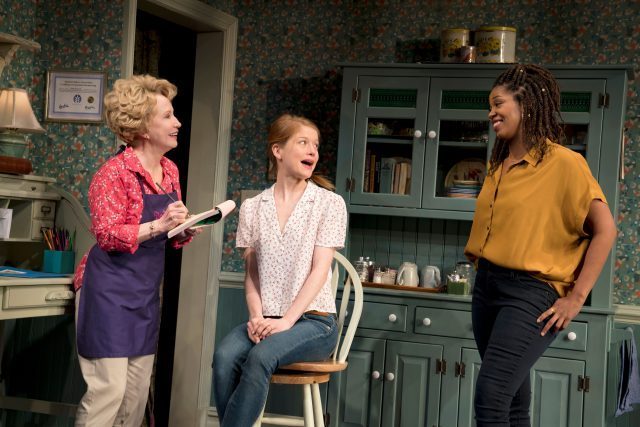
Successful art historian and proud humanist Kristin Miller (Stockard Channing) makes no apologies for the choices she’s made in Alexi Kaye Campbell’s Apologia, which continues at the Roundabout’s Laura Pels Theatre through November 30. An ex-pat living in the English countryside, Kristin is an uncompromising feminist and atheist who gave up custody of her children in order to pursue her career in Europe. On a spring day in 2009, she is expecting company for dinner, including her son Peter (Hugh Dancy), his new girlfriend, Trudi (Talene Monahon), her other son, Simon (also Dancy), his girlfriend, Claire (Megalyn Echikunwoke), and Kristin’s longtime friend, Hugh (John Tillinger). As they arrive, serious religious and socioeconomic conversations ensue, and it quickly becomes clear that Kristin respects no one as much as she does her own opinion. “Still raping the Third World?” she asks Peter, who responds, “If helping local initiatives and infrastructure projects off the ground is considered rape then, yes, brutally.” When she learns that Trudi is a vegetarian and a faithful Christian who met Peter at a prayer meeting, she digs in her talons. “I believe in mystery, imagination, and the power of myth and metaphor. But not in outmoded patriarchal propaganda,” she declares. When Claire, an actress, announces that her contract on a television series has been extended, all are happy for her except Kristin, who is quick to insult the program. “It was a little vacuous. I kept asking myself, ‘Why do people watch this? And why do they make it?’” But when the subject turns to Kristin’s latest book, a memoir called Apologia, the tension ratchets up, since she failed to mention anything about her sons or her family in it. But she’s not about to apologize for that either, as is evident when she explains what the title means: “a formal, written defence of one’s opinions or conduct.”

(photo by Jenny Anderson)

Hugh Dancy, Talene Monahon and Megalyn Echikunwoke in rehearsal for Apologia (photo by Jenny Anderson)

Tony winner Channing (Other Desert Cities, Six Degrees of Separation) is passionate and unrelenting as Kristin, who was English in the original version. She manages to keep the selfish, smug, and snarky writer from becoming too villainous or a mere relic from a different time; you keep wanting Kristin to say or do the right thing even though she never does, instead insisting on exploiting her supposed moral and intellectual superiority over everyone. She’s also not afraid to be exactly who she is; when she is given a Nigerian mask as a birthday present, she doesn’t hide her distaste. And it’s more than just a plot device that her oven isn’t working so she won’t be able to make dinner, a typically motherly responsibility. Dancy (Venus in Fur, The Pride) excels as both sons, whose names reference one of Jesus’s disciples, Simon Peter. Tillinger, a director who was lured back to the stage by Channing for this production — they starred together in Peter Nichols’s Joe Egg on Broadway in 1985 — does his best with Hugh, a relatively thankless part that merely serves as comic relief; when he departs Dane Laffrey’s book- and art-heavy set, his character is not really missed. Three-time Obie-winning director Daniel Aukin (Bad Jews, Admissions) guides the actors through some familiar, clichéd territory that is too straightforward and borders on just the kind of drama Kristin argues that Claire acts in. “She’s a bloody nightmare,” Peter tells Trudi. “Opinionated, didactic, dictatorial.” But that doesn’t mean she isn’t bold, brave, and heroic in her own way.

DRUID: WAITING FOR GODOT

(photo by Richard Termine)

Estragon (Aaron Monaghan) and Vladimir (Marty Rea) pass the time in Druid’s Waiting for Godot at White Light Festival (photo by Richard Termine)

WAITING FOR GODOT
Gerald W. Lynch Theater at John Jay College
November 2-13, $55-$95
www.lincolncenter.org
www.druid.ie

While celebrity casting certainly helps sell tickets, sometimes it can make a show more about the actors than the play itself. Regardless of the quality of the production, it’s often hard to separate the stars from roles, to judge the work by the writing and direction instead of the famous faces. Such has been the case with Samuel Beckett’s mid-nineteenth-century absurdist masterpiece Waiting for Godot. Here in New York City, Mike Nichols’s 1988 Lincoln Center revival featured Robin Williams, Steve Martin, Bill Irwin, F. Murray Abraham, and Lukas Haas; a 2009 Broadway adaptation boasted Nathan Lane, John Goodman, John Glover, and Irwin; and a 2013 Broadway smash had Sir Patrick Stewart, Sir Ian McKellen, Billy Crudup, and Shuler Hensley. New Yiddish Rep’s 2013 reimagined version in Yiddish, Vartn Af Godot, might not have had well-known actors, but the translation became the star. (It’s back for an encore engagement this winter at the 14th St. Y.) So it’s thrilling to see Irish theater company Druid’s adaptation at John Jay College’s Gerald W. Lynch Theater, where it continues through November 13 as part of Lincoln Center’s White Light Festival. The cast, at least here in America, is unknown, and they speak in Beckett’s native Irish tongue (even if the work was originally written in French), so the play’s the thing.

(photo by Richard Termine)

Lucky (Garrett Lombard) finally has a lot to say in Waiting for Godot at the Gerald W. Lynch Theater at John Jay College (photo by Richard Termine)

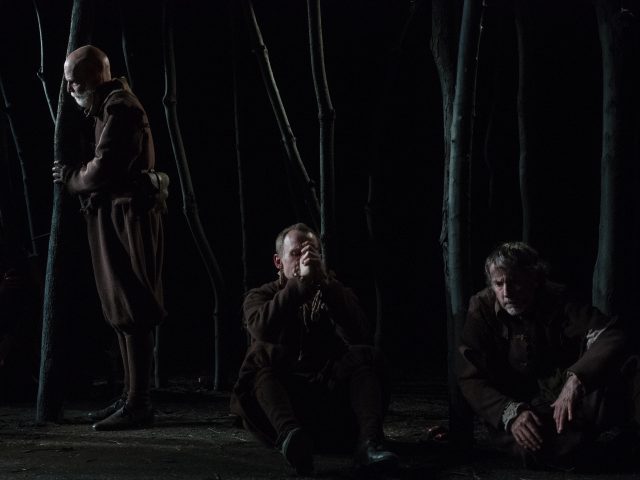
The tall and thin Marty Rea is Vladimir, or Didi, with shorter and stouter Aaron Monaghan as Estragon, or Gogo, somewhat reminiscent of Abbott and Costello. Francis O’Connor’s set features a leafless, curved tree and a smooth stone, possibly polished from years of Gogo sitting on it. O’Connor also designed the costumes, which include the two leads’ black, semi-homeless wear, bowler hats, and Gogo’s decrepit shoes, which have left one of his feet bloody. As they wait for Godot even though they have no idea why, they mutter about the burden of being human, dancing, crucifixion, and time. “We’ve no rights any more?” Gogo asks. “You’d make me laugh if it wasn’t prohibited,” Didi responds. “We’ve lost our rights?” Gogo repeats. “We got rid of them,” Didi answers. They get to the heart of the matter when Didi explains, “One is what one is. . . . The essential doesn’t change.”

They are confused when a boisterous man named Pozzo (Rory Nolan) shows up, dragging an apparent slave, Lucky (Garrett Lombard), with him; Lucky is not so lucky, carrying lots of luggage and being pulled by a noose. A noose had previously been referred to when Didi and Gogo examined the bare tree and considered hanging themselves from it, at one point curving their bodies to match the bend in the tree. And in each act a boy (either Nathan Reid or Jaden Pace) confuses them even further. Tony winner Garry Hynes’s (The Beauty Queen of Leenane, The Cripple of Inishmaan) direction makes such connections clearer than usual, allowing the audience to glory in Beckett’s language, from very funny conversations to a dizzying monologue delivered by Lucky. “That passed the time,” Didi says. “It would have passed in any case,” Gogo replies. “Yes, but not so rapidly,” Didi concludes. This two-and-a-half-hour production is more than a fine way to pass the time, offering a fresh, comic look at an old favorite.