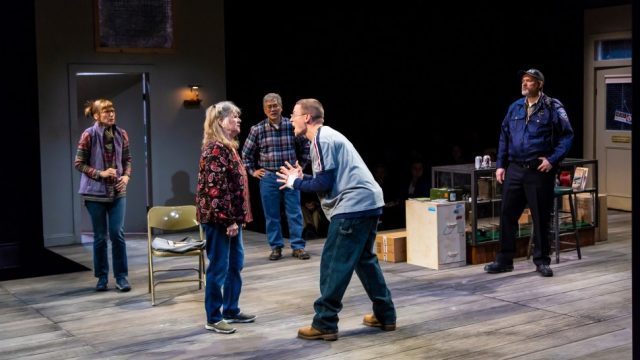
Joe (Edmund Donovan) takes issue with his mother (Judith Ivey) in Samuel D. Hunter’s Greater Clements (photo by T. Charles Erickson)
Lincoln Center Theater at the Mitzi E. Newhouse
150 West 65th St. between Broadway & Amsterdam Ave.
Through January 19, $92
212-362-7600 www.lct.org
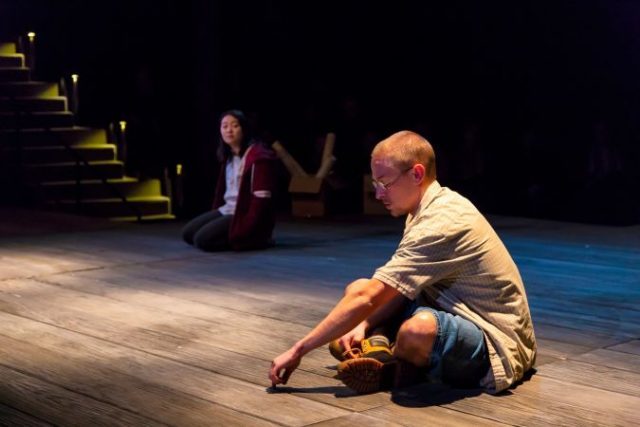
Samuel D. Hunter takes a sharp snapshot of a downtrodden America in the poignant drama Greater Clements, which ends its run at Lincoln Center’s Mitzi E. Newhouse Theater on Sunday. The play is set in Hunter’s home state of Idaho, the site of many of his works (A Bright New Boise, Lewiston/Clarkston). It’s 2017, and Greater Clements is at the end of the line; the Dodson Mine suffered a horrific tragedy in 1972 and shut down in 2005, and now there’s a referendum to abolish the town as a civic entity, at least in part as a reaction to the flood of wealthy Californians moving in. Maggie (Judith Ivey), who owns the local mine museum, is closing up shop; she has just brought her mentally ill twenty-seven-year-old son, Joe (Edmund Donovan), back from a stint in Anchorage, where he went to get away from some trouble he caused but did not necessarily fully understand. Maggie is visited by her high school flame, the gentle and stoic Japanese-American Billy (Ken Narasaki), and his adventurous fourteen-year-old granddaughter, Kel (Haley Sakamoto); Maggie, who is divorced, and Billy, who is widowed, flirt around with the idea of perhaps getting back together. Meanwhile, Maggie’s friend and employee, Livvy (Nina Hellman), is leading the charge for the town to remain incorporated, and Wayne (Andrew Garman), the police chief, is keeping a close watch on Joe, who appears to have potentially dangerous tendencies.
Kel (Haley Sakamoto) tries to befriend Joe (Edmund Donovan) in Greater Clements (photo by T. Charles Erickson)
Shrewdly and discerningly directed by Hunter’s longtime collaborator, Davis McCallum (Stupid Fucking Bird,London Wall), the nearly three-hour Greater Clements explores a wide range of issues, from Japanese internment camps and cancer to mental illness and gentrification, from corporate insensitivity and greed to fear and, perhaps most pointedly, loneliness. Dane Laffrey’s potent, active set, which includes a small part of the audience seated in a corner section virtually amid the action, features a second level that descends from above; unfortunately, the construction requires numerous poles that will occasionally block some of your view as the setting changes from the mine and the museum to a bedroom and living room. Yi Zhao’s lighting is supremely effective in the scenes that take place in the mine itself, putting us inside the dark underbelly of America. Tony and Obie winner Ivey (Steaming, Hurlyburly) is exquisite as Maggie, bringing an intimate, realistic warmth to a stalwart woman who deserves better out of life, but Donovan (Lewiston/Clarkston; Xander Xyst, Dragon: 1) steals the show with his powerful, in-your-face portrayal of a man all-too-aware of his situation but not necessarily capable of controlling it.
London-born comedian and disability activist Jess Thom returns to the BRIC House Ballroom with a spectacular sixty-minute presentation, a brilliantly conceived evening that reimagines the theatrical experience, for both actor and audience. In May 2016, Thom, who has Tourette Syndrome, held the New York premiere of her Edinburgh Fringe hit Backstage in Biscuit Land at the Brooklyn arts institution, delivering a “one-woman show for two” that humorously looks at her life and how she deals with Tourette’s, a neurological disorder that causes her to uncontrollably shout out words and phrases, such as “biscuit,” “hedgehog,” “sausage,” “I love cats,” and “Fuck a goat.” (Only ten percent of those with Tourette’s have copralalia, involving foul language.) She also uses a wheelchair, as her disability comprises various physical tics, such as banging her chest whenever she says “biscuit,” that make it too dangerous for her to walk on her feet.
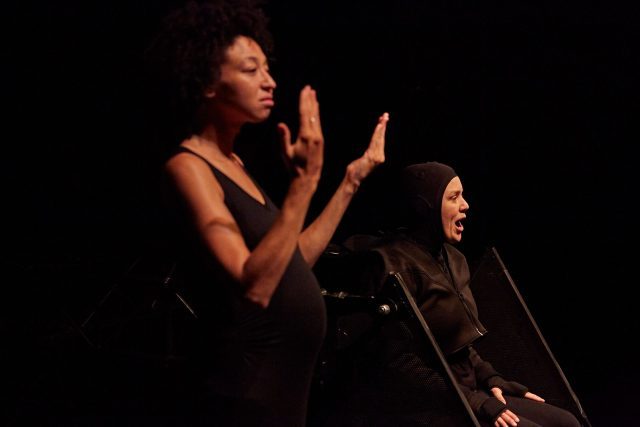
Back at BRIC for the Public Theater’s Under the Radar Festival, Thom is performing Samuel Beckett’s 1972 monologue Not I in a relaxed, inclusive environment. As you enter the small, intimate black-box space, Thom is in her wheelchair, greeting each audience member and inviting them to sit either on cushions, benches, or folding chairs. She is friendly and outgoing, and she doesn’t pause or change moods when the tics come up. She even plays off them; for example, when she says, “I love cats,” she quickly adds something like, “Well, I don’t really even like cats,” and when she proclaims, “Fuck a goat,” she responds by assuring everyone that no one will be having sex with an animal. Meanwhile, to her right, ASL performer Lindsey D. Snyder signs everything Thom says, including the verbal tics. Reaching the whole audience matters to Thom: The seating in Not I is inspired by how she was rudely treated when she attended a 2011 show by stand-up comic Mark Thomas, when theater staff confined her to a sound booth because other members of the audience objected to her gesticulations and vocal outbursts.
Once everyone is settled, she explains the plans for the evening and describes how a friend had told her that she should consider staging her own version of Not I, because it relates so organically to her life. The play, which has been performed by such actresses as Jessica Tandy, Beckett muse Billie Whitelaw, Julianne Moore, and Lisa Dwan and gets its title because it is told in the third person by the protagonist, is an ellipses-filled diatribe of incomplete thoughts and tangents that generally runs between nine and fifteen minutes; it is not a race, but the performer is expected to go through the 2,268 words as fast as possible. “I am not unduly concerned with intelligibility. I hope the piece may work on the nerves of the audience, not its intellect,” Beckett wrote in a 1972 letter to Tandy prior to the play’s world premiere at Lincoln Center. Dressed all in black, wearing a balaclava and a hoodie, Thom, in her wheelchair, is lifted eight feet in the air (the set is designed by Ben Pacey), and she is lit so only the bottom half of her face can be seen. Usually, only the actress’s mouth can be seen, as if it exists by itself, but changes had to be made because of Thom’s Tourette’s. As she power-drives through the piece, she occasionally gets caught in a series of “biscuit” moments but then forges ahead. She is moving through the dialogue so fast, and so unpredictably, that Snyder, also dressed in black and taking the place of the Auditor, the second character in the play, is practically dancing on the floor. (Beckett’s movement directions for the Auditor note, “This consists in simple sideways raising of arms from sides and their falling back, in a gesture of helpless compassion.”)
The audience is not meant to understand every word and plot detail as a woman, identified as “Mouth” in the script, relates several stories involving shopping in a supermarket, going to court, sitting on a mound in Croker’s Acres, and searching for cowslips in a field, bringing up such concepts as shame, torment, sin, pleasure, and guilt. This protagonist has suffered an unnamed trauma that has led to her becoming an outcast from society and virtually unable to communicate with others via speech. It’s clear why Thom’s friend suggested Not I for her, perhaps most evident from the following excerpt:
“what? . . tongue? . . yes . . . lips . . . cheeks . . . jaws . . . tongue . . . never still a second . . . mouth on fire . . . stream of words . . . in her ear . . . practically in her ear . . . not catching the half . . . not the quarter . . . no idea what she’s saying . . . imagine! . . no idea what she’s saying! . . and can’t stop . . . no stopping it . . . she who but a moment before . . . but a moment! . . could not make a sound . . . no sound of any kind . . . now can’t stop . . . imagine! . . can’t stop the stream . . . and the whole brain begging . . . something begging in the brain . . . begging the mouth to stop . . . pause a moment . . . if only for a moment . . . and no response . . . as if it hadn’t heard . . . or couldn’t . . . couldn’t pause a second . . . like maddened . . . all that together . . . straining to hear . . . piece it together . . . and the brain . . . raving away on its own . . . trying to make sense of it . . . or make it stop . . .”
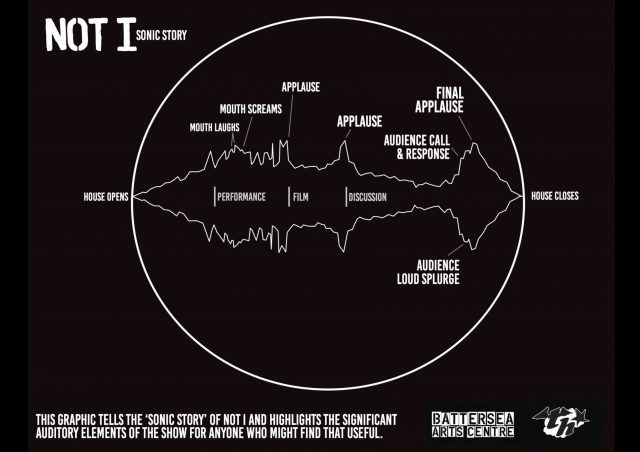
Not I has a sound map to ensure everyone is comfortable and no one feels excluded for auditory reasons
When we go to live theater and watch someone stumble over lines or hesitate and stammer as if they’ve lost their place, our hearts tend to sink and we don’t want the actor to be embarrassed. But when Thom, tearing through the words at a frenetic pace, suddenly goes into “biscuit” mode, not only are we rooting for her, we are with her every second, willing her on to get to the finish line with glory. It’s exhilarating when she storms back into Beckett’s language. But it’s important to note that we are not rooting for her because of or in spite of her disability (a word, by the way, that she freely uses); we are helping carry her to the end in a communal act that goes far beyond mere kindness.
The Beckett section is followed by Sophie Robinson’s short documentary Me, My Mouth, and I, which goes behind the scenes of the creation of Thom’s performance, and then Thom — who is also known as Touretteshero for her work with children and for her same-named organization that seeks to “change the world one tic at a time” — offers the audience the chance to talk to their neighbors about their thoughts on the play and ask her questions. The evening, which is passionately directed by her longtime collaborator Matthew Pountney, concludes with Thom signing copies of her 2012 book, Welcome to Biscuitland, in which Stephen Fry writes in the foreword, “Jess is a true hero, with or without her Touretteshero costume. Jess fuck biscuit Thom, I biscuit fuck fuck biscuit salute biscuit you.” And so will you.
Edward Mawere, Leland Fowler, and Jamyl Dobson star in Donja R. Love’s New Group world premiere, one in two (photo by Monique Carboni)
The New Group at the Pershing Square Signature Center
The Alice Griffin Jewel Box Theatre
480 West 42nd St. between between Ninth & Tenth Aves.
Through January 12, $33-$63 thenewgroup.org
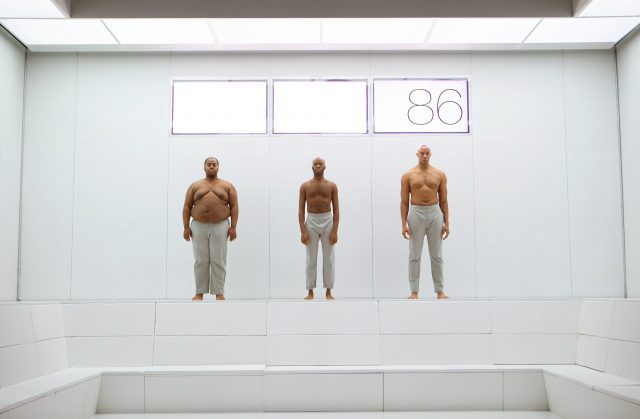
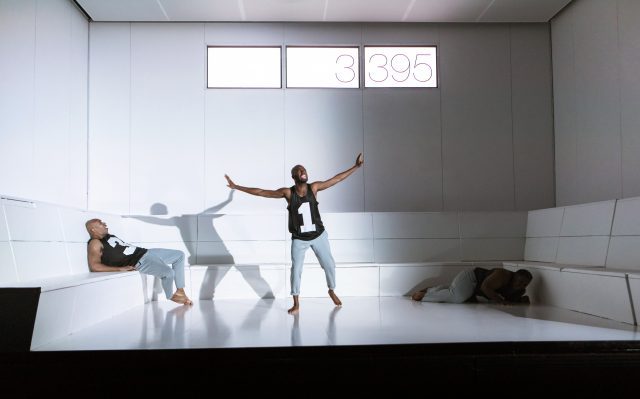
Donja R. Love’s one in two presents the human side of numbers and elements of chance that are staggering: According to the CDC, fifty percent of queer and bisexual black men will contract HIV. Yes, one in two. The eighty-five-minute New Group world premiere takes place on Arnulfo Maldonado’s brilliant set, a blindingly white otherworldly waiting room that wittily morphs into a bar, a bedroom, a hospital room, and other locations. At the top of the back wall, three windowlike panels display numbers that move sequentially, reminiscent of the countdown clock in Lost, except here they go up, tallying the HIV toll second by second. But Love, who wrote the play in his notes app as he approached the tenth anniversary of his testing positive — and “experiencing suicidal ideations,” he explains in a program pamphlet — has not created a somber melodrama about disease. Instead, under the superbly inventive direction of Stevie Walker-Webb, one in two is as funny as it is serious, making its points in complex, intricate scenes filled with humor and intelligence.
As you enter the Alice Griffin Jewel Box Theatre at the Pershing Square Signature Center, there are three shirtless men onstage, lounging about as if in a sauna that is not quite right. They take numbers from a ticket dispenser and then play Rock Paper Scissors to determine who will be #1, #2, and #3. (The actors have to know the lines for each character, since their part could change from one night to the next, the chances one in three.) At the show I saw, Leland Fowler was #1, who becomes Donté Hart, a young man who has just learned that he has HIV and the only character to have an actual name. Edward Mawere was #2, and Jamyl Dobson #3; they both play multiple roles, including a nurse, a bartender, Donté’s mother, Kinda Ex-Boyfriend, Married Man at the Center, Trade Hung Like Horse Underscore 99, and Man of Your Dreams. Fowler, Mawere, and Dobson have an intoxicating camaraderie that is a joy to watch, perhaps because each one so well understands the other men’s roles, since they have played them numerous times as well.
#1 (Leland Fowler) gesticulates wildly while facing a positive diagnosis in brilliantly realized play at the Signature (photo by Monique Carboni)
The trio goes back and forth in time, performing key moments from Donté’s life, fully aware that they are play-acting, occasionally breaking away to express their displeasure about what is happening onstage. “I don’t want to be the mom,” #3 says as a scene ends with him as the nurse. “If you don’t have to then neither, neither do I,” #2 replies. “Well, somebody’s gotta do it,” #1 argues. The one who becomes the mom puts on a colorful flowing wrap that is turned inside out for another role, the name of which can’t be printed here. (Andy Jean’s costumes also feature black T-shirts with the numbers 1, 2, and 3 on them to help identify who’s who.) The play has a powerful conclusion that resonates deeply; Love (Sugar in Our Wounds,Fireflies) and Walker-Webb (Ain’t No Mo’) avoid proselytizing and are not seeking sympathy; instead, they have an important narrative to share, and they do so with great skill and compassion while breaking through theatrical conventions. “I’m not just a number. I’m flesh. I’m blood. I feel,” #1 says early on. He’s not just a number, and as the play demonstrates, he might be number one, but his positivity affects so many others in his life. As Love writes in the pamphlet, one in two is “the story of a community — a community that’s in a hidden state of emergency.”
Wang Xiaohuan and Li Jialong star in Nick Payne’s Constellations at Under the Radar Festival (photo by Yang Yang)
Ellen Stewart Theatre, La MaMa Experimental Theatre Club
66 East Fourth St.
January 9-12, $30
Festival continues through January 19
212-475-7710 lamama.org/constellations publictheater.org
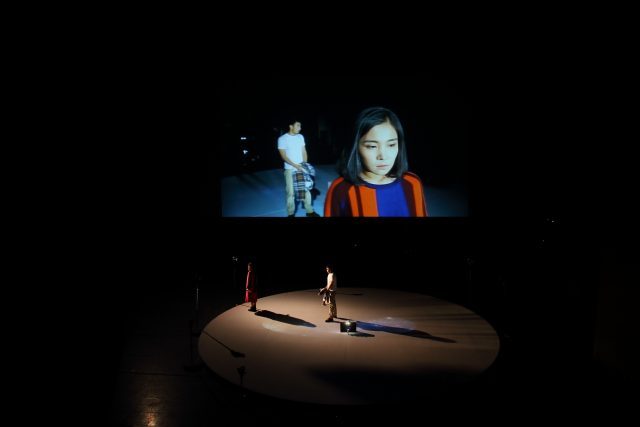
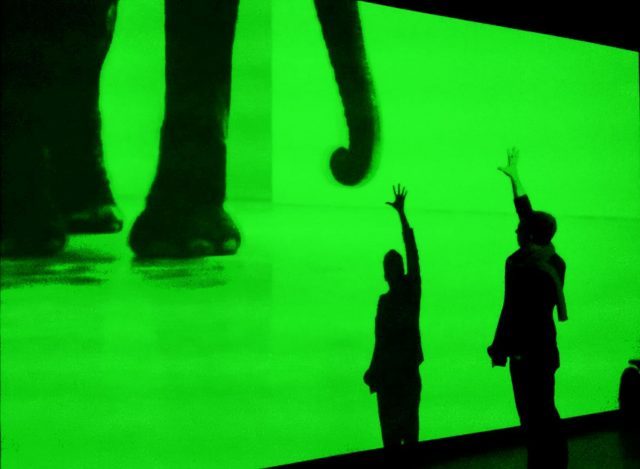
Five years ago, Jake Gyllenhaal and Ruth Wilson starred in Nick Payne’s Constellations on Broadway, a time-bending play set in the quantum multiverse, taking place in the past, present, and future as a beekeeper and a cosmologist repeat scenes over and over again to reveal the intricacies of a relationship. Now artistic director Wang Chong and his Théâtre du Rêve Expérimental are bringing a Chinese twist to the work, which is running January 9-12 at La MaMa as part of the Public Theater’s Under the Radar Festival. The ninety-minute multimedia piece, which features live streaming video and a hamster, stars Wang Xiaohuan and Li Jialong, with music by Li Yangfan, set design by Ji Linlin and Di Tianyi, and lighting by Meng Lingyang. The play takes place on a circular white stage on the floor, surrounded by video cameras. At the center of the floor is a hamster on a wheel in a see-through Lucite case. Wang and Ji enact each scene in front of a different camera — multiple versions of how they met, their first night together, fidelity issues, etc. — resulting in distinct visual perspectives and emotions that are watched on a large screen suspended behind them. In between scenes, director Wang cuts to video of the hamster, who is often running on the wheel in either direction, as if he is making the time go backward or forward by his motion, which is accompanied by celestial projections on the floor.
In writing Constellations, Payne — who previously tackled climate change in If There Is I Haven’t Found It Yet, in which Gyllenhaal made his New York theater debut — was inspired by the work of Columbia physics and mathematics professor Brian Greene, the superstring theorist and author of the highly influential book The Elegant Universe, lending a well-researched scientific edge to the play. Founded in 2008, Théâtre du Rêve Expérimental’s previous productions include Henrik Ibsen’s Ghosts 2.0, Mike Daisey’s The Agony and the Ecstasy of Steve Jobs, Woody Allen’s Central Park West, and such Wang originals as Thunderstorm 2.0 and The Warfare of Landmine 2.0.
Matthew Lopez’s The Inheritance tackles issues of gay eroticism, literature, and legacy over six and a half hours (photo by Matthew Murphy for MurphyMade, 2019)
Ethel Barrymore Theatre
243 West 47th St. between Broadway & Eighth Ave.
Wednesday – Sunday through June 7, $39 – $199 theinheritanceplay.com
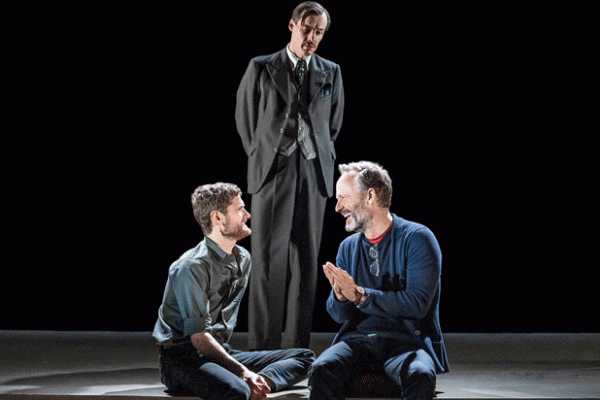
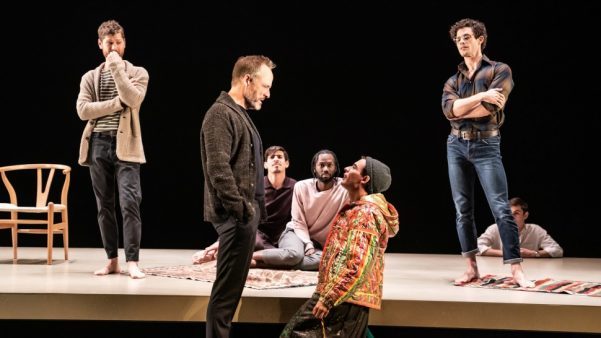
Matthew Lopez’s The Inheritance is a terrific two-and-a-half-hour play — however, it runs six and a half hours in two lengthy installments at the Ethel Barrymore Theatre, each of which requires separate admission. Angels in America meets The Boys in the Band by way of E. M. Forster’s Howards End in the epic drama, which broke the record for winning the most Best Play awards in the West End, including four Oliviers (Best Play, Best Actor for Kyle Soller, Best Director for Stephen Daldry, and Best Lighting Design by Jon Clark). The play is set in contemporary New York City, where Eric Glass (Soller) and Toby Darling (Andrew Burnap) are in love and are considering marriage after seven years together. Toby is a beautiful, magnetic, hard-partying writer who is turning his coming-of-age novel, Loved Boy, into a play; the more grounded Eric works for Jasper (Kyle Harris), a social justice entrepreneur. Eric and Toby are friends with an urbane, wealthy older couple, Walter Poole (Paul Hilton) and Henry Wilcox (John Benjamin Hickey), who host fabulous gatherings at their summer place in the Hamptons. Fate brings actor Adam McDowell (Samuel H. Levine) into Toby’s life; Toby quickly thinks Adam should star in his play. But when Toby meets bedraggled street prostitute Leo (Levine), a double for Adam, various relationships start swirling out of control.
Eric Glass (Kyle Soller) and Henry Wilcox (John Benjamin Hickey) talk about life and love as E. M. Forster (Paul Hilton) looks on in Olivier Award winner (photo by Matthew Murphy for MurphyMade, 2019)
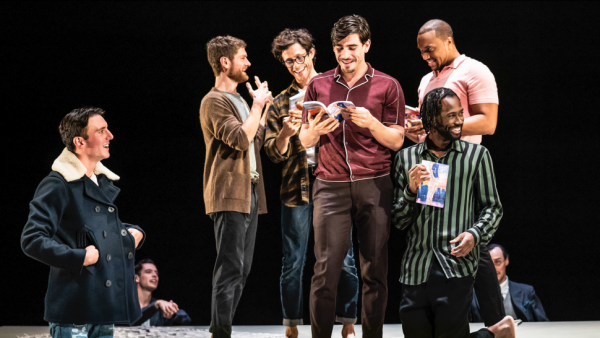
Throughout the play, Forster (Hilton) comments on the plot and interacts with some of the characters, as if he’s the omniscient narrator of a novel. Early on, a Greek chorus of young men speak with Forster about Howards End. “It’s a great book, don’t get me wrong. And the movie’s good. But, I mean, the world is so different now. I can’t identify with it at all,” one man says. “It’s been a hundred years,” adds another. “The world has changed so much,” a third points out. “Our lives are nothing like the people in your book,” a fourth chimes in. Forster asks, “How can that be true? Hearts still love, don’t they? And break. Hope, fear, jealousy, desire. Your lives may be different. But surely the feelings are the same. The difference is merely setting, context, costumes. But those are just details.” Lopez is referring to his play itself, a modern-day reimagining of Howards End that has been transformed into a gay fantasia. The difference in context matters very much, however, and is brought into sharp focus by the presence of Forster, a closeted homosexual who did not have sex until he was thirty-eight and died in 1970 at the age of ninety-one. He would not allow his own gay fantasia, the queer novel Maurice, written in 1912, to be published until after his death, a fact that is discussed in the play, which also deals directly with the AIDS crisis of the 1980s and 1990s.
Hilton (Peter Pan, Anatomy of a Suicide) is sensational as both Forster and Walter; when he reappears onstage after a lengthy absence, the audience erupts into applause, and with good reason: He is essential to the narrative, which too often drifts into melodrama that would even make Douglas Sirk cringe. Levine (Kill Floor) makes a poignant Broadway debut as Adam and Leo, switching between two characters that are polar opposites of each other. Soller is superb as the thoughtful and caring Eric, displaying a tender chemistry with Tony winner Hickey (The Normal Heart, Love! Valour! Compassion!), whose Henry is the seasoned sage of the group and whose painful memories of those lost to AIDS leads to one of the play’s most searing moments. (Hickey will be on hiatus through April 22 to make his directing debut with Plaza Suite and will be replaced by Tony Goldwyn.) Daldry (Billy Elliot,Skylight) tries to keep things moving on Bob Crowley’s minimal set, a large platform around which Eric and Toby’s friends and wannabe writers (including Jonathan Burke, Carson McCalley, Jordan Barbour, Darryl Gene Daughtry Jr., Dylan Frederick, and Arturo Luís Soria) hang out, watch the action, and interject, getting more in the way than adding worthwhile dialogue.
Henry Wilcox (John Benjamin Hickey) has some sharp things to say to the younger generation in Matthew Lopez’s The Inheritance (photo by Matthew Murphy for MurphyMade, 2019)
“With personal relationships. Here is something comparatively solid in a world full of violence and cruelty,” Forster wrote in his seminal 1938 essay “What I Believe,” continuing, “Not absolutely solid, for Psychology has split and shattered the idea of a ‘Person,’ and has shown that there is something incalculable in each of us, which may at any moment rise to the surface and destroy our normal balance. We don’t know what we are like. We can’t know what other people are like. How, then, can we put any trust in personal relationships, or cling to them in the gathering political storm? In theory we cannot. But in practice we can and do.” Lopez (The Whipping Man, The Legend of Georgia McBride) captures that part of Forster’s ethos but also strays from it too often.
There is also a very noticeable lack of women in the story, and only one onstage, the key figure of Margaret, played by the impeccable Lois Smith (The Trip to Bountiful,Marjorie Prime), who sums it all up at the end, but by that time Lopez has long bit off more than he can chew, taking on too much and losing focus of the main plot in favor of emotionally manipulative scenes that lack the necessary subtlety even as he tackles such intense subjects as gay eroticism, class, sex, AIDS, and, most critically, legacy. The Inheritance is filled with delicate, beautiful scenes that will move you deeply, unforgettable moments that exemplify what makes live theater so potent. But it just can’t sustain itself for six and a half hours.
Sophia Petrides’s BREATHING WITH THE ROOM is part of New Ear Festival
Once upon a time, January was considered a relative artistic wasteland, as people suffered from a post-holidays letdown with a dearth of high-quality movies and Broadway shows opening up. But this century continues to fill that void with more and more cutting-edge, experimental, and offbeat music, dance, film, and theater at unique performance festivals around the city. You can catch cabaret at Pangea, opera at Prototype, dance at the 92nd St. Y and New York Live Arts, jazz at JazzFest, Irish theater at Origin’s 1st, avant-garde music and film at New Ear, and a little of everything at Under the Radar. Sadly, the last few years have seen the demise of COIL and American Realness. Below are only some of the highlights of this exciting time to try something that might be outside your comfort zone and take a chance on something new and different to kick off your 2020, especially with the majority of tickets going for about twenty-five bucks.
NEW EAR FESTIVAL
Fridman Gallery
287 Spring St. by Hudson St.
January 6–12, $20, 8:00 www.fridmangallery.com
Monday, January 6 CT::SWaM ExChange, with Ginny Benson, Jeremy Toussaint-Baptiste, Dani Dobkin, Bernd Klug, and a very special guest
Tuesday, January 7
Victoria Keddie exchanges transmissions from Copenhagen, improvised animations and sound by Theodore Darst and Kevin Carey, and a performance by Adelaide Damoah
Wednesday, January 8
Tariq “Black Thought” Trotter of the Roots, with Zachary Tye Richardson, Vuyo Sotashe, Onyx Violins, and Brother Paul Daniels II
Thursday, January 9 Model Home, new commission by Brandon Lopez with TAK Ensemble, and Sa’dia Rehman
Friday, January 10
Susie Ibarra and Dreamtime Ensemble, Allard van Hoorn, and the Dream Mapping Project
Saturday, January 11
Violist Joanna Mattrey, percussionist William Hooker’s quartet, and Sophia Petrides
Sunday, January 12
DeForrest Brown Jr., Muyassar Kurdi and MV Carbon, and SHYBOI
UNDER THE RADAR
Public Theater and other venues
425 Lafayette St. by Astor Pl.
January 6–19 publictheater.org
January 6, 10, 12, 20 Daniel J. Watts’ The Jam: Only Child, with Daniel J. Watts and DJ Duggz, Joe’s Pub, $35
January 8–19 The Shadow Whose Prey the Hunter Becomes, with Michael Chan, Simon Laherty, Sarah Mainwaring, and Scott Price, LuEsther Hall, Public Theater, $30
January 10–19 Selina Thompson: salt., with Rochelle Rose, Martinson Hall, Public Theater, $30
January 11–19 The Truth Has Changed, by Josh Fox & International WOW Company, Newman Theater, Public Theater, $30
January 11 & 17 Waterboy and the Mighty World by the HawtPlates, Shiva Theater, Public Theater, $25
London Assurance is part of Origin’s 1st Irish Festival (photo by Carol Rosegg)
ORIGIN’S 1st IRISH FESTIVAL
Multiple venues
January 7 – February 3 www.origintheatre.org
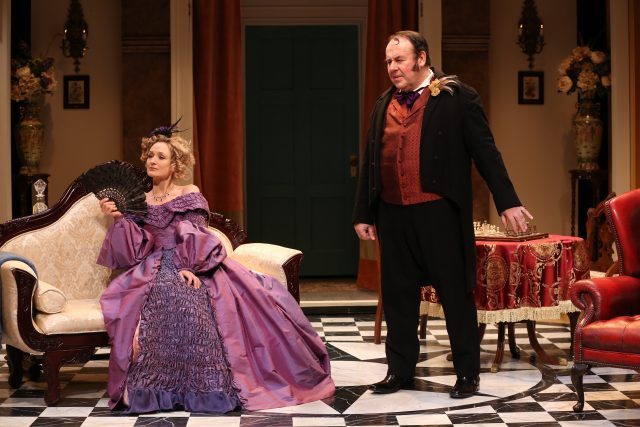
Through January 26 London Assurance, by Dion Boucicault, directed by Charlotte Moore, Irish Repertory Theatre, $50-$70
January 7–18 The 8th, written and directed by Seanie Sugrue, the Secret Theatre, $20
January 22 – February 2 The Scourge, by Michelle Dooley Mahon, directed by Ben Barnes, starring Michelle Dooley Mahon, Irish Repertory Theatre, $50
January 26 – February 1 Appropriate, by Sarah-Jane Scott, directed by Paul Meade, starring Sarah-Jane Scott, New York Irish Center, $26
January 27–28 Round Room: An Open Studio, by Honor Molloy, directed by Britt Berke, music by Susan McKeown, with Labhaoise Magee, Brenda Meaney, Rachel Pickup, Maeve Price, Zoe Watkins, and Aoife Williamson, the Alchemical Studios, $16
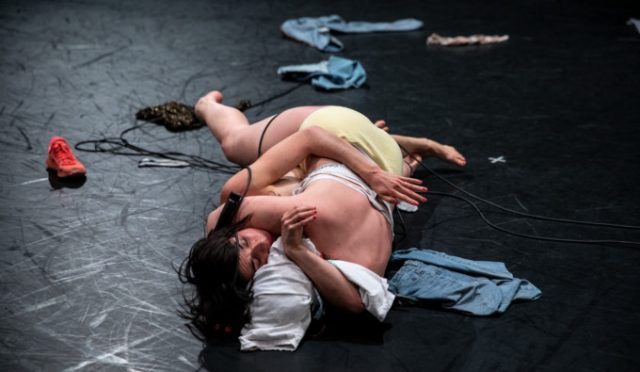
Molly Lieber and Eleanor Smith will present Body Comes Apart at New York Live Arts (photo by Maria Baranova)
LIVE ARTERY
New York Live Arts
219 West 19th St.
January 8-14 newyorklivearts.org
Saturday, January 11 Kathy Westwater: Rambler, Worlds Worlds a Part, $10, 2:00 Kimberly Bartosik/Daela: Through the Mirror of Their Eyes, 5:00
Saturday, January 11, 9:00
Sunday, January 12, 12 noon Molly Lieber and Eleanor Smith: Body Comes Apart, $15
January 12-14 Sean Dorsey: Boys in Trouble, $15
Monday, January 13 Yanira Castro/a canary torsi: Last Audience, free with RSVP, 4:0
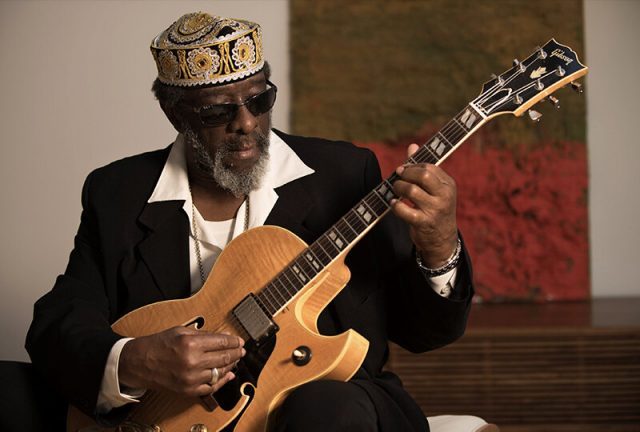
James ‘Blood’ Ulmer will be at the Sultan Room on January 11
January 9, 12, 15–17 Blood Moon, by Ellen McLaughlin and composer Garrett Fisher, Baruch Performing Arts Center, $35-$75
January 11–17 Magdalene, chamber opera cocreated by performer Danielle Birrittella and director Zoe Aja Moore, with poetry by Marie Howe, HERE, $35-$75
January 10–11 Iron & Coal, rock opera by Jeremy Schonfeld, featuring Brooklyn Youth Chorus, Contemporaneous, MasterVoices, Rinde Eckert, and Daniel Rowan, Gerald W. Lynch Theater, $35-$75
January 14–15, 17–19 Ellen West, by poet Frank Bidart and composer Ricky Ian Gordon, Gelsey Kirkland Arts Center, $35-$75
January 15–18 Cion: Requiem of Ravel’s Boléro, by Gregory Maqoma, featuring Vuyani Dance Theatre, Joyce Theater, $10-$75
January 17–18 REV. 23, libretto by Cerise Lim Jacobs, composed by Julian Wachner, featuring Novus NY, Gerald W. Lynch Theater, $35-$75
Harkness Dance Center festival features Catherine Tharin, Kyle Marshall Choreography, and more
92Y HARKNESS DANCE CENTER ARTISTS IN RESIDENCE: ShAIRed SHOW AND MORE!
92nd St. Y
1395 Lexington Ave.
January 10-12, $15 in advance, $25 at the door www.92y.org
Friday, January 10 King by Kyle Marshall Choreography, through the mirror of their eyes by Kimberly Bartosik (work-in progress excerpt), Quarry by Ivy Baldwin Dance, Good Rhythm Wonderful Life by Kazunori Kumagai, noon
Sunday, January 12 Good Rhythm Wonderful Life by Kazunori Kumagai, 3:00 through the mirror of their eyes by Kimberly Bartosik (work-in progress excerpt), 4:0 Of you from here by Catherine Tharin, 4:45 Quarry by Ivy Baldwin Dance, 5:30 A.D. by Kyle Marshall Choreography, 6:15 DECADOSE (excerpts) by cullen+them, 7:15
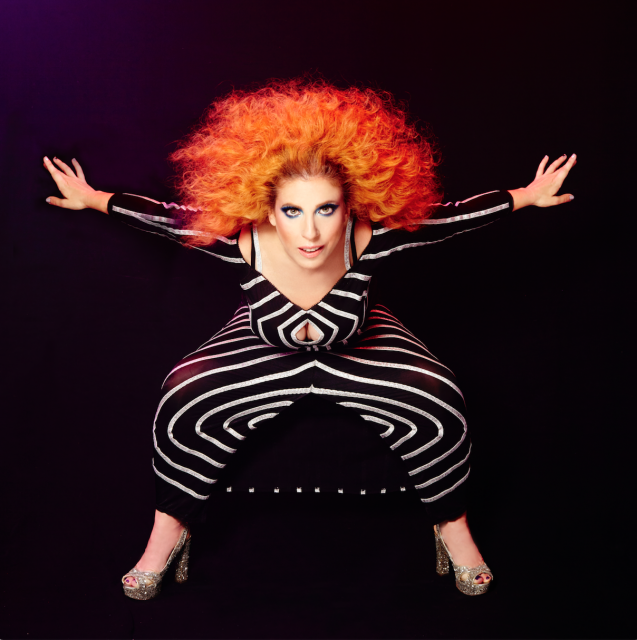
Raquel Cion will perform Me and Mr. Jones: My Intimate Relationship with David Bowie at Pangea Winter Alt-Fest
WINTER ALT-FEST
Pangea NYC
178 Second Ave.
January 10–18 www.pangeanyc.com
Tuesday, January 7, 14, 21
Barbara Bleier & Austin Pendleton, Bits and Pieces, $20-$25 plus $20 food/beverage minimum, 7:00
Friday, January 10
Vicki Kristina Barcelona, the songs of Tom Waits, $15-$20 plus $20 food/beverage minimum, 7:00
Hannah Reimann: Both Sides Now: The Music of Joni Mitchell 1966 – 1974, $20-$25 plus $20 food/beverage minimum, 9:30
Thursday, January 16, 7:00, and Friday, January 17, 9:30
Raquel Cion: Me and Mr. Jones: My Intimate Relationship with David Bowie, $20-$25 plus $20 food/beverage minimum
Friday, January 17
Susanne Mack: Where I Belong, $20-$25 plus $20 food/beverage minimum, 7:00
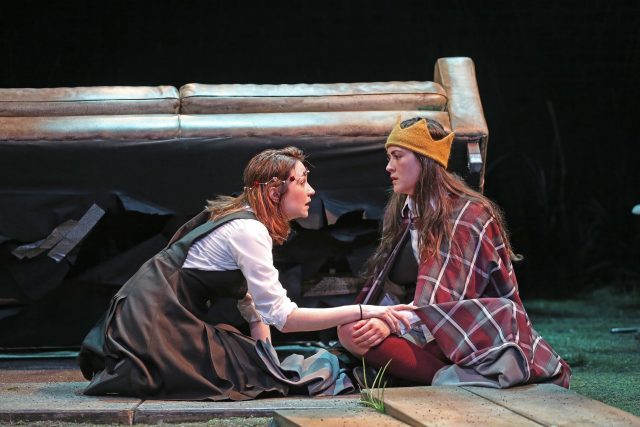
Lady Macbeth (Ismenia Mendes) reaches out to her royal husband (Isabelle Fuhrman) in inventive reimagining of Shakespeare tragedy (photo by Richard Termine)
Hunter Theater Project
Frederick Loewe Theater at Hunter College
East 68th St. between Lexington & Park Aves.
Monday – Saturday, January 6 – February 22, $49 ($15 for students) www.huntertheaterproject.org
If you missed Erica Schmidt’s Red Bull Theater production of Mac Beth at the Lucille Lortel Theater in mid-2019, it will be back for a return engagement at the Frederick Loewe Theater at Hunter College as part of the Hunter Theater Project, running January 6 to February 22. Below is my original review of this inventive and engaging work, which features much of the original cast, with Brittany Bradford now as the title character and Dylan Gelula taking over for AnnaSophia Robb.
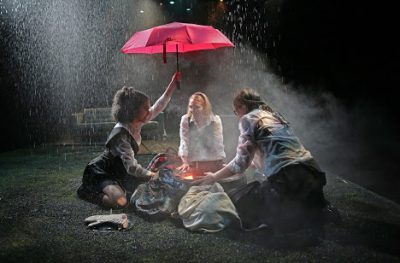
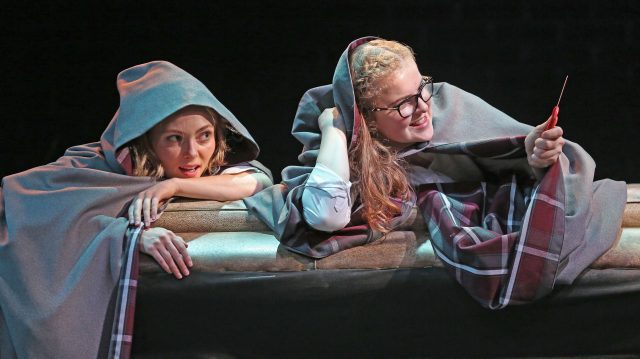
Erica Schmidt’s beautifully frenetic Shakespeare adaptation Mac Beth — yes, she has made the title two words, perhaps to emphasize the more feminine second half of the title — is an exhilarating demonstration of grrl power, ratcheted up to the nth degree. The Red Bull production is set at a girls school where seven students enact an all-female version of Macbeth. They are dressed in schoolgirl uniforms of buttoned white shirts under tartan tops and skirts, with bloodred socks reaching up to their knees; aggressively ominous and gender-neutral hooded capes are added for the Weird Sisters. (The costumes are by Jessica Pabst.) Catherine Cornell’s set juts into the audience, covered in fake grass with a partially overturned couch, an iron bathtub, a campfire, and water-filled craters, as if the aftermath of a wild sorority bash. (When the characters imbibe, they do so from red plastic cups, a party staple.) And although they speak in the traditional iambic pentameter, they don’t disguise their voices to be more adult, instead sounding like a bunch of kids invigorated by putting on a show exactly the way they want to.
The Weird Sisters (Sharlene Cruz, AnnaSophia Robb, and Sophie Kelly-Hedrick) stir the boiling cauldron in Mac Beth (photo by Richard Termine)
Macbeth (Isabelle Fuhrman) is returning from a successful military campaign with the loyal Banquo (Ayana Workman) when they come upon three witches (AnnaSophia Robb, Sophie Kelly-Hedrick, and Sharlene Cruz, who play multiple roles) who predict that Macbeth will become Thane of Cawdor, then king, while Banquo’s sons will one day rule. Fear, jealousy, and revenge take over as the power grab is on, but with delicious twists; in the Bard’s day, his plays were performed by an all-male cast, but this twenty-first-century all-woman cast — armed with smartphones — revels in the gender shifts without altering the original text. “Are you a man?” Lady Macbeth (Ismenia Mendes) asks her husband. Facing a ghost (hysterically played by Workman), Macbeth declares, “What man dare, I dare: be alive again, / And dare me to the desert with thy sword; / If trembling I inhabit then, protest me / The baby of a girl. Hence, horrible shadow! / Unreal mock’ry, hence!” It’s as if they are caught up in a teenage horror flick, with all the adolescent tropes in place but seen only from the girls’ point of view. Even one of the witches’ prophecies takes on new meaning when she predicts, “Be bloody, bold, and resolute: laugh to scorn / The power of man, for none of woman born / Shall harm Macbeth.” At one point Lady Macbeth tells a witch, “Unsex me here.”
AnnaSophia Robb and Sophie Kelly-Hedrick play witches and other characters in Bard play set at a girls school (photo by Richard Termine)
Schmidt’s (A Month in the Country, Invasion!) breathlessly paced version flies by in a furious ninety minutes, both sexy and sinister, gleefully performed by the terrific cast led by Fuhrman’s (All the Fine Boys,Orphan) tortured Macbeth and Mendes’s (Marys Seacole, Orange Is the New Black) malevolent Lady Macbeth. Robb (The Carrie Diaries, Bridge to Terabithia), NYU Tisch freshman Kelly-Hedrick, and recent CCNY grad Cruz make strong off-Broadway debuts, playing the witches as well as Duncan, Malcolm, Fleance, Rosse, Angus, Lenox, and other minor characters; in particular, Kelly-Hedrick captures the essence of girlhood — tinged with menace — in her squeaky delivery. Schmidt’s inventive staging also boasts a thrilling storm, a creepy doll, and a touch of gymnastics, although if there was one more loud bang against the tub I was going to scream. Schmidt was inspired to revisit Macbeth by reading stories about girls being murdered in the woods. In Mac Beth, she takes back the power, putting the girls in charge in a gender swap that is as exciting as it is, in this day and age, necessary. Schmidt makes us look at the bloody power plays of Scottish kings as if they are the social dominance battles of high school — and vice versa — and every audience member comes out a winner.